
Concept Cell Biology tools microscopy chemistry The quality
Concept: Cell Biology tools - microscopy & chemistry • The quality of an image depends on – Magnification, the ratio of an object’s image size to its real size – Resolution, the measure of the clarity of the image, or the minimum distance of two distinguishable points – Contrast, visible differences in parts of the sample (can be enhanced by stains/markers)
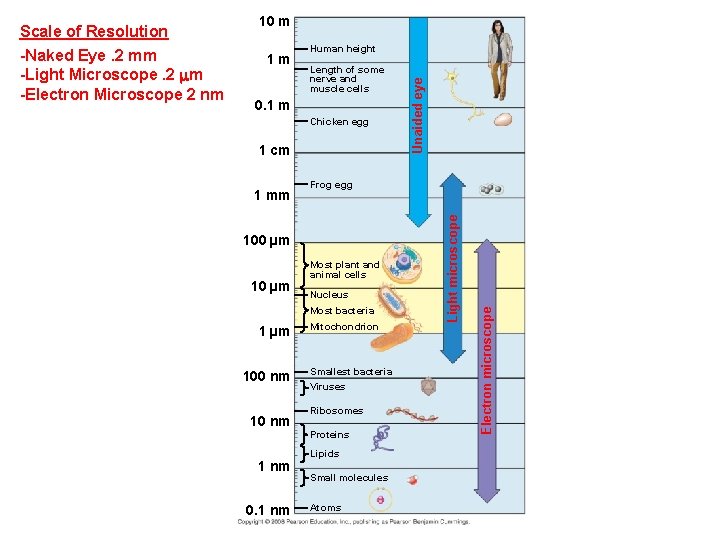
Human height Length of some nerve and muscle cells 0. 1 m Chicken egg 1 cm 1 mm Frog egg 100 µm 10 µm Most plant and animal cells Nucleus Most bacteria 1 µm 100 nm 1 nm 0. 1 nm Mitochondrion Smallest bacteria Viruses Ribosomes Proteins Lipids Small molecules Atoms Electron microscope 1 m Light microscope -Naked Eye. 2 mm -Light Microscope. 2 mm -Electron Microscope 2 nm 10 m Unaided eye Scale of Resolution
Light Microscopy • In a light microscope (LM), visible light passes through a specimen and then through glass lenses, which magnify the image • Various techniques enhance contrast and enable cell components to be stained or labeled • Most subcellular structures, including organelles (membrane-enclosed compartments), are too small to be resolved by a Light Microscope
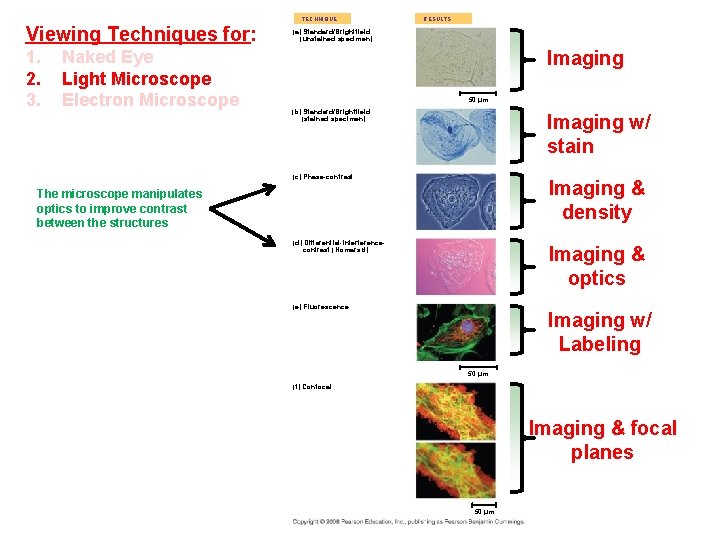
TECHNIQUE Viewing Techniques for: 1. 2. 3. Naked Eye Light Microscope Electron Microscope RESULTS (a) Standard/Brightfield (unstained specimen) Imaging 50 µm (b) Standard/Brightfield (stained specimen) Imaging w/ stain (c) Phase-contrast Imaging & density The microscope manipulates optics to improve contrast between the structures (d) Differential-interferencecontrast (Nomarski) Imaging & optics (e) Fluorescence Imaging w/ Labeling 50 µm (f) Confocal Imaging & focal planes 50 µm
Electron microscopy • Two basic types of electron microscopes (EMs) are used to study subcellular structures • Scanning electron microscopes (SEMs) focus a beam of electrons onto the surface of a heavy metal stained specimen, providing images that look 3 -D • Transmission electron microscopes (TEMs) focus a beam of electrons through a heavy metal stained specimen, used mainly to study the internal structure of cells
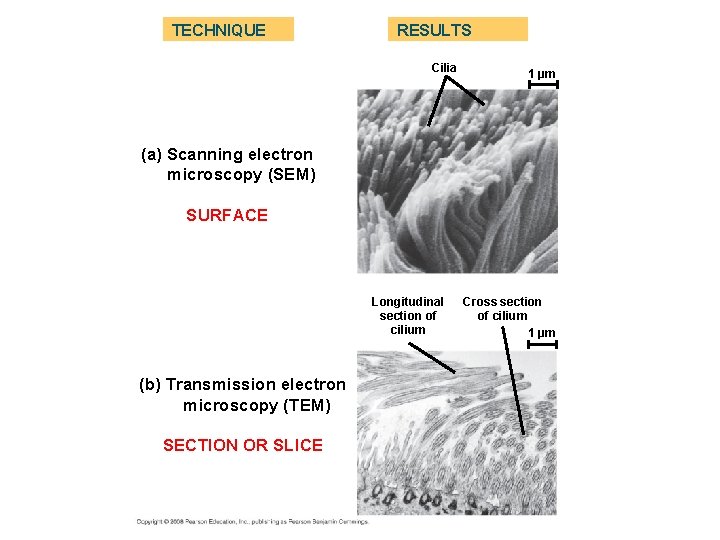
TECHNIQUE RESULTS Cilia 1 µm (a) Scanning electron microscopy (SEM) SURFACE Longitudinal section of cilium (b) Transmission electron microscopy (TEM) SECTION OR SLICE Cross section of cilium 1 µm
Cell Fractionation • Cell fractionation takes cells apart and separates the major organelles from one another • Centrifuges fractionate cells into their component parts • Cell fractionation enables scientists to determine the functions of organelles • Biochemistry and cytology help correlate cell function with structure
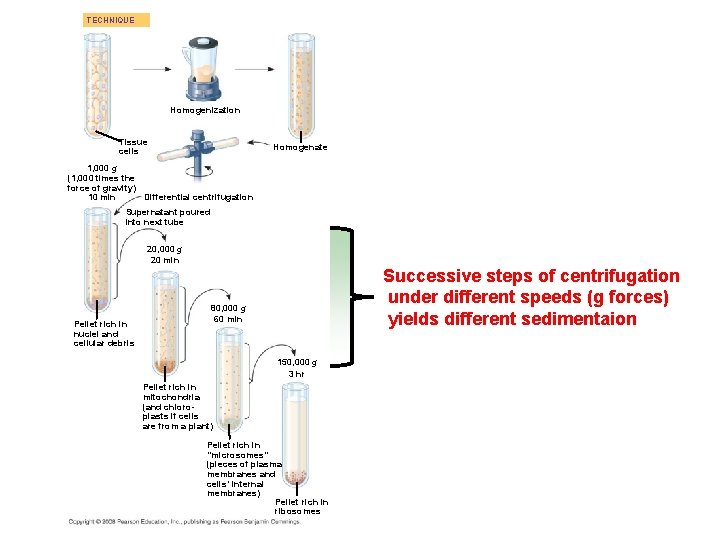
TECHNIQUE Homogenization Tissue cells Homogenate 1, 000 g (1, 000 times the force of gravity) Differential centrifugation 10 min Supernatant poured into next tube 20, 000 g 20 min Pellet rich in nuclei and cellular debris Successive steps of centrifugation under different speeds (g forces) yields different sedimentaion 80, 000 g 60 min 150, 000 g 3 hr Pellet rich in mitochondria (and chloroplasts if cells are from a plant) Pellet rich in “microsomes” (pieces of plasma membranes and cells’ internal membranes) Pellet rich in ribosomes
- Slides: 8