
CONCEPT AND SCOPE OF BIOTECHNOLOGY INTRODUCTION Biotechnology is
CONCEPT AND SCOPE OF BIOTECHNOLOGY
INTRODUCTION Biotechnology is "the application of biological organisms, system or processes to manufacturing and service industries"( British Biotechnologist). Biotechnology is the use of living organisms and their components in agriculture, food and other industrial processes. Biotechnology is "the application of scientific and engineering principles of the processing of materials by biological agents to provide goods and services''(Holt and Lilley, 1982).
CONCEPT The origin of biotechnology is as old as human civilization. As a science it is little more than 100 years old. Fermentation is the oldest biotechnological process discovered by the people by prolonged soaking of grains or by sorting juices of fruits or palms. Other early processes practiced by man included leavening of bread, production of alcoholic beverages, production of vinegar, production of curd, etc. Nowadays biotechnology has achieved greatest advancement in the filed of Recombinant DNA technology, PCR, Cell-culture and fusion, gene cloning, DNA fingerprinting, environmental engineering, Immunology etc. Biotechnology is an umbrella term: Genetic engineering falls under it
HISTORY 6000 B. C. , Sumarians and Babylonians Knew the technique of preparing beer. 2500 B. C. , Aryans started preparing curd. 2000 B. C. , Greeks were probably first to prepare cheese from milk ( cheese one of the first fermented food). 1822 -1895 Louis Pasteur, "The father of Microbiology and father of Industrial Biotechnology'‘ discovered that yeast produced alcohol in wine and rod-shaped bacteria produced acetic acid, cause souring of wine. 1929, Alexander Fleming discovered antibiotic penicillin. 1973, First successful genetic engineering experiments were carried out in famous world laboratories. The term Biotechnology was coined by Karl Ereky.

SCOPE OF BIOTECHNOLOGY Biotechnology is a multidisciplinary pursuit that has emerged as a demanding industry during the recent past. Besides being a branch of advance biological sciences, it has attracted many multinational companies including those are concerned with: • The production of pharmaceutical products for the cure or control of many human diseases. These products include antibiotics, vaccines, life saving drugs and gene therapy. • Improvement of clinical testing and diagnostic tools. • Production of novel varieties of crop plants and animals.
Continue…. • Production of wide range of food products, fertilisers, pesticides and beverages. • Waste treatment, bioremediation and energy production. • Production of reagents including enzymes, DNA/RNA, etc. • Biotechnology has also enhanced the sale of many biological products in the world market by improving their varieties and increasing their large scale production. • These items include alcoholic beverage, antibiotics (penicillins, tetracyclines etc. ), amino acids, enzymes, vaccines, steroids, vitamins, insulin, human growth hormones, microbial pesticides, citric acid, improved variety seeds, etc.
CONCLUSION Biotechnology is the production of interaction between biological science and modern technology. During last two decades biotechnology has achieved greatest advancements in the fields of recombinant DNA technology, Polymerase chain reaction(PCR), gene cloning, DNA finger-printing etc. Being a branch of advance biological sciences, it has also attracted many multinational companies. Insulin production and production of growth harmones is one of the greatest blessing of Biotechnology.
CONCEPT OF GENE CLONING
Gene Cloning - definition • Clone: from the Greek - klon, a twig • The production of exact copies (clones) of a particular gene or DNA sequence using genetic engineering techniques. • The DNA containing the target gene(s) is split into fragments using restriction enzymes. These fragments are then inserted into cloning vectors which transfer the recombinant DNA to suitable host cells. • Inside the host cell the recombinant DNA undergoes replication; thus, a bacterial host will give rise to a colony of cells containing the cloned target gene.
Significance • A particular gene can be isolated and its nucleotide sequence determined • Control sequences of DNA can be identified & analyzed • Protein/enzyme/RNA function can be investigated • Mutations can be identified, e. g. gene defects related to specific diseases • Organisms can be ‘engineered’ for specific purposes
History • G. Mendel, in the middle of the 19 th century coined the term gene for the factor controlling the inheritance of biological characteristics of an organism. • In 1903, W. Sutton proposed that genes reside on chromosomes. • In 1922 Gene mapping by T H Morgan and he analyzed the relative positions of 2000 genes on 4 chromosomes of the fruitfly, Drosophila melanogaster. • In 1944 Avery, Macleod and Mc. Carty and in 1952 Hershey and Chase explained the molecular nature of the gene to be Deoxyribonucleic acid. • 1952 to 1966: The Structure of DNA, genetic code and the process of transcription and translation. • 1971 -1973: New technology like recombinant DNA technology or genetic engineering or the process of Gene cloning developed. This technology helped in studying the regulation of genes, aberrations in the genes and then used genes for production of desired proteins. • In 1985, Kary Mullis invented the Polymerase Chain reaction
Steps involved in gene cloning 1. Generation of the DNA fragment 2. 3. Construction of the recombinant DNA molecule by joining of DNA fragment with a vector Introduction of the recombinant vector into host cell, multiplication of recombinant DNA molecule along with host cell 12
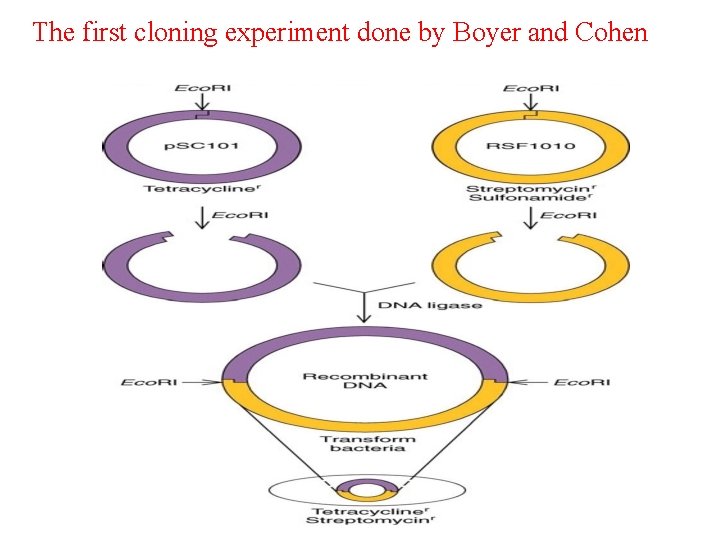
The first cloning experiment done by Boyer and Cohen
- Slides: 13