
Concept and Feature of Motivation The term motivation
- Slides: 12
Concept and Feature of Motivation • • The term motivation has been derived from the word ‘motive’. Motive is anything that initiates or sustains activity. Motive as a psychological force within an individual that set him in motion for the achievement of certain goals or satisfaction of certain needs. It is an inner state that energises activates and directs behaviour towards goal. It also refers to the way a person is enthused at work to intensify his desire and willingness to use his energy for the achievement of organisational objectives.
Concept and Feature of Motivation • According to Likert “Motivation is the core of Management". • According to Robert Dubin “Motivation is a complex of forces starting and keeping a person at work in an organisation. Motivation is something that moves the person to action and continuous him in the course of action already initiated. • In the words of Dalton E. Mc. Farland, “Motivation refers to the way in which urges, drives desire aspirations striving or needs direct control or explain the behaviour of human beings".
Features of Motivation • It is an internal feeling it cannot be observed directly we can observe and visuals actions and then interpret his behaviour in terms of underlying motives. • It is a complex and continuous process. • It is a dynamic process as needs and motives of an individual change from time to time even though he may continue to behave in the same way. • It is totally different from satisfaction it implies a drive towards an outcome while satisfaction involves outcomes already experienced.
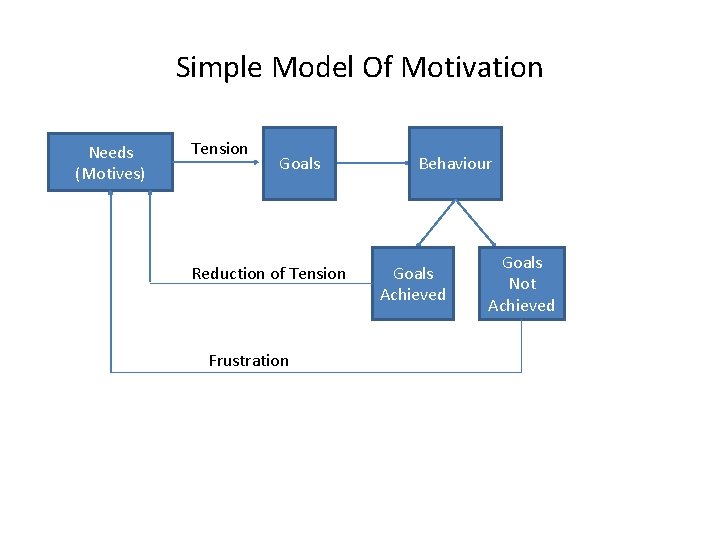
Simple Model Of Motivation Needs (Motives) Tension Goals Reduction of Tension Frustration Behaviour Goals Achieved Goals Not Achieved
Significance of Motivation • Motivation is an effective instrument in the hands of a manager for inspiring the workforce and creating a confidence in it and by this management creates "will to work" which is necessary for the achievement of organisational goals.
If the employees are properly motivated following results may be achieved by the organisations. • Factor of labour turnover and absenteeism among the workers will be low. • Number of complaints and grievances will come down • Accident rate will also be low • There will be increase in the quantity and quality of products. • Waste and scrap will be less. • There will be e good human relations in the organisation • Workers well tend to be e as efficient as possible by improving upon their skills and knowledge to contribute to the progress of the organisation. • If the physiological and psychological needs of the workforce will be satisfied by the management the workers will co-operate voluntarily with the management and will contribute with their maximum.
Theories of Motivation • Theories of motivation management can do its job effectively only through motivating people to work for the accomplishment of organisational objectives but it is difficult to understand motivation without considering what people want and expect from their work.
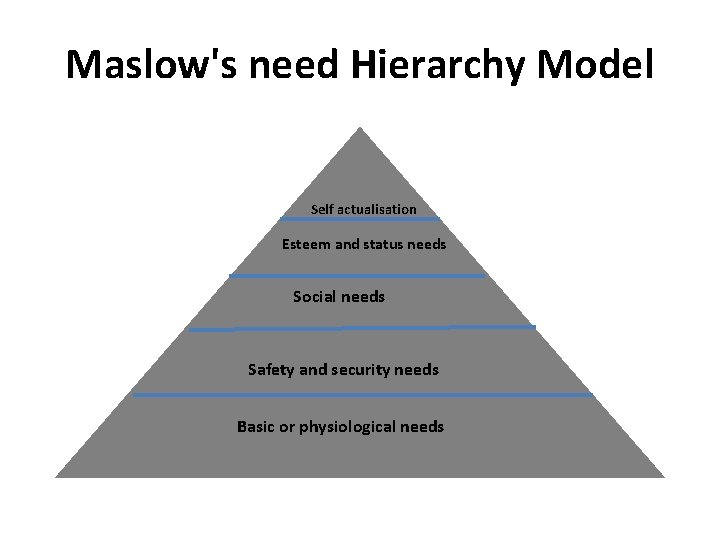
Maslow's need Hierarchy • Maslow's theory is considered as an important theory of motivation because it highlights the needs of the people. • A. H. Maslow define a person's effectiveness as a function of matching man's opportunity with the appropriate position of hierarchy of needs. the process of motivation begins with an assumption that behaviour at least is directed towards the achievement of satisfaction of needs. He proposed that human needs can be arranged in a particular order from the lower to the higher.
Maslow's need Hierarchy Model Self actualisation Esteem and status needs Social needs Safety and security needs Basic or physiological needs
Continue The need hierarchy is as follows: • Basic or physiological needs- these needs relate to the survival and maintenance of human life. They include things like shelter, air, water, food, clothing, and other necessities of life. • Safety and security needs- after satisfying the physiological needs people won the assurance of maintaining a given economic level. They want job security, security of source of income, insurance provision for old age etc. • Social needs-man is a social human being so he therefore expect recognition, sense of belongingness, companionship, sociability, exchange of feelings and grievances etc. from the society.
Continue • Esteem and Status Needs- These needs embrace such things as self confidence independence achievement competence knowledge and success. They are also known as egoistic needs. They are concerned with prestige and status of the individual. • Self Actualisation/ Fulfilment Needs- Once the other needs are fulfilled as the desire for personal achievement. he wants to do something which is challenging and since this challenge gives him enough dash and initiative to work. Person starts realising his potentialities for continued self development and being creative
Continue • Maslow proposed that the needs are definite sequence of domination. • Second need does not dominate until the previous one have been reasonably satisfied and so on. • He also stated that needs arise in a certain order of preference and not randomly. • If one's lower level needs are unsatisfied you can be motivated only by satisfying is lower level needs and not satisfying is higher level needs. • Once a need or a certain order of needs is satisfied, it ceases to be a motivating factor. • Maslow’s need hierarchy has application to the lower level workers in a country like India where the basic needs of the workers are not satisfied.