
Concept 40 1 Earths climate influences the structure
- Slides: 17
Concept 40. 1: Earth’s climate influences the structure and distribution of terrestrial biomes • The long-term prevailing weather conditions in an area constitute its climate • Four major abiotic components of climate are temperature, precipitation, sunlight, and wind
• Abiotic factors are the nonliving chemical and physical attributes of the environment • Biotic factors are the other organisms that make up the living component of the environment • Macroclimate consists of patterns on the global, regional, and landscape level
Global Climate Patterns • Global climate patterns are determined largely by solar energy and the planet’s movement in space • The warming effect of the sun causes temperature variations, which drive evaporation and the circulation of air and water • This causes latitudinal variations in climate
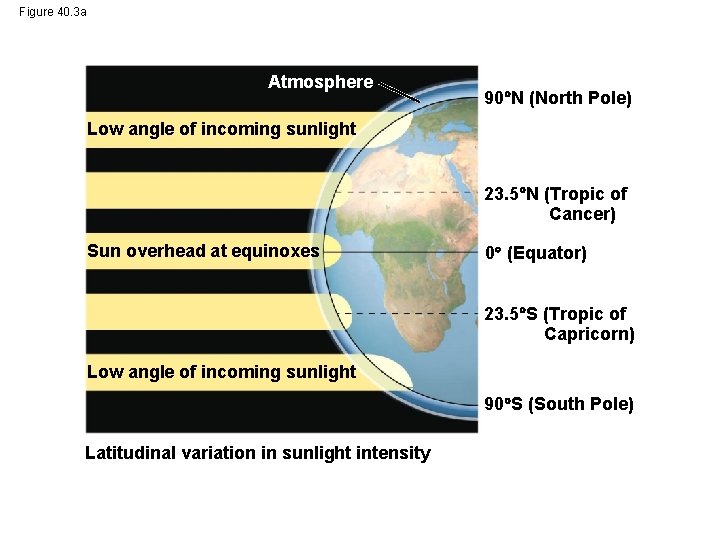
• Latitudinal variation in sunlight intensity is caused by the curved shape of Earth • Sunlight strikes the tropics, regions between 23. 5 north and 23. 5 south latitude, most directly • At higher latitudes, where sunlight strikes Earth at an oblique angle, light is more diffuse
Figure 40. 3 a Atmosphere 90 N (North Pole) Low angle of incoming sunlight 23. 5 N (Tropic of Cancer) Sun overhead at equinoxes 0 (Equator) 23. 5 S (Tropic of Capricorn) Low angle of incoming sunlight 90 S (South Pole) Latitudinal variation in sunlight intensity
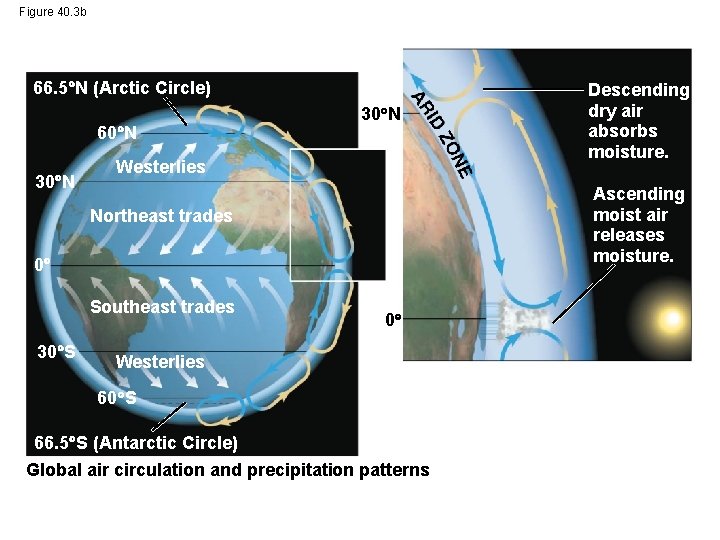
• Global air circulation and precipitation patterns are initiated by intense solar radiation near the equator • Warm, wet air rising near the equator creates precipitation in the tropics • Dry air descending at 30 north and south latitudes causes desert conditions • This pattern of precipitation and drying is repeated at the 60 north and south latitudes and the poles
Figure 40. 3 b 66. 5 N (Arctic Circle) 60 N 30 N Westerlies Ascending moist air releases moisture. Northeast trades 0 Southeast trades 30 S Descending dry air absorbs moisture. 0 Westerlies 60 S 66. 5 S (Antarctic Circle) Global air circulation and precipitation patterns
• Variation in the speed of Earth’s rotation at different latitudes results in the major wind patterns • Trade winds blow east to west in the tropics • Westerlies blow west to east in temperate zones
Regional Effects on Climate • Climate is affected by seasonality, large bodies of water, and mountains
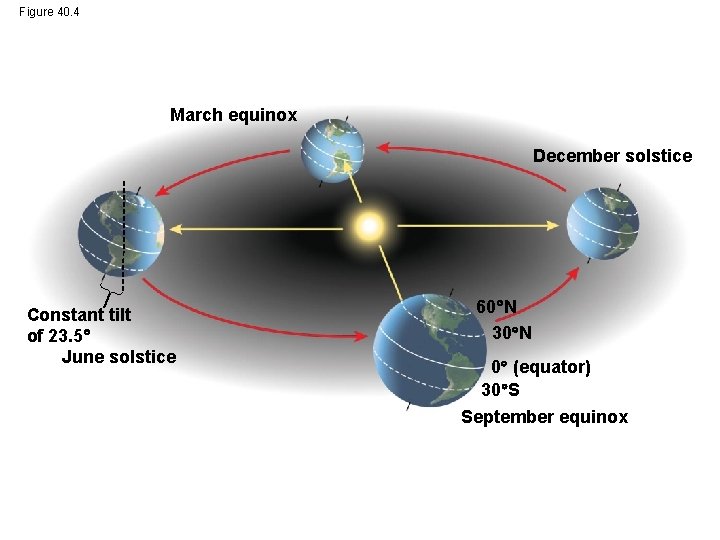
Seasonality • Seasonal variations of light and temperature increase steadily toward the poles • Seasonality at high latitudes is caused by the tilt of Earth’s axis of rotation and its annual passage around the sun • Belts of wet and dry air straddling the equator shift throughout the year with the changing angle of the sun • Changing wind patterns affect ocean currents
Figure 40. 4 March equinox December solstice Constant tilt of 23. 5 June solstice 60 N 30 N 0 (equator) 30 S September equinox
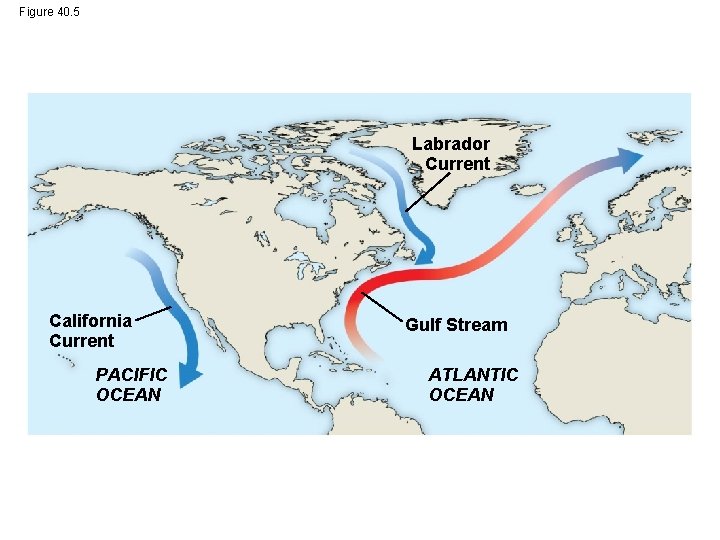
Bodies of Water • Oceans, their currents, and large lakes moderate the climate of nearby terrestrial environments • The California Current carries cold water southward along western North America • The Gulf Stream carries warm water from the equator to the North Atlantic
Figure 40. 5 Labrador Current California Current PACIFIC OCEAN Gulf Stream ATLANTIC OCEAN
• During the day, air rises over warm land draws a cool breeze from the water across the land • As the land cools at night, air rises over the warmer water and draws cooler air from land back over the water, which is replaced by warmer air from offshore
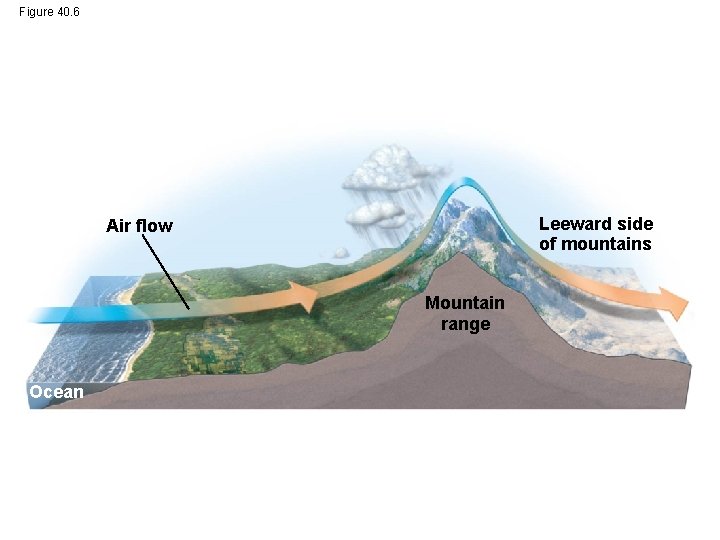
Figure 40. 6 Leeward side of mountains Air flow Mountain range Ocean
Mountains • Rising air releases moisture on the windward side of a peak and creates a “rain shadow” as it absorbs moisture on the leeward side • Many deserts are found in the “rain shadow” of mountains
• Mountains affect the amount of sunlight reaching an area • In the Northern Hemisphere, south-facing slopes receive more sunlight than north-facing slopes • Every 1, 000 -m increase in elevation produces a temperature drop of approximately 6 C