
Concept 17 4 Translation is the RNAdirected synthesis
- Slides: 38
Concept 17. 4: Translation is the RNA-directed synthesis of a polypeptide: a closer look • The translation of m. RNA to protein can be examined in more detail Copyright © 2008 Pearson Education Inc. , publishing as Pearson Benjamin Cummings
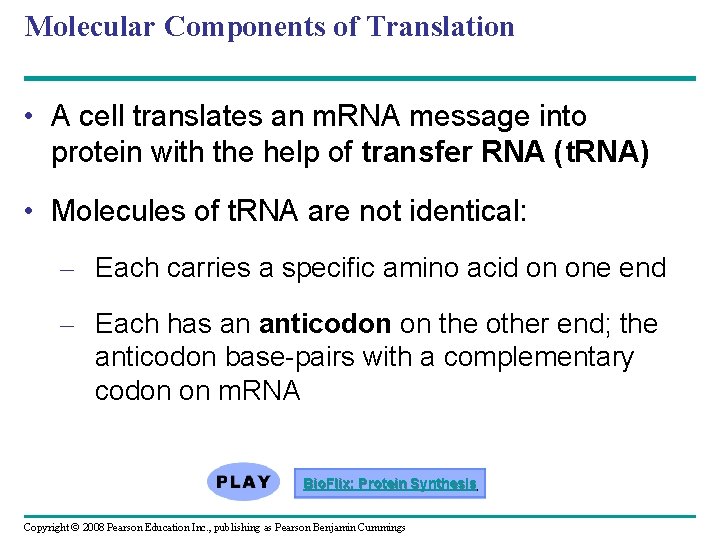
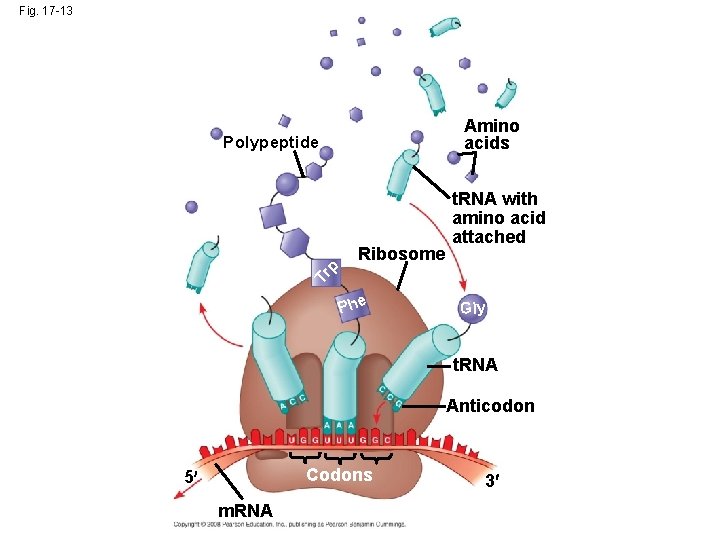
Molecular Components of Translation • A cell translates an m. RNA message into protein with the help of transfer RNA (t. RNA) • Molecules of t. RNA are not identical: – Each carries a specific amino acid on one end – Each has an anticodon on the other end; the anticodon base-pairs with a complementary codon on m. RNA Bio. Flix: Protein Synthesis Copyright © 2008 Pearson Education Inc. , publishing as Pearson Benjamin Cummings
Fig. 17 -13 Amino acids Polypeptide Tr p Ribosome t. RNA with amino acid attached Phe Gly t. RNA Anticodon Codons 5 m. RNA 3
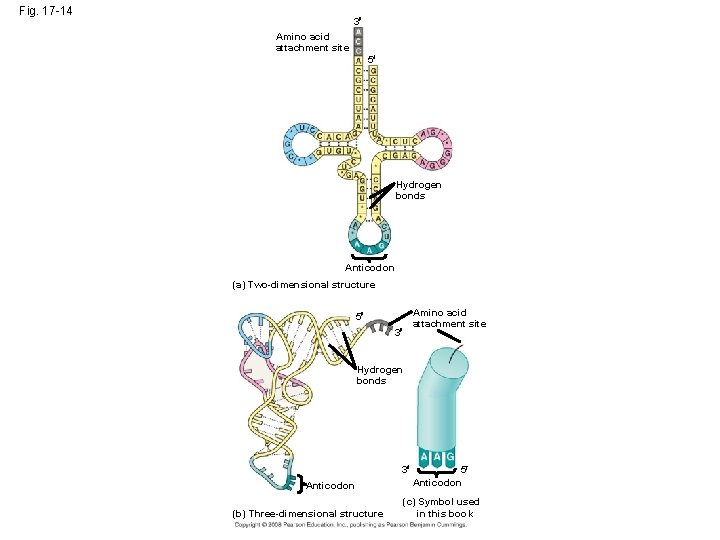
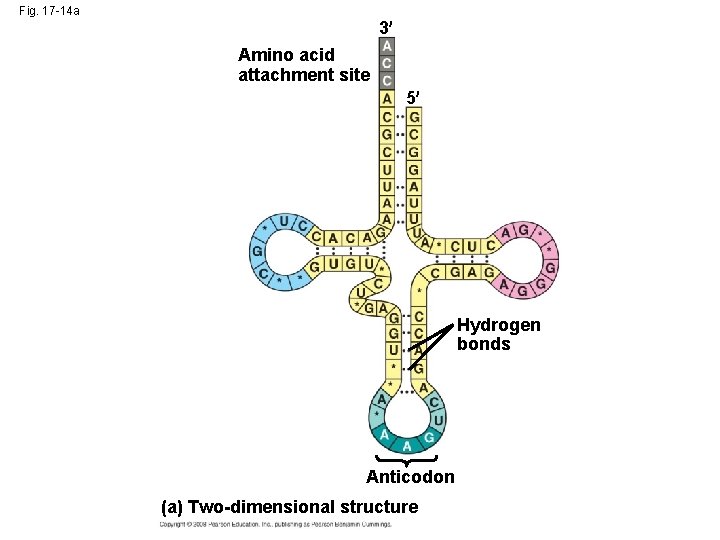
The Structure and Function of Transfer RNA • A t. RNA molecule consists of a single RNA A C strand that is only about 80 nucleotides long C • Flattened into one plane to reveal its base pairing, a t. RNA molecule looks like a cloverleaf Copyright © 2008 Pearson Education Inc. , publishing as Pearson Benjamin Cummings
Fig. 17 -14 3 Amino acid attachment site 5 Hydrogen bonds Anticodon (a) Two-dimensional structure Amino acid attachment site 5 3 Hydrogen bonds 3 Anticodon (b) Three-dimensional structure 5 Anticodon (c) Symbol used in this book
Fig. 17 -14 a 3 Amino acid attachment site 5 Hydrogen bonds Anticodon (a) Two-dimensional structure
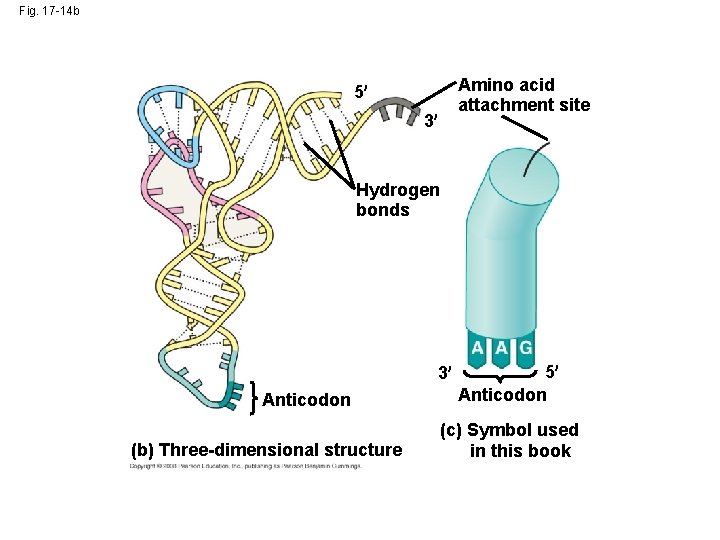
Fig. 17 -14 b Amino acid attachment site 5 3 Hydrogen bonds 3 Anticodon (b) Three-dimensional structure 5 Anticodon (c) Symbol used in this book
• Because of hydrogen bonds, t. RNA actually twists and folds into a three-dimensional molecule • t. RNA is roughly L-shaped Copyright © 2008 Pearson Education Inc. , publishing as Pearson Benjamin Cummings
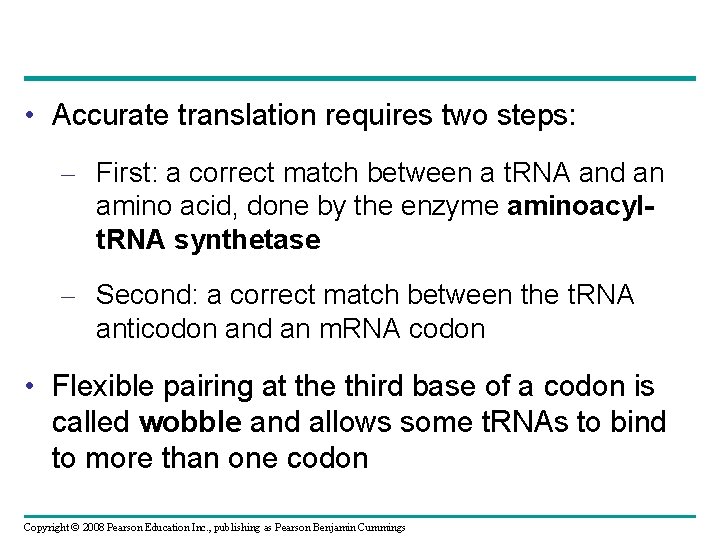
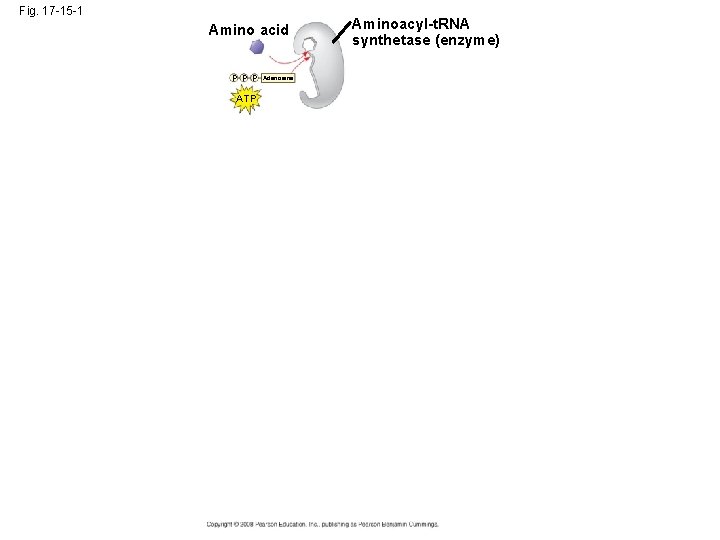
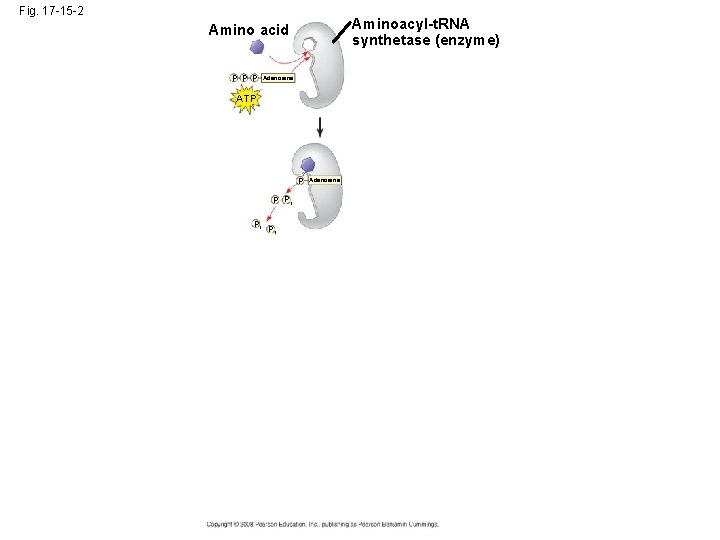
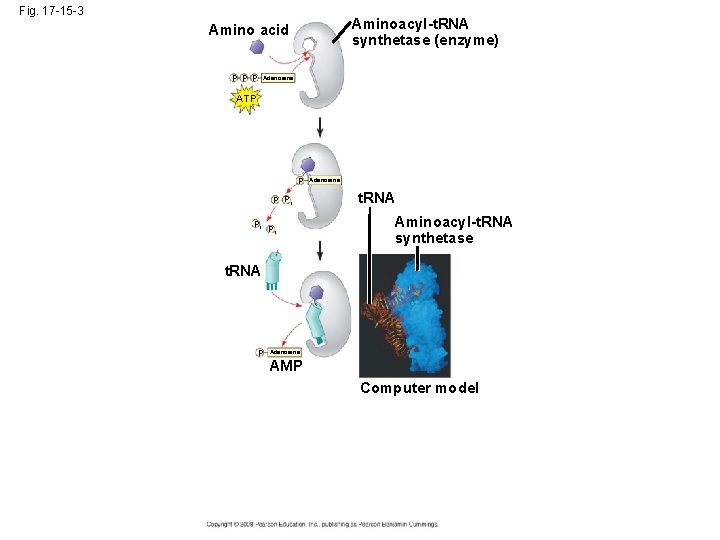
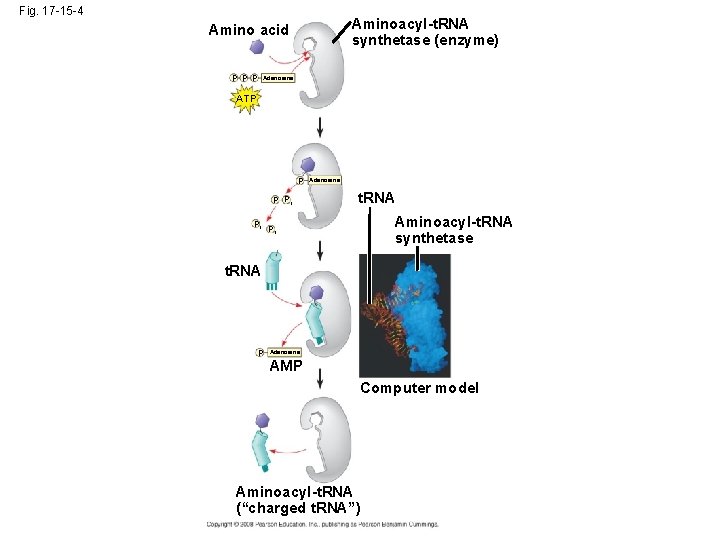
• Accurate translation requires two steps: – First: a correct match between a t. RNA and an amino acid, done by the enzyme aminoacylt. RNA synthetase – Second: a correct match between the t. RNA anticodon and an m. RNA codon • Flexible pairing at the third base of a codon is called wobble and allows some t. RNAs to bind to more than one codon Copyright © 2008 Pearson Education Inc. , publishing as Pearson Benjamin Cummings
Fig. 17 -15 -1 Amino acid P P P ATP Adenosine Aminoacyl-t. RNA synthetase (enzyme)
Fig. 17 -15 -2 Aminoacyl-t. RNA synthetase (enzyme) Amino acid P P P Adenosine ATP P P Pi Pi Pi Adenosine
Fig. 17 -15 -3 Aminoacyl-t. RNA synthetase (enzyme) Amino acid P P P Adenosine ATP P P Pi Pi Pi Adenosine t. RNA Aminoacyl-t. RNA synthetase t. RNA P Adenosine AMP Computer model
Fig. 17 -15 -4 Aminoacyl-t. RNA synthetase (enzyme) Amino acid P P P Adenosine ATP P P Pi Pi Adenosine t. RNA Aminoacyl-t. RNA synthetase Pi t. RNA P Adenosine AMP Computer model Aminoacyl-t. RNA (“charged t. RNA”)
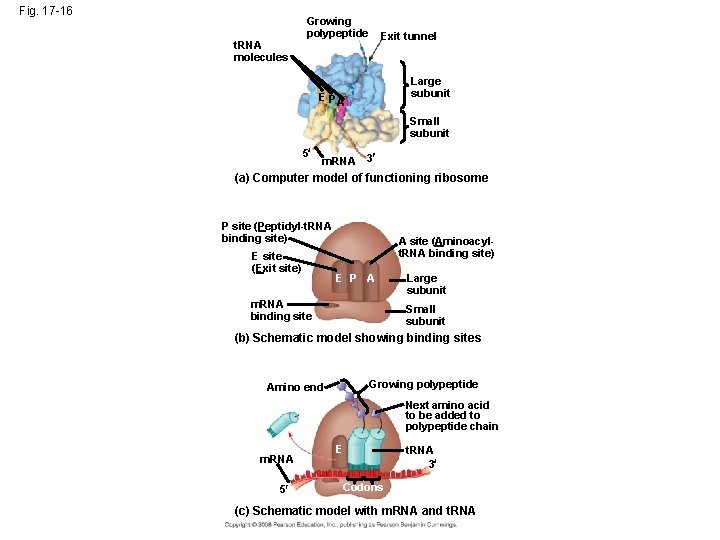
Ribosomes • Ribosomes facilitate specific coupling of t. RNA anticodons with m. RNA codons in protein synthesis • The two ribosomal subunits (large and small) are made of proteins and ribosomal RNA (r. RNA) Copyright © 2008 Pearson Education Inc. , publishing as Pearson Benjamin Cummings
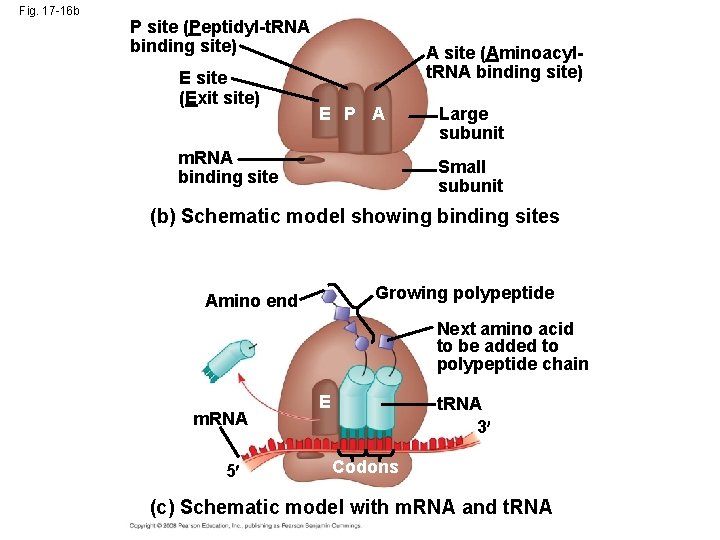
Fig. 17 -16 Growing polypeptide Exit tunnel t. RNA molecules EP Large subunit A Small subunit 5 m. RNA 3 (a) Computer model of functioning ribosome P site (Peptidyl-t. RNA binding site) E site (Exit site) A site (Aminoacylt. RNA binding site) E P A m. RNA binding site Large subunit Small subunit (b) Schematic model showing binding sites Growing polypeptide Amino end Next amino acid to be added to polypeptide chain m. RNA 5 E t. RNA 3 Codons (c) Schematic model with m. RNA and t. RNA
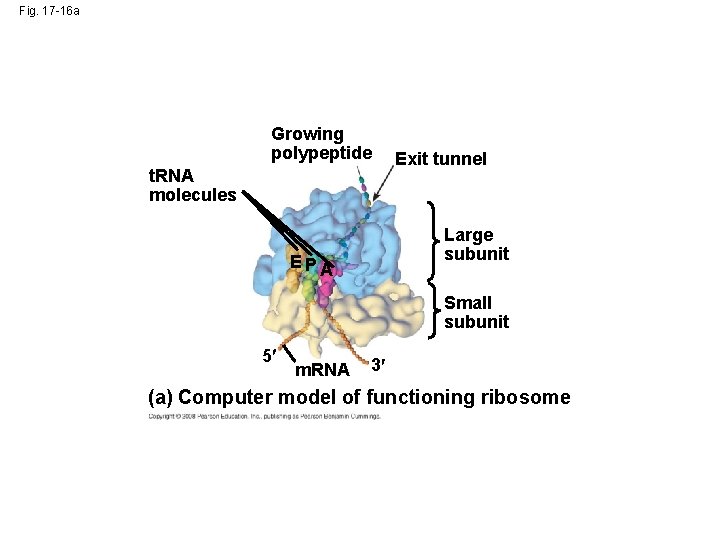
Fig. 17 -16 a Growing polypeptide t. RNA molecules Exit tunnel Large subunit E PA Small subunit 5 m. RNA 3 (a) Computer model of functioning ribosome
Fig. 17 -16 b P site (Peptidyl-t. RNA binding site) E site (Exit site) A site (Aminoacylt. RNA binding site) E P A m. RNA binding site Large subunit Small subunit (b) Schematic model showing binding sites Growing polypeptide Amino end Next amino acid to be added to polypeptide chain m. RNA 5 E t. RNA 3 Codons (c) Schematic model with m. RNA and t. RNA
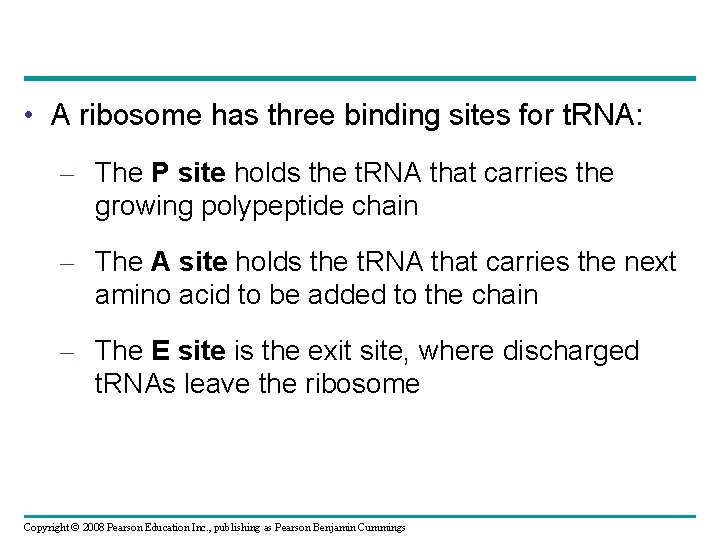
• A ribosome has three binding sites for t. RNA: – The P site holds the t. RNA that carries the growing polypeptide chain – The A site holds the t. RNA that carries the next amino acid to be added to the chain – The E site is the exit site, where discharged t. RNAs leave the ribosome Copyright © 2008 Pearson Education Inc. , publishing as Pearson Benjamin Cummings
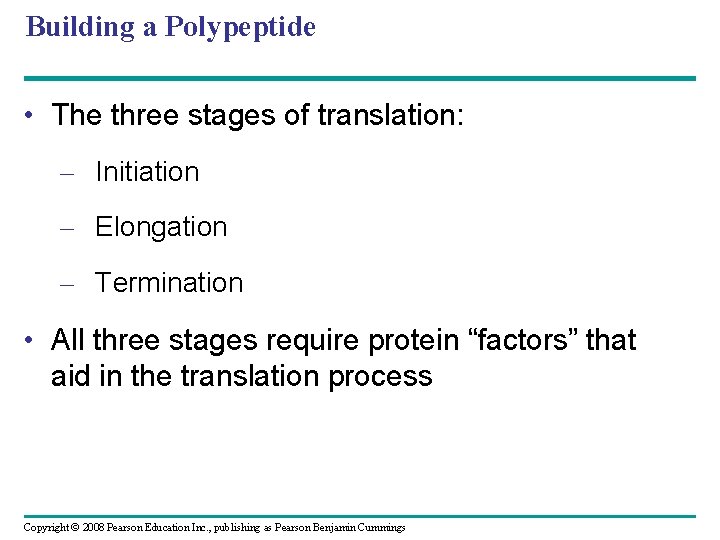
Building a Polypeptide • The three stages of translation: – Initiation – Elongation – Termination • All three stages require protein “factors” that aid in the translation process Copyright © 2008 Pearson Education Inc. , publishing as Pearson Benjamin Cummings
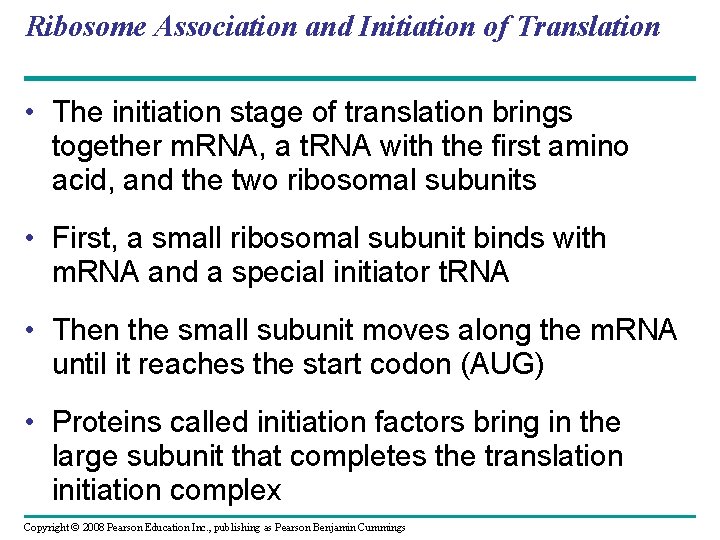
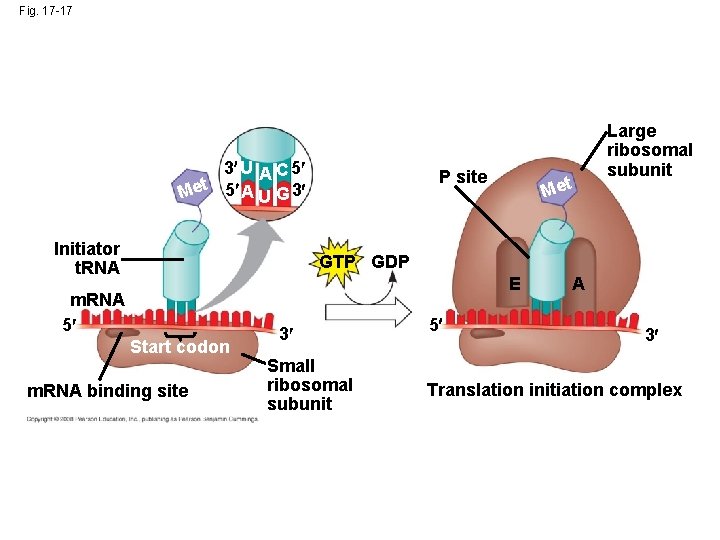
Ribosome Association and Initiation of Translation • The initiation stage of translation brings together m. RNA, a t. RNA with the first amino acid, and the two ribosomal subunits • First, a small ribosomal subunit binds with m. RNA and a special initiator t. RNA • Then the small subunit moves along the m. RNA until it reaches the start codon (AUG) • Proteins called initiation factors bring in the large subunit that completes the translation initiation complex Copyright © 2008 Pearson Education Inc. , publishing as Pearson Benjamin Cummings
Fig. 17 -17 3 U A C 5 Met 5 A U G 3 Initiator t. RNA P site Met Large ribosomal subunit GTP GDP E m. RNA 5 Start codon m. RNA binding site 3 Small ribosomal subunit 5 A 3 Translation initiation complex
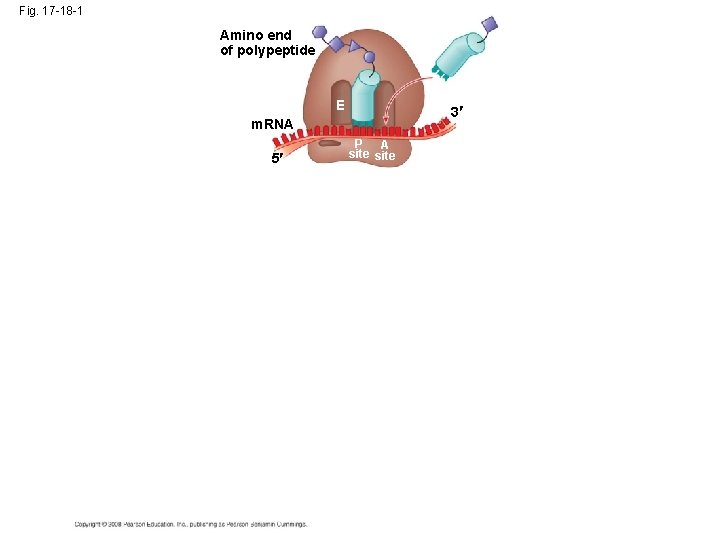
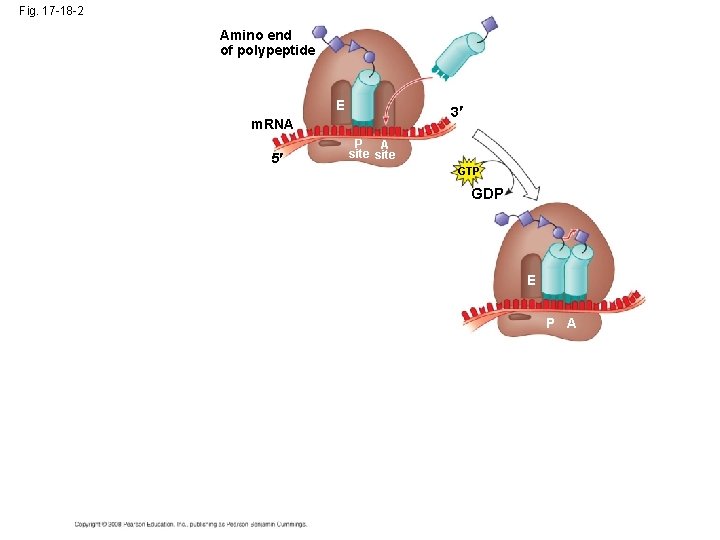
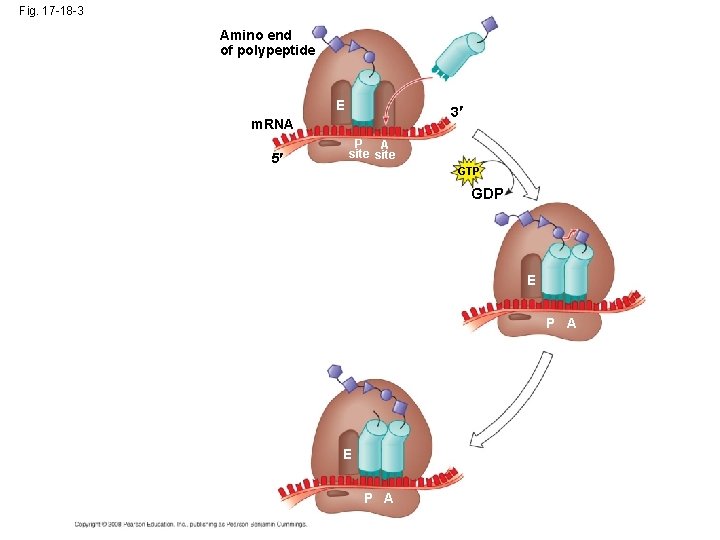
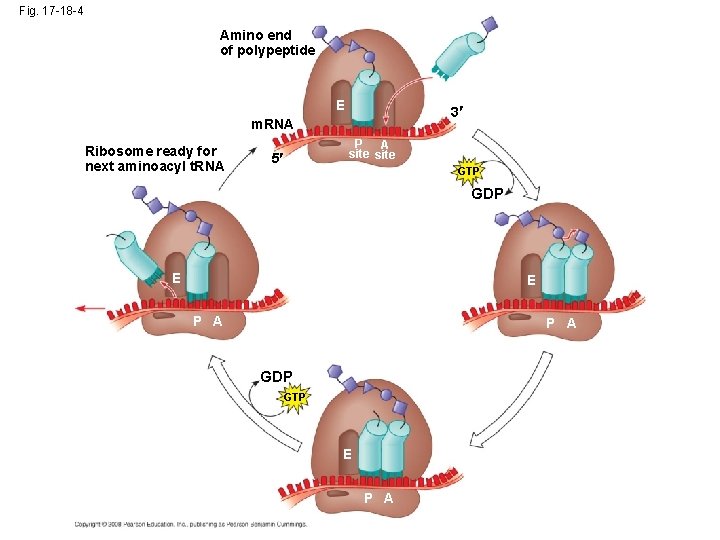
Elongation of the Polypeptide Chain • During the elongation stage, amino acids are added one by one to the preceding amino acid • Each addition involves proteins called elongation factors and occurs in three steps: codon recognition, peptide bond formation, and translocation Copyright © 2008 Pearson Education Inc. , publishing as Pearson Benjamin Cummings
Fig. 17 -18 -1 Amino end of polypeptide E 3 m. RNA 5 P A site
Fig. 17 -18 -2 Amino end of polypeptide E 3 m. RNA 5 P A site GTP GDP E P A
Fig. 17 -18 -3 Amino end of polypeptide E 3 m. RNA 5 P A site GTP GDP E P A
Fig. 17 -18 -4 Amino end of polypeptide E 3 m. RNA Ribosome ready for next aminoacyl t. RNA P A site 5 GTP GDP E E P A GDP GTP E P A
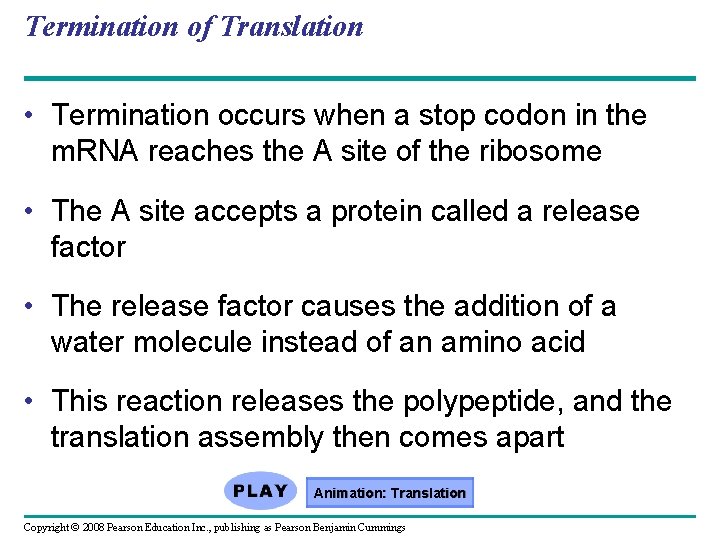
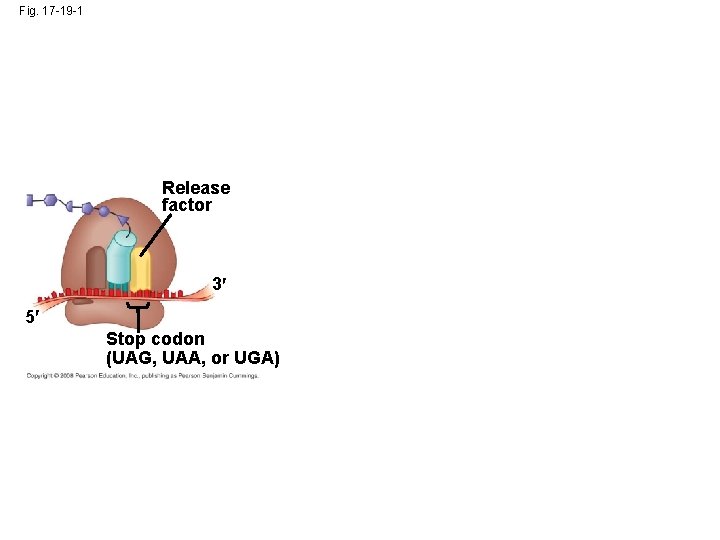
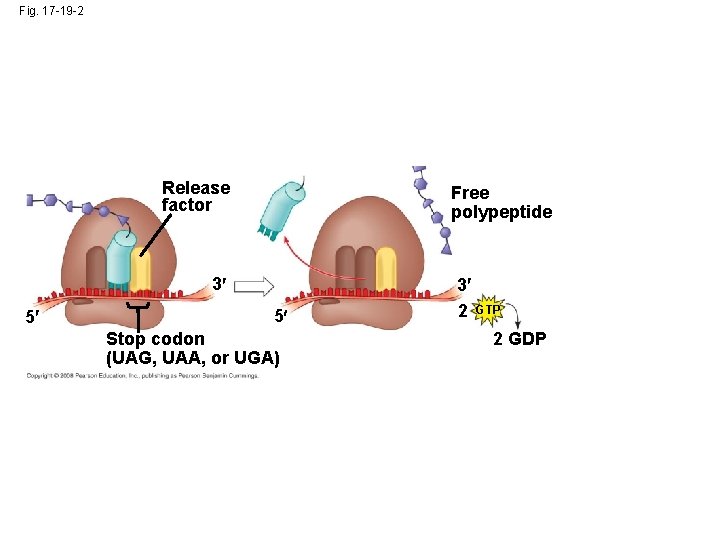
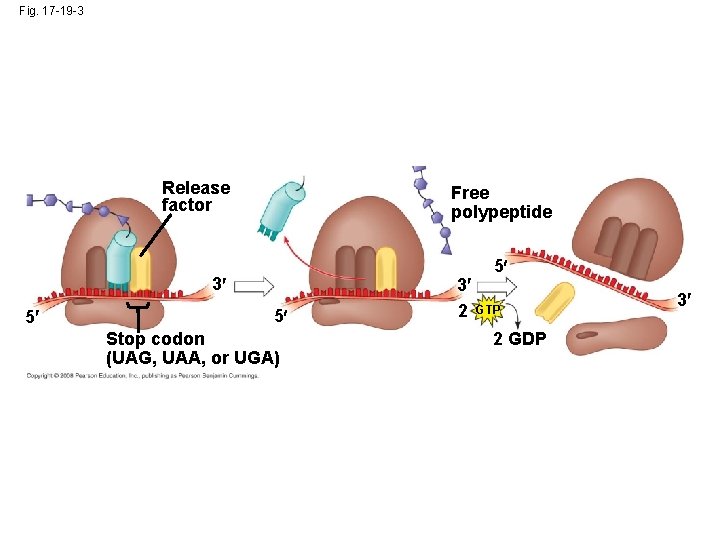
Termination of Translation • Termination occurs when a stop codon in the m. RNA reaches the A site of the ribosome • The A site accepts a protein called a release factor • The release factor causes the addition of a water molecule instead of an amino acid • This reaction releases the polypeptide, and the translation assembly then comes apart Animation: Translation Copyright © 2008 Pearson Education Inc. , publishing as Pearson Benjamin Cummings
Fig. 17 -19 -1 Release factor 3 5 Stop codon (UAG, UAA, or UGA)
Fig. 17 -19 -2 Release factor Free polypeptide 3 5 5 Stop codon (UAG, UAA, or UGA) 3 2 GTP 2 GDP
Fig. 17 -19 -3 Release factor Free polypeptide 5 3 5 5 Stop codon (UAG, UAA, or UGA) 3 2 GTP 2 GDP 3
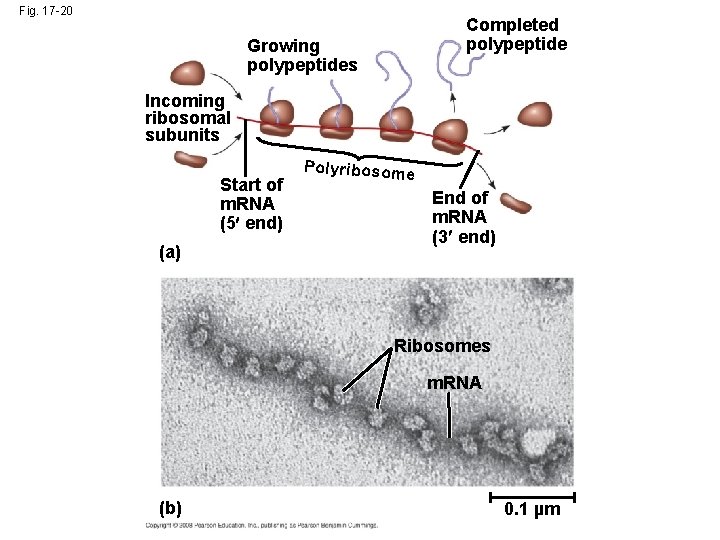
Polyribosomes • A number of ribosomes can translate a single m. RNA simultaneously, forming a polyribosome (or polysome) • Polyribosomes enable a cell to make many copies of a polypeptide very quickly Copyright © 2008 Pearson Education Inc. , publishing as Pearson Benjamin Cummings
Fig. 17 -20 Completed polypeptide Growing polypeptides Incoming ribosomal subunits Start of m. RNA (5 end) (a) Polyribosome End of m. RNA (3 end) Ribosomes m. RNA (b) 0. 1 µm
Completing and Targeting the Functional Protein • Often translation is not sufficient to make a functional protein • Polypeptide chains are modified after translation • Completed proteins are targeted to specific sites in the cell Copyright © 2008 Pearson Education Inc. , publishing as Pearson Benjamin Cummings
Protein Folding and Post-Translational Modifications • During and after synthesis, a polypeptide chain spontaneously coils and folds into its threedimensional shape • Proteins may also require post-translational modifications before doing their job • Some polypeptides are activated by enzymes that cleave them • Other polypeptides come together to form the subunits of a protein Copyright © 2008 Pearson Education Inc. , publishing as Pearson Benjamin Cummings
Targeting Polypeptides to Specific Locations • Two populations of ribosomes are evident in cells: free ribsomes (in the cytosol) and bound ribosomes (attached to the ER) • Free ribosomes mostly synthesize proteins that function in the cytosol • Bound ribosomes make proteins of the endomembrane system and proteins that are secreted from the cell • Ribosomes are identical and can switch from free to bound Copyright © 2008 Pearson Education Inc. , publishing as Pearson Benjamin Cummings
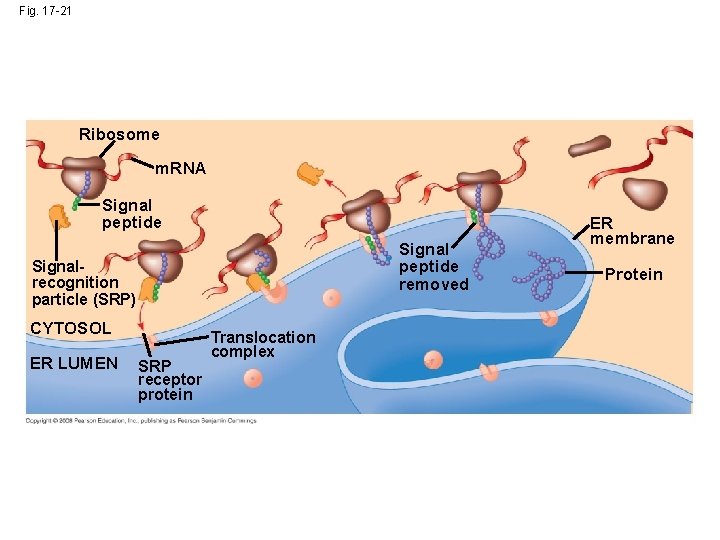
• Polypeptide synthesis always begins in the cytosol • Synthesis finishes in the cytosol unless the polypeptide signals the ribosome to attach to the ER • Polypeptides destined for the ER or for secretion are marked by a signal peptide Copyright © 2008 Pearson Education Inc. , publishing as Pearson Benjamin Cummings
• A signal-recognition particle (SRP) binds to the signal peptide • The SRP brings the signal peptide and its ribosome to the ER Copyright © 2008 Pearson Education Inc. , publishing as Pearson Benjamin Cummings
Fig. 17 -21 Ribosome m. RNA Signal peptide removed Signalrecognition particle (SRP) CYTOSOL ER LUMEN SRP receptor protein Translocation complex ER membrane Protein