
CONCENTRATIONS OF SOLUTIONS Chapter 16 2 OBJECTIVES I
CONCENTRATIONS OF SOLUTIONS Chapter 16. 2
OBJECTIVES • I will be able to calculate the molarity of a solution • I will be able to calculate the percent by volume and mass of a solution
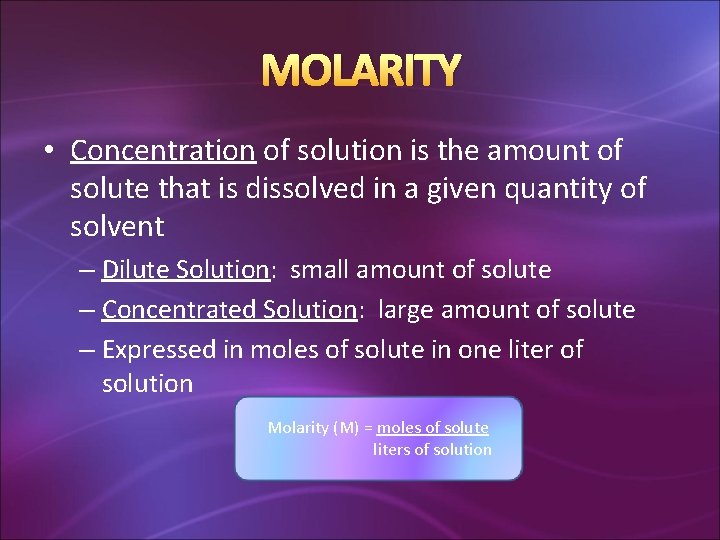
MOLARITY • Concentration of solution is the amount of solute that is dissolved in a given quantity of solvent – Dilute Solution: small amount of solute – Concentrated Solution: large amount of solute – Expressed in moles of solute in one liter of solution Molarity (M) = moles of solute liters of solution
SAMPLE PROBLEM 16. 2 • Intravenous (IV) saline solutions are often administered to patients in the hospital. One saline solution contains 0. 90 g Na. Cl in exactly 100 m. L of solution. What is the molarity of the solution?
SAMPLE PROBLEM 16. 3 • Household laundry bleach is a dilute aqueous solution of sodium hypochlorite. How many moles of solute are present in 1. 5 L of 0. 70 M sodium hypochlorite?
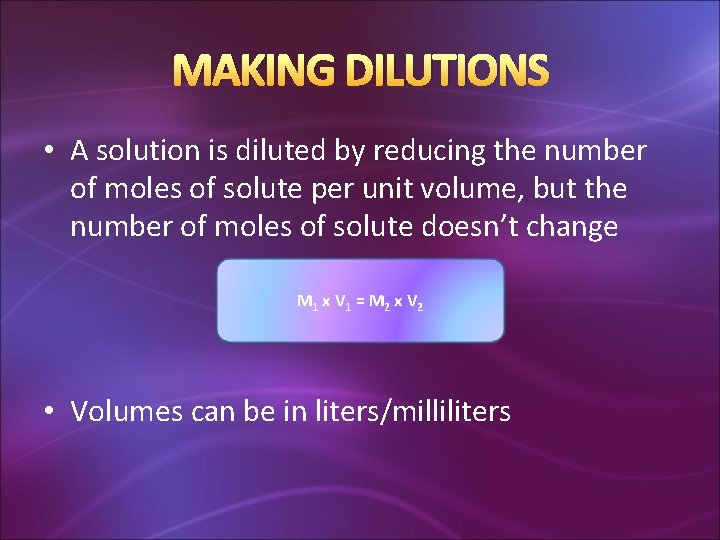
MAKING DILUTIONS • A solution is diluted by reducing the number of moles of solute per unit volume, but the number of moles of solute doesn’t change M 1 x V 1 = M 2 x V 2 • Volumes can be in liters/milliliters
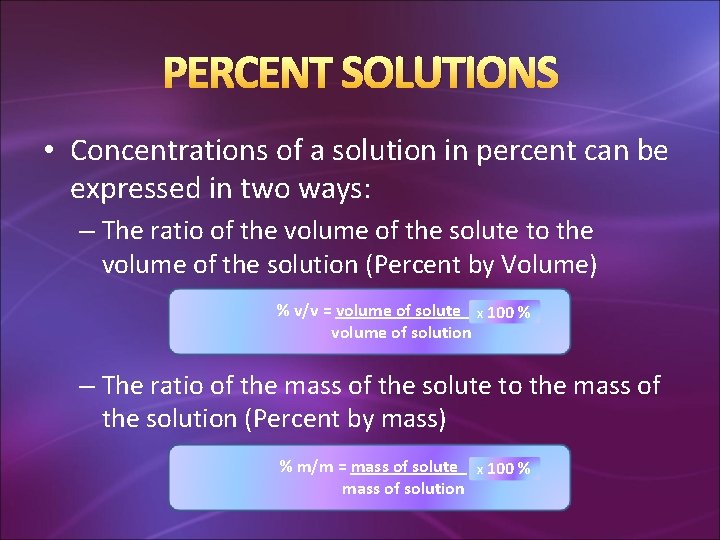
PERCENT SOLUTIONS • Concentrations of a solution in percent can be expressed in two ways: – The ratio of the volume of the solute to the volume of the solution (Percent by Volume) % v/v = volume of solute X 100 % volume of solution – The ratio of the mass of the solute to the mass of the solution (Percent by mass) % m/m = mass of solute mass of solution X 100 %
SAMPLE PROBLEM 16. 5 • What is the percent by volume of ethanol (C 2 H 6 O, or ethyl alcohol) in the final solution when 85 m. L of ethanol is diluted to a volume of 250 m. L with water?
SAMPLE PROBLEM • How many grams of K 2 SO 4 would you need to prepare 1500 g of 5. 0% K 2 SO 4 (m/m) solution?
- Slides: 9