
Concentrations of Solutions Behavior of solutions depend on
Concentrations of Solutions • Behavior of solutions depend on compound itself and on how much is present, i. e. on the concentration. • Two solutions can contain the same compounds but behave quite different because the proportions of those compounds are different.
Concentrations of Solutions • Concentration of a solution: the more solute in a given volume of solvent, the more concentrated • 1 tsp salt (Na. Cl)/cup of water vs • 3 Tbsp salt/cup water
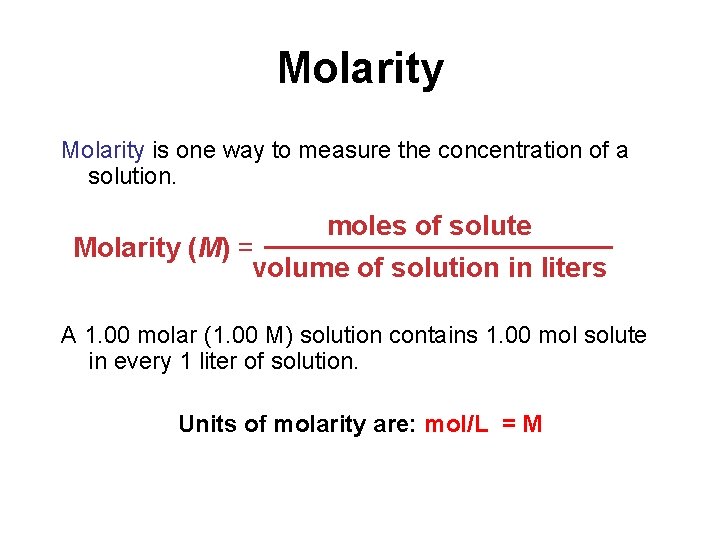
Molarity is one way to measure the concentration of a solution. moles of solute Molarity (M) = volume of solution in liters A 1. 00 molar (1. 00 M) solution contains 1. 00 mol solute in every 1 liter of solution. Units of molarity are: mol/L = M
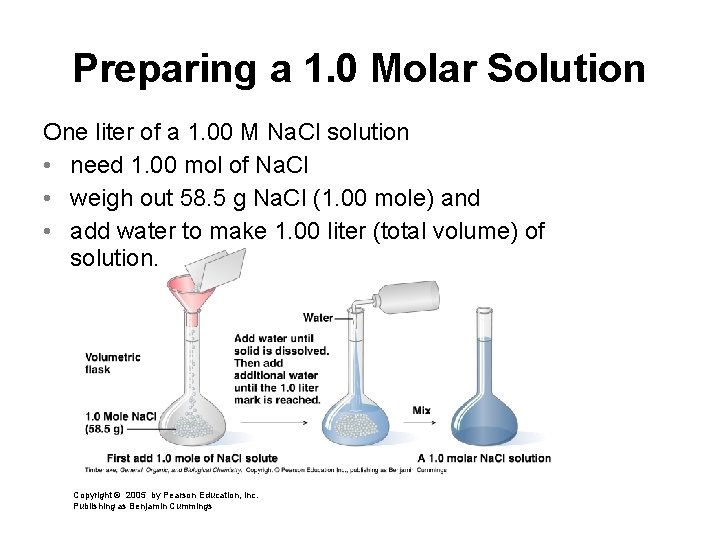
Preparing a 1. 0 Molar Solution One liter of a 1. 00 M Na. Cl solution • need 1. 00 mol of Na. Cl • weigh out 58. 5 g Na. Cl (1. 00 mole) and • add water to make 1. 00 liter (total volume) of solution. Copyright © 2005 by Pearson Education, Inc. Publishing as Benjamin Cummings
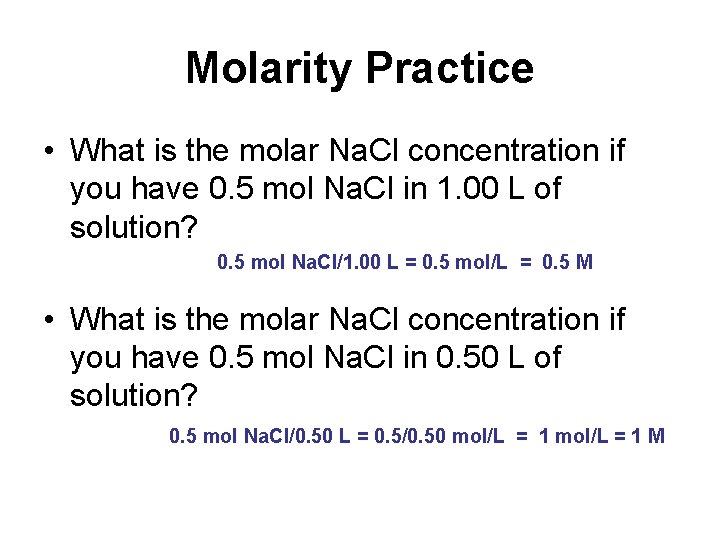
Molarity Practice • What is the molar Na. Cl concentration if you have 0. 5 mol Na. Cl in 1. 00 L of solution? 0. 5 mol Na. Cl/1. 00 L = 0. 5 mol/L = 0. 5 M • What is the molar Na. Cl concentration if you have 0. 5 mol Na. Cl in 0. 50 L of solution? 0. 5 mol Na. Cl/0. 50 L = 0. 5/0. 50 mol/L = 1 M
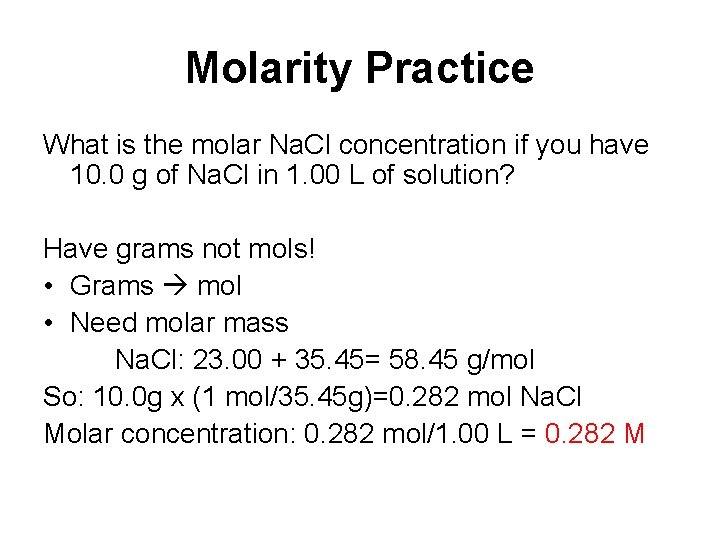
Molarity Practice What is the molar Na. Cl concentration if you have 10. 0 g of Na. Cl in 1. 00 L of solution? Have grams not mols! • Grams mol • Need molar mass Na. Cl: 23. 00 + 35. 45= 58. 45 g/mol So: 10. 0 g x (1 mol/35. 45 g)=0. 282 mol Na. Cl Molar concentration: 0. 282 mol/1. 00 L = 0. 282 M
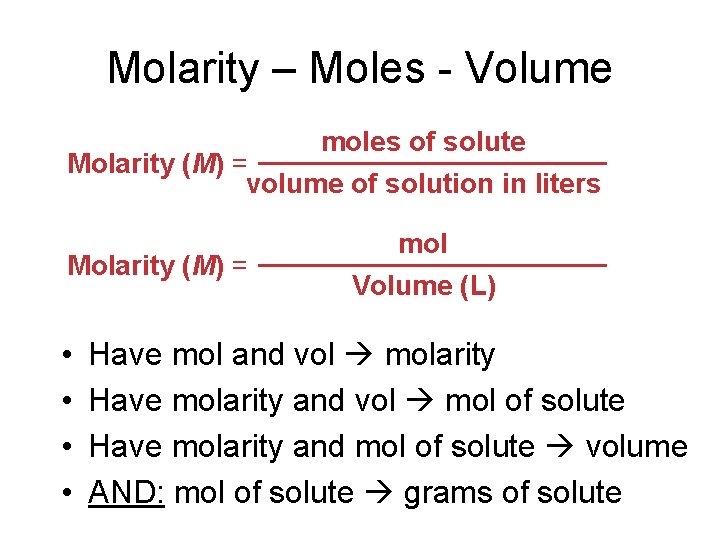
Molarity – Moles - Volume moles of solute Molarity (M) = volume of solution in liters Molarity (M) = • • mol Volume (L) Have mol and vol molarity Have molarity and vol mol of solute Have molarity and mol of solute volume AND: mol of solute grams of solute
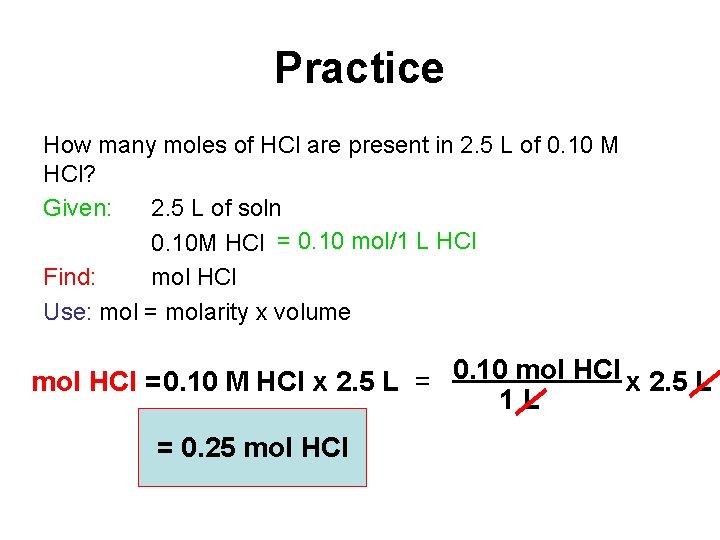
Practice How many moles of HCl are present in 2. 5 L of 0. 10 M HCl? Given: 2. 5 L of soln 0. 10 M HCl = 0. 10 mol/1 L HCl Find: mol HCl Use: mol = molarity x volume mol HCl =0. 10 M HCl x 2. 5 L = 0. 10 mol HCl x 2. 5 L 1 L = 0. 25 mol HCl
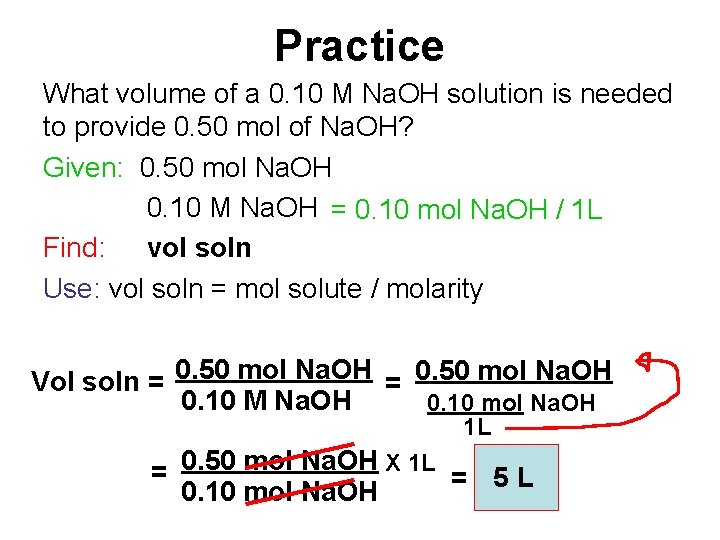
Practice What volume of a 0. 10 M Na. OH solution is needed to provide 0. 50 mol of Na. OH? Given: 0. 50 mol Na. OH 0. 10 M Na. OH = 0. 10 mol Na. OH / 1 L Find: vol soln Use: vol soln = mol solute / molarity Vol soln = 0. 50 mol Na. OH 0. 10 M Na. OH 0. 10 mol Na. OH 1 L = 0. 50 mol Na. OH X 1 L = 5 L 0. 10 mol Na. OH
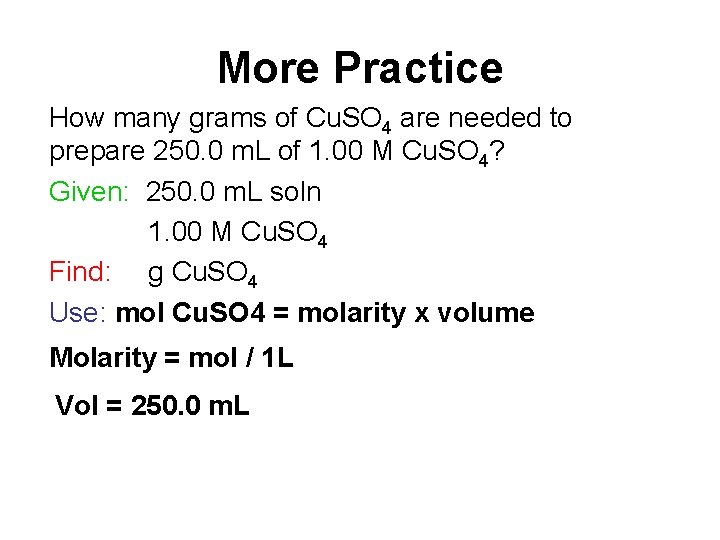
More Practice How many grams of Cu. SO 4 are needed to prepare 250. 0 m. L of 1. 00 M Cu. SO 4? Given: 250. 0 m. L soln 1. 00 M Cu. SO 4 Find: g Cu. SO 4 Use: mol Cu. SO 4 = molarity x volume Molarity = mol / 1 L Vol = 250. 0 m. L
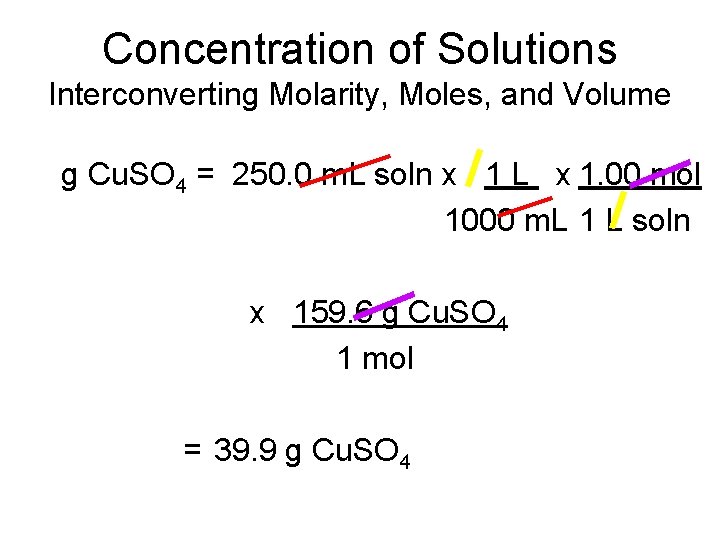
Concentration of Solutions Interconverting Molarity, Moles, and Volume g Cu. SO 4 = 250. 0 m. L soln x 1 L x 1. 00 mol 1000 m. L 1 L soln x 159. 6 g Cu. SO 4 1 mol = 39. 9 g Cu. SO 4
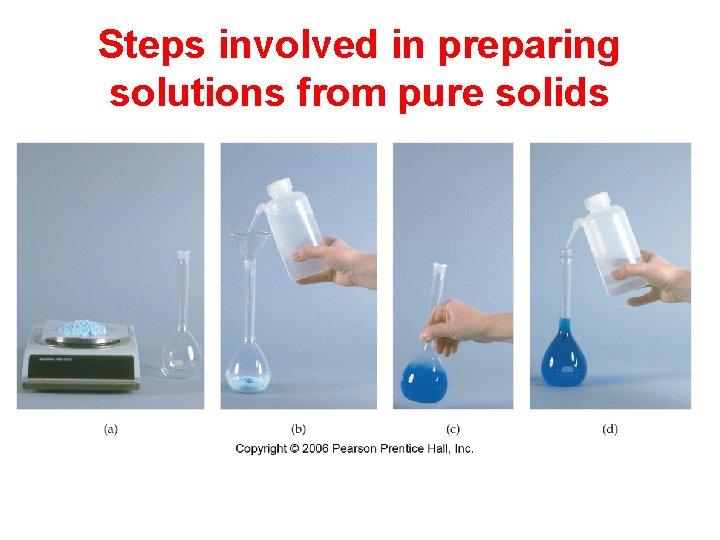
Steps involved in preparing solutions from pure solids
Steps involved in preparing solutions from pure solids – Calculate the amount of solid required – Weigh out the solid – Place in an appropriate volumetric flask – Fill flask about half full with water and mix. – Fill to the mark with water and invert to mix. You should be able to describe this process (including calculating the mass of solid to use) for any solution I specify.
Dilutions • Many laboratory chemicals such as acids are purchased as concentrated solutions (stock solutions). e. g. 12 M HCl 12 M H 2 SO 4 • More dilute solutions are prepared by taking a certain quantity of the stock solution and diluting it with water.
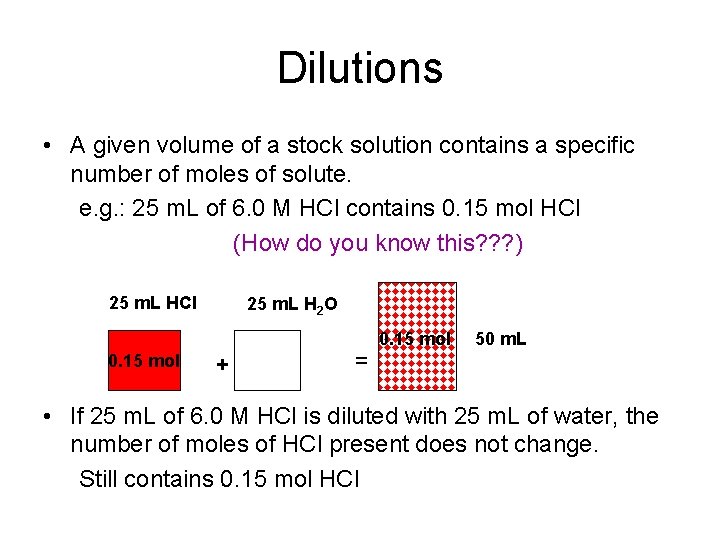
Dilutions • A given volume of a stock solution contains a specific number of moles of solute. e. g. : 25 m. L of 6. 0 M HCl contains 0. 15 mol HCl (How do you know this? ? ? ) 25 m. L HCl 0. 15 mol 25 m. L H 2 O + = 0. 15 mol 50 m. L • If 25 m. L of 6. 0 M HCl is diluted with 25 m. L of water, the number of moles of HCl present does not change. Still contains 0. 15 mol HCl
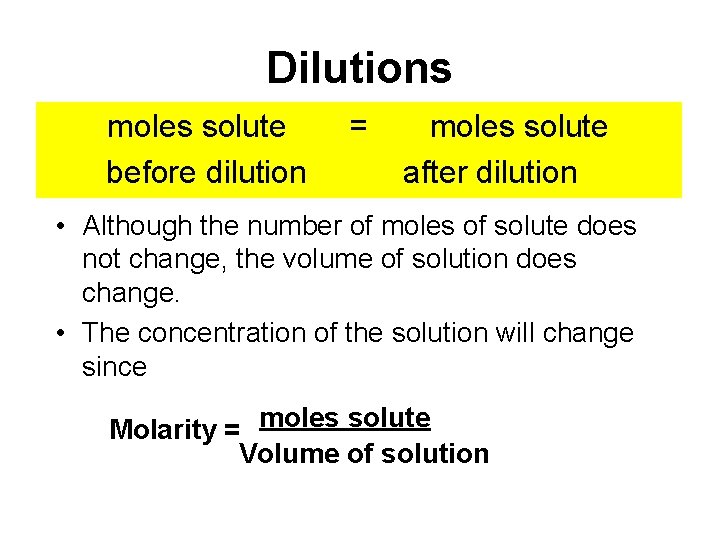
Dilutions moles solute before dilution = moles solute after dilution • Although the number of moles of solute does not change, the volume of solution does change. • The concentration of the solution will change since Molarity = moles solute Volume of solution

Dilution Calculation • When a solution is diluted, the concentration of the new solution can be found using: Mc x V c = M d x V d where Mc= initial concentration (mol/L)= more concentrated Vc = initial volume of more conc. solution Md =final concentration (mol/L) in dilution Vd = final volume of diluted solution

Dilution Calculation What is the concentration of a solution prepared by diluting 25. 0 m. L of 6. 00 M HCl to a total volume of 50. 0 m. L? Given: Vc = 25. 0 m. L Note: Vcand Vd do not have to be in liters, but they Mc = 6. 00 M must be in the same Vd = 50. 0 m. L units. Find: Md Use Vcx Mc= Vdx Md Solve for Md

Dilution • Make a diluted solution once you know Vc and Vd – Use a pipet to deliver a volume of the concentrated solution to a new volumetric flask. – Add solvent to the line on the neck of the new flask. – Mix well.
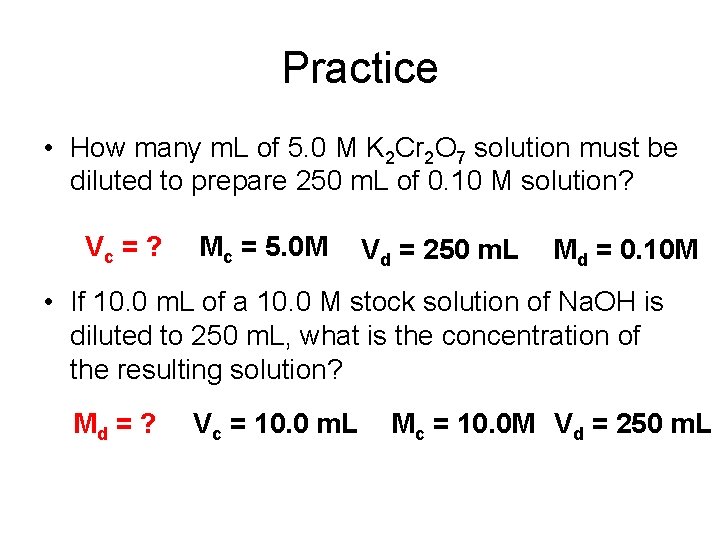
Practice • How many m. L of 5. 0 M K 2 Cr 2 O 7 solution must be diluted to prepare 250 m. L of 0. 10 M solution? Vc = ? Mc = 5. 0 M Vd = 250 m. L Md = 0. 10 M • If 10. 0 m. L of a 10. 0 M stock solution of Na. OH is diluted to 250 m. L, what is the concentration of the resulting solution? Md = ? Vc = 10. 0 m. L Mc = 10. 0 M Vd = 250 m. L
Solution Stoichiometry • Remember: reactions occur on a mole to mole basis. – For pure reactants, we measure reactants using mass – For reactants that are added to a reaction as aqueous solutions, we measure the reactants using volume of solution.
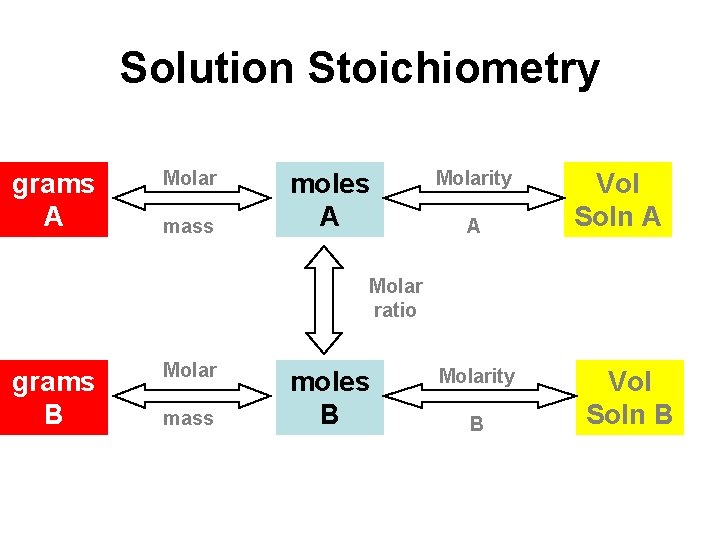
Solution Stoichiometry grams A Molar mass moles A Molarity A Vol Soln A Molar ratio grams B Molar mass moles B Molarity B Vol Soln B

Solution Stoichiometry Practice If 25. 0 m. L of 2. 5 M Na. OH are needed to neutralize (i. e. react completely with) a solution of H 3 PO 4, how many moles of H 3 PO 4 were present in the solution? 3 Na. OH (aq) + H 3 PO 4 (aq) Na 3 PO 4 (aq) + 3 H 2 O(l) Given: 25. 0 m. L 2. 5 M Na. OH balanced eqn: 3 mol Na. OH/1 mol H 3 PO 4 Find: moles of H 3 PO 4
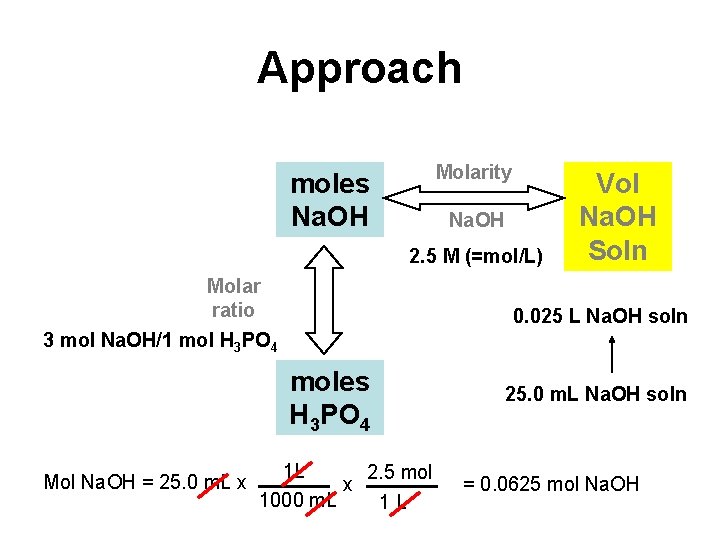
Approach Molarity moles Na. OH 2. 5 M (=mol/L) Molar ratio 3 mol Na. OH/1 mol H 3 PO 4 0. 025 L Na. OH soln moles H 3 PO 4 Mol Na. OH = 25. 0 m. L x Vol Na. OH Soln 1 L 2. 5 mol x 1000 m. L 1 L 25. 0 m. L Na. OH soln = 0. 0625 mol Na. OH
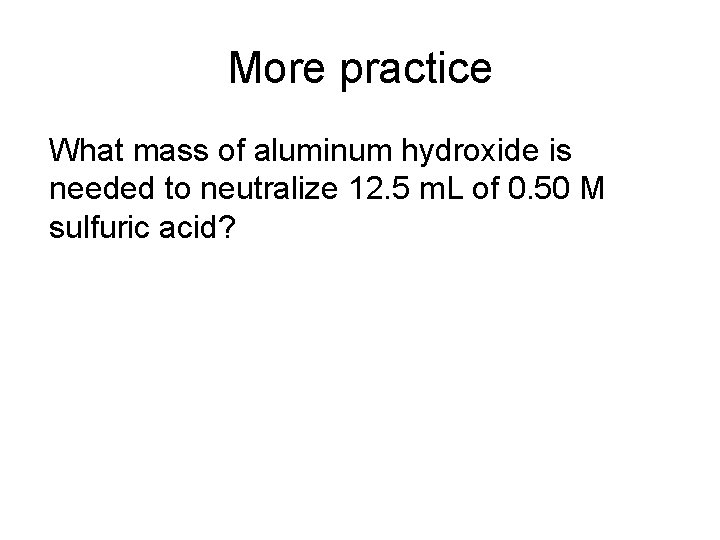
More practice What mass of aluminum hydroxide is needed to neutralize 12. 5 m. L of 0. 50 M sulfuric acid?

Solution Stoichiometry • Solution stoichiometry can be used to determine the concentration of aqueous solutions used in reactions. • Concentration of an acid can be determined using a process called titration. reacting a known volume of the acid with a known volume of a standard base solution (i. e. a base whose concentration is known)
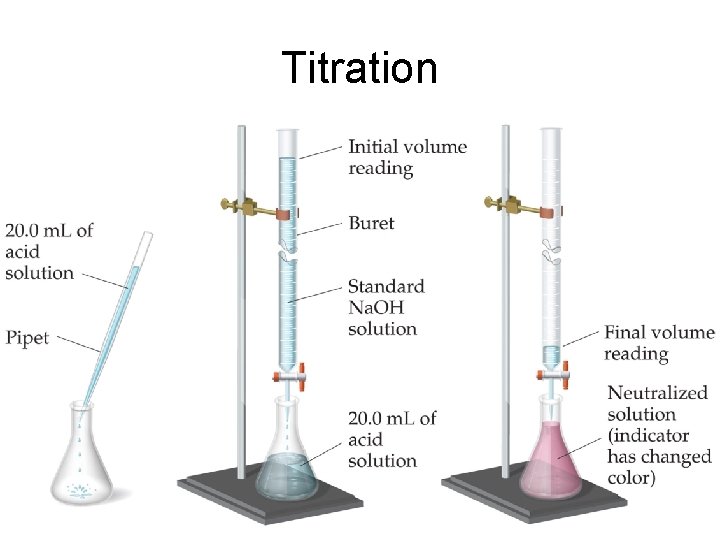
Titration

Practice If 35. 50 m. L of 2. 5 M Na. OH are needed to neutralize 50. 0 m. L of an H 3 PO 4 solution, what is the concentration (molarity) of the H 3 PO 4 solution? 3 Na. OH (aq) + H 3 PO 4 (aq) Na 3 PO 4 (aq) + 3 H 2 O(l) Given: 35. 50 m. L 2. 5 M Na. OH 50. 0 m. L of H 3 PO 4 sol’n Find: molarity (mol/L) H 3 PO 4
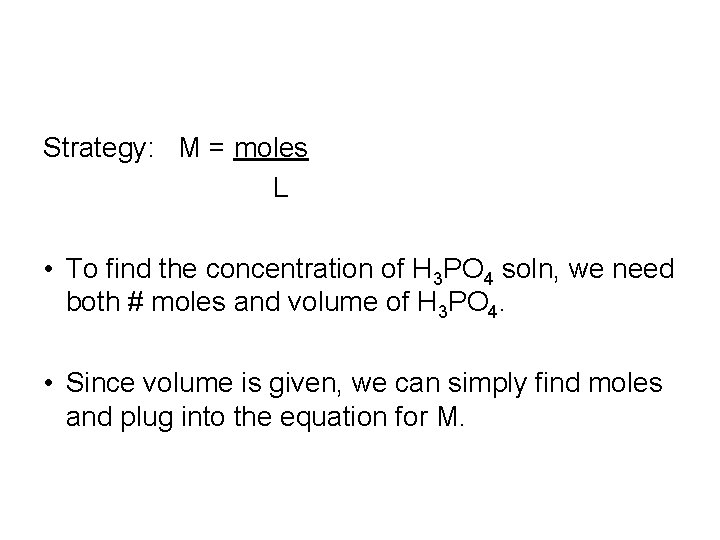
Strategy: M = moles L • To find the concentration of H 3 PO 4 soln, we need both # moles and volume of H 3 PO 4. • Since volume is given, we can simply find moles and plug into the equation for M.
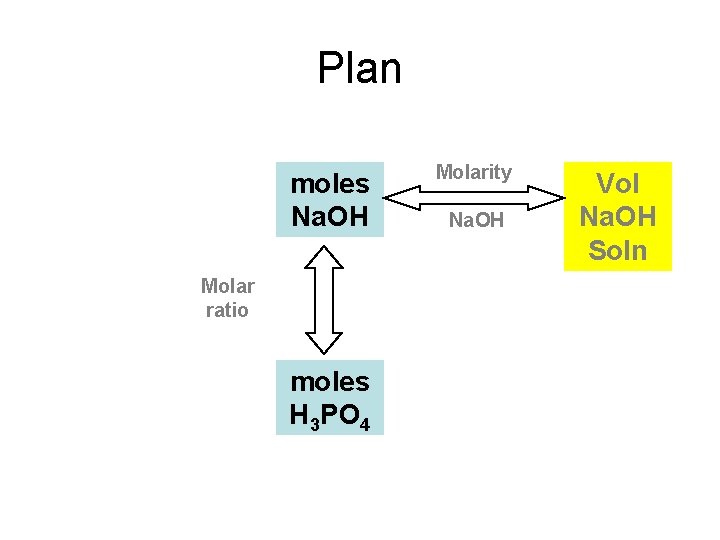
Plan moles Na. OH Molar ratio moles H 3 PO 4 Molarity Na. OH Vol Na. OH Soln
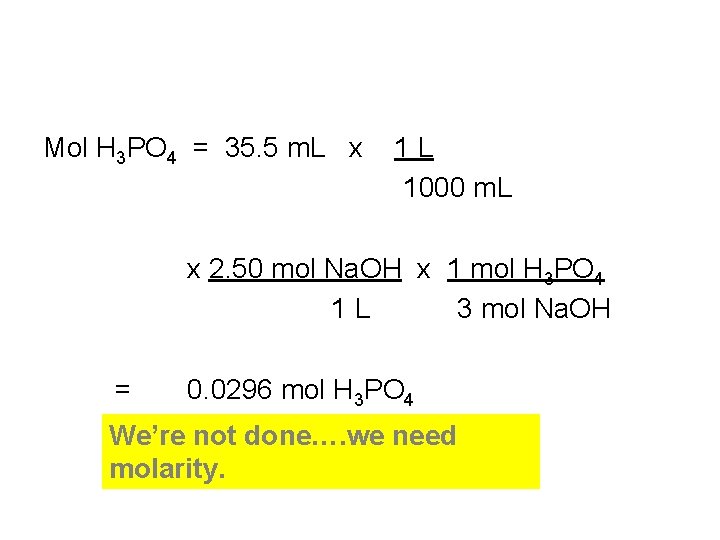
Mol H 3 PO 4 = 35. 5 m. L x 1 L 1000 m. L x 2. 50 mol Na. OH x 1 mol H 3 PO 4 1 L 3 mol Na. OH = 0. 0296 mol H 3 PO 4 We’re not done…. we need molarity.
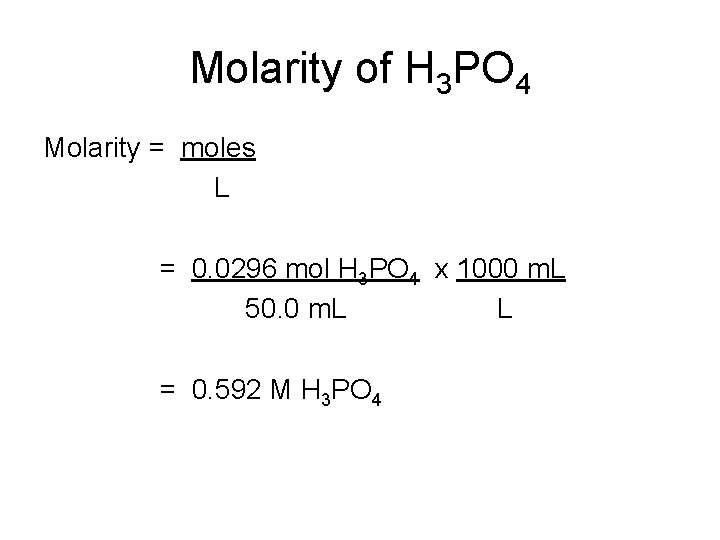
Molarity of H 3 PO 4 Molarity = moles L = 0. 0296 mol H 3 PO 4 x 1000 m. L 50. 0 m. L L = 0. 592 M H 3 PO 4
- Slides: 32