
Concentration and dilution of urine 1 Body fluid
Concentration and dilution of urine 1
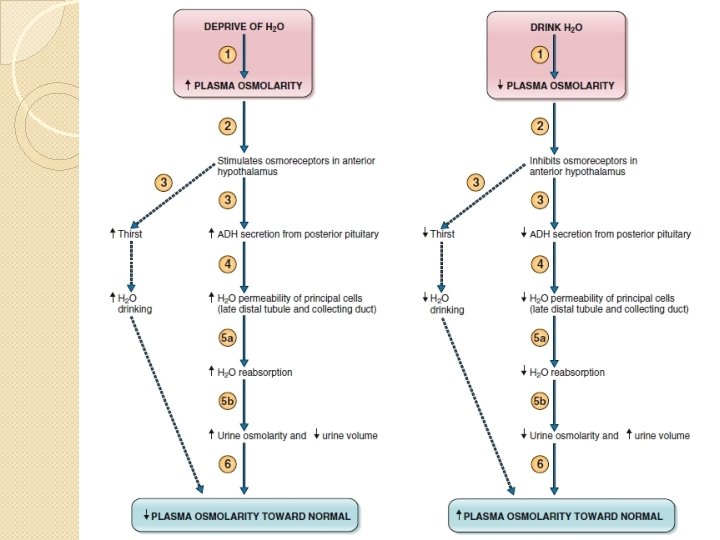
�Body fluid osmolarity is maintained at a value of about 290 m. Osm/L (for simplicity, 300 m. Osm/L) by processes called osmoregulation. �Control of water balance is exerted by hormones at the level of the late distal tubule and collecting duct. 2
Regulation of plasma osmolarity �Is accomplished by varying the amount of water excreted relative to the amount of solute excreted (i. e. , by varying urine osmolarity). 1. Response to water deprivation 2. Response to water intake 3
4
Corticopapillary osmotic gradient �It is a gradient of osmolarity in the interstitial fluid of the kidney from the cortex to the papilla. �The osmolarity of the cortex is approximately 300 m. Osm/L, similar to the osmolarity of other body fluids. Moving from the cortex to the outer medulla, inner medulla, and papilla, the interstitial fluid osmolarity progressively increases. At the tip of the papilla, the osmolarity can be as high as 1200 m. Osm/L. 5

Corticopapillary osmotic gradient in the renal medulla (values are in m. Osm) 6
Corticopapillary osmotic gradient �Corticopapillary osmotic gradient is established by: 1. countercurrent multiplication a function of the loop of Henle 2. urea recycling a function of the inner medullary collecting ducts, 7
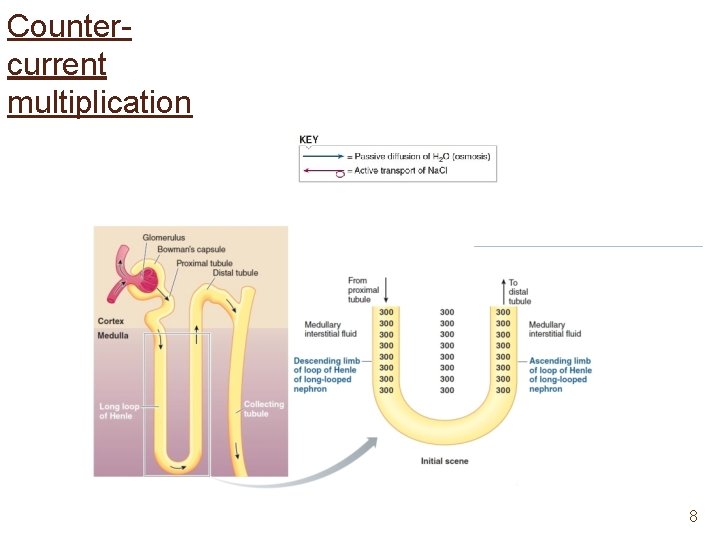
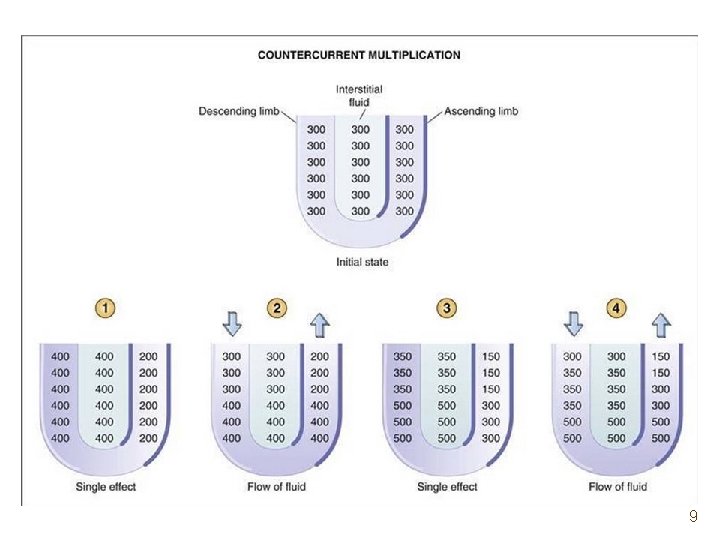
Countercurrent multiplication 8
9
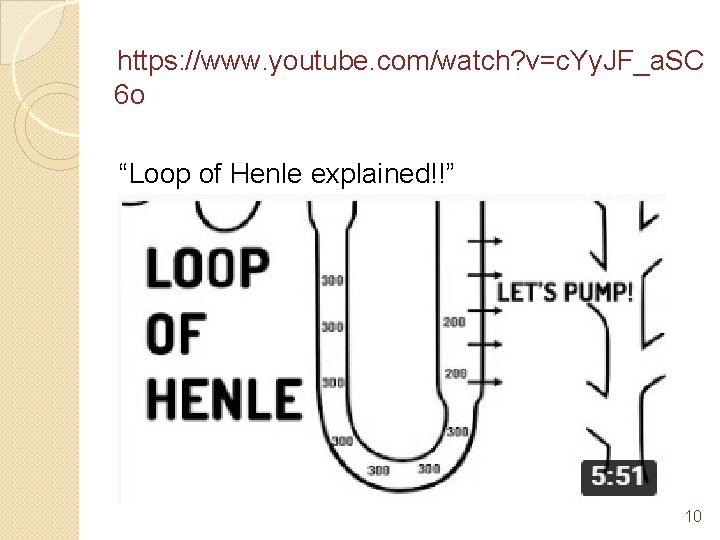
https: //www. youtube. com/watch? v=c. Yy. JF_a. SC 6 o “Loop of Henle explained!!” 10

Urea recycling 11
Vasa recta �The vasa recta are capillaries that serve the medulla and papilla of the kidney. �The vasa recta participate in countercurrent exchange. �Countercurrent exchange is a purely passive process that helps maintain the gradient. 12
Antidiuretic hormone (ADH) �ADH has three actions on the renal tubule: 1. It increases the water permeability of the principal cells of the late distal tubule and collecting ducts. 2. It increases the activity of the Na+-K+-2 Cl− cotransporter of the thick ascending limb, thereby enhancing countercurrent multiplication and the size of the corticopapillary osmotic gradient. 3. It increases urea permeability in the inner medullary collecting ducts, enhancing urea 13
�In the absence of ADH, the principal cells are impermeable to water. �In the presence of ADH, water channels, or aquaporins, are inserted in the luminal membrane of the principal cells, making them permeable to water. 14
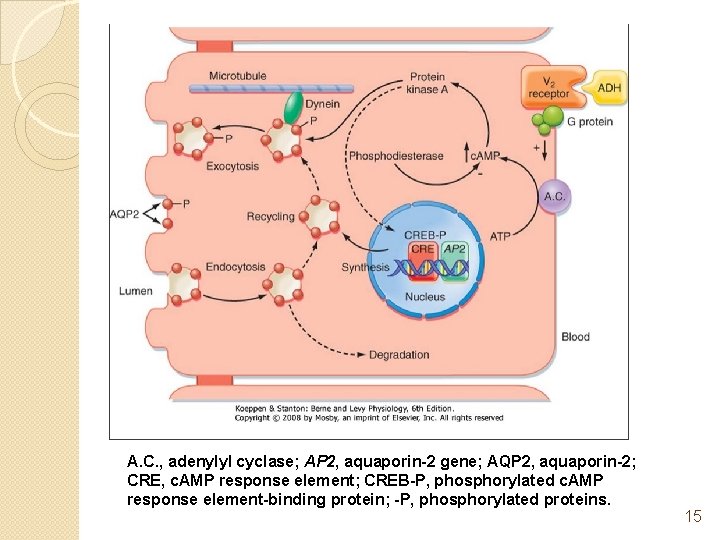
A. C. , adenylyl cyclase; AP 2, aquaporin-2 gene; AQP 2, aquaporin-2; CRE, c. AMP response element; CREB-P, phosphorylated c. AMP response element-binding protein; -P, phosphorylated proteins. 15
Production of concentrated urine �Is also called hyperosmotic urine, in which urine osmolarity > blood osmolarity. �Is produced when circulating ADH levels are high (e. g. , water deprivation, volume depletion, SIADH). 16
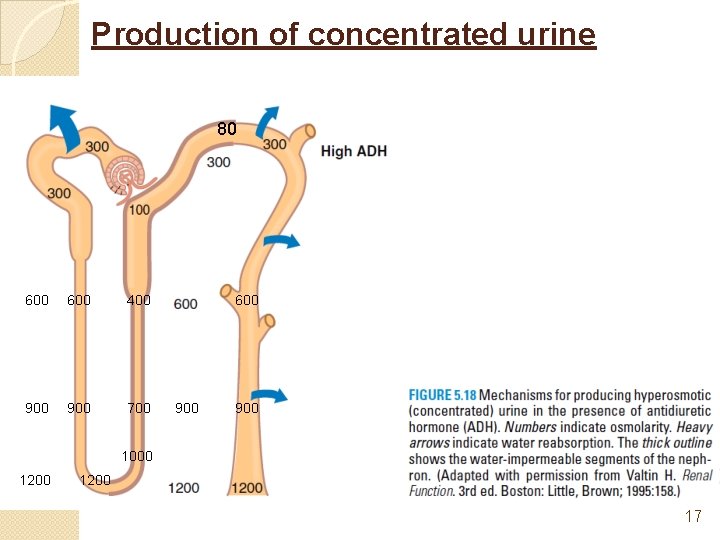
Production of concentrated urine 80 600 400 900 700 600 900 1000 1200 17
Proximal tubule – high ADH �The osmolarity of the glomerular filtrate is identical to that of plasma (300 m. Osm/L). �Two-thirds of the filtered H 2 O is reabsorbed isosmotically (with Na+, Cl-, HCO 3 -, glucose, amino acids, and so forth) in the proximal tubule. �TF/Posm = 1. 0 throughout the proximal tubule because H 2 O is reabsorbed isosmotically with solute. 18
Thick ascending limb of the loop of Henle—high ADH �Is called the diluting segment. �Reabsorbs Na. Cl by the Na+–K+– 2 Clcotransporter. �Is impermeable to H 2 O. Therefore, H 2 O is not reabsorbed with Na. Cl, and the tubular fluid becomes dilute. �The fluid that leaves the thick ascending limb has an osmolarity of 100 m. Osm/L and TF/Posm < 1. 0 as a result of the dilution process. 19
Early distal tubule - ADH �Is called the cortical diluting segment. �Like thick ascending limb, the early distal tubule reabsorbs Na. Cl but is impermeable to water. Consequently, tubular fluid is further diluted. 20
Late distal tubule – high ADH �ADH increases the H 2 O permeability of the principal cells of the late distal tubule. �H 2 O is reabsorbed from the tubule until the osmolarity of distal tubular fluid equals that of the surrounding interstitial fluid in the renal cortex (300 m. Osm/L). �TF/Posm = 1. 0 at the end of the distal tubule because osmotic equilibration occurs in the presence of ADH. 21
Collecting ducts - high ADH �As in the late distal tubule, ADH increases the H 2 O permeability of the principal cells of the collecting ducts. �As tubular fluid flows through the collecting ducts, it passes through the corticopapillary gradient (regions of increasingly higher osmolarity), which was previously established by countercurrent multiplication and urea recycling. 22
Collecting ducts - high ADH �H 2 O is reabsorbed from the collecting ducts until the osmolarity of tubular fluid equals that of the surrounding interstitial fluid. �The osmolarity of the final urine equals that at the bend of the loop of Henle and the tip of the papilla (1200 m. Osm/L). �TF/Posm > 1. 0 because osmotic equilibration occurs with the corticopapillary gradient in the presence of ADH. 23
Production of dilute urine �Is called hyposmotic urine, in which urine osmolarity < blood osmolarity. �Is produced when circulating levels of ADH are low (e. g. , water intake, central diabetes insipidus) or when ADH is ineffective (nephrogenic diabetes insipidus). 24
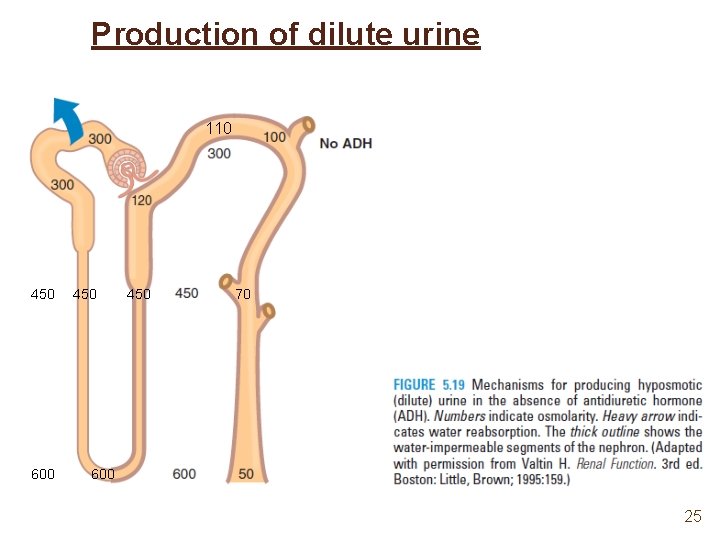
Production of dilute urine 110 450 600 450 70 600 25
1. Corticopapillary osmotic gradient - no ADH �Is smaller than in the presence of ADH because ADH stimulates both countercurrent multiplication and urea recycling. 2. Proximal tubule—no ADH �As in the presence of ADH, two-thirds of the filtered water is reabsorbed isosmotically. �TF/Posm = 1. 0 throughout the proximal tubule. 26
3. Thick ascending limb of the loop of Henle -no ADH �As in the presence of ADH, Na. Cl is reabsorbed without water, and the tubular fluid becomes dilute (although not quite as dilute as in the presence of ADH). �TF/Posm < 1. 0. 4. Early distal tubule—no ADH �As in the presence of ADH, Na. Cl is reabsorbed without H 2 O and the tubular fluid is further diluted. �TF/Posm < 1. 0. 27
Late distal tubules and collecting ducts – no ADH �In the absence of ADH, the cells of the late distal tubule and collecting ducts are impermeable to H 2 O. �Thus, even though the tubular fluid flows through the corticopapillary osmotic gradient, osmotic equilibration does not occur. �The osmolarity of the final urine will be dilute with an osmolarity as low as 50 m. Osm/L. �TF/Posm < 1. 0. 28
Free-water clearance (CH 2 O) �Is used to estimate the ability to concentrate or dilute the urine. �Free water, or solute-free water, is produced in the diluting segments of the kidney (i. e. , thick ascending limb and early distal tubule), where Na. Cl is reabsorbed and free water is left behind in the tubular fluid. 29
�In the absence of ADH, this solute-free water is excreted and CH 2 O is positive. �In the presence of ADH, this solute-free water is not excreted but is reabsorbed by the late distal tubule and collecting ducts and CH 2 O is negative. 30
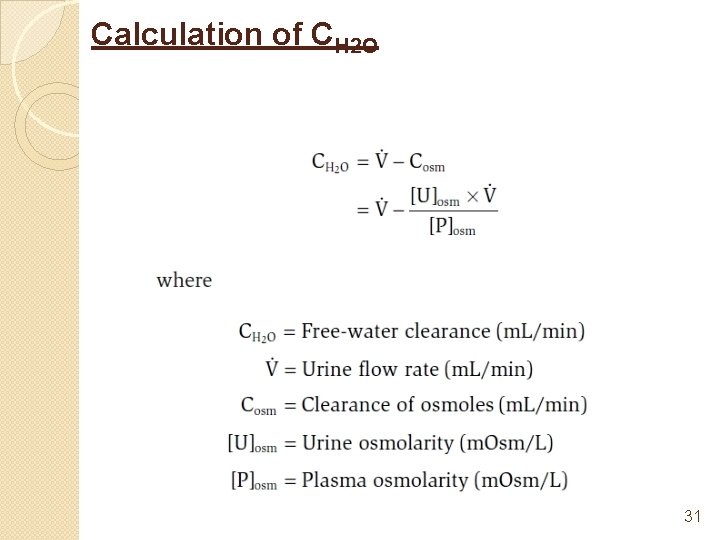
Calculation of CH 2 O 31
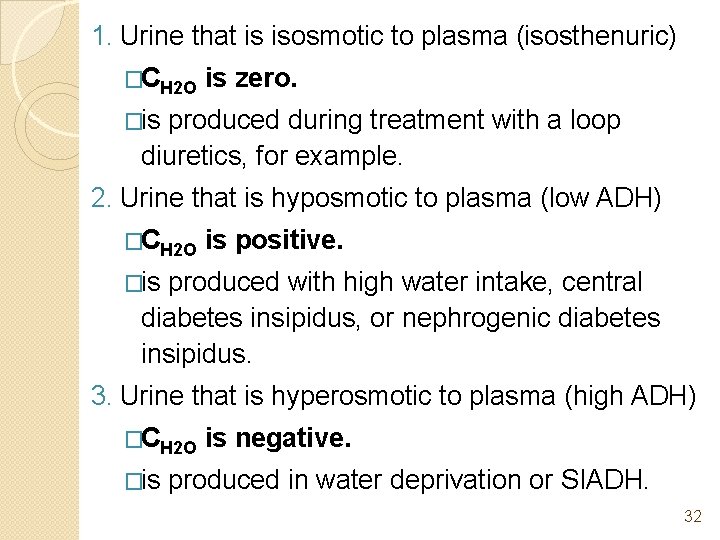
1. Urine that is isosmotic to plasma (isosthenuric) �CH 2 O is zero. �is produced during treatment with a loop diuretics, for example. 2. Urine that is hyposmotic to plasma (low ADH) �CH 2 O is positive. �is produced with high water intake, central diabetes insipidus, or nephrogenic diabetes insipidus. 3. Urine that is hyperosmotic to plasma (high ADH) �CH 2 O �is is negative. produced in water deprivation or SIADH. 32
33
34
- Slides: 34