
CONc EPT Commonwealth Neurobehavioral Project Karen W Brown
CONc. EPT Commonwealth Neurobehavioral Project Karen W. Brown, Executive Director Brain Injury Services, Inc. July 24 th, 2015
NEUROBEHAVIORAL TREATMENT: HISTORY OF SERVICE NEEDS Joint Legislative Audit Review Commission (JLARC) 2007 Among the key findings included: the limited availability of services for individuals who have neurobehavioral consequences resulting from the brain injury. • • Neurobehavioral Treatment for Virginians with Brain injury-”white paper” Ad hoc committee-May 2009/2010 (published) Response to the DARS Commissioner Three level systems of care-treatment options Cost estimates at every level of demonstration project
Purpose-CNI Trust Fund Innovative Community-Based Neurobehavioral Program Collaborative project between Crossroads for Brain Injury Recovery and Brain Injury Services Ø Designed to increase access to critical supports for persons with brain injury who exhibit neurobehavioral symptoms Ø Utilizes an Inter-professional team Ø Maximize independence and productivity in the community Ø
How We Got Here Ø Ø Ø 2012 - Brain Injury Services received a three year grant through the Potomac Health Foundation for a Community Based Neurobehavioral Program Therapist/Clinical Case Management Team Interdisciplinary Team collaboration to replicate inpatient setting Funds for Ancillary Services Benefits from participants knowing they are part of a “program”
Continued Ø Ø Ø In 2009, Crossroads to Brain Injury Recovery received a CNI Trust Fund grant Needs assessment based on providers’ perspectives on barriers to accessing services, particularly crisis intervention services for persons with brain injury Concept of Inter-professional Triage Team grew out of this grant
Collaborators Ø VA Department for Aging & Rehabilitative Services (DARS) v. Commonwealth Neurotrauma Initiative Trust Fund Ø Brain Injury Services Ø Crossroads Ø James to Brain Injury Recovery, Inc. Madison University
Need Ø Behavioral and cognitive issues are the most common debilitating consequences of brain injury Ø These issues may place persons at greater risk for: v. Disenfranchisement v. Institutionalization v. Repeat hospitalizations v. Incarceration
Key Elements Ø Ø Ø Inter-professional triage team to assess risk and make treatment recommendations Intensive case management and increased in-home supports Providing / providing for evaluations, counseling, support and other interventions & facilitating access to specialists Utilization of assistive devices / technology; telepractice Team building and education
Neurobehavioral Definition Ø Co-occurring condition(s) Ø health, mental health and/or substance abuse condition Ø Behaviors are barriers to community integration ◦ Job loss, single or multiple ◦ Loss of a primary relationship such as life partner or close family member ◦ Lack of friends or desired social life ◦ Difficulty maintaining a volunteer job ◦ Lack of or major difficulty with social skills ◦ Difficulty maintaining or creating new friendships / relationships ◦ Homeless or unstable / inappropriate housing situation
Anticipated Benefits Ø Improve access to services and resources Ø Increase quality of life for persons served Ø Address challenging behaviors that impede community integration / inclusion Ø Improve effectiveness and efficiency of service delivery
Evaluation Ø Pre- and post-intervention assessments and evaluations v Identified assessment instruments v Mayo-Portland Adaptability Inventory v Potential for risk assessment? v In-house visual analog scale for perceived satisfaction with life Ø Participant goal achievement Ø Participant surveys Ø Reduced hospitalizations, incarcerations, and placements in other institutional settings
Case Management “Plus” 2 or more of the following in addition to basic case management: ◦ Referred for additional evaluations, assessments ◦ Specialist care including counseling, SA treatment, psychiatry, neuropsychiatry ◦ Therapies (SLP, OT, PT, etc. ) ◦ Community Support Services (life skills training) ◦ Assistive technology ◦ Behavioral supports ◦ Job coaching ◦ Life planning
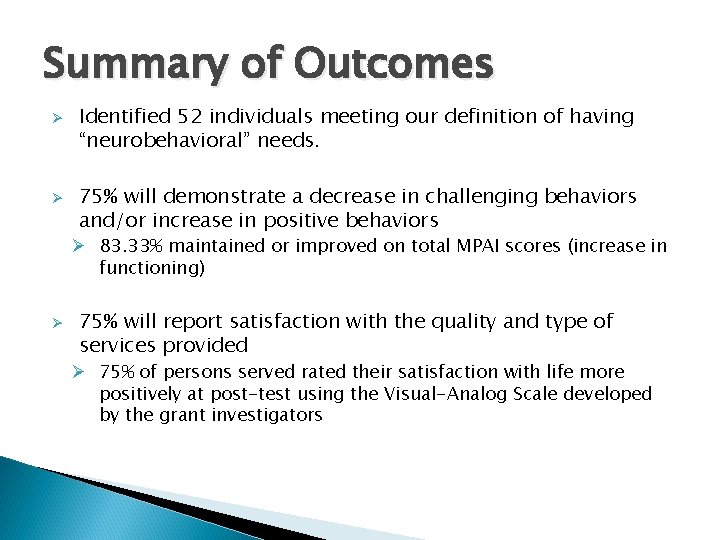
Summary of Outcomes Ø Ø Identified 52 individuals meeting our definition of having “neurobehavioral” needs. 75% will demonstrate a decrease in challenging behaviors and/or increase in positive behaviors Ø 83. 33% maintained or improved on total MPAI scores (increase in functioning) Ø 75% will report satisfaction with the quality and type of services provided Ø 75% of persons served rated their satisfaction with life more positively at post-test using the Visual-Analog Scale developed by the grant investigators
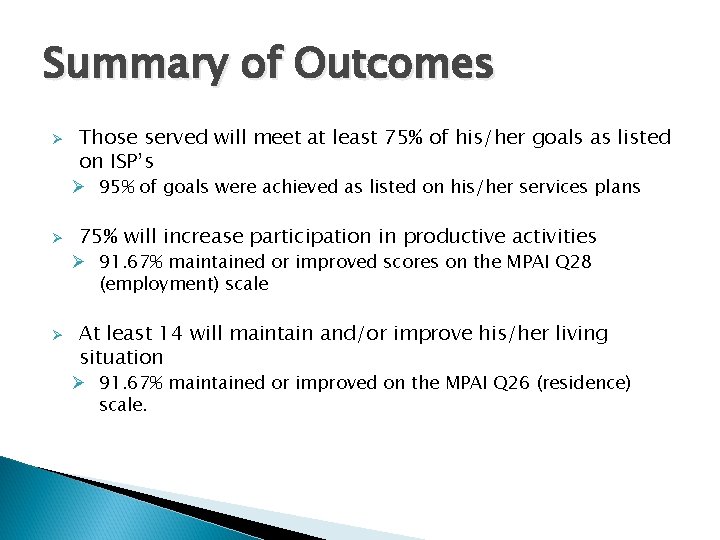
Summary of Outcomes Ø Those served will meet at least 75% of his/her goals as listed on ISP’s Ø 95% of goals were achieved as listed on his/her services plans Ø 75% will increase participation in productive activities Ø 91. 67% maintained or improved scores on the MPAI Q 28 (employment) scale Ø At least 14 will maintain and/or improve his/her living situation Ø 91. 67% maintained or improved on the MPAI Q 26 (residence) scale.
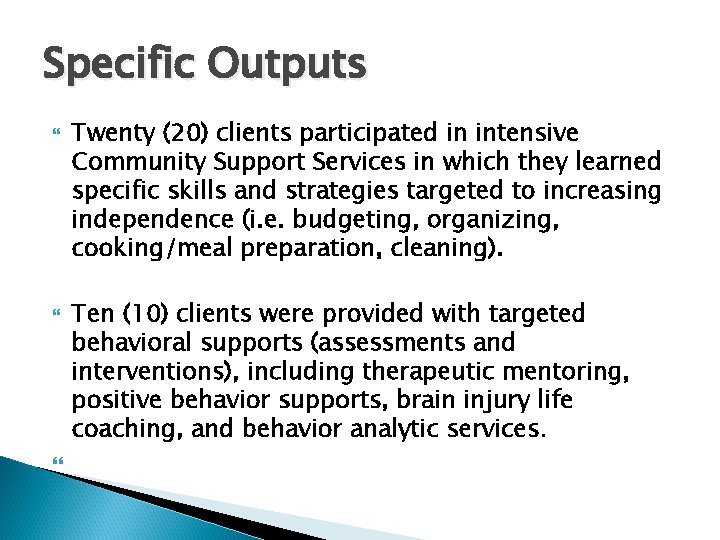
Specific Outputs Twenty (20) clients participated in intensive Community Support Services in which they learned specific skills and strategies targeted to increasing independence (i. e. budgeting, organizing, cooking/meal preparation, cleaning). Ten (10) clients were provided with targeted behavioral supports (assessments and interventions), including therapeutic mentoring, positive behavior supports, brain injury life coaching, and behavior analytic services.
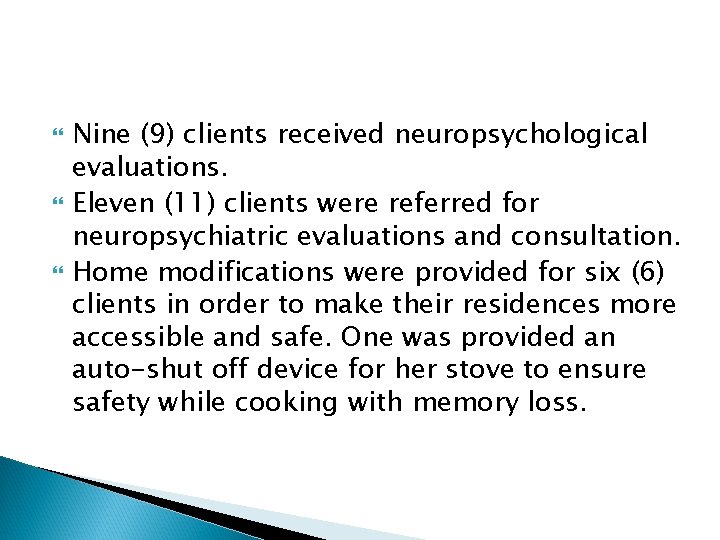
Nine (9) clients received neuropsychological evaluations. Eleven (11) clients were referred for neuropsychiatric evaluations and consultation. Home modifications were provided for six (6) clients in order to make their residences more accessible and safe. One was provided an auto-shut off device for her stove to ensure safety while cooking with memory loss.
Special supports continued Eight (8) clients were provided assistive devices (i. Pad, laptops, AAC devices) in order to improve communication and organization. Fourteen (14) clients were referred for other general medical/specialist evaluations including obtaining a primary care physician, speechlanguage therapy, pain management, and dental services. 1 client received funds to complete several dog obedience classes to begin therapy dog training and volunteer for BIS.
Specific Outputs continued 4 clients received supports to obtain or maintain housing Other services / supports provided include home organizing supplies, calendars, gas cards, transportation vouchers, eye glasses, gym / wellness program memberships, clothing, pottery class/art therapy, citizenship fee, educational supports, and groceries.
Case Study – Dina Ø 26 year old female- from India Ø Injury from being pushed down stairs at 2 years old. Sustained a severe traumatic brain injury resulting in intellectual disabilities. Ø Received comprehensive neuropsychological evaluation, mental health therapy, nutrition counseling for thyroid problems, positive behavioral supports and vocational support. Outcome: gainfully employed, living in community
- Slides: 19