
Con Edison Sustainability Programs Done By Harry Charalambides
Con Edison: Sustainability Programs Done By: Harry Charalambides Environmental Economics 2505 Professor Sean Mac. Donald
A Brief History Of Con Edison: • Consolidated Edison Inc. is the full company name. • It is one of the largest investor owned energy companies in the U. S. . • Approximately $13 billion in revenue and over $36 billion in assets (2014). • It started out as New York Gas Light Company in 1823. • In 1824 it was listed on the New York Stock Exchange.
A Brief History of Con Edison (Cont. ): • In 1884 six gas companies combined into the Consolidated Gas Company. • In 1936 its electric sales were much bigger than its gas sales so they changed the name to Consolidated Edison Company of New York Inc. . • Finally in January 1 st of 1998, following the deregulation of the utility industry in New York State, Consolidated Edison Inc. was formed.
Some Interesting Facts: • Con Edison operates the largest commercial steam system in the world, providing steam service to nearly 1, 600 commercial and residential establishments in Manhattan from Battery Park to 96 th street. • The underground cable in the electric system it uses (93, 000 miles) can wrap around the earth 3. 6 times! • The overhead electric cables the company installs is enough to stretch from New York to LA 13 times, its length is about 36, 000 miles! • The Con Edison gas system has nearly 7, 200 miles of pipes, if laid end to end it can reach Paris and come back again! • Con Edison produces 30 billion pounds of steam each year through its seven power plants which boil water to 1000 degrees Fahrenheit and pumps it into the New York City steam system the largest district steam system in the world. • In March 2002, Fortune magazine named the company as one of “America’s Most Admired Companies”.
Con Edison’s Sustainability Strategy: • The company’s sustainability strategy is focused on two concepts regarding the environmental stewardship: mitigation and adaptation. From the mitigation standpoint the company strives to reduce its environmental footprint making wise and effective use of natural resources. From the adaptation standpoint, the company realizes that it must adapt to the climate change taking place and its impact on the business. The company has identified five Key Sustainability Aspects related to the company’s environmental performance.
The Five Key Sustainability Aspects: • Air: Reduce direct and indirect emissions to improve air quality. • Water: Enhance the efficiency of our water used and seek opportunities to improve water quality. • Habitat and Biodiversity: Manage the company’s environmental legacy and minimize the company’s impact to natural ecosystems. • Resource Conservation: Focus on reducing, reusing, and to minimize consumption. • Climate Change: Design the company’s work in consideration of climate forecasts.
Has Con Edison made an effect on our environment using these five key aspects? Air: • Direct Emissions – The company has reduced its greenhouse gas emissions (GHG) by 47% from 2005. In 2014 the GHG gases were 7% lower than in 2013. Carbon Dioxide emissions were reduced by 150, 000 tons from 2013. The company reduced the CO 2 emissions by using biodiesel fuel, hybrid and other alternative fuel in its vehicle fleet. • Indirect Emissions (Consumer emissions) – In the Customer Energy Efficiency program the company tells customers how to save energy and be more efficient. The company has also set up a Conversion Program to make a switch from oil to natural gas. In the Customer Distribution Generation section the customers can find renewable generation installations such as PV solar to reduce their emissions.
Air: • Con Edison promotes renewable energy development through its Con Edison Solutions subsidiary. Residential customers in New York may purchase a mix of 65% low impact hydropower and 35% wind energy through a product called Green Power, or even purchase 100% wind power to meet their electricity requirements. • In 2014, Con Edison Solutions has enrolled over 1, 500 new customers into various renewable products for a total of 19, 000 customers and sales of more than 234, 000 MWh.
Water: • Con Edison is the second largest consumer of municipal water in New York. The company consumed 3. 6 billion gallons of water which was used to generate steam and for heating and cooling customers. And 100 million gallons for basic water and sewage services at the company’s facilities. • The water that is used for cooling at the steam generation plants is withdrawn from the Hudson and East River but is returned directly to the river at quality levels specified in the SPDES (State Pollutant Discharge Elimination System) permit program such that the water’s quality is not impacted at all and there is conservation.
Habitat and Biodiversity: • Con Edison’s Land Vegetation Management Program was developed to encourage biological diversity and is achieved through three primary objectives: 1. Selective management of vegetation to provide a diversified habitat as a means to enhance and maintain a diversified mix of wildlife. 2. Disposal of wood waste on-site in a manner that provides cover and protection for a variety of birds, mammals and reptiles. 3. Protection of site conditions and plants to encourage reproduction and spreading of desirable grasses, forbs, and shrubs.
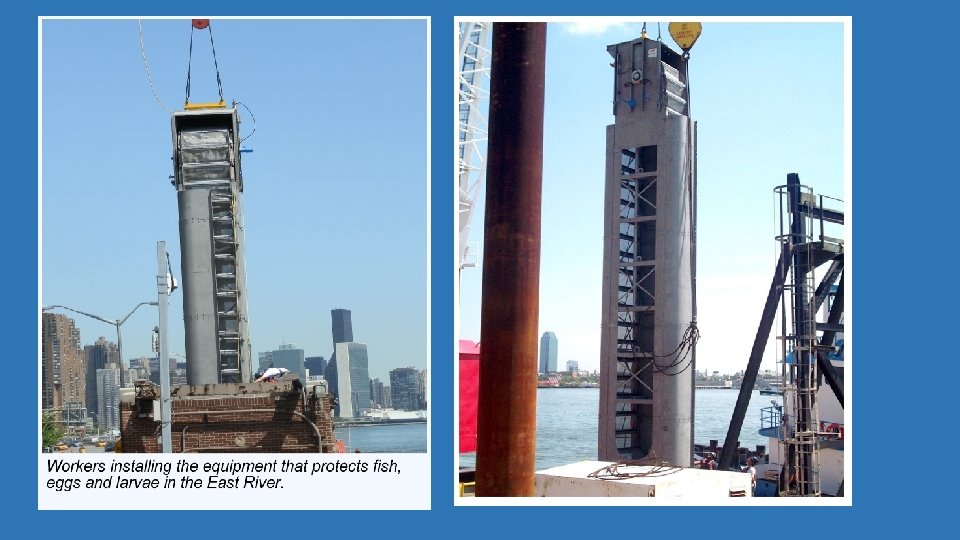
Habitat and Biodiversity: • In 2013, five fine mesh screens were installed to filter fish, eggs, and larvae from the intake of the East River Generating Station. This measure, plus the installation of a dedicated fish-return system helped to reduce the impact of the plant on the river. • The fish-return system uses a low-pressure spray wash to gently remove any aquatic organisms trapped on new fine mesh screens and delicately return them to the river.
Resource Conservation: • Con Edison’s goal is to manage materials at the beginning of their life cycle, to reduce waste down the line. To do this the company steers its focus from waste segregation to a broader understanding of resource conservation and materials management. • The company focuses on refurbishing and repairing all its equipment in its own workshop and before disposing any of it, the parts that are recyclable are done so. • Orange and Rockland Subsidiaries of Con Edison have set up a recycling program to help break down any equipment and resell them, and in the process employ workers from Rockland County who have intellectual and developmental disabilities. • Rockland has since 1991 recycled more than three million pounds of paper, million pounds of cardboard, over a million pounds of steel and aluminum wire and a half a million of assorted metals. They have saved over a million cubic feet of landfill space in the process.
Climate Change: • Con Edison designs its work in consideration of climate forecasts. The company believes that in order address climate change their must be an involvement of all sectors of the economy and all sources of greenhouse gases. Con Edison has identified seven climate change principles: 1. Work with federal, state, and local governments and other stakeholders to address climate change. 2. Maintain an inventory of the company’s direct and indirect GHG emissions. 3. Consider the potential impact of business decisions on GHG emissions. 4. Pursue improvements in energy efficiency in the company’s operations to reduce GHG emissions. 5. Advocate, promote and support energy improvements among the company’s customers. 6. Support new technology development in coordination with other key stakeholders. 7. Support development of renewable sources of energy and other generation that reduces emissions, including GHG emissions.
Notable Contributions to Customers and Partners: Rebates for replacing old HVAC systems Free smart thermostats Appliance recycling Financial incentives to upgrade HVAC systems for small businesses In the last four years Con Edison has managed to increase its Photovoltaic Panel consumers to about 3, 100 who produce most of their electricity in their households from solar power. • The company has helped consumers to buy around 5, 800 electric vehicles in the past 3 years. • The company has helped Columbia University save $700, 000 a year through the upgrade of the school’s water chilling system in cooperation with the Con Edison Green Team. Through the Department of Energy they managed to get the funds for this project. • At the Brooklyn Army Terminal in Sunset Park they have created a smart grid demonstration project where through the integration of three components, a solar photovoltaic array panel, a building management system and an on-site battery for energy storage they managed to provide electricity about 100 k. W for 4 hours to the whole area. • • •
References: • Con Edison of New York. (2016). Retrieved April 02, 2016, from http: //www. coned. com/ • Strategy. (2016). Retrieved April 02, 2016, from http: //www. conedison. com/ehs/2014 -sustainability-report/leadership-and -strategy/ • Elstein, A. (2014, April 21). As the economy heats up, Con Ed goes green. Retrieved April 02, 2016, from http: //www. crainsnewyork. com/article/20140421/FINANCE/140419838/as -the-economy-heats-up-con-ed-goes-green • Urban Innovation & Sustainability. (2015, August 28). Retrieved May 22, 2016, from http: //www. nycedc. com/industry/urban-innovationsustainability • Consolidated Edison. (2016, April 28). Retrieved May 22, 2016, from https: //en. wikipedia. org/wiki/Consolidated_Edison
- Slides: 16