
COMSOL Simulation of the Free Electrons in a
- Slides: 8
COMSOL Simulation of the Free Electrons in a Surface Flashover Xiaoli Guo Me. VArc 2019 Delft University of Technology Challenge the future
The background theory 1. Parameters in a flashover. Many parameters can influence the flashover voltage of insulators in vacuum, such as: • Material • Geometry • Surface finish • Attachments to electrodes • For AC HV ‒ the applied voltage waveform ‒ duration ‒ single pulse or repetitive • The process history • Operating environment • Previous applications of voltage This simulation is only about the geometry of the insulators. (H. Craig Miller, 2015) 2
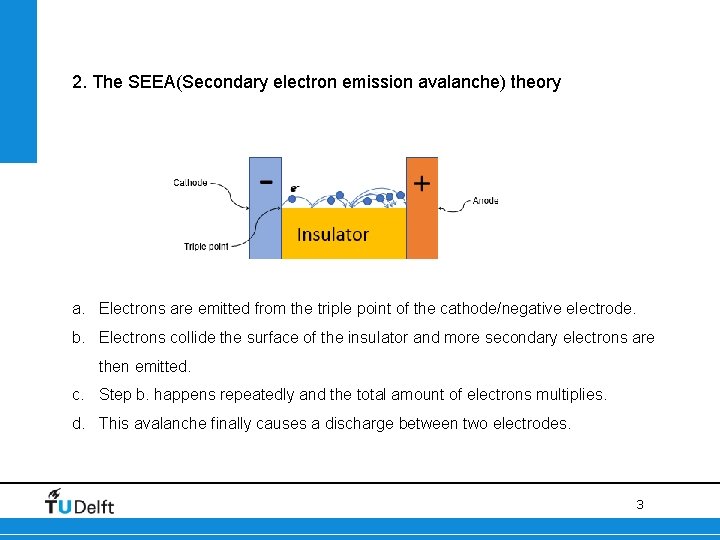
2. The SEEA(Secondary electron emission avalanche) theory a. Electrons are emitted from the triple point of the cathode/negative electrode. b. Electrons collide the surface of the insulator and more secondary electrons are then emitted. c. Step b. happens repeatedly and the total amount of electrons multiplies. d. This avalanche finally causes a discharge between two electrodes. 3
The flashover simulation in COMSOL 3. The basics of the simulation(1) • Software • COMSOL Multiphysics 5. 4 • Modules of COMSOL used • ACDC • Charged particle tracing • Judging criteria • The Multiplication factor of electrons from the cathode to the anode(negative wafer to the positive wafer). 4
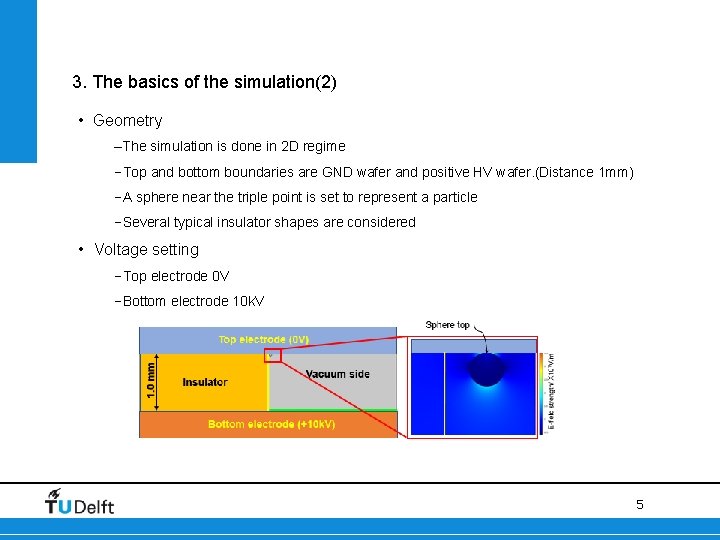
3. The basics of the simulation(2) • Geometry ‒The simulation is done in 2 D regime −Top and bottom boundaries are GND wafer and positive HV wafer. (Distance 1 mm) −A sphere near the triple point is set to represent a particle −Several typical insulator shapes are considered • Voltage setting −Top electrode 0 V −Bottom electrode 10 k. V 5
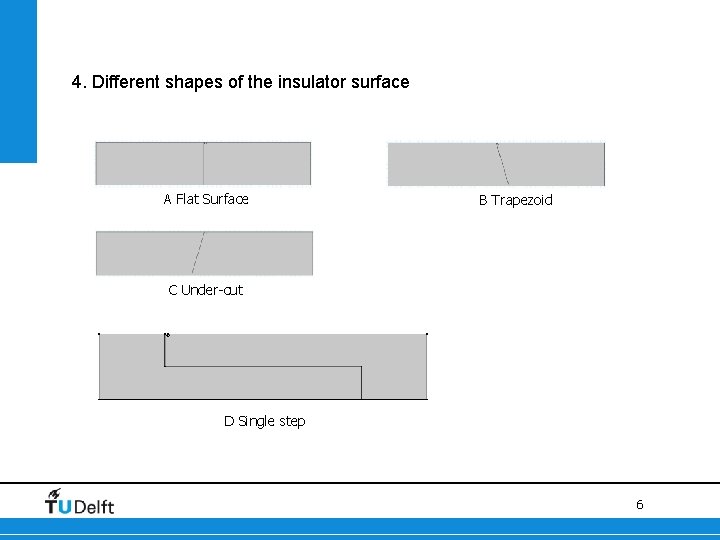
4. Different shapes of the insulator surface A Flat Surface B Trapezoid C Under-cut D Single step 6
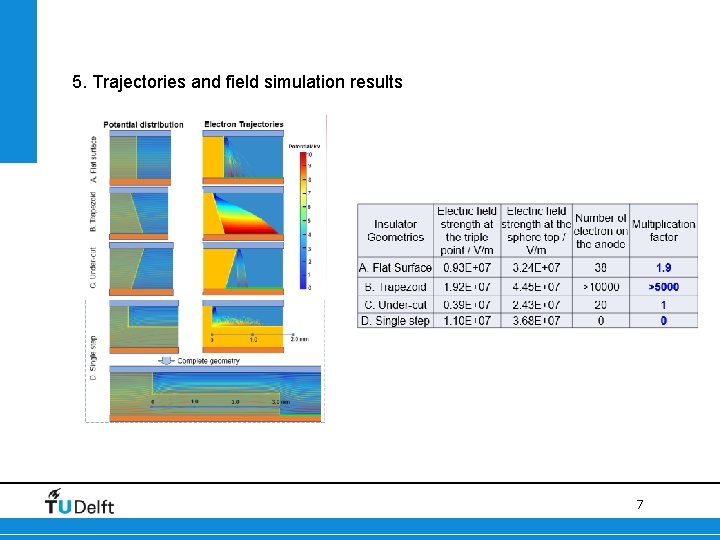
5. Trajectories and field simulation results 7
6. Conclusions • Different geometries of insulator surface have significant influence on the SEEA of a surface flash over. • A dielectric particle can enhance the electric field by at least 2 times in the simulation. • The single step insulator with proper width is easy to manufacture and can block the SE emission avalanche. • The insulator with trapezoid surface in case B, has very high chance to trigger an secondary electron emission avalanche. 8