
computing with assemblies Christos H Papadimitriou Columbia U
computing with assemblies Christos H. Papadimitriou Columbia U

How does one think computationally about the Brain?
![Good[the. Question! way the brain works] a computational theory may be characterized by less](http://slidetodoc.com/presentation_image_h/05ea42ce1a17debf61c479658bfeeb53/image-3.jpg "Good[the. Question! way the brain works] a computational theory may be characterized by less")
Good[the. Question! way the brain works] a computational theory may be characterized by less of the Brain is both logical and arithmetical depth possible and essential than we are normally used to
What are some examples of productive computational models and paradigms in the study of the Brain?
• The Mc. Culloch-Pitts neuron and the feedforward neural network • The recurrent neural network and in particular Hopfield memory and Boltzmann machine • Neural coding in the sensory cortex, and in particular sparse dictionary coding • Valiant’s neuroidal model and theory of memory • Reinforcement learning • Spiking neurons
This talk: computing with assemblies
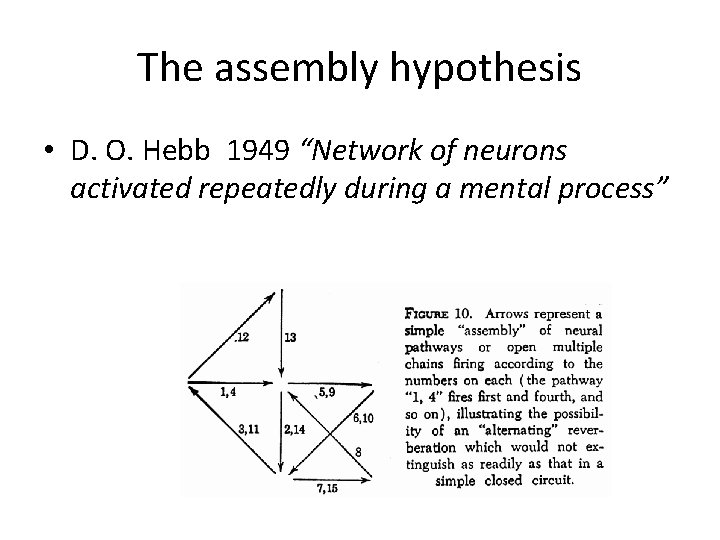
The assembly hypothesis • D. O. Hebb 1949 “Network of neurons activated repeatedly during a mental process”
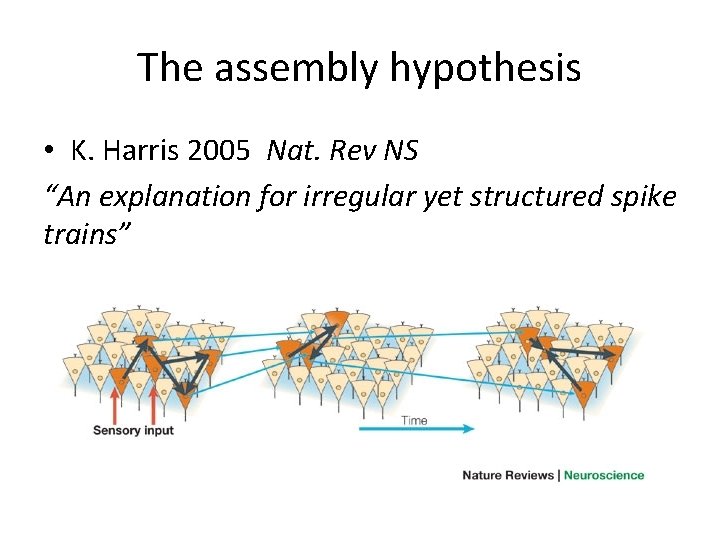
The assembly hypothesis • K. Harris 2005 Nat. Rev NS “An explanation for irregular yet structured spike trains”
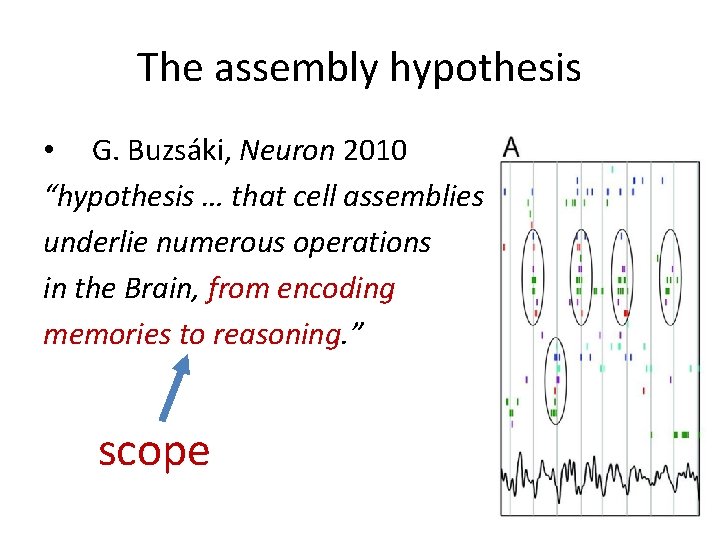
The assembly hypothesis • G. Buzsáki, Neuron 2010 “hypothesis … that cell assemblies underlie numerous operations in the Brain, from encoding memories to reasoning. ” scope
The assembly hypothesis (computational version) There is an intermediate level of Brain computation that can be best understood in terms of the synchronized firing of persistent, large, and heavily interconnected populations of neurons, and may be implicated in long -term memory and certain higher cognitive functions
Outline • • Assembly operations: project and associate More assembly operations The Assembly Programming Language Assemblies for language

Santosh Vempala Georgia Tech Wolfgang Maass TU Graz Mike Collins Columbia U Robert Legenstein TU Graz
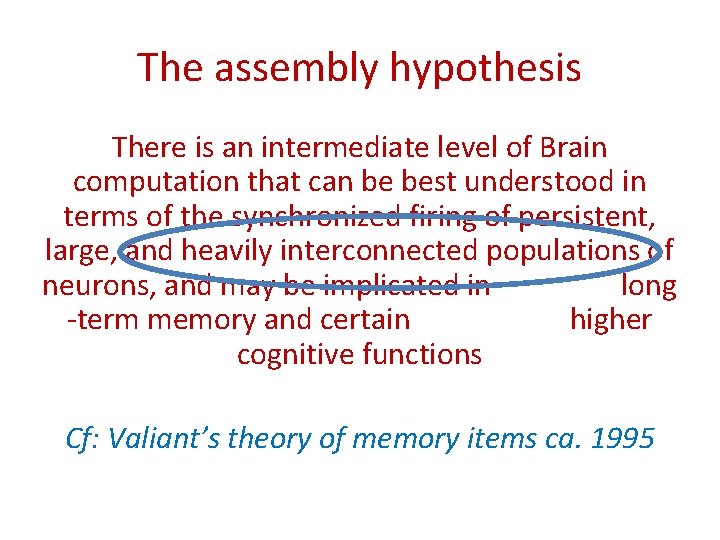
The assembly hypothesis There is an intermediate level of Brain computation that can be best understood in terms of the synchronized firing of persistent, large, and heavily interconnected populations of neurons, and may be implicated in long -term memory and certain higher cognitive functions Cf: Valiant’s theory of memory items ca. 1995
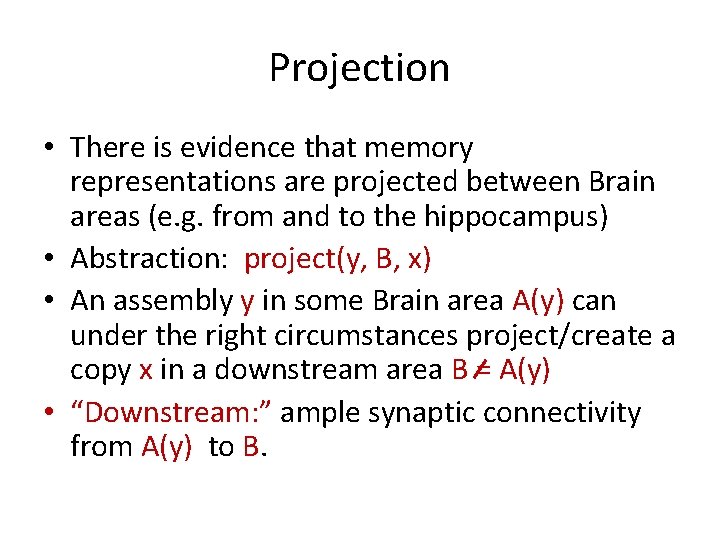
Projection • There is evidence that memory representations are projected between Brain areas (e. g. from and to the hippocampus) • Abstraction: project(y, B, x) • An assembly y in some Brain area A(y) can under the right circumstances project/create a copy x in a downstream area B = A(y) • “Downstream: ” ample synaptic connectivity from A(y) to B.
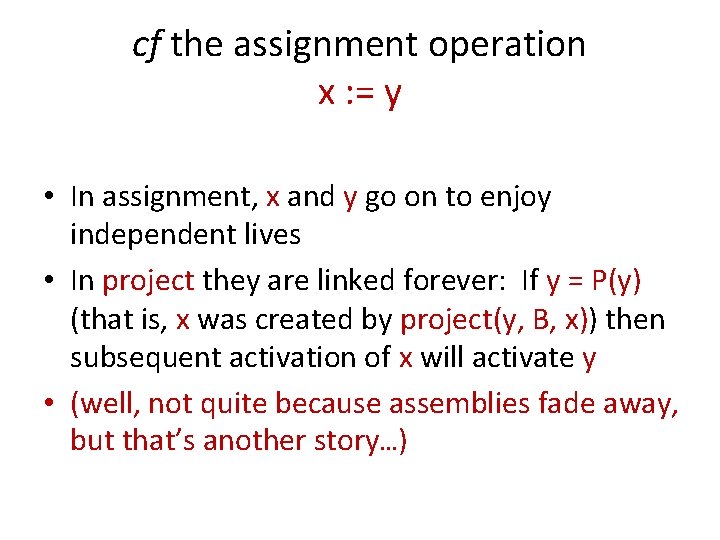
cf the assignment operation x : = y • In assignment, x and y go on to enjoy independent lives • In project they are linked forever: If y = P(y) (that is, x was created by project(y, B, x)) then subsequent activation of x will activate y • (well, not quite because assemblies fade away, but that’s another story…)
Implementation? • As befits a programming language, all operations should be translatable down to the level of neuron and synapses • So, how is projection implemented?
A computational challenge • In a sparse random network, how can you select a densely connected subnetwork? Intractable!
![Projection: [al. et Axel, 2011] on mouse olfaction 2](http://slidetodoc.com/presentation_image_h/05ea42ce1a17debf61c479658bfeeb53/image-18.jpg "Projection: [al. et Axel, 2011] on mouse olfaction 2")
Projection: [al. et Axel, 2011] on mouse olfaction 2
![From the Discussion section of [al. et Axel] An odorant may [cause] a small](http://slidetodoc.com/presentation_image_h/05ea42ce1a17debf61c479658bfeeb53/image-19.jpg "From the Discussion section of [al. et Axel] An odorant may [cause] a small")
From the Discussion section of [al. et Axel] An odorant may [cause] a small subset of … neurons [in the PC to fire]. This small fraction of. . . cells would then generate sufficient recurrent excitation to recruit a larger population of neurons. Inhibition triggered by this activity will prevent further firing In the extreme, some cells could receive enough recurrent input to fire … without receiving [initial] input…
![Implementation of projection: results • Simulations [Legenstein et al. 2016, Pokorny et al. 2018]](http://slidetodoc.com/presentation_image_h/05ea42ce1a17debf61c479658bfeeb53/image-20.jpg "Implementation of projection: results • Simulations [Legenstein et al. 2016, Pokorny et al. 2018]")
Implementation of projection: results • Simulations [Legenstein et al. 2016, Pokorny et al. 2018] • Simplified graph-theoretic model [Maass et al. 2017]
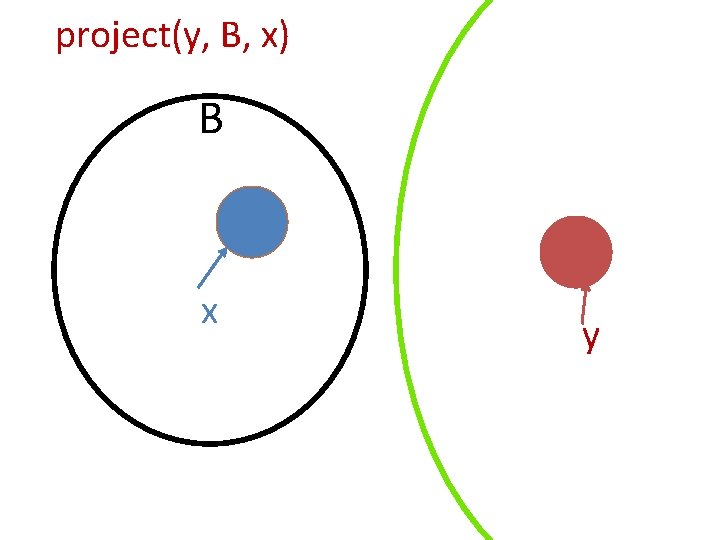
project(y, B, x) B x y
Simplified Model • Two large sets of excitatory neurons: A(y) and B • Synapses A(y) B and B B form random Gn, p directed graphs (probability that i j = p independently)* • Discrete time • The neurons in y fire for a small number of steps T • At each time t, the set At of K neurons in B that have the largest synaptic input (from A(y) or B) will fire* • Hebbian Plasticity: If at time t cell i fires, and at time t + 1 cell j fires, the weight of synapse (i, j) increases by β
![Mathematical Model: Results Theorem: The precise narrative of [al. et Axel 2011] obtains with](http://slidetodoc.com/presentation_image_h/05ea42ce1a17debf61c479658bfeeb53/image-23.jpg "Mathematical Model: Results Theorem: The precise narrative of [al. et Axel 2011] obtains with")
Mathematical Model: Results Theorem: The precise narrative of [al. et Axel 2011] obtains with high probability NB: Cute approximation algorithm for the densest subgraph problem…
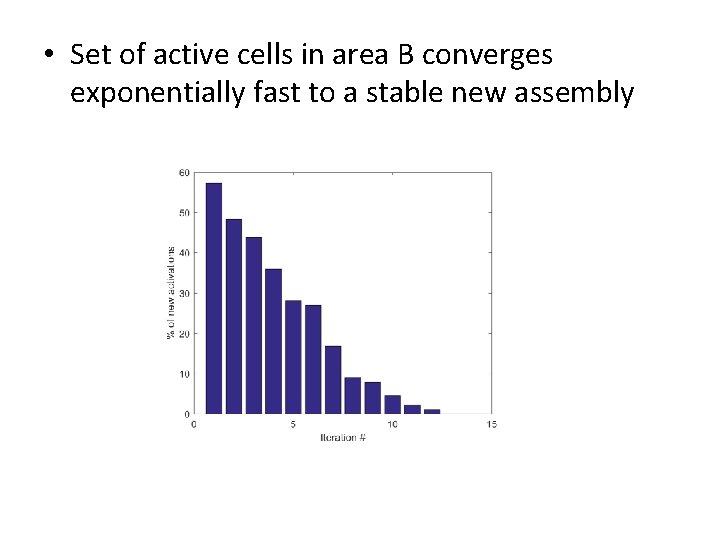
• Set of active cells in area B converges exponentially fast to a stable new assembly
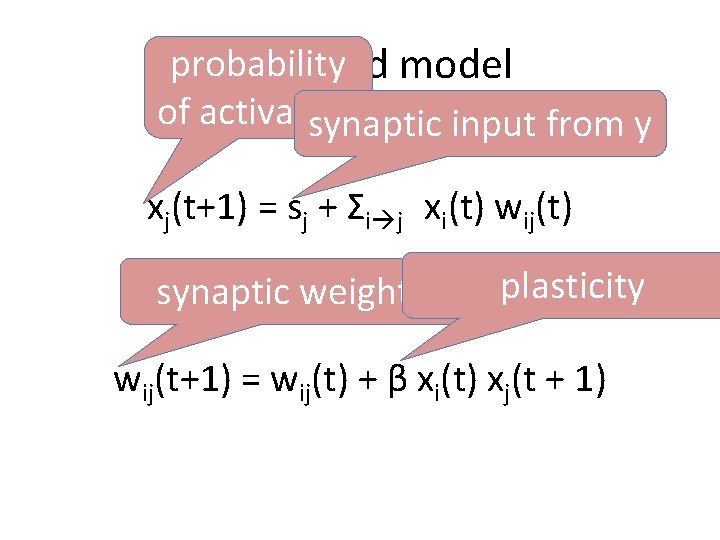
probability Linearized model of activation synaptic input from y xj(t+1) = sj + Σi j xi(t) wij(t) synaptic weights plasticity wij(t+1) = wij(t) + β xi(t) xj(t + 1)
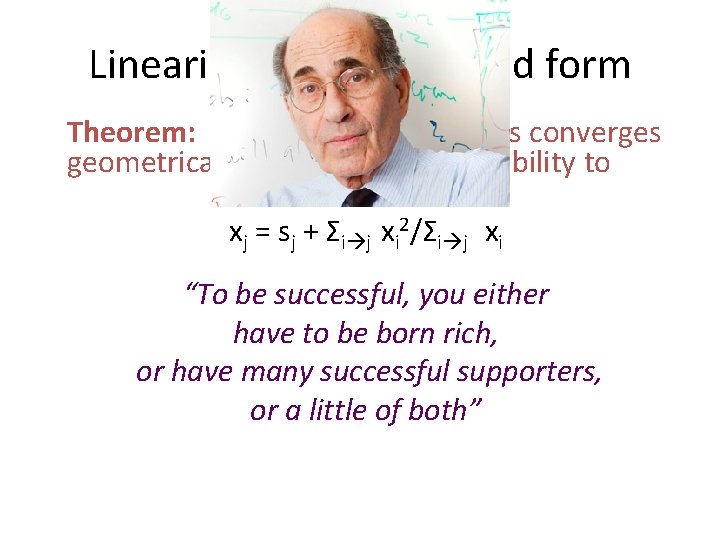
Linearized model: Closed form Theorem: The linearized dynamics converges geometrically and with high probability to xj = sj + Σi j xi 2/Σi j xi “To be successful, you either have to be born rich, or have many successful supporters, or a little of both”
chicken and egg. . . • Q: Btw, how are assemblies created? • A: One-shot learning: Projection from a “proto-assembly” putatively from a high sensory area such as IT or the olfactory bulb, to the hippocampus or the piriform cortex
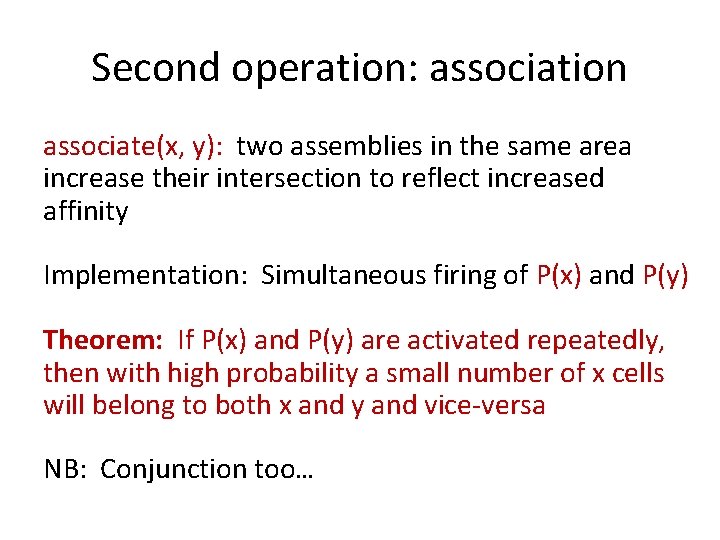
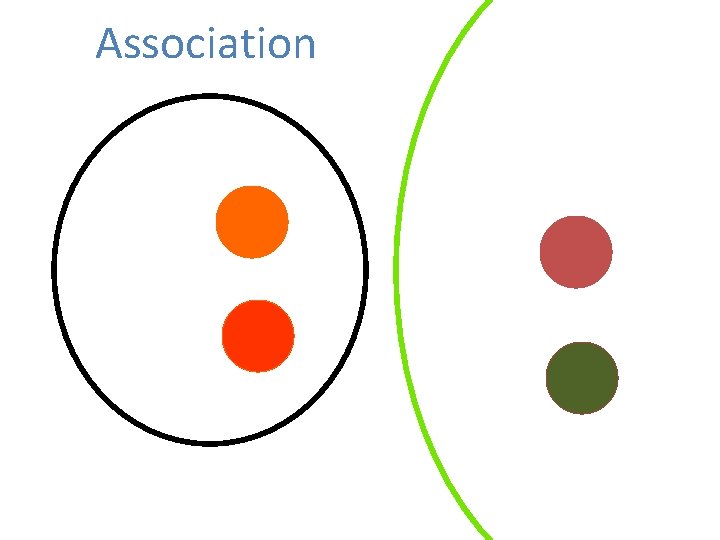
Second operation: association associate(x, y): two assemblies in the same area increase their intersection to reflect increased affinity Implementation: Simultaneous firing of P(x) and P(y) Theorem: If P(x) and P(y) are activated repeatedly, then with high probability a small number of x cells will belong to both x and y and vice-versa NB: Conjunction too…
Association
NB: The operational semantics of association • Association is not idempotent: more applications increase the intersection… • If x and y are associated, the activation of x will result, with some probability, to the activation of y
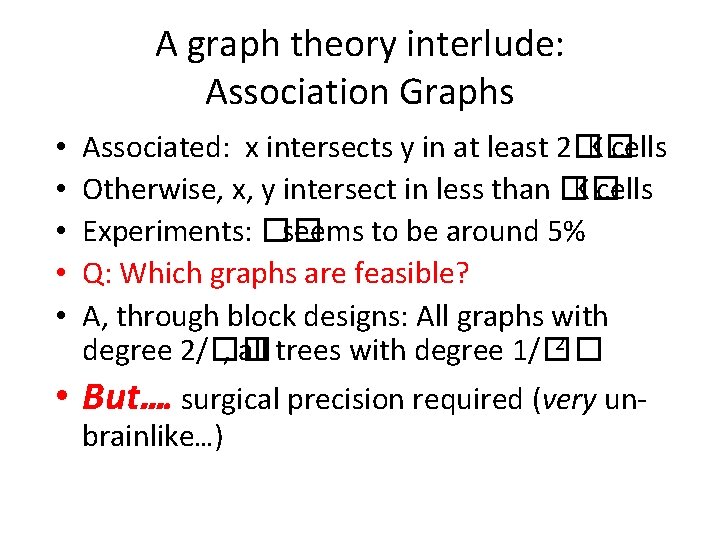
A graph theory interlude: Association Graphs • • • Associated: x intersects y in at least 2�� K cells Otherwise, x, y intersect in less than �� K cells Experiments: �� seems to be around 5% Q: Which graphs are feasible? A, through block designs: All graphs with 2 degree 2/�� , all trees with degree 1/�� • But…. surgical precision required (very unbrainlike…)
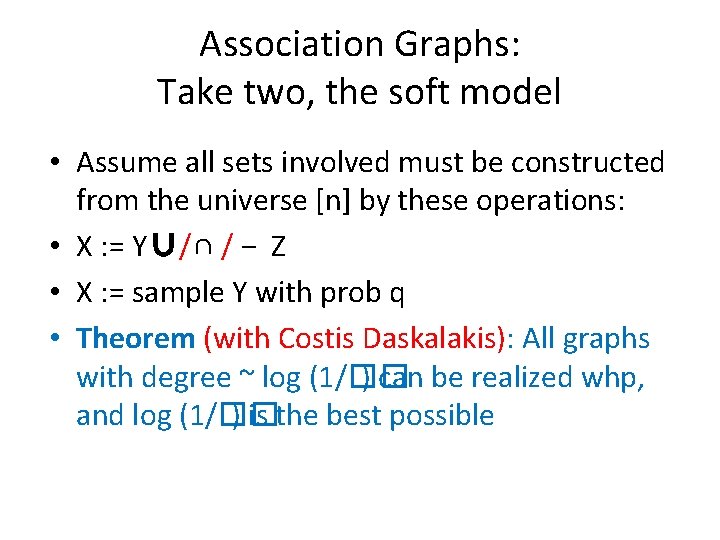
Association Graphs: Take two, the soft model • Assume all sets involved must be constructed from the universe [n] by these operations: • X : = Y∪/∩ / − Z • X : = sample Y with prob q • Theorem (with Costis Daskalakis): All graphs with degree ~ log (1/�� ) can be realized whp, and log (1/�� ) is the best possible
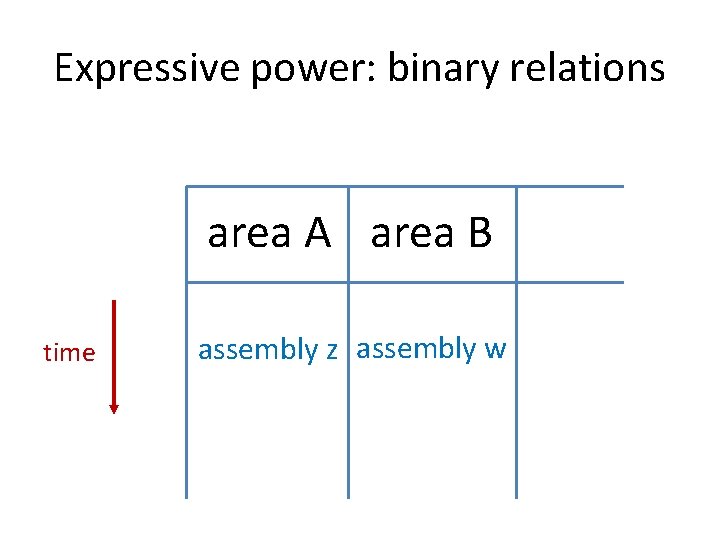
Expressive power: binary relations area A area B time assembly z assembly w
More operations? • Projection and Association are both supported by experimental evidence • Speculate about other operations: criteria • Useful (if real, they help explain phenomena) • Plausible (can be compiled down to neurons and synapses)
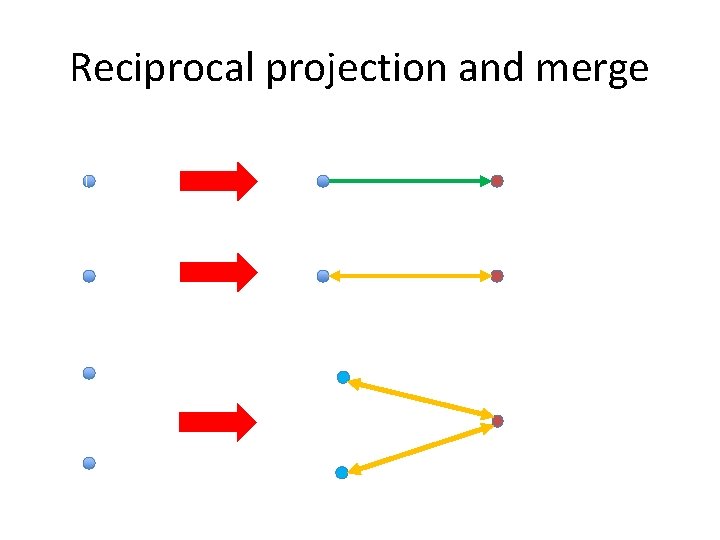
Reciprocal projection and merge
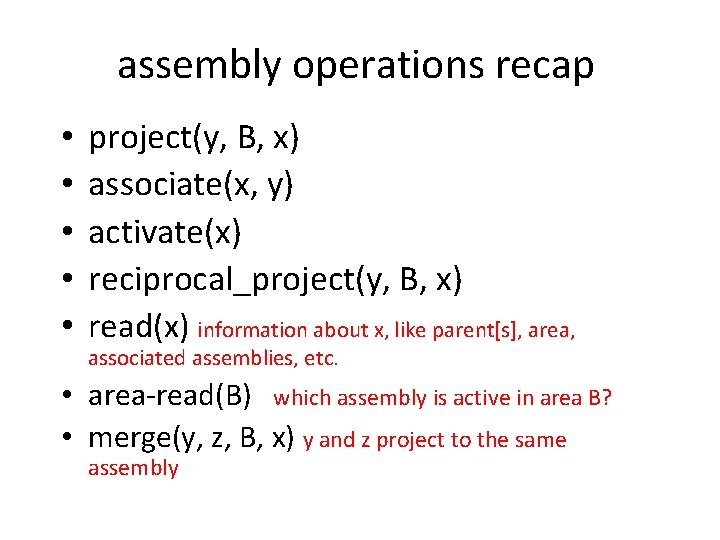
assembly operations recap • • • project(y, B, x) associate(x, y) activate(x) reciprocal_project(y, B, x) read(x) information about x, like parent[s], area, associated assemblies, etc. • area-read(B) which assembly is active in area B? • merge(y, z, B, x) y and z project to the same assembly
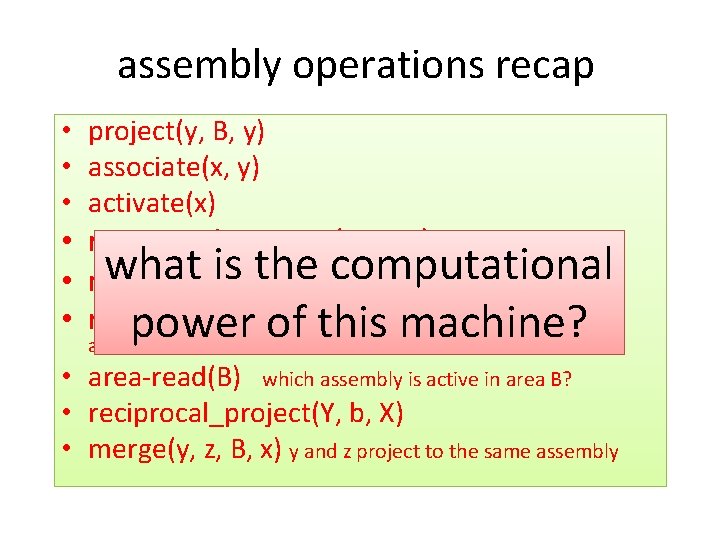
assembly operations recap • project(y, B, y) • associate(x, y) • activate(x) • reciprocal_project(y, B, x) what is • merge(y, z, B, the x) computational • read[x] information x, like machine? parents, associated power ofabout this assemblies, etc. • area-read(B) which assembly is active in area B? • reciprocal_project(Y, b, X) • merge(y, z, B, x) y and z project to the same assembly
Which brings us to: Language • An environment created by us a few thousand generations ago • A “last-minute adaptation” • Hypothesis: it evolved so as to exploit the Brain’s strengths • Invaluable lens for studying the Brain • A deluge of recent experiments!
![[Nelson…Dehaene, PNAS 2017]](http://slidetodoc.com/presentation_image_h/05ea42ce1a17debf61c479658bfeeb53/image-39.jpg "[Nelson…Dehaene, PNAS 2017]")
[Nelson…Dehaene, PNAS 2017]
![[Frankland & Greene PNAS 2015] “The ball hit the truck” vs “The truck hit](http://slidetodoc.com/presentation_image_h/05ea42ce1a17debf61c479658bfeeb53/image-40.jpg "[Frankland & Greene PNAS 2015] “The ball hit the truck” vs “The truck hit")
[Frankland & Greene PNAS 2015] “The ball hit the truck” vs “The truck hit the ball’’ Different areas of the STG responded to “truck” in the two sentences [Recall relations…] The first area also responded to “The truck was hit by the ball”
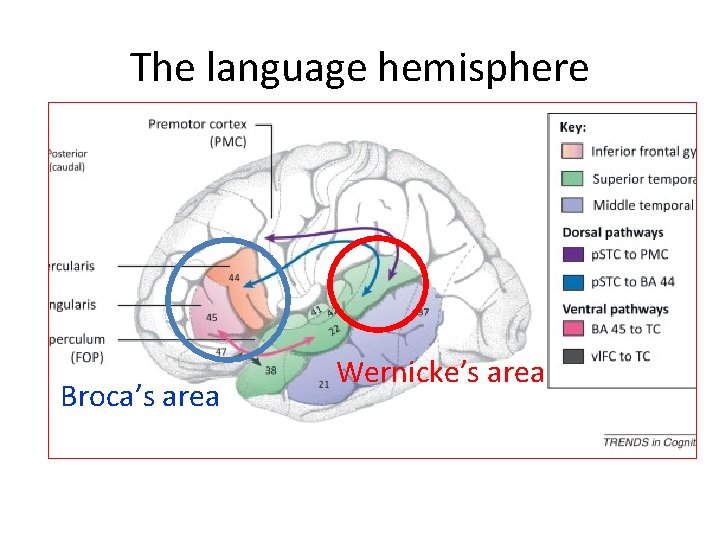
The language hemisphere Broca’s area Wernicke’s area
![The [Ding et al. 2016] experiment fret ship hill give true melt fans blue](http://slidetodoc.com/presentation_image_h/05ea42ce1a17debf61c479658bfeeb53/image-42.jpg "The [Ding et al. 2016] experiment fret ship hill give true melt fans blue")
The [Ding et al. 2016] experiment fret ship hill give true melt fans blue guess hits then cats 4 hertz
![The [Ding et al. 2016] experiment, stage II bad cats eat fish new plan](http://slidetodoc.com/presentation_image_h/05ea42ce1a17debf61c479658bfeeb53/image-43.jpg "The [Ding et al. 2016] experiment, stage II bad cats eat fish new plan")
The [Ding et al. 2016] experiment, stage II bad cats eat fish new plan gave joy little boy kicks ball 1 2 hertz 4
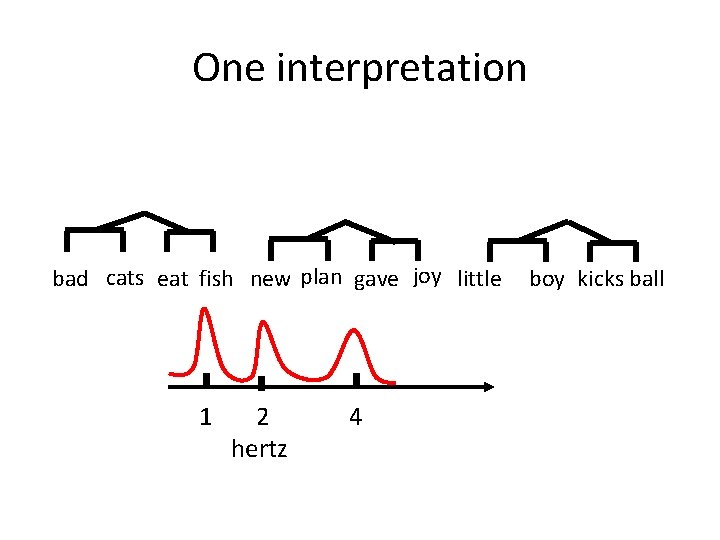
One interpretation bad cats eat fish new plan gave joy little 1 2 hertz 4 boy kicks ball
Syntax trees in the Brain? BUT: can each tree-building step be accomplished by about a dozen spikes? (12 ~ 50 Hz/4 Hz)
Zaccarella & Friedericci “Merge in the human Brain” Front. Psych. 2015 • The completion of phrases, and especially of sentences, lights up parts of Broca’s area
![[ZF 2010]: Neural pathways for syntax? Broca’s area Wernicke’s area](http://slidetodoc.com/presentation_image_h/05ea42ce1a17debf61c479658bfeeb53/image-47.jpg "[ZF 2010]: Neural pathways for syntax? Broca’s area Wernicke’s area")
[ZF 2010]: Neural pathways for syntax? Broca’s area Wernicke’s area
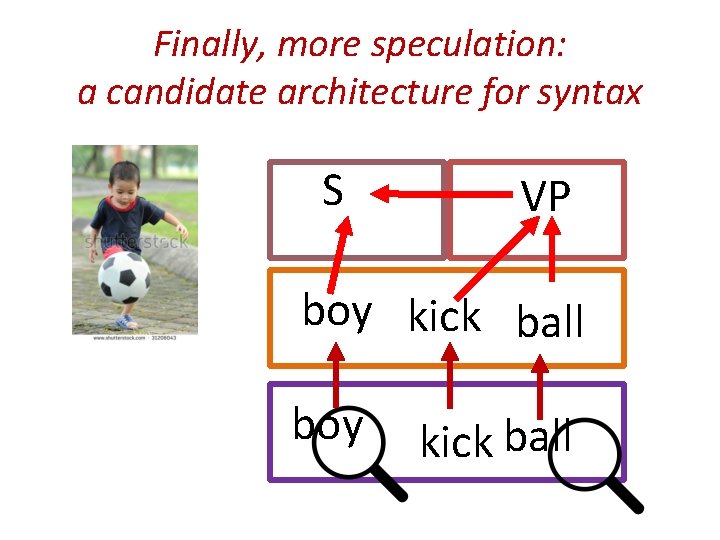
Finally, more speculation: a candidate architecture for syntax S VP boy kick ball
Sooooooo… • How does one think computationally about the Brain? • Assemblies and their operations may be one productive path • A fascinating repertoire of operations • Opens many interesting technical questions • Ultimately, language

Thanks !
- Slides: 50