
Computing the output response of LTI Systems By
Computing the output response of LTI Systems. • By breaking or decomposing and representing the input signal to the LTI system into terms of a linear combination of a set of basic signals. • Using the superposition property of LTI system to compute the output of the system in terms of its response to these basic signals. 1
General Signal Representations By Basic Signal • The basic signal - in particular the unit impulse can be used to decompose and represent the general form of any signal. • Linear combination of delayed impulses can represent these general signals. 2

Response of LTI System to General Input Signal General Output LTI SYSTEM Input Response Signal Delayed Impulse Signal 1 Delayed Impulse LTI SYSTEM Response to Impulse signal N 3

Representation of Discrete-time Signals in Terms of Impulses. Discrete-time signals are sequences of individual impulses. x[n] -4 -1 -3 -2 2 3 0 1 -1 -4 -3 -2 -4 n 2 3 0 1 2 -1 -3 -2 4 0 1 3 4 n 4
![Discrete-time signals are sequences of individual scaled unit impulses. x[n] -4 -1 -3 -2](http://slidetodoc.com/presentation_image_h/d53c78f25372dd410603af44c44a6a2b/image-5.jpg "Discrete-time signals are sequences of individual scaled unit impulses. x[n] -4 -1 -3 -2")
Discrete-time signals are sequences of individual scaled unit impulses. x[n] -4 -1 -3 -2 2 3 0 1 -1 -4 -3 -2 -4 2 -1 -4 4 n 3 0 1 2 -1 -3 -2 n 2 3 0 1 -3 -2 4 0 1 4 n 3 5
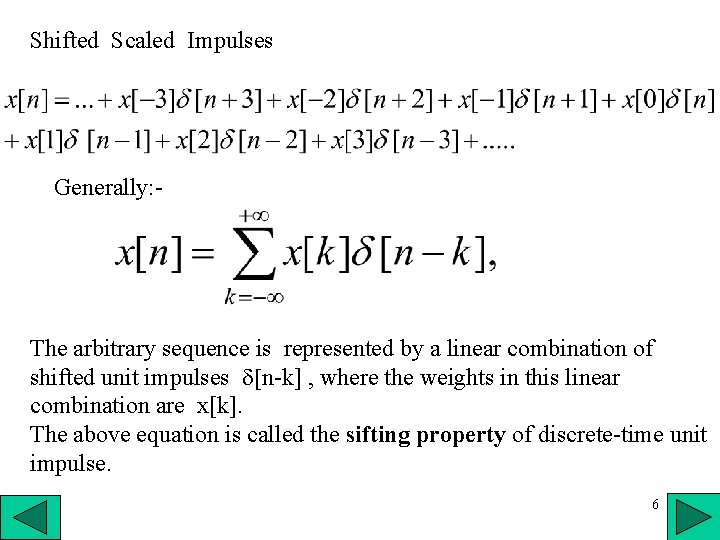
Shifted Scaled Impulses Generally: - The arbitrary sequence is represented by a linear combination of shifted unit impulses d[n-k] , where the weights in this linear combination are x[k]. The above equation is called the sifting property of discrete-time unit impulse. 6
![As Example consider unit step signal x[n]=u[n]: - Generally: - The unit step sequence](http://slidetodoc.com/presentation_image_h/d53c78f25372dd410603af44c44a6a2b/image-7.jpg "As Example consider unit step signal x[n]=u[n]: - Generally: - The unit step sequence")
As Example consider unit step signal x[n]=u[n]: - Generally: - The unit step sequence is represented by a linear combination of shifted unit impulses d[n-k] , where the weights in this linear combination are ones from k=0 right up to k= This is identically similar to the expression we have derived in our previous lecture a few weeks back when we dealt with unit step. 7
The Discrete-time Unit Impulse Responses and the Convolution Sum Representation • To determine the output response of an LTI system to an arbitrary input signal x[n], we make use of the sifting property for input signal and the superposition and timeinvariant properties of LTI system. 8
![Convolution Sum Representation • The response of a linear system to x[n] will be](http://slidetodoc.com/presentation_image_h/d53c78f25372dd410603af44c44a6a2b/image-9.jpg "Convolution Sum Representation • The response of a linear system to x[n] will be")
Convolution Sum Representation • The response of a linear system to x[n] will be the superposition of the scaled responses of the system to each of these shifted impulses. • From the time-invariant property, the response of LTI system to the time-shifted unit impulses are simply time-shifted responses of one another. 9
![Unit Impulse Response h[n] d[n] 0 ho[n] LTI System n=0 d[n-k] k hk[n] LTI](http://slidetodoc.com/presentation_image_h/d53c78f25372dd410603af44c44a6a2b/image-10.jpg "Unit Impulse Response h[n] d[n] 0 ho[n] LTI System n=0 d[n-k] k hk[n] LTI")
Unit Impulse Response h[n] d[n] 0 ho[n] LTI System n=0 d[n-k] k hk[n] LTI System n=k 10
![Response to scaled unit impulse input x[n]d[n-k] x[-k]. d[n+k] LTI System -k x[0]. d[n]](http://slidetodoc.com/presentation_image_h/d53c78f25372dd410603af44c44a6a2b/image-11.jpg "Response to scaled unit impulse input x[n]d[n-k] x[-k]. d[n+k] LTI System -k x[0]. d[n]")
Response to scaled unit impulse input x[n]d[n-k] x[-k]. d[n+k] LTI System -k x[0]. d[n] 0 x[-k]. h-k[n] n=-k x[0]. ho[n] LTI System n=0 x[+k]. d[n-k] k LTI System x[+k]. hk[n] n=+k 11
![Output y[n] of LTI System Thus, if we know the response of a linear](http://slidetodoc.com/presentation_image_h/d53c78f25372dd410603af44c44a6a2b/image-12.jpg "Output y[n] of LTI System Thus, if we know the response of a linear")
Output y[n] of LTI System Thus, if we know the response of a linear system to the set of shifted unit impulses, we can construct the response y[n] to an arbitrary input signal x[n]. 12
![h-1[n] x[n] h 0[n] 0 h 1[n] 13](http://slidetodoc.com/presentation_image_h/d53c78f25372dd410603af44c44a6a2b/image-13.jpg "h-1[n] x[n] h 0[n] 0 h 1[n] 13")
h-1[n] x[n] h 0[n] 0 h 1[n] 13
![x[-1]h-1[n] x[-1]d[n+1] 0 0 x[0]h 0[n] x[0]d[n] 0 x[1]d[n-1] 0 0 0 x[n] 0](http://slidetodoc.com/presentation_image_h/d53c78f25372dd410603af44c44a6a2b/image-14.jpg "x[-1]h-1[n] x[-1]d[n+1] 0 0 x[0]h 0[n] x[0]d[n] 0 x[1]d[n-1] 0 0 0 x[n] 0")
x[-1]h-1[n] x[-1]d[n+1] 0 0 x[0]h 0[n] x[0]d[n] 0 x[1]d[n-1] 0 0 0 x[n] 0 x[1]h 1[n] y[n] 0 14
![• In general, the response hk[n] need not be related to each other](http://slidetodoc.com/presentation_image_h/d53c78f25372dd410603af44c44a6a2b/image-15.jpg "• In general, the response hk[n] need not be related to each other")
• In general, the response hk[n] need not be related to each other for different values of k. • If the linear system is also time-invariant system, then these responses hk[n] to time shifted unit impulse are all time-shifted versions of each other. • I. e. hk[n]=h 0[n-k]. • For notational convenience we drop the subscript on h 0[n] =h[n]. • h[n] is defined as the unit impluse (sample) response 15
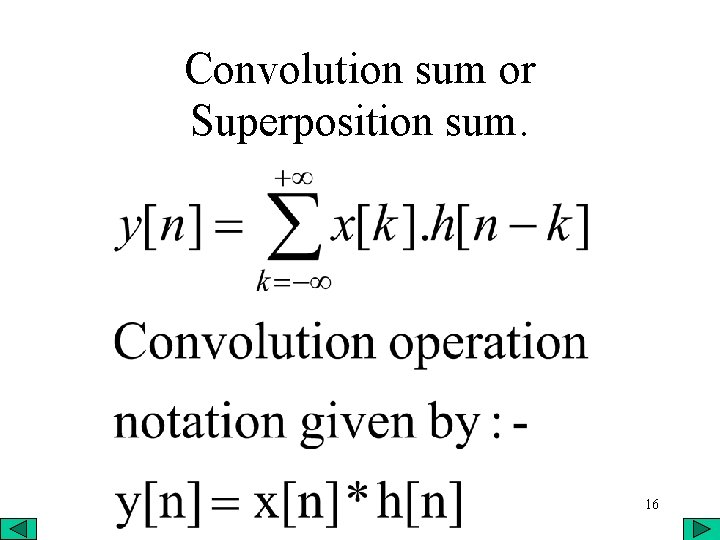
Convolution sum or Superposition sum. 16
![Convolution sum or Superposition sum. x[k] h[k] 17](http://slidetodoc.com/presentation_image_h/d53c78f25372dd410603af44c44a6a2b/image-17.jpg "Convolution sum or Superposition sum. x[k] h[k] 17")
Convolution sum or Superposition sum. x[k] h[k] 17
![Convolution sum or Superposition sum. x[k] h[k] 18](http://slidetodoc.com/presentation_image_h/d53c78f25372dd410603af44c44a6a2b/image-18.jpg "Convolution sum or Superposition sum. x[k] h[k] 18")
Convolution sum or Superposition sum. x[k] h[k] 18
![Convolution sum or Superposition sum. x[k] h[k] 19](http://slidetodoc.com/presentation_image_h/d53c78f25372dd410603af44c44a6a2b/image-19.jpg "Convolution sum or Superposition sum. x[k] h[k] 19")
Convolution sum or Superposition sum. x[k] h[k] 19
![Convolution sum or Superposition sum. x[k] h[k] 20](http://slidetodoc.com/presentation_image_h/d53c78f25372dd410603af44c44a6a2b/image-20.jpg "Convolution sum or Superposition sum. x[k] h[k] 20")
Convolution sum or Superposition sum. x[k] h[k] 20
![y[n]=x[0]h[n-0]+x[1]h[n-1]= 0. 5 h[n]+2 h[n-1] 1 1 1 x x h[n] x 0. 5](http://slidetodoc.com/presentation_image_h/d53c78f25372dd410603af44c44a6a2b/image-21.jpg "y[n]=x[0]h[n-0]+x[1]h[n-1]= 0. 5 h[n]+2 h[n-1] 1 1 1 x x h[n] x 0. 5")
y[n]=x[0]h[n-0]+x[1]h[n-1]= 0. 5 h[n]+2 h[n-1] 1 1 1 x x h[n] x 0. 5 x 1 x[n] 0 0. 5 h[n] 2 2 h[n-1] 2. 5 2 y[n] 0. 5 21
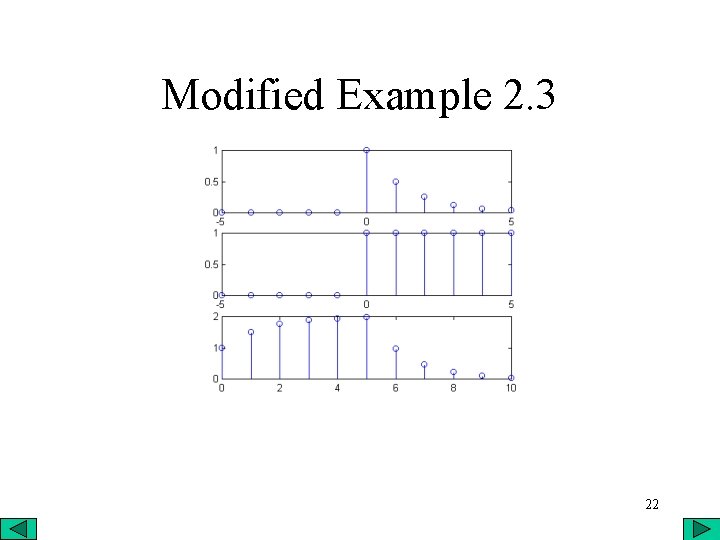
Modified Example 2. 3 22
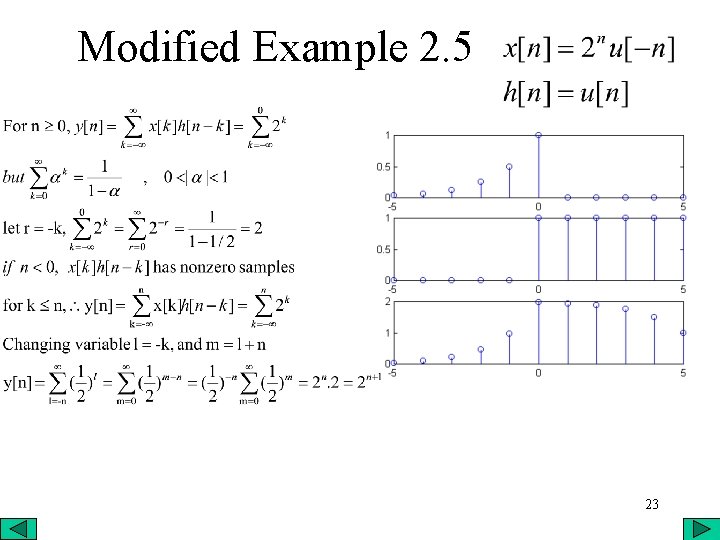
Modified Example 2. 5 23
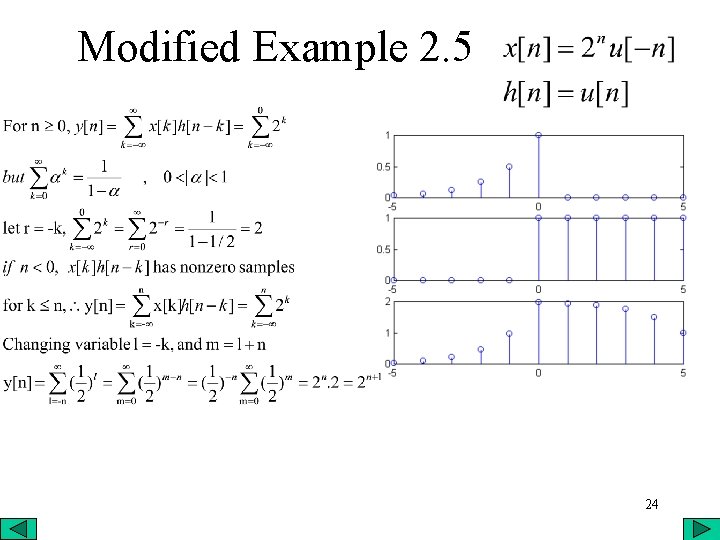
Modified Example 2. 5 24
- Slides: 24