
Computing Technology REvolution 1935 1946 2010 Economic Impact
- Slides: 40
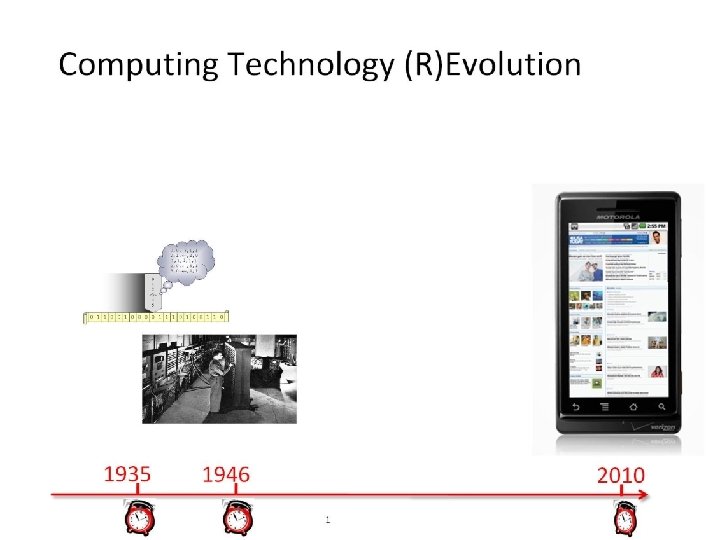
Computing Technology (R)Evolution 1935 1946 2010
Economic Impact
Social Impact
Three Stories: Google Model Checking Machine Learning
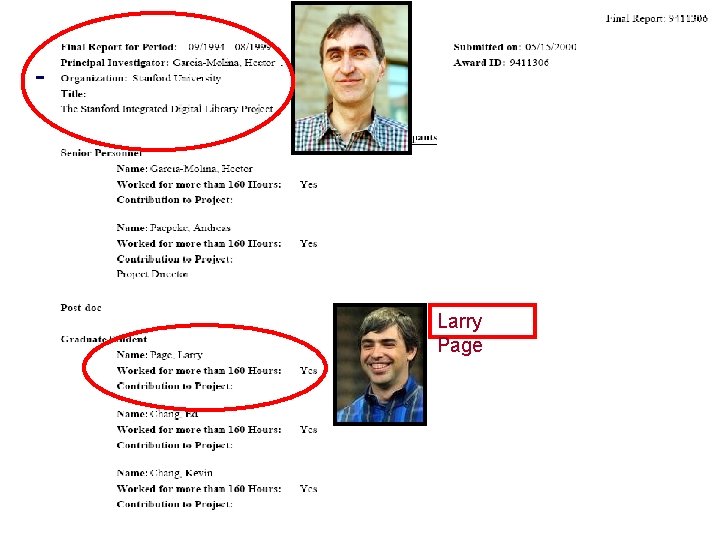
Larry Page
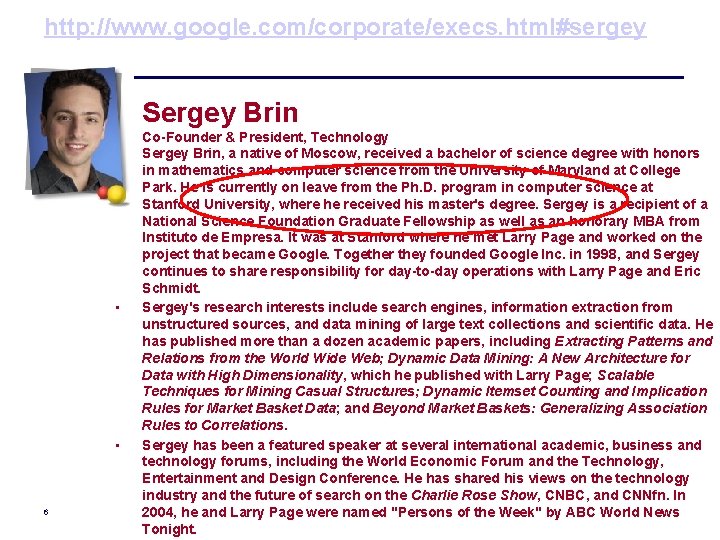
http: //www. google. com/corporate/execs. html#sergey • Sergey Brin • • 6 Co-Founder & President, Technology Sergey Brin, a native of Moscow, received a bachelor of science degree with honors in mathematics and computer science from the University of Maryland at College Park. He is currently on leave from the Ph. D. program in computer science at Stanford University, where he received his master's degree. Sergey is a recipient of a National Science Foundation Graduate Fellowship as well as an honorary MBA from Instituto de Empresa. It was at Stanford where he met Larry Page and worked on the project that became Google. Together they founded Google Inc. in 1998, and Sergey continues to share responsibility for day-to-day operations with Larry Page and Eric Schmidt. Sergey's research interests include search engines, information extraction from unstructured sources, and data mining of large text collections and scientific data. He has published more than a dozen academic papers, including Extracting Patterns and Relations from the World Wide Web; Dynamic Data Mining: A New Architecture for Data with High Dimensionality, which he published with Larry Page; Scalable Techniques for Mining Casual Structures; Dynamic Itemset Counting and Implication Rules for Market Basket Data; and Beyond Market Baskets: Generalizing Association Rules to Correlations. Sergey has been a featured speaker at several international academic, business and technology forums, including the World Economic Forum and the Technology, Entertainment and Design Conference. He has shared his views on the technology industry and the future of search on the Charlie Rose Show, CNBC, and CNNfn. In 2004, he and Larry Page were named "Persons of the Week" by ABC World News Tonight.
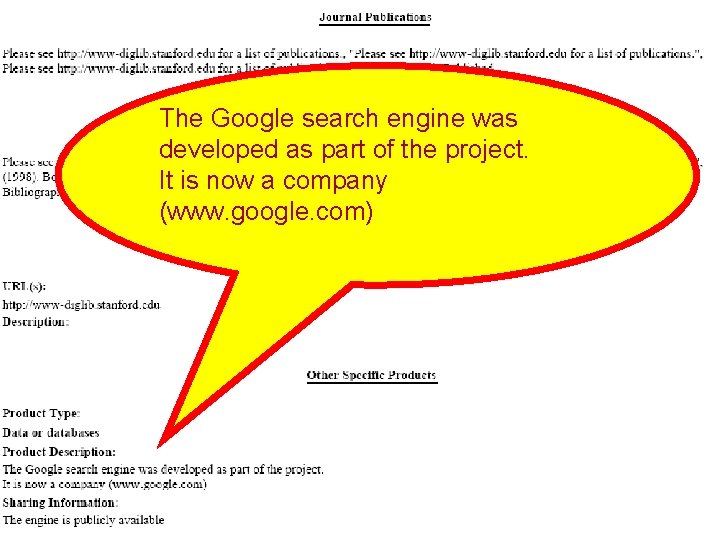
The Google search engine was developed as part of the project. It is now a company (www. google. com)
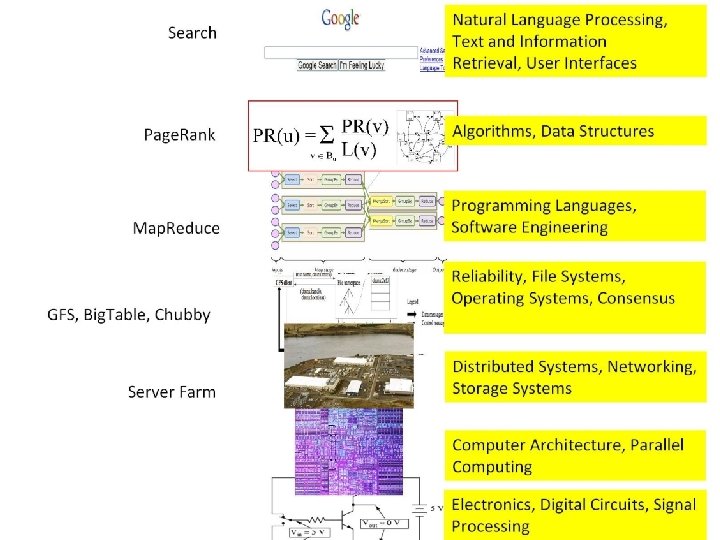
Natural Language Processing, Text and Information Retrieval, User Interfaces Search Algorithms, Data Structures Page. Ran k PR(v) PR(u) = Σ v ∈ B L(v) Programming Languages, Software Engineering Map. Reduc e GFS, Big. Table, Chubby Server Farm u Reliability, File Systems, Operating Systems, Consensus Distributed Systems, Networking, Storage Systems Computer Architecture, Parallel Computing 8 Electronics, Digital Circuits, Signal Processing
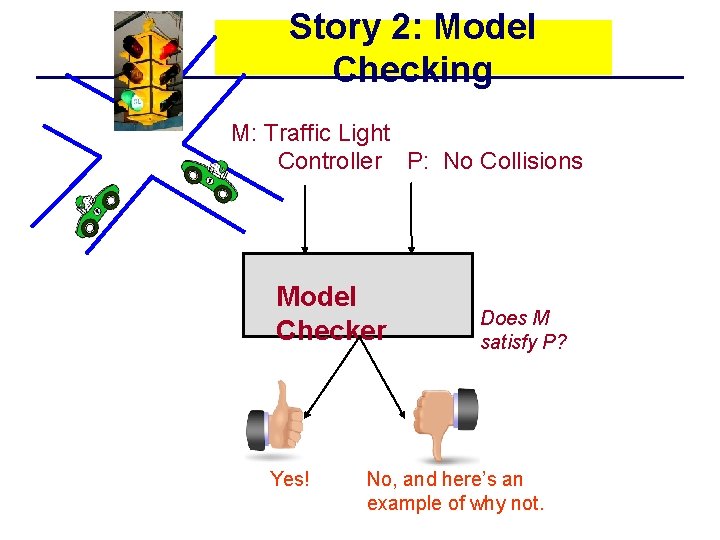
Story 2: Model Checking M: Traffic Light Controller P: No Collisions Model Checker Yes! Does M satisfy P? No, and here’s an example of why not.
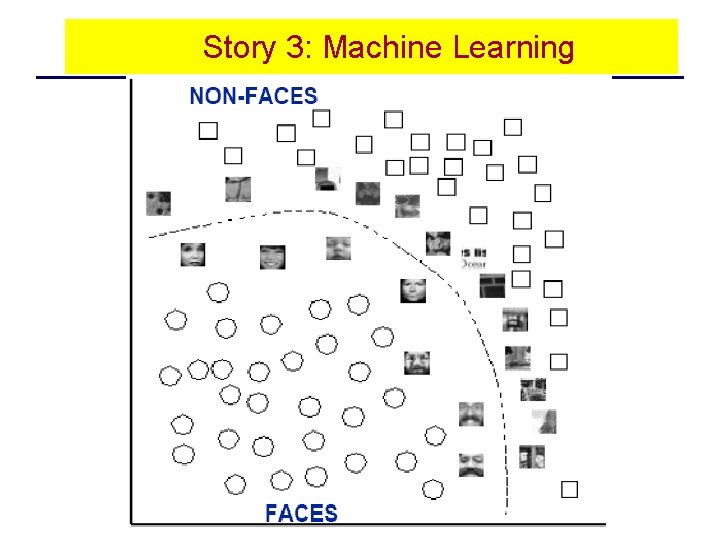
Story 3: Machine Learning
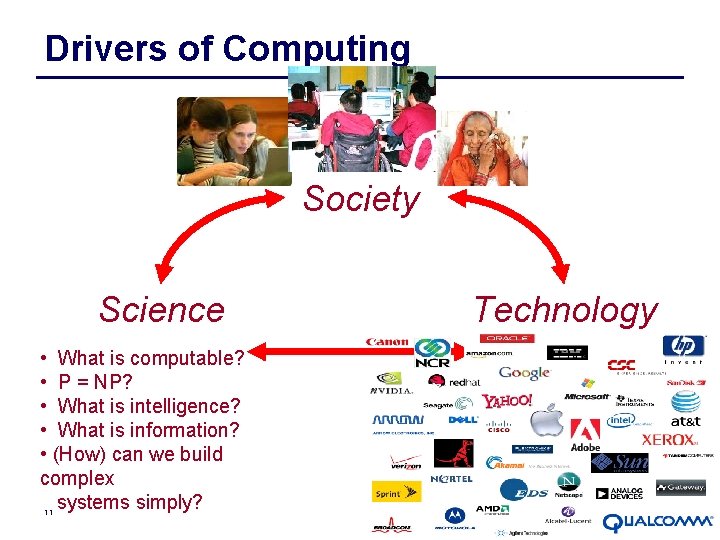
Drivers of Computing Society Science • What is computable? • P = NP? • What is intelligence? • What is information? • (How) can we build complex systems simply? 11 Technology
Data to Knowledge to Action 10 0 0 1 1 1 010 0 10 1 0 0 1 1 1 110 0 1 0 0 0 1 1 010 1 1 1 0 0 101 001 101 0 0 0 1 1 1 0 1 0 1 0 101 1 0010 0 0 1 1 0 001 1 1 0 0 0 1 0 1 1 1 0 0 1 1 101 0101 0 1 1 010 1 0 0 1 1 1 1 0 0 0 1 101 101 101 0 0 010 0 1 1 0 1 0 0 0 1 1 010 010 101 100 1 0 1 0 101 1 0 0 1 0 1 0 0 1 1 1 0 101 101 010 011 0 0 1 1 1 0 0 0 1 001 1 1 0 0 0 1 1 0 0 0 1 1 110 010 1000 0 1 1 1 0 1 0 0 1 01 110101011101 0101000101 1 10 101110 1000101100 0 011101 0 1 011010
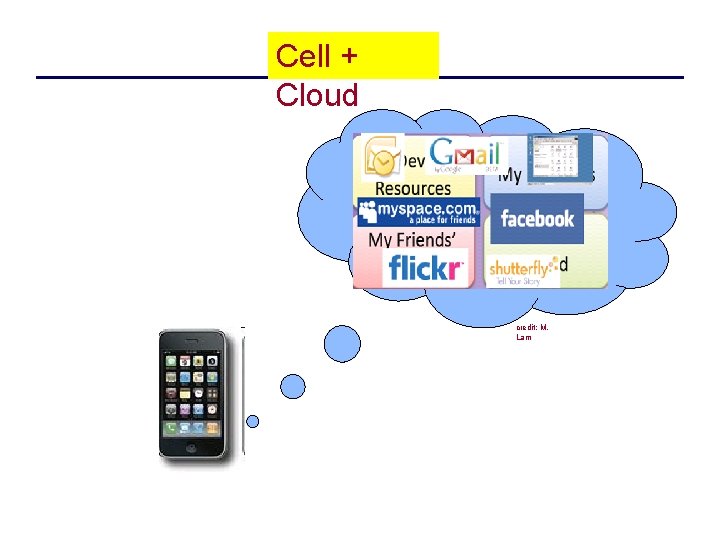
Cell + Cloud credit: M. Lam
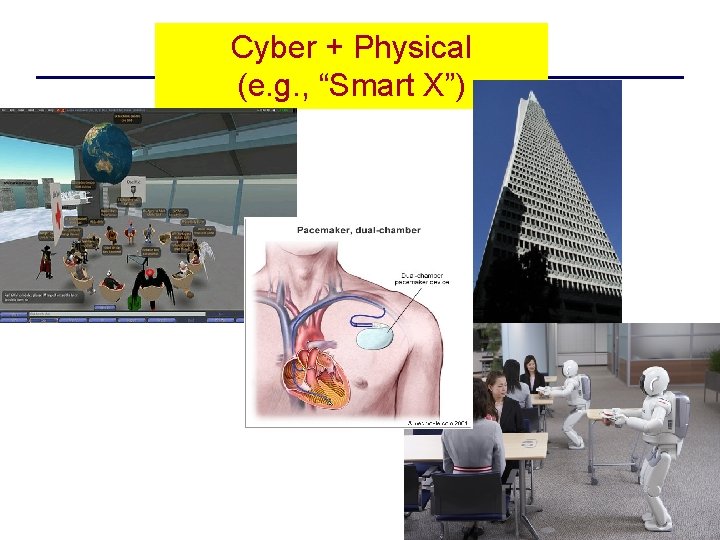
Cyber + Physical (e. g. , “Smart X”)
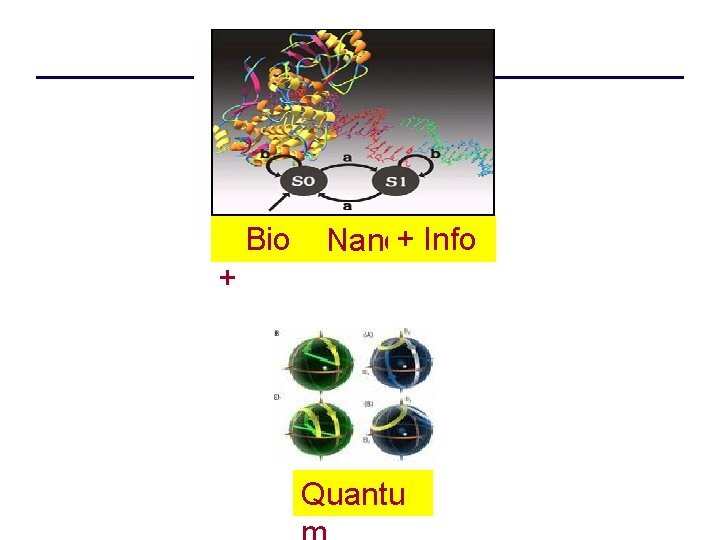
Bio Nano+ Info + Quantu
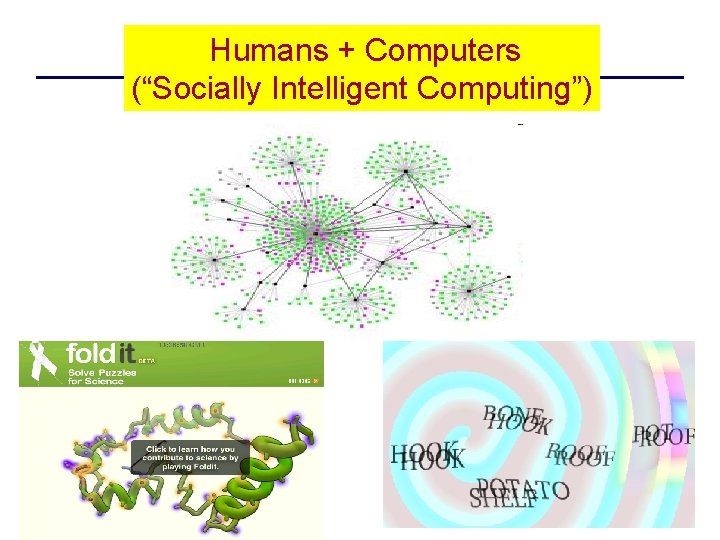
Humans + Computers (“Socially Intelligent Computing”)
Societal Drivers
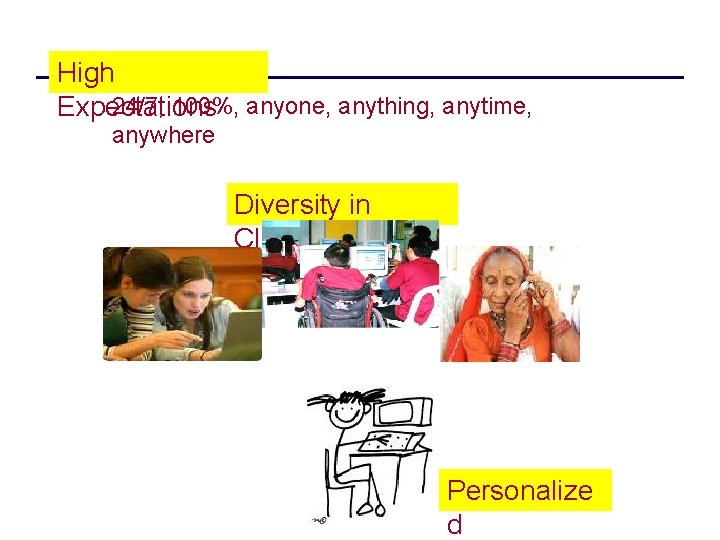
High 24/7, 100%, anyone, anything, anytime, Expectations anywhere Diversity in Classes Personalize d
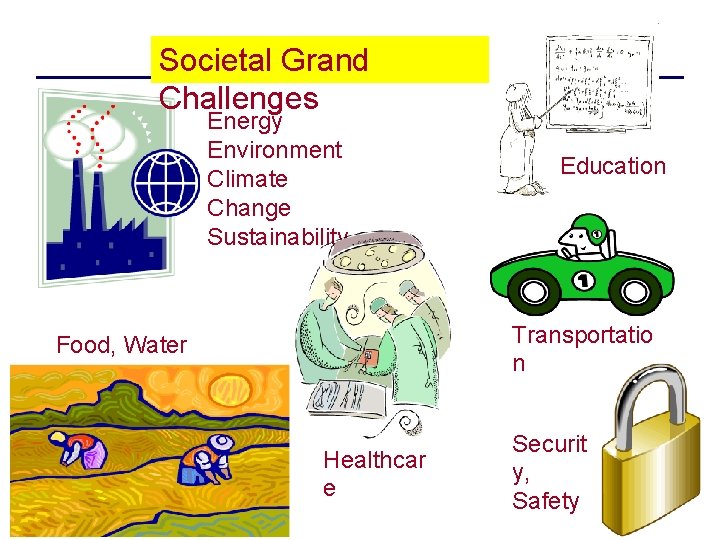
Societal Grand Challenges Energy Environment Climate Change Sustainability Education Transportatio n Food, Water Healthcar e Securit y, Safety
Science: Five Deep Questions in Computing • What is computable? • P = NP? • What is intelligence? • What is information? • (How) can we build complex systems simply?
Computational Thinking What is it? Computer Science Unplugged 21
Computational Thinking (CT) (from Jeannette Wing’s website) • Computational thinking will be a fundamental skill used by everyone in the world by the middle of the 21 st Century. • J. M. Wing, “Computational Thinking, ” CACM Viewpoint, March 2006, pp. 33 -35. http: //www. cs. cmu. edu/~wing/ 22
Examples of CT (from Jeannette Wing’s website) • Determining how difficult a problem is to solve. Thinking recursively. • Choosing an appropriate representation for data to simplify the solution to problems. • Reformulating a seemingly difficult problem into one which we know how to solve. • Using abstraction and decomposition in tackling a large complex task. • Using the difficulty of solving hard AI problems to foil computing agents. 23
Examples of CT in daily life (from Jeannette Wing’s website) • Sorting important documents. • Choosing a line at the supermarket. (queuing and scheduling) • Putting things in your child’s knapsack for the day. (caching) • Running errands (Traveling salesperson) • Cooking dinner or washing loads of laundry (parallel processing/pipelining) 24
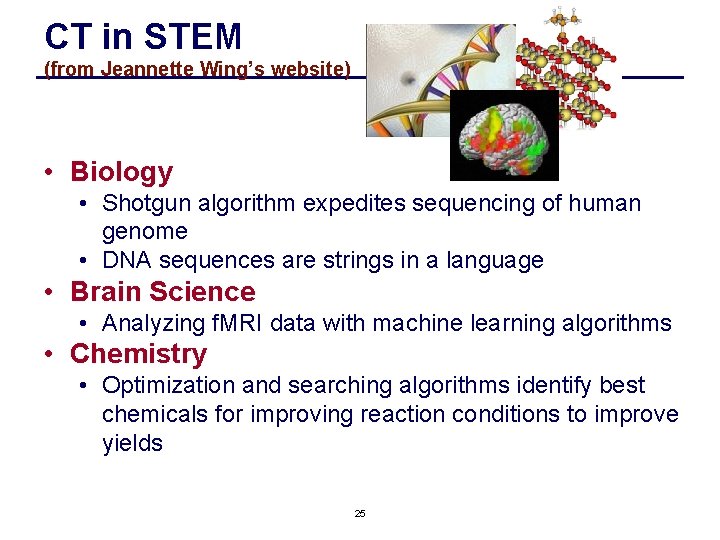
CT in STEM (from Jeannette Wing’s website) • Biology • Shotgun algorithm expedites sequencing of human genome • DNA sequences are strings in a language • Brain Science • Analyzing f. MRI data with machine learning algorithms • Chemistry • Optimization and searching algorithms identify best chemicals for improving reaction conditions to improve yields 25
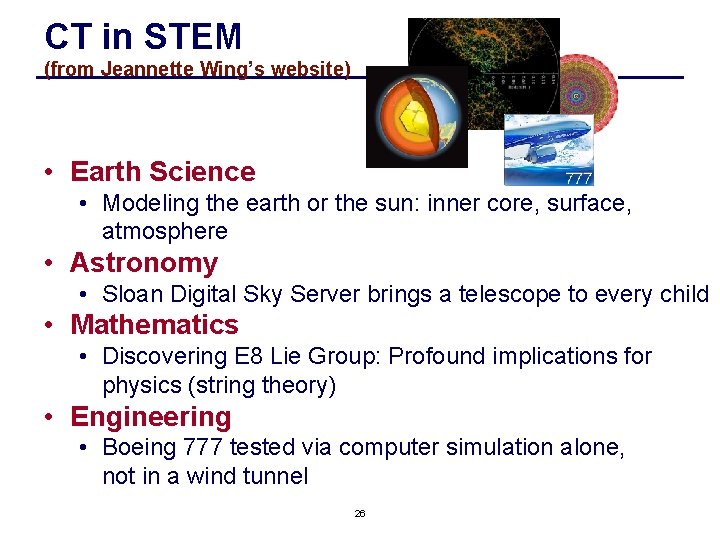
CT in STEM (from Jeannette Wing’s website) • Earth Science • Modeling the earth or the sun: inner core, surface, atmosphere • Astronomy • Sloan Digital Sky Server brings a telescope to every child • Mathematics • Discovering E 8 Lie Group: Profound implications for physics (string theory) • Engineering • Boeing 777 tested via computer simulation alone, not in a wind tunnel 26
Computational Thinking An Operational Definition for K-12 Computational thinking (CT) is a problem-solving process that includes (but is not limited to) the following characteristics: • • • Formulating problems in a way that enables us to use a computer and other tools to help solve them. Logically organizing and analyzing data Representing data through abstractions such as models and simulations Automating solutions through algorithmic thinking (a series of ordered steps) Identifying, analyzing, and implementing possible solutions with the goal of achieving the most efficient and effective combination of steps and resources 27 Generalizing and transferring this problem solving process to a
Computational Thinking An Operational Definition for K-12 These skills are supported and enhanced by a number of dispositions or attitudes that are essential dimensions of CT. These dispositions or attitudes include: • • • Confidence in dealing with complexity Persistence in working with difficult problems Tolerance for ambiguity The ability to deal with open ended problems The ability to communicate and work with others to achieve a common goal or solution 28
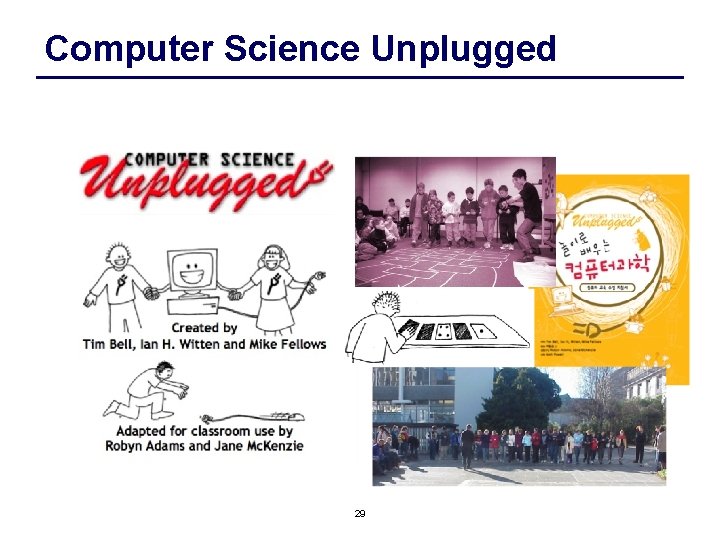
Computer Science Unplugged 29
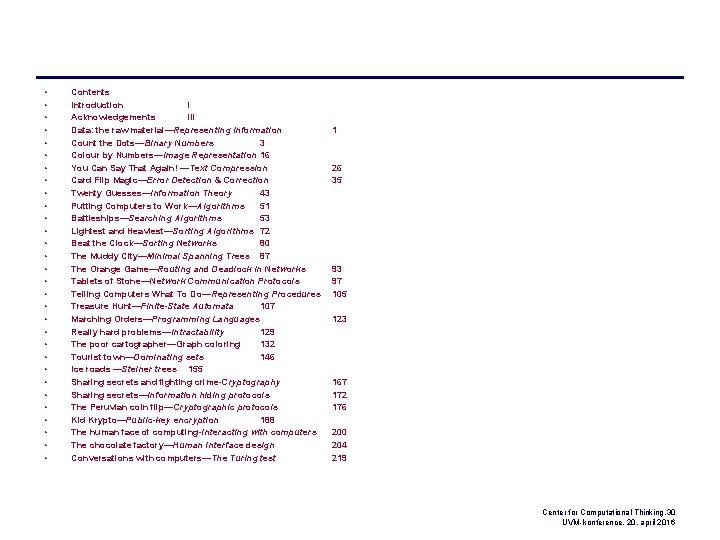
• • • • • • • • Contents Introduction i Acknowledgements iii Data: the raw material—Representing information Count the Dots—Binary Numbers 3 Colour by Numbers—Image Representation 16 You Can Say That Again! —Text Compression Card Flip Magic—Error Detection & Correction Twenty Guesses—Information Theory 43 Putting Computers to Work—Algorithms 51 Battleships—Searching Algorithms 53 Lightest and Heaviest—Sorting Algorithms 72 Beat the Clock—Sorting Networks 80 The Muddy City—Minimal Spanning Trees 87 The Orange Game—Routing and Deadlock in Networks Tablets of Stone—Network Communication Protocols Telling Computers What To Do—Representing Procedures Treasure Hunt—Finite-State Automata 107 Marching Orders—Programming Languages Really hard problems—Intractability 129 The poor cartographer—Graph coloring 132 Tourist town—Dominating sets 146 Ice roads —Steiner trees 155 Sharing secrets and fighting crime-Cryptography Sharing secrets—Information hiding protocols The Peruvian coin flip—Cryptographic protocols Kid Krypto—Public-key encryption 188 The human face of computing-Interacting with computers The chocolate factory—Human interface design Conversations with computers—The Turing test 1 26 35 93 97 105 123 167 172 176 200 204 219 Center for Computational Thinking. 30 UVM-konference, 20. april 2016
Count The Dots • Data in computers is stored and transmitted as a series of zeros and ones. – How can we represent words and numbers using just these two symbols?
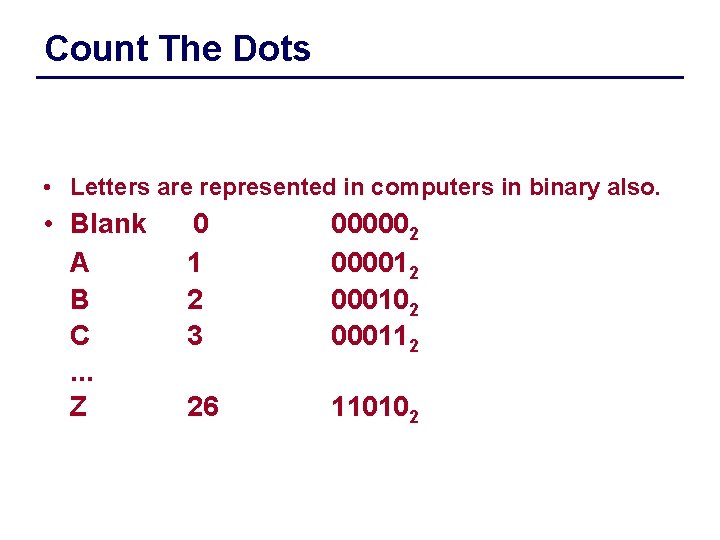
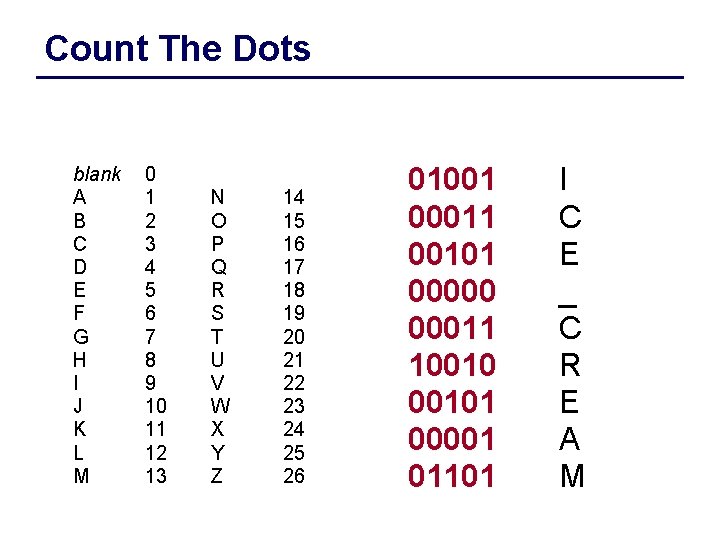
Count The Dots • Letters are represented in computers in binary also. • Blank A B C. . . Z 0 1 2 3 000002 000012 000102 000112 26 110102
Count The Dots blank A B C D E F G H I J K L M 0 1 2 3 4 5 6 7 8 9 10 11 12 13 N O P Q R S T U V W X Y Z 14 15 16 17 18 19 20 21 22 23 24 25 26 01001 00011 00101 00000 00011 100101 00001 01101 I C E _ C R E A M
Color By Numbers • Computer screens are divided up into a grid of small dots called pixels (picture elements). In a black and white picture, each pixel is either black or white. • Computers store drawings, photographs and other pictures using only numbers. • The following activity demonstrates how a computer image can be stored efficiently.
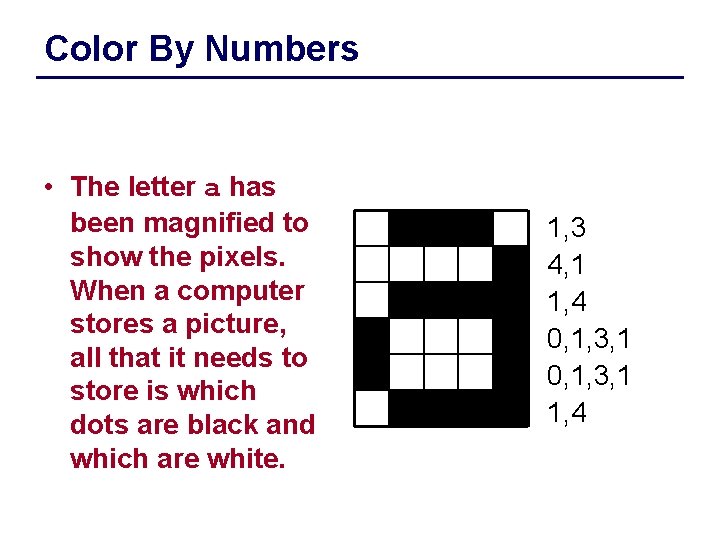
Color By Numbers • The letter a has been magnified to show the pixels. When a computer stores a picture, all that it needs to store is which dots are black and which are white. 1, 3 4, 1 1, 4 0, 1, 3, 1 1, 4
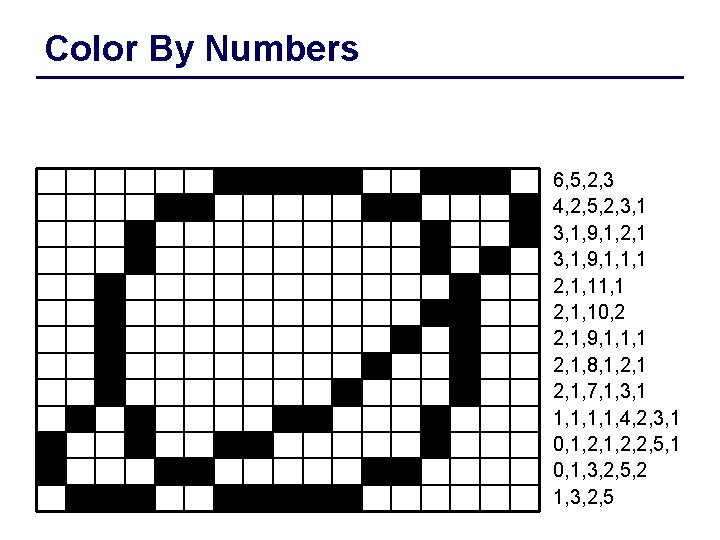
Color By Numbers 6, 5, 2, 3 4, 2, 5, 2, 3, 1, 9, 1, 2, 1 3, 1, 9, 1, 1, 1 2, 1, 10, 2 2, 1, 9, 1, 1, 1 2, 1, 8, 1, 2, 1, 7, 1, 3, 1 1, 1, 4, 2, 3, 1 0, 1, 2, 2, 5, 1 0, 1, 3, 2, 5, 2 1, 3, 2, 5
Color By Numbers • This technique is called run-length encoding. – Fax transmission – Compression of images • Color encoding – Use two numbers per run • First number is how many pixels as before • Second number is what color (1=red, 2=green, . . . )
Information Theory • How much information is there in a book? Is there more information in a telephone book, or in Harry Potter and the Deathly Hallows? – If we can measure this, we can estimate how much space is needed to store the information. • Can you read the following sentence? Ths sntnc hs th vwls mssng.
Twenty Guesses • I am thinking of a number between 0 and 127. • You may only ask questions that have a "yes" or "no" answer. • For each question, you will lose one piece of candy. • Once you guess the number correctly, you can keep whatever candy remains.
Twenty Guesses • To pick a number between 0 and 127, you only need 7 guesses. – Always shoot for the middle number of the range and eliminate half the possibilities! – This concept is called binary search. • If the number was between 0 and 1, 023, you would only need 3 additional guesses. • You can guess a number between 0 and 1, 048, 575 in only 20 guesses!