
Computing Scores in a Complete Search System Web

Computing Scores in a Complete Search System Web Search and Mining Lecture 8: Scoring and results assembly 1
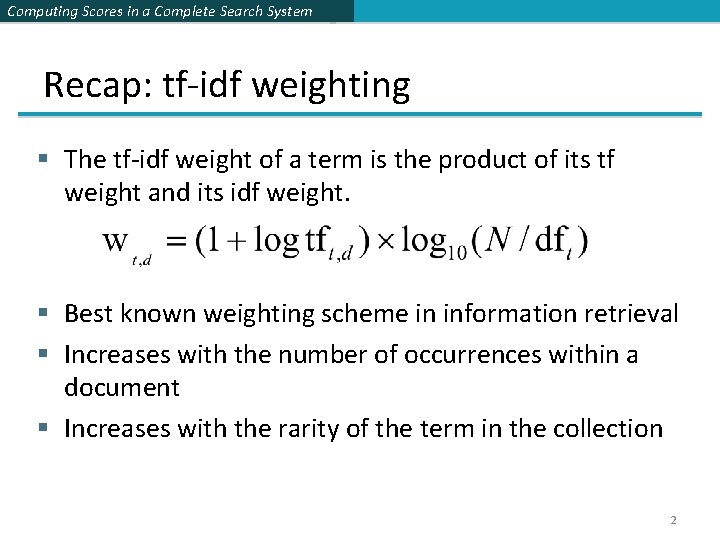
Computing Scores in a Complete Search System Recap: tf-idf weighting § The tf-idf weight of a term is the product of its tf weight and its idf weight. § Best known weighting scheme in information retrieval § Increases with the number of occurrences within a document § Increases with the rarity of the term in the collection 2
Computing Scores in a Complete Search System Recap: Queries as vectors § Key idea 1: Do the same for queries: represent them as vectors in the space § Key idea 2: Rank documents according to their proximity to the query in this space § proximity = similarity of vectors 3
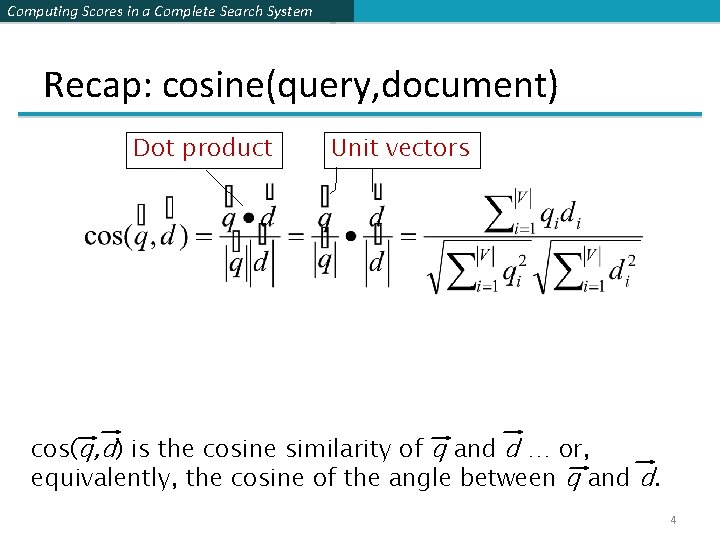
Computing Scores in a Complete Search System Recap: cosine(query, document) Dot product Unit vectors cos(q, d) is the cosine similarity of q and d … or, equivalently, the cosine of the angle between q and d. 4
Computing Scores in a Complete Search System This lecture § Speeding up vector space ranking § Putting together a complete search system § Will require learning about a number of miscellaneous topics and heuristics 5
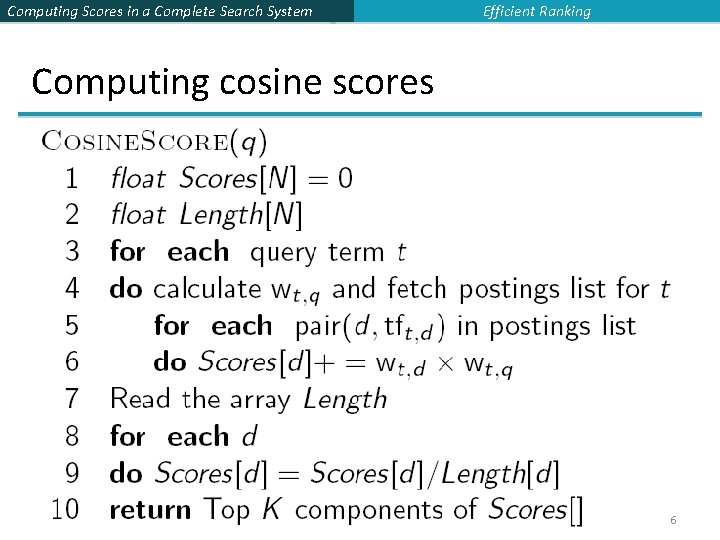
Computing Scores in a Complete Search System Efficient Ranking Computing cosine scores 6
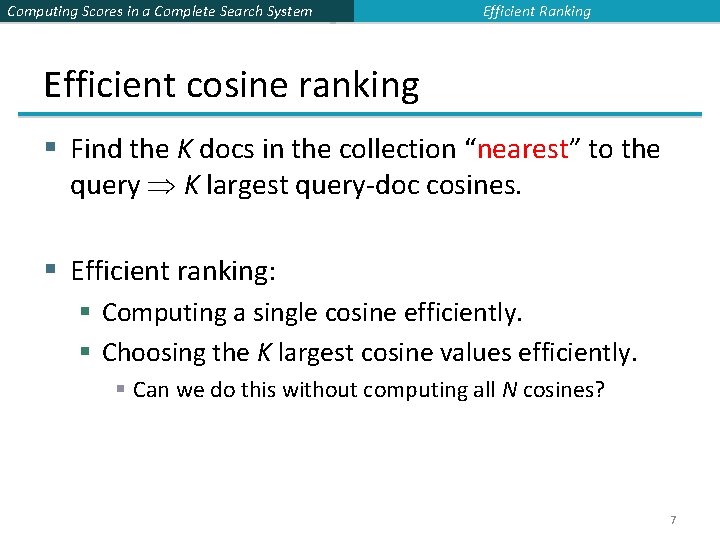
Computing Scores in a Complete Search System Efficient Ranking Efficient cosine ranking § Find the K docs in the collection “nearest” to the query K largest query-doc cosines. § Efficient ranking: § Computing a single cosine efficiently. § Choosing the K largest cosine values efficiently. § Can we do this without computing all N cosines? 7
Computing Scores in a Complete Search System Efficient Ranking Efficient cosine ranking § What we’re doing in effect: solving the K-nearest neighbor problem for a query vector § In general, we do not know how to do this efficiently for high-dimensional spaces § But it is solvable for short queries, and standard indexes support this well 8
Computing Scores in a Complete Search System Efficient Ranking Special case – unweighted queries § No weighting on query terms § Assume each query term occurs only once § Then for ranking, don’t need to normalize query vector § Slight simplification of algorithm from Lecture 7 9
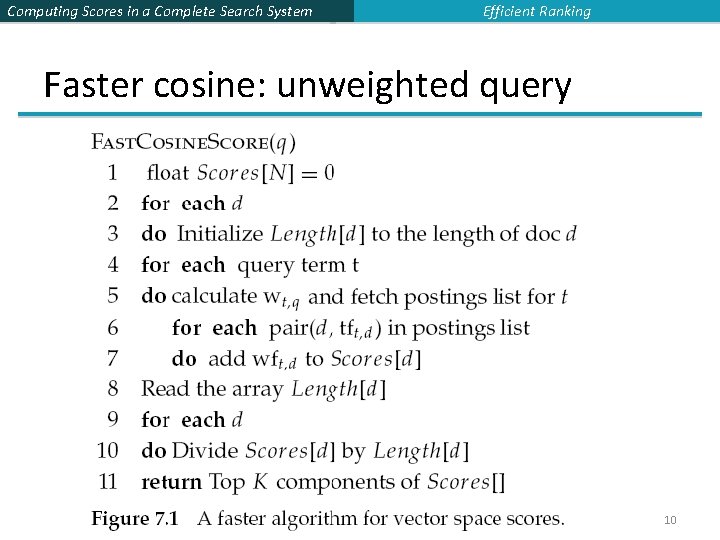
Computing Scores in a Complete Search System Efficient Ranking Faster cosine: unweighted query 10
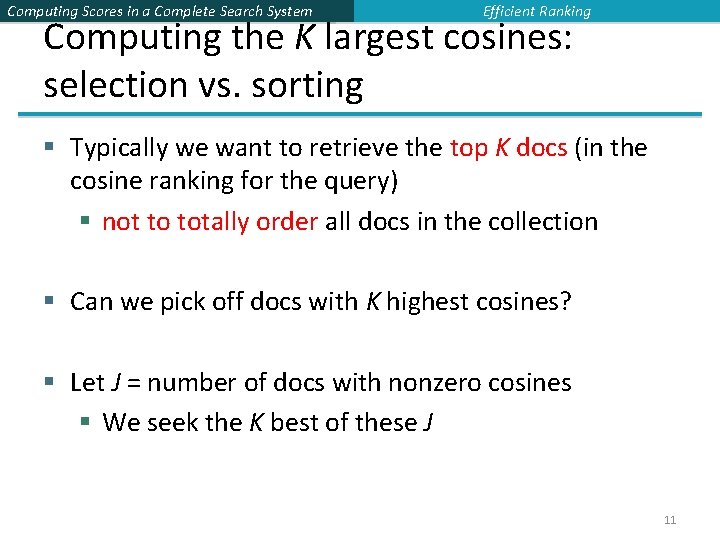
Computing Scores in a Complete Search System Efficient Ranking Computing the K largest cosines: selection vs. sorting § Typically we want to retrieve the top K docs (in the cosine ranking for the query) § not to totally order all docs in the collection § Can we pick off docs with K highest cosines? § Let J = number of docs with nonzero cosines § We seek the K best of these J 11
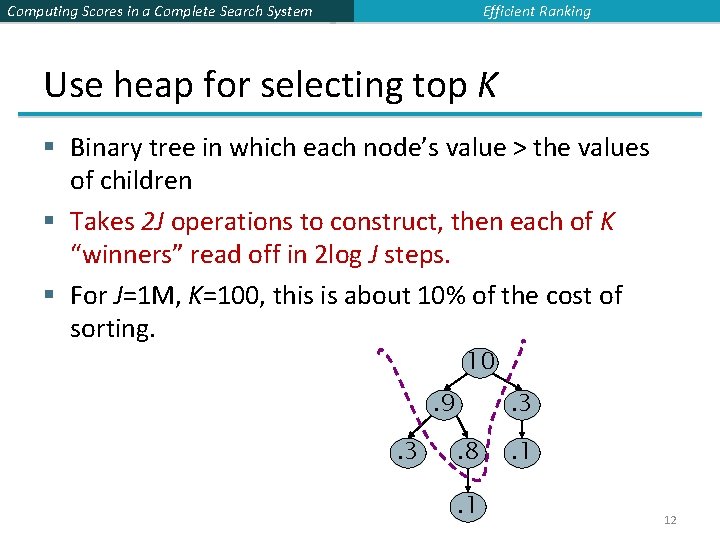
Efficient Ranking Computing Scores in a Complete Search System Use heap for selecting top K § Binary tree in which each node’s value > the values of children § Takes 2 J operations to construct, then each of K “winners” read off in 2 log J steps. § For J=1 M, K=100, this is about 10% of the cost of sorting. 10 . 9. 3 . 3. 8. 1 12
Computing Scores in a Complete Search System Efficient Ranking Bottlenecks § Primary computational bottleneck in scoring: cosine computation § Can we avoid all this computation? § Yes, but may sometimes get it wrong § a doc not in the top K may creep into the list of K output docs § Is this such a bad thing? 13
Computing Scores in a Complete Search System Efficient Ranking Cosine similarity is only a proxy § User has a task and a query formulation § Cosine matches docs to query § Thus cosine is anyway a proxy for user happiness § If we get a list of K docs “close” to the top K by cosine measure, should be ok 14
Computing Scores in a Complete Search System Efficient Ranking Generic approach § Find a set A of contenders, with K < |A| << N § A does not necessarily contain the top K, but has many docs from among the top K § Return the top K docs in A § Think of A as pruning non-contenders § The same approach is also used for other (noncosine) scoring functions § Will look at several schemes following this approach 15
Computing Scores in a Complete Search System Efficient Ranking Index elimination § Basic algorithm Fast. Cosine. Score of Fig 7. 1 only considers docs containing at least one query term § Take this further: § Only consider high-idf query terms § Only consider docs containing many query terms 16
Computing Scores in a Complete Search System Efficient Ranking High-idf query terms only § For a query such as catcher in the rye § Only accumulate scores from catcher and rye § Intuition: in and the contribute little to the scores and so don’t alter rank-ordering much § Benefit: § Postings of low-idf terms have many docs these (many) docs get eliminated from set A of contenders 17
Computing Scores in a Complete Search System Efficient Ranking Docs containing many query terms § Any doc with at least one query term is a candidate for the top K output list § For multi-term queries, only compute scores for docs containing several of the query terms § Say, at least 3 out of 4 § Imposes a “soft conjunction” on queries seen on web search engines (early Google) § Easy to implement in postings traversal 18
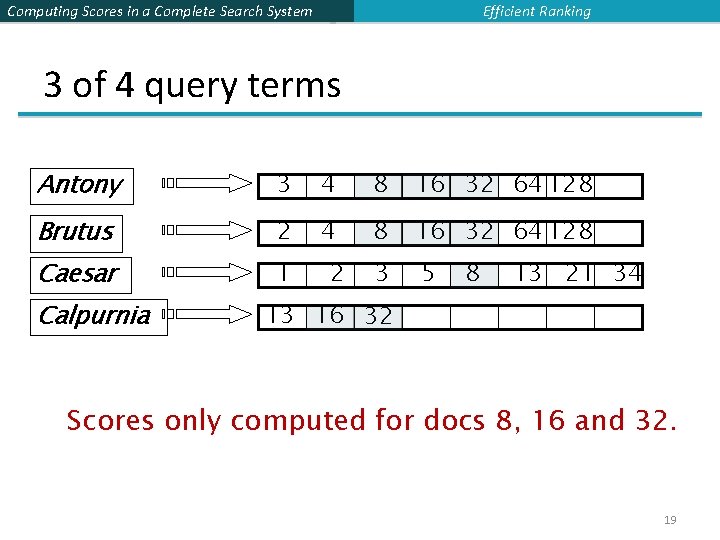
Efficient Ranking Computing Scores in a Complete Search System 3 of 4 query terms Antony 3 4 8 16 32 64 128 Brutus 2 4 8 16 32 64 128 Caesar 1 3 5 Calpurnia 2 8 13 21 34 13 16 32 Scores only computed for docs 8, 16 and 32. 19
Computing Scores in a Complete Search System Efficient Ranking Champion lists § Precompute for each dictionary term t, the r docs of highest weight in t’s postings § Call this the champion list for t § (aka fancy list or top docs for t) § Note that r has to be chosen at index build time § Thus, it’s possible that r < K § At query time, only compute scores for docs in the champion list of some query term § Pick the K top-scoring docs from amongst these 20
Computing Scores in a Complete Search System Efficient Ranking Exercises § How do Champion Lists relate to Index Elimination? Can they be used together? § How can Champion Lists be implemented in an inverted index? § Note that the champion list has nothing to do with small doc. IDs 21
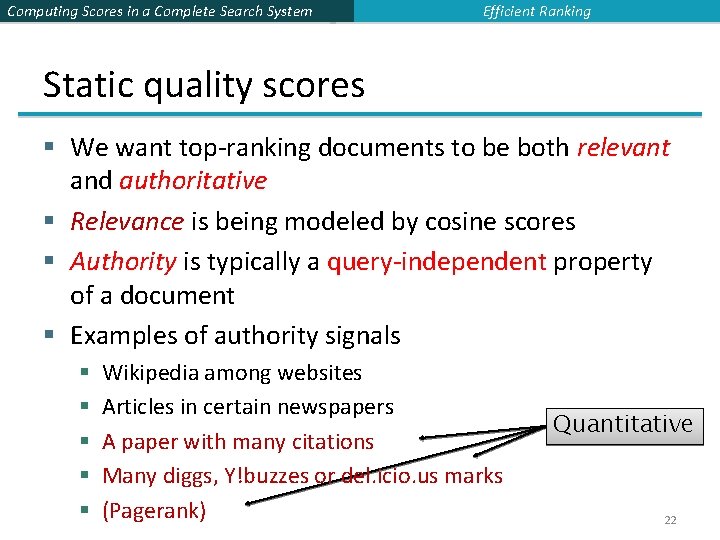
Computing Scores in a Complete Search System Efficient Ranking Static quality scores § We want top-ranking documents to be both relevant and authoritative § Relevance is being modeled by cosine scores § Authority is typically a query-independent property of a document § Examples of authority signals § § § Wikipedia among websites Articles in certain newspapers A paper with many citations Many diggs, Y!buzzes or del. icio. us marks (Pagerank) Quantitative 22
Computing Scores in a Complete Search System Efficient Ranking Modeling authority § Assign to each document a query-independent quality score in [0, 1] to each document d § Denote this by g(d) § Thus, a quantity like the number of citations is scaled into [0, 1] § Exercise: suggest a formula for this. 23
Computing Scores in a Complete Search System Efficient Ranking Net score § Consider a simple total score combining cosine relevance and authority § net-score(q, d) = g(d) + cosine(q, d) § Can use some other linear combination than an equal weighting § Indeed, any function of the two “signals” of user happiness – more later § Now we seek the top K docs by net score 24
Computing Scores in a Complete Search System Efficient Ranking Top K by net score – fast methods § First idea: Order all postings by g(d) § Key: this is a common ordering for all postings § Thus, can concurrently traverse query terms’ postings for § Postings intersection § Cosine score computation 25
Computing Scores in a Complete Search System Efficient Ranking Why order postings by g(d)? § Under g(d)-ordering, top-scoring docs likely to appear early in postings traversal § In time-bound applications (say, we have to return whatever search results we can in 50 ms), this allows us to stop postings traversal early § Short of computing scores for all docs in postings 26
Computing Scores in a Complete Search System Efficient Ranking Champion lists in g(d)-ordering § Can combine champion lists with g(d)-ordering § Maintain for each term a champion list of the r docs with highest g(d) + tf-idftd § Seek top-K results from only the docs in these champion lists 27
Computing Scores in a Complete Search System Efficient Ranking High and low lists § For each term, we maintain two postings lists called high and low § Think of high as the champion list § When traversing postings on a query, only traverse high lists first § If we get more than K docs, select the top K and stop § Else proceed to get docs from the low lists § Can be used even for simple cosine scores, without global quality g(d) § A means for segmenting index into two tiers 28
Computing Scores in a Complete Search System Efficient Ranking Impact-ordered postings § We only want to compute scores for docs for which wft, d is high enough § We sort each postings list by wft, d § Now: not all postings in a common order! § How do we compute scores in order to pick off top K? § Two ideas follow 29
Computing Scores in a Complete Search System Efficient Ranking 1. Early termination § When traversing t’s postings, stop early after either § a fixed number of r docs § wft, d drops below some threshold § Take the union of the resulting sets of docs § One from the postings of each query term § Compute only the scores for docs in this union 30
Computing Scores in a Complete Search System Efficient Ranking 2. idf-ordered terms § When considering the postings of query terms § Look at them in order of decreasing idf § High idf terms likely to contribute most to score § As we update score contribution from each query term § Stop if doc scores relatively unchanged § Can apply to cosine or some other net scores 31
Computing Scores in a Complete Search System Efficient Ranking Cluster pruning: preprocessing § Pick N docs at random: call these leaders § For every other doc, pre-compute nearest leader § Docs attached to a leader: its followers; § Likely: each leader has ~ N followers. 32
Computing Scores in a Complete Search System Efficient Ranking Cluster pruning: query processing § Process a query as follows: § Given query Q, find its nearest leader L. § Seek K nearest docs from among L’s followers. 33
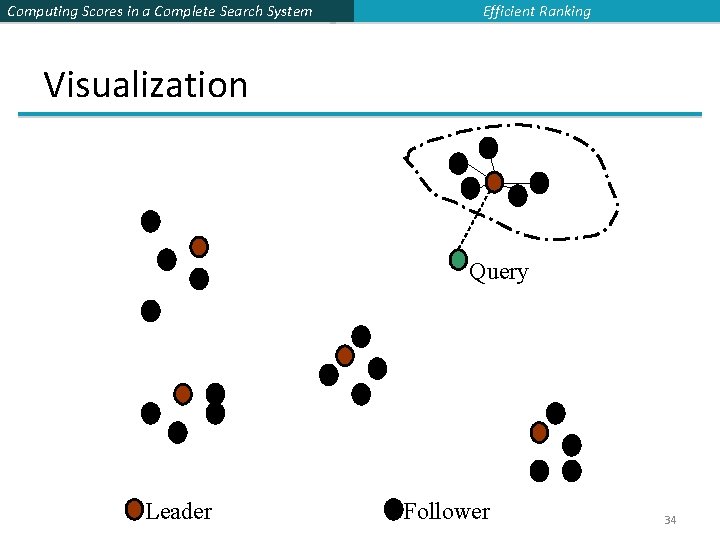
Computing Scores in a Complete Search System Efficient Ranking Visualization Query Leader Follower 34
Computing Scores in a Complete Search System Efficient Ranking Why use random sampling § Fast § Leaders reflect data distribution 35
Computing Scores in a Complete Search System Efficient Ranking General variants § Have each follower attached to b 1=3 (say) nearest leaders. § From query, find b 2=4 (say) nearest leaders and their followers. § Can recur on leader/follower construction. 36
Computing Scores in a Complete Search System Efficient Ranking Exercises § To find the nearest leader in step 1, how many cosine computations do we do? § Why did we have N in the first place? § What is the effect of the constants b 1, b 2 on the previous slide? § Devise an example where this is likely to fail – i. e. , we miss one of the K nearest docs. § Likely under random sampling. 37
Computing Scores in a Complete Search System Parametric and Zone Indexes Parametric and zone indexes § Thus far, a doc has been a sequence of terms § In fact documents have multiple parts, some with special semantics: § § § Author Title Date of publication Language Format etc. § These constitute the metadata about a document 38
Computing Scores in a Complete Search System Parametric and Zone Indexes Fields § We sometimes wish to search by these metadata § E. g. , find docs authored by William Shakespeare in the year 1601, containing alas poor Yorick § Year = 1601 is an example of a field § Also, author last name = shakespeare, etc § Field or parametric index: postings for each field value § Sometimes build range trees (e. g. , for dates) § Field query typically treated as conjunction § (doc must be authored by shakespeare) 39
Computing Scores in a Complete Search System Parametric and Zone Indexes Zone § A zone is a region of the doc that can contain an arbitrary amount of text e. g. , § Title § Abstract § References … § Build inverted indexes on zones as well to permit querying § E. g. , “find docs with merchant in the title zone and matching the query gentle rain” 40
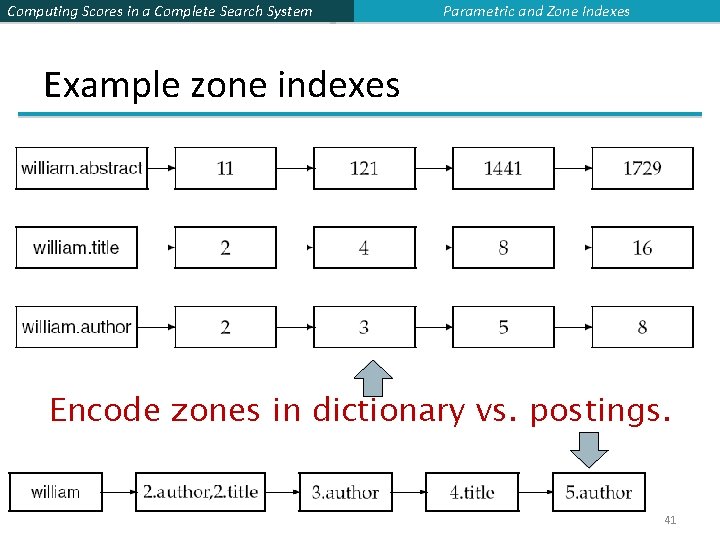
Computing Scores in a Complete Search System Parametric and Zone Indexes Example zone indexes Encode zones in dictionary vs. postings. 41
Computing Scores in a Complete Search System Components of a IR System Tiered indexes § Break postings up into a hierarchy of lists § Most important § … § Least important § Can be done by g(d) or another measure § Inverted index thus broken up into tiers of decreasing importance § At query time use top tier unless it fails to yield K docs § If so drop to lower tiers 42
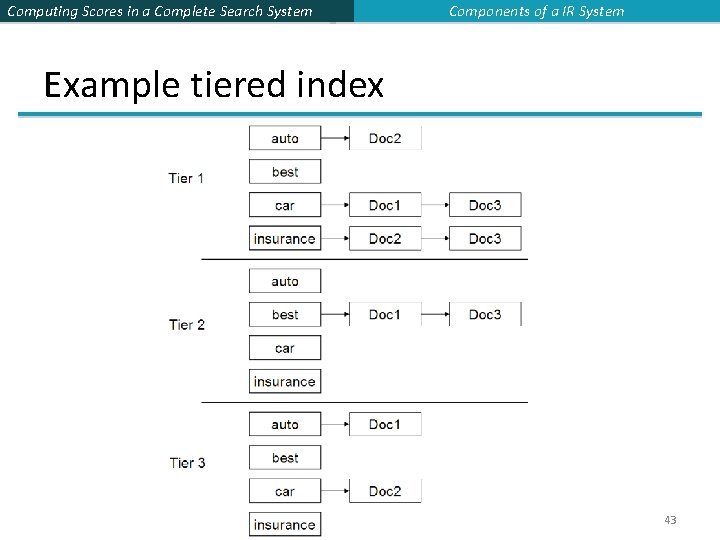
Computing Scores in a Complete Search System Components of a IR System Example tiered index 43
Computing Scores in a Complete Search System Components of a IR System Query term proximity § Free text queries: just a set of terms typed into the query box – common on the web § Users prefer docs in which query terms occur within close proximity of each other § Let w be the smallest window in a doc containing all query terms, e. g. , § For the query strained mercy the smallest window in the doc The quality of mercy is not strained is 4 (words) § Would like scoring function to take this into account – how? 44
Computing Scores in a Complete Search System Components of a IR System Query parsers § Free text query from user may in fact spawn one or more queries to the indexes, e. g. query rising interest rates § Run the query as a phrase query § If <K docs contain the phrase rising interest rates, run the two phrase queries rising interest and interest rates § If we still have <K docs, run the vector space query rising interest rates § Rank matching docs by vector space scoring § This sequence is issued by a query parser 45
Computing Scores in a Complete Search System Components of a IR System Aggregate scores § We’ve seen that score functions can combine cosine, static quality, proximity, etc. § How do we know the best combination? § Some applications – expert-tuned § Increasingly common: machine-learned § See later lectures 46
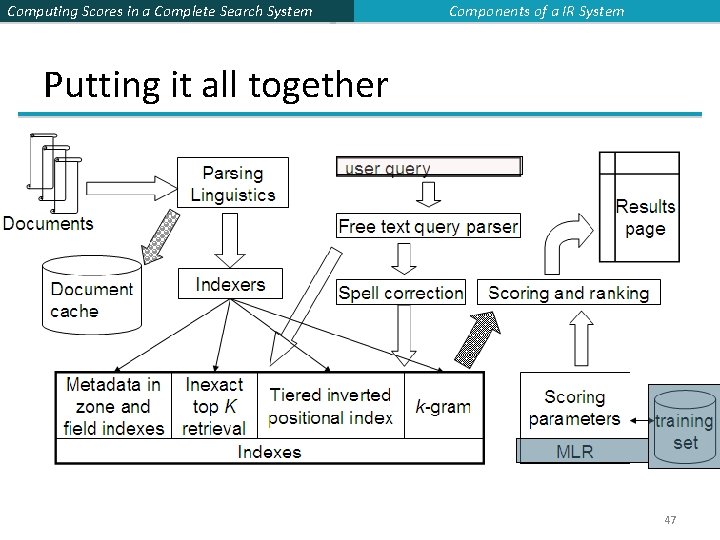
Computing Scores in a Complete Search System Components of a IR System Putting it all together 47
Computing Scores in a Complete Search System Resources § IIR 7, 6. 1 48
- Slides: 48