
Computing Polynomials with Positive Coefficients Using Stochastic Logic
- Slides: 1
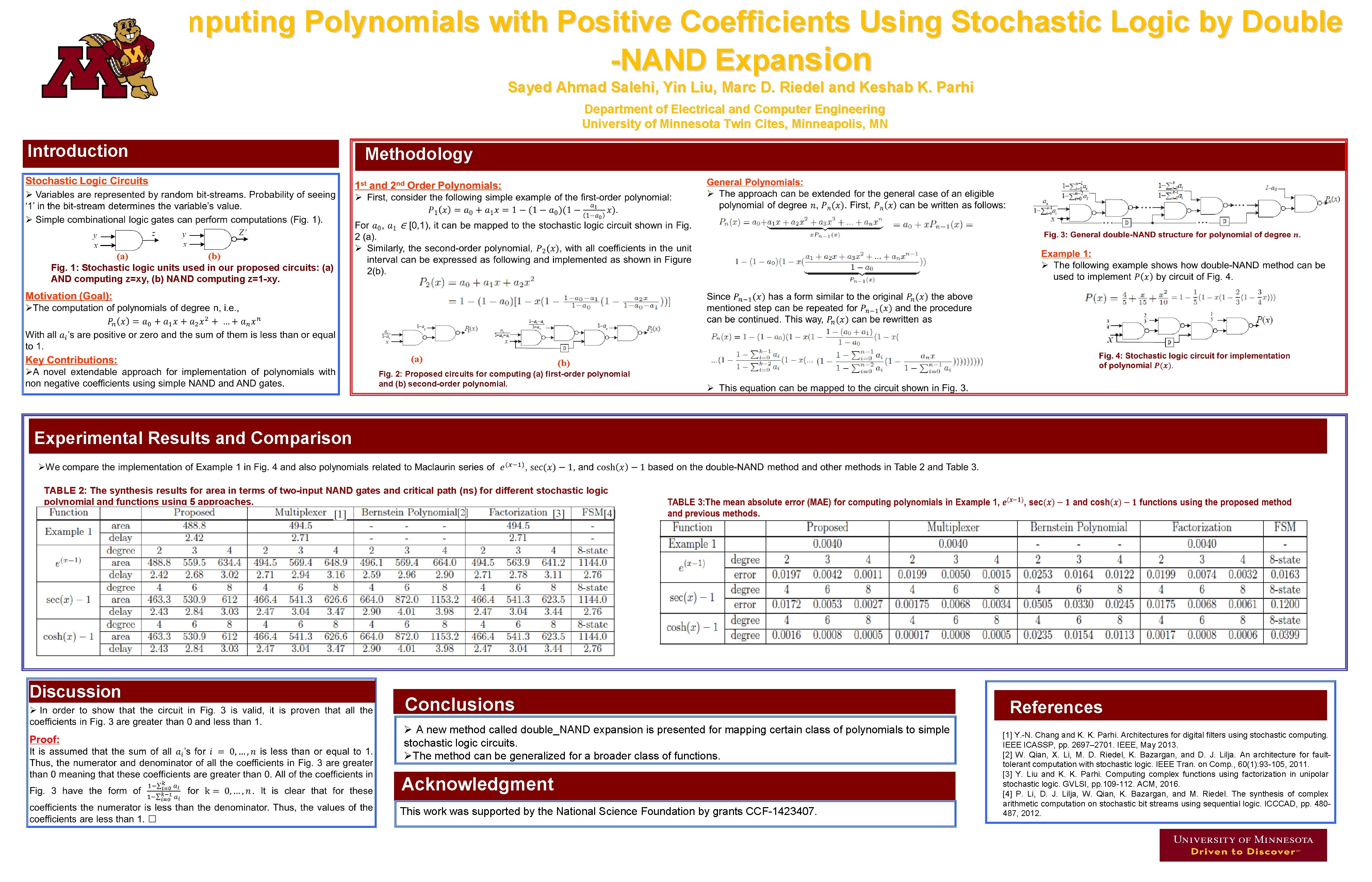
Computing Polynomials with Positive Coefficients Using Stochastic Logic by Double -NAND Expansion Sayed Ahmad Salehi, Yin Liu, Marc D. Riedel and Keshab K. Parhi Department of Electrical and Computer Engineering University of Minnesota Twin Cites, Minneapolis, MN Introduction Methodology (a) (b) Fig. 1: Stochastic logic units used in our proposed circuits: (a) AND computing z=xy, (b) NAND computing z=1 -xy. (a) (b) Fig. 2: Proposed circuits for computing (a) first-order polynomial and (b) second-order polynomial. Experimental Results and Comparison TABLE 2: The synthesis results for area in terms of two-input NAND gates and critical path (ns) for different stochastic logic polynomial and functions using 5 approaches. [2] [3] [4] [1] Discussion Conclusions Ø A new method called double_NAND expansion is presented for mapping certain class of polynomials to simple stochastic logic circuits. ØThe method can be generalized for a broader class of functions. Acknowledgment This work was supported by the National Science Foundation by grants CCF-1423407. References [1] Y. -N. Chang and K. K. Parhi. Architectures for digital filters using stochastic computing. IEEE ICASSP, pp. 2697– 2701. IEEE, May 2013. [2] W. Qian, X. Li, M. D. Riedel, K. Bazargan, and D. J. Lilja. An architecture for faulttolerant computation with stochastic logic. IEEE Tran. on Comp. , 60(1): 93 -105, 2011. [3] Y. Liu and K. K. Parhi. Computing complex functions using factorization in unipolar stochastic logic. GVLSI, pp. 109 -112. ACM, 2016. [4] P. Li, D. J. Lilja, W. Qian, K. Bazargan, and M. Riedel. The synthesis of complex arithmetic computation on stochastic bit streams using sequential logic. ICCCAD, pp. 480487, 2012.