
Computing Lesson 3 Tracing Algorithms Kashif Ahmed Materials

![Task 1 - Tracing code - part 2 1 lowest = items[0] 2 for](https://slidetodoc.com/presentation_image_h2/7aab21520a7ea2aa83ca721820470649/image-11.jpg "Task 1 - Tracing code - part 2 1 lowest = items[0] 2 for")
- Slides: 18
Computing Lesson 3: Tracing Algorithms Kashif Ahmed Materials from the Teach Computing Curriculum created by the National Centre for Computing Education 1
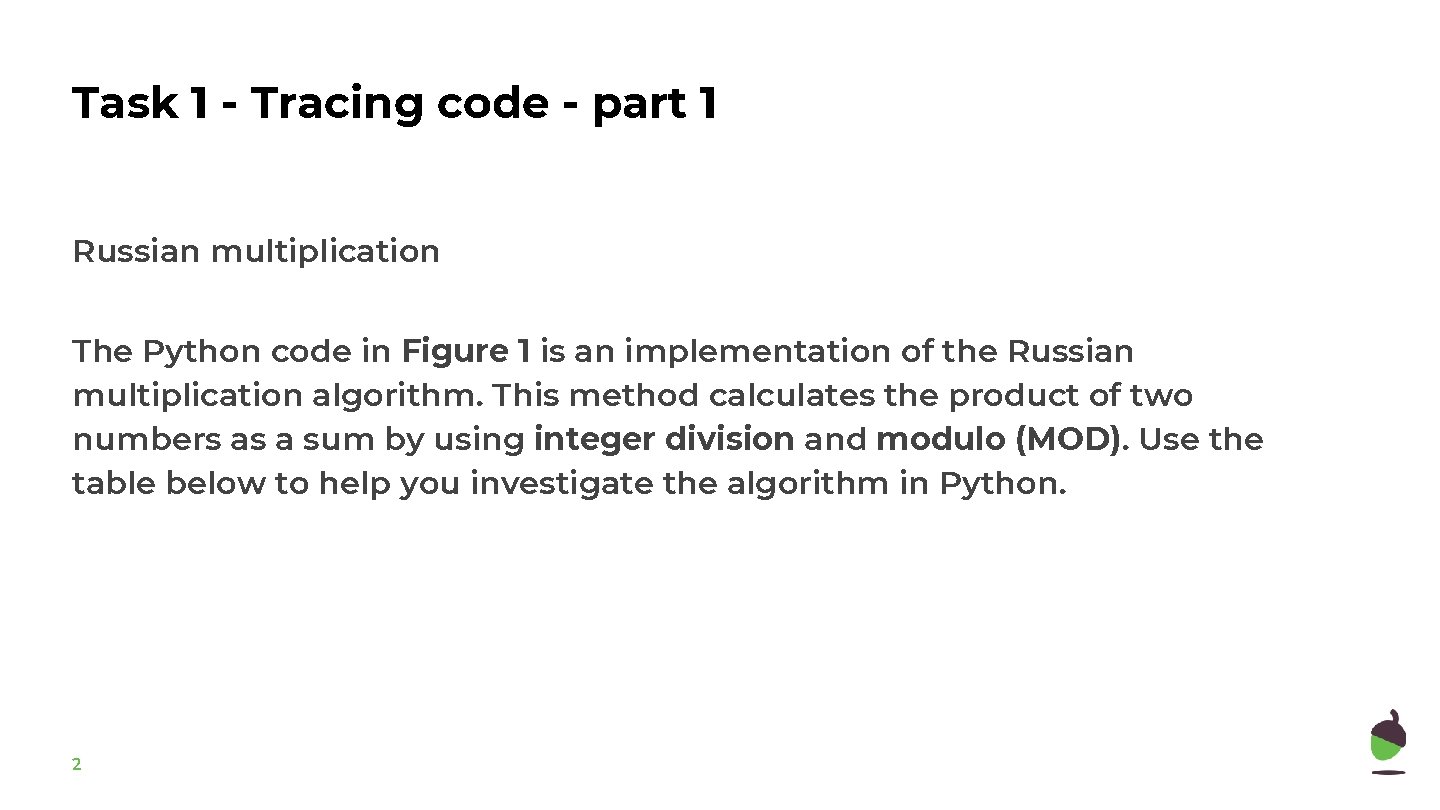
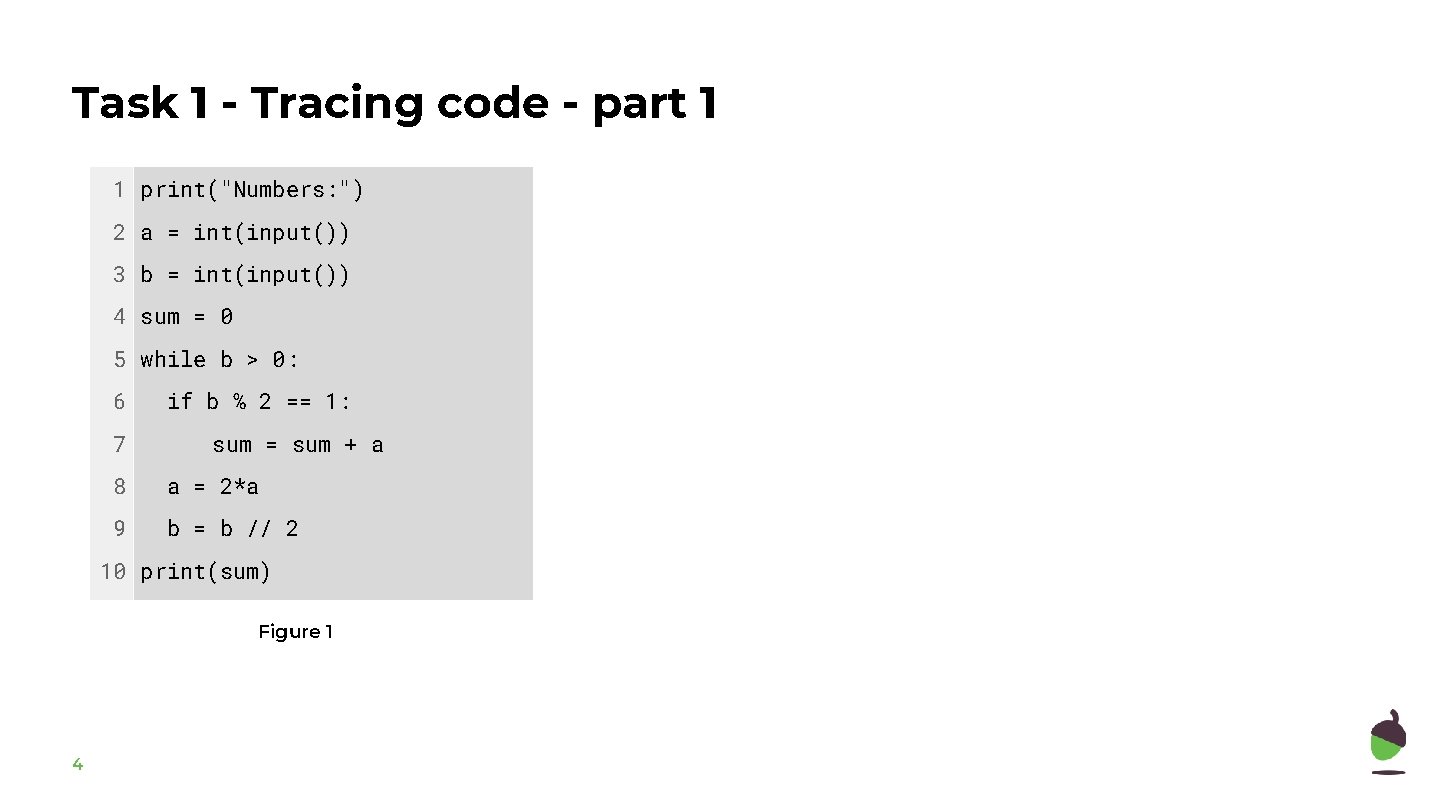
Task 1 - Tracing code - part 1 Russian multiplication The Python code in Figure 1 is an implementation of the Russian multiplication algorithm. This method calculates the product of two numbers as a sum by using integer division and modulo (MOD). Use the table below to help you investigate the algorithm in Python. 2
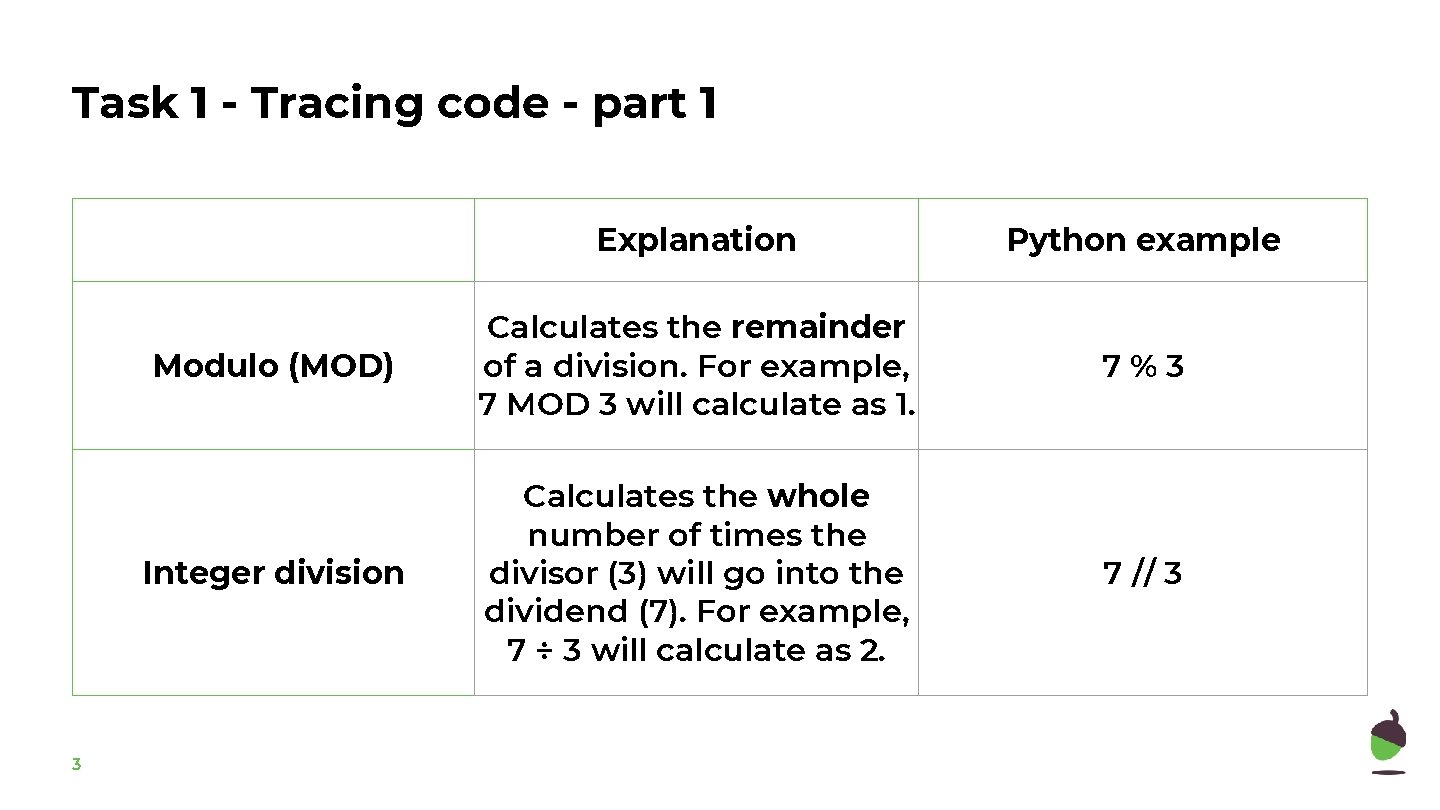
Task 1 - Tracing code - part 1 3 Explanation Python example Modulo (MOD) Calculates the remainder of a division. For example, 7 MOD 3 will calculate as 1. 7%3 Integer division Calculates the whole number of times the divisor (3) will go into the dividend (7). For example, 7 ÷ 3 will calculate as 2. 7 // 3
Task 1 - Tracing code - part 1 1 print("Numbers: ") 2 a = int(input()) 3 b = int(input()) 4 sum = 0 5 while b > 0: 6 7 if b % 2 == 1: sum = sum + a 8 a = 2*a 9 b = b // 2 10 print(sum) Figure 1 4
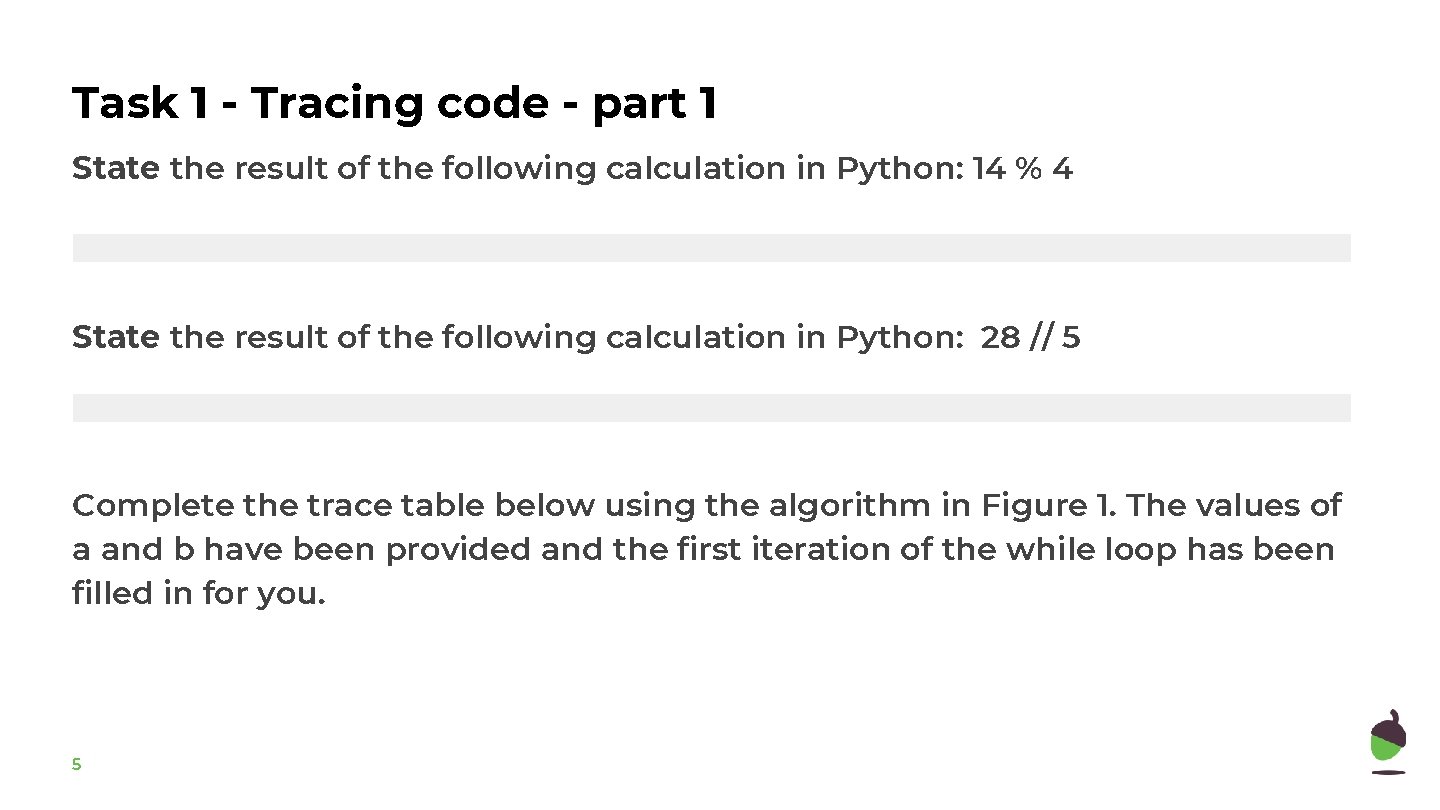
Task 1 - Tracing code - part 1 State the result of the following calculation in Python: 14 % 4 State the result of the following calculation in Python: 28 // 5 Complete the trace table below using the algorithm in Figure 1. The values of a and b have been provided and the first iteration of the while loop has been filled in for you. 5
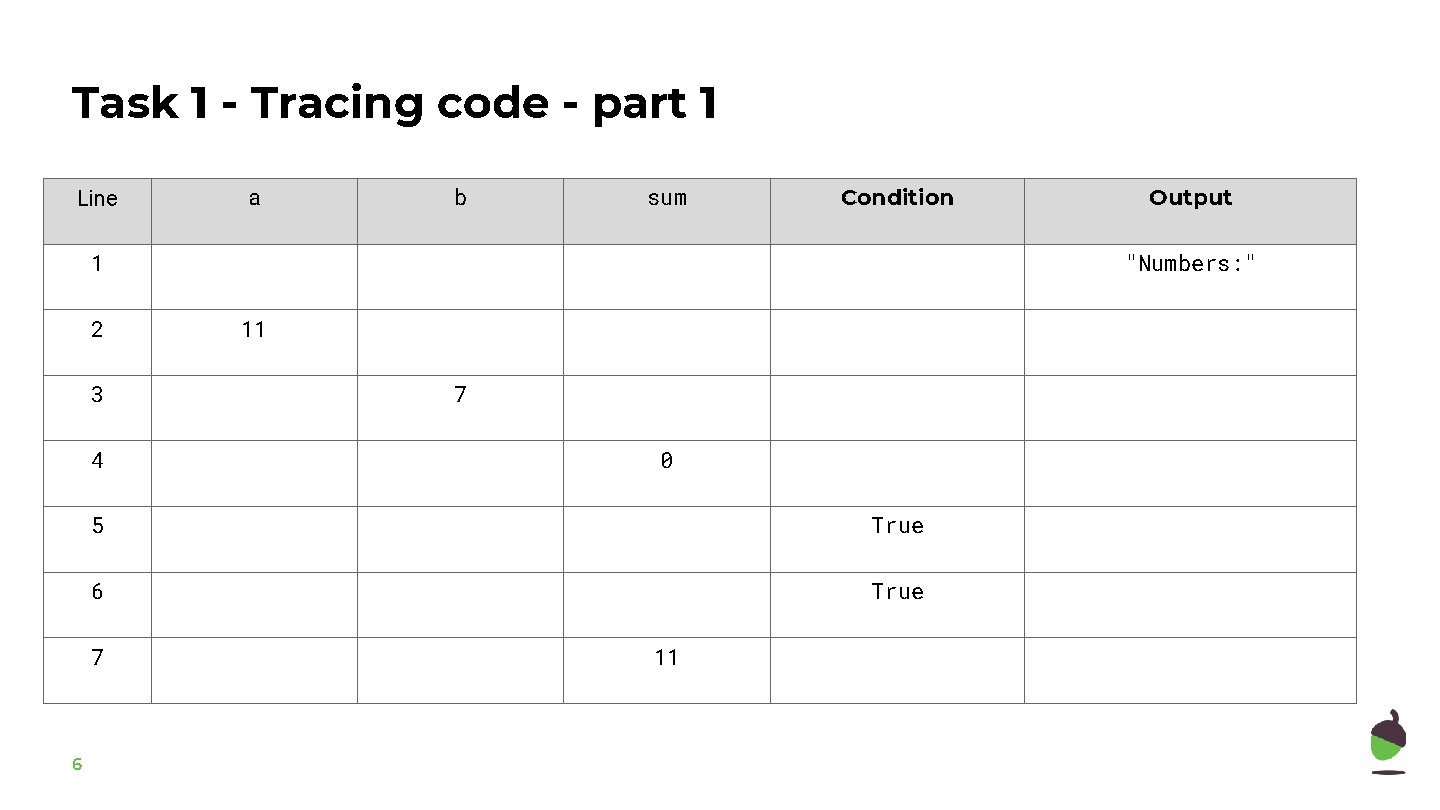
Task 1 - Tracing code - part 1 Line a b sum Condition 1 2 3 4 6 "Numbers: " 11 7 0 5 True 6 True 7 Output 11
Task 1 - Tracing code - part 1 Line a 8 22 9 5 7 b sum Condition 3 True Output
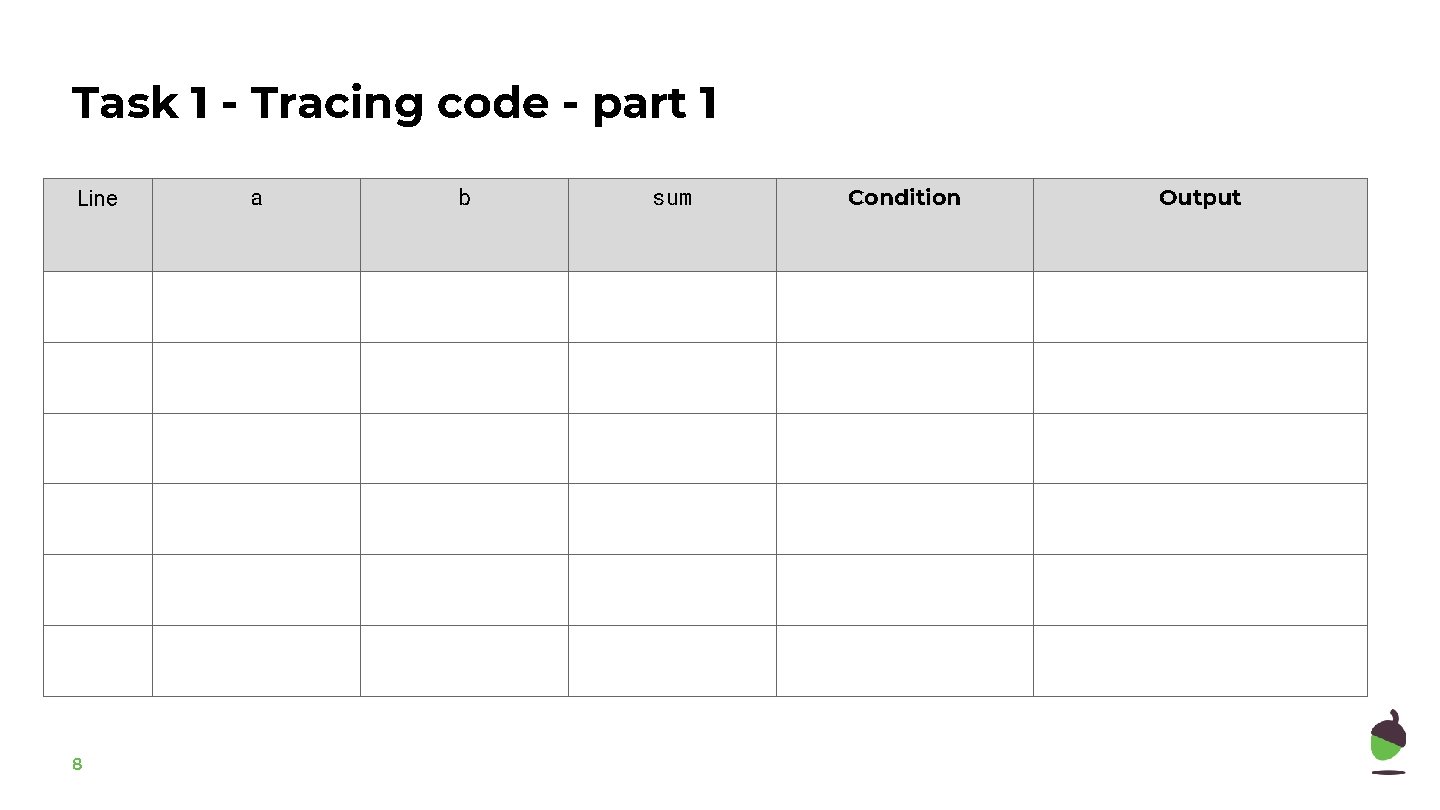
Task 1 - Tracing code - part 1 Line 8 a b sum Condition Output
Task 1 - Tracing code - part 1 Does the algorithm in Figure 1 loop infinitely, or not? Explain your answer. 9
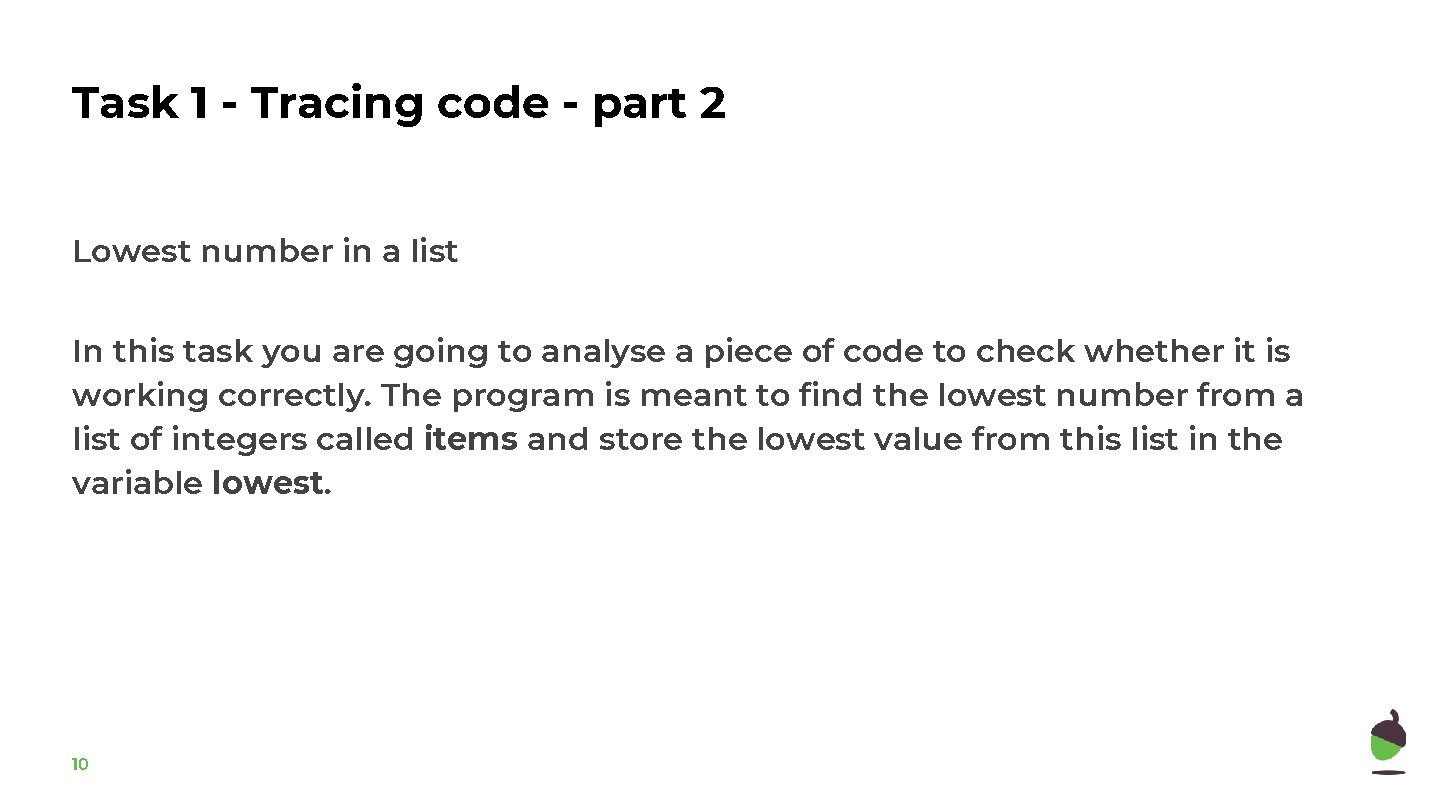
Task 1 - Tracing code - part 2 Lowest number in a list In this task you are going to analyse a piece of code to check whether it is working correctly. The program is meant to find the lowest number from a list of integers called items and store the lowest value from this list in the variable lowest. 10
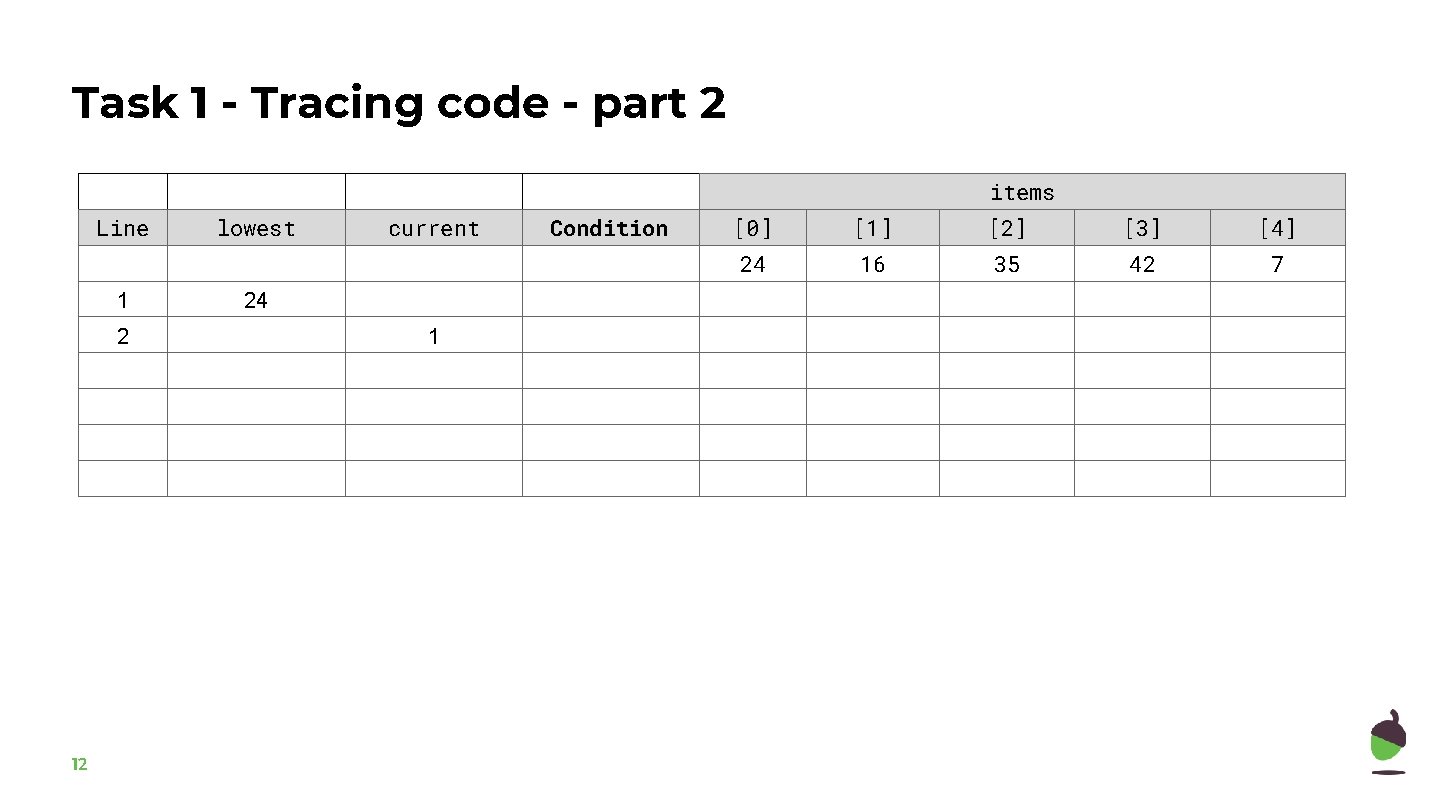
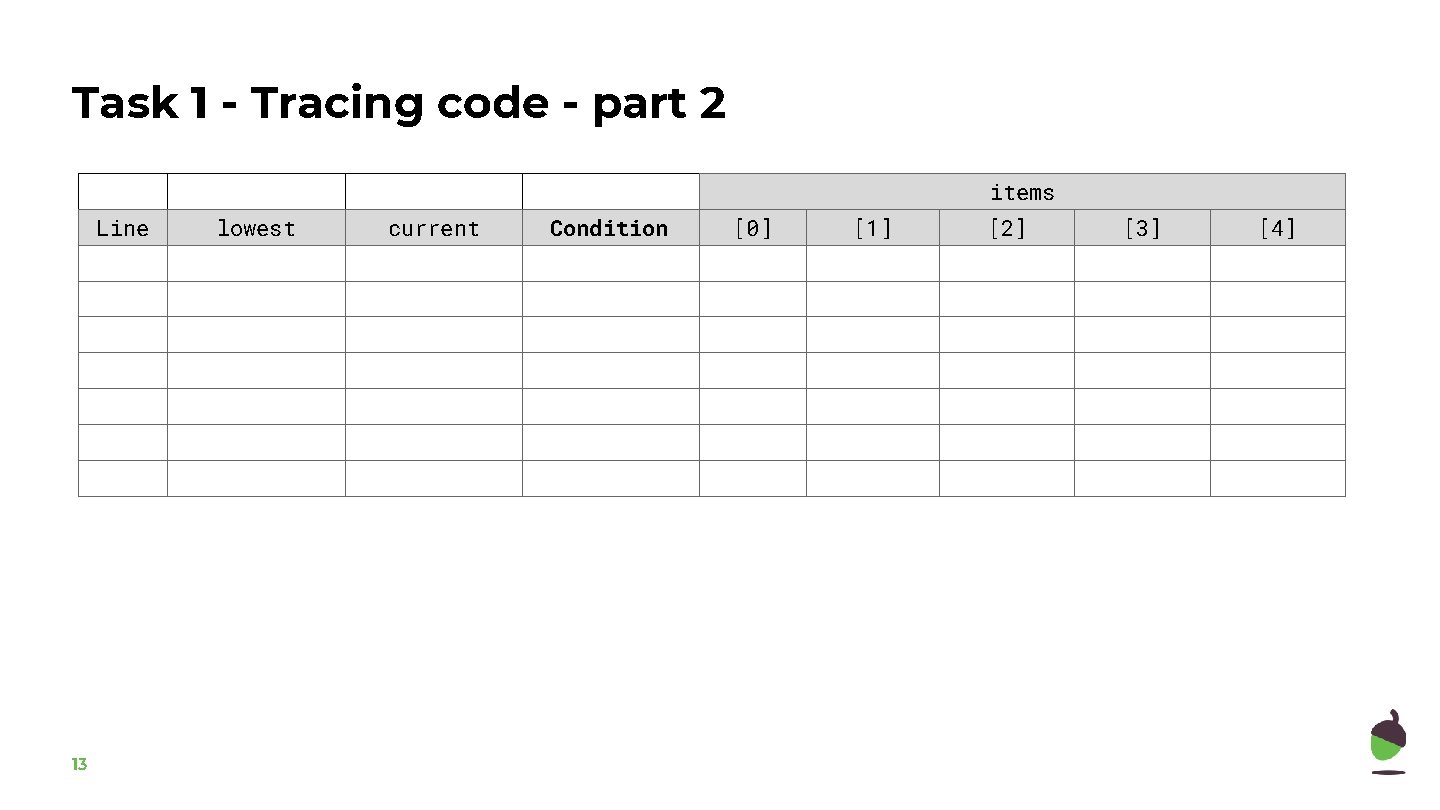
Task 1 - Tracing code - part 2 1 lowest = items[0] 2 for current in range(1, len(items)): 3 4 if lowest < items[current]: lowest = items[current] Figure 2 Complete the trace table below using the algorithm in Figure 2. The list of items and the first two lines of code have been filled in for you. 11
Task 1 - Tracing code - part 2 items Line 1 2 12 lowest current 24 1 Condition [0] [1] [2] [3] [4] 24 16 35 42 7
Task 1 - Tracing code - part 2 items Line 13 lowest current Condition [0] [1] [2] [3] [4]
Task 1 - Tracing code - part 2 Explain whether the algorithm in Figure 2 works as intended. 14
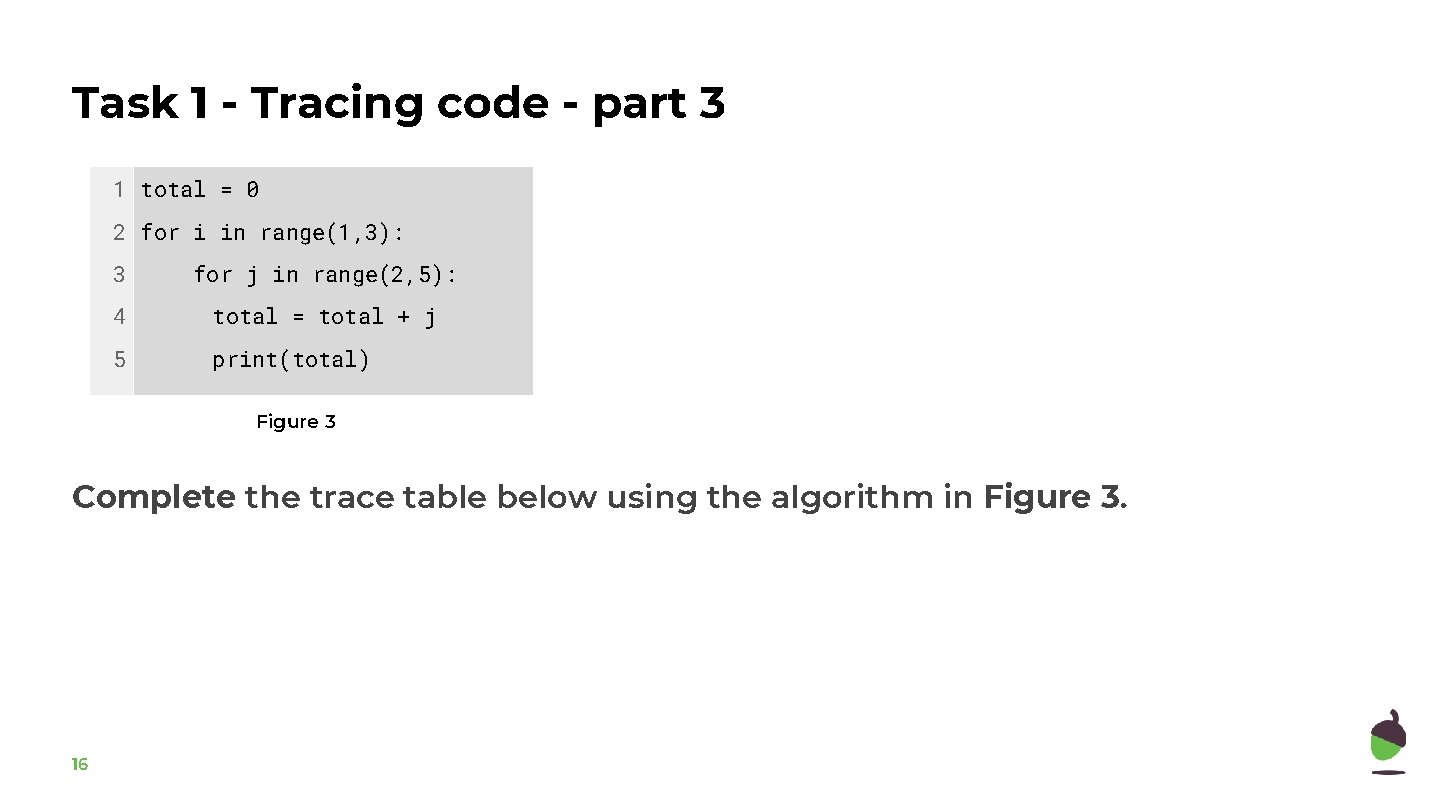
Task 1 - Tracing code - part 3 Nested loops The algorithm in Figure 3 contains a nested loop: a loop within a loop. The outer for loop has a lower number of iterations than the inner loop. Note that the end number of the range is not included in the generated sequence because it is used as the stop point. 15
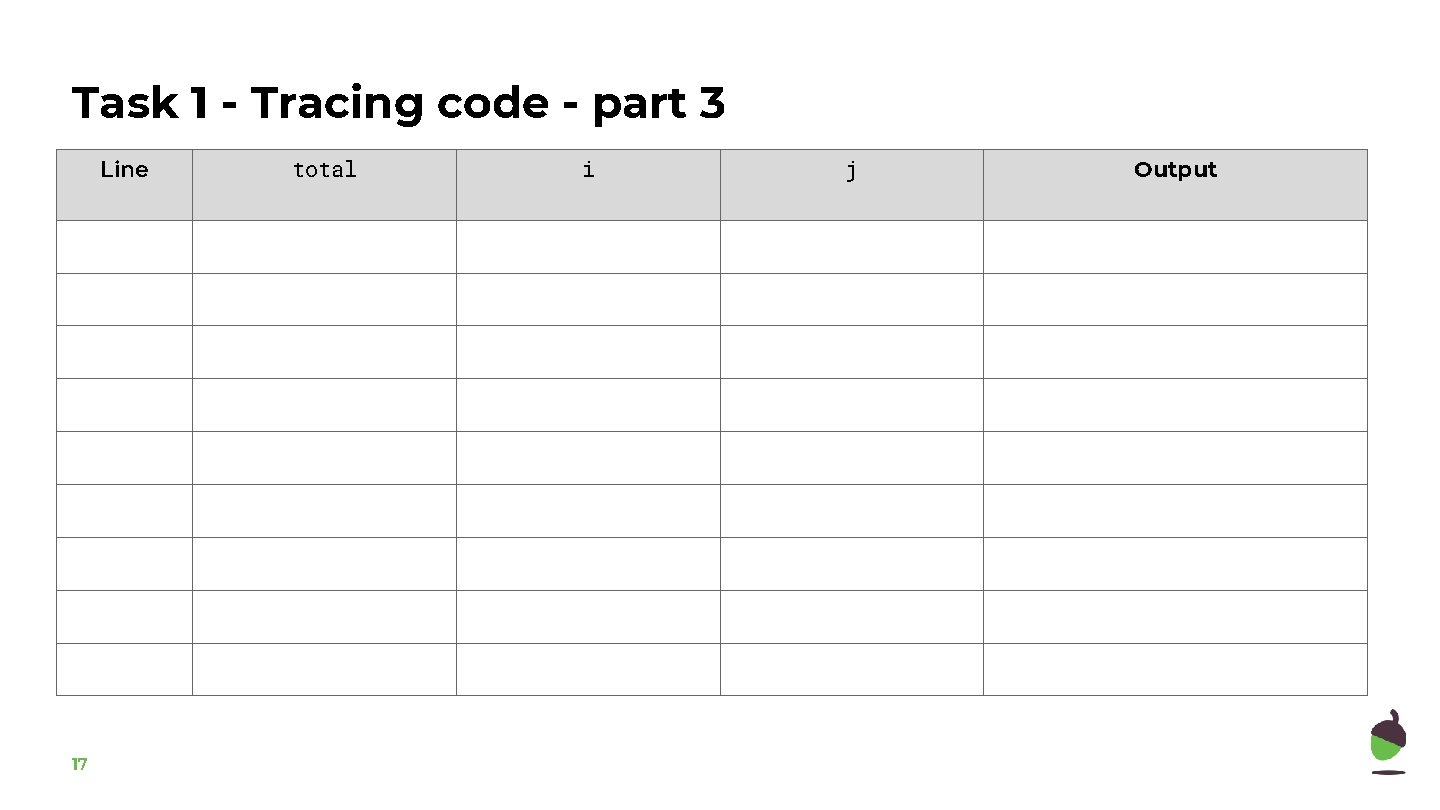
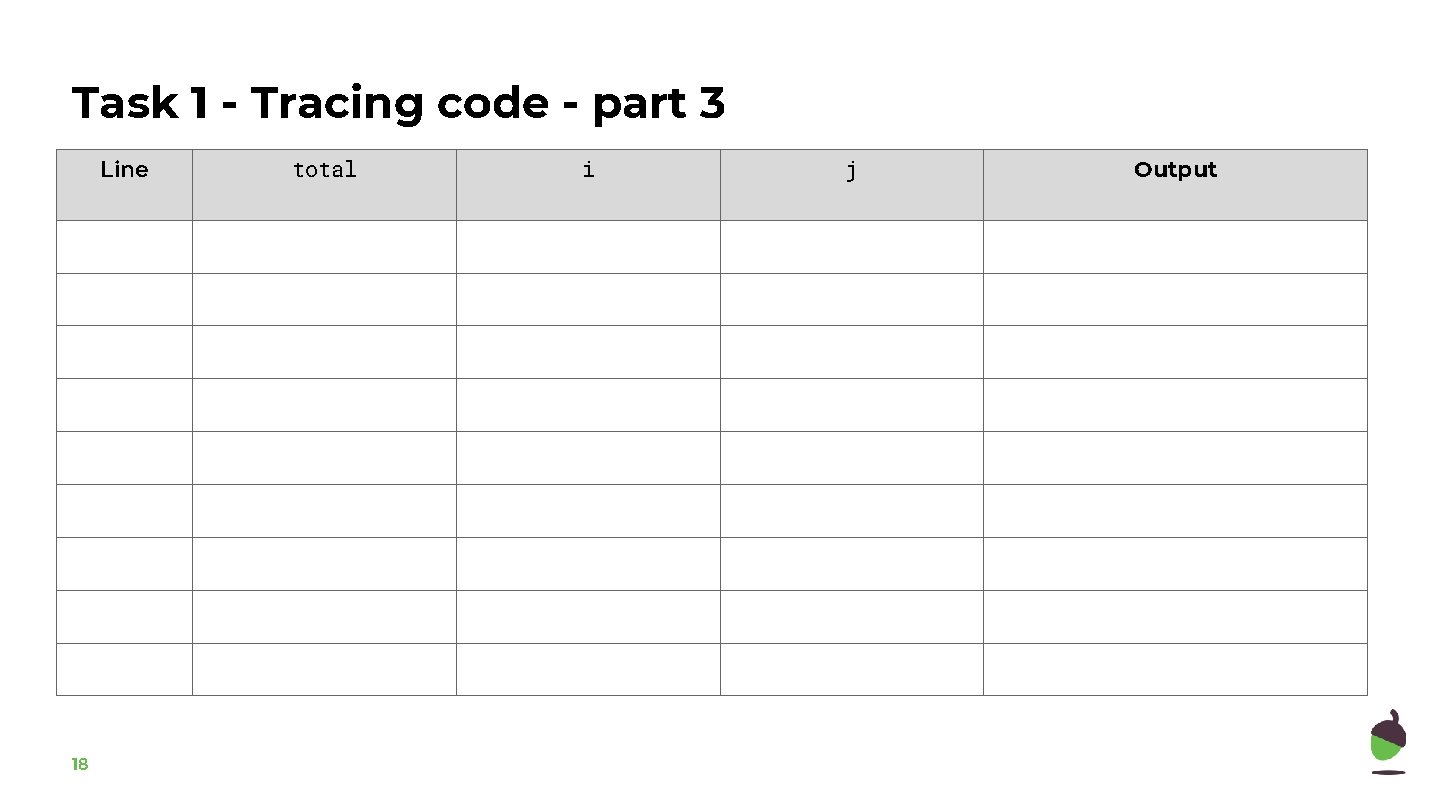
Task 1 - Tracing code - part 3 1 total = 0 2 for i in range(1, 3): 3 for j in range(2, 5): 4 total = total + j 5 print(total) Figure 3 Complete the trace table below using the algorithm in Figure 3. 16
Task 1 - Tracing code - part 3 Line 17 total i j Output
Task 1 - Tracing code - part 3 Line 18 total i j Output