
Computers How They Work 1 2 3 4

- Slides: 32
Computers: How They Work 1. 2. 3. 4. 5. 6. 7. 8. 9. 10. 11. 12. 13. 14. What is a Computer Components of Computer World’s First Computers and CPUs Mother Board Machine Code and the processor’s Instruction Set – Software Memory types (ROM, DRAM, SRAM, FLASH) Hard Drive Compact Disk Keyboard Monitor The Mouse Other I/O DSL and connection to Internet File Compression
Demonstrations ► ► PC Mother Boards Memory § § § ► ► Hard Drive Magnetic Tape Punch Cards CDs SIMM cards Polarized Films LCDs Keyboard CCD chips
What is a Computer? A machine that stores instructions and data and operates on information/data.
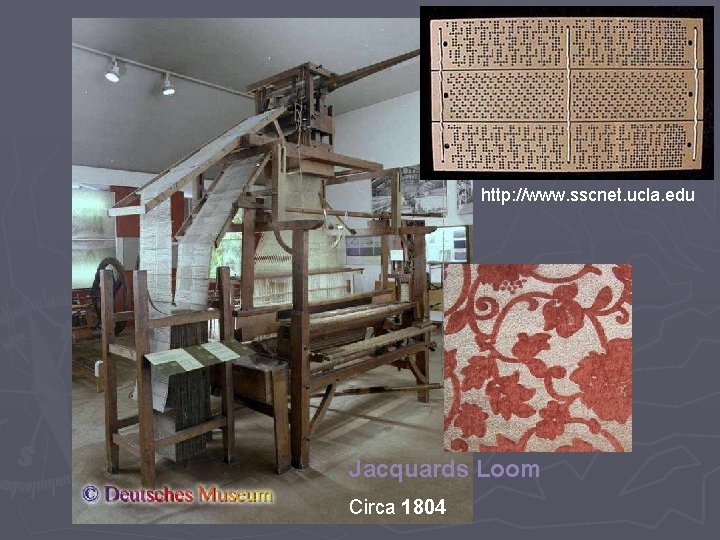
http: //www. sscnet. ucla. edu Jacquards Loom Circa 1804
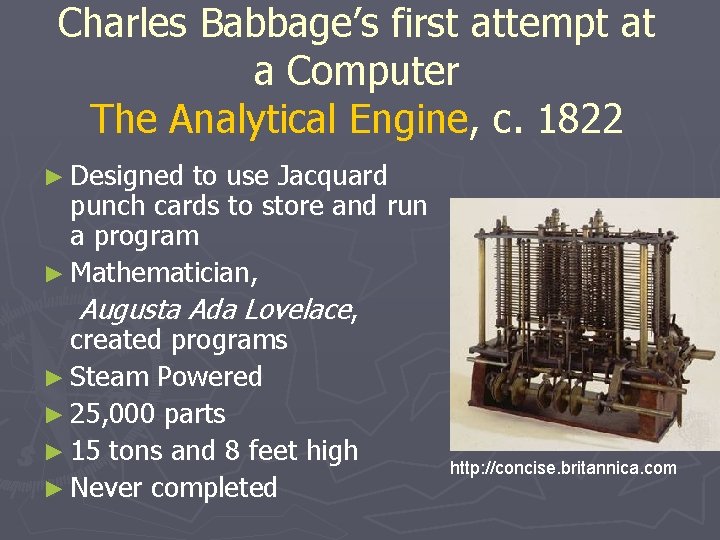
Charles Babbage’s first attempt at a Computer The Analytical Engine, c. 1822 ► Designed to use Jacquard punch cards to store and run a program ► Mathematician, Augusta Ada Lovelace, created programs ► Steam Powered ► 25, 000 parts ► 15 tons and 8 feet high ► Never completed http: //concise. britannica. com
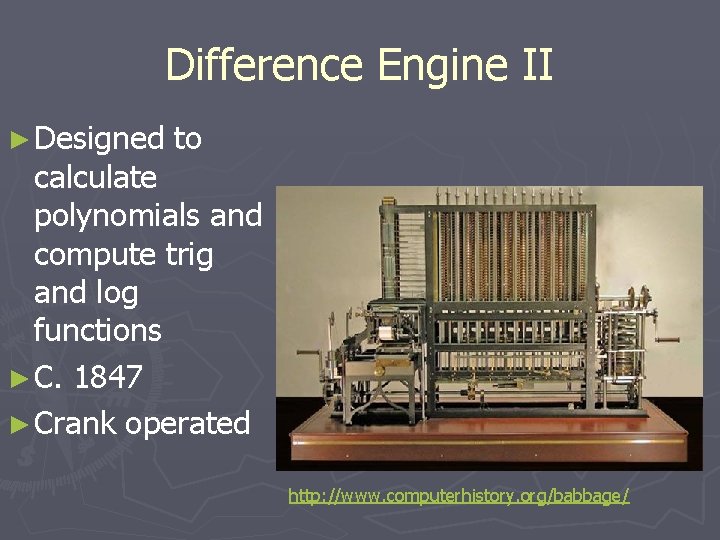
Difference Engine II ► Designed to calculate polynomials and compute trig and log functions ► C. 1847 ► Crank operated http: //www. computerhistory. org/babbage/
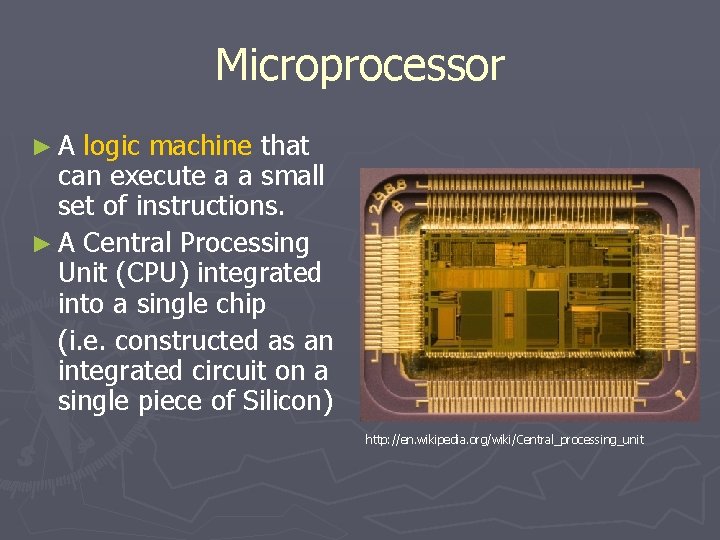
Microprocessor ►A logic machine that can execute a a small set of instructions. ► A Central Processing Unit (CPU) integrated into a single chip (i. e. constructed as an integrated circuit on a single piece of Silicon) http: //en. wikipedia. org/wiki/Central_processing_unit
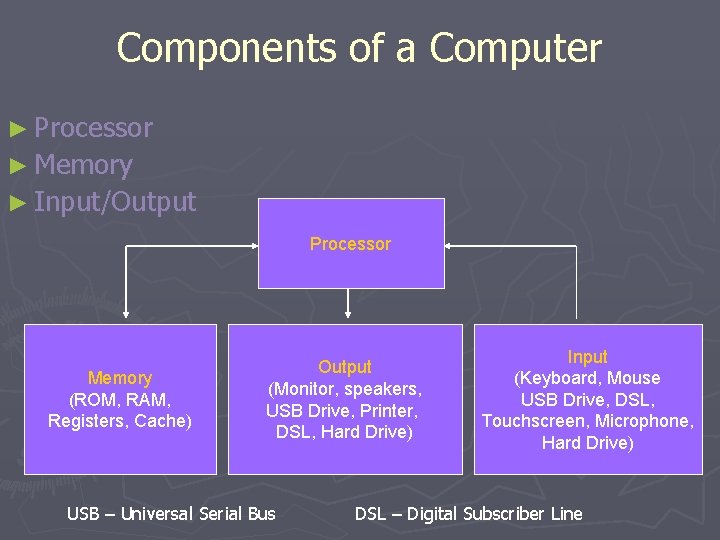
Components of a Computer ► Processor ► Memory ► Input/Output Processor Memory (ROM, RAM, Registers, Cache) Output (Monitor, speakers, USB Drive, Printer, DSL, Hard Drive) USB – Universal Serial Bus Input (Keyboard, Mouse USB Drive, DSL, Touchscreen, Microphone, Hard Drive) DSL – Digital Subscriber Line
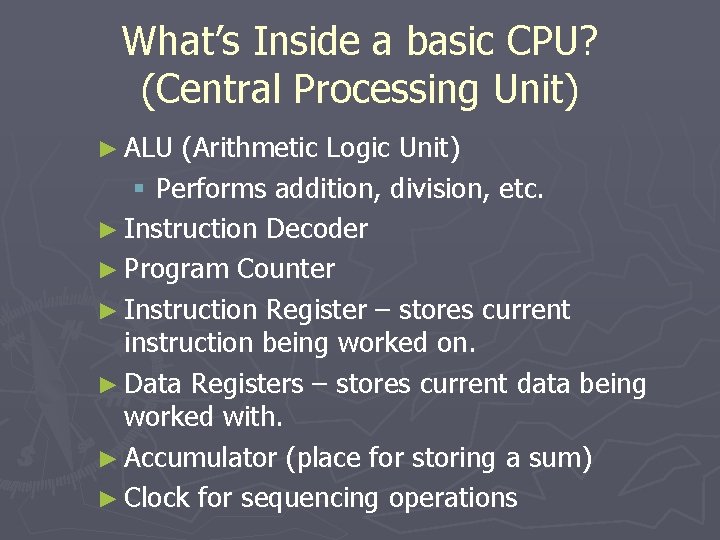
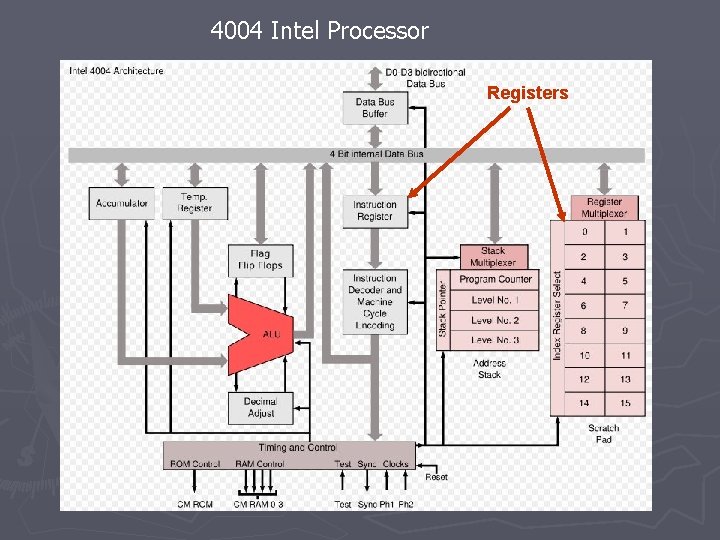
What’s Inside a basic CPU? (Central Processing Unit) ► ALU (Arithmetic Logic Unit) § Performs addition, division, etc. ► Instruction Decoder ► Program Counter ► Instruction Register – stores current instruction being worked on. ► Data Registers – stores current data being worked with. ► Accumulator (place for storing a sum) ► Clock for sequencing operations
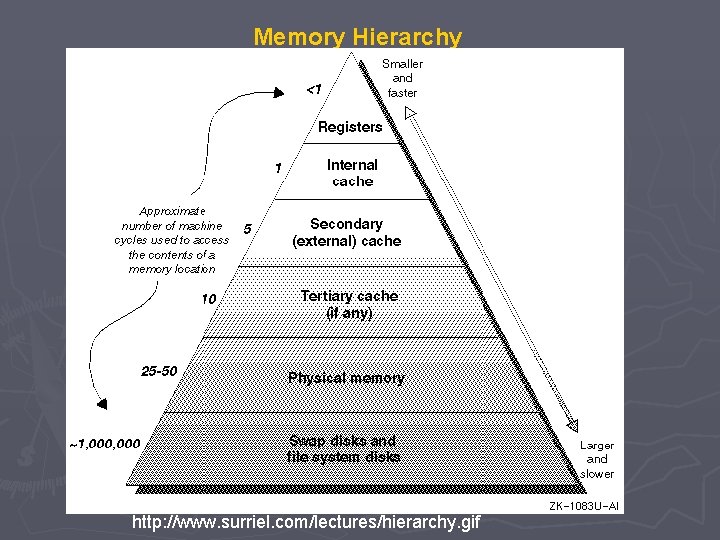
Memory – A Device that “remembers” a previous input. Registers are the high speed memory on the CPU chip. These registers are used for storing data that is frequently needed. Instructions are pre-fetched and stored in registers too so that they are ready when needed.
4004 Intel Processor Registers
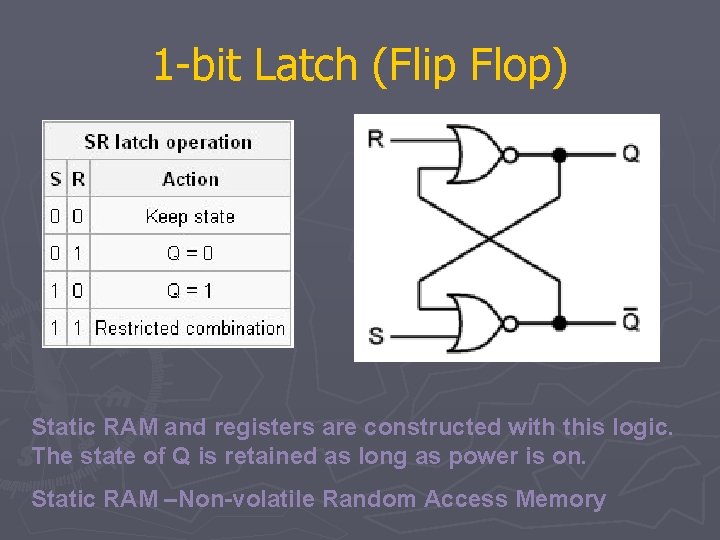
1 -bit Latch (Flip Flop) Static RAM and registers are constructed with this logic. The state of Q is retained as long as power is on. Static RAM –Non-volatile Random Access Memory
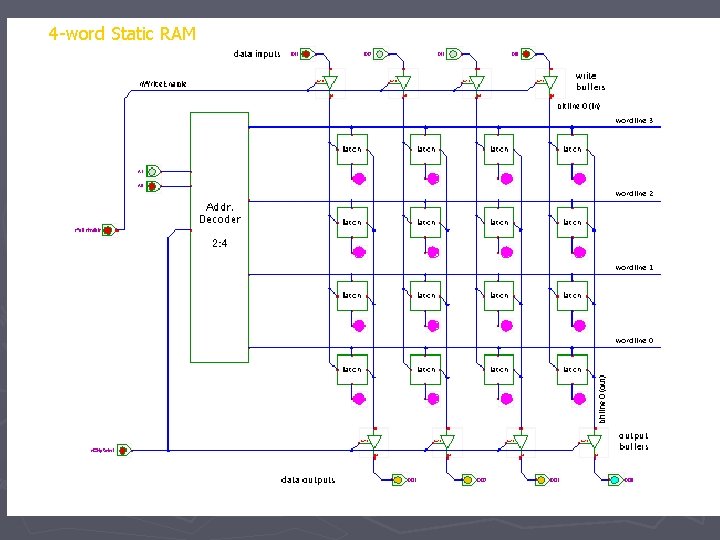
4 -word Static RAM
Memory Hierarchy http: //www. surriel. com/lectures/hierarchy. gif
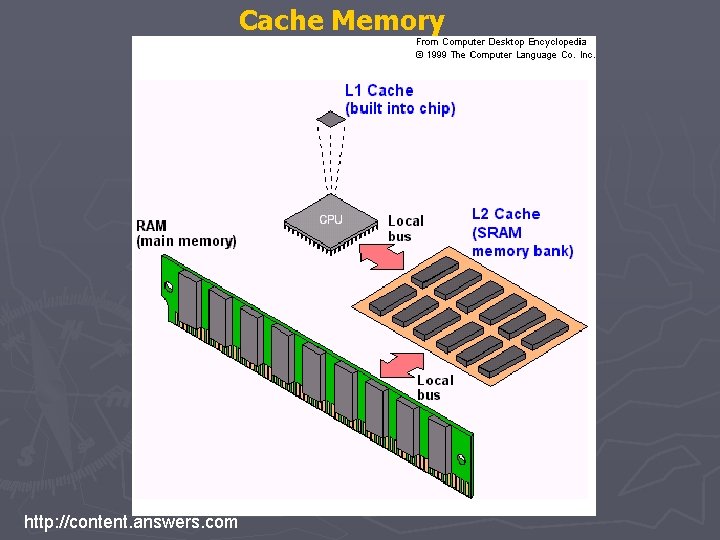
Cache Memory http: //content. answers. com
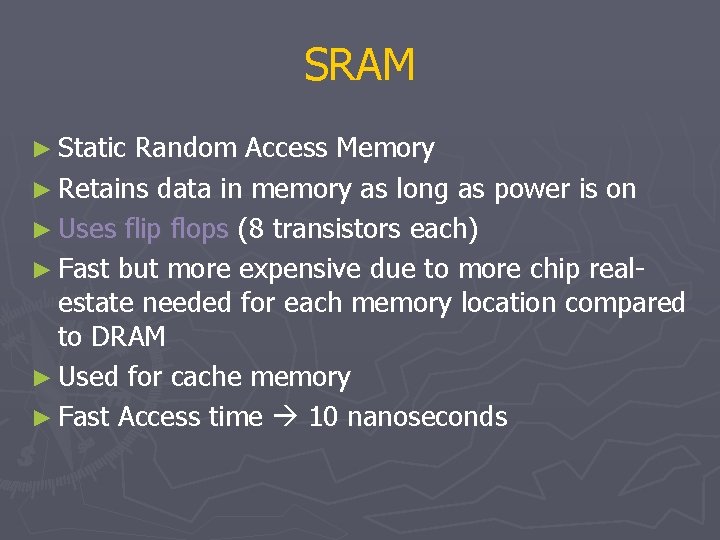
SRAM ► Static Random Access Memory ► Retains data in memory as long as power is on ► Uses flip flops (8 transistors each) ► Fast but more expensive due to more chip realestate needed for each memory location compared to DRAM ► Used for cache memory ► Fast Access time 10 nanoseconds
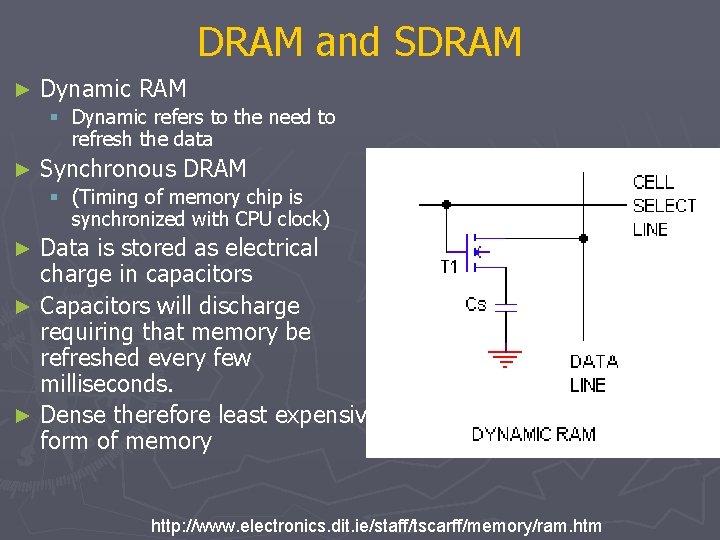
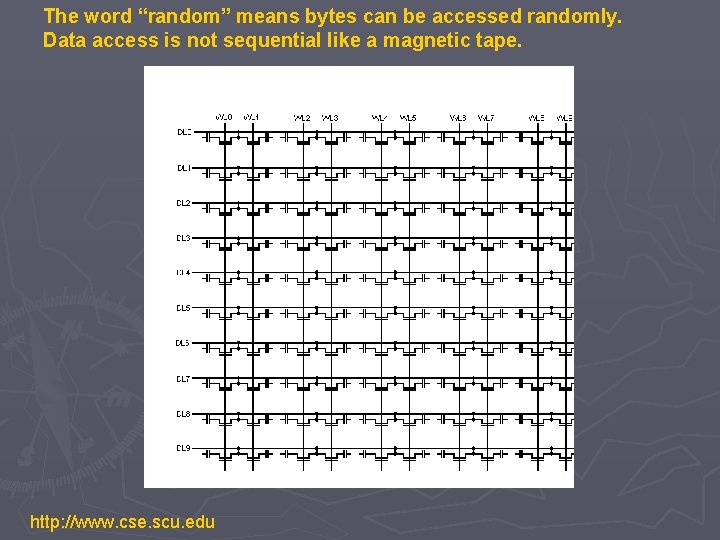
DRAM and SDRAM ► Dynamic RAM § Dynamic refers to the need to refresh the data ► Synchronous DRAM § (Timing of memory chip is synchronized with CPU clock) Data is stored as electrical charge in capacitors ► Capacitors will discharge requiring that memory be refreshed every few milliseconds. ► Dense therefore least expensive form of memory ► http: //www. electronics. dit. ie/staff/tscarff/memory/ram. htm
The word “random” means bytes can be accessed randomly. Data access is not sequential like a magnetic tape. http: //www. cse. scu. edu
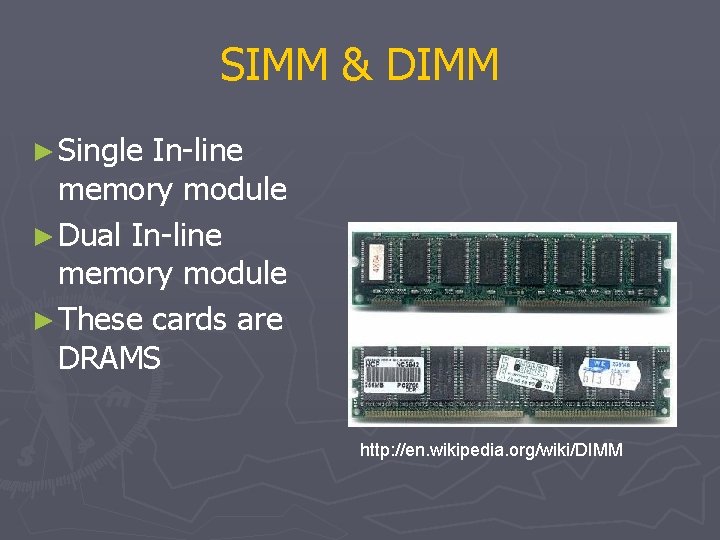
SIMM & DIMM ► Single In-line memory module ► Dual In-line memory module ► These cards are DRAMS http: //en. wikipedia. org/wiki/DIMM
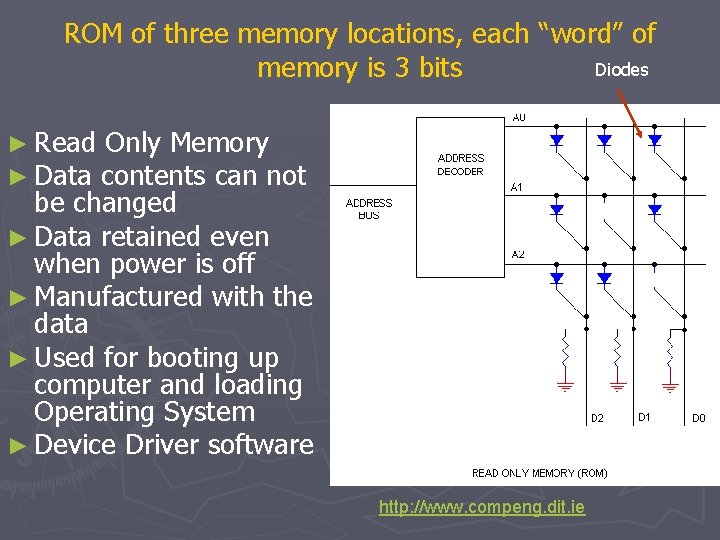
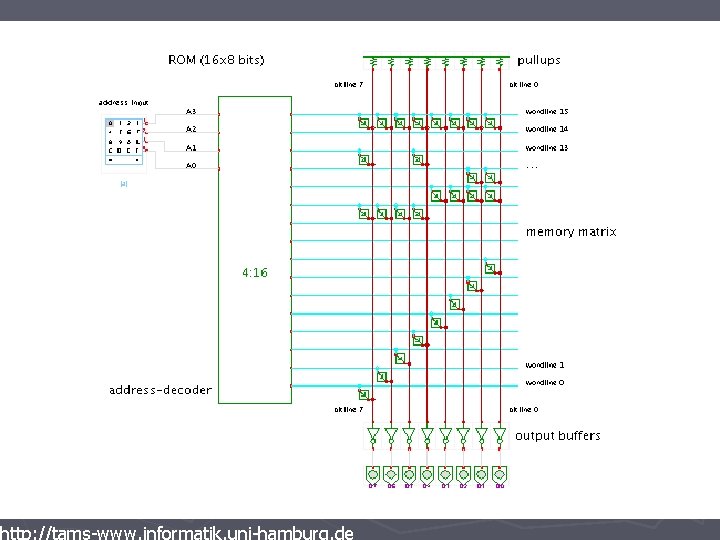
ROM of three memory locations, each “word” of Diodes memory is 3 bits ► Read Only Memory ► Data contents can not be changed ► Data retained even when power is off ► Manufactured with the data ► Used for booting up computer and loading Operating System ► Device Driver software http: //www. compeng. dit. ie
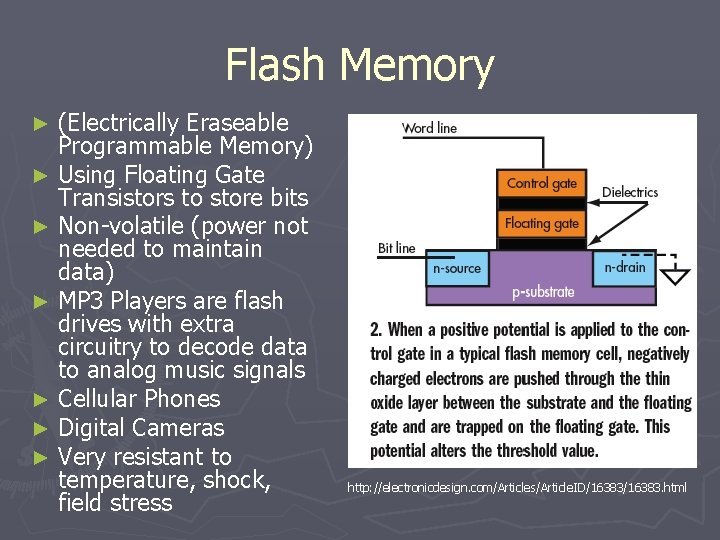
Flash Memory (Electrically Eraseable Programmable Memory) ► Using Floating Gate Transistors to store bits ► Non-volatile (power not needed to maintain data) ► MP 3 Players are flash drives with extra circuitry to decode data to analog music signals ► Cellular Phones ► Digital Cameras ► Very resistant to temperature, shock, field stress ► http: //electronicdesign. com/Articles/Article. ID/16383. html
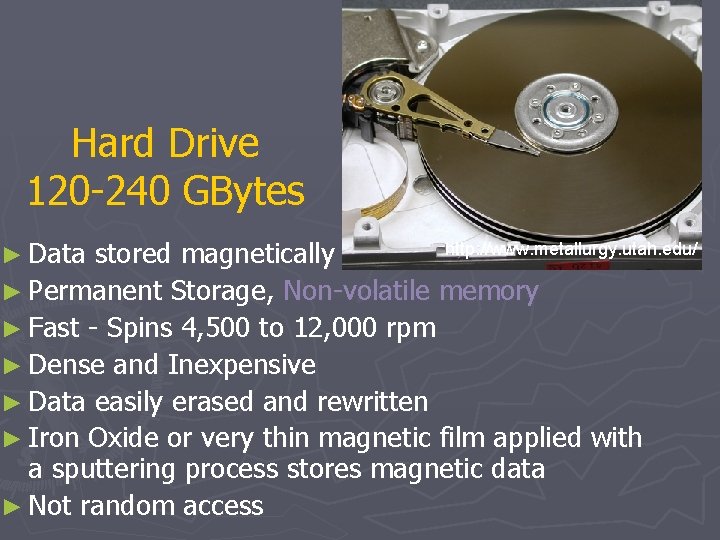
Hard Drive 120 -240 GBytes ► Data http: //www. metallurgy. utah. edu/ stored magnetically ► Permanent Storage, Non-volatile memory ► Fast - Spins 4, 500 to 12, 000 rpm ► Dense and Inexpensive ► Data easily erased and rewritten ► Iron Oxide or very thin magnetic film applied with a sputtering process stores magnetic data ► Not random access
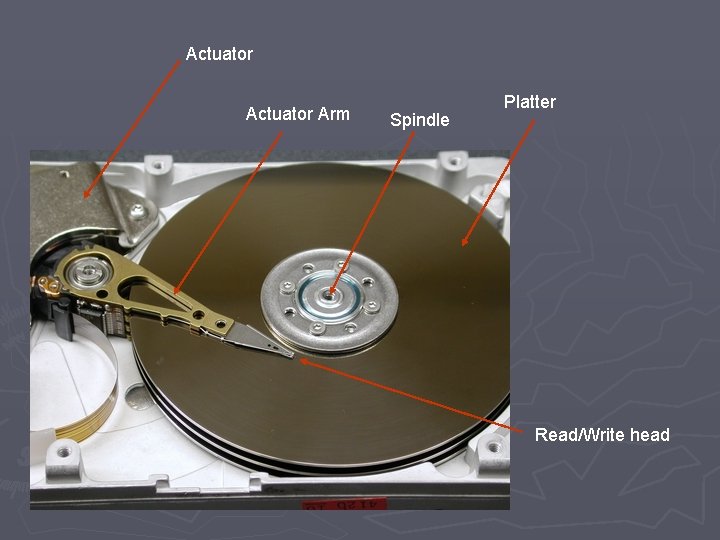
Actuator Arm Spindle Platter Read/Write head
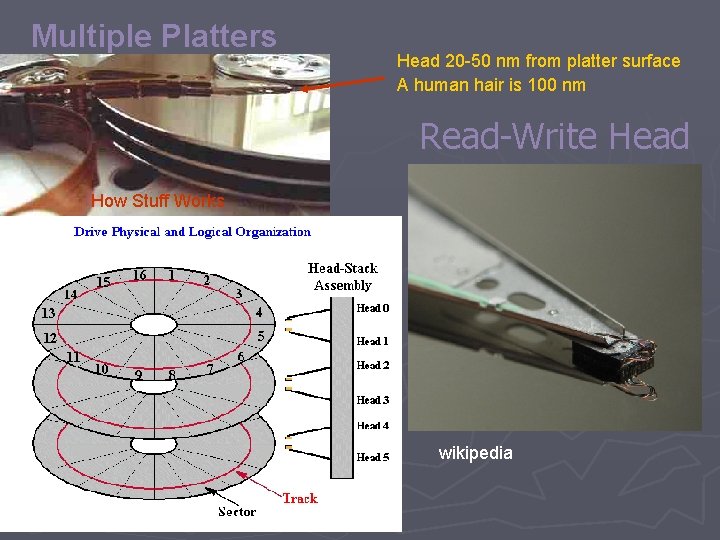
Multiple Platters Head 20 -50 nm from platter surface A human hair is 100 nm Read-Write Head How Stuff Works wikipedia www. hddtech. co. uk
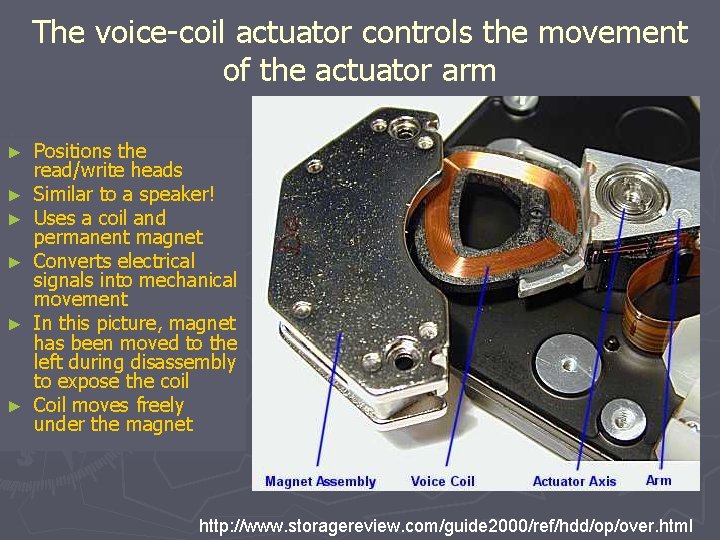
The voice-coil actuator controls the movement of the actuator arm ► ► ► Positions the read/write heads Similar to a speaker! Uses a coil and permanent magnet Converts electrical signals into mechanical movement In this picture, magnet has been moved to the left during disassembly to expose the coil Coil moves freely under the magnet http: //www. storagereview. com/guide 2000/ref/hdd/op/over. html
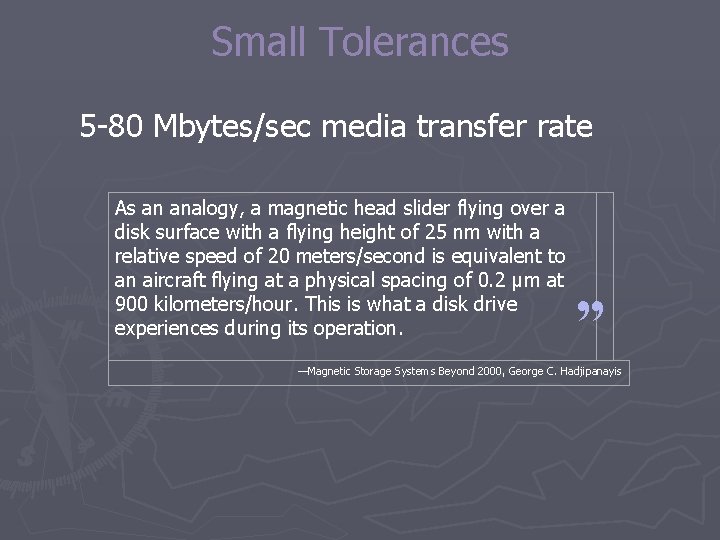
Small Tolerances 5 -80 Mbytes/sec media transfer rate As an analogy, a magnetic head slider flying over a disk surface with a flying height of 25 nm with a relative speed of 20 meters/second is equivalent to an aircraft flying at a physical spacing of 0. 2 µm at 900 kilometers/hour. This is what a disk drive experiences during its operation. ” —Magnetic Storage Systems Beyond 2000, George C. Hadjipanayis
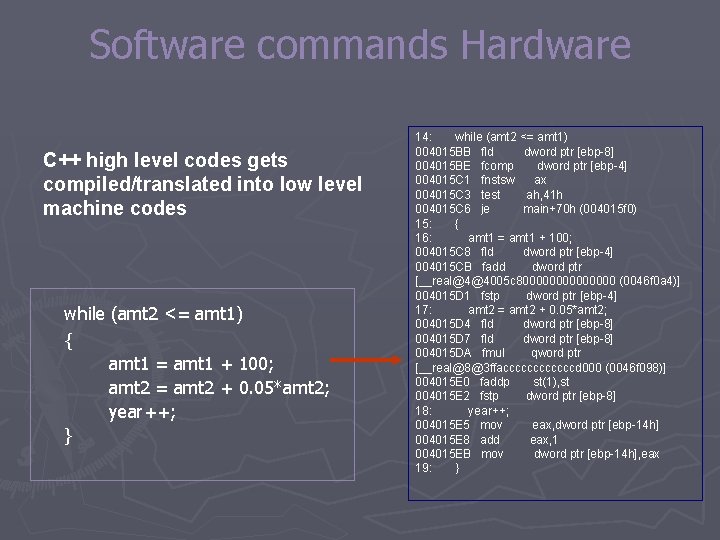
Software commands Hardware C++ high level codes gets compiled/translated into low level machine codes while (amt 2 <= amt 1) { amt 1 = amt 1 + 100; amt 2 = amt 2 + 0. 05*amt 2; year++; } 14: while (amt 2 <= amt 1) 004015 BB fld dword ptr [ebp-8] 004015 BE fcomp dword ptr [ebp-4] 004015 C 1 fnstsw ax 004015 C 3 test ah, 41 h 004015 C 6 je main+70 h (004015 f 0) 15: { 16: amt 1 = amt 1 + 100; 004015 C 8 fld dword ptr [ebp-4] 004015 CB fadd dword ptr [__real@4@4005 c 80000000 (0046 f 0 a 4)] 004015 D 1 fstp dword ptr [ebp-4] 17: amt 2 = amt 2 + 0. 05*amt 2; 004015 D 4 fld dword ptr [ebp-8] 004015 D 7 fld dword ptr [ebp-8] 004015 DA fmul qword ptr [__real@8@3 ffaccccccd 000 (0046 f 098)] 004015 E 0 faddp st(1), st 004015 E 2 fstp dword ptr [ebp-8] 18: year++; 004015 E 5 mov eax, dword ptr [ebp-14 h] 004015 E 8 add eax, 1 004015 EB mov dword ptr [ebp-14 h], eax 19: }
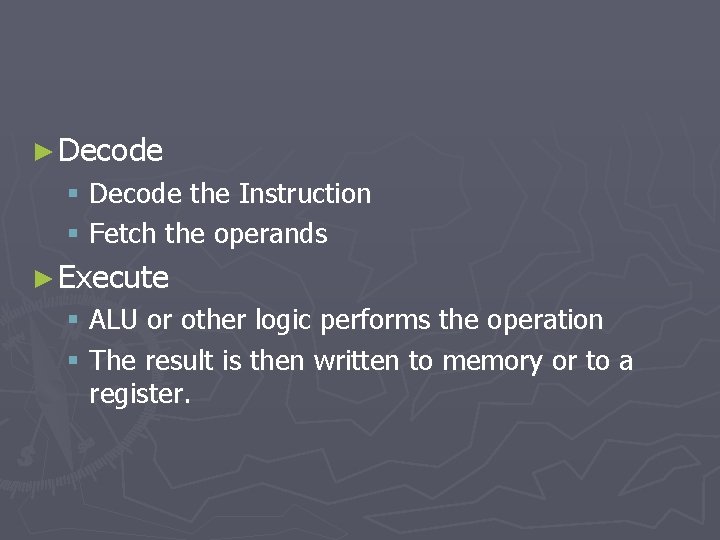
Fetch-Decode-Execute Cycle ► Fetch an Instruction: § Fetch instruction at address stored in address register § Increment Program Counter § Load the Instruction Register with this Instruction
► Decode § Decode the Instruction § Fetch the operands ► Execute § ALU or other logic performs the operation § The result is then written to memory or to a register.
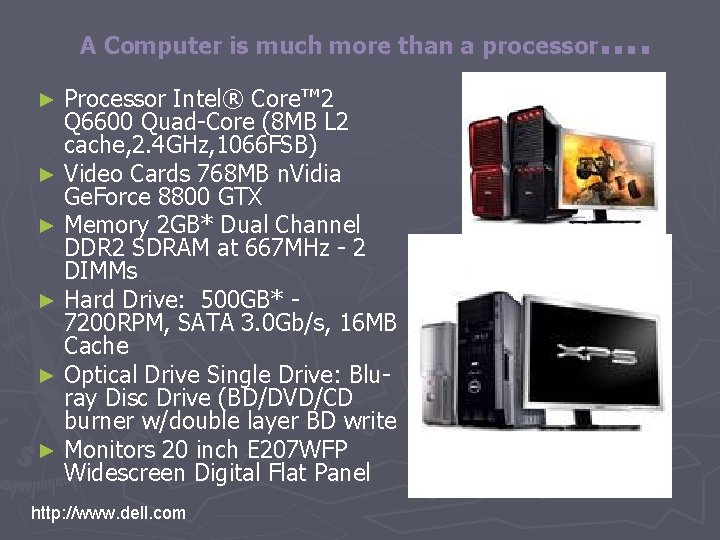
…. A Computer is much more than a processor Processor Intel® Core™ 2 Q 6600 Quad-Core (8 MB L 2 cache, 2. 4 GHz, 1066 FSB) ► Video Cards 768 MB n. Vidia Ge. Force 8800 GTX ► Memory 2 GB* Dual Channel DDR 2 SDRAM at 667 MHz - 2 DIMMs ► Hard Drive: 500 GB* 7200 RPM, SATA 3. 0 Gb/s, 16 MB Cache ► Optical Drive Single Drive: Bluray Disc Drive (BD/DVD/CD burner w/double layer BD write ► Monitors 20 inch E 207 WFP Widescreen Digital Flat Panel ► http: //www. dell. com
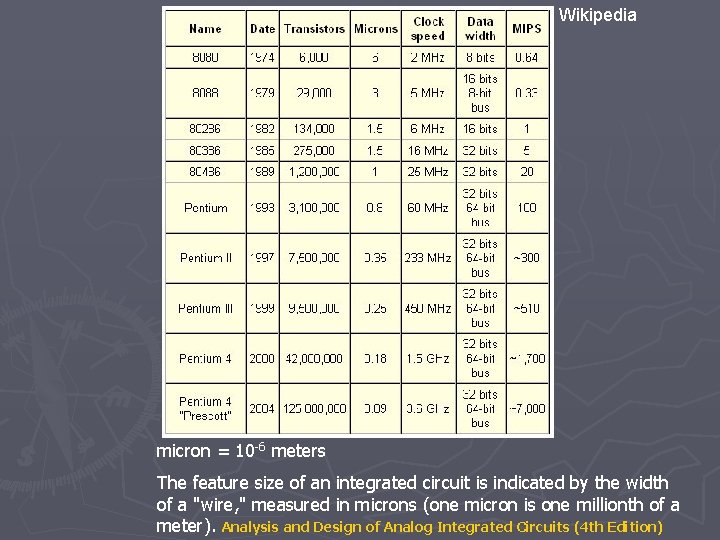
Wikipedia micron = 10 -6 meters The feature size of an integrated circuit is indicated by the width of a "wire, " measured in microns (one micron is one millionth of a meter). Analysis and Design of Analog Integrated Circuits (4 th Edition)