
Computers and Society Ethics and Morality Notice This

- Slides: 53
Computers and Society Ethics and Morality Notice: This set of slides is based on the notes by Professor Guattery of Bucknell and by the textbook author Michael Quinn Computers and Society 1
An important part of this class is a discussion of ethics. Per Quinn (Ethics for the Information Age, p. 53), “Ethics is the philosophical study of morality, a rational examination into people’s moral beliefs and behaviors. ” Computers and Society
Society A society is an association of people organized under a system of rules designed to advance the good of its members over time. A society may be a nation, but it may also be a social organization, a professional organization, a sports organization, a musical group, etc. Computers and Society
Morality People in society also interact and compete with each other. For example, how should the society divide limited resources? To deal with this competition, societies set rules of conduct. These rules specify the morality of the society. People usually belong to multiple societies, which can lead to conflicts between the moralities of those societies. People within a single society may have different moral beliefs. In such cases, how should we determine what is the right thing to do? Computers and Society
Different Moral Views Exist • A view from a typical western culture – Self-centered, if everyone takes care of herself, the society would be taken care of as a whole; – Of course, taking care of oneself need to collaborate with others. E. g. , to drive safely on a highway, everyone has to follow the traffic rules. Computers and Society 5
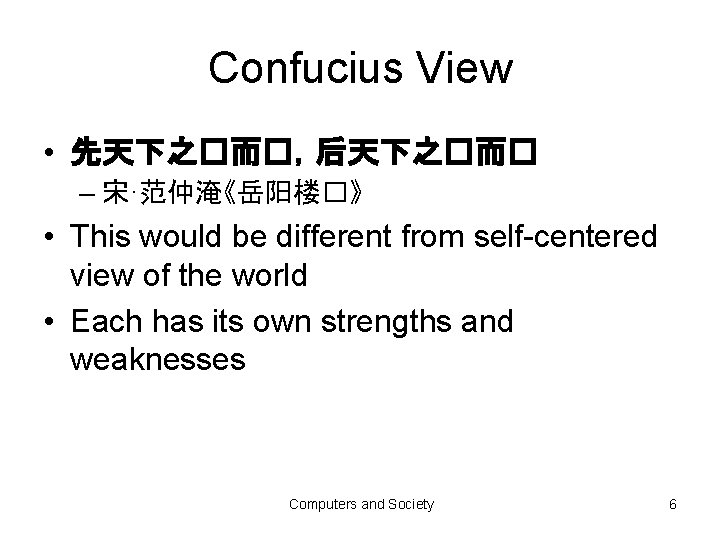
Confucius View • 先天下之�而�,后天下之�而� – 宋·范仲淹《岳阳楼�》 • This would be different from self-centered view of the world • Each has its own strengths and weaknesses Computers and Society 6
Ethics and Morality Ethics is the philosophical study of morality. It involves a rational examination of moral beliefs and behaviors. It often is applied to analysis of moral dilemmas. A dilemma is a situation in which one is confronted with a choice, neither of which is desirable. A moral dilemma is a dilemma in which the choices are based on moral principles: the choices represent conflicting ideas of what is right. Computers and Society
Asiana Airline Crash Victim • Another example of real life moral dilemma (July 6, 2013) • http: //www. cbsnews. com/news/new-videoshows-firefighters-knew-asiana-victim-was -on-the-ground/ • We’ll leave it to the legal system to come to a conclusion – But the fire-fighters were facing at least a very serious moral dilemma … Computers and Society 8
Do these stories (or moral dilemma) have anything to do with us (CS/IT professionals)? ? Computers and Society 9
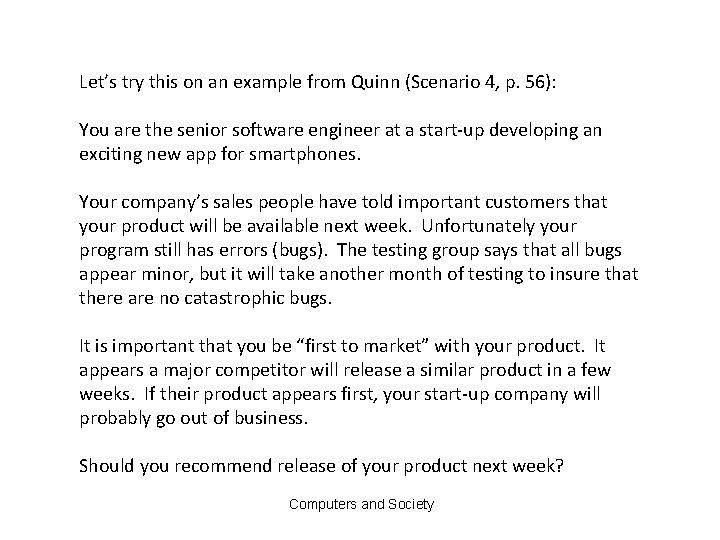
Let’s try this on an example from Quinn (Scenario 4, p. 56): You are the senior software engineer at a start-up developing an exciting new app for smartphones. Your company’s sales people have told important customers that your product will be available next week. Unfortunately your program still has errors (bugs). The testing group says that all bugs appear minor, but it will take another month of testing to insure that there are no catastrophic bugs. It is important that you be “first to market” with your product. It appears a major competitor will release a similar product in a few weeks. If their product appears first, your start-up company will probably go out of business. Should you recommend release of your product next week? Computers and Society
You May Actually Have to Make that Decision! • Does the previous example sound familiar? Are there any recent example(s) that resemble the situation? • The October 1 st, 2013 roll-out of the “Affordable Care Act” website! – http: //www. reuters. com/article/2013/11/22/ususa-healthcare-websiteid. USBRE 9 AL 03 K 20131122 Computers and Society 11
Overview of Ethical Theories There is a wide range of ethical theories people use for discussing moral dilemmas. Quinn argues that we should focus on theories “that make it possible for a person to present a persuasive, logical argument to a diverse audience of skeptical, yet open-minded people. ” Quinn calls these theories “the workable theories” (p. 58) Computers and Society
Eight Ethical Theories Quinn then presents eight ethical theories. He rejects the first four (in sections 2. 2 -2. 5) as not meeting his standard. Quinn accepts four that are workable, which will be discussed in detail. Computers and Society
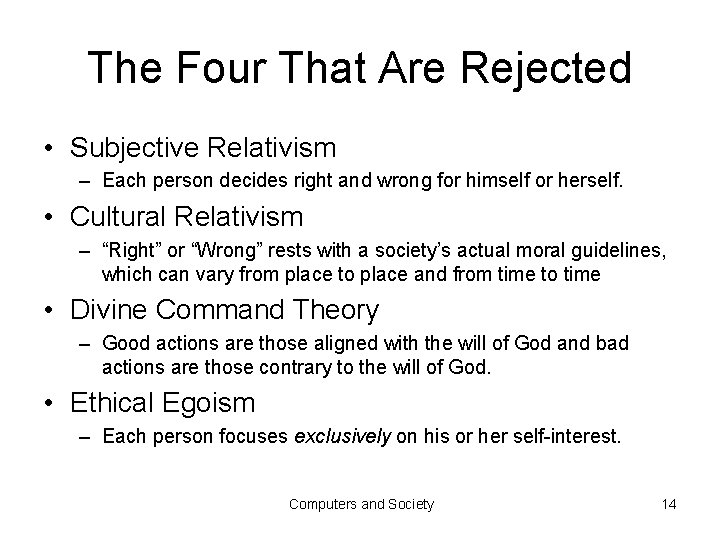
The Four That Are Rejected • Subjective Relativism – Each person decides right and wrong for himself or herself. • Cultural Relativism – “Right” or “Wrong” rests with a society’s actual moral guidelines, which can vary from place to place and from time to time • Divine Command Theory – Good actions are those aligned with the will of God and bad actions are those contrary to the will of God. • Ethical Egoism – Each person focuses exclusively on his or her self-interest. Computers and Society 14
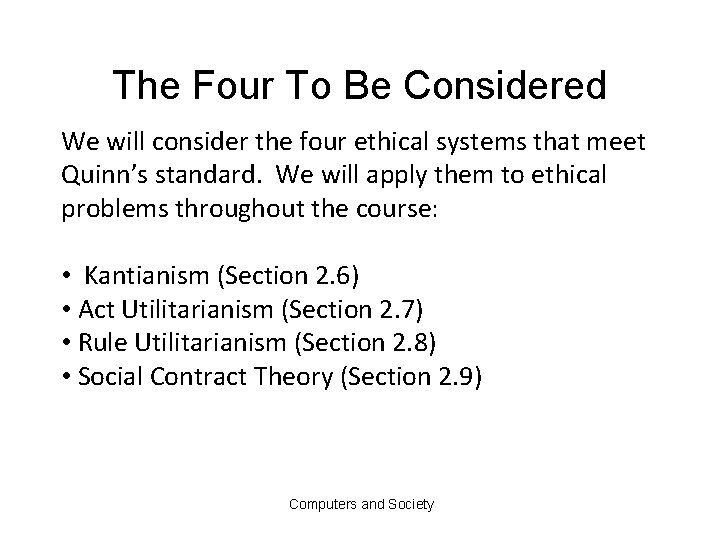
The Four To Be Considered We will consider the four ethical systems that meet Quinn’s standard. We will apply them to ethical problems throughout the course: • Kantianism (Section 2. 6) • Act Utilitarianism (Section 2. 7) • Rule Utilitarianism (Section 2. 8) • Social Contract Theory (Section 2. 9) Computers and Society
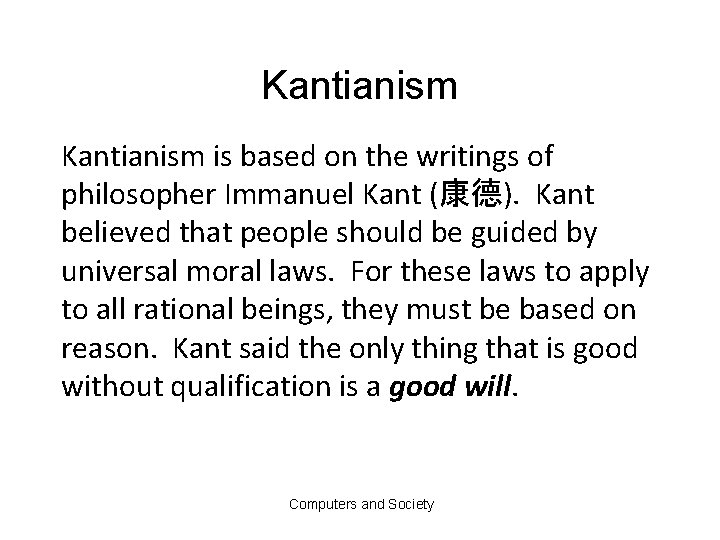
Kantianism is based on the writings of philosopher Immanuel Kant (康德). Kant believed that people should be guided by universal moral laws. For these laws to apply to all rational beings, they must be based on reason. Kant said the only thing that is good without qualification is a good will. Computers and Society
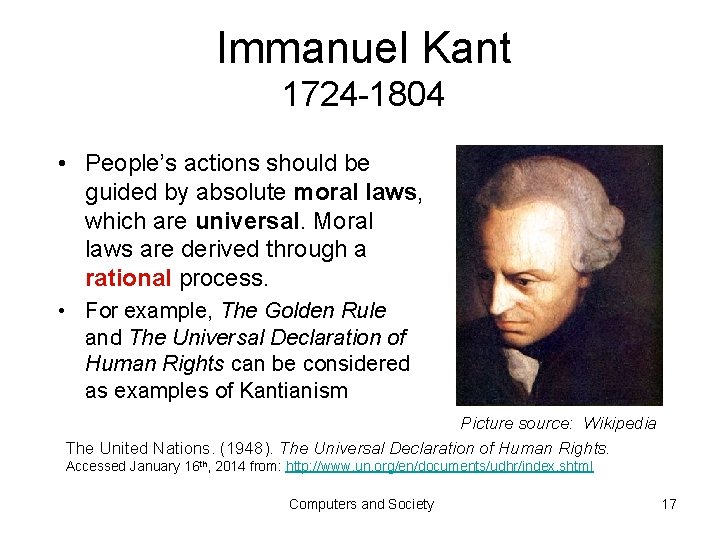
Immanuel Kant 1724 -1804 • People’s actions should be guided by absolute moral laws, which are universal. Moral laws are derived through a rational process. • For example, The Golden Rule and The Universal Declaration of Human Rights can be considered as examples of Kantianism Picture source: Wikipedia The United Nations. (1948). The Universal Declaration of Human Rights. Accessed January 16 th, 2014 from: http: //www. un. org/en/documents/udhr/index. shtml Computers and Society 17
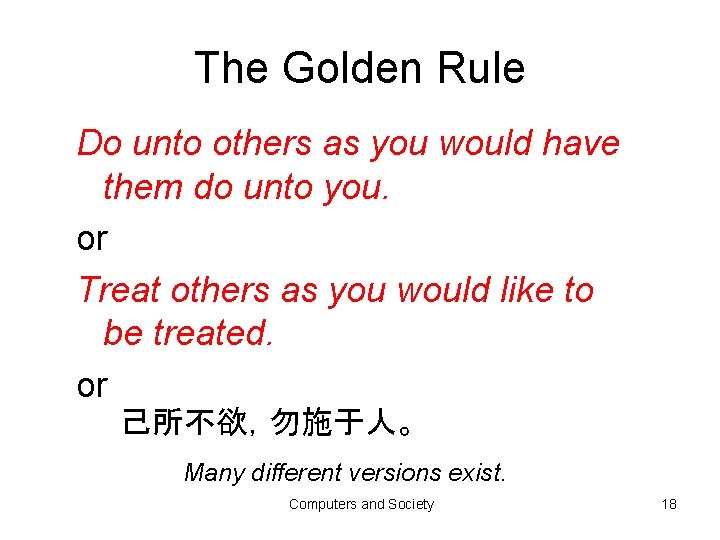
The Golden Rule Do unto others as you would have them do unto you. or Treat others as you would like to be treated. or 己所不欲,勿施于人。 Many different versions exist. Computers and Society 18
Kantian Ethics (Duty-Based Ethics) • Kant believed that there are higher principles that are good in every time, every culture, and every situation. When faced with an ethical dilemma, he believes we should ask ourselves: “To whom do I owe a duty and what duty do I owe them? ” Duty-based ethics http: //www. bbc. co. uk/ethics/introduction/duty_1. shtml Accessed January 16 th, 2014 Computers and Society 19
The Categorical Imperative How does someone know what he or she ought to do? Kant stated this in his Categorical Imperative. The first formulation of the categorical imperative says “Act only from moral rules you can at the same time will to be universal moral laws. ” Note that “you can” and “you will!” -- “You can”, actions allowed by moral rules -- “You will”, take the action no matter what This is called Categorical Imperative (First Formation) Computers and Society
Universal Moral Rule Illustrated • How do you universalize a moral rule? Kant illustrates this with the following example • Consider a moral rule: “A person makes a false promise when that is the only way to escape a difficult situation. ” • To universalize it, consider what would happen if everyone followed this rule. Then no one would believe promises, and no one in a difficult situation could make a promise that anyone would believe. The rule falls apart. Computers and Society 21
Categorical Imperative, 2 nd Form Kant restated his categorical imperative in a second way (the second formulation): “Act so that you always treat both yourself and other people as ends in themselves, and never only as a means to an end. ” That is, it is wrong for one person to use another person to get what he or she wants. An example is when you make friends with someone because they can help you get something (an end), then drop him or her when you have what you want. You have used them as a means to that end. Computers and Society
Kantianism Pros and Cons • Minuses: 1. Sometimes no single rule fully characterizes an action. • Steal food for starving children? 2. Sometimes there is no way to resolve a conflict between rules. • “Don’t steal. ” vs. “Don’t starve your children. ” 3. Kantianism allows no exceptions to perfect duties. Computers and Society 23
Kantianism Pros and Cons Pluses: 1. Kantianism is rational. 2. Kantianism produces universal moral guidelines. In summary, Kantianism is a workable ethical theory. Computers and Society
Can you give some examples of Kantianism? Computers and Society 25
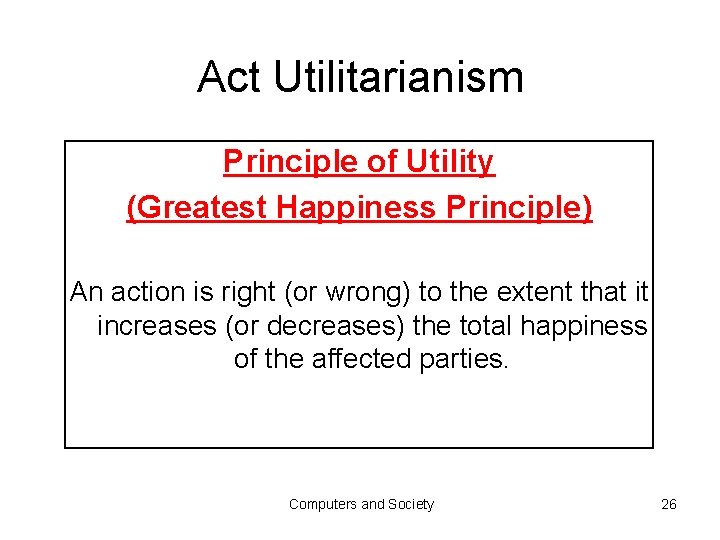
Act Utilitarianism Principle of Utility (Greatest Happiness Principle) An action is right (or wrong) to the extent that it increases (or decreases) the total happiness of the affected parties. Computers and Society 26
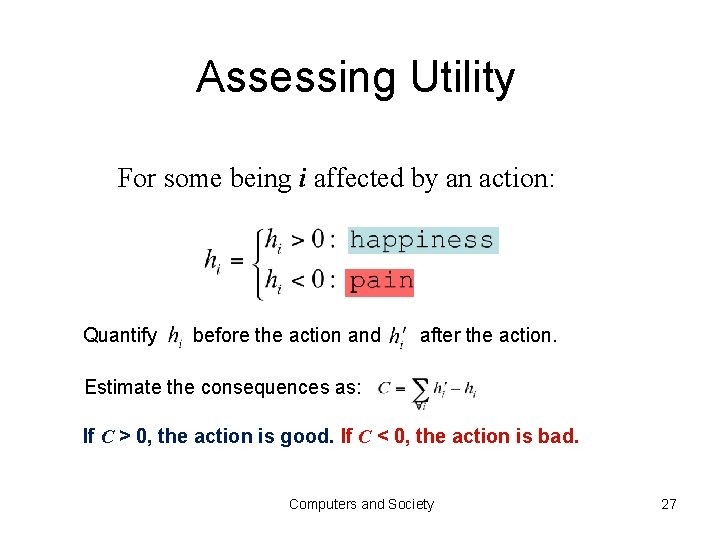
Assessing Utility For some being i affected by an action: Quantify before the action and after the action. Estimate the consequences as: If C > 0, the action is good. If C < 0, the action is bad. Computers and Society 27
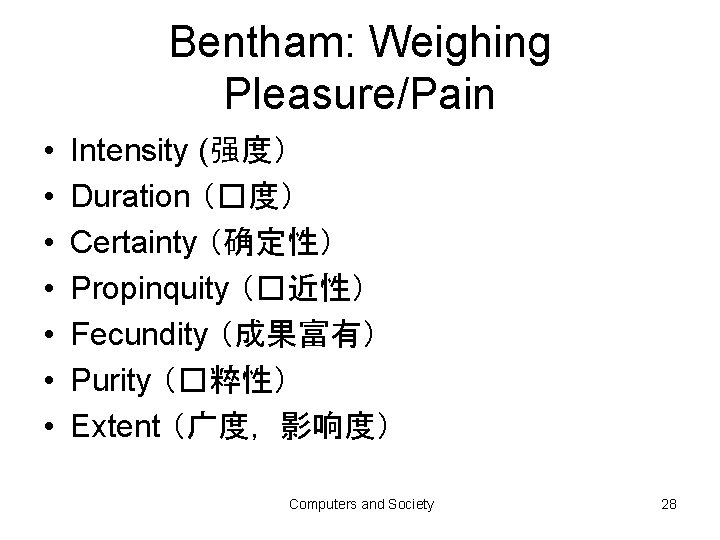
Bentham: Weighing Pleasure/Pain • • Intensity (强度) Duration (�度) Certainty (确定性) Propinquity (�近性) Fecundity (成果富有) Purity (�粹性) Extent (广度, 影响度) Computers and Society 28
Principle of Utility Computers and Society 29
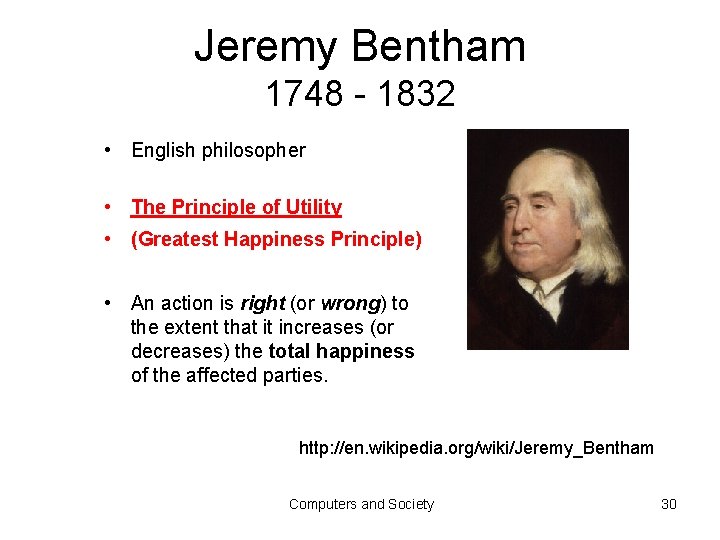
Jeremy Bentham 1748 - 1832 • English philosopher • The Principle of Utility • (Greatest Happiness Principle) • An action is right (or wrong) to the extent that it increases (or decreases) the total happiness of the affected parties. http: //en. wikipedia. org/wiki/Jeremy_Bentham Computers and Society 30
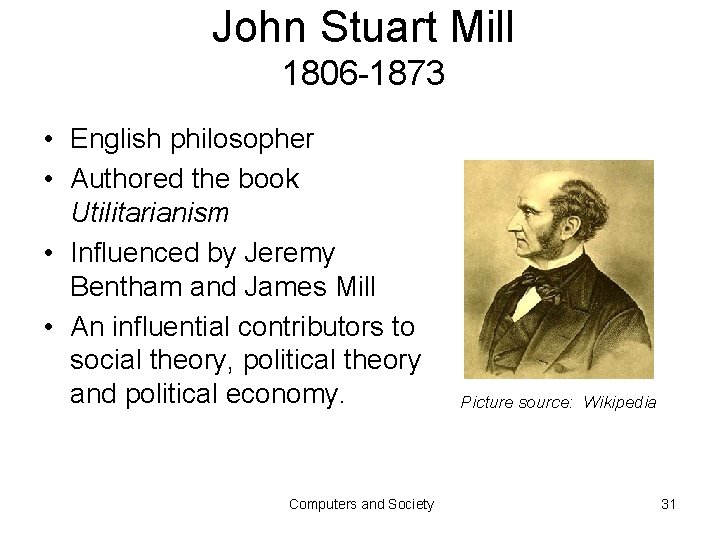
John Stuart Mill 1806 -1873 • English philosopher • Authored the book Utilitarianism • Influenced by Jeremy Bentham and James Mill • An influential contributors to social theory, political theory and political economy. Computers and Society Picture source: Wikipedia 31
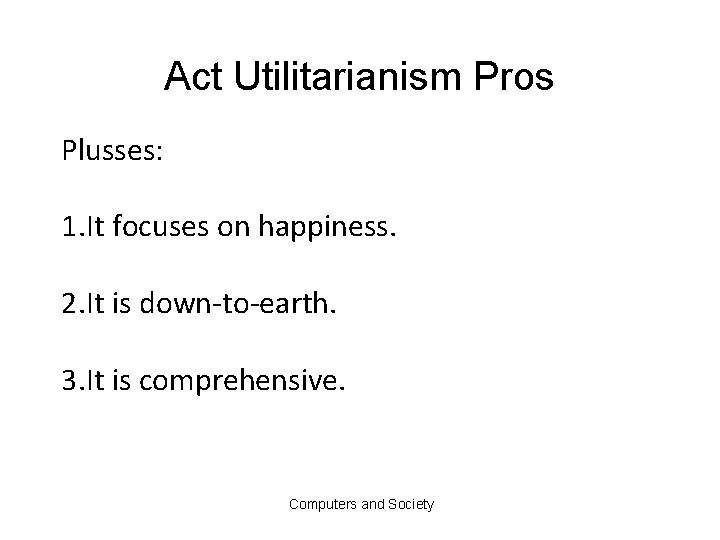
Act Utilitarianism Pros Plusses: 1. It focuses on happiness. 2. It is down-to-earth. 3. It is comprehensive. Computers and Society
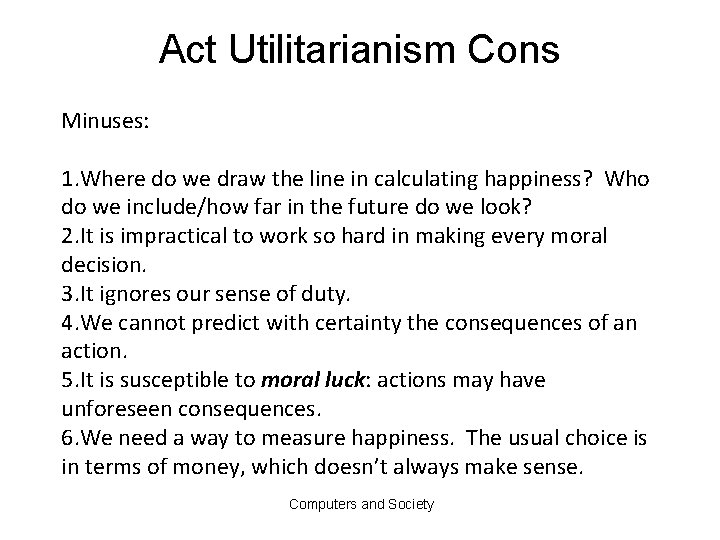
Act Utilitarianism Cons Minuses: 1. Where do we draw the line in calculating happiness? Who do we include/how far in the future do we look? 2. It is impractical to work so hard in making every moral decision. 3. It ignores our sense of duty. 4. We cannot predict with certainty the consequences of an action. 5. It is susceptible to moral luck: actions may have unforeseen consequences. 6. We need a way to measure happiness. The usual choice is in terms of money, which doesn’t always make sense. Computers and Society
Act Utilitarianism Workable • While it is not perfect, act utilitarianism is an objective, rational ethical theory that allows a person to explain why a particular action is right or wrong. Computers and Society 34
Can you give some examples of act utilitarianism? Computers and Society 35
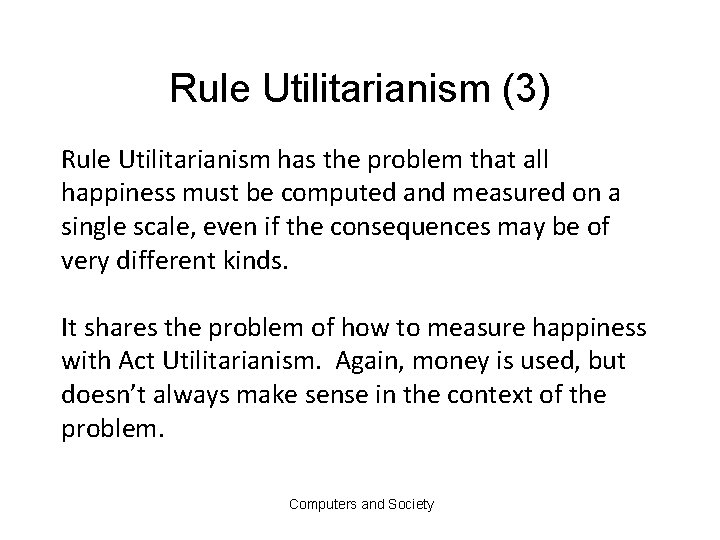
Rule Utilitarianism is another ethical system based on the Principle of Utility. It is meant to improve on weaknesses of Act Utilitarianism. Rule Utilitarianism holds that we should adopt moral rules that, if followed by everyone (that is, followed universally), will lead to the greatest increase in total happiness (that is, across all of society). Computers and Society
Rule Utilitarianism (2) Rule Utilitarianism applies the Principle of Utility to moral rules; Act Utilitarianism applies it to individual moral actions. Rule Utilitarianism looks at the consequences of actions; it is different from Kantianism, which looks at the will motivating the action. Computers and Society
Rule Utilitarianism (3) Rule Utilitarianism has the problem that all happiness must be computed and measured on a single scale, even if the consequences may be of very different kinds. It shares the problem of how to measure happiness with Act Utilitarianism. Again, money is used, but doesn’t always make sense in the context of the problem. Computers and Society
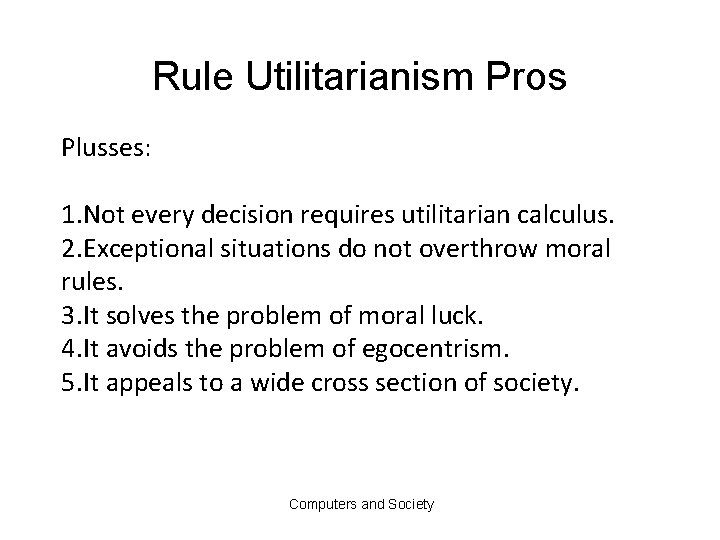
Rule Utilitarianism Pros Plusses: 1. Not every decision requires utilitarian calculus. 2. Exceptional situations do not overthrow moral rules. 3. It solves the problem of moral luck. 4. It avoids the problem of egocentrism. 5. It appeals to a wide cross section of society. Computers and Society
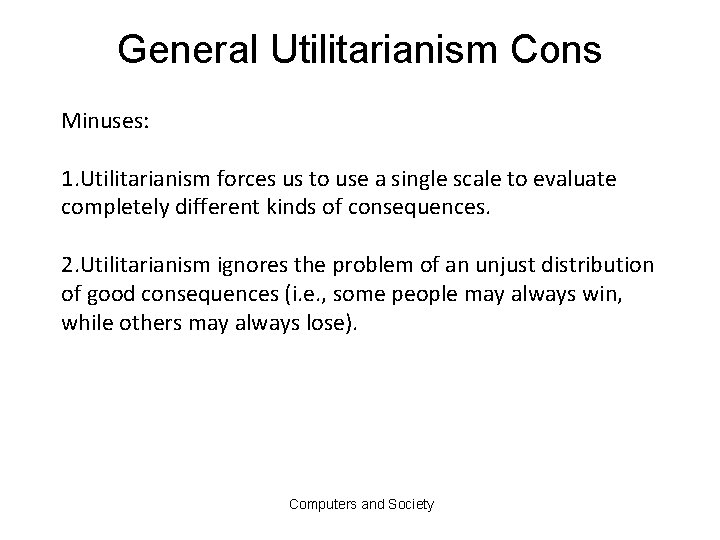
General Utilitarianism Cons Minuses: 1. Utilitarianism forces us to use a single scale to evaluate completely different kinds of consequences. 2. Utilitarianism ignores the problem of an unjust distribution of good consequences (i. e. , some people may always win, while others may always lose). Computers and Society
Can you give some examples of Rule Utilitarianism? Computers and Society 41
Social Contract Theory is based on the work of philosopher Thomas Hobbes. It states that social cooperation requires people to agree to rules of behavior. These rules form the moral basis of society. Everyone in the society implicitly agrees to these rules. Hobbes also thought that everyone living in a society implicitly agrees to having a government that is able to enforce these rules. Computers and Society
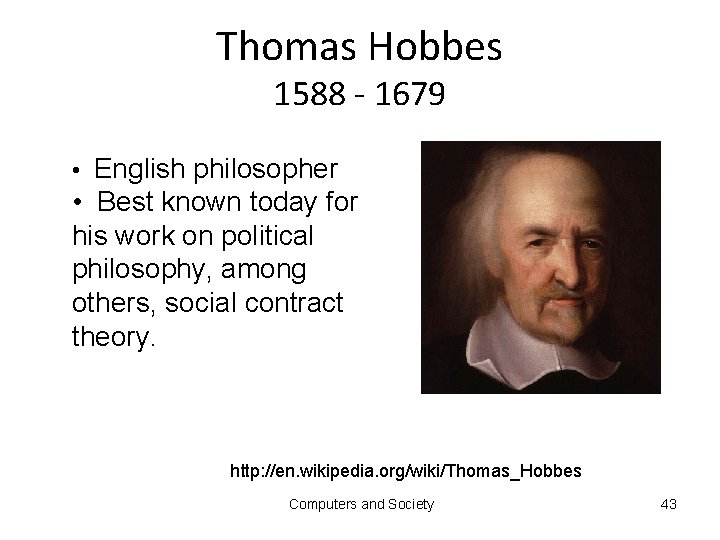
Thomas Hobbes 1588 - 1679 • English philosopher • Best known today for his work on political philosophy, among others, social contract theory. http: //en. wikipedia. org/wiki/Thomas_Hobbes Computers and Society 43
Rousseau’s Social Contract Theory Jean-Jacques Rousseau (�素) extended the idea of the social contract to this form (as stated by James Rachels): “Morality consists in the sets of rules, governing how people treat one another, that rational people will agree to accept, for their mutual benefit, on the condition that others will follow those rules as well. ” Computers and Society
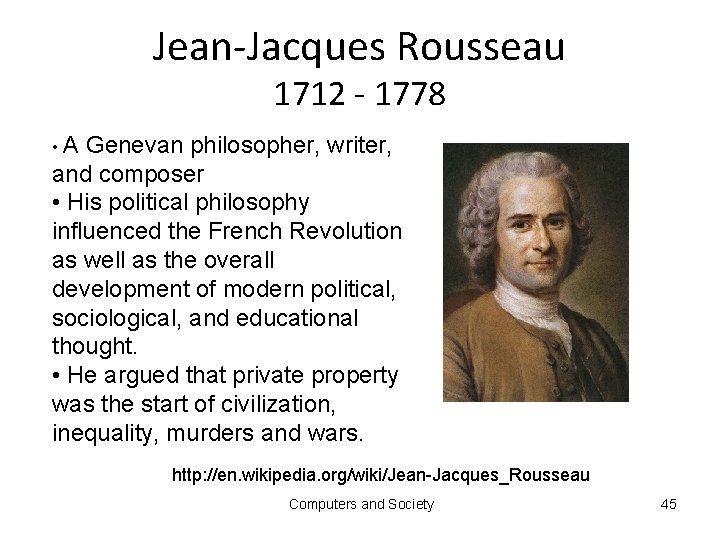
Jean-Jacques Rousseau 1712 - 1778 • A Genevan philosopher, writer, and composer • His political philosophy influenced the French Revolution as well as the overall development of modern political, sociological, and educational thought. • He argued that private property was the start of civilization, inequality, murders and wars. http: //en. wikipedia. org/wiki/Jean-Jacques_Rousseau Computers and Society 45
Social Contract Theory Explained Social Contract Theory also deals with rights. Rights imply duties that the rules of the society must respect. Rights may be positive or negative. A positive right obligates others to do something on your behalf. For example, a right to free health care obligates others (society) to provide you with health care. A negative right obligates others to leave you alone to exercise that right. For example, a right to free expression is a negative right. Computers and Society
Another View on Rights Another way to look at two types of rights (negative and positive) is to consider whether they are absolute or limited – An absolute right is a right guaranteed without exception. • Usually negative rights are considered as absolute rights. The right to life is an example of an absolute right. – A limited right is a right that may be restricted based on the circumstances. • Usually positive rights are considered as limited rights. For example, rights to education in the U. S. While k-12 education is guaranteed, higher education is not because of budget. Computers and Society 47
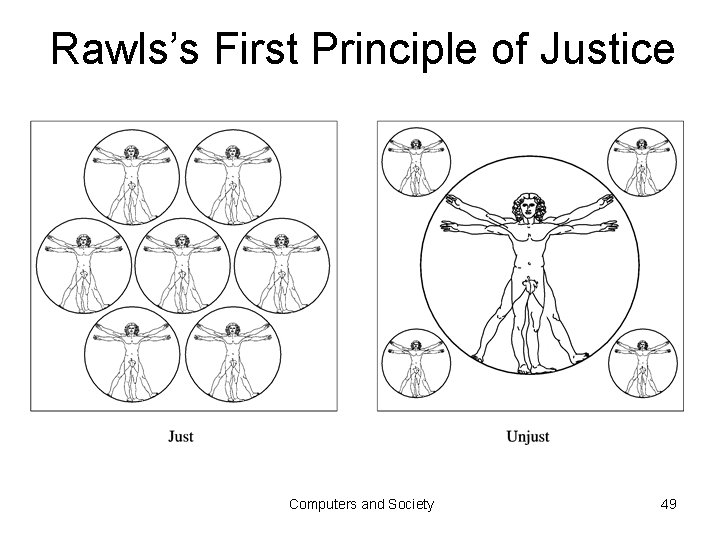
John Rawls’s Principles of Justice • John Rawls proposed two principles of justice based on contract: • First Principle: Each person has the same indefeasible claim to a fully adequate scheme of equal basic liberties, which scheme is compatible with the same scheme of liberties for all; • Second Principle: Social and economic inequalities are to satisfy two conditions (The Difference Principle): 1. They are to be attached to offices and positions open to all under conditions of fair equality of opportunity; 2. They are to be to the greatest benefit of the least-advantaged members of society. Computers and Society 48
Rawls’s First Principle of Justice Computers and Society 49
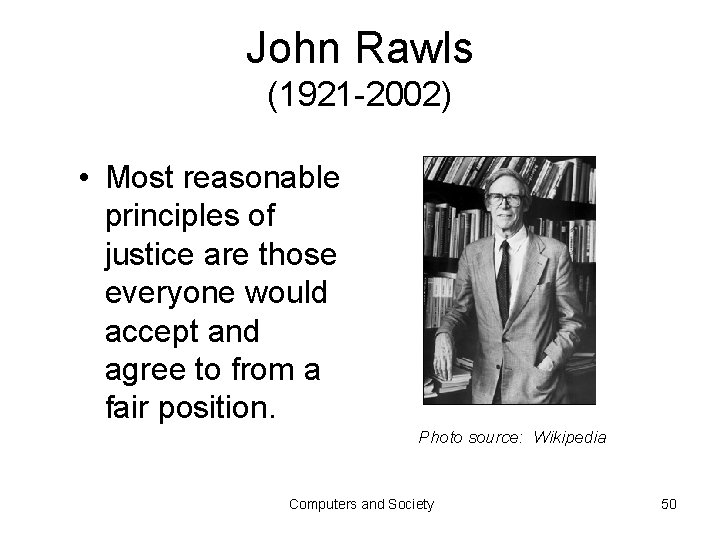
John Rawls (1921 -2002) • Most reasonable principles of justice are those everyone would accept and agree to from a fair position. Photo source: Wikipedia Computers and Society 50
HOW TO HANDLE MORAL DILEMMA? Computers and Society 51
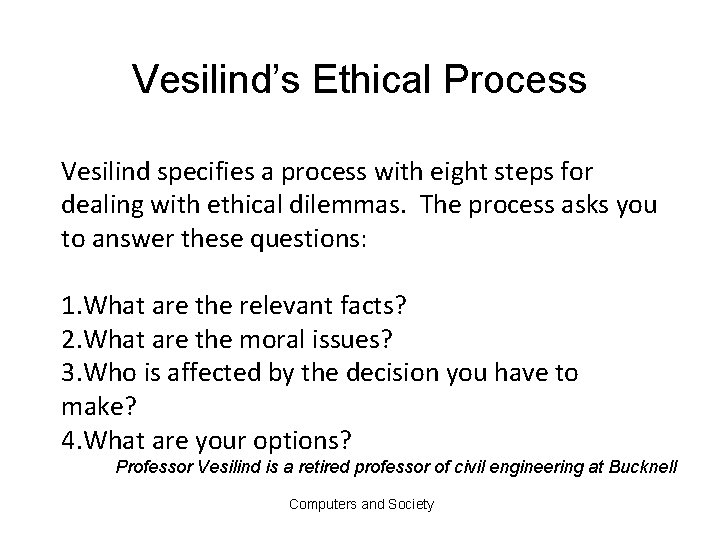
Vesilind’s Ethical Process Vesilind specifies a process with eight steps for dealing with ethical dilemmas. The process asks you to answer these questions: 1. What are the relevant facts? 2. What are the moral issues? 3. Who is affected by the decision you have to make? 4. What are your options? Professor Vesilind is a retired professor of civil engineering at Bucknell Computers and Society
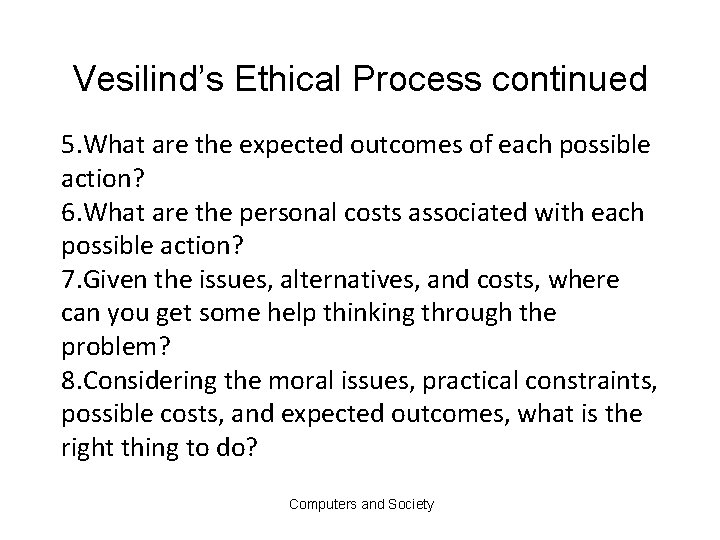
Vesilind’s Ethical Process continued 5. What are the expected outcomes of each possible action? 6. What are the personal costs associated with each possible action? 7. Given the issues, alternatives, and costs, where can you get some help thinking through the problem? 8. Considering the moral issues, practical constraints, possible costs, and expected outcomes, what is the right thing to do? Computers and Society