
Computerized Accounting Information Systems OVERVIEW IS 423 5
- Slides: 32
Computerized Accounting Information Systems OVERVIEW IS 423 ชดท 5 1
Transaction Processing System Architectures • A firm’s transaction processing systems may either be manual or computerized IS 423 ชดท 5 2
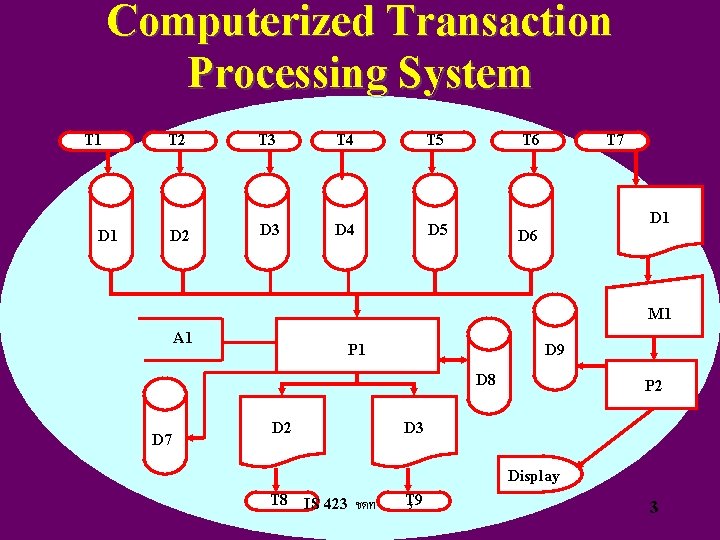
Computerized Transaction Processing System T 1 D 1 T 2 T 3 T 4 T 5 D 2 D 3 D 4 D 5 T 6 T 7 D 1 D 6 M 1 A 1 P 1 D 9 D 8 D 7 D 2 P 2 D 3 Display T 8 IS 423 ชดท T 9 5 3
Components of the Transaction Processing System • – – – What are some examples of inputs? customer orders sales slips invoices purchase orders employee time cards IS 423 ชดท 5 4
Components of the Transaction Processing System • Processing involves the use of journals and registers to provide a permanent and chronological record of inputs. • Journals are used to record financial accounting transactions. • Registers are used to record other types of data not directly related to accounting. IS 423 ชดท 5 5
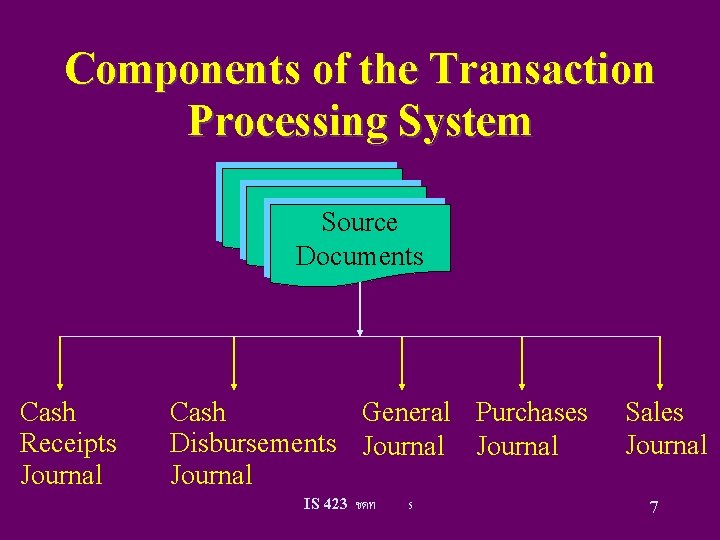
Components of the Transaction Processing System • Special journals are used to record similar and recurring transactions. • What are examples of special journals? – sales journal – purchase journal – cash receipts journal – cash disbursements journal IS 423 ชดท 5 6
Components of the Transaction Processing System Source Documents Cash Receipts Journal Cash General Purchases Disbursements Journal IS 423 ชดท 5 Sales Journal 7
Components of the Transaction Processing System • Ledgers and files provide storage of data in both manual and computerized systems. • Ledgers provide summaries of a firm’s financial accounting transactions. • A file is an organized collection of data. – transaction file – master file – reference or table file IS 423 ชดท 5 8
Components of the Transaction Processing System • • • – – What is an output? It is any document generated in the system. What are some examples of outputs? trial balance financial reports operational reports paychecks IS 423 ชดท 5 9
Designing Double-Entry Systems • An accounting system must “fit” a particular organization. • What must be taken into account in designing an accounting system? – the nature and purpose of the organization – its structural and functional characteristics – its physical layout, products, and services – the personnel who operate the system IS 423 ชดท 5 10
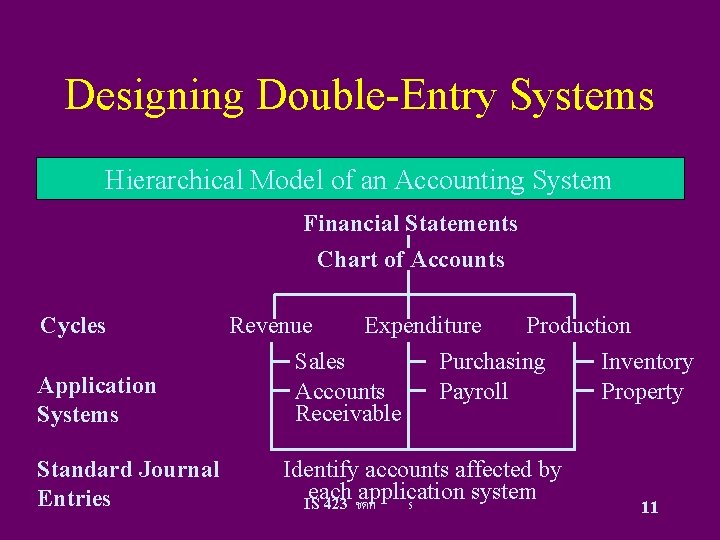
Designing Double-Entry Systems Hierarchical Model of an Accounting System Financial Statements Chart of Accounts Cycles Application Systems Standard Journal Entries Revenue Expenditure Production Sales Purchasing Inventory Payroll Property Accounts Receivable Identify accounts affected by each application system IS 423 ชดท 5 11
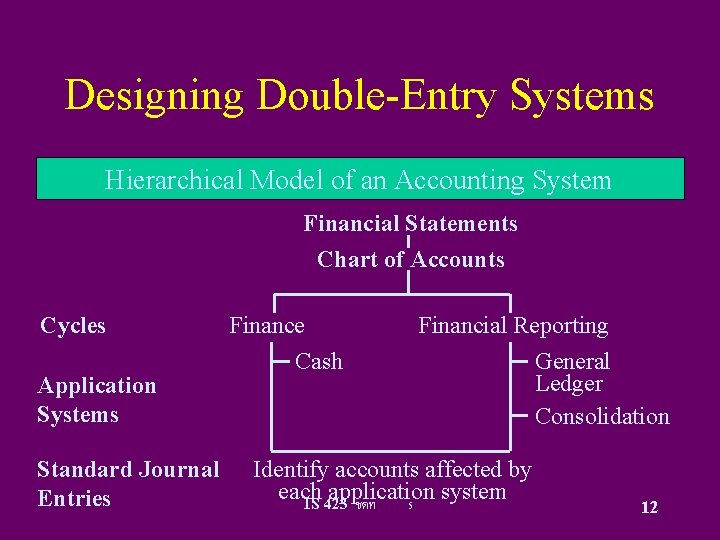
Designing Double-Entry Systems Hierarchical Model of an Accounting System Financial Statements Chart of Accounts Cycles Application Systems Standard Journal Entries Finance Cash Financial Reporting Identify accounts affected by each application system IS 423 ชดท 5 General Ledger Consolidation 12
Designing Double-Entry Systems • What are the four stages involved in the design of an accounting system? 1 Design a rough classification of accounts, or chart of accounts, and related financial statements and reports. 2 Review this with management and operating personnel. IS 423 ชดท 5 13
Designing Double-Entry Systems 3 Finalize statements, chart of accounts, and other reports. 4 Prepare a plan of journalizing and design the necessary business papers and procedures to implement and operate the system. IS 423 ชดท 5 14
Designing Double-Entry Systems • The chart of accounts is a listing of all asset, liability, revenue, expense, and equity accounts used in an accounting system. • It is used to achieve an organization’s objectives for financial reporting and control. IS 423 ชดท 5 15
Designing Double-Entry Systems • A plan for journalizing and posting transactions involves several steps. • Step 1: Analyze the natures of activities within the four basic transaction cycles. 1 Revenue cycle 2 Expenditure cycle 3 Finance cycle 4 Production cycle IS 423 ชดท 5 16
Designing Double-Entry Systems • It is common to identify a fifth major transaction cycle to group accounts that are not directly affected by transactional activity. • The financial reporting cycle does not process transactions involving external parties. IS 423 ชดท 5 17
Designing Double-Entry Systems • Step 2: Group activities within each major transaction cycle into application systems. • An application system processes a logically related set of transactions. • Step 3: Develop a complete set of standard or recurring journal entries. IS 423 ชดท 5 18
Designing Double-Entry Systems • What are standard journal entries? • They are pro forma or hypothetical entries that are expected to occur in the normal operation of the system. • They should indicate three items. 1 The accounts affected by the entry 2 The source of the entry 3 The date or period of the entry IS 423 ชดท 5 19
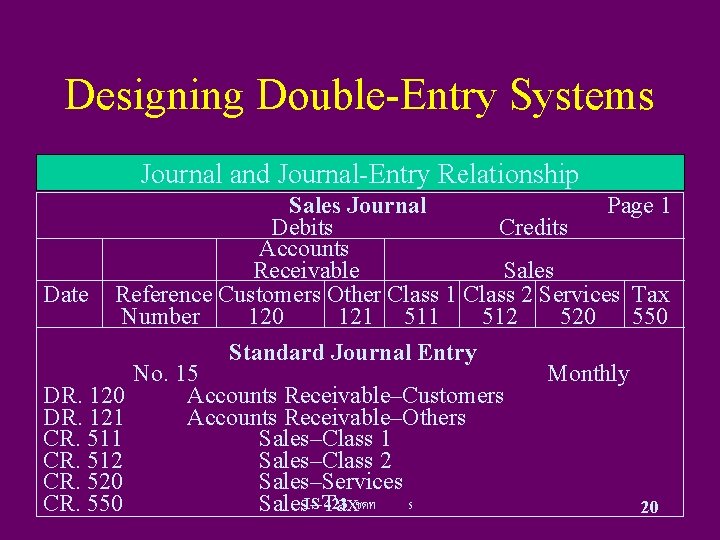
Designing Double-Entry Systems Journal and Journal-Entry Relationship Sales Journal Page 1 Debits Credits Accounts Receivable Sales Date Reference Customers Other Class 1 Class 2 Services Tax Number 120 121 512 520 550 Standard Journal Entry No. 15 Monthly DR. 120 Accounts Receivable–Customers DR. 121 Accounts Receivable–Others CR. 511 Sales–Class 1 CR. 512 Sales–Class 2 CR. 520 Sales–Services IS 423 ชดท 5 CR. 550 Sales–Tax 20
Designing Double-Entry Systems • The flow of processing in a manual accounting system is from source documents to journals, journals to ledgers, and from ledgers to financial statements. • Multiple transaction techniques become essential as the volume of transactions grows. IS 423 ชดท 5 21
Designing Double-Entry Systems • What is a one-write system? • It is a device that both posts a transaction and journalizes it in the same operation. • A writing board is designed to allow simultaneous recording on several documents arranged and held on a special board. IS 423 ชดท 5 22
Designing Double-Entry Systems • What is ledgerless bookkeeping? • It is a form of processing in which source documents are sorted and filed rather than posted to ledgers. • The file of source documents replaces a separate ledger. IS 423 ชดท 5 23
Designing Double-Entry Systems • Accounts receivable and accounts payable systems are typically best suited for ledgerless bookkeeping applications. • Ledgerless bookkeeping systems have less redundancy, and therefore less inherent control. IS 423 ชดท 5 24
Designing Double-Entry Systems • When computers are used to process transactions, two different modes of processing accounting transactions are possible. 1 Batch processing 2 Direct processing IS 423 ชดท 5 25
Designing Double-Entry Systems • Batch processing is a form of processing in which batches of transactions are accumulated and processed as a group. • Direct processing is a form of processing in which individual transactions are processed separately. IS 423 ชดท 5 26
Designing Double-Entry Systems • What is data validation? • It is the process of reviewing transaction details for accuracy and completeness during input. IS 423 ชดท 5 27
Designing Double-Entry Systems • The basic double-entry accounting model contains just three accounts: assets, liabilities, and equity. • Block coding is a way to organize a chart of accounts. • It sets aside a “block” or group of sequential account numbers for each major group of accounts. IS 423 ชดท 5 28
Form Design and Records Retention Considerations • Accounting-related forms and papers serve several functions. • What are these functions? • They serve as a physical medium to store and transmit data. • They transmit authority and responsibility. • They assist employees by indicating what data should be recorded. IS 423 ชดท 5 29
Form Design and Records Retention Considerations • The fundamental consideration in form design is the user. • Concerning paper forms, optional design features such as multiple colors, prenumbering, and rigid specifications for size and quality of the paper stock are often desirable. IS 423 ชดท 5 30
Form Design and Records Retention Considerations • Records retention requirements must be considered in the design of an accounting system. • Various government and tax regulations set specific guidelines and legal requirements over records retention. IS 423 ชดท 5 31
Form Design and Records Retention Considerations • Records retention must also be considered from the internal viewpoint of information storage and usage. IS 423 ชดท 5 32