
ComputerAssisted Language Learning Advantages of CALL in the
- Slides: 18
Computer-Assisted Language Learning Advantages of CALL in the Foreign Language Classroom by Maria Bullard
What is CALL? O CALL is a many- faceted tool that can be employed by teachers to implement different instructional approaches and help each student in the class reach her/his full learning potential. O “‘CALL’ is not shorthand for ‘the use of technology’ but designates a dynamic complex in which technology, theory, and pedagogy are inseparably interwoven” (Garrett p. 719 -20).
Motivation & Flexibility O The use of Web 2. 0 tools including You. Tube videos, blogs, and social media increase student motivation. O The flexibility of computer-based activities accommodates students’ diverse abilities and interests.
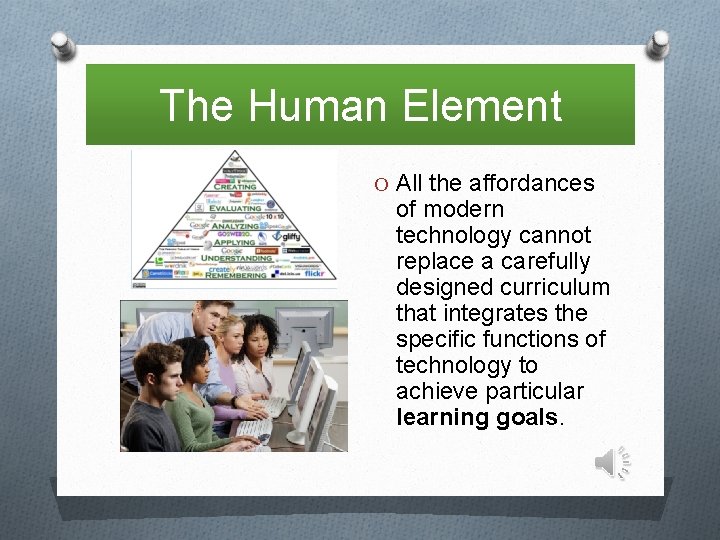
The Human Element O All the affordances of modern technology cannot replace a carefully designed curriculum that integrates the specific functions of technology to achieve particular learning goals.
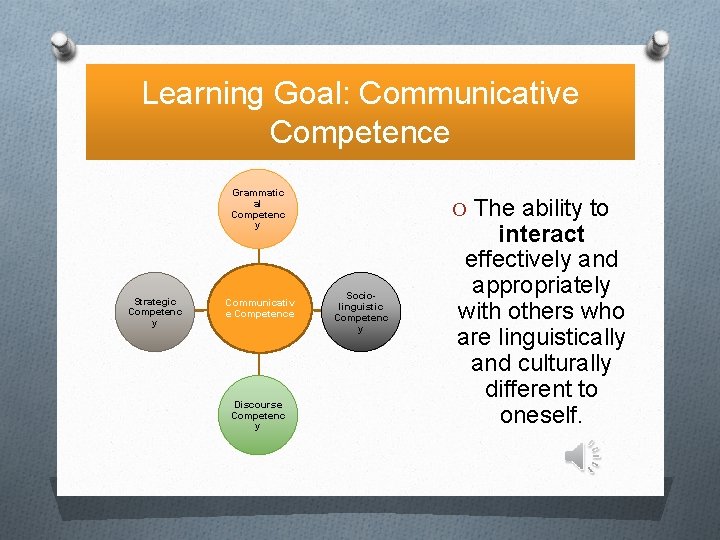
Learning Goal: Communicative Competence Grammatic al Competenc y Strategic Competenc y Communicativ e Competence Discourse Competenc y O The ability to Sociolinguistic Competenc y interact effectively and appropriately with others who are linguistically and culturally different to oneself.
Understanding Culture O Understanding culture is fundamental to language learning. O The following video illustrates the culture shock experienced by a group of immigrants to the U. S. http: //www. youtube. com/watch? v=BT 0 kz. F 4 A-WQ&feature=youtu. be
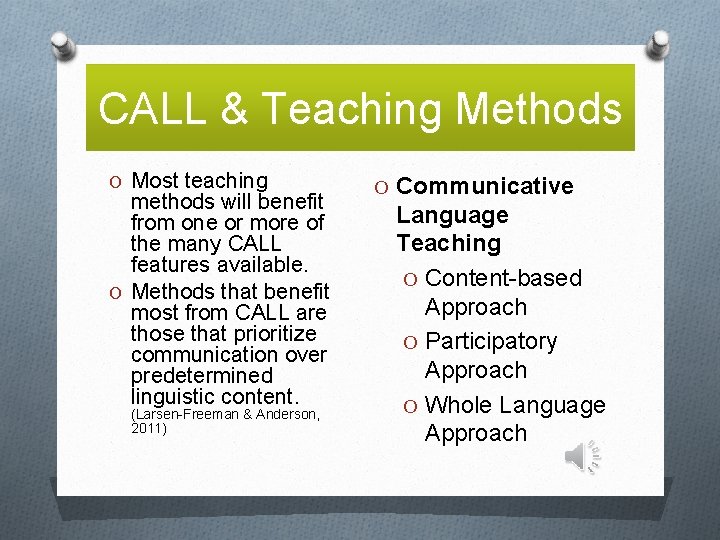
CALL & Teaching Methods O Most teaching methods will benefit from one or more of the many CALL features available. O Methods that benefit most from CALL are those that prioritize communication over predetermined linguistic content. (Larsen-Freeman & Anderson, 2011) O Communicative Language Teaching O Content-based Approach O Participatory Approach O Whole Language Approach
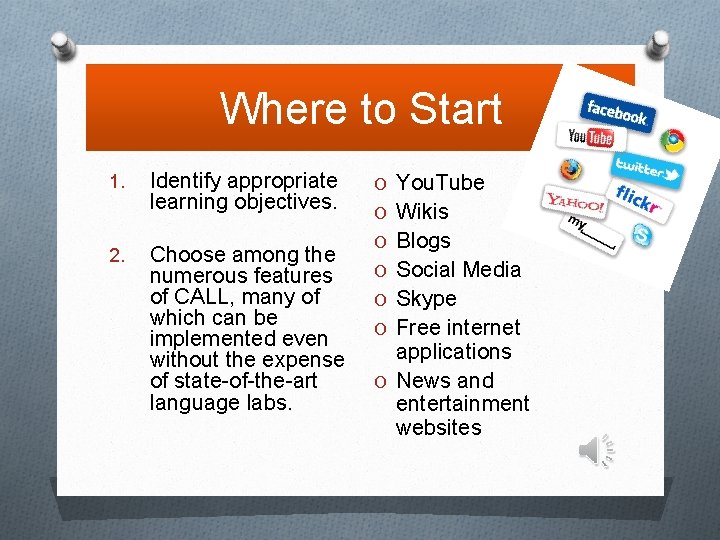
Where to Start 1. 2. Identify appropriate learning objectives. Choose among the numerous features of CALL, many of which can be implemented even without the expense of state-of-the-art language labs. O You. Tube O Wikis O Blogs O Social Media O Skype O Free internet applications O News and entertainment websites
Facilitating Communicative Competence: Authentic Materials O Authentic materials are produced by and for an audience of the target language. O You. Tube O News & Entertainment Media O Blogs & Public Forums O Wikis
Examples of Italian Language Authentic Materials O You. Tube – access to a constantly growing number of authentic videos http: //www. youtube. com/watch? v=Pu 0 Ib p 2 bul. A&feature=share&list=UUCn. Z 63 B WE 7 arp. B 9 x. ZLFuii. Q O Online Magazines O The online version of La Cucina Italiana offers insight into the current Italian food scene. It also has a great selection of food preparation videos. http: //www. lacucinaitaliana. it/ O News – free internet access to international radio and television, including RAI-Italy http: //www. rai. tv/dl/Rai. TV/program mi. html q Example video retrieved from RAI http: //www. rai. tv/dl/Rai. TV/programmi/ media/Content. Item-b 01997 fc-3 f 314 d 51 -bbe 9 -9601432 be 622. html
Facilitating Communicative Competence: Interaction O Free internet affordances that facilitate interaction with speakers of the target language O Skype O Blogs/Public Forums O Social Media
Interaction Using Social Media O Facebook O Ning O Edmodo O Research reveals that students write more and show more growth in their writing when using social media than with more traditional assignments. (Konig, 2012)
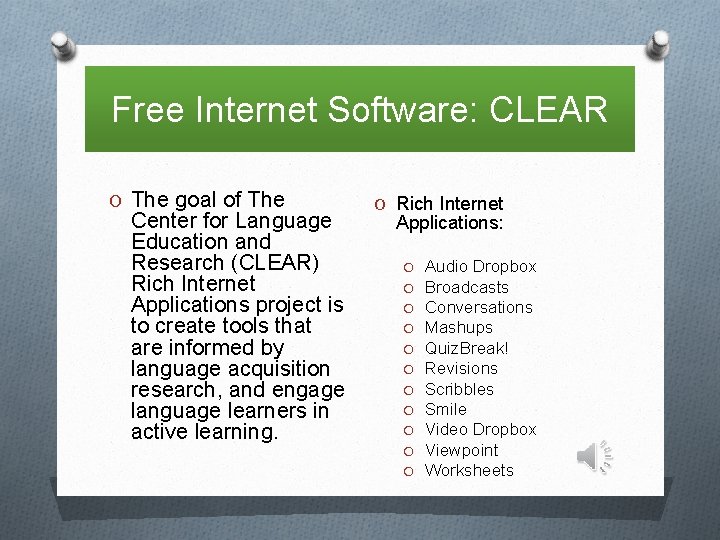
Free Internet Software: CLEAR O The goal of The Center for Language Education and Research (CLEAR) Rich Internet Applications project is to create tools that are informed by language acquisition research, and engage language learners in active learning. O Rich Internet Applications: O O O Audio Dropbox Broadcasts Conversations Mashups Quiz. Break! Revisions Scribbles Smile Video Dropbox Viewpoint Worksheets
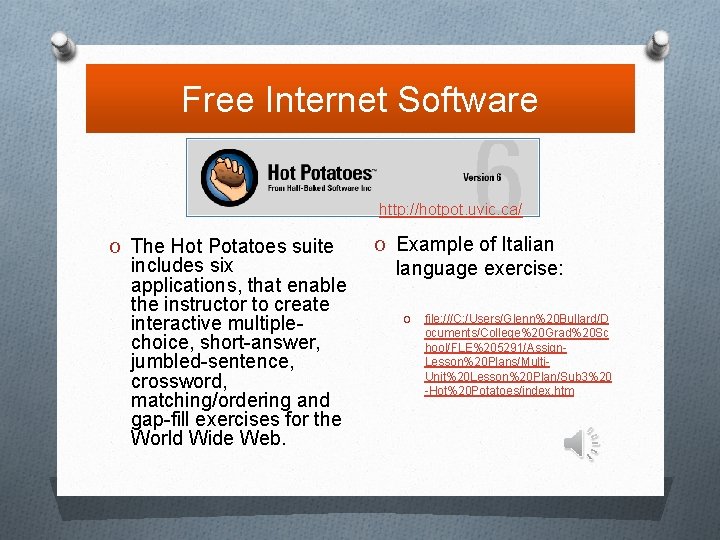
Free Internet Software http: //hotpot. uvic. ca/ O The Hot Potatoes suite includes six applications, that enable the instructor to create interactive multiplechoice, short-answer, jumbled-sentence, crossword, matching/ordering and gap-fill exercises for the World Wide Web. O Example of Italian language exercise: O file: ///C: /Users/Glenn%20 Bullard/D ocuments/College%20 Grad%20 Sc hool/FLE%205291/Assign. Lesson%20 Plans/Multi. Unit%20 Lesson%20 Plan/Sub 3%20 -Hot%20 Potatoes/index. htm
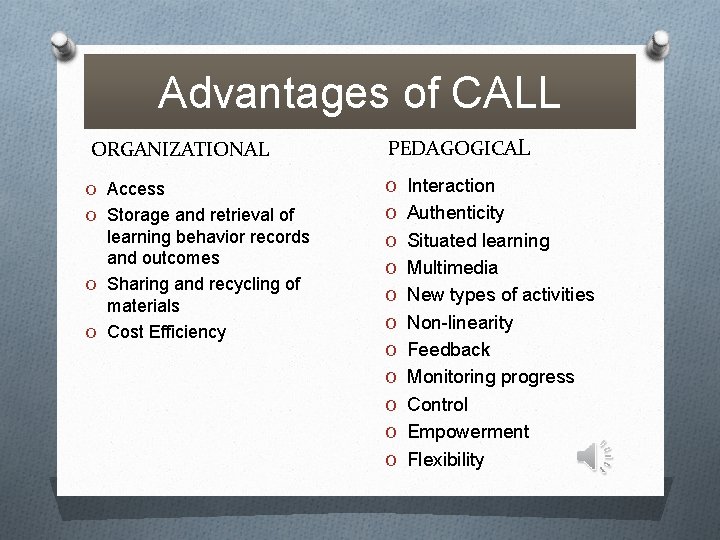
Advantages of CALL ORGANIZATIONAL PEDAGOGICAL O Access O Interaction O Storage and retrieval of O Authenticity learning behavior records and outcomes O Sharing and recycling of materials O Cost Efficiency O Situated learning O Multimedia O New types of activities O Non-linearity O Feedback O Monitoring progress O Control O Empowerment O Flexibility
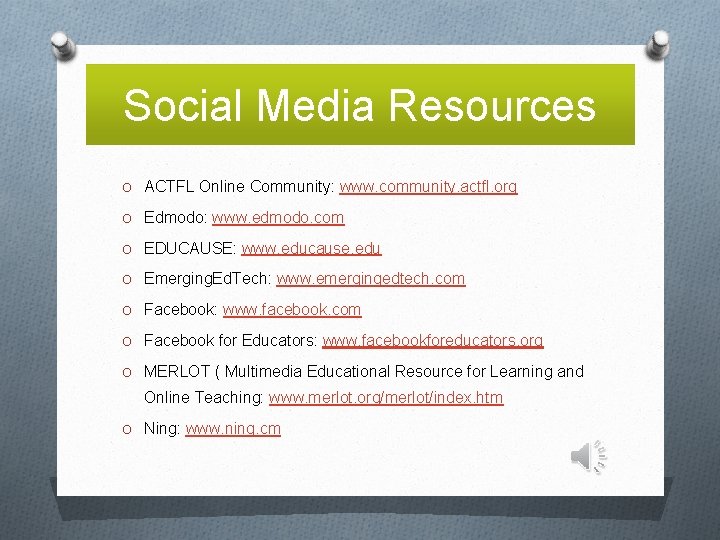
Social Media Resources O ACTFL Online Community: www. community. actfl. org O Edmodo: www. edmodo. com O EDUCAUSE: www. educause. edu O Emerging. Ed. Tech: www. emergingedtech. com O Facebook: www. facebook. com O Facebook for Educators: www. facebookforeducators. org O MERLOT ( Multimedia Educational Resource for Learning and Online Teaching: www. merlot. org/merlot/index. htm O Ning: www. ning. cm
Multilingual Communities Resources O Around the World with 80 Schools: O O O O www. aroundtheworldwith 80 schools. net Around the World with Skype: www. langwithces. wikispaces. com/Around+The+World+With+Sky pe Cross-Cultural Classroom Connections, UW-Madison: www. studyabroad. wisc. edu. /classroomconntections. html Edublogs Student Blogging Challenge: www. studentchallenge. edublogs. org e. Pals: www. epals. com Flat Classroom Project: www. flatclassroomproject. org Global Competency Matrix: www. c 21 hub. com/globalpartnership/global-matrix/ Mivoz: www. mivoz. com
References Adair-Hauck, B. (1996). Practical whole language strategies for secondary and university-level students. Foreign Language Annals, 29(2), 253 -262. Retrieved from http: //www. actfl. org/publications/foreignlanguage-annals Cutshall, S. (2012, October). More than a decade of standards: Integrating “communities” in your language instruction. The Language Educator, 7(6), 32 -35. Davies, A. (2003). The native speaker: Myth and reality. Tonawanda, NY: Multilingual Matters. Fantini, A. E. (2005). About intercultural communicative competence: A construct. School for International Training. Retrieved from http: //www. sit. edu/graduate/5416. htm Garrett, N. (2009). Computer-assisted language learning trends and issues revisited: Integrating innovation. The Modern Language Journal, 93, 719 -740. Retrieved from http: //www. lib. usf. edu Konig, P. (2012, October). Learning through online networking. The Language Educator, 7(5), 44 -48. Larsen-Freeman, D. and Anderson, M. (2011). Techniques and principles in language teaching. Oxford: Oxford UP. Schuetze, U. (2008). Exchanging second language messages online: developing an intercultural communicative competence? Foreign Language Annals, 41(4), 660 -672. Retrieved from http: //www. lib. usf. edu Stockwell, G. (2012). Computer-assisted language learning: Diversity in research and practice. Retrieved from http: //www. lib. usf. edu Yamauchi, M. (2009). Integrating internet technology into the EFL classroom: A case study. International Journal of Pedagogies and Learning, 5, 3 -19. http: //jpl. econtentmanagement. com/ Images Retrieved from: Microsoft Clip Art; Google Images; http: //classroomaid. files. wordpress. com/2012/04/teaching-with-technology. png https: //media. startalk. umd. edu/workshops/2009/Occidental/index. php