
Computer Whats a computer Until the 1930 s

- Slides: 27
Computer? What’s a computer? Until the 1930 s a “computer” was a person who did mathematical calculations. This changed at least in part due to World War II -The US, Great Britain and Germany all had active research into computer technology. Copyright © 2008 by Helene G. Kershner
Computer? What’s a computer? Man vs. Machine Albert Einstein said: Computers are incredibly fast, accurate, and stupid: Humans are incredibly slow, inaccurate and brilliant; Together they are powerful beyond imagination. 1 -- Albert Einstein www. quotiki. com Copyright © 2008 by Helene G. Kershner
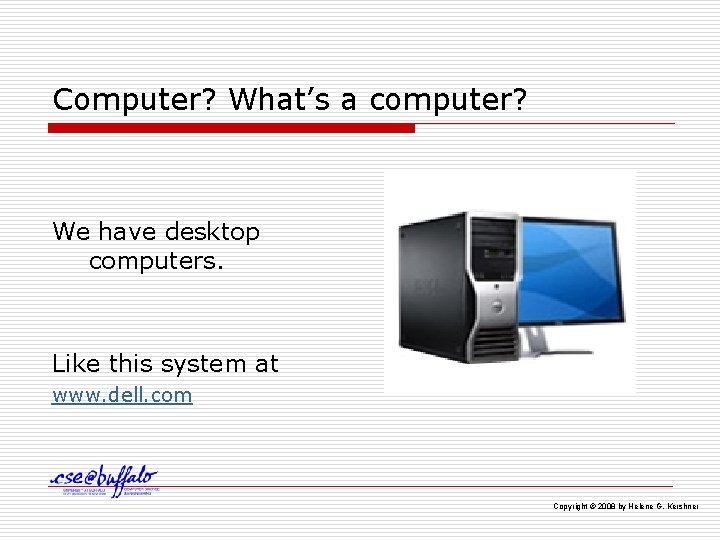
Computer? What’s a computer? We have desktop computers. Like this system at www. dell. com Copyright © 2008 by Helene G. Kershner
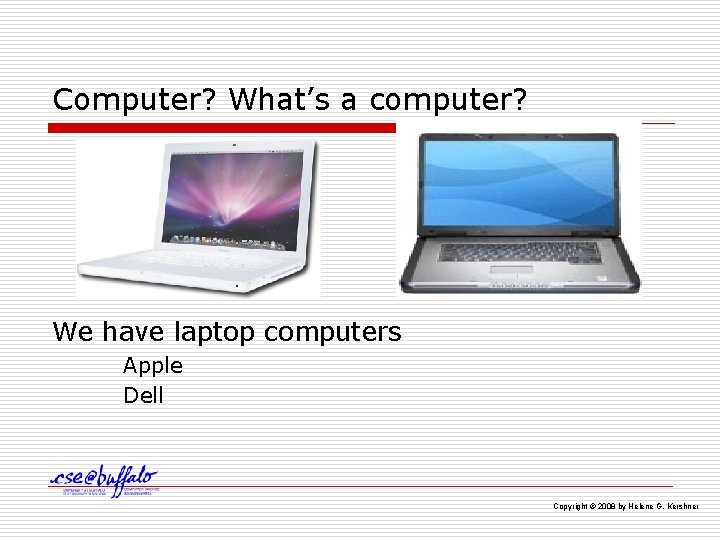
Computer? What’s a computer? We have laptop computers Apple Dell Copyright © 2008 by Helene G. Kershner
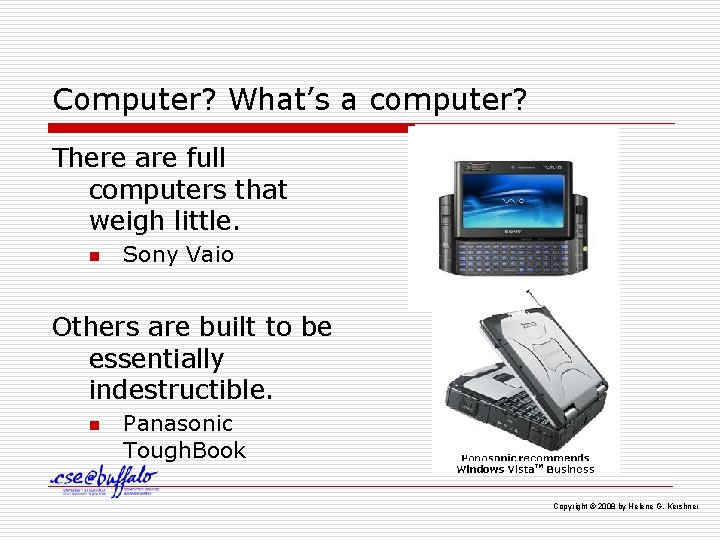
Computer? What’s a computer? There are full computers that weigh little. n Sony Vaio Others are built to be essentially indestructible. n Panasonic Tough. Book Copyright © 2008 by Helene G. Kershner
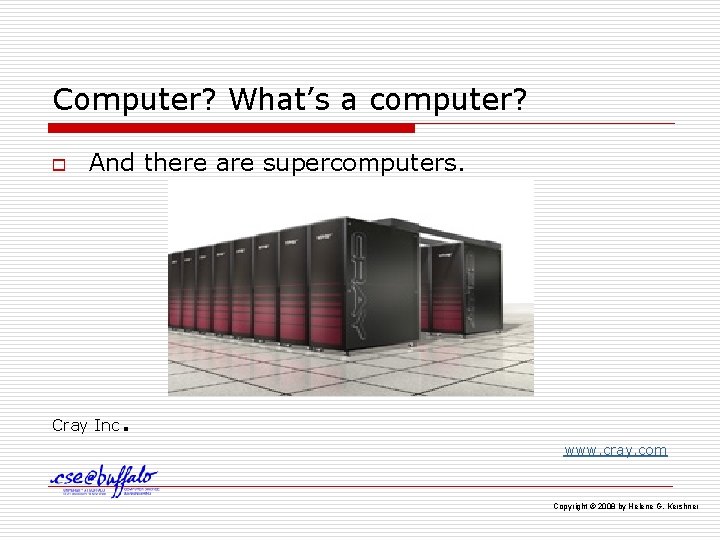
Computer? What’s a computer? o And there are supercomputers. Cray Inc . www. cray. com Copyright © 2008 by Helene G. Kershner
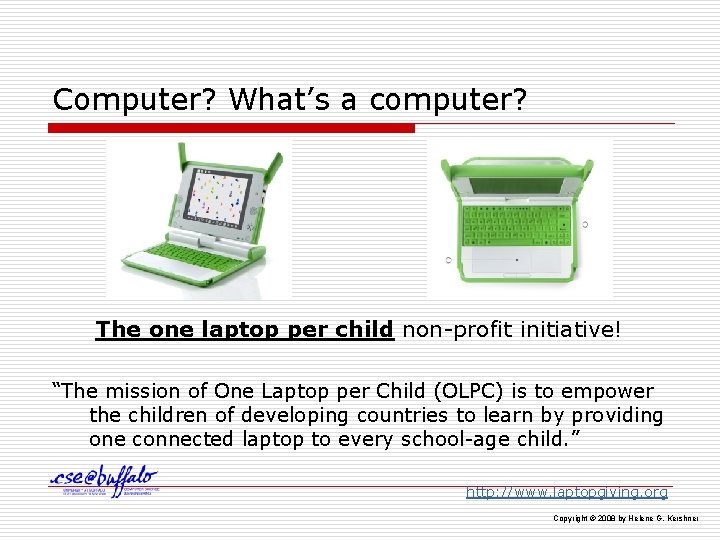
Computer? What’s a computer? The one laptop per child non-profit initiative! “The mission of One Laptop per Child (OLPC) is to empower the children of developing countries to learn by providing one connected laptop to every school-age child. ” http: //www. laptopgiving. org Copyright © 2008 by Helene G. Kershner
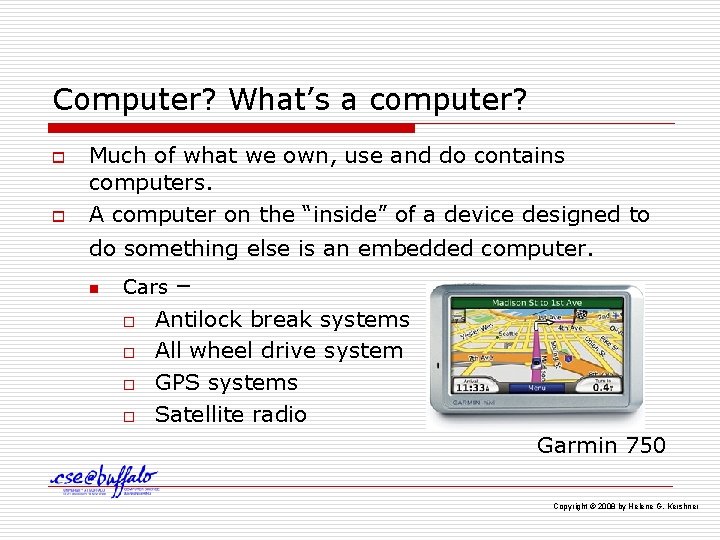
Computer? What’s a computer? o o Much of what we own, use and do contains computers. A computer on the “inside” of a device designed to do something else is an embedded computer. n Cars o o – Antilock break systems All wheel drive system GPS systems Satellite radio Garmin 750 Copyright © 2008 by Helene G. Kershner
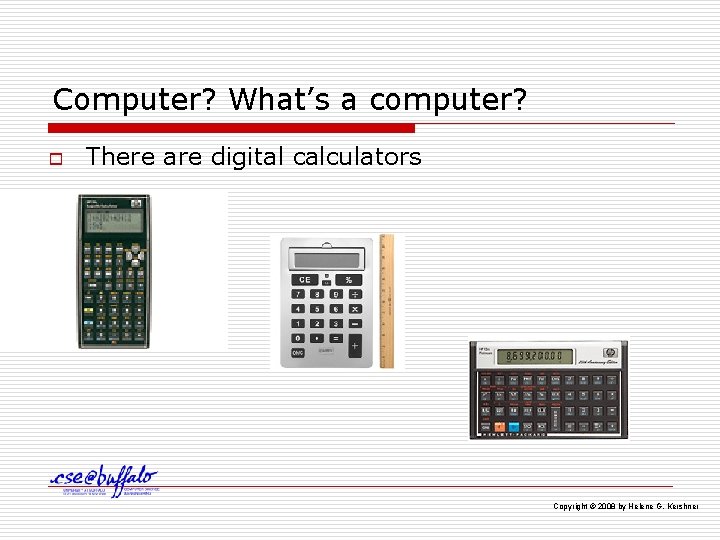
Computer? What’s a computer? o There are digital calculators Copyright © 2008 by Helene G. Kershner
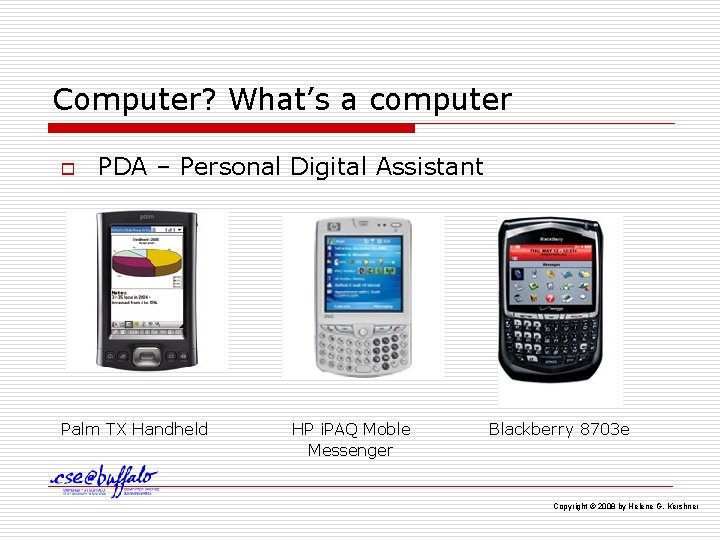
Computer? What’s a computer o PDA – Personal Digital Assistant Palm TX Handheld HP i. PAQ Moble Messenger Blackberry 8703 e Copyright © 2008 by Helene G. Kershner
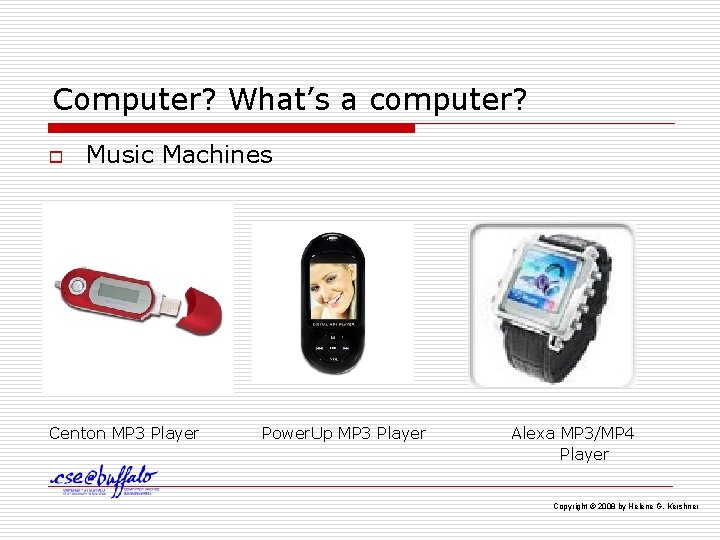
Computer? What’s a computer? o Music Machines Centon MP 3 Player Power. Up MP 3 Player Alexa MP 3/MP 4 Player Copyright © 2008 by Helene G. Kershner
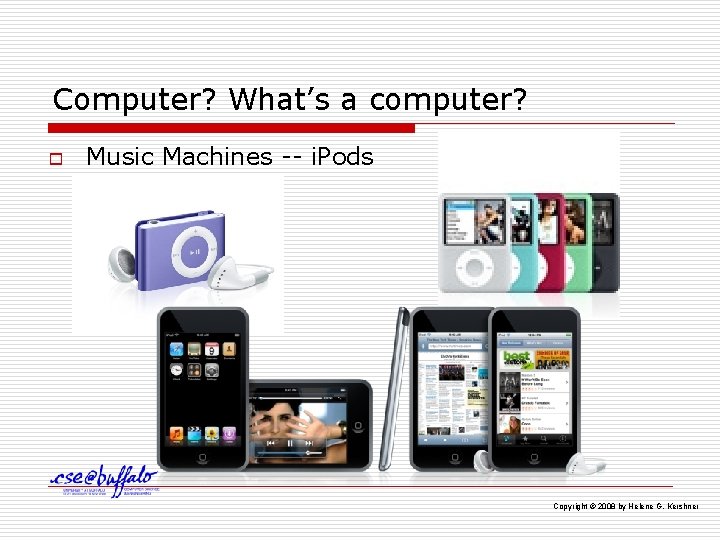
Computer? What’s a computer? o Music Machines -- i. Pods Copyright © 2008 by Helene G. Kershner
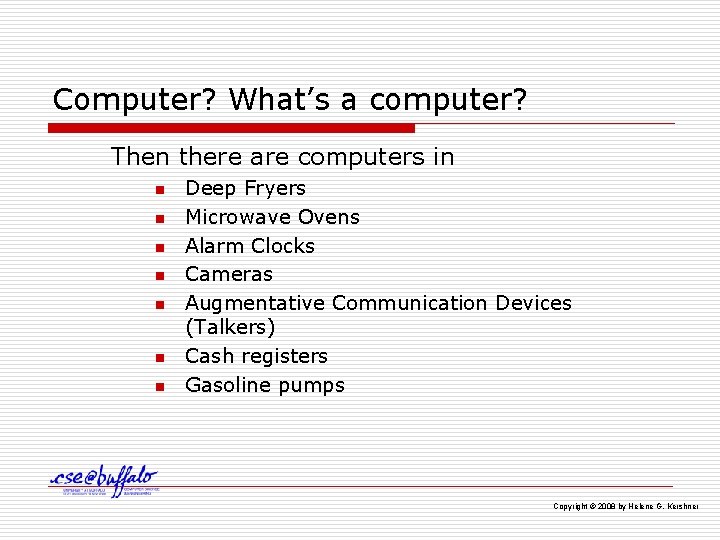
Computer? What’s a computer? Then there are computers in n n n Deep Fryers Microwave Ovens Alarm Clocks Cameras Augmentative Communication Devices (Talkers) Cash registers Gasoline pumps Copyright © 2008 by Helene G. Kershner
Computer? What’s a computer? And then there are cell phones? Or are these PDAs, cameras, alarm clocks, time pieces and… computers Copyright © 2008 by Helene G. Kershner
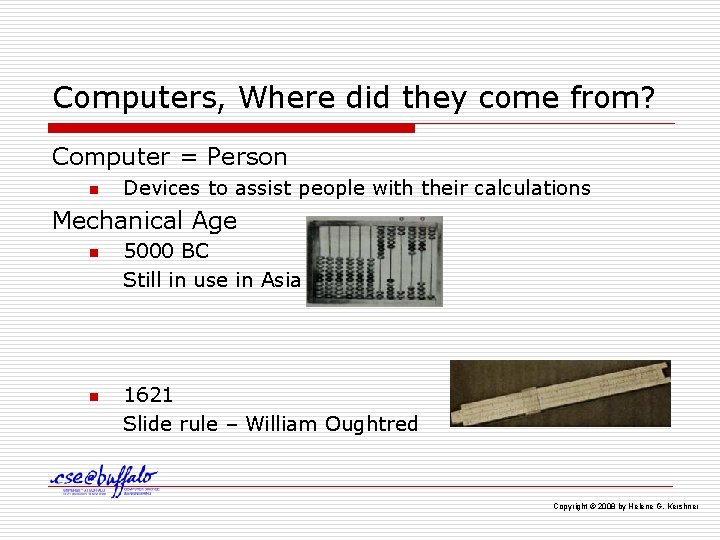
Computers, Where did they come from? Computer = Person n Devices to assist people with their calculations Mechanical Age n n 5000 BC Still in use in Asia 1621 Slide rule – William Oughtred Copyright © 2008 by Helene G. Kershner
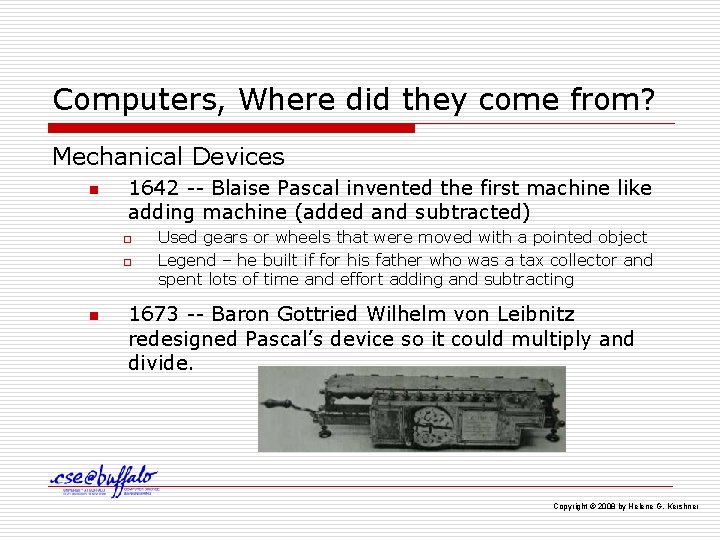
Computers, Where did they come from? Mechanical Devices n 1642 -- Blaise Pascal invented the first machine like adding machine (added and subtracted) o o n Used gears or wheels that were moved with a pointed object Legend – he built if for his father who was a tax collector and spent lots of time and effort adding and subtracting 1673 -- Baron Gottried Wilhelm von Leibnitz redesigned Pascal’s device so it could multiply and divide. Copyright © 2008 by Helene G. Kershner
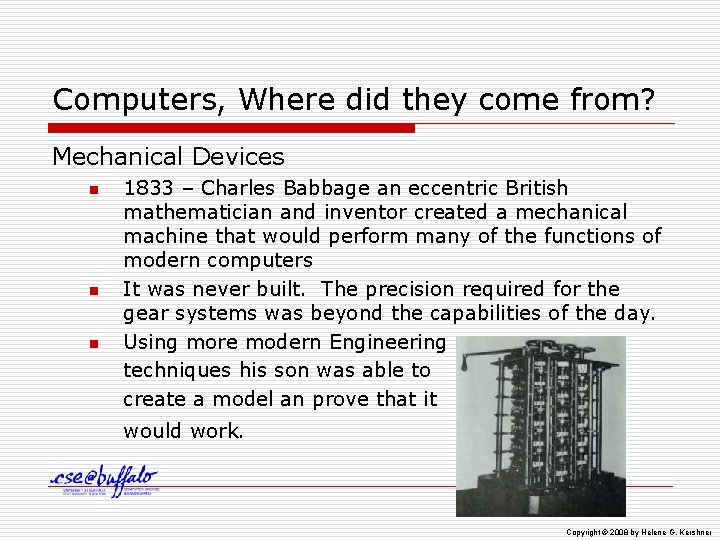
Computers, Where did they come from? Mechanical Devices n n n 1833 – Charles Babbage an eccentric British mathematician and inventor created a mechanical machine that would perform many of the functions of modern computers It was never built. The precision required for the gear systems was beyond the capabilities of the day. Using more modern Engineering techniques his son was able to create a model an prove that it would work. Copyright © 2008 by Helene G. Kershner
Computers, Where did they come from? The Industrial Age – mid 1800 s through early 1900 s o o o n Herman Hollerith’s Tabulating machine o o n Agrarian world Industrialization Farms factories Cloth made by hand textile industries (mechanical loom) Animal power steam internal combustion engine Gas lights electic lights Contest to calculate the 1900 census “Grandparent” company of IBM 1888 – William Burroughs’ created & patented a paper tape adding machine o Burroughs Corp. moved from adding machines to computers in 1961. Copyright © 2008 by Helene G. Kershner
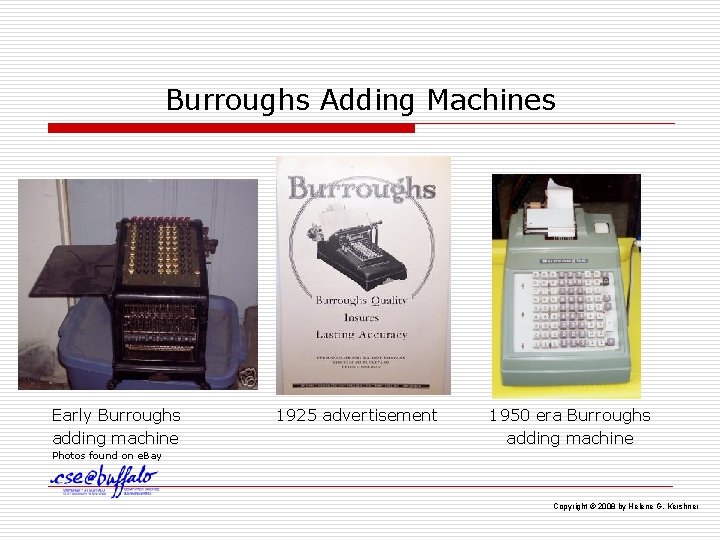
Burroughs Adding Machines Early Burroughs adding machine 1925 advertisement 1950 era Burroughs adding machine Photos found on e. Bay Copyright © 2008 by Helene G. Kershner
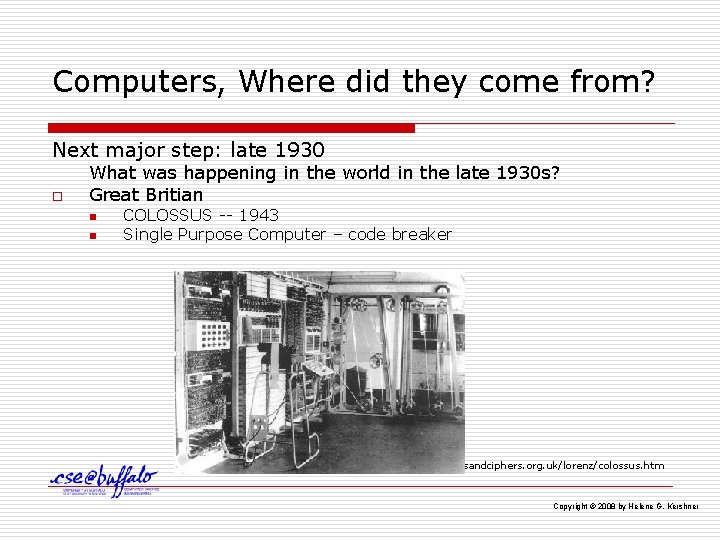
Computers, Where did they come from? Next major step: late 1930 o What was happening in the world in the late 1930 s? Great Britian n n COLOSSUS -- 1943 Single Purpose Computer – code breaker www. codesandciphers. org. uk/lorenz/colossus. htm Copyright © 2008 by Helene G. Kershner
Computers, Great Ideas o o In 1936, mathematician Alan Turing theorized that a general purpose computer could be built. Great Idea – He asked, what is computable? He then suggested that “a task is computable if one can specify a sequence of instructions which when followed will result in the completion of the task. ” * This was intended strictly as a mathematical idea. This concept/thought experiment is known as a Turing machine. In 1943, Turing helped the British government develop COLOSSUS. plato. stanford. edu/entries/turing-machine/ * Copyright © 2008 by Helene G. Kershner
Computers, Great Ideas o o o In 1944, scientist John Von Neumann added his talents to the ENIAC team. Great Idea -- Developed the concept of storing a program in the computer’s memory, rather part of it’s circuitry. This is called the stored program concept. Each program was a numeric code using binary digits (0 or 1) (off or on). Both the program and the data could now be stored in memory. Kershner, Computer Literacy 3 rd Ed. Copyright © 2008 by Helene G. Kershner
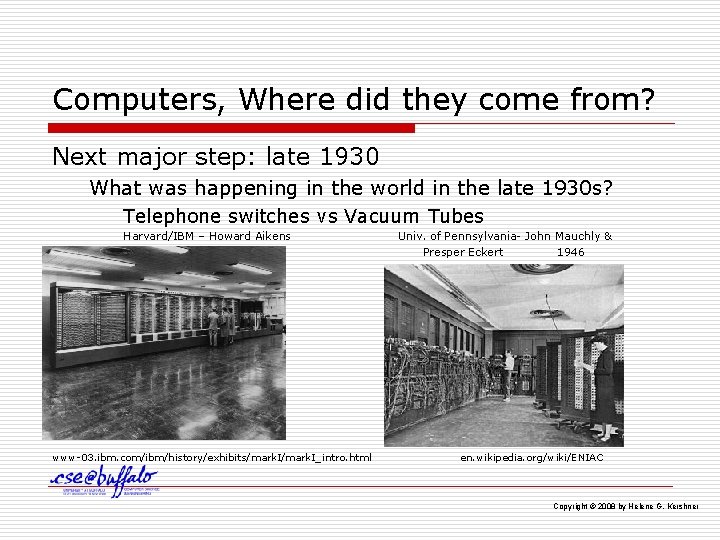
Computers, Where did they come from? Next major step: late 1930 What was happening in the world in the late 1930 s? Telephone switches vs Vacuum Tubes Harvard/IBM – Howard Aikens 1943 www-03. ibm. com/ibm/history/exhibits/mark. I_intro. html Univ. of Pennsylvania- John Mauchly & Presper Eckert 1946 en. wikipedia. org/wiki/ENIAC Copyright © 2008 by Helene G. Kershner
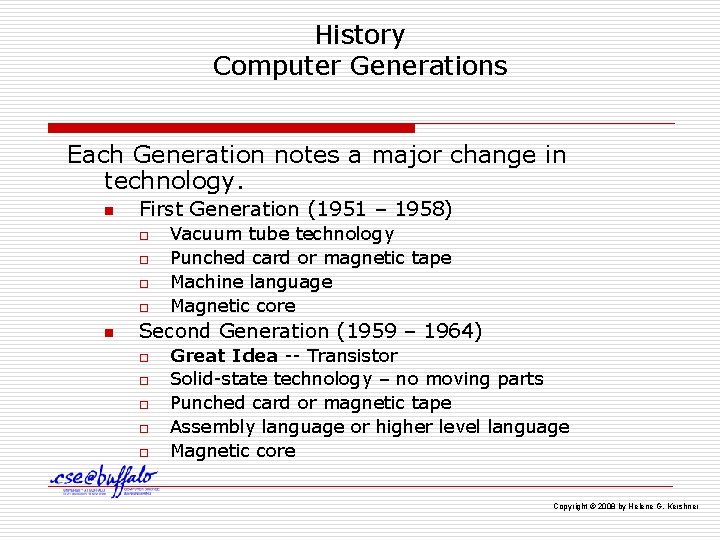
History Computer Generations Each Generation notes a major change in technology. n First Generation (1951 – 1958) o o n Vacuum tube technology Punched card or magnetic tape Machine language Magnetic core Second Generation (1959 – 1964) o o o Great Idea -- Transistor Solid-state technology – no moving parts Punched card or magnetic tape Assembly language or higher level language Magnetic core Copyright © 2008 by Helene G. Kershner
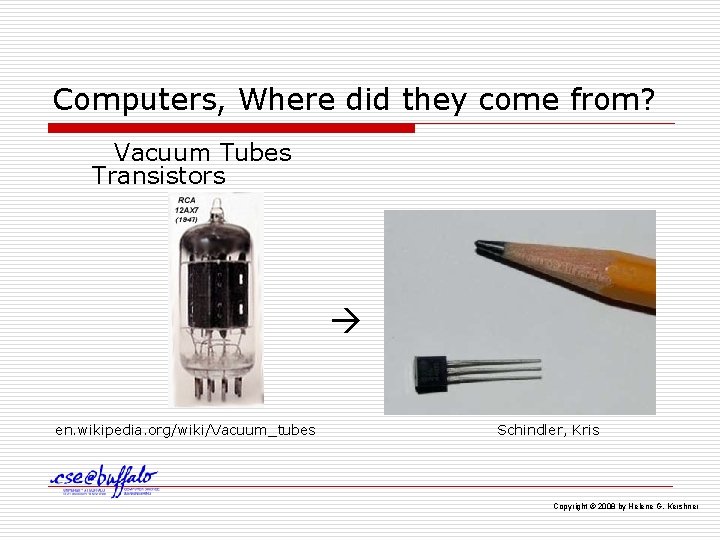
Computers, Where did they come from? Vacuum Tubes Transistors en. wikipedia. org/wiki/Vacuum_tubes Schindler, Kris Copyright © 2008 by Helene G. Kershner
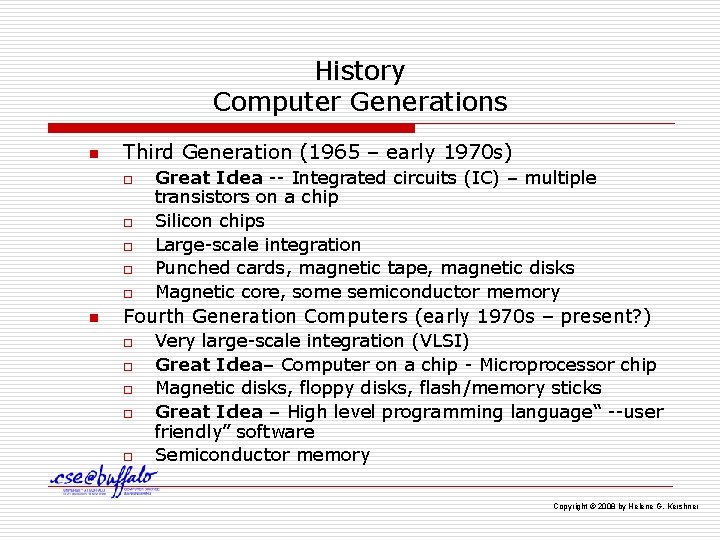
History Computer Generations n Third Generation (1965 – early 1970 s) o o o n Great Idea -- Integrated circuits (IC) – multiple transistors on a chip Silicon chips Large-scale integration Punched cards, magnetic tape, magnetic disks Magnetic core, some semiconductor memory Fourth Generation Computers (early 1970 s – present? ) o o o Very large-scale integration (VLSI) Great Idea– Computer on a chip - Microprocessor chip Magnetic disks, floppy disks, flash/memory sticks Great Idea – High level programming language“ --user friendly” software Semiconductor memory Copyright © 2008 by Helene G. Kershner
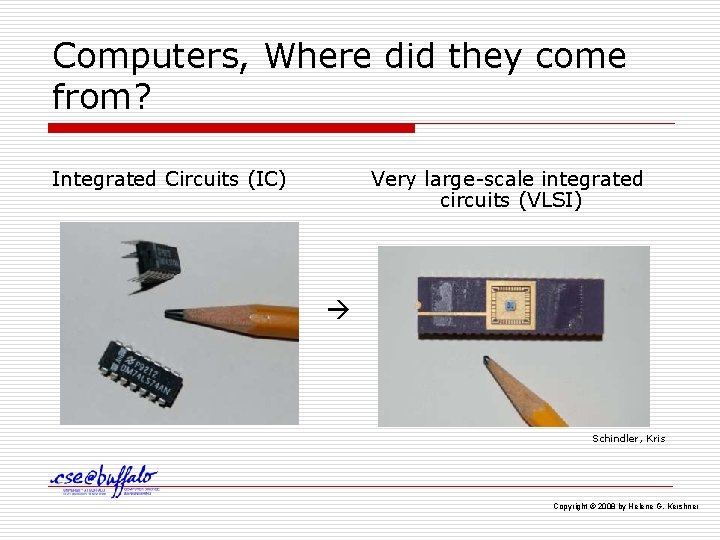
Computers, Where did they come from? Integrated Circuits (IC) Very large-scale integrated circuits (VLSI) Schindler, Kris Copyright © 2008 by Helene G. Kershner