
Computer Vision TP 8 Advanced Segmentation Miguel Tavares




- Slides: 48
Computer Vision – TP 8 Advanced Segmentation Miguel Tavares Coimbra
Outline • Segmentation by Clustering • Segmentation by Fitting • Semantic Segmentation Computer Vision - TP 8 - Advanced Segmentation 2
Topic: Segmentation by Clustering • Segmentation by Fitting • Semantic Segmentation Computer Vision - TP 8 - Advanced Segmentation 3
What is ‘Segmentation’? (again? ) • Traditional definition: “Separation of the image in different areas“ • Decompose an image into “superpixels” • Colour and texture coherence. • Aren’t there other ways to look at the ‘Segmentation’ concept? Computer Vision - TP 8 - Advanced Segmentation 4
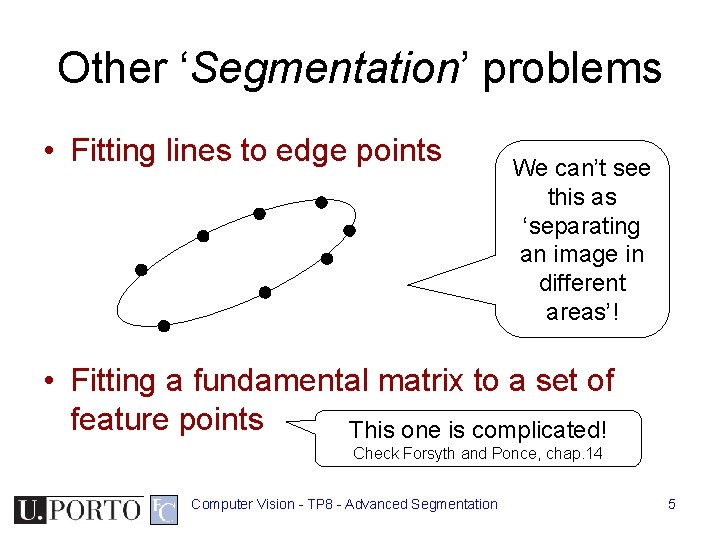
Other ‘Segmentation’ problems • Fitting lines to edge points We can’t see this as ‘separating an image in different areas’! • Fitting a fundamental matrix to a set of feature points This one is complicated! Check Forsyth and Ponce, chap. 14 Computer Vision - TP 8 - Advanced Segmentation 5
Segmentation as Clustering • Tries to answer the question: “Which components of the data set naturally belong together? ” • Two approaches: – Partitioning • Decompose a large data set into pieces that are ‘good’ according to our model – Grouping • Collect sets of data items that ‘make sense’ according to our model Computer Vision - TP 8 - Advanced Segmentation 6
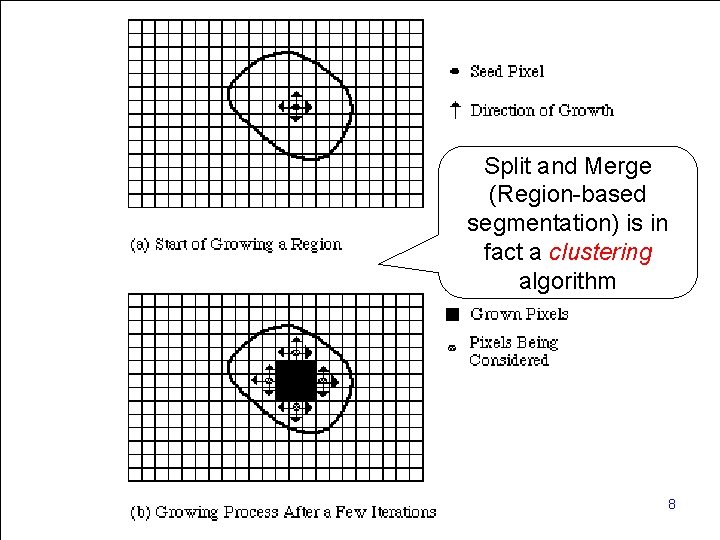
Simple clustering • Two natural types of clustering: – Divisive clustering • Entire data set is regarded as a cluster • Clusters are recursively split – Agglomerative clustering • Each data item is a cluster • Clusters are recursively merged • Where have I seen this before? Computer Vision - TP 8 - Advanced Segmentation 7
Split and Merge (Region-based segmentation) is in fact a clustering algorithm Computer Vision - TP 8 - Advanced Segmentation 8
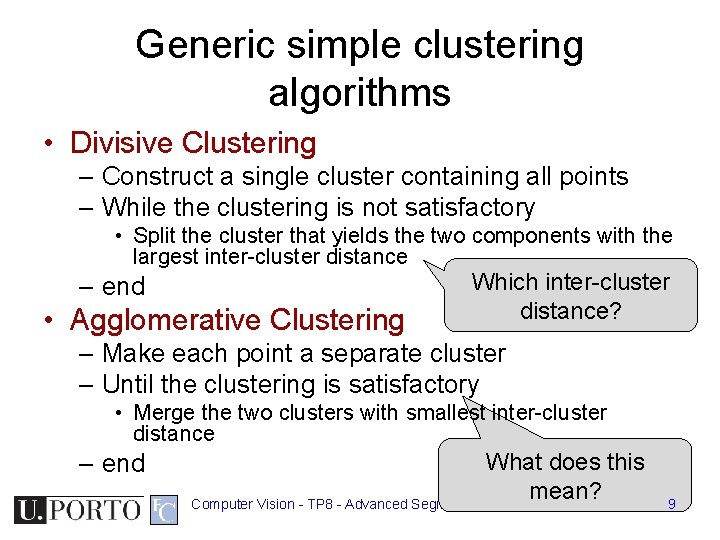
Generic simple clustering algorithms • Divisive Clustering – Construct a single cluster containing all points – While the clustering is not satisfactory • Split the cluster that yields the two components with the largest inter-cluster distance – end • Agglomerative Clustering Which inter-cluster distance? – Make each point a separate cluster – Until the clustering is satisfactory • Merge the two clusters with smallest inter-cluster distance – end What does this mean? Computer Vision - TP 8 - Advanced Segmentation 9
Simple clustering with images • Some specific problems arise: – Lots of pixels! Graphical representations are harder to read – Segmentation: It is desirable that certain objects are connected. How to enforce this? – When do we stop splitting/merging process? • Complex situations require more complex clustering solutions! Computer Vision - TP 8 - Advanced Segmentation 10
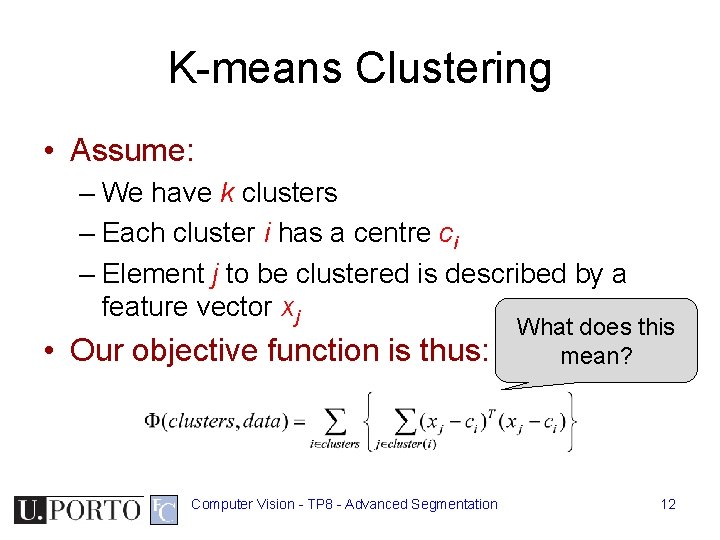
K-means Clustering • What if we know that there are k clusters in the image? • We can define an objective function! – Expresses how good my representation is • We can now build an algorithm to obtain the best representation Caution! “Best” given my objective function! Computer Vision - TP 8 - Advanced Segmentation 11
K-means Clustering • Assume: – We have k clusters – Each cluster i has a centre ci – Element j to be clustered is described by a feature vector xj • Our objective function is thus: Computer Vision - TP 8 - Advanced Segmentation What does this mean? 12
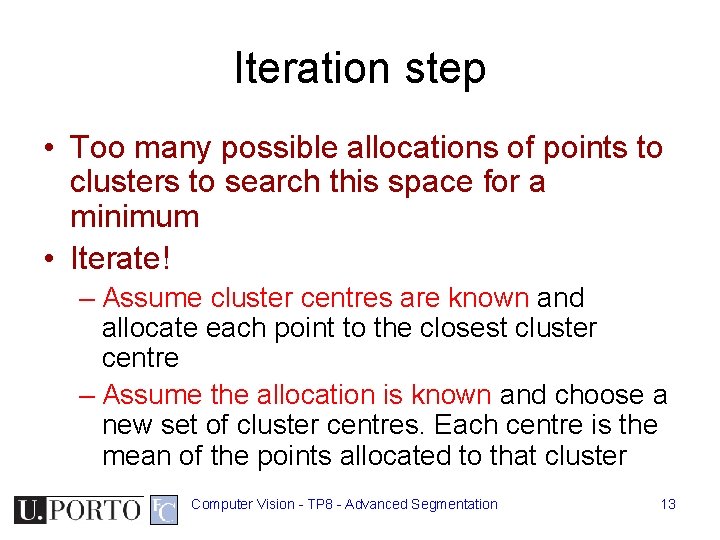
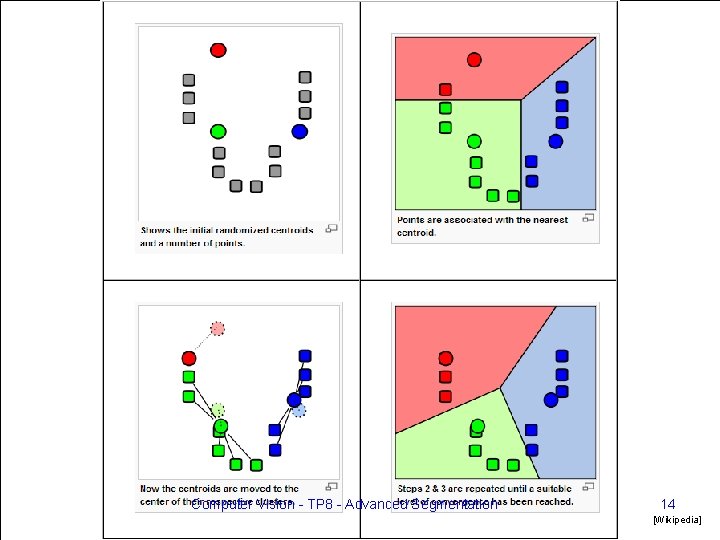
Iteration step • Too many possible allocations of points to clusters to search this space for a minimum • Iterate! – Assume cluster centres are known and allocate each point to the closest cluster centre – Assume the allocation is known and choose a new set of cluster centres. Each centre is the mean of the points allocated to that cluster Computer Vision - TP 8 - Advanced Segmentation 13
Computer Vision - TP 8 - Advanced Segmentation 14 [Wikipedia]
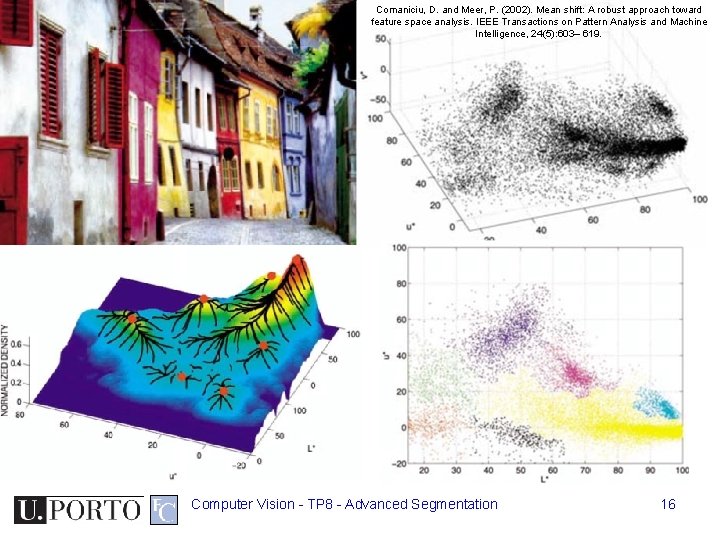
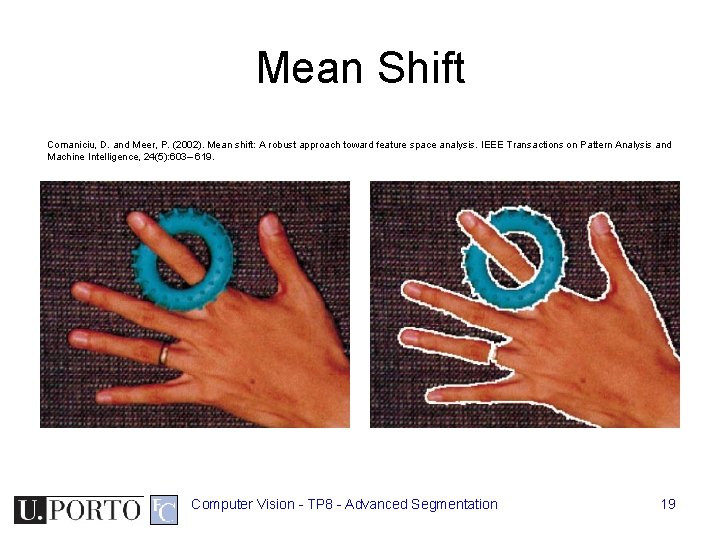
Mean Shift • K-means: – Segments our feature space (and not the image!) into clusters (and not regions) – Uses a parametric model for its distributions (e. g. Gaussians), whose locations (centers) and shape (covariance) can be estimated • Mean shift: – Segments an image (and not the feature space) into regions – Uses a non-parametric model (simply tries to find distribution peaks) Computer Vision - TP 8 - Advanced Segmentation 15
Comaniciu, D. and Meer, P. (2002). Mean shift: A robust approach toward feature space analysis. IEEE Transactions on Pattern Analysis and Machine Intelligence, 24(5): 603– 619. Computer Vision - TP 8 - Advanced Segmentation 16
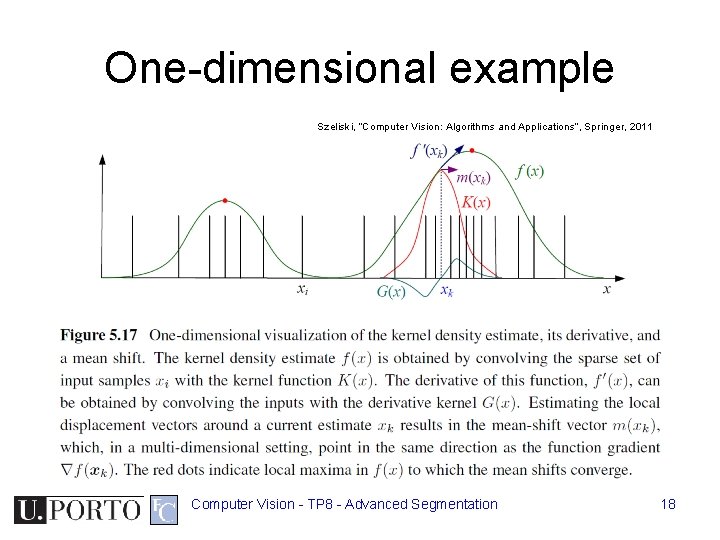
How does it work? • Each pixel ‘finds’ its nearest distribution peak by ‘climbing uphill’ the image’s kernel density function f(x) • The gradient of f(x) defines the direction for this ‘climb’, by defining mean-shift vectors • Pixels that ‘climb’ to the same peak form a region Computer Vision - TP 8 - Advanced Segmentation 17
One-dimensional example Szeliski, “Computer Vision: Algorithms and Applications”, Springer, 2011 Computer Vision - TP 8 - Advanced Segmentation 18
Mean Shift Comaniciu, D. and Meer, P. (2002). Mean shift: A robust approach toward feature space analysis. IEEE Transactions on Pattern Analysis and Machine Intelligence, 24(5): 603– 619. Computer Vision - TP 8 - Advanced Segmentation 19
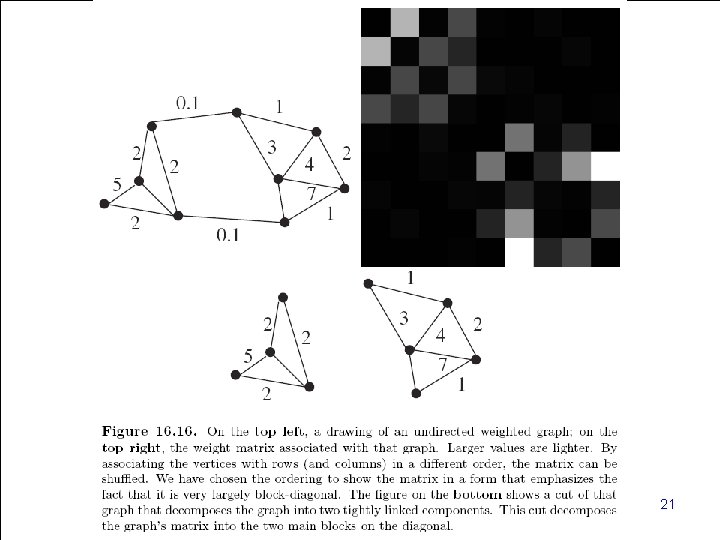
Normalized Cuts • Clustering can be seen as a problem of “cutting graphs into good pieces” • Data Items – Vertex in a weighted graph – Weights are large if elements are similar • Cut edges – Cut edges with small weights – Keep connected components with large interior weights Regions! Computer Vision - TP 8 - Advanced Segmentation 20
Computer Vision - TP 8 - Advanced Segmentation 21
Graphs and Clustering • Associate each element to be clustered with a vertex on a graph • Construct an edge from every element to every other • Associate a weight with each edge based on a similarity measure • Cut the edges in the graph to form a good set of connected components Computer Vision - TP 8 - Advanced Segmentation 22
Weight Matrices • Typically look like block diagonal matrices • Why? – Interclusters similarities are strong – Intracluster similarities are weak • Split a matrix into smaller matrices, each of which is a block • Define Affinity Measures Computer Vision - TP 8 - Advanced Segmentation 23
More on this • Affinity measures – Affinity by Distance – Affinity by Intensity – Affinity by Colour – Affinity by Texture Want to know more? Check out: Forsyth and Ponce, Section 14. 5 • Popular method: Normalized cuts Jianbo Shi and Jitendra Malik, “Normalized Cuts and Image Segmentation”, IEEE Transactions on Pattern Analysis And Machine Intelligence, Vol. 22, No. 8, August 2000 Computer Vision - TP 8 - Advanced Segmentation 24
Topic: Segmentation by Fitting • Segmentation by Clustering • Segmentation by Fitting • Semantic Segmentation Computer Vision - TP 8 - Advanced Segmentation 25
Fitting and Clustering • Another definition for segmentation: – Pixels belong together because they conform to some model • Sounds like “Segmentation by Clustering”. . . We have a • Key difference: – The model is now explicit mathematical model for the object we want to segment. Ex: A line Computer Vision - TP 8 - Advanced Segmentation 26
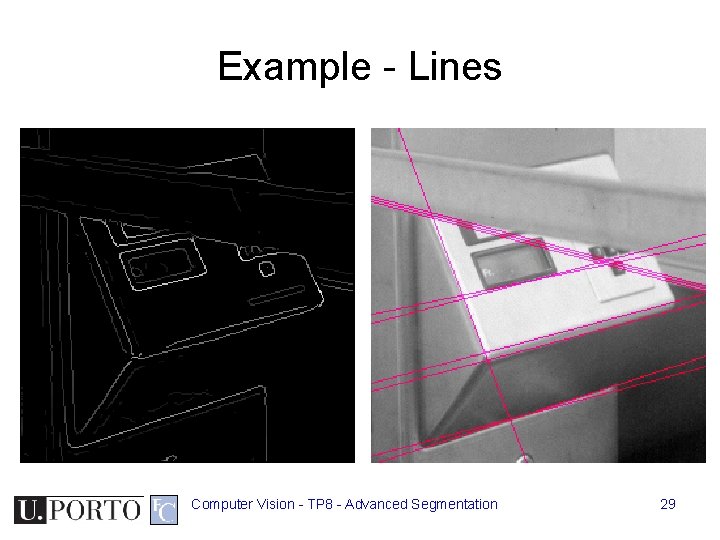
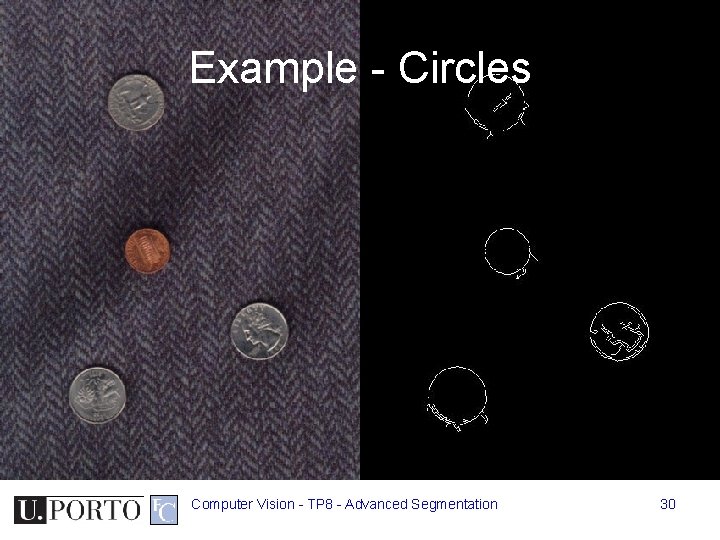
Hough Transform • Elegant method for direct object recognition • Edges need not be connected • Complete object need not be visible • Key Idea: Edges VOTE for the possible model Computer Vision - TP 8 - Advanced Segmentation 27
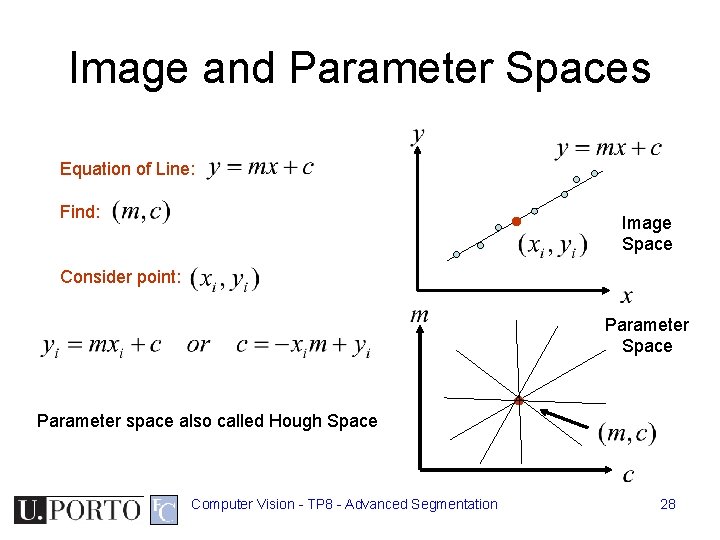
Image and Parameter Spaces Equation of Line: Find: Image Space Consider point: Parameter Space Parameter space also called Hough Space Computer Vision - TP 8 - Advanced Segmentation 28
Example - Lines Computer Vision - TP 8 - Advanced Segmentation 29
Example - Circles Computer Vision - TP 8 - Advanced Segmentation 30
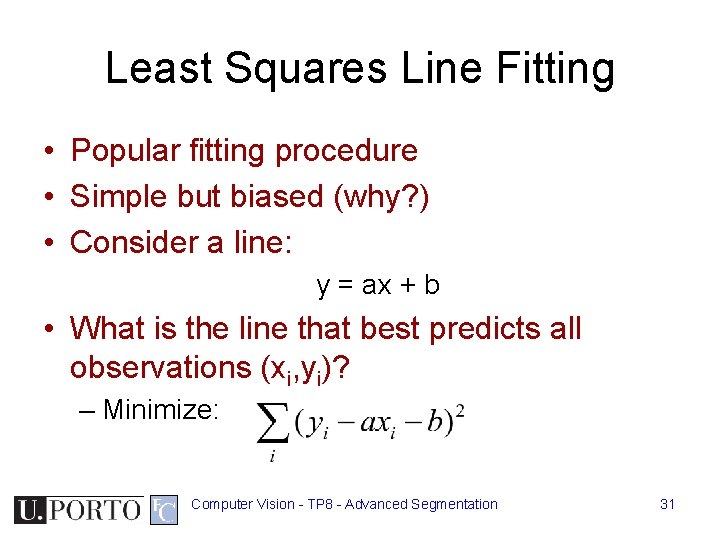
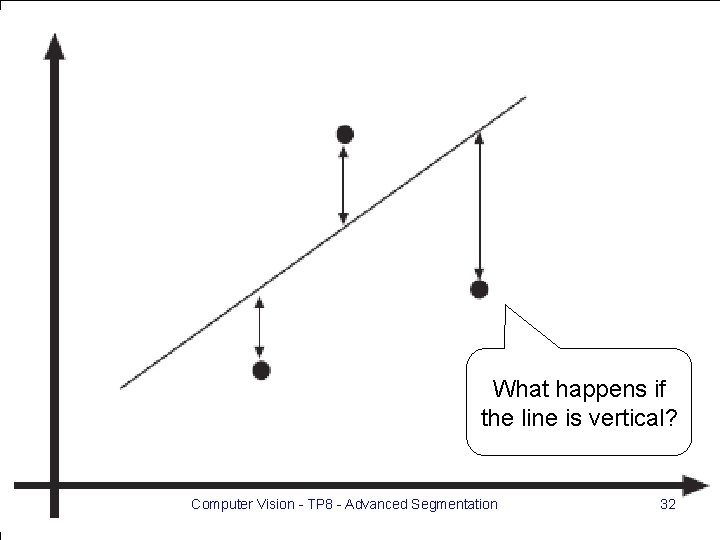
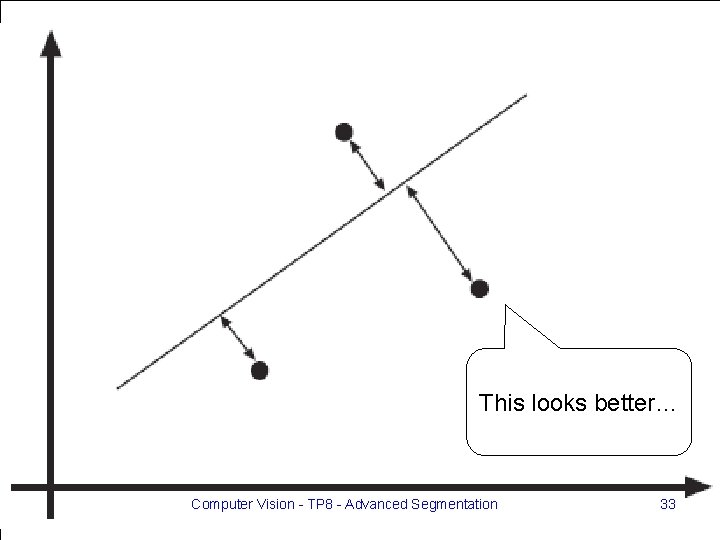
Least Squares Line Fitting • Popular fitting procedure • Simple but biased (why? ) • Consider a line: y = ax + b • What is the line that best predicts all observations (xi, yi)? – Minimize: Computer Vision - TP 8 - Advanced Segmentation 31
What happens if the line is vertical? Computer Vision - TP 8 - Advanced Segmentation 32
This looks better… Computer Vision - TP 8 - Advanced Segmentation 33
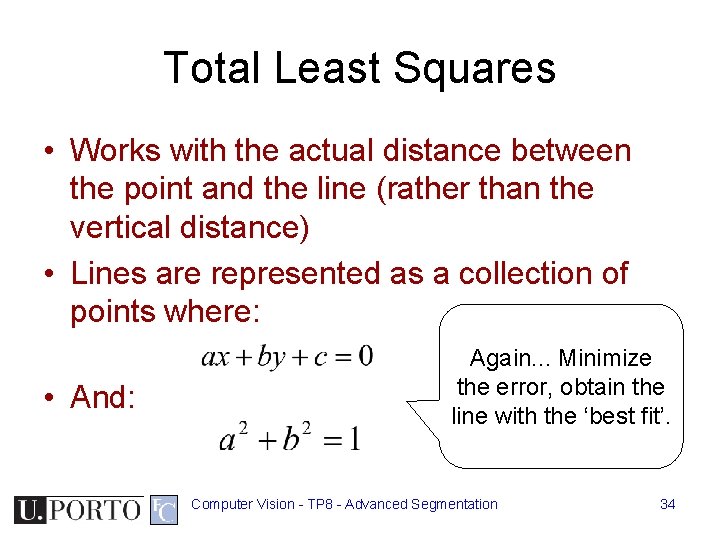
Total Least Squares • Works with the actual distance between the point and the line (rather than the vertical distance) • Lines are represented as a collection of points where: • And: Again. . . Minimize the error, obtain the line with the ‘best fit’. Computer Vision - TP 8 - Advanced Segmentation 34
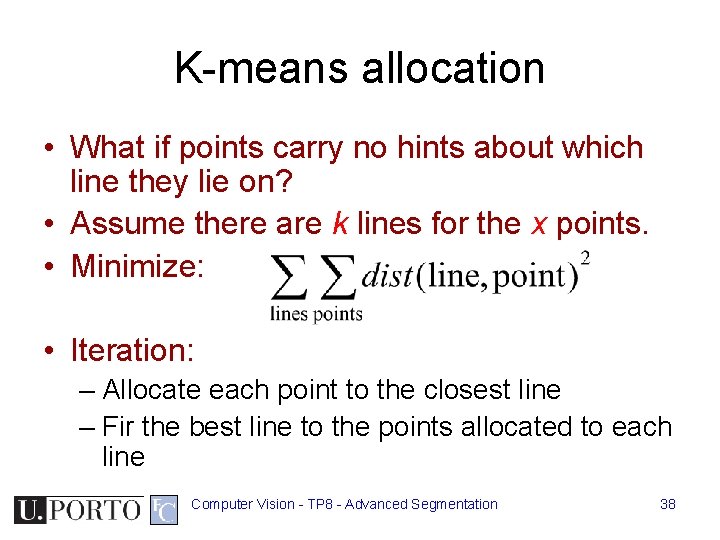
Point correspondence • We can estimate a line but, which points are on which line? • Usually: – We are fitting lines to edge points, so… – Edge directions can give us hints! • What if I only have isolated points? • Let’s look at two options: – Incremental fitting – Allocating points to lines with K-means Computer Vision - TP 8 - Advanced Segmentation 35
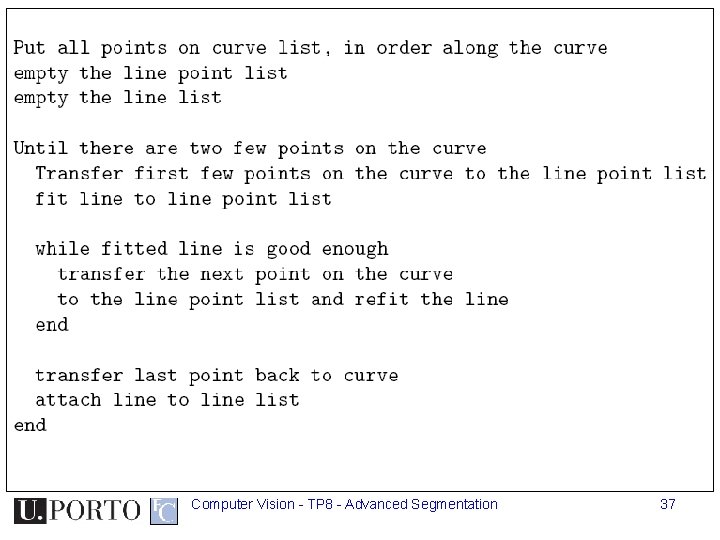
Incremental Fitting • Start with connected curves of edge points • Fit lines to those points in that curve • Incremental fitting: – Start at one end of the curve – Keep fitting all points in that curve to a line – Begin another line when the fitting deteriorates too much • Great for closed curves! Computer Vision - TP 8 - Advanced Segmentation 36
Computer Vision - TP 8 - Advanced Segmentation 37
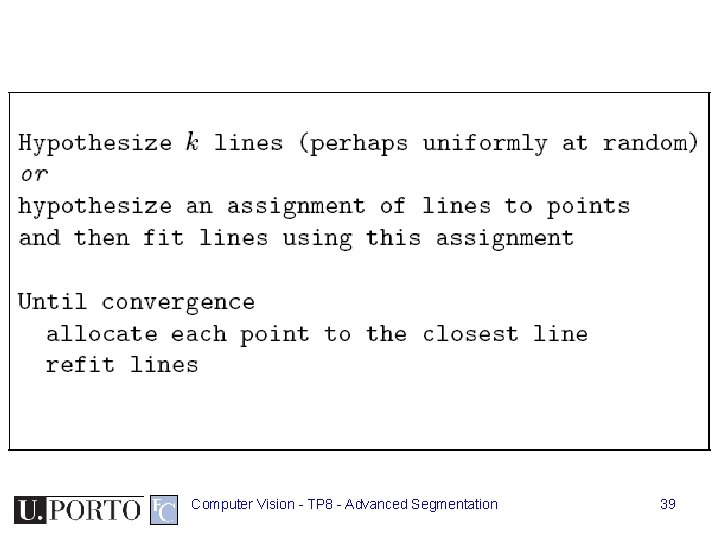
K-means allocation • What if points carry no hints about which line they lie on? • Assume there are k lines for the x points. • Minimize: • Iteration: – Allocate each point to the closest line – Fir the best line to the points allocated to each line Computer Vision - TP 8 - Advanced Segmentation 38
Computer Vision - TP 8 - Advanced Segmentation 39
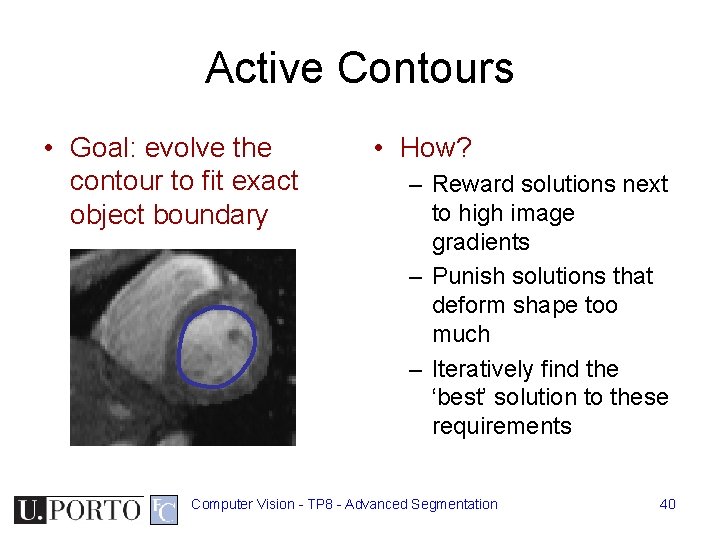
Active Contours • Goal: evolve the contour to fit exact object boundary • How? – Reward solutions next to high image gradients – Punish solutions that deform shape too much – Iteratively find the ‘best’ solution to these requirements Computer Vision - TP 8 - Advanced Segmentation 40
Topic: Semantic Segmentation • Segmentation by Clustering • Segmentation by Fitting • Semantic Segmentation Computer Vision - TP 8 - Advanced Segmentation 41
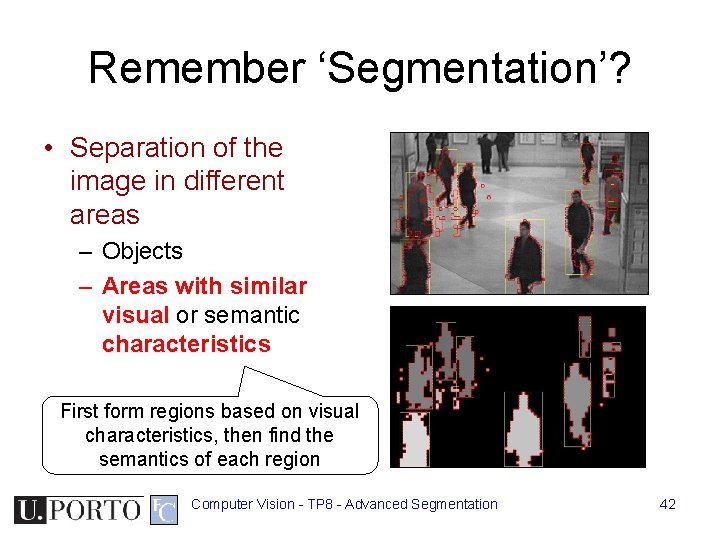
Remember ‘Segmentation’? • Separation of the image in different areas – Objects – Areas with similar visual or semantic characteristics First form regions based on visual characteristics, then find the semantics of each region Computer Vision - TP 8 - Advanced Segmentation 42
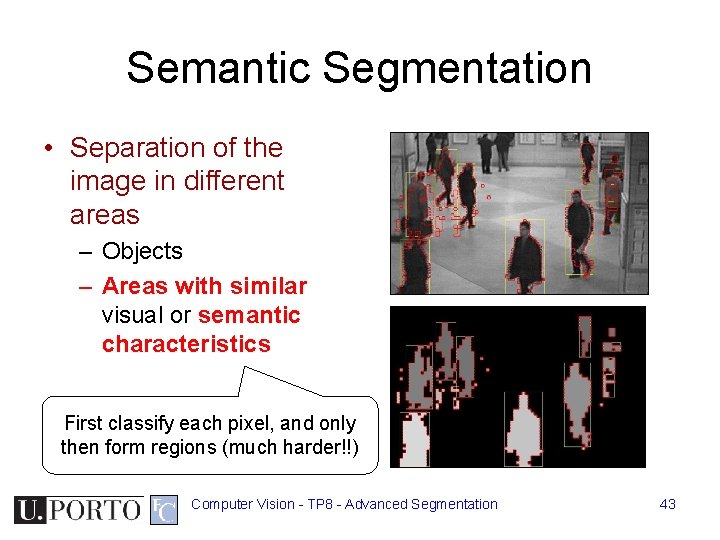
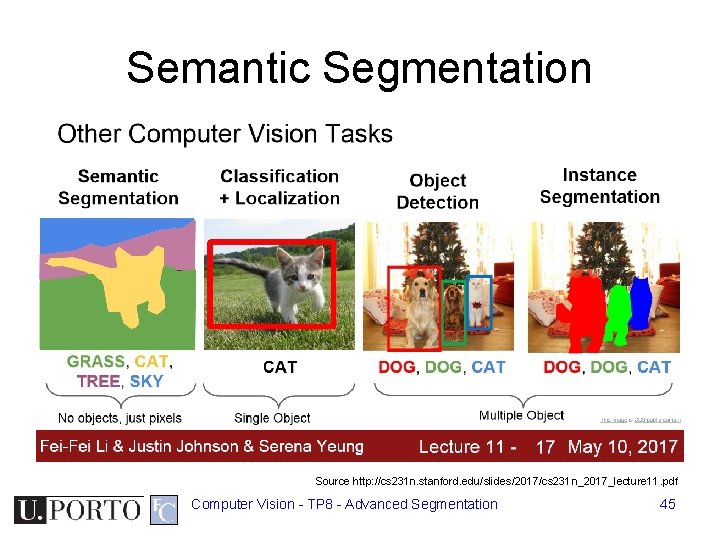
Semantic Segmentation • Separation of the image in different areas – Objects – Areas with similar visual or semantic characteristics First classify each pixel, and only then form regions (much harder!!) Computer Vision - TP 8 - Advanced Segmentation 43
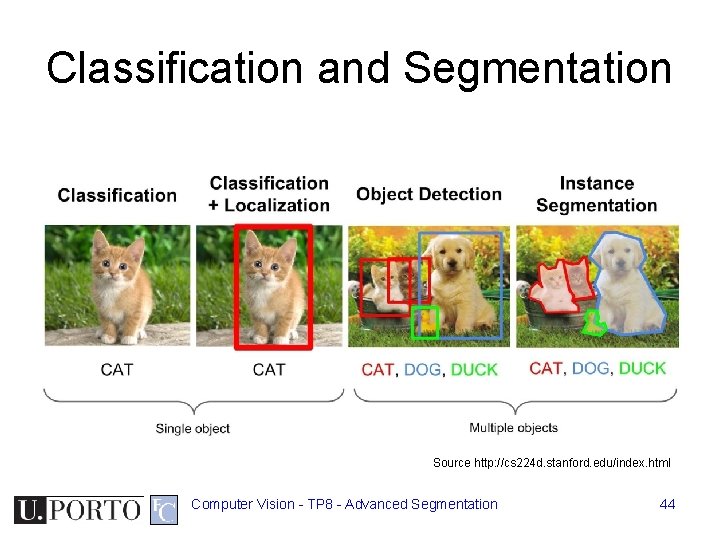
Classification and Segmentation Source http: //cs 224 d. stanford. edu/index. html Computer Vision - TP 8 - Advanced Segmentation 44
Semantic Segmentation Source http: //cs 231 n. stanford. edu/slides/2017/cs 231 n_2017_lecture 11. pdf Computer Vision - TP 8 - Advanced Segmentation 45
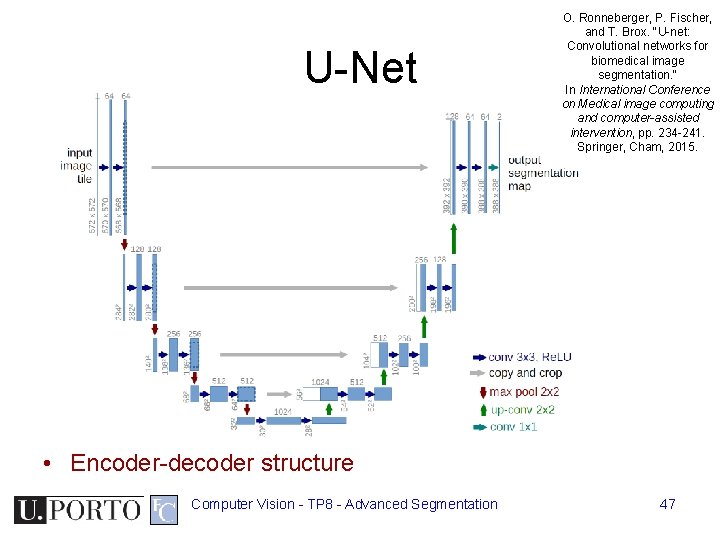
Semantic Segmentation • Requires sophisticated pixel-level classification algorithms to be effective • Powerful data-based approach to segmentation • Fueled by recent advances in deep neural networks, such as U-NET Computer Vision - TP 8 - Advanced Segmentation 46
U-Net O. Ronneberger, P. Fischer, and T. Brox. "U-net: Convolutional networks for biomedical image segmentation. " In International Conference on Medical image computing and computer-assisted intervention, pp. 234 -241. Springer, Cham, 2015. • Encoder-decoder structure Computer Vision - TP 8 - Advanced Segmentation 47
Resources • Szeliski, “Computer Vision: Algorithms and Applications”, Springer, 2011 – Chapter 5 – “Segmentation” Computer Vision - TP 8 - Advanced Segmentation 48