
Computer Vision The 2 D projective plane and

- Slides: 67
Computer Vision The 2 D projective plane and it’s applications HZ Ch 2. In particular: Ch 2. 1 -4, 2. 7, Szelisky: Ch 2. 1. 1, 2. 1. 2 Estimation: HZ: Ch 4. 1 -4. 2. 5, 4. 4. 4 -4. 8 cursorly Richard Hartley and Andrew Zisserman, Multiple View Geometry, Cambridge University Publishers, 2 nd ed. 2004
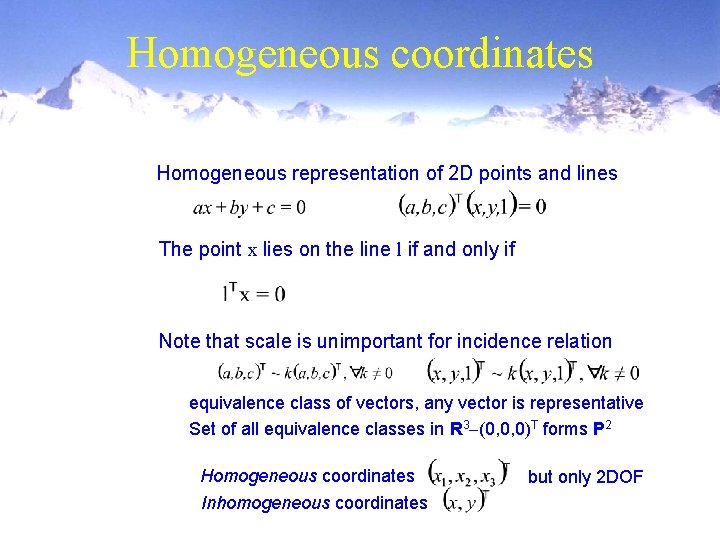
Homogeneous coordinates Homogeneous representation of 2 D points and lines The point x lies on the line l if and only if Note that scale is unimportant for incidence relation equivalence class of vectors, any vector is representative Set of all equivalence classes in R 3 (0, 0, 0)T forms P 2 Homogeneous coordinates Inhomogeneous coordinates but only 2 DOF
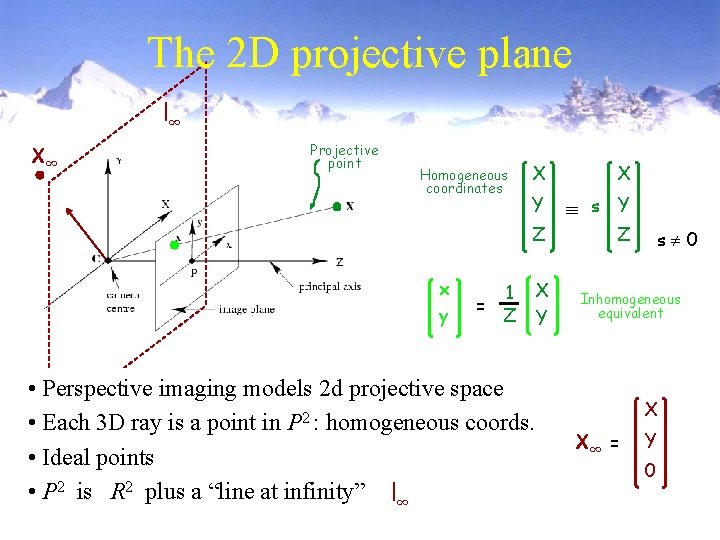
The 2 D projective plane l∞ X∞ Projective point Homogeneous coordinates X Y Z x y = 1 Z X • Perspective imaging models 2 d projective space • Each 3 D ray is a point in P 2 : homogeneous coords. • Ideal points • P 2 is R 2 plus a “line at infinity” l∞ Y X s Y Z s 0 Inhomogeneous equivalent X X∞ = Y 0
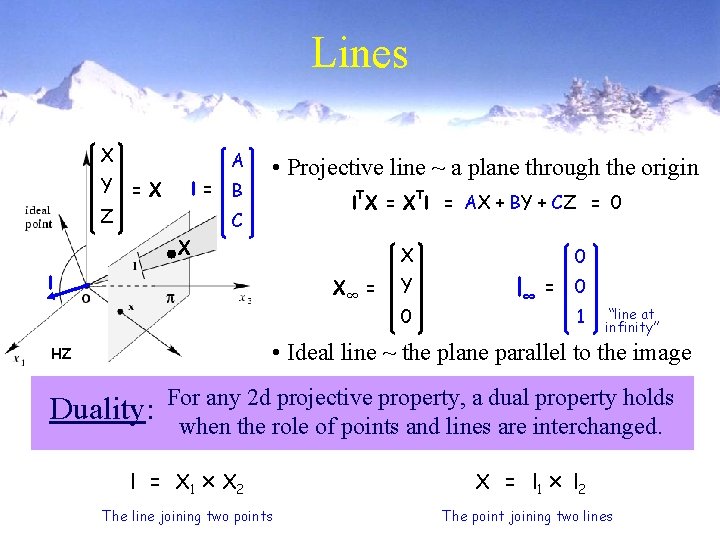
Lines X Y A = X l= Z B • Projective line ~ a plane through the origin T T l X = X l = AX + BY + CZ = 0 C X X l X∞ = Y 0 0 l∞ = 0 1 “line at infinity” • Ideal line ~ the plane parallel to the image HZ Duality: For any 2 d projective property, a dual property holds when the role of points and lines are interchanged. l = X 1 X 2 The line joining two points X = l 1 l 2 The point joining two lines
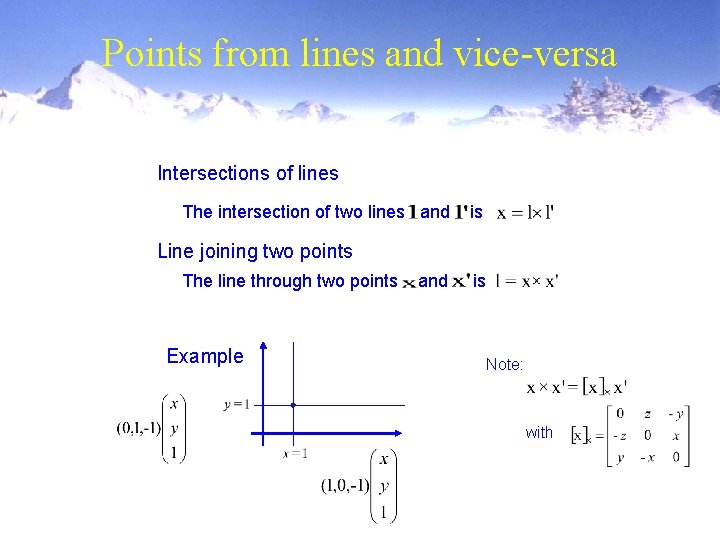
Points from lines and vice-versa Intersections of lines The intersection of two lines and is Line joining two points The line through two points Example and is Note: with
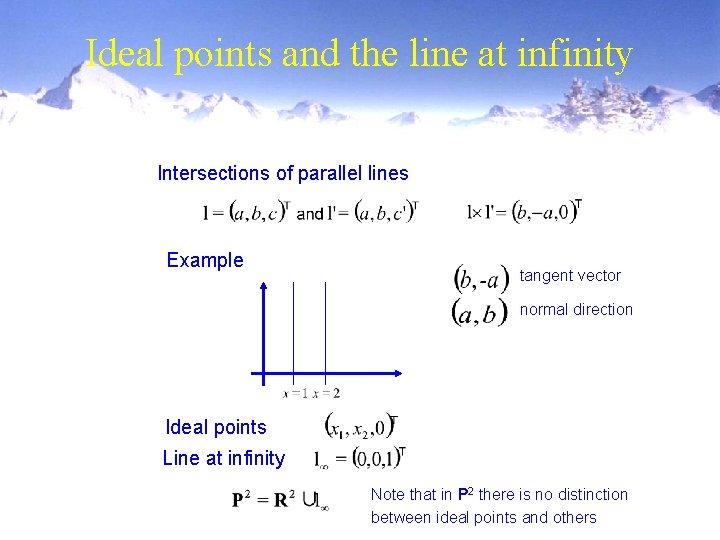
Ideal points and the line at infinity Intersections of parallel lines Example tangent vector normal direction Ideal points Line at infinity Note that in P 2 there is no distinction between ideal points and others
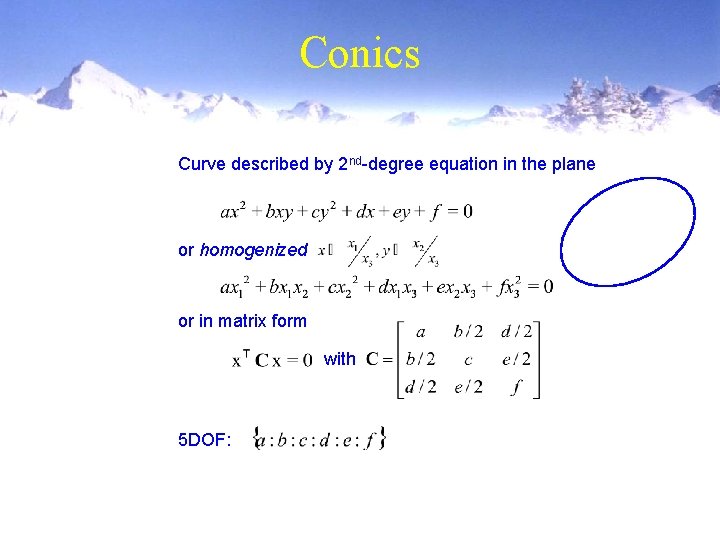
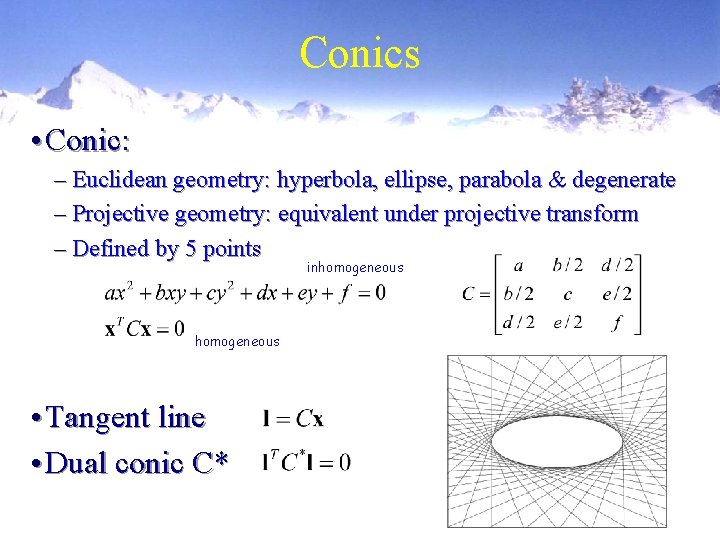
Conics Curve described by 2 nd-degree equation in the plane or homogenized or in matrix form with 5 DOF:
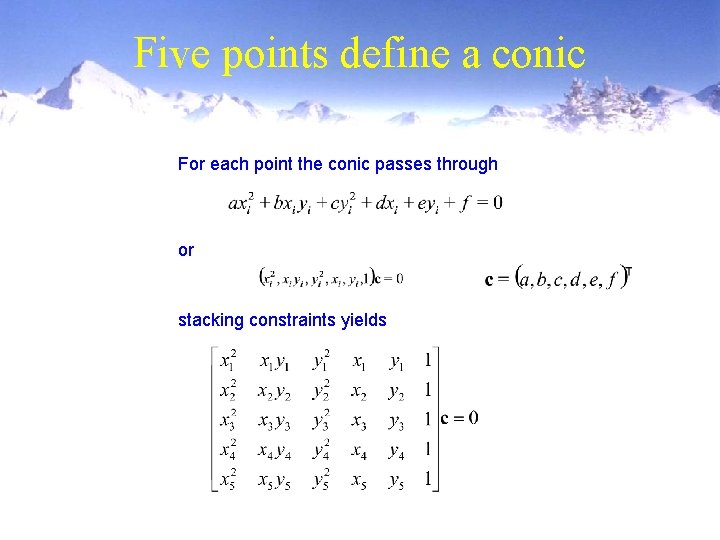
Five points define a conic For each point the conic passes through or stacking constraints yields
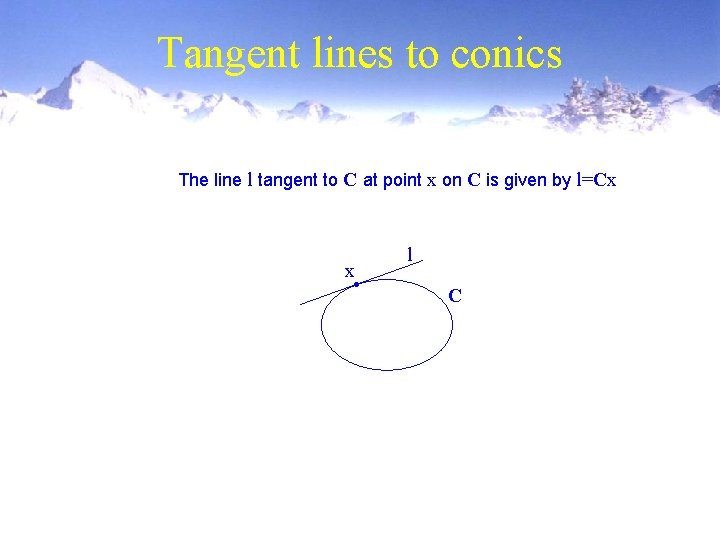
Tangent lines to conics The line l tangent to C at point x on C is given by l=Cx x l C
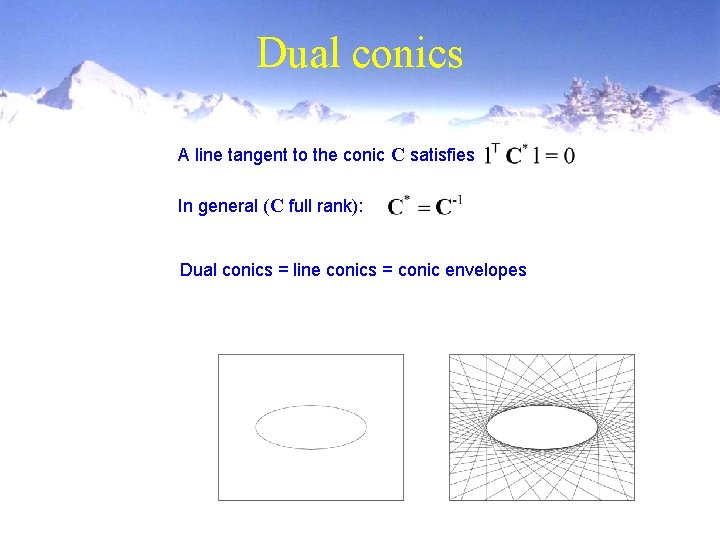
Dual conics A line tangent to the conic C satisfies In general (C full rank): Dual conics = line conics = conic envelopes
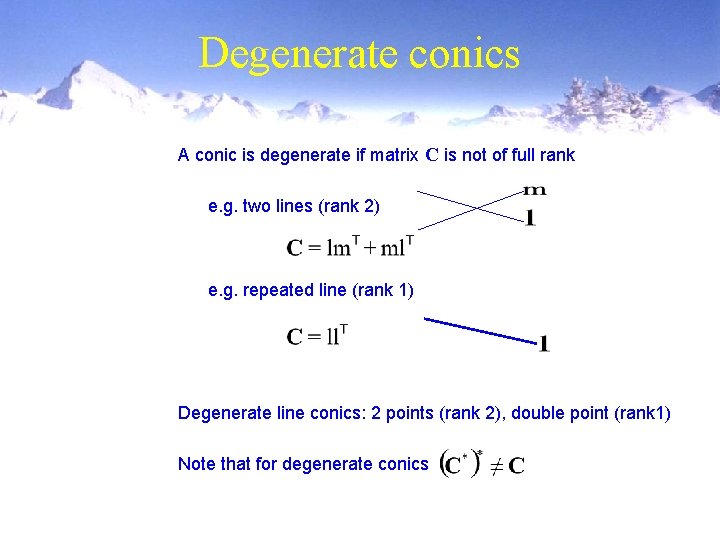
Degenerate conics A conic is degenerate if matrix C is not of full rank e. g. two lines (rank 2) e. g. repeated line (rank 1) Degenerate line conics: 2 points (rank 2), double point (rank 1) Note that for degenerate conics
Conics • Conic: – Euclidean geometry: hyperbola, ellipse, parabola & degenerate – Projective geometry: equivalent under projective transform – Defined by 5 points inhomogeneous • Tangent line • Dual conic C*
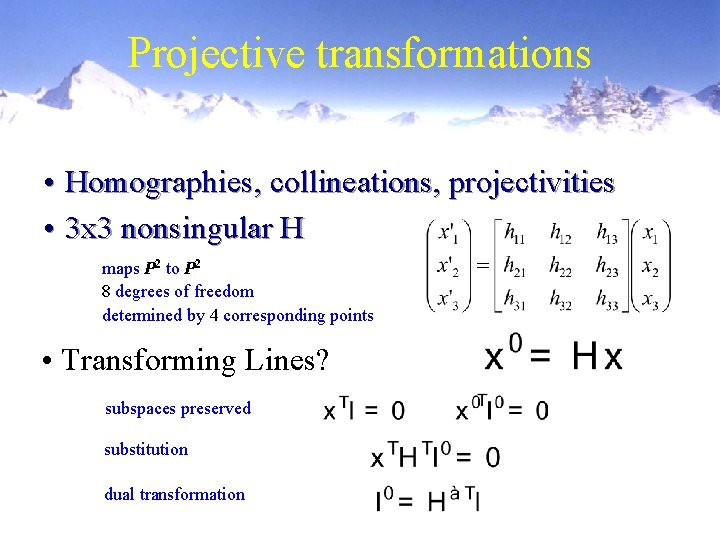
Projective transformations • Homographies, collineations, projectivities • 3 x 3 nonsingular H maps P 2 to P 2 8 degrees of freedom determined by 4 corresponding points • Transforming Lines? subspaces preserved substitution dual transformation
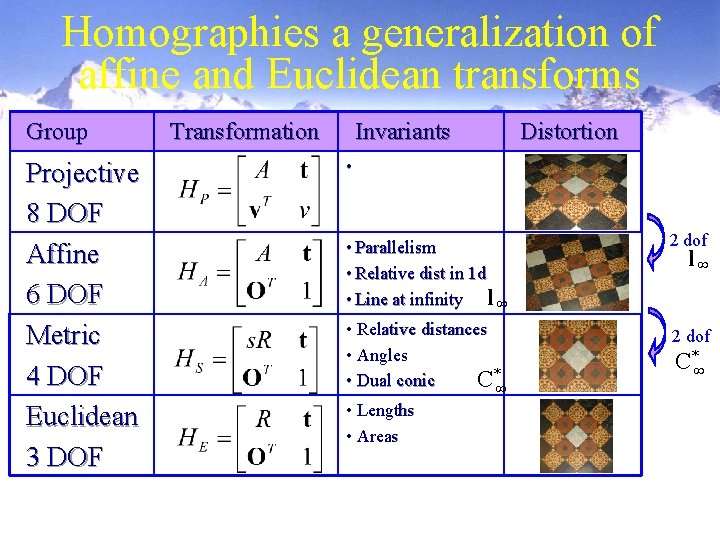
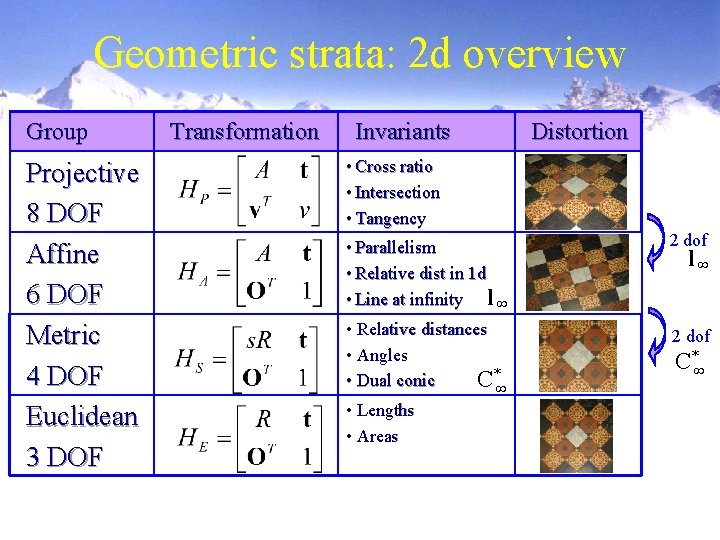
Homographies a generalization of affine and Euclidean transforms Group Projective 8 DOF Affine 6 DOF Metric 4 DOF Euclidean 3 DOF Transformation Invariants Distortion • • Parallelism • Relative dist in 1 d • Line at infinity l 2 dof • Relative distances • Angles • Dual conic C* 2 dof • Lengths • Areas l C*
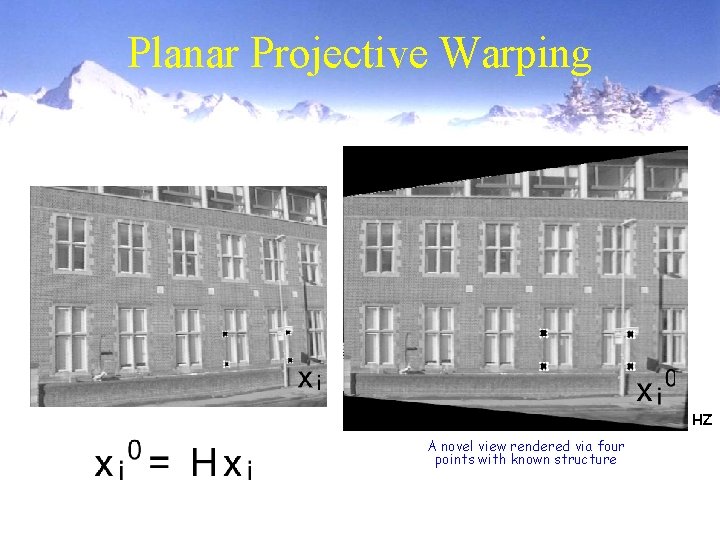
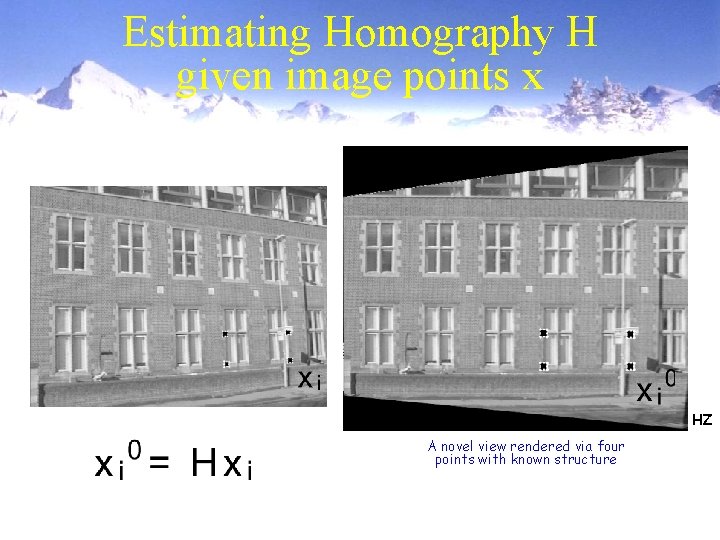
Planar Projective Warping HZ A novel view rendered via four points with known structure
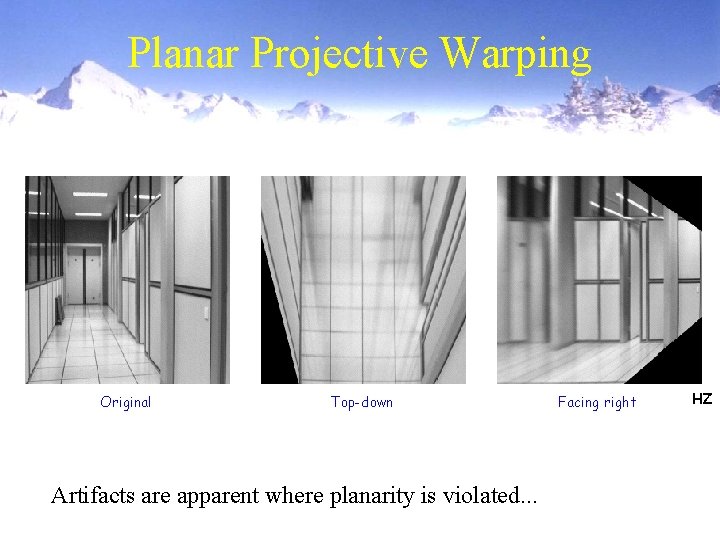
Planar Projective Warping Original Top-down Artifacts are apparent where planarity is violated. . . Facing right HZ
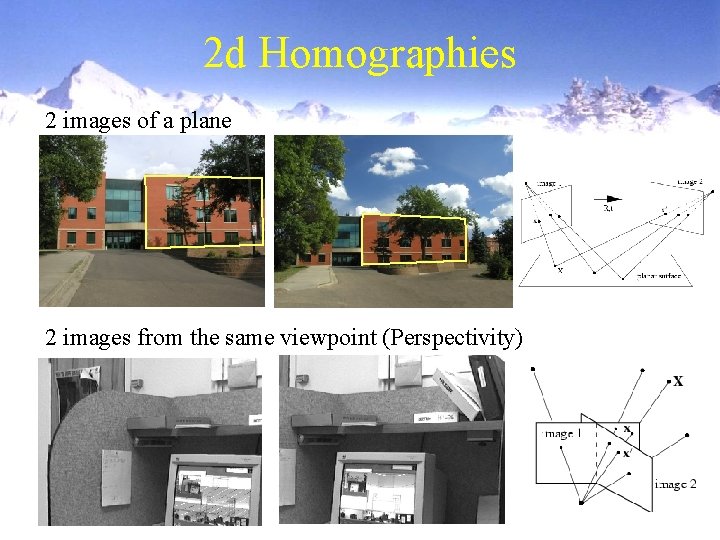
2 d Homographies 2 images of a plane 2 images from the same viewpoint (Perspectivity)
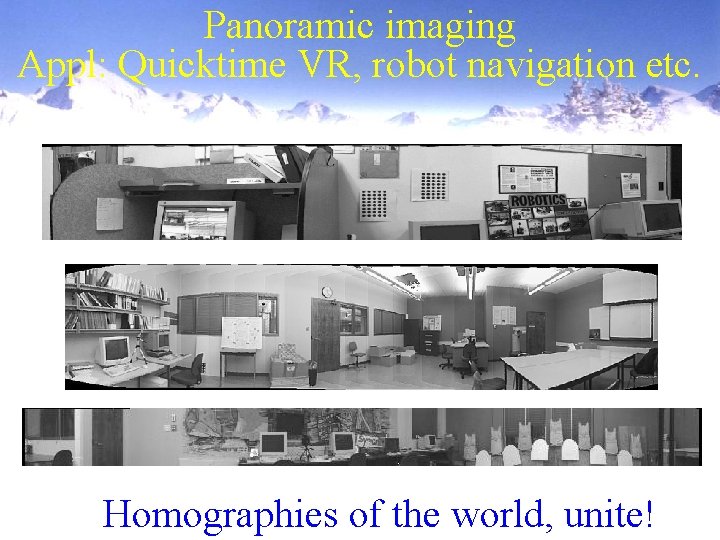
Panoramic imaging Appl: Quicktime VR, robot navigation etc. Homographies of the world, unite!
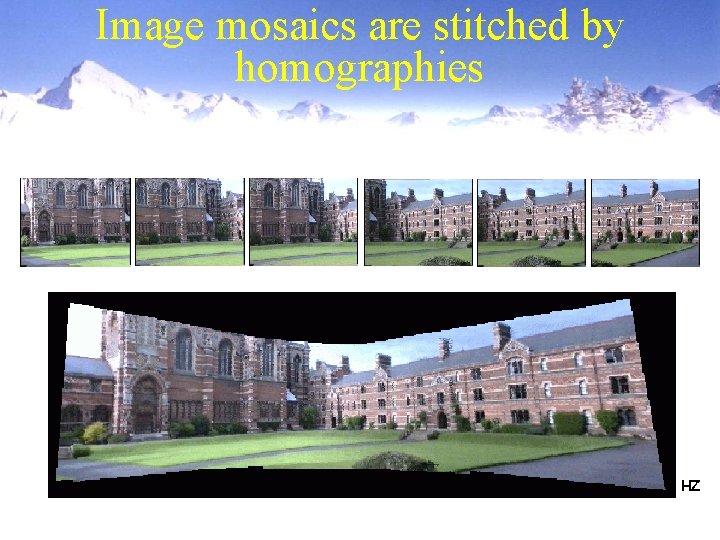
Image mosaics are stitched by homographies HZ
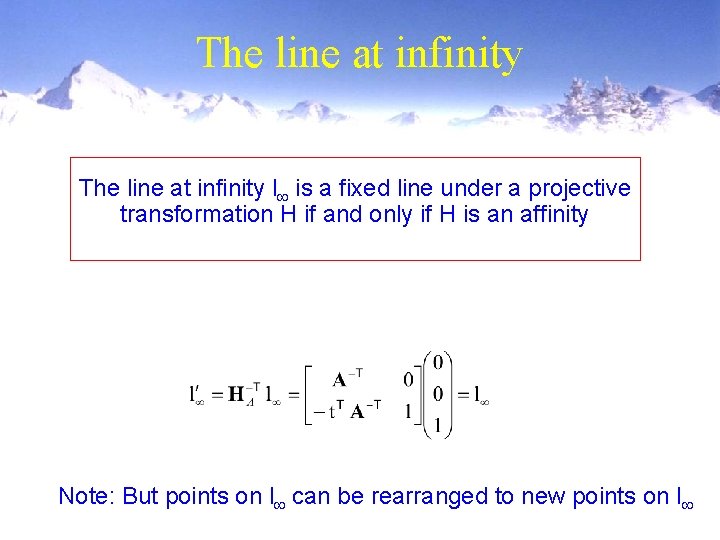
The line at infinity l is a fixed line under a projective transformation H if and only if H is an affinity Note: But points on l can be rearranged to new points on l
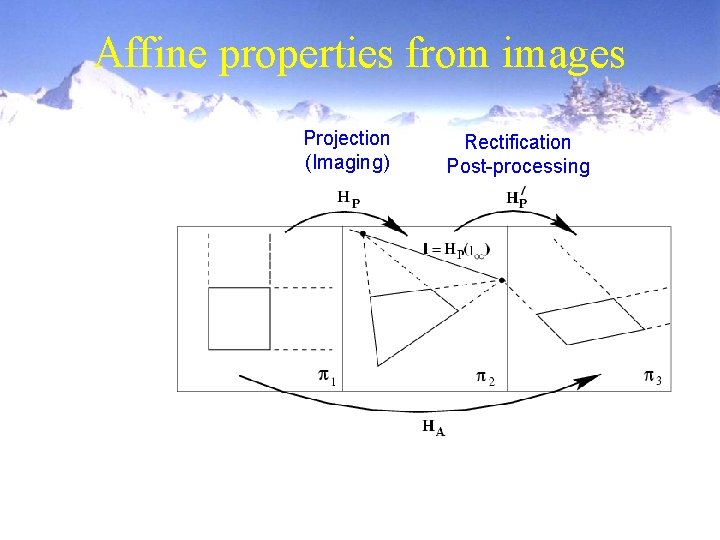
Affine properties from images Projection (Imaging) Rectification Post-processing
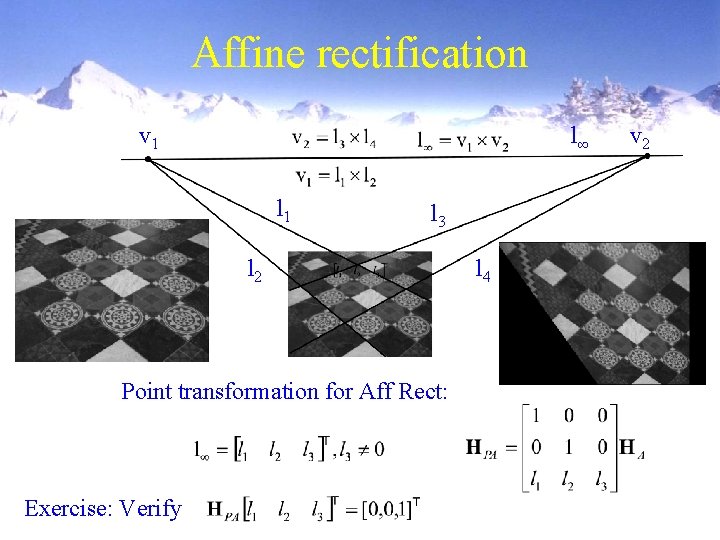
Affine rectification l∞ v 1 l 3 l 2 Point transformation for Aff Rect: Exercise: Verify l 4 v 2
Geometric strata: 2 d overview Group Projective 8 DOF Affine 6 DOF Metric 4 DOF Euclidean 3 DOF Transformation Invariants Distortion • Cross ratio • Intersection • Tangency • Parallelism • Relative dist in 1 d • Line at infinity l 2 dof • Relative distances • Angles • Dual conic C* 2 dof • Lengths • Areas l C*
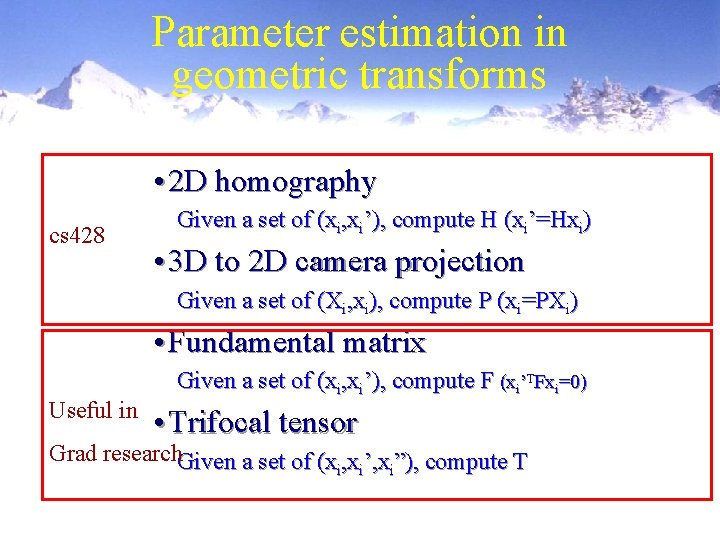
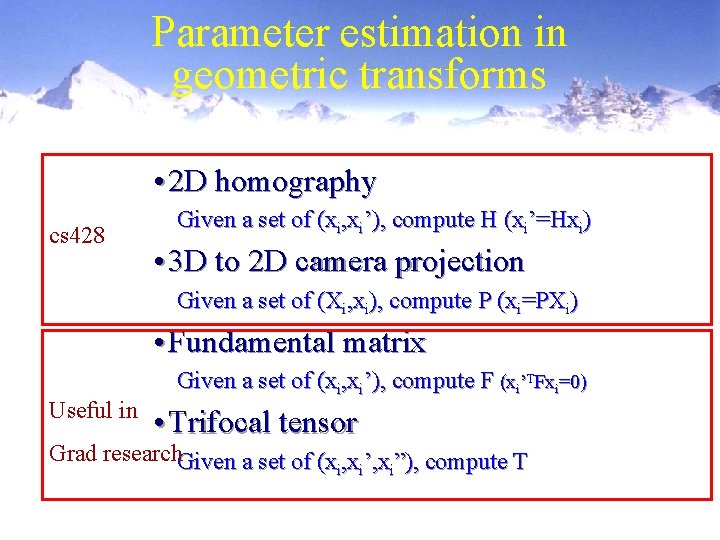
Parameter estimation in geometric transforms • 2 D homography cs 428 Given a set of (xi, xi’), compute H (xi’=Hxi) • 3 D to 2 D camera projection Given a set of (Xi, xi), compute P (xi=PXi) • Fundamental matrix Useful in Given a set of (xi, xi’), compute F (xi’TFxi=0) • Trifocal tensor Grad research. Given a set of (x , x ’, x ”), compute T i i i
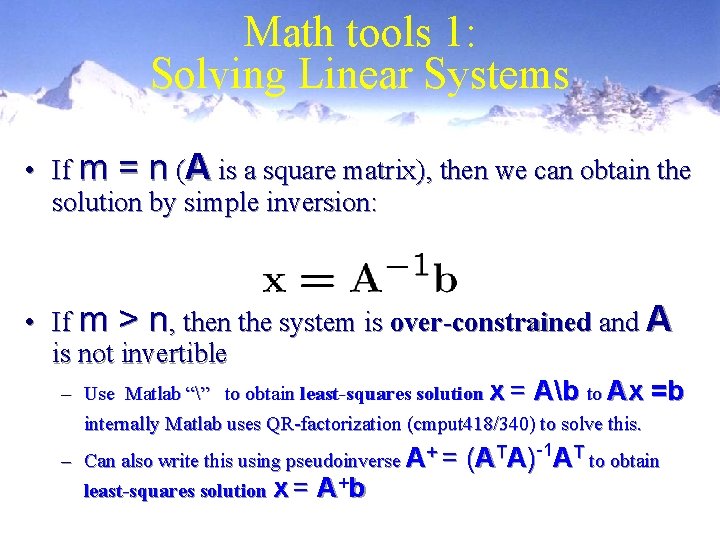
Math tools 1: Solving Linear Systems • If m = n (A is a square matrix), then we can obtain the solution by simple inversion: • If m > n, then the system is over-constrained and A is not invertible – Use Matlab “” to obtain least-squares solution x = Ab to Ax =b internally Matlab uses QR-factorization (cmput 418/340) to solve this. – Can also write this using pseudoinverse A+ = least-squares solution x = A+b (ATA)-1 AT to obtain
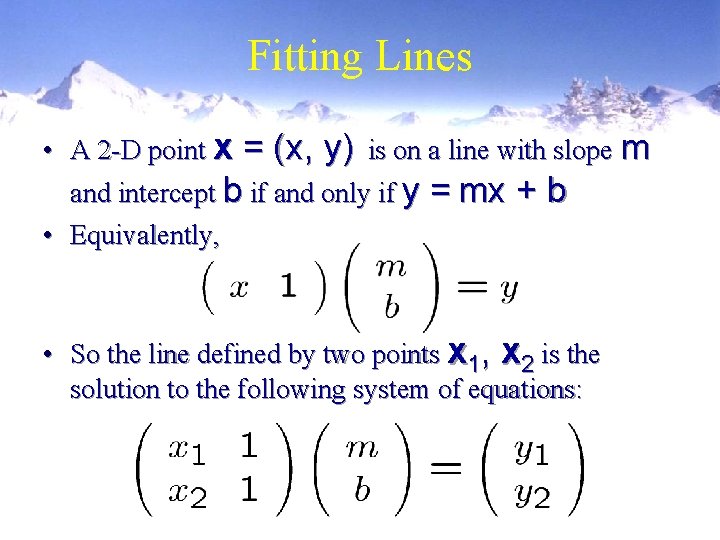
Fitting Lines • A 2 -D point x = (x, y) is on a line with slope m and intercept b if and only if y = mx + b • Equivalently, • So the line defined by two points x 1, x 2 is the solution to the following system of equations:
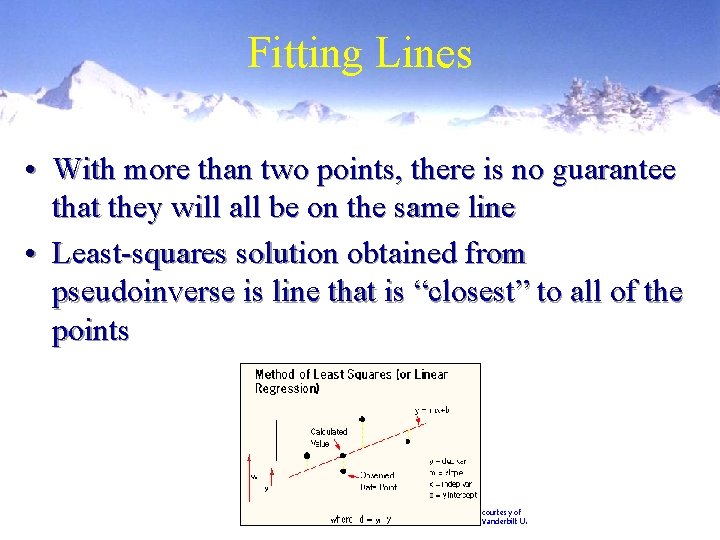
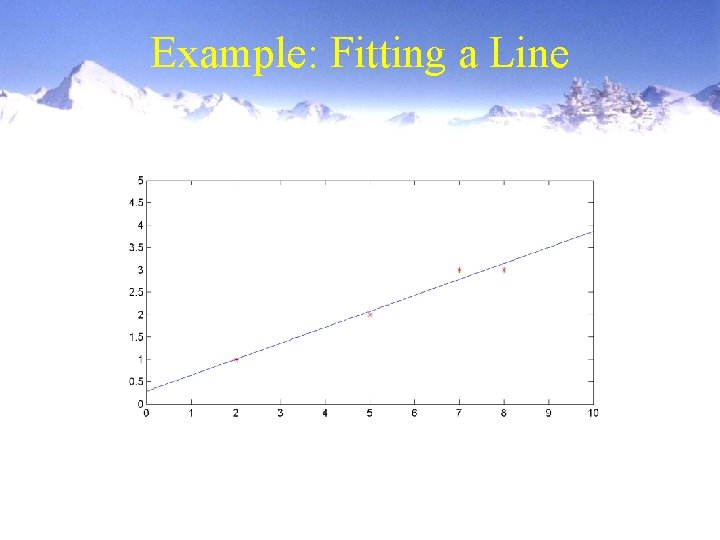
Fitting Lines • With more than two points, there is no guarantee that they will all be on the same line • Least-squares solution obtained from pseudoinverse is line that is “closest” to all of the points courtesy of Vanderbilt U.
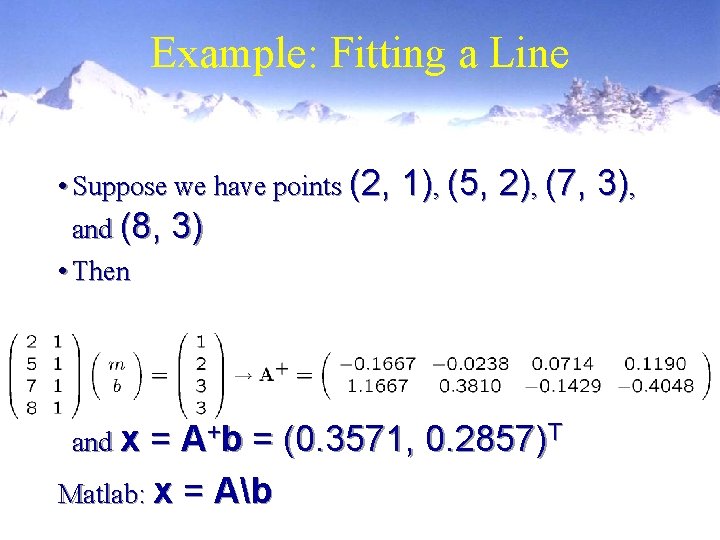
Example: Fitting a Line • Suppose we have points (2, 1), (5, 2), (7, 3), and (8, 3) • Then and x = A+b = (0. 3571, 0. 2857)T Matlab: x = Ab
Example: Fitting a Line
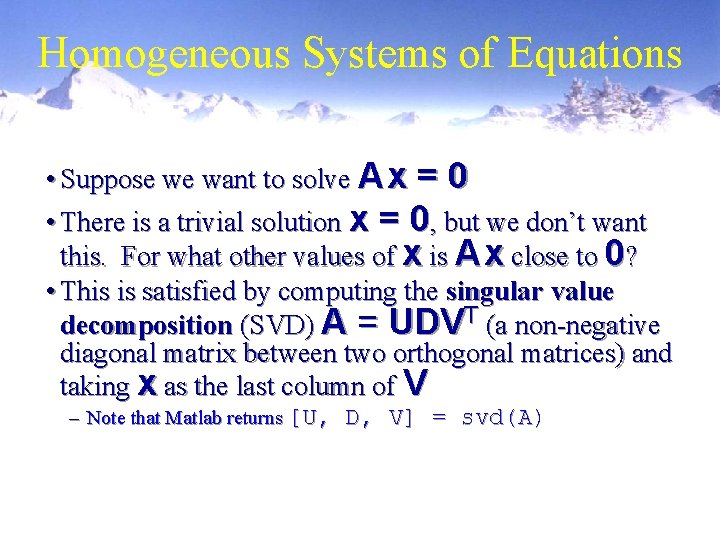
Homogeneous Systems of Equations • Suppose we want to solve A x = 0 • There is a trivial solution x = 0, but we don’t want this. For what other values of x is A x close to 0? • This is satisfied by computing the singular value decomposition (SVD) A = UDVT (a non-negative diagonal matrix between two orthogonal matrices) and taking x as the last column of V – Note that Matlab returns [U, D, V] = svd(A)
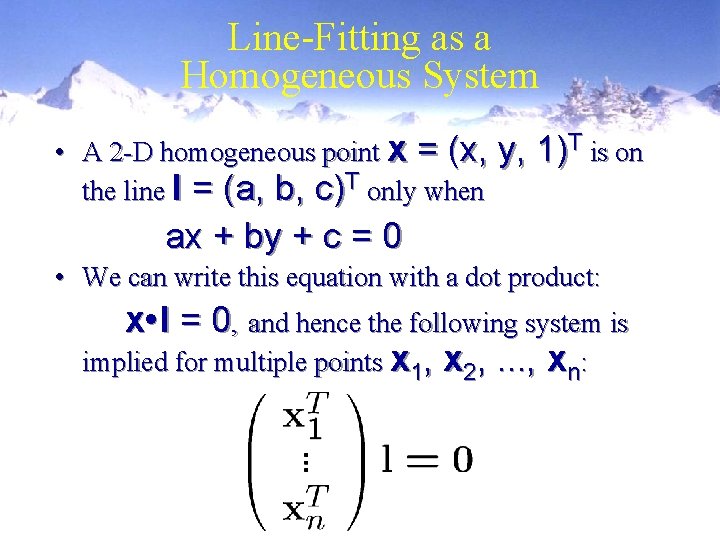
Line-Fitting as a Homogeneous System • A 2 -D homogeneous point x = (x, the line l = (a, b, c)T only when y, 1)T is on ax + by + c = 0 • We can write this equation with a dot product: x • l = 0, and hence the following system is implied for multiple points x 1, x 2, . . . , xn:
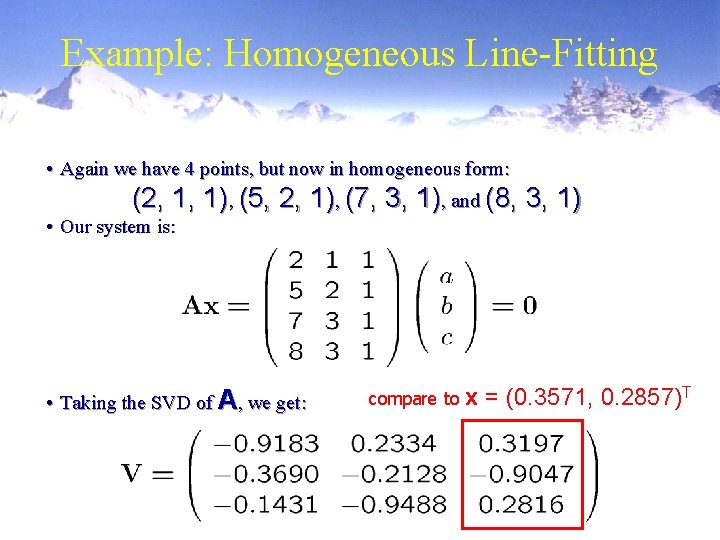
Example: Homogeneous Line-Fitting • Again we have 4 points, but now in homogeneous form: (2, 1, 1), (5, 2, 1), (7, 3, 1), and (8, 3, 1) • Our system is: • Taking the SVD of A, we get: compare to x = (0. 3571, 0. 2857)T
Parameter estimation in geometric transforms • 2 D homography cs 428 Given a set of (xi, xi’), compute H (xi’=Hxi) • 3 D to 2 D camera projection Given a set of (Xi, xi), compute P (xi=PXi) • Fundamental matrix Useful in Given a set of (xi, xi’), compute F (xi’TFxi=0) • Trifocal tensor Grad research. Given a set of (x , x ’, x ”), compute T i i i
Estimating Homography H given image points x HZ A novel view rendered via four points with known structure
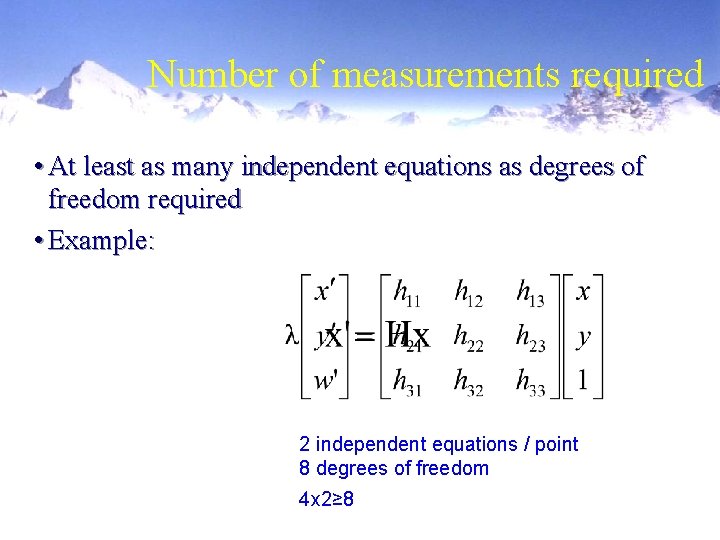
Number of measurements required • At least as many independent equations as degrees of freedom required • Example: 2 independent equations / point 8 degrees of freedom 4 x 2≥ 8
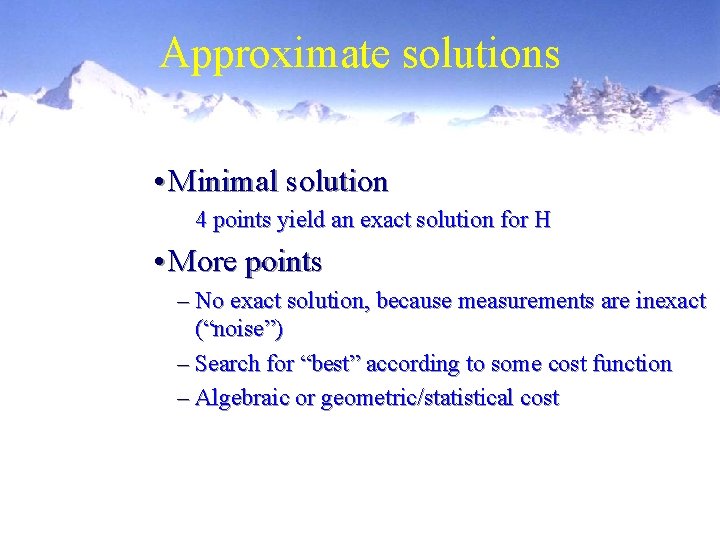
Approximate solutions • Minimal solution 4 points yield an exact solution for H • More points – No exact solution, because measurements are inexact (“noise”) – Search for “best” according to some cost function – Algebraic or geometric/statistical cost
Many ways to solve: Different Cost functions => differences in solution • Algebraic distance • Geometric distance • Reprojection error • Comparison • Geometric interpretation
Gold Standard algorithm • Cost function that is optimal for some assumptions • Computational algorithm that minimizes it is called “Gold Standard” algorithm • Other algorithms can then be compared to it
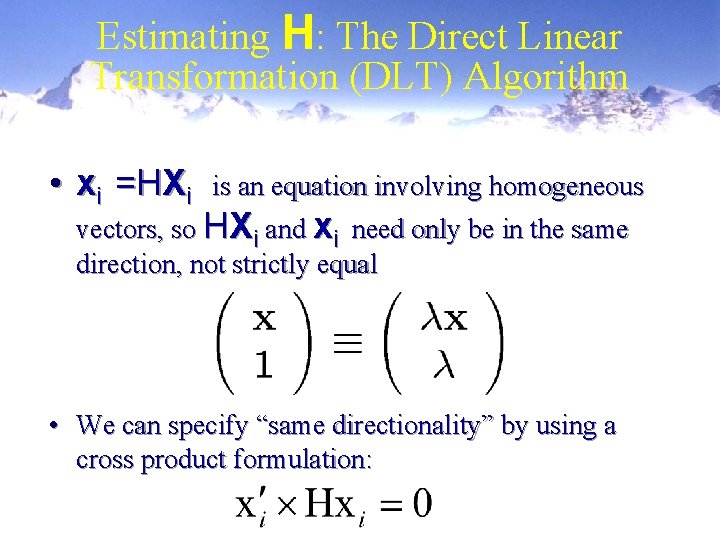
Estimating H: The Direct Linear Transformation (DLT) Algorithm • xi =HXi is an equation involving homogeneous vectors, so HXi and xi need only be in the same direction, not strictly equal • We can specify “same directionality” by using a cross product formulation:
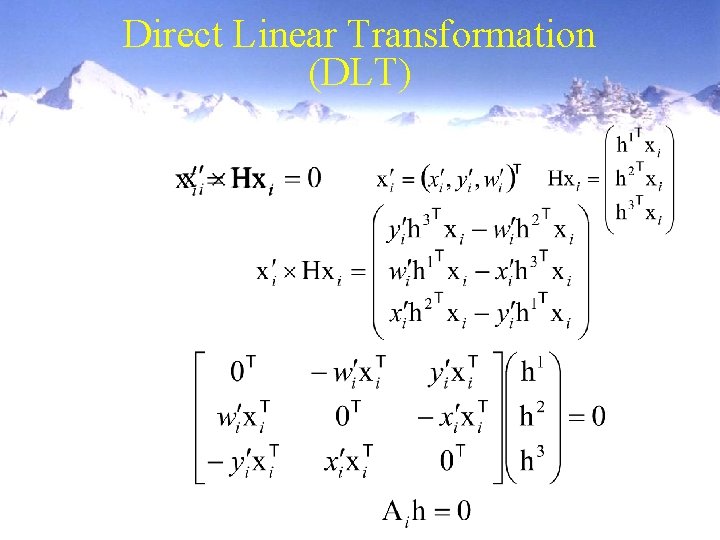
Direct Linear Transformation (DLT)
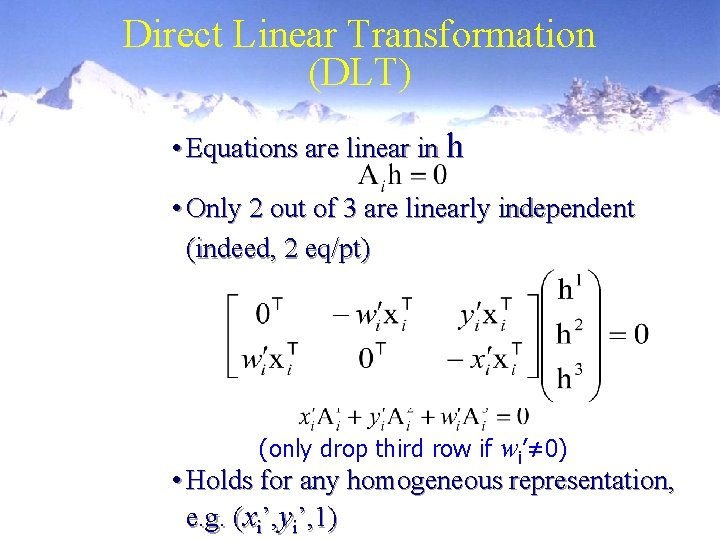
Direct Linear Transformation (DLT) • Equations are linear in h • Only 2 out of 3 are linearly independent (indeed, 2 eq/pt) (only drop third row if wi’≠ 0) • Holds for any homogeneous representation, e. g. (xi’, yi’, 1)
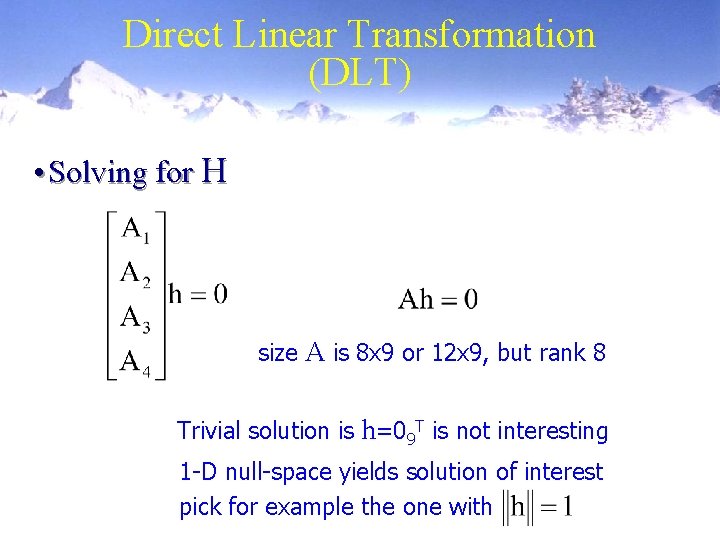
Direct Linear Transformation (DLT) • Solving for H size A is 8 x 9 or 12 x 9, but rank 8 Trivial solution is h=09 T is not interesting 1 -D null-space yields solution of interest pick for example the one with
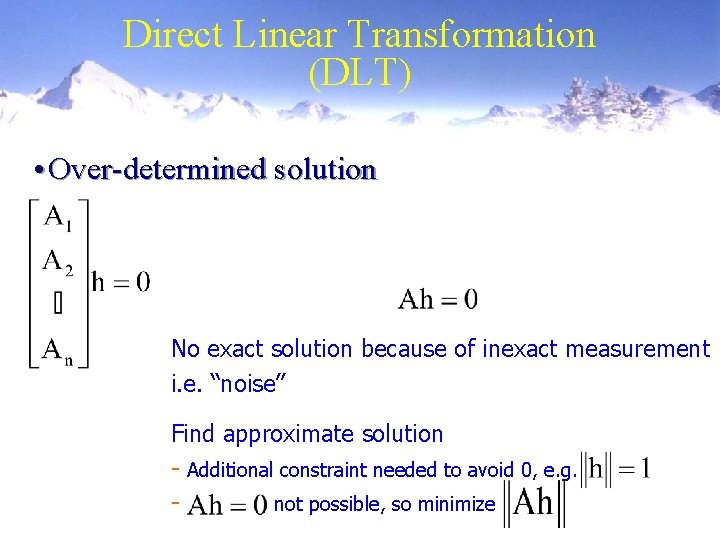
Direct Linear Transformation (DLT) • Over-determined solution No exact solution because of inexact measurement i. e. “noise” Find approximate solution - Additional constraint needed to avoid 0, e. g. not possible, so minimize
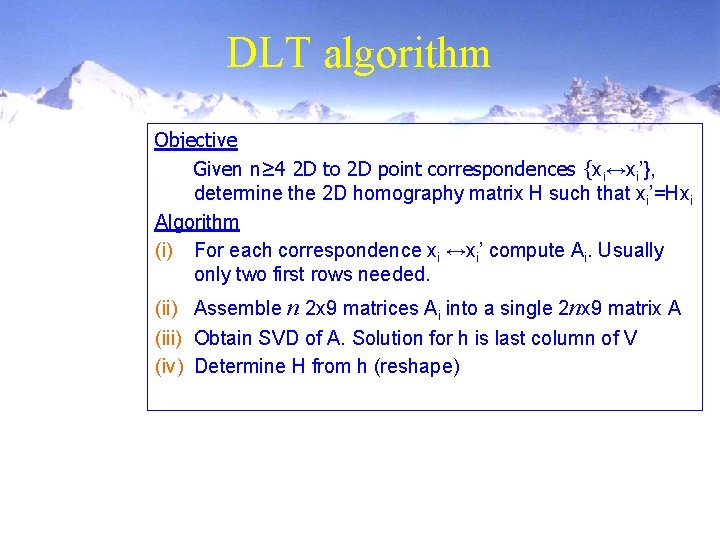
DLT algorithm Objective Given n≥ 4 2 D to 2 D point correspondences {xi↔xi’}, determine the 2 D homography matrix H such that xi’=Hxi Algorithm (i) For each correspondence xi ↔xi’ compute Ai. Usually only two first rows needed. (ii) Assemble n 2 x 9 matrices Ai into a single 2 nx 9 matrix A (iii) Obtain SVD of A. Solution for h is last column of V (iv) Determine H from h (reshape)
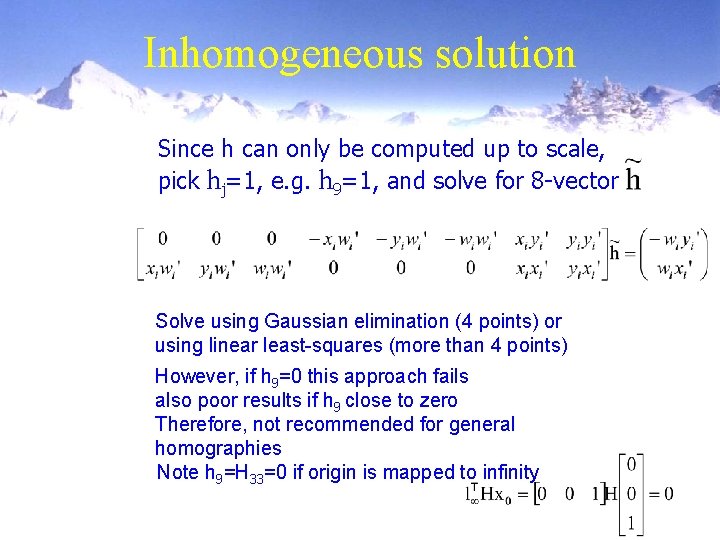
Inhomogeneous solution Since h can only be computed up to scale, pick hj=1, e. g. h 9=1, and solve for 8 -vector Solve using Gaussian elimination (4 points) or using linear least-squares (more than 4 points) However, if h 9=0 this approach fails also poor results if h 9 close to zero Therefore, not recommended for general homographies Note h 9=H 33=0 if origin is mapped to infinity
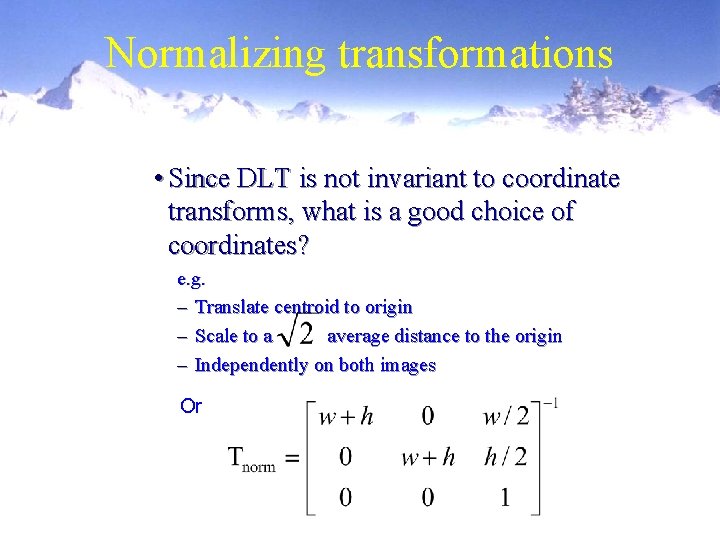
Normalizing transformations • Since DLT is not invariant to coordinate transforms, what is a good choice of coordinates? e. g. – Translate centroid to origin – Scale to a average distance to the origin – Independently on both images Or
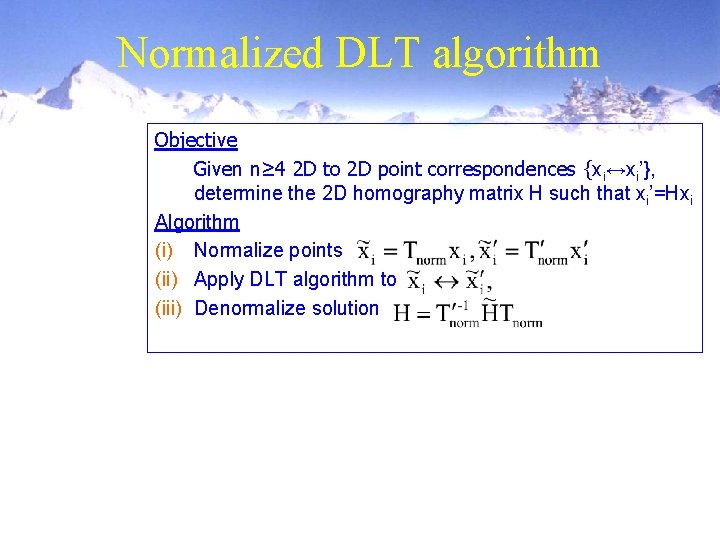
Normalized DLT algorithm Objective Given n≥ 4 2 D to 2 D point correspondences {xi↔xi’}, determine the 2 D homography matrix H such that xi’=Hxi Algorithm (i) Normalize points (ii) Apply DLT algorithm to (iii) Denormalize solution
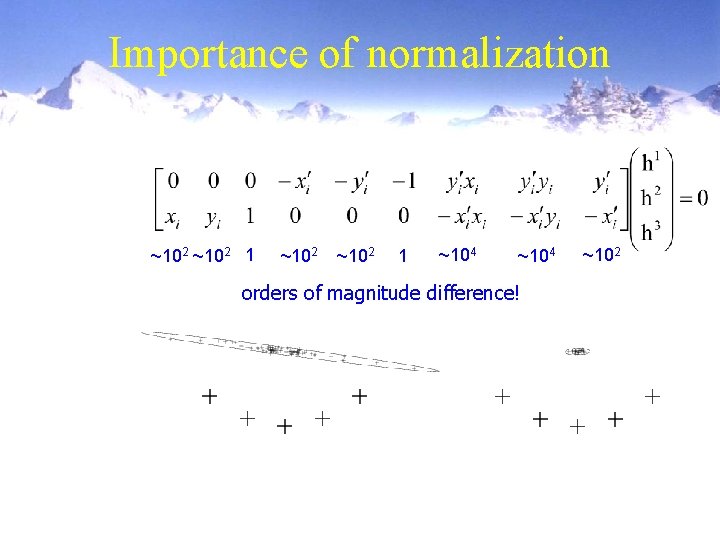
Importance of normalization ~102 1 ~104 orders of magnitude difference! ~102
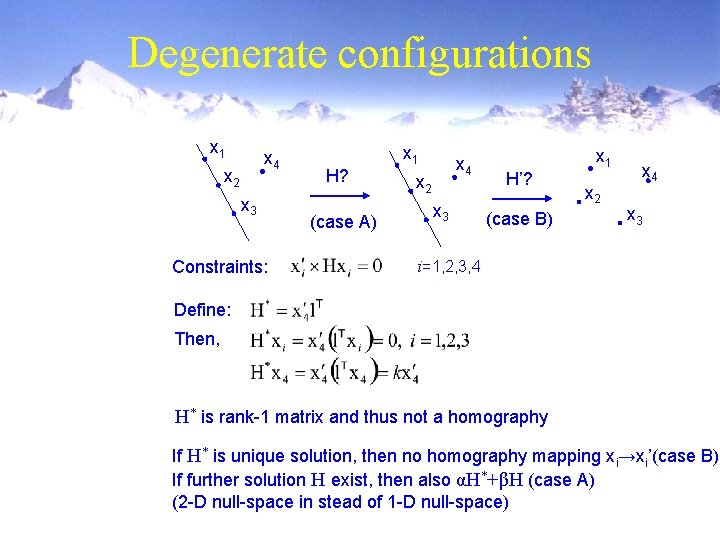
Degenerate configurations x 1 x 4 x 2 x 3 Constraints: H? (case A) x 1 x 4 x 2 x 3 H’? (case B) x 1 x 2 x 4 x 3 i=1, 2, 3, 4 Define: Then, H* is rank-1 matrix and thus not a homography If H* is unique solution, then no homography mapping xi→xi’(case B) If further solution H exist, then also αH*+βH (case A) (2 -D null-space in stead of 1 -D null-space)
• First 3 D proj geom • Then review and more on camera models • Then following P estimation
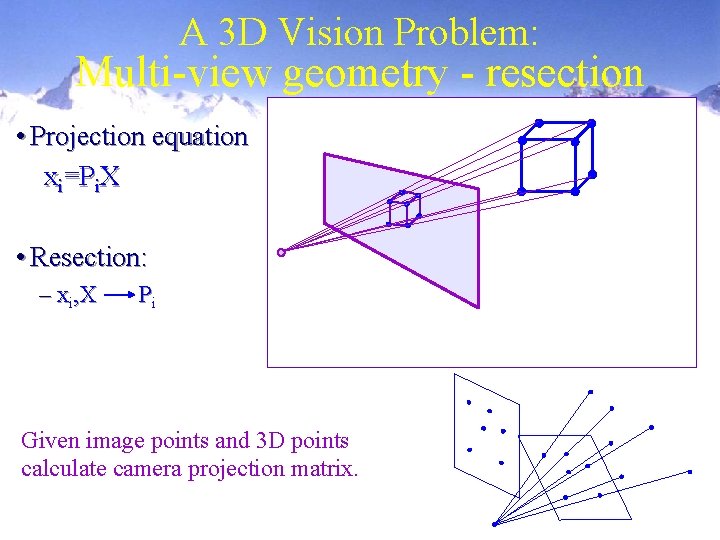
A 3 D Vision Problem: Multi-view geometry - resection • Projection equation xi=Pi. X • Resection: – xi, X Pi Given image points and 3 D points calculate camera projection matrix.
Estimating camera matrix P • Given a number of correspondences between 3 D points and their 2 -D image projections Xi xi, we would like to determine the camera projection matrix P such that xi = PXi for all i
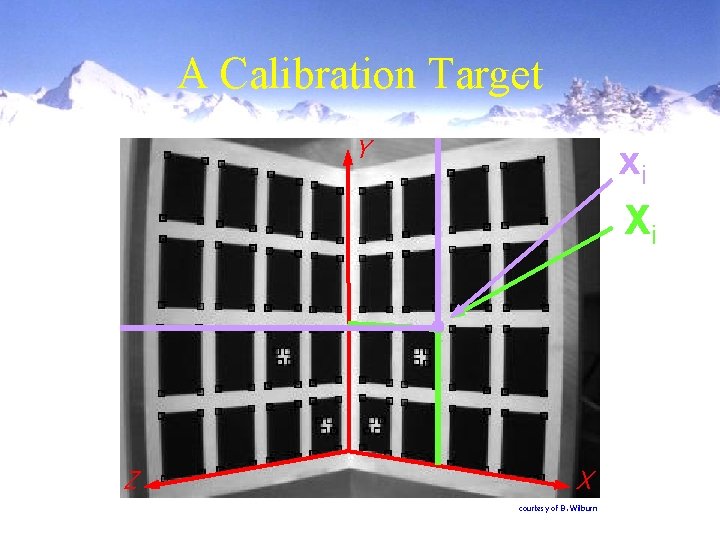
A Calibration Target Y Z xi Xi X courtesy of B. Wilburn
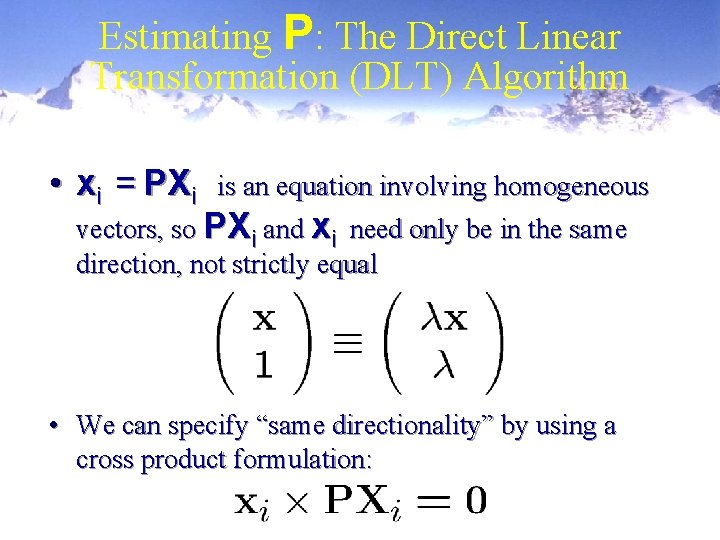
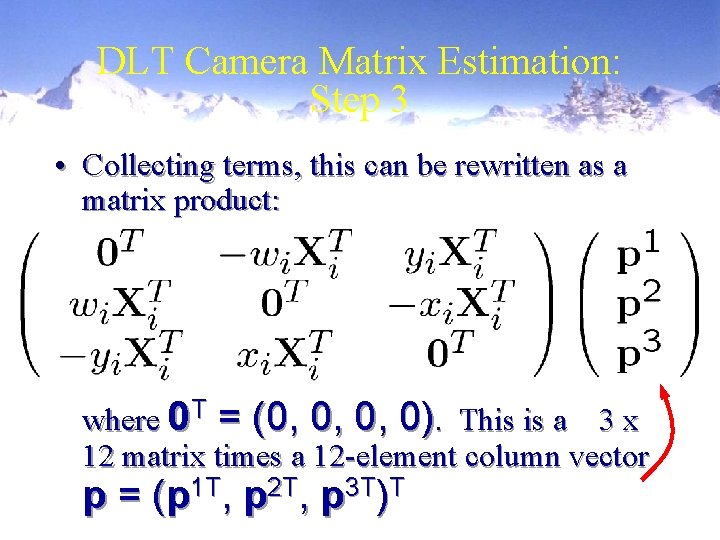
Estimating P: The Direct Linear Transformation (DLT) Algorithm • xi = PXi is an equation involving homogeneous vectors, so PXi and xi need only be in the same direction, not strictly equal • We can specify “same directionality” by using a cross product formulation:
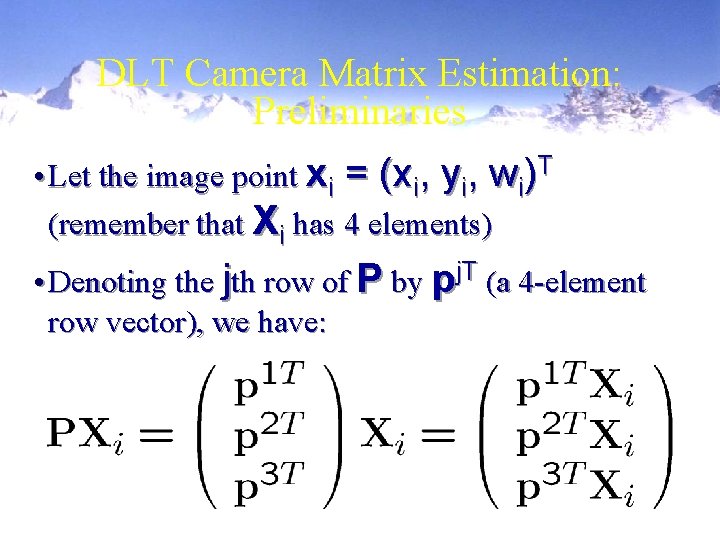
DLT Camera Matrix Estimation: Preliminaries • Let the image point xi = (xi, yi, wi)T (remember that Xi has 4 elements) • Denoting the jth row of P by pj. T (a 4 -element row vector), we have:
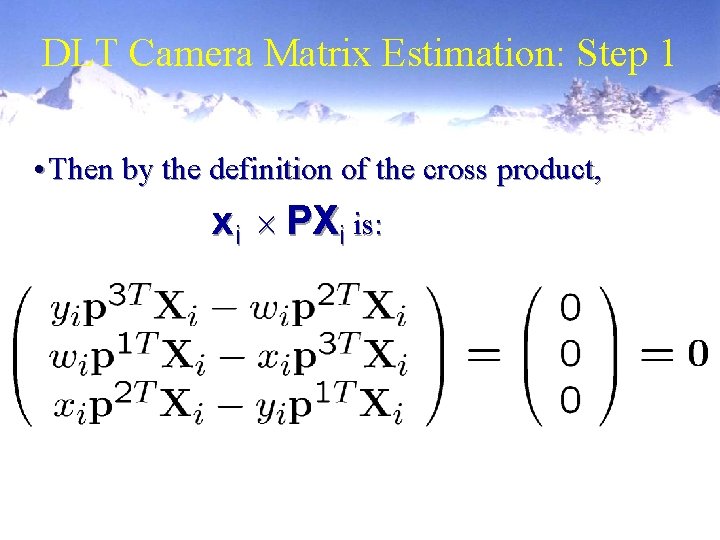
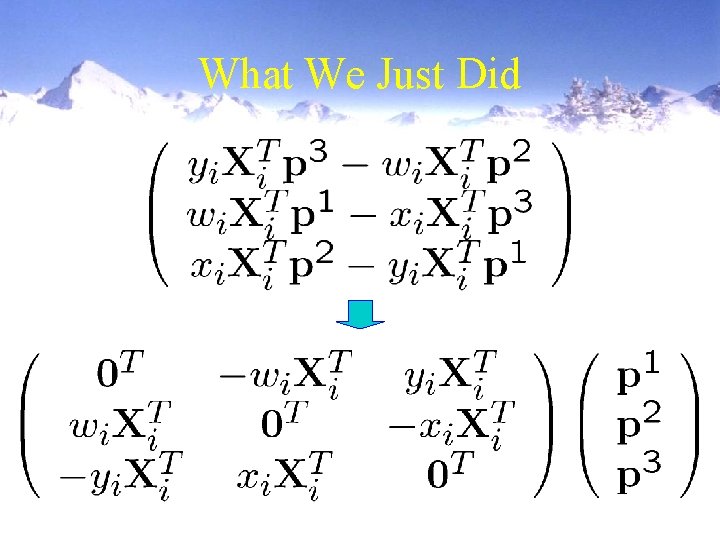
DLT Camera Matrix Estimation: Step 1 • Then by the definition of the cross product, xi PXi is:
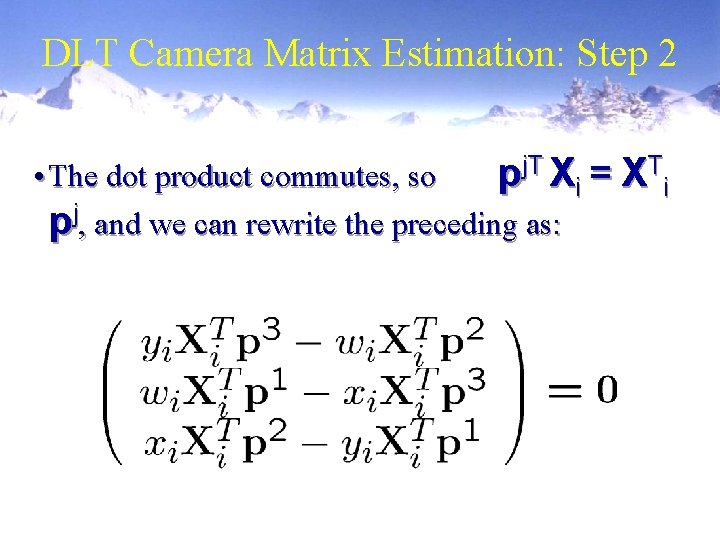
DLT Camera Matrix Estimation: Step 2 • The dot product commutes, so pj. T Xi = XTi pj, and we can rewrite the preceding as:
DLT Camera Matrix Estimation: Step 3 • Collecting terms, this can be rewritten as a matrix product: where 0 T = (0, 0, 0, 0). This is a 3 x 12 matrix times a 12 -element column vector p = ( p 1 T , p 2 T , p 3 T )T
What We Just Did
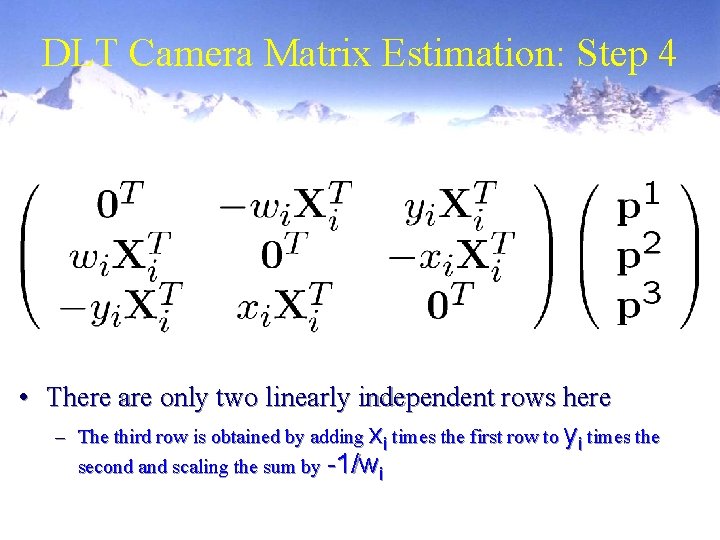
DLT Camera Matrix Estimation: Step 4 • There are only two linearly independent rows here – The third row is obtained by adding xi times the first row to yi times the second and scaling the sum by -1/wi
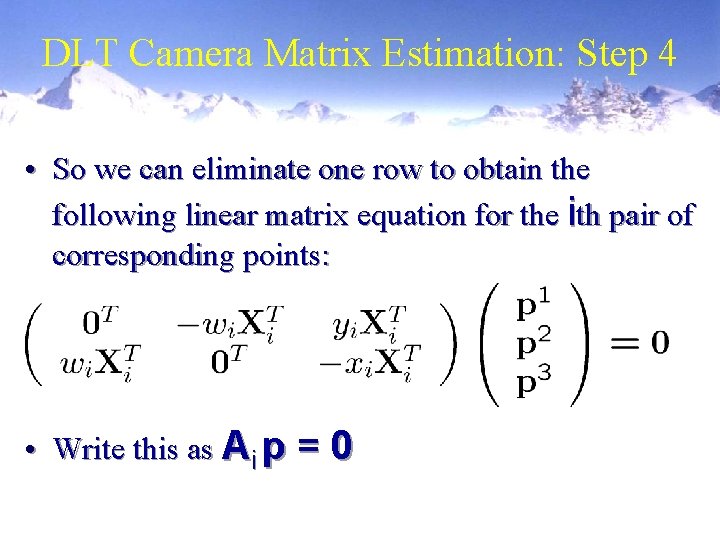
DLT Camera Matrix Estimation: Step 4 • So we can eliminate one row to obtain the following linear matrix equation for the ith pair of corresponding points: • Write this as Ai p = 0
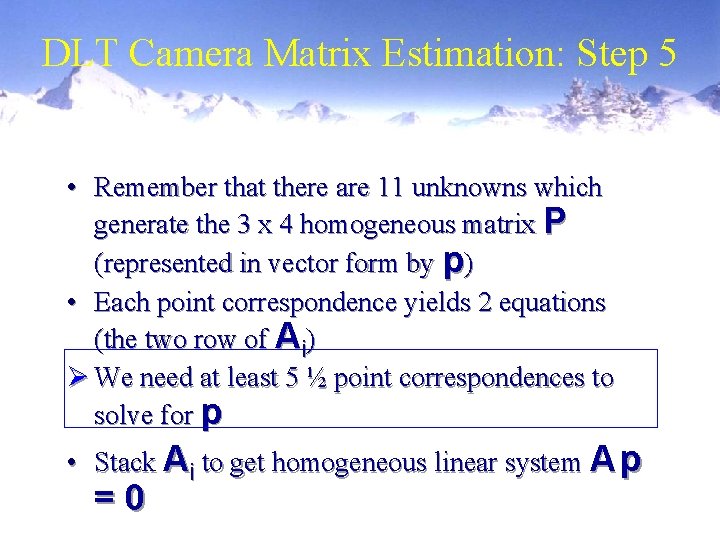
DLT Camera Matrix Estimation: Step 5 • Remember that there are 11 unknowns which generate the 3 x 4 homogeneous matrix P (represented in vector form by p) • Each point correspondence yields 2 equations (the two row of Ai) Ø We need at least 5 ½ point correspondences to solve for p • Stack Ai to get homogeneous linear system A p =0
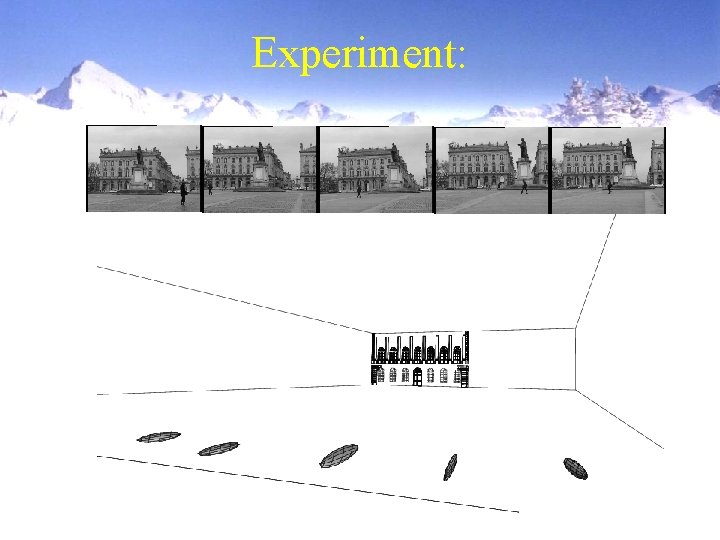
Experiment:
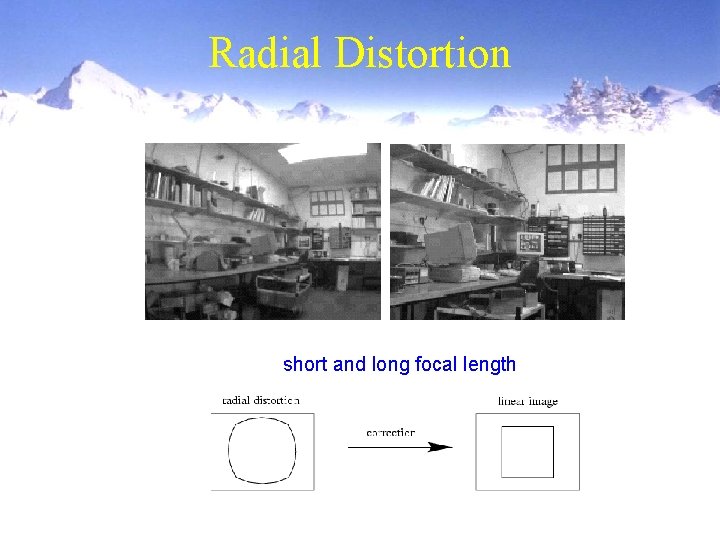
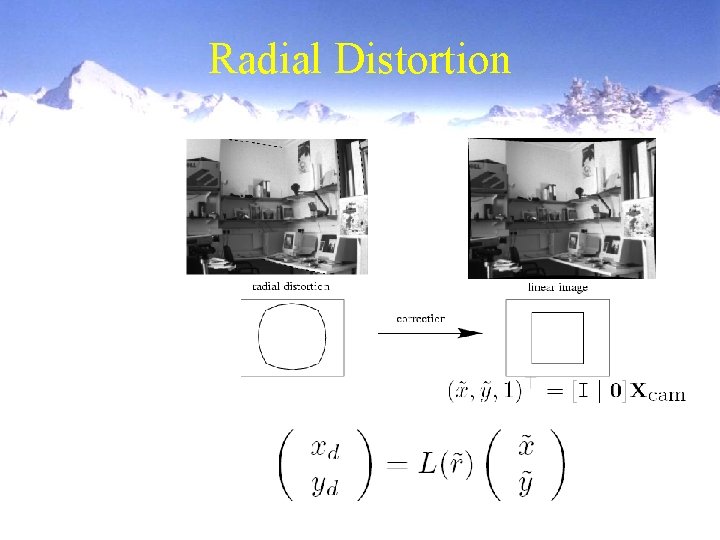
Radial Distortion short and long focal length
Radial Distortion
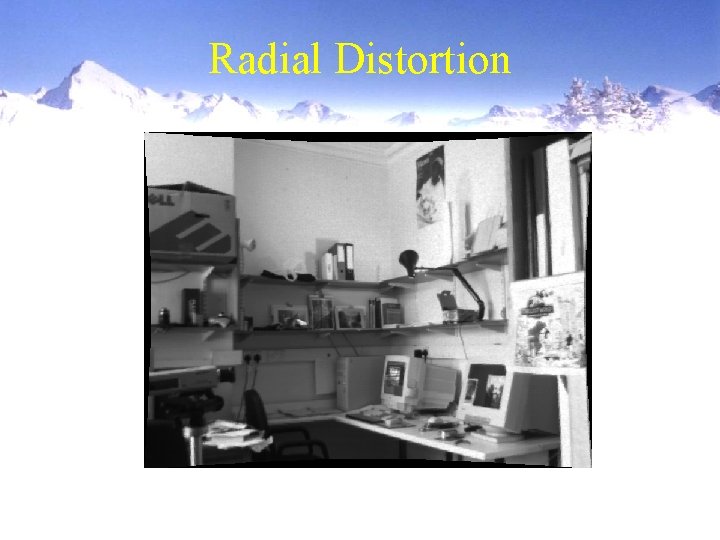
Radial Distortion
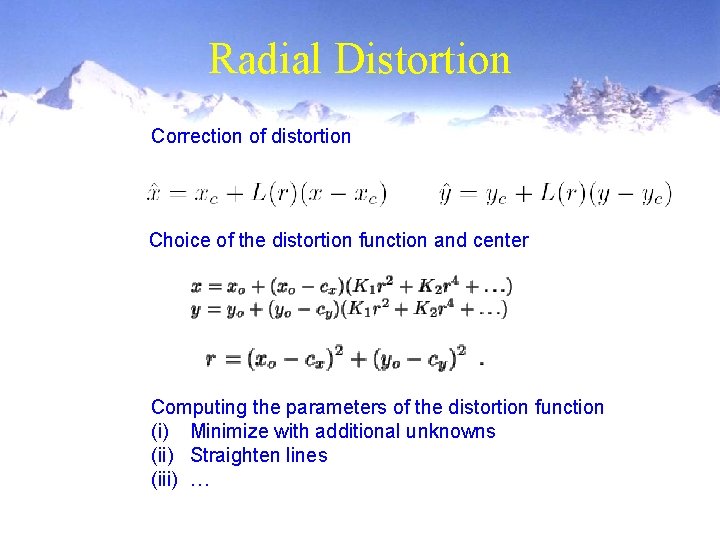
Radial Distortion Correction of distortion Choice of the distortion function and center Computing the parameters of the distortion function (i) Minimize with additional unknowns (ii) Straighten lines (iii) …