
Computer Vision Multimedia Lab University of Pavia Industrial
Computer Vision & Multimedia Lab University of Pavia Industrial Engineering and Computer Science Department 2

Staff • • Virginio Cantoni, Professor - Director Luca Lombardi, Associate Professor Mauro Mosconi, Assistant Professor (part-time) Marco Porta, Assistant Professor Marco Piastra, Contract Professor Roberto Marmo, Contract Professor Alessandra Setti, System Administrator 3
History – the beginnings • The initial research activities of the group (early 70 s) concentrated on the techniques of image enhancement and restoration, with particular regard for medical imagery • Later, a broad background has been acquired on low level and intermediate level vision • From the early 80 s a new stream of research has been actively followed in the field of parallel architectures for vision and image processing • . . . 4
Current research areas • New research areas are now activated on: • • Pattern Recognition in Proteomics, Human-Computer Interaction, 3 D Vision, Multimedia, E-learning, Image Synthesis, Visual Languages, Pyramidal Architectures for Computer Vision 5
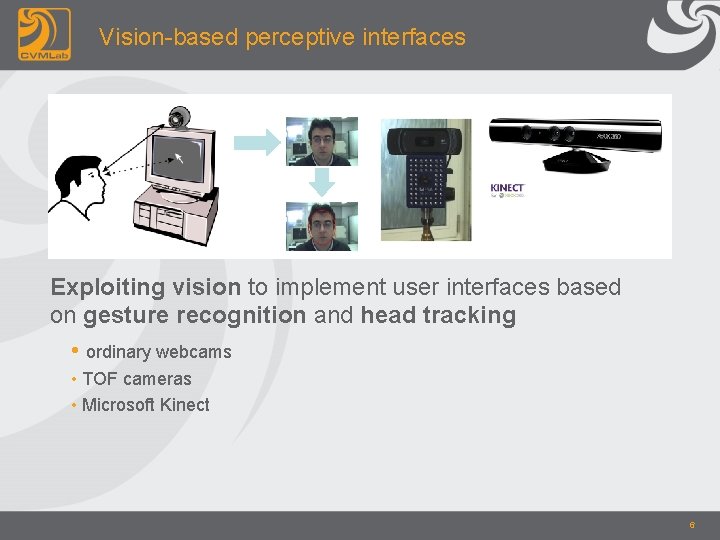
Vision-based perceptive interfaces Exploiting vision to implement user interfaces based on gesture recognition and head tracking • ordinary webcams • TOF cameras • Microsoft Kinect 6
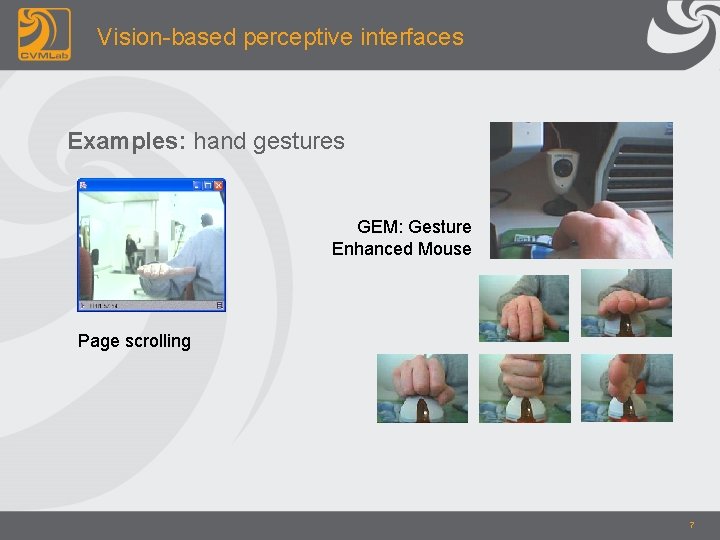
Vision-based perceptive interfaces Examples: hand gestures GEM: Gesture Enhanced Mouse Page scrolling 7
Human Computer Interaction • "Traditional" activity: design of visual interfaces (i. e. drag-and-drop for e-commerce websites, new paradigms for browsing of images) • Experience on web accessibility • Experience on usability evaluation (cognitive walkthrough, thinking aloud) 8
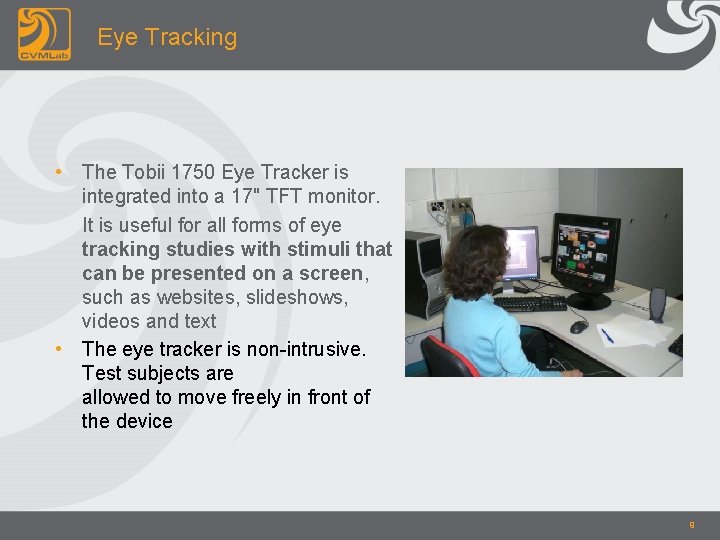
Eye Tracking • The Tobii 1750 Eye Tracker is integrated into a 17" TFT monitor. It is useful for all forms of eye tracking studies with stimuli that can be presented on a screen, such as websites, slideshows, videos and text • The eye tracker is non-intrusive. Test subjects are allowed to move freely in front of the device 9
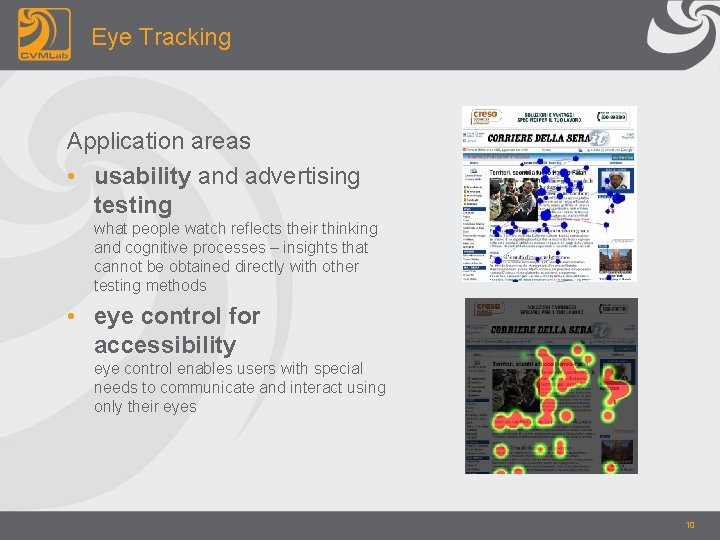
Eye Tracking Application areas • usability and advertising testing what people watch reflects their thinking and cognitive processes – insights that cannot be obtained directly with other testing methods • eye control for accessibility eye control enables users with special needs to communicate and interact using only their eyes 10
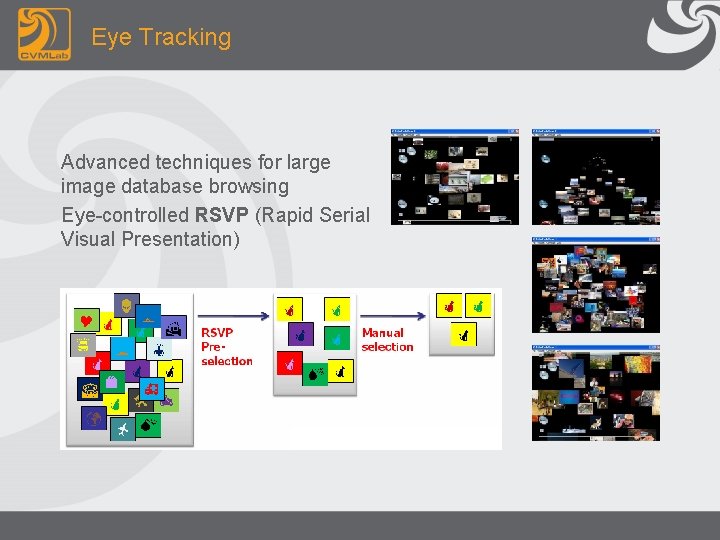
Eye Tracking Advanced techniques for large image database browsing Eye-controlled RSVP (Rapid Serial Visual Presentation)
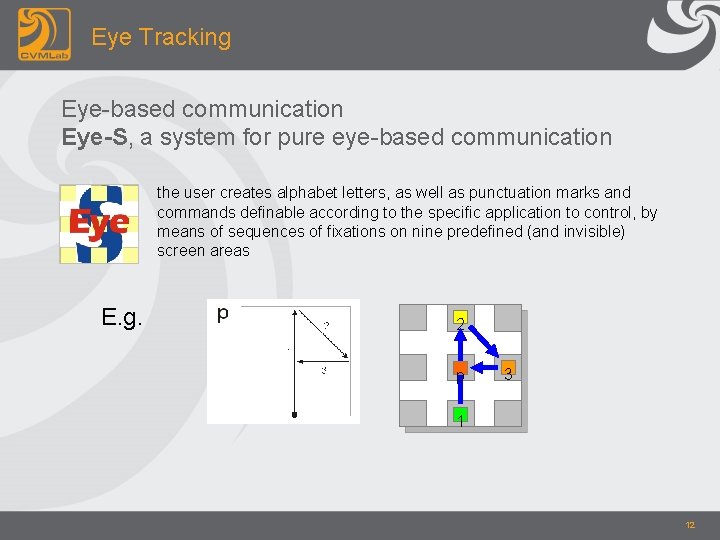
Eye Tracking Eye-based communication Eye-S, a system for pure eye-based communication the user creates alphabet letters, as well as punctuation marks and commands definable according to the specific application to control, by means of sequences of fixations on nine predefined (and invisible) screen areas E. g. 2 p 3 1 12
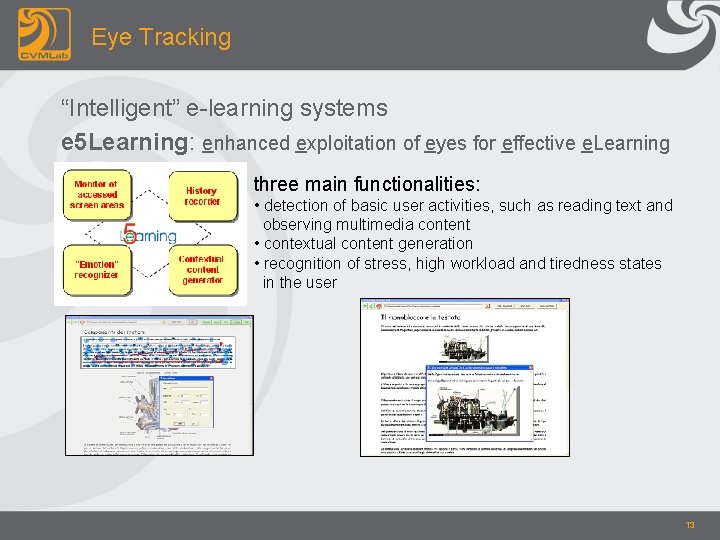
Eye Tracking “Intelligent” e-learning systems e 5 Learning: enhanced exploitation of eyes for effective e. Learning three main functionalities: • detection of basic user activities, such as reading text and observing multimedia content • contextual content generation • recognition of stress, high workload and tiredness states in the user 13
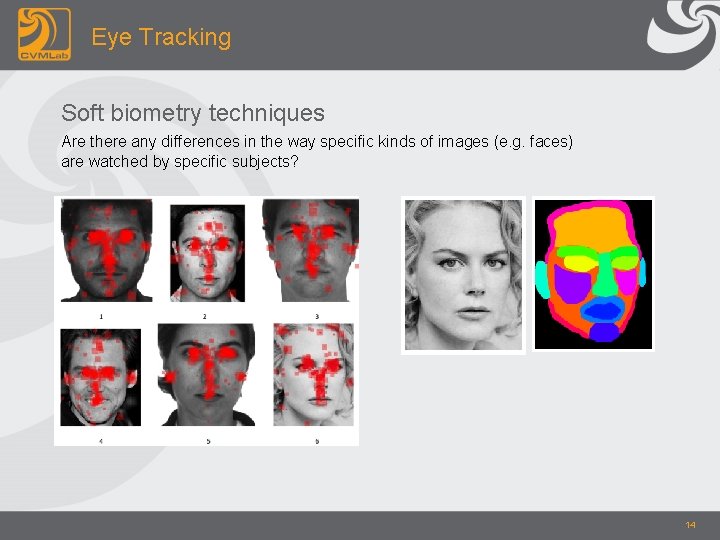
Eye Tracking Soft biometry techniques Are there any differences in the way specific kinds of images (e. g. faces) are watched by specific subjects? 14
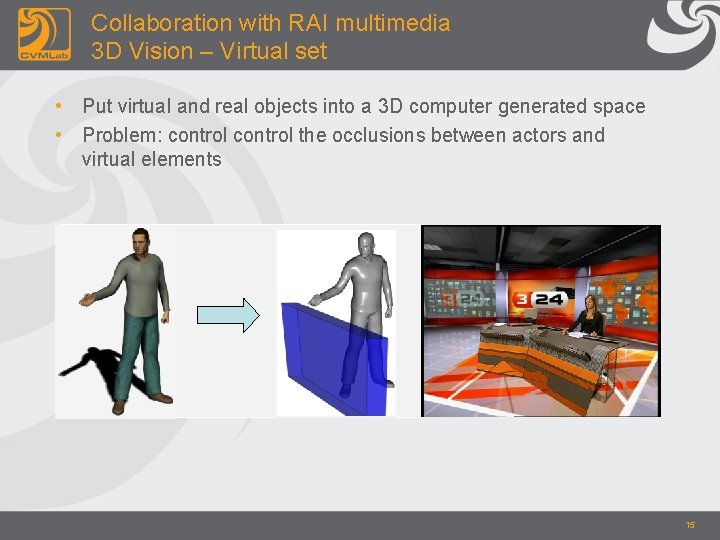
Collaboration with RAI multimedia 3 D Vision – Virtual set • Put virtual and real objects into a 3 D computer generated space • Problem: control the occlusions between actors and virtual elements 15
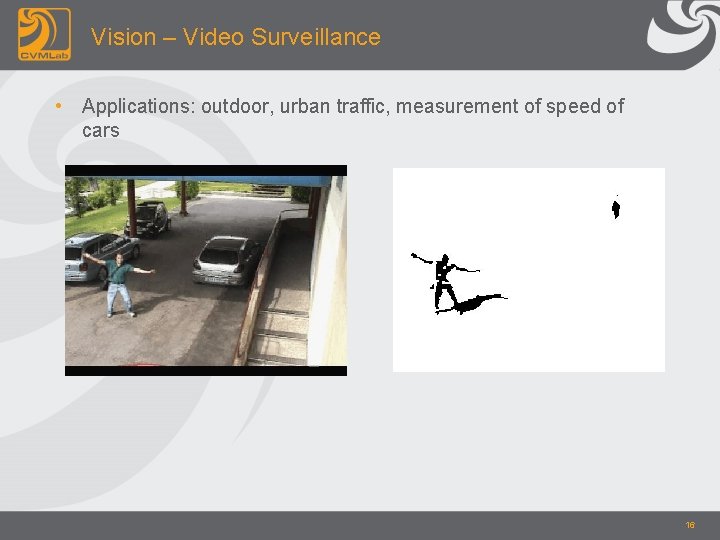
Vision – Video Surveillance • Applications: outdoor, urban traffic, measurement of speed of cars 16
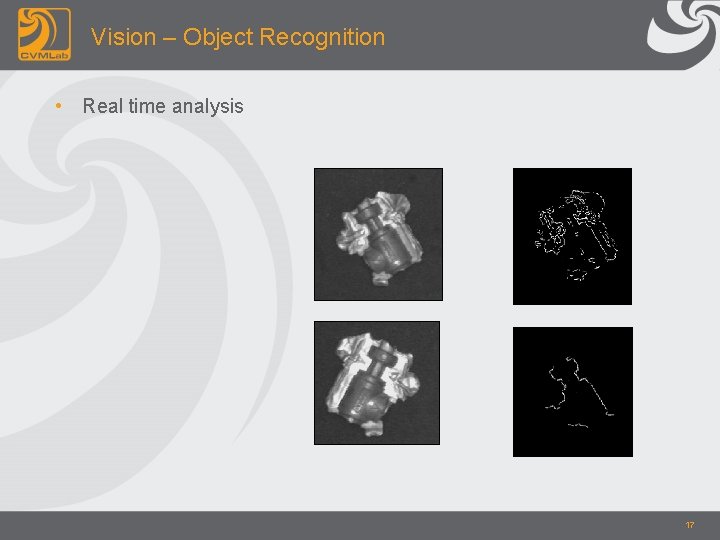
Vision – Object Recognition • Real time analysis 17
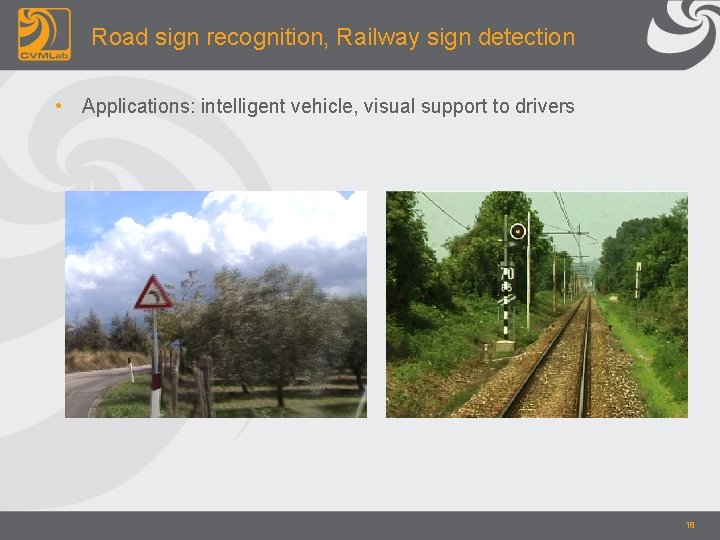
Road sign recognition, Railway sign detection • Applications: intelligent vehicle, visual support to drivers 18
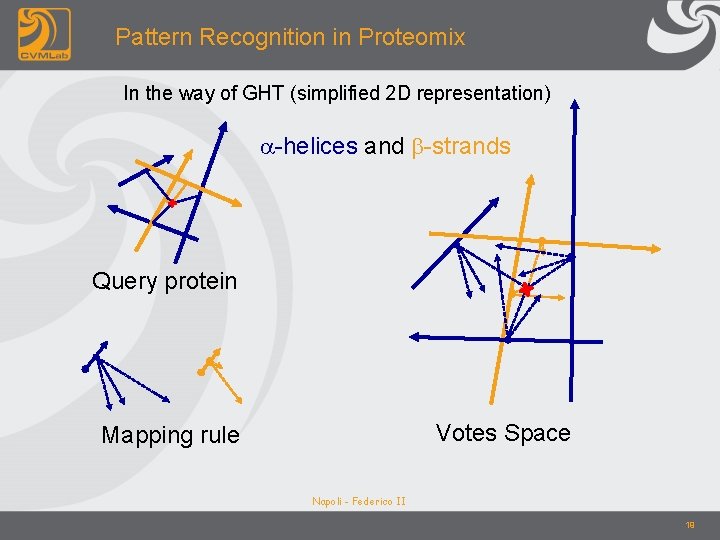
Pattern Recognition in Proteomix In the way of GHT (simplified 2 D representation) a-helices and b-strands Query protein Votes Space Mapping rule Napoli - Federico II 19
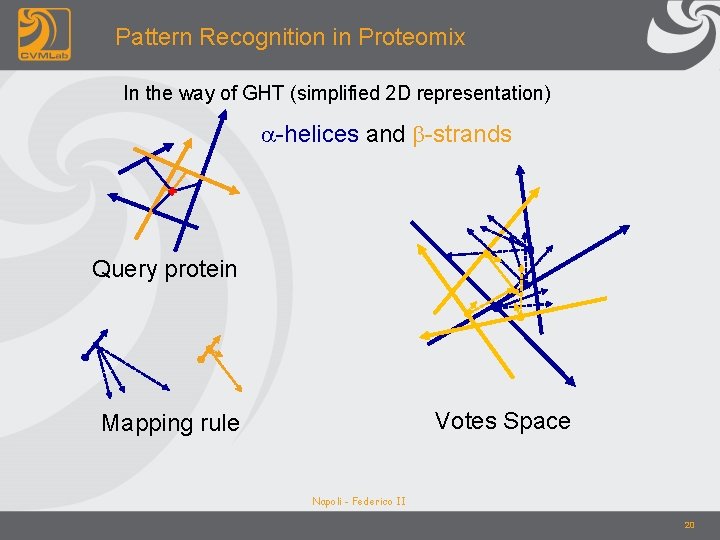
Pattern Recognition in Proteomix In the way of GHT (simplified 2 D representation) a-helices and b-strands Query protein Votes Space Mapping rule Napoli - Federico II 20
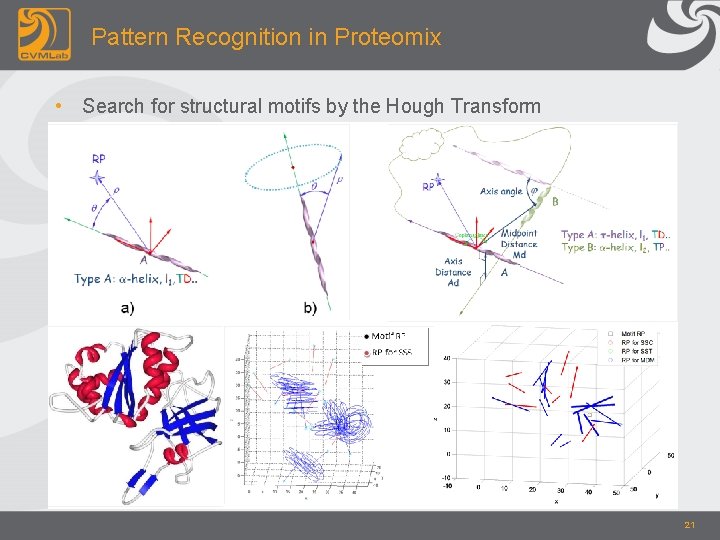
Pattern Recognition in Proteomix • Search for structural motifs by the Hough Transform 21
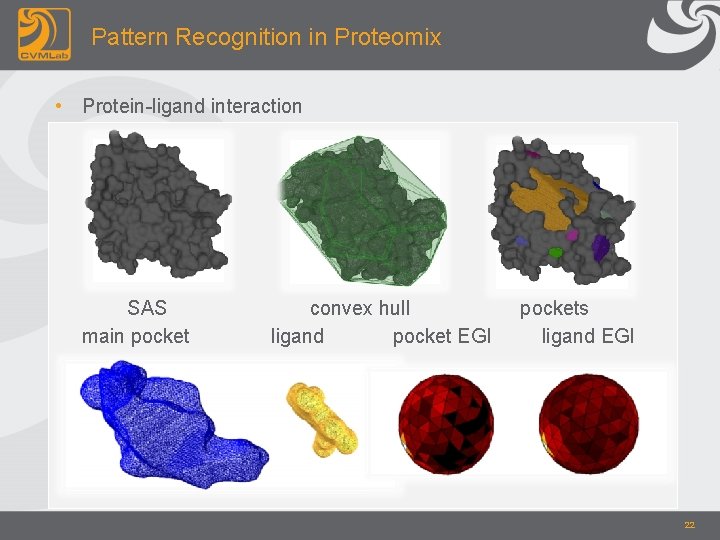
Pattern Recognition in Proteomix • Protein-ligand interaction SAS main pocket convex hull ligand pocket EGI pockets ligand EGI 22
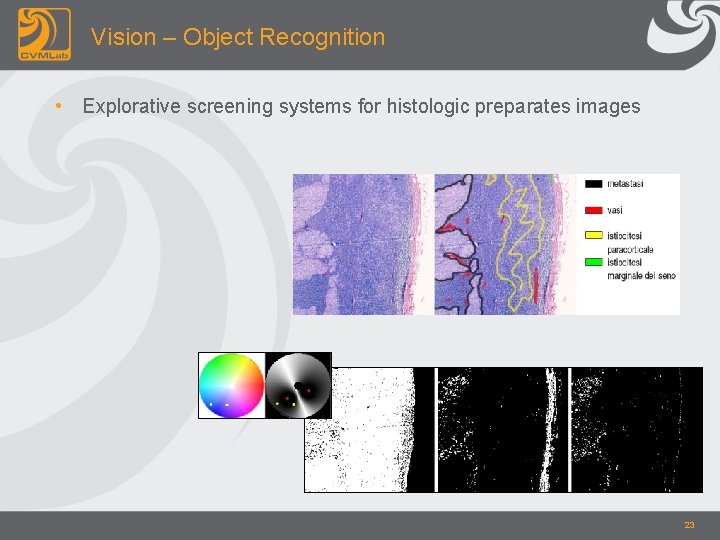
Vision – Object Recognition • Explorative screening systems for histologic preparates images 23
QCT/FEA Models of Proximal Femurs: Image-based Mesh Generation Episode III : 2011 -12 -05 A joint effort with Mayo Clinic and STMicroelectronics
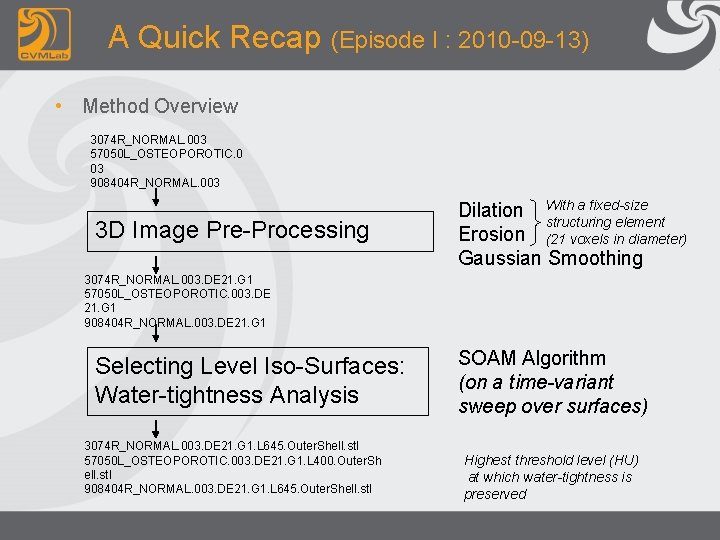
A Quick Recap (Episode I : 2010 -09 -13) • Method Overview 3074 R_NORMAL. 003 57050 L_OSTEOPOROTIC. 0 03 908404 R_NORMAL. 003 3 D Image Pre-Processing a fixed-size Dilation With structuring element Erosion (21 voxels in diameter) Gaussian Smoothing 3074 R_NORMAL. 003. DE 21. G 1 57050 L_OSTEOPOROTIC. 003. DE 21. G 1 908404 R_NORMAL. 003. DE 21. G 1 Selecting Level Iso-Surfaces: Water-tightness Analysis 3074 R_NORMAL. 003. DE 21. G 1. L 645. Outer. Shell. stl 57050 L_OSTEOPOROTIC. 003. DE 21. G 1. L 400. Outer. Sh ell. stl 908404 R_NORMAL. 003. DE 21. G 1. L 645. Outer. Shell. stl SOAM Algorithm (on a time-variant sweep over surfaces) Highest threshold level (HU) at which water-tightness is preserved
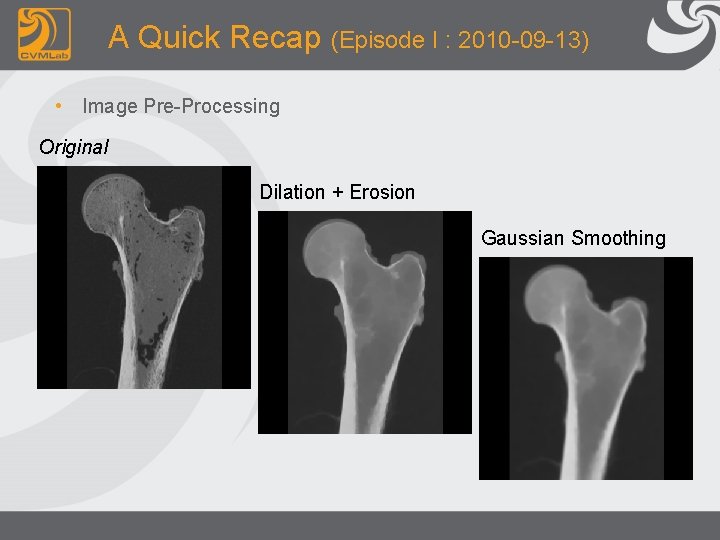
A Quick Recap (Episode I : 2010 -09 -13) • Image Pre-Processing Original Dilation + Erosion Gaussian Smoothing
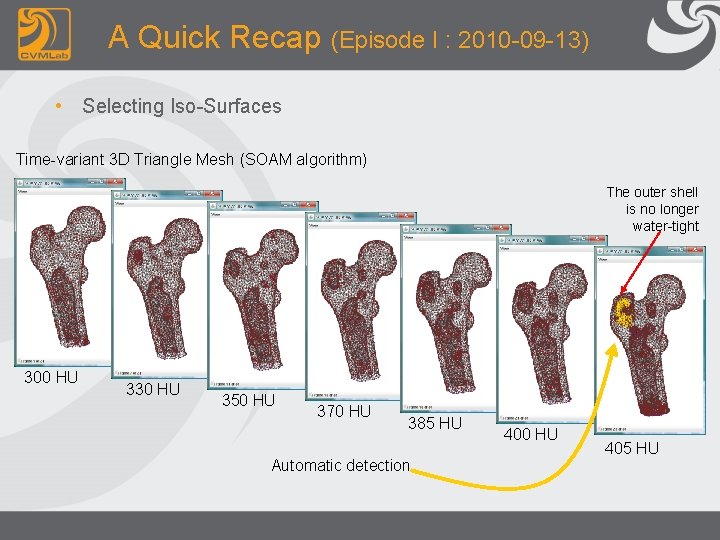
A Quick Recap (Episode I : 2010 -09 -13) • Selecting Iso-Surfaces Time-variant 3 D Triangle Mesh (SOAM algorithm) The outer shell is no longer water-tight 300 HU 330 HU 350 HU 370 HU 385 HU Automatic detection 400 HU 405 HU
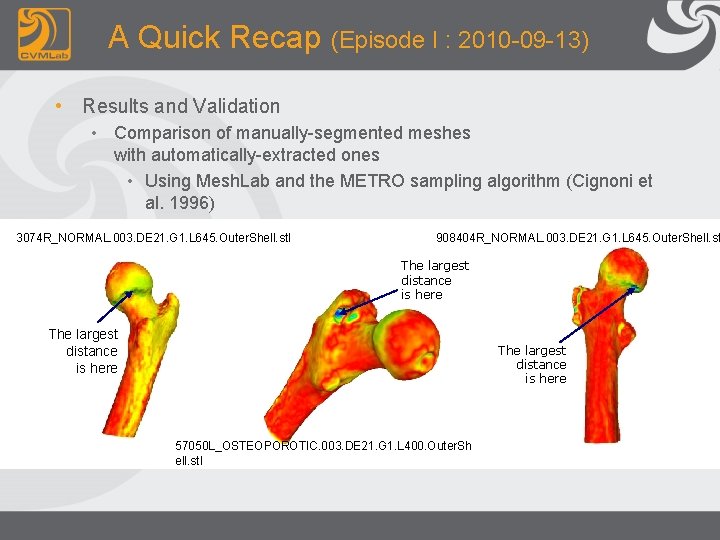
A Quick Recap (Episode I : 2010 -09 -13) • Results and Validation • Comparison of manually-segmented meshes with automatically-extracted ones • Using Mesh. Lab and the METRO sampling algorithm (Cignoni et al. 1996) 3074 R_NORMAL. 003. DE 21. G 1. L 645. Outer. Shell. stl 908404 R_NORMAL. 003. DE 21. G 1. L 645. Outer. Shell. st The largest distance is here 57050 L_OSTEOPOROTIC. 003. DE 21. G 1. L 400. Outer. Sh ell. stl
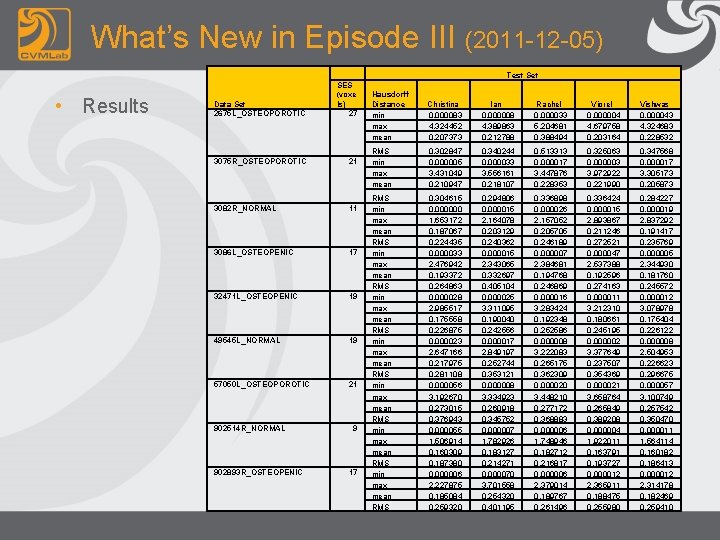
What’s New in Episode III (2011 -12 -05) Test Set • Results Data Set 2675 L_OSTEOPOROTIC SES (voxe ls) 27 3075 R_OSTEOPOROTIC 21 3082 R_NORMAL 11 3086 L_OSTEOPENIC 17 32471 L_OSTEOPENIC 19 49545 L_NORMAL 19 57050 L_OSTEOPOROTIC 21 902514 R_NORMAL 902893 R_OSTEOPENIC 9 17 Hausdorff Distance min max mean Christina 0. 000083 4. 324452 0. 207373 Ian 0. 000008 4. 389863 0. 212788 Rachel 0. 000033 5. 204681 0. 388494 Viorel 0. 000004 4. 679758 0. 203164 Vishwas 0. 000043 4. 324683 0. 228532 RMS min max mean 0. 302847 0. 000005 3. 431049 0. 210947 0. 340244 0. 000033 3. 556161 0. 218107 0. 513313 0. 000017 3. 447876 0. 228353 0. 325063 0. 000003 3. 972922 0. 221990 0. 347568 0. 000017 3. 305173 0. 205873 RMS min max mean RMS min max mean RMS 0. 304615 0. 000000 1. 653172 0. 187067 0. 224435 0. 000033 2. 476942 0. 193372 0. 264863 0. 000028 2. 985517 0. 175558 0. 226875 0. 000023 2. 647166 0. 217975 0. 281108 0. 000056 3. 192670 0. 273015 0. 376943 0. 000055 1. 506914 0. 160309 0. 187380 0. 000006 2. 227875 0. 185084 0. 259320 0. 294806 0. 000015 2. 164078 0. 203129 0. 240362 0. 000015 2. 343065 0. 332697 0. 405104 0. 000025 3. 311095 0. 190040 0. 242556 0. 000017 2. 849197 0. 252744 0. 353121 0. 000008 3. 334923 0. 260918 0. 345752 0. 000007 1. 782926 0. 183127 0. 214271 0. 000070 3. 701558 0. 254320 0. 401195 0. 336898 0. 000026 2. 157052 0. 205705 0. 246189 0. 000007 2. 384681 0. 194768 0. 246869 0. 000016 3. 283424 0. 192348 0. 252586 0. 000008 3. 222083 0. 265175 0. 362309 0. 000020 3. 448210 0. 277172 0. 368883 0. 000006 1. 748946 0. 182712 0. 216817 0. 000006 2. 379014 0. 189767 0. 261496 0. 336424 0. 000015 2. 893867 0. 211246 0. 272521 0. 000047 2. 537388 0. 192596 0. 274163 0. 000011 3. 212310 0. 180661 0. 245195 0. 000002 3. 377649 0. 237507 0. 354369 0. 000021 3. 658764 0. 265849 0. 389208 0. 000004 1. 922011 0. 163791 0. 193727 0. 000012 2. 365911 0. 188475 0. 255980 0. 284227 0. 000019 2. 837292 0. 191417 0. 235769 0. 000005 2. 344930 0. 181760 0. 245572 0. 000012 3. 078978 0. 175404 0. 226122 0. 000008 2. 504953 0. 226623 0. 296675 0. 000057 3. 100749 0. 257542 0. 350470 0. 000011 1. 564114 0. 160182 0. 186413 0. 000012 2. 314178 0. 182469 0. 259410
Data fusion segmentation • Our approach uses these data sources: • A standard RGB camera • A TOF camera • Possible applications: • • • People Tracking Human – Machine Interaction (HCI) 3 D reconstruction Augmented reality Etc. 30
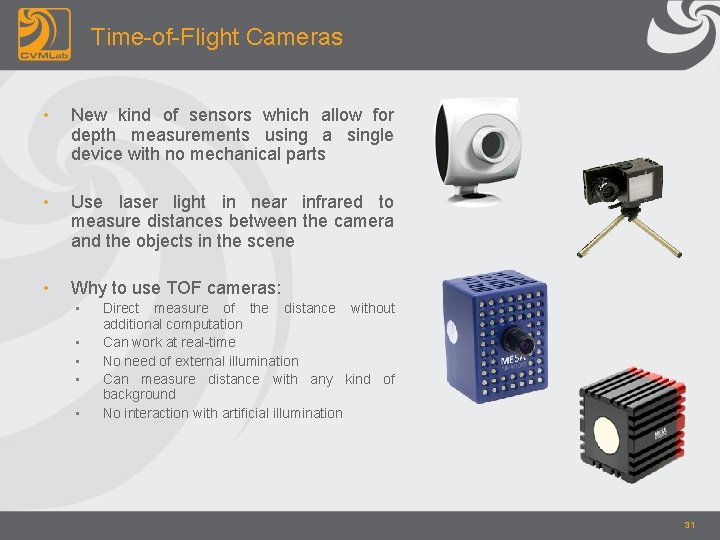
Time-of-Flight Cameras • New kind of sensors which allow for depth measurements using a single device with no mechanical parts • Use laser light in near infrared to measure distances between the camera and the objects in the scene • Why to use TOF cameras: • • • Direct measure of the distance without additional computation Can work at real-time No need of external illumination Can measure distance with any kind of background No interaction with artificial illumination 31
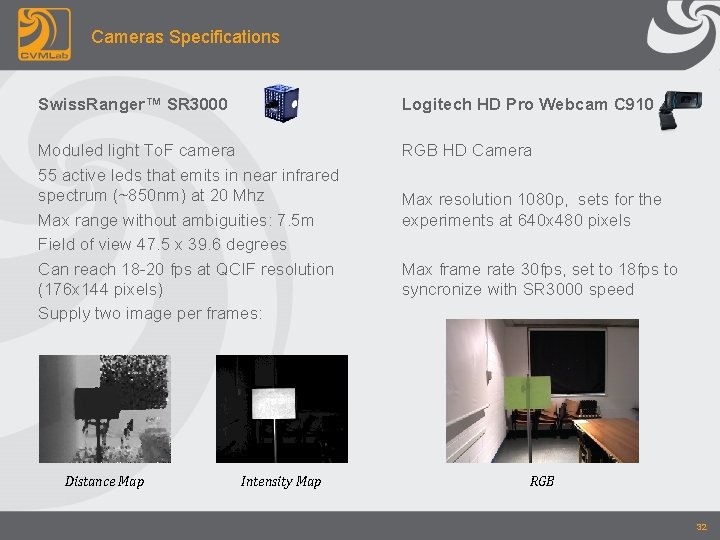
Cameras Specifications Swiss. Ranger™ SR 3000 Logitech HD Pro Webcam C 910 Moduled light To. F camera 55 active leds that emits in near infrared spectrum (~850 nm) at 20 Mhz Max range without ambiguities: 7. 5 m Field of view 47. 5 x 39. 6 degrees Can reach 18 -20 fps at QCIF resolution (176 x 144 pixels) Supply two image per frames: RGB HD Camera Distance Map Intensity Map Max resolution 1080 p, sets for the experiments at 640 x 480 pixels Max frame rate 30 fps, set to 18 fps to syncronize with SR 3000 speed RGB 32
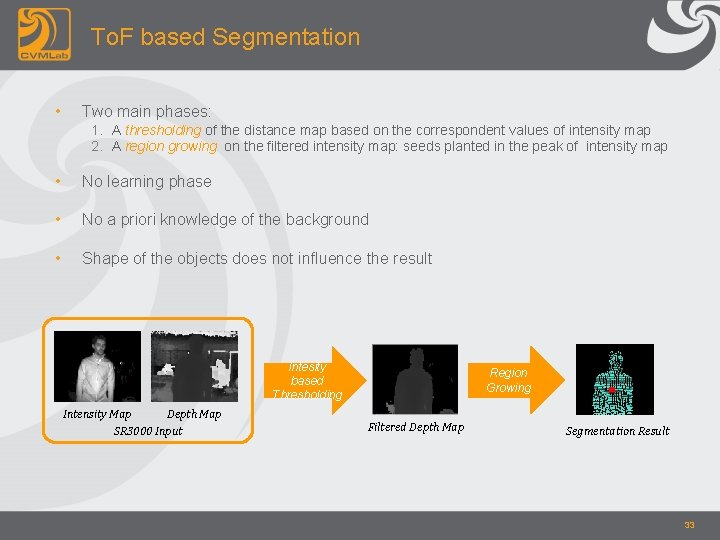
To. F based Segmentation • Two main phases: 1. A thresholding of the distance map based on the correspondent values of intensity map 2. A region growing on the filtered intensity map: seeds planted in the peak of intensity map • No learning phase • No a priori knowledge of the background • Shape of the objects does not influence the result Intesity based Thresholding Intensity Map Depth Map SR 3000 Input Region Growing Filtered Depth Map Segmentation Result 33
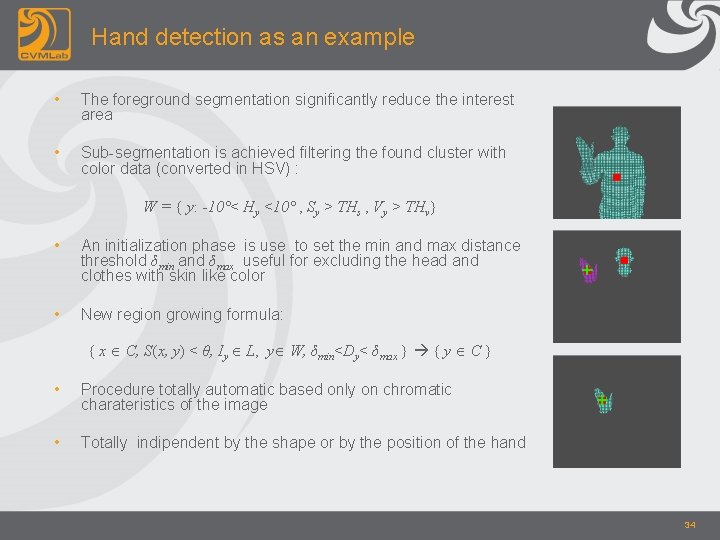
Hand detection as an example • The foreground segmentation significantly reduce the interest area • Sub-segmentation is achieved filtering the found cluster with color data (converted in HSV) : W = { y: -10°< Hy <10° , Sy > THs , Vy > THv} • An initialization phase is use to set the min and max distance threshold δmin and δmax useful for excluding the head and clothes with skin like color • New region growing formula: { x C, S(x, y) < θ, Iy L, y W, δmin<Dy< δmax } { y C } • Procedure totally automatic based only on chromatic charateristics of the image • Totally indipendent by the shape or by the position of the hand 34
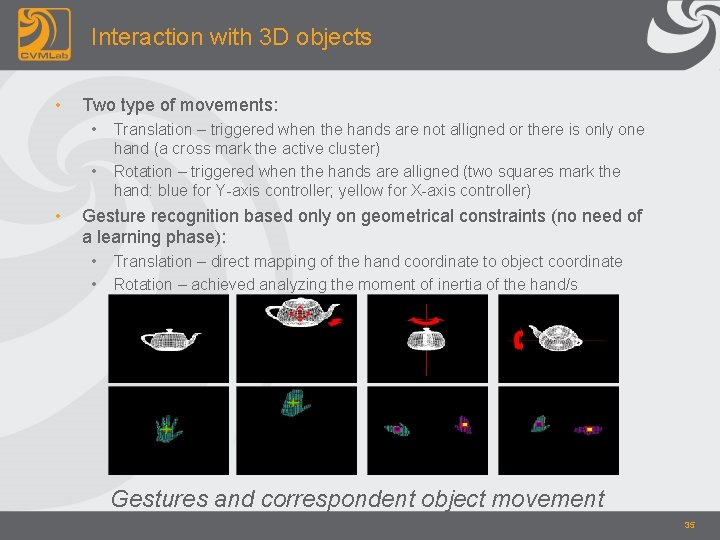
Interaction with 3 D objects • Two type of movements: • • • Translation – triggered when the hands are not alligned or there is only one hand (a cross mark the active cluster) Rotation – triggered when the hands are alligned (two squares mark the hand: blue for Y-axis controller; yellow for X-axis controller) Gesture recognition based only on geometrical constraints (no need of a learning phase): • • Translation – direct mapping of the hand coordinate to object coordinate Rotation – achieved analyzing the moment of inertia of the hand/s Gestures and correspondent object movement 35
- Slides: 34