
Computer Vision Group Prof Daniel Cremers Autonomous Navigation
- Slides: 28
Computer Vision Group Prof. Daniel Cremers Autonomous Navigation for Flying Robots Lecture 3. 1: 3 D Geometry Jürgen Sturm Technische Universität München
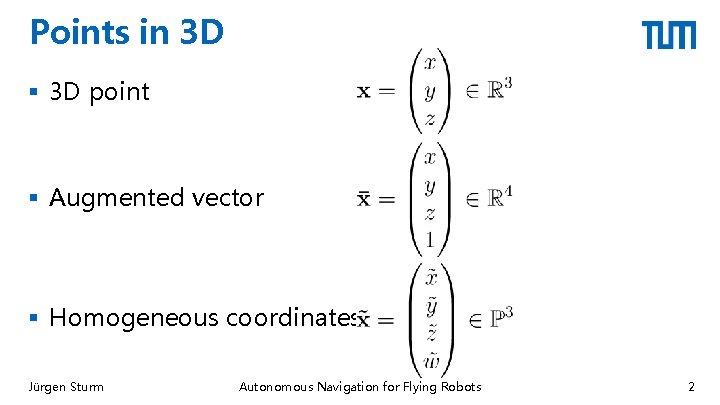
Points in 3 D § 3 D point § Augmented vector § Homogeneous coordinates Jürgen Sturm Autonomous Navigation for Flying Robots 2
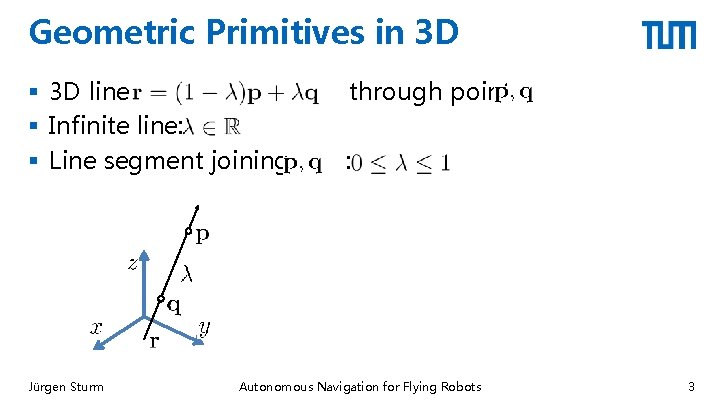
Geometric Primitives in 3 D § 3 D line § Infinite line: § Line segment joining Jürgen Sturm through points : Autonomous Navigation for Flying Robots 3
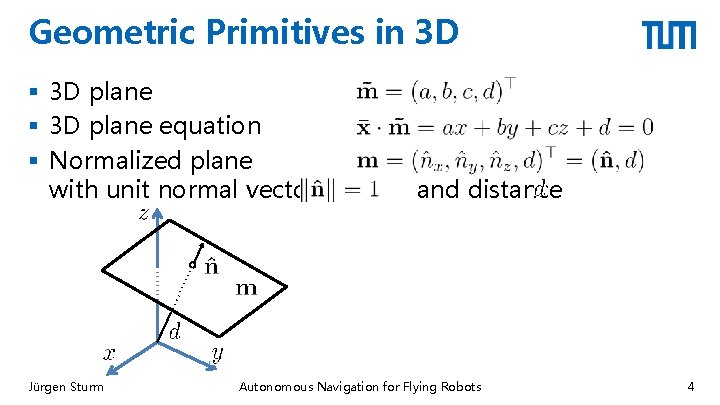
Geometric Primitives in 3 D § 3 D plane equation § Normalized plane with unit normal vector Jürgen Sturm and distance Autonomous Navigation for Flying Robots 4
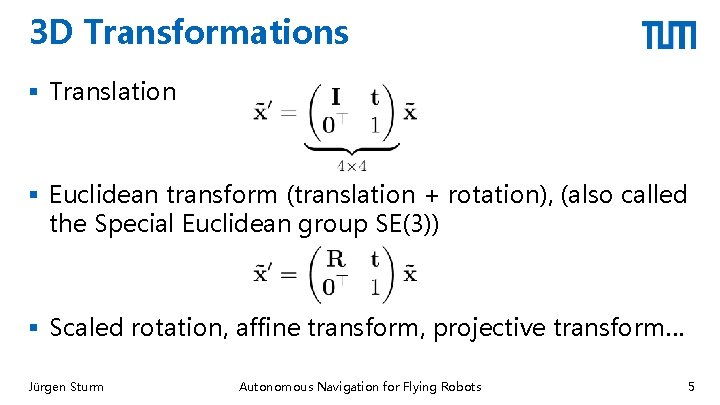
3 D Transformations § Translation § Euclidean transform (translation + rotation), (also called the Special Euclidean group SE(3)) § Scaled rotation, affine transform, projective transform… Jürgen Sturm Autonomous Navigation for Flying Robots 5
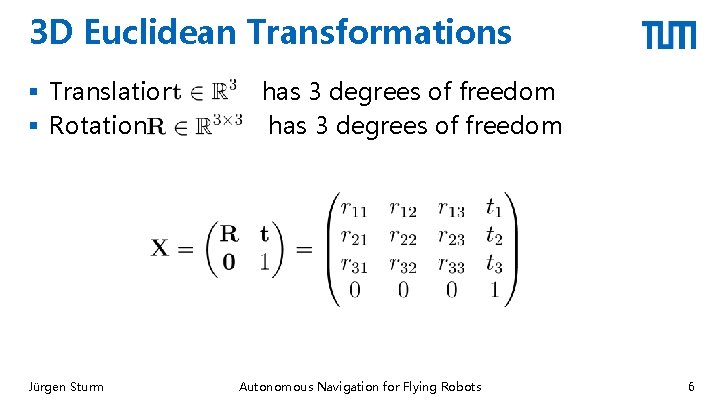
3 D Euclidean Transformations § Translation § Rotation Jürgen Sturm has 3 degrees of freedom Autonomous Navigation for Flying Robots 6
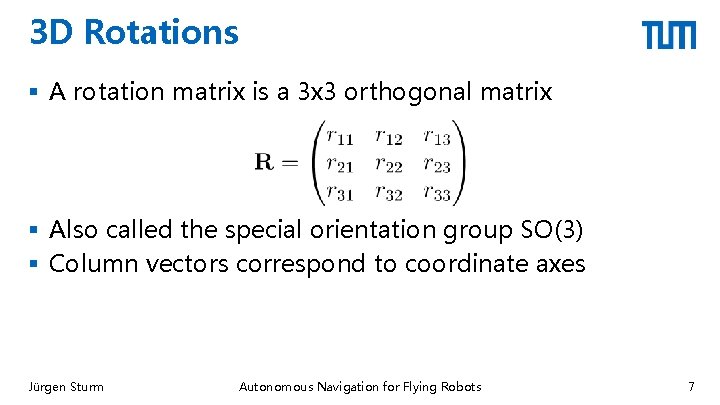
3 D Rotations § A rotation matrix is a 3 x 3 orthogonal matrix § Also called the special orientation group SO(3) § Column vectors correspond to coordinate axes Jürgen Sturm Autonomous Navigation for Flying Robots 7
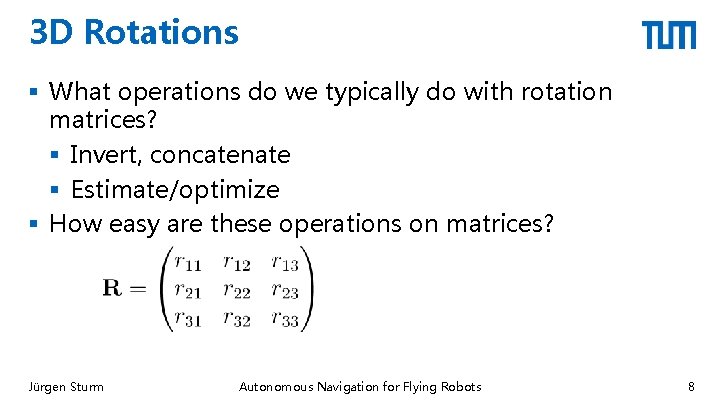
3 D Rotations § What operations do we typically do with rotation matrices? § Invert, concatenate § Estimate/optimize § How easy are these operations on matrices? Jürgen Sturm Autonomous Navigation for Flying Robots 8
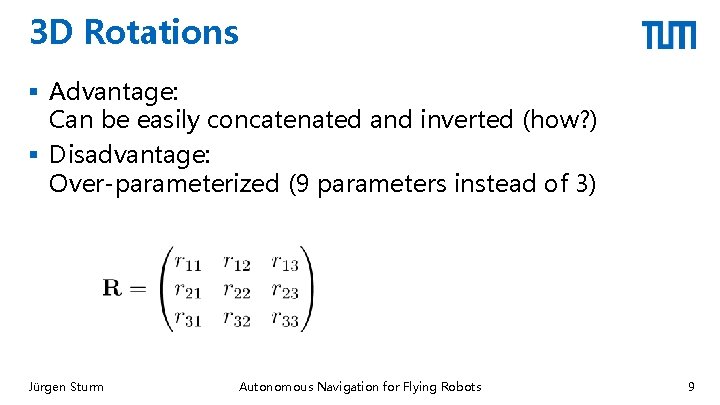
3 D Rotations § Advantage: Can be easily concatenated and inverted (how? ) § Disadvantage: Over-parameterized (9 parameters instead of 3) Jürgen Sturm Autonomous Navigation for Flying Robots 9
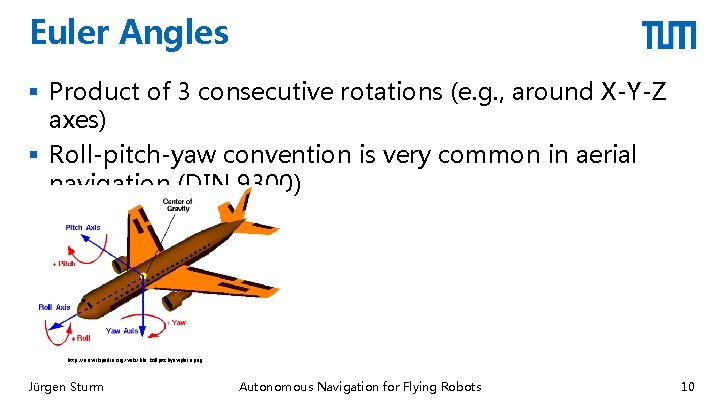
Euler Angles § Product of 3 consecutive rotations (e. g. , around X-Y-Z axes) § Roll-pitch-yaw convention is very common in aerial navigation (DIN 9300) http: //en. wikipedia. org/wiki/File: Rollpitchyawplain. png Jürgen Sturm Autonomous Navigation for Flying Robots 10
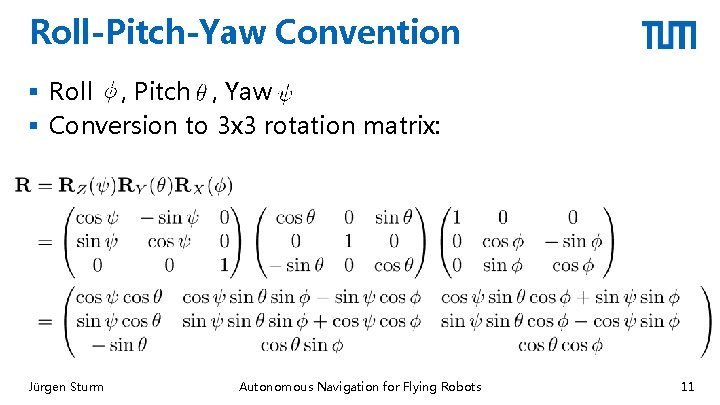
Roll-Pitch-Yaw Convention § Roll , Pitch , Yaw § Conversion to 3 x 3 rotation matrix: Jürgen Sturm Autonomous Navigation for Flying Robots 11
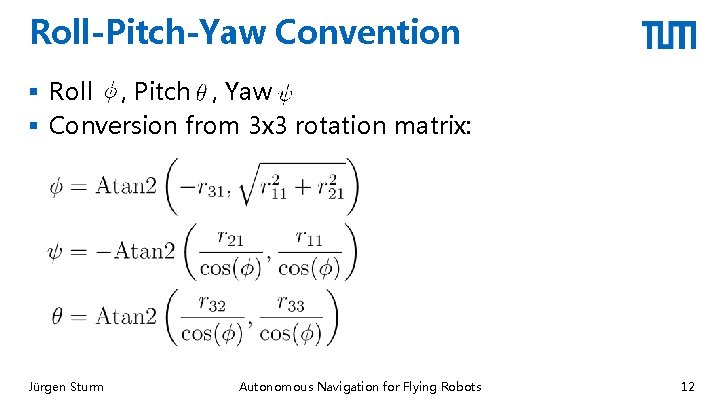
Roll-Pitch-Yaw Convention § Roll , Pitch , Yaw § Conversion from 3 x 3 rotation matrix: Jürgen Sturm Autonomous Navigation for Flying Robots 12
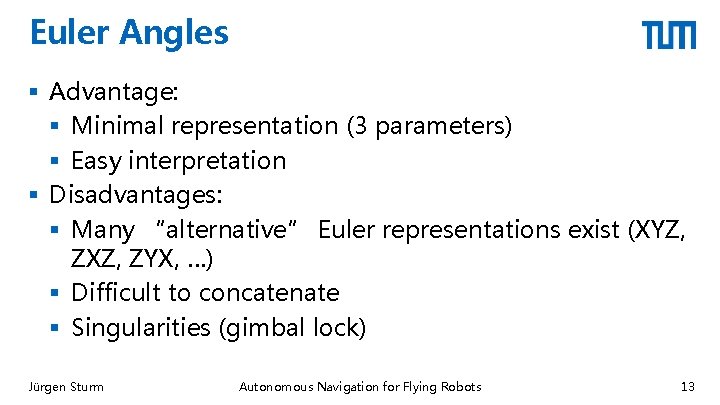
Euler Angles § Advantage: § Minimal representation (3 parameters) § Easy interpretation § Disadvantages: § Many “alternative” Euler representations exist (XYZ, ZXZ, ZYX, …) § Difficult to concatenate § Singularities (gimbal lock) Jürgen Sturm Autonomous Navigation for Flying Robots 13
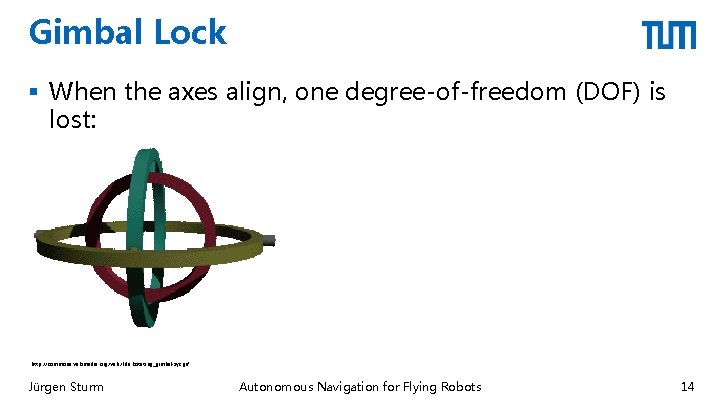
Gimbal Lock § When the axes align, one degree-of-freedom (DOF) is lost: http: //commons. wikimedia. org/wiki/File: Rotating_gimbal-xyz. gif Jürgen Sturm Autonomous Navigation for Flying Robots 14
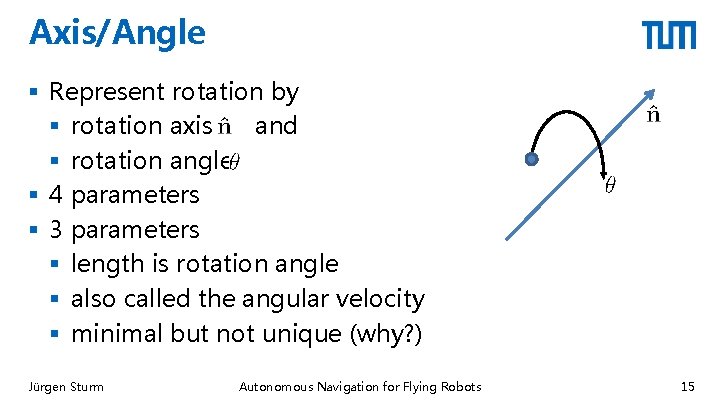
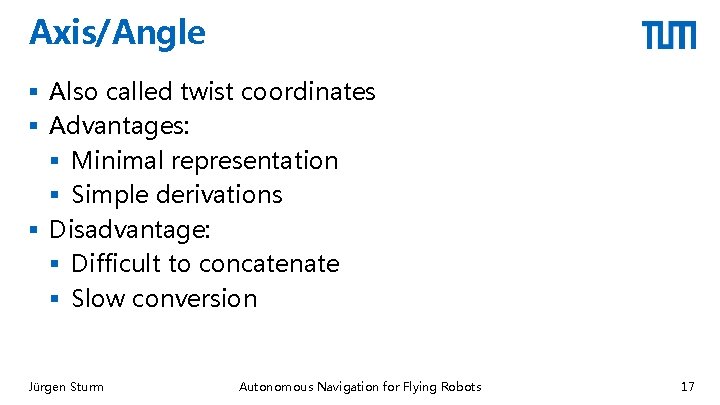
Axis/Angle § Represent rotation by § rotation axis and § rotation angle § 4 parameters § 3 parameters § length is rotation angle § also called the angular velocity § minimal but not unique (why? ) Jürgen Sturm Autonomous Navigation for Flying Robots 15
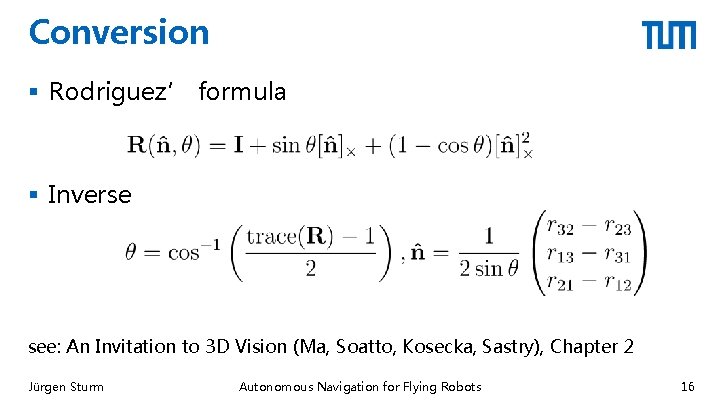
Conversion § Rodriguez’ formula § Inverse see: An Invitation to 3 D Vision (Ma, Soatto, Kosecka, Sastry), Chapter 2 Jürgen Sturm Autonomous Navigation for Flying Robots 16
Axis/Angle § Also called twist coordinates § Advantages: § Minimal representation § Simple derivations § Disadvantage: § Difficult to concatenate § Slow conversion Jürgen Sturm Autonomous Navigation for Flying Robots 17
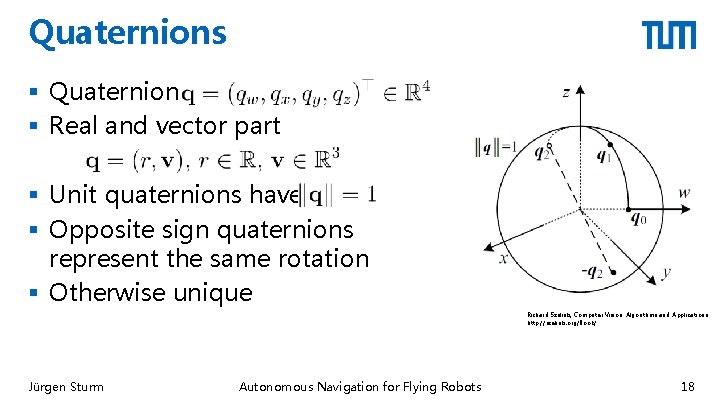
Quaternions § Quaternion § Real and vector part § Unit quaternions have § Opposite sign quaternions represent the same rotation § Otherwise unique Richard Szeliski, Computer Vision: Algorithms and Applications http: //szeliski. org/Book/ Jürgen Sturm Autonomous Navigation for Flying Robots 18
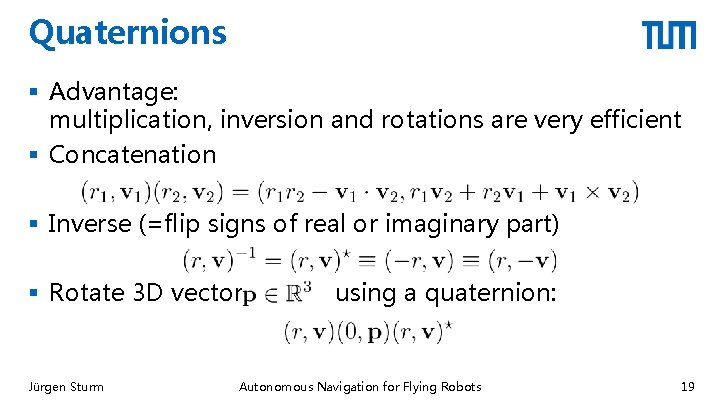
Quaternions § Advantage: multiplication, inversion and rotations are very efficient § Concatenation § Inverse (=flip signs of real or imaginary part) § Rotate 3 D vector Jürgen Sturm using a quaternion: Autonomous Navigation for Flying Robots 19
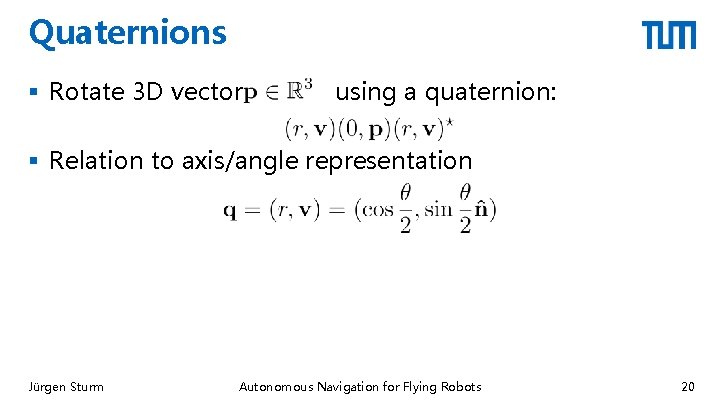
Quaternions § Rotate 3 D vector using a quaternion: § Relation to axis/angle representation Jürgen Sturm Autonomous Navigation for Flying Robots 20
3 D Orientations § Note: In general, it is very hard to “read” 3 D orientations/rotations, no matter in what representation § Observation: They are usually easy to visualize and can then be intuitively interpreted § Advice: Use 3 D visualization tools for debugging (RVIZ, libqglviewer, …) Jürgen Sturm Autonomous Navigation for Flying Robots 21
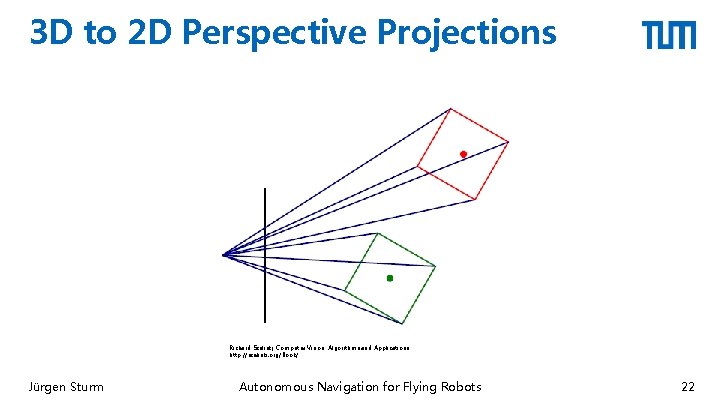
3 D to 2 D Perspective Projections Richard Szeliski, Computer Vision: Algorithms and Applications http: //szeliski. org/Book/ Jürgen Sturm Autonomous Navigation for Flying Robots 22
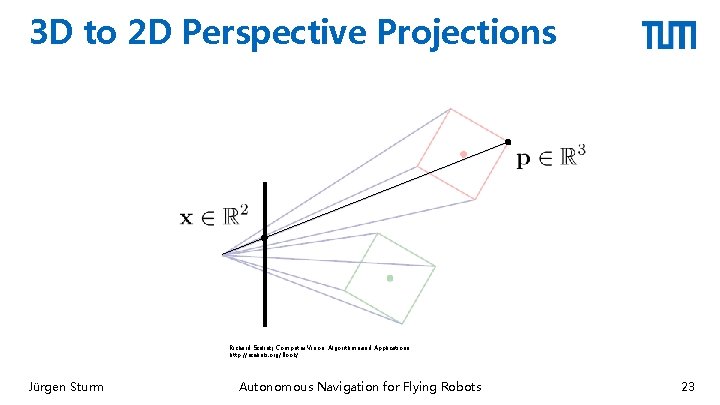
3 D to 2 D Perspective Projections Richard Szeliski, Computer Vision: Algorithms and Applications http: //szeliski. org/Book/ Jürgen Sturm Autonomous Navigation for Flying Robots 23
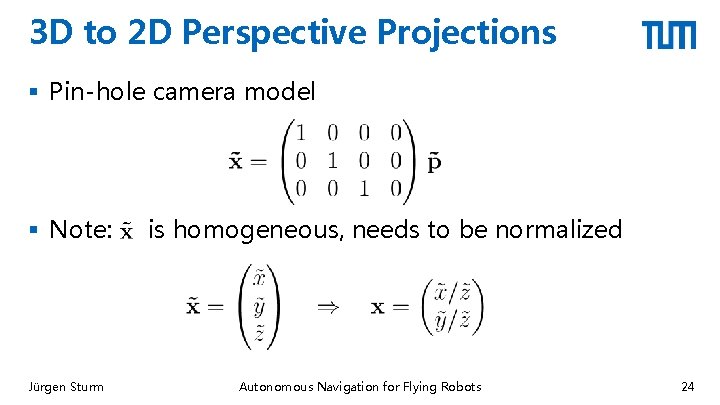
3 D to 2 D Perspective Projections § Pin-hole camera model § Note: Jürgen Sturm is homogeneous, needs to be normalized Autonomous Navigation for Flying Robots 24
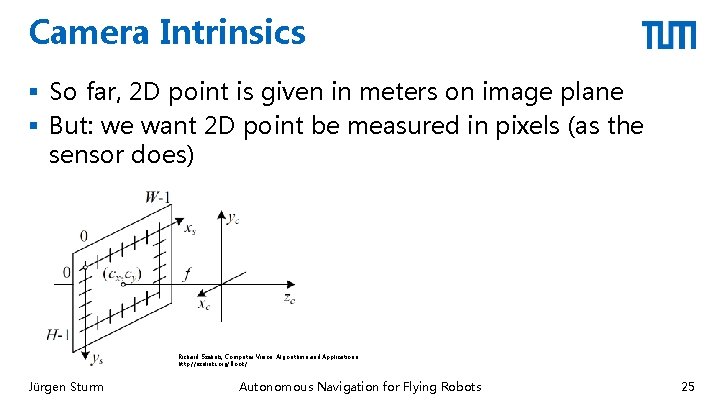
Camera Intrinsics § So far, 2 D point is given in meters on image plane § But: we want 2 D point be measured in pixels (as the sensor does) Richard Szeliski, Computer Vision: Algorithms and Applications http: //szeliski. org/Book/ Jürgen Sturm Autonomous Navigation for Flying Robots 25
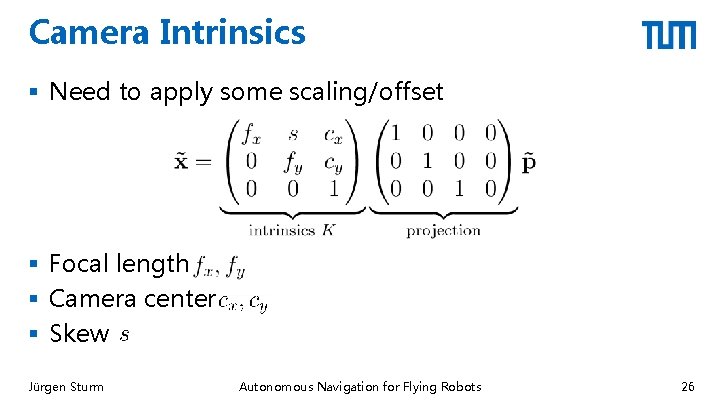
Camera Intrinsics § Need to apply some scaling/offset § Focal length § Camera center § Skew Jürgen Sturm Autonomous Navigation for Flying Robots 26
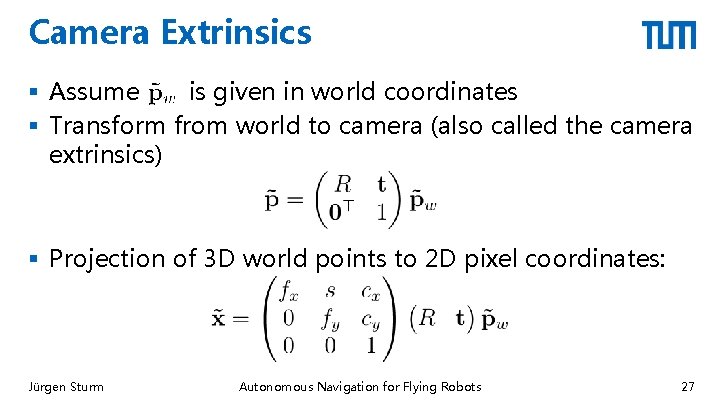
Camera Extrinsics § Assume is given in world coordinates § Transform from world to camera (also called the camera extrinsics) § Projection of 3 D world points to 2 D pixel coordinates: Jürgen Sturm Autonomous Navigation for Flying Robots 27
Lessons Learned § 3 D points, lines, planes § 3 D transformations § Different representations for 3 D orientations § Choice depends on application § Which representations do you remember? § 3 D to 2 D perspective projections § You really have to know 2 D/3 D transformations by heart (for more info, read Szeliski, Chapter 2, available online) Jürgen Sturm Autonomous Navigation for Flying Robots 28