
Computer Vision CSEEE 576 Interest Regions Recognition and



- Slides: 57
Computer Vision CSE/EE 576 Interest Regions, Recognition, and Matching Linda Shapiro Professor of Computer Science & Engineering Professor of Electrical & Computer Engineering
The Kadir Operator Saliency, Scale and Image Description Timor Kadir and Michael Brady University of Oxford 2
The issues… • salient – standing out from the rest, noticeable, conspicous, prominent • scale – find the best scale for a feature • image description – create a descriptor for use in object recognition 3
Early Vision Motivation • pre-attentive stage: features pop out • attentive stage: relationships between features and grouping 4
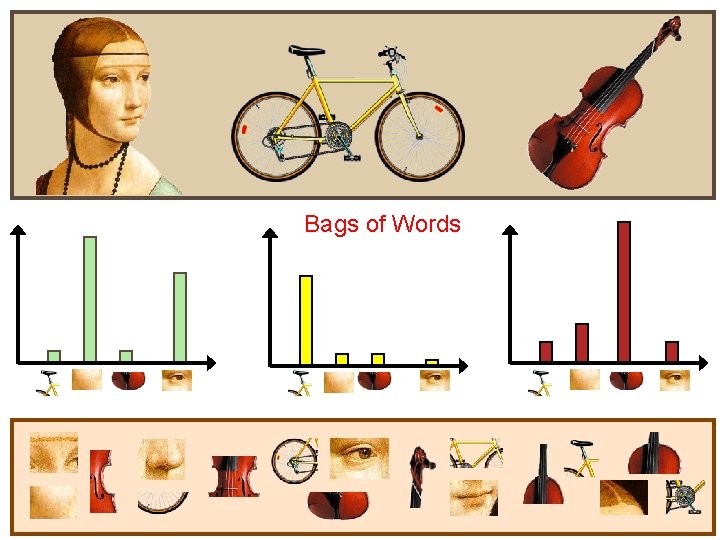
Bags of Words 5
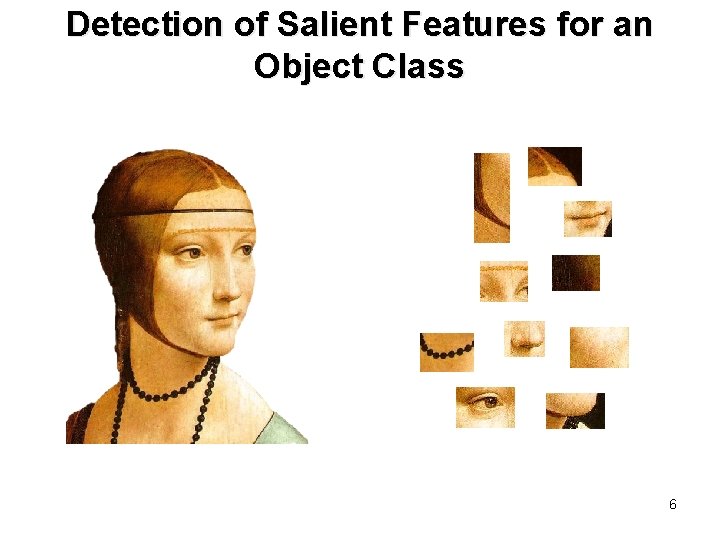
Detection of Salient Features for an Object Class 6
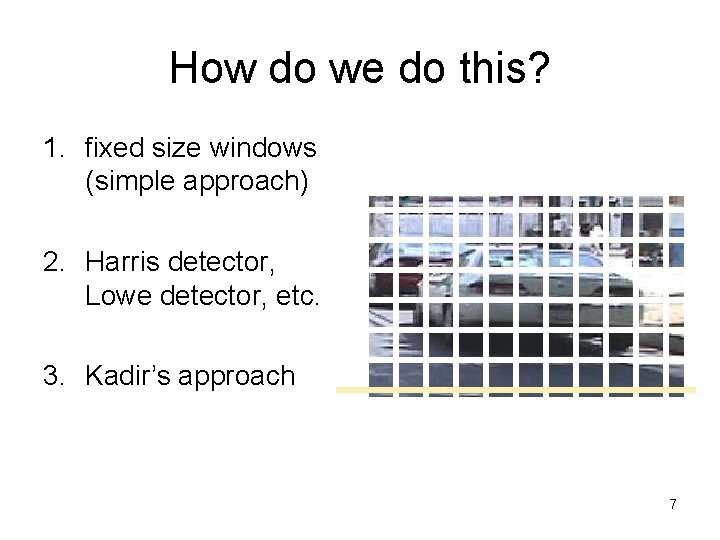
How do we do this? 1. fixed size windows (simple approach) 2. Harris detector, Lowe detector, etc. 3. Kadir’s approach 7
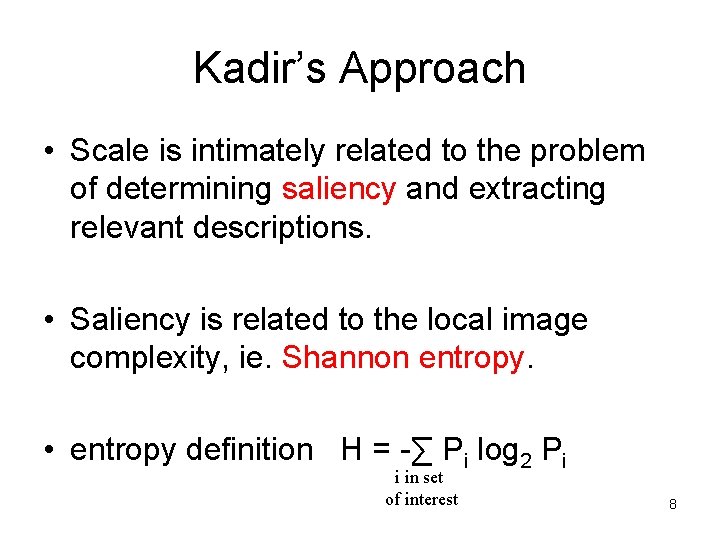
Kadir’s Approach • Scale is intimately related to the problem of determining saliency and extracting relevant descriptions. • Saliency is related to the local image complexity, ie. Shannon entropy. • entropy definition H = -∑ Pi log 2 Pi i in set of interest 8
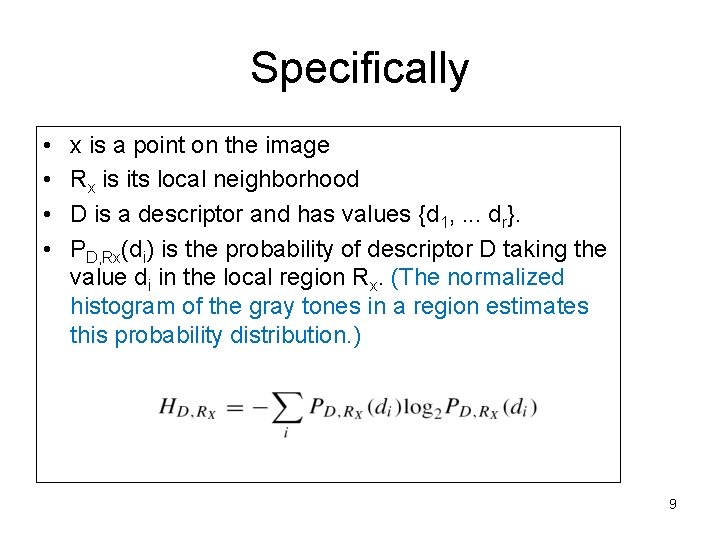
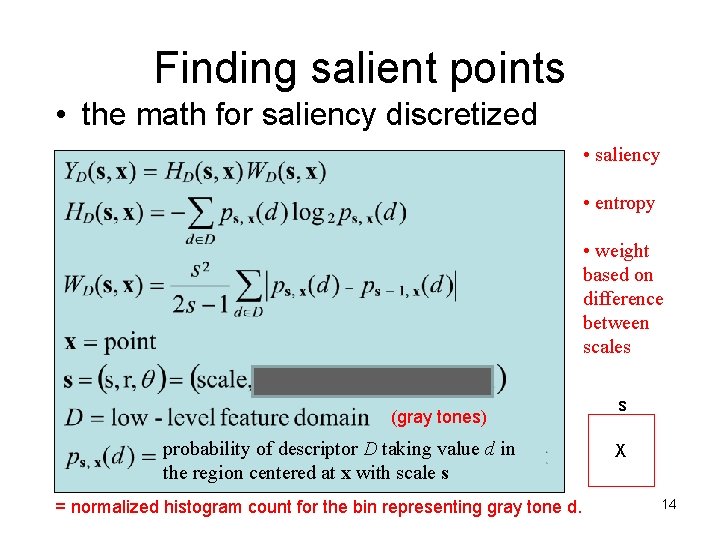
Specifically • • x is a point on the image Rx is its local neighborhood D is a descriptor and has values {d 1, . . . dr}. PD, Rx(di) is the probability of descriptor D taking the value di in the local region Rx. (The normalized histogram of the gray tones in a region estimates this probability distribution. ) 9
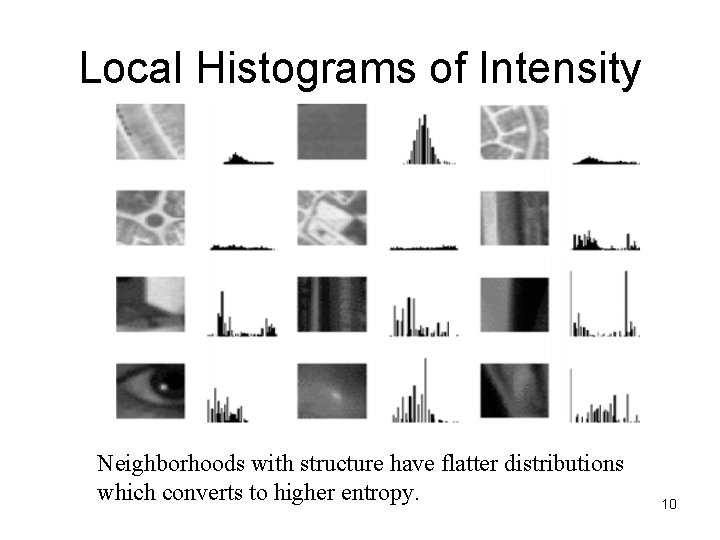
Local Histograms of Intensity Neighborhoods with structure have flatter distributions which converts to higher entropy. 10
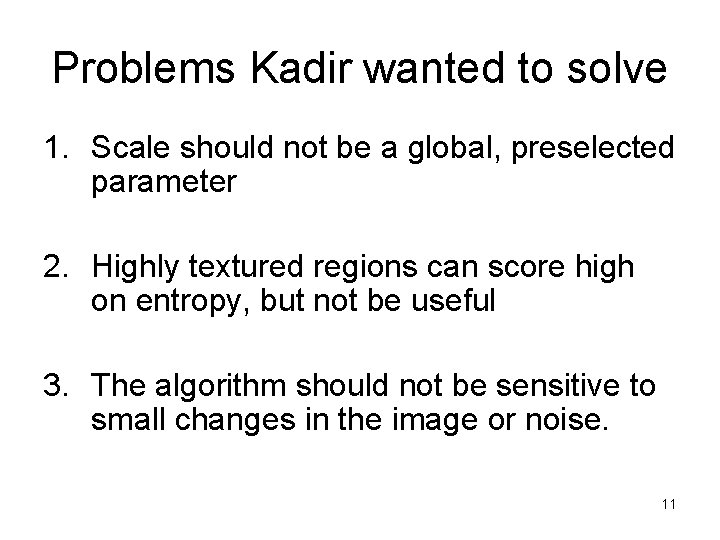
Problems Kadir wanted to solve 1. Scale should not be a global, preselected parameter 2. Highly textured regions can score high on entropy, but not be useful 3. The algorithm should not be sensitive to small changes in the image or noise. 11
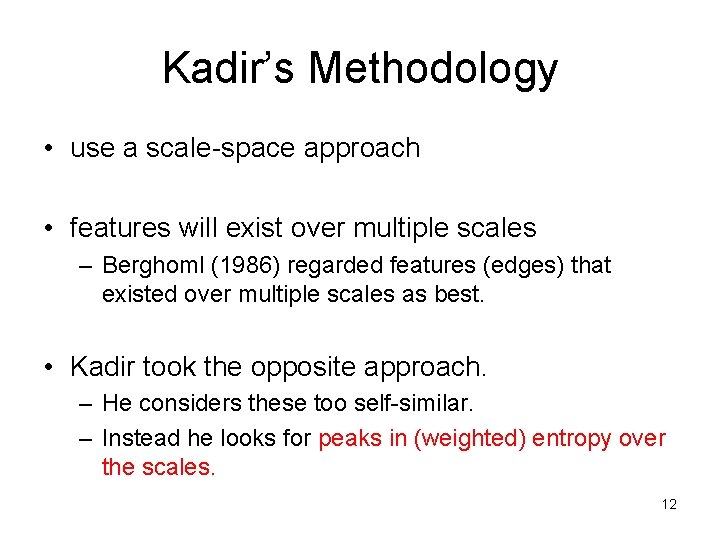
Kadir’s Methodology • use a scale-space approach • features will exist over multiple scales – Berghoml (1986) regarded features (edges) that existed over multiple scales as best. • Kadir took the opposite approach. – He considers these too self-similar. – Instead he looks for peaks in (weighted) entropy over the scales. 12
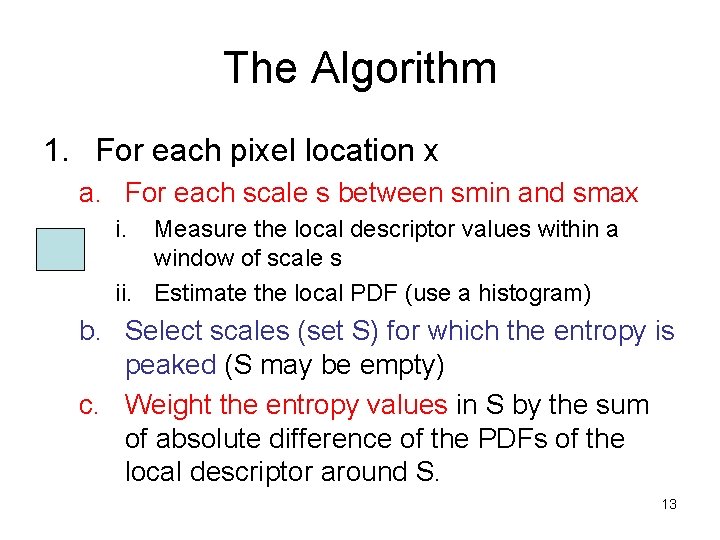
The Algorithm 1. For each pixel location x a. For each scale s between smin and smax i. Measure the local descriptor values within a window of scale s ii. Estimate the local PDF (use a histogram) b. Select scales (set S) for which the entropy is peaked (S may be empty) c. Weight the entropy values in S by the sum of absolute difference of the PDFs of the local descriptor around S. 13
Finding salient points • the math for saliency discretized • saliency • entropy • weight based on difference between scales (gray tones) probability of descriptor D taking value d in the region centered at x with scale s = normalized histogram count for the bin representing gray tone d. s X 14
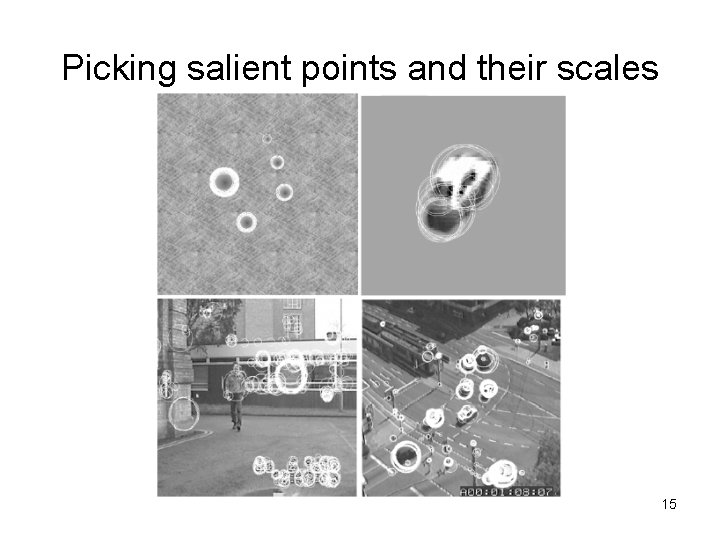
Picking salient points and their scales 15
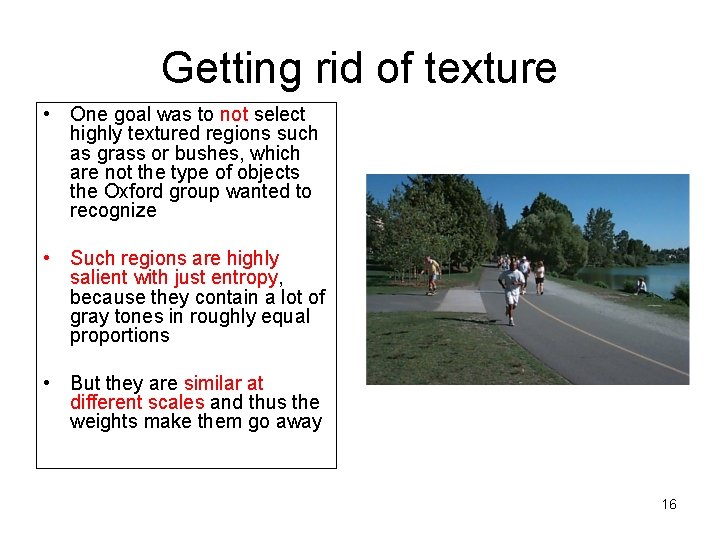
Getting rid of texture • One goal was to not select highly textured regions such as grass or bushes, which are not the type of objects the Oxford group wanted to recognize • Such regions are highly salient with just entropy, because they contain a lot of gray tones in roughly equal proportions • But they are similar at different scales and thus the weights make them go away 16
Salient Regions • Instead of just selecting the most salient points (based on weighted entropy), select salient regions (more robust). • Regions are like volumes in scale space. • Kadir used clustering to group selected points into regions. • We found the clustering was a critical step. 17
Kadir’s clustering (VERY ad hoc) • Apply a global threshold on saliency. • Choose the highest salient points (50% works well). • Find the K nearest neighbors (K=8 preset) • Check variance at center points with these neighbors. • Accept if far enough away from existant clusters and variance small enough. • Represent with mean scale and spatial location of the K points • Repeat with next highest salient point 18
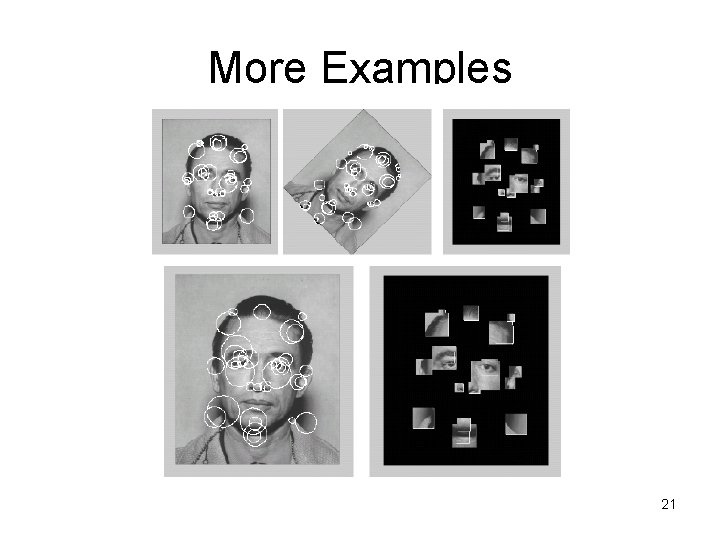
More examples 19
Robustness Claims • scale invariant (chooses its scale) • rotation invariant (uses circular regions and histograms) • somewhat illumination invariant (why? ) • not affine invariant (able to handle small changes in viewpoint) 20
More Examples 21
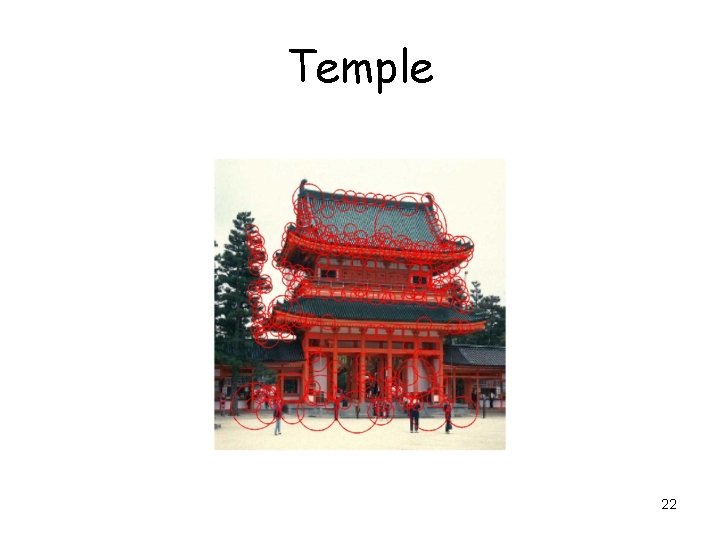
Temple 22
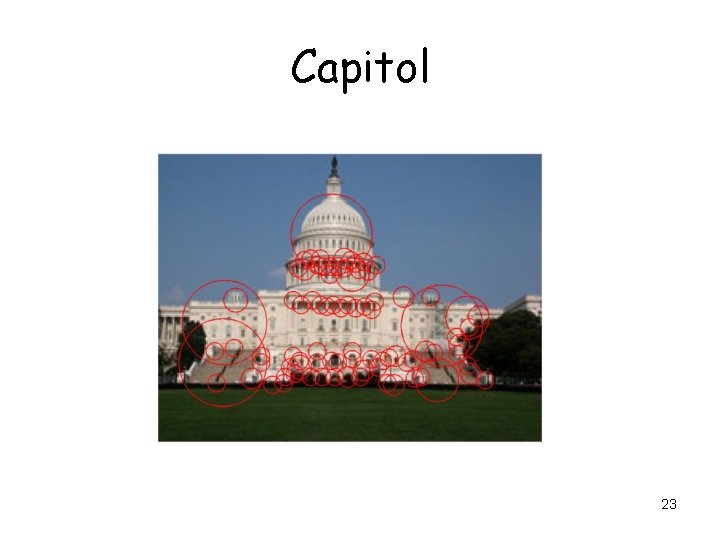
Capitol 23
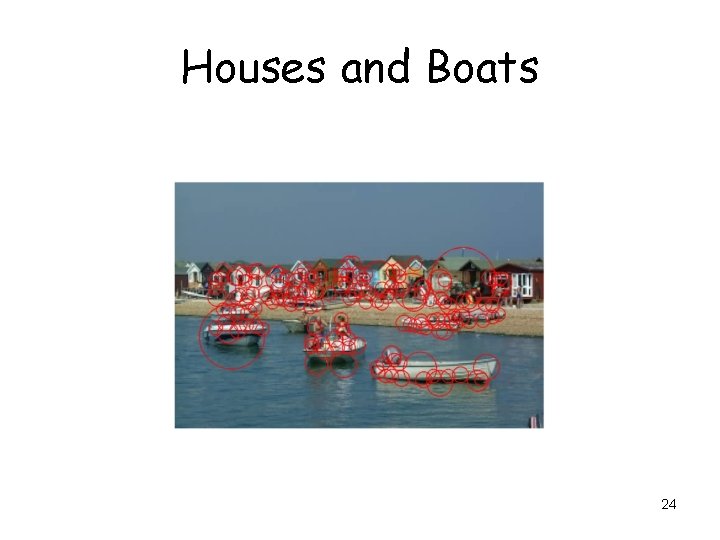
Houses and Boats 24
Houses and Boats 25
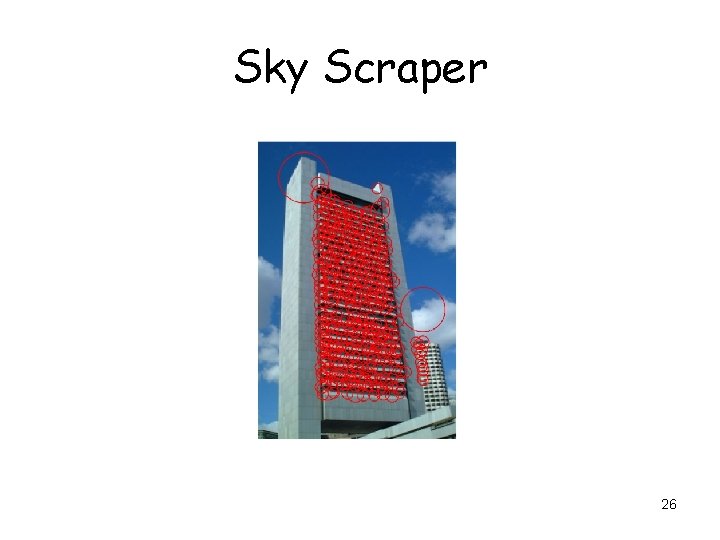
Sky Scraper 26
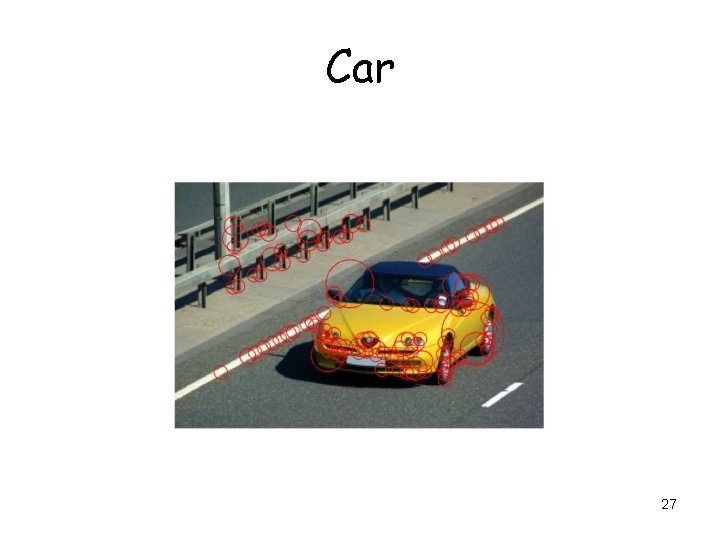
Car 27
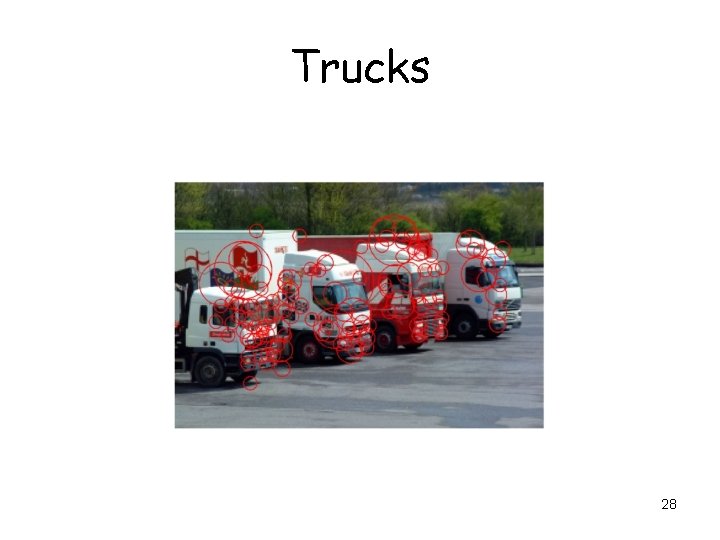
Trucks 28
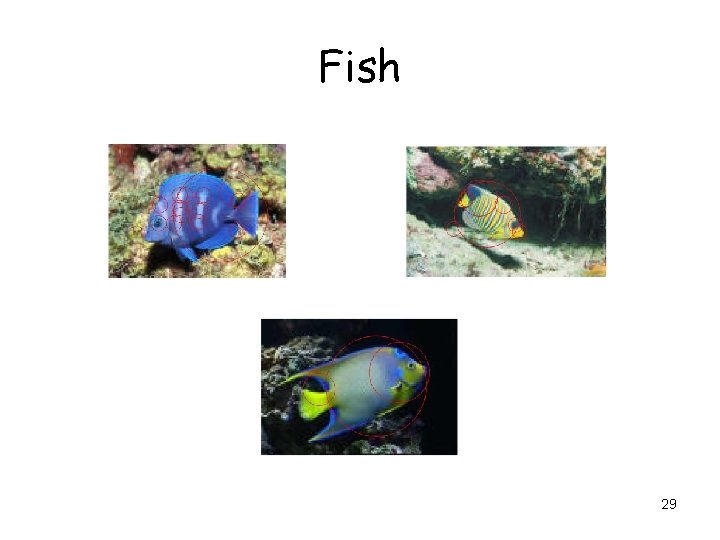
Fish 29
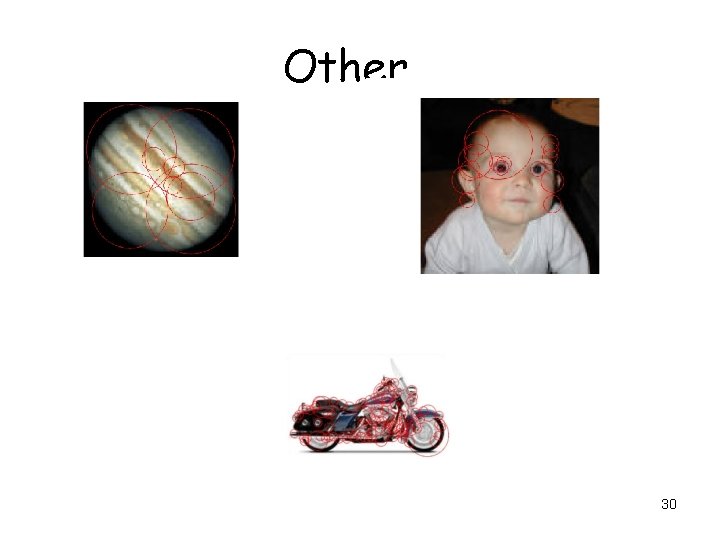
Other … 30
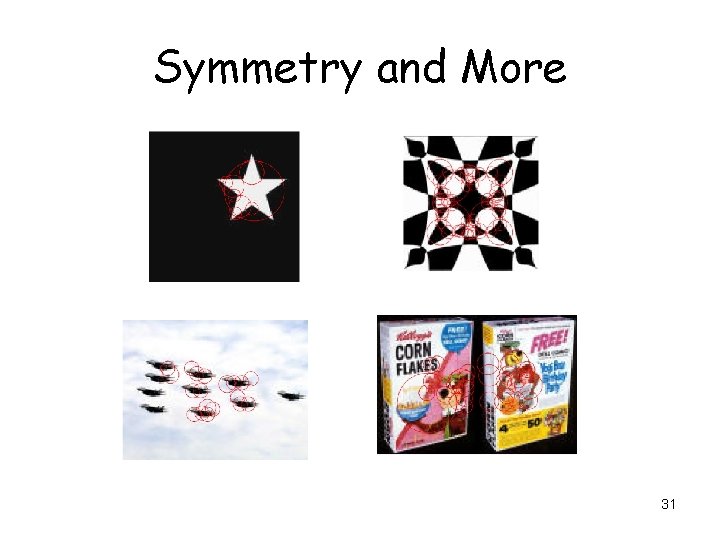
Symmetry and More 31
Benefits • General feature: not tied to any specific object • Can be used to detect rather complex objects that are not all one color • Location invariant, rotation invariant • Selects relevant scale, so scale invariant • What else is good? • Anything bad? 32
Object Recognition with Interest Operators • Object recognition started with line segments. - Roberts recognized objects from line segments and junctions. - This led to systems that extracted linear features. - CAD-model-based vision works well for industrial. • An “appearance-based approach” was first developed for face recognition and later generalized up to a point. • The interest operators have led to a new kind of recognition by “parts” that can handle a variety of objects that were previously difficult or impossible. 33
Object Class Recognition by Unsupervised Scale-Invariant Learning R. Fergus, P. Perona, and A. Zisserman Oxford University and Caltech CVPR 2003 won the best student paper award CVPR 2013 won the best 10 -year award 34
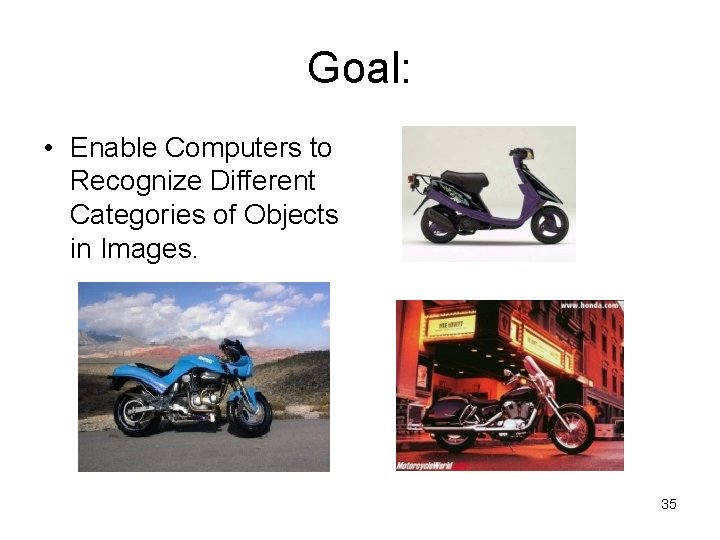
Goal: • Enable Computers to Recognize Different Categories of Objects in Images. 35
36
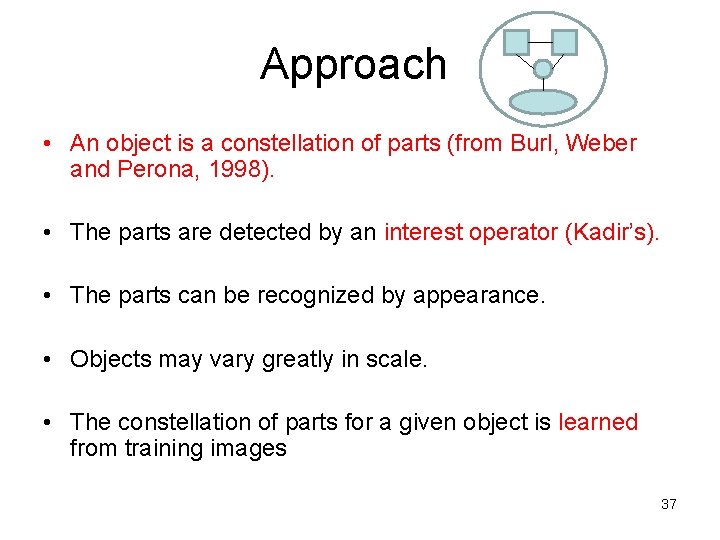
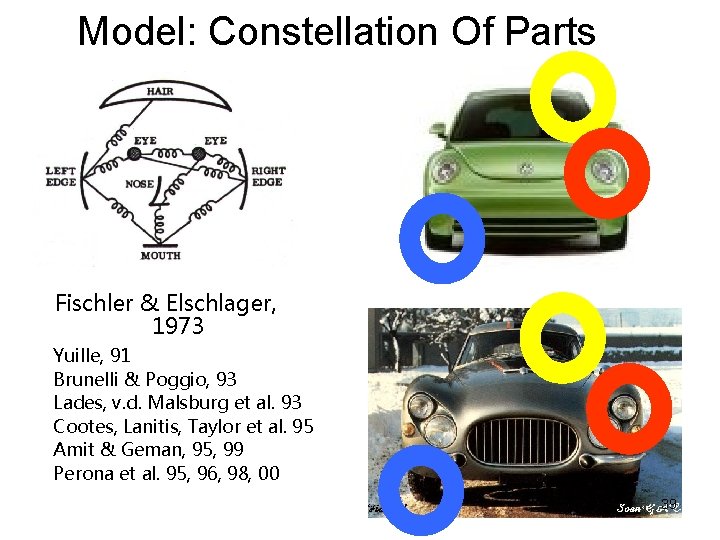
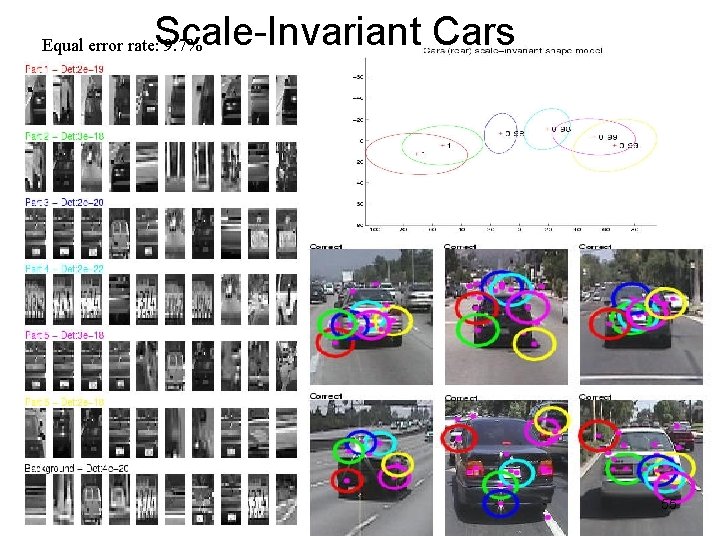
Approach • An object is a constellation of parts (from Burl, Weber and Perona, 1998). • The parts are detected by an interest operator (Kadir’s). • The parts can be recognized by appearance. • Objects may vary greatly in scale. • The constellation of parts for a given object is learned from training images 37
Components • Model – Generative Probabilistic Model including Location, Scale, and Appearance of Parts • Learning – Estimate Parameters Via EM Algorithm • Recognition – Evaluate Image Using Model and Threshold 38
Model: Constellation Of Parts Fischler & Elschlager, 1973 f f f Yuille, 91 Brunelli & Poggio, 93 Lades, v. d. Malsburg et al. 93 Cootes, Lanitis, Taylor et al. 95 Amit & Geman, 95, 99 Perona et al. 95, 96, 98, 00 39
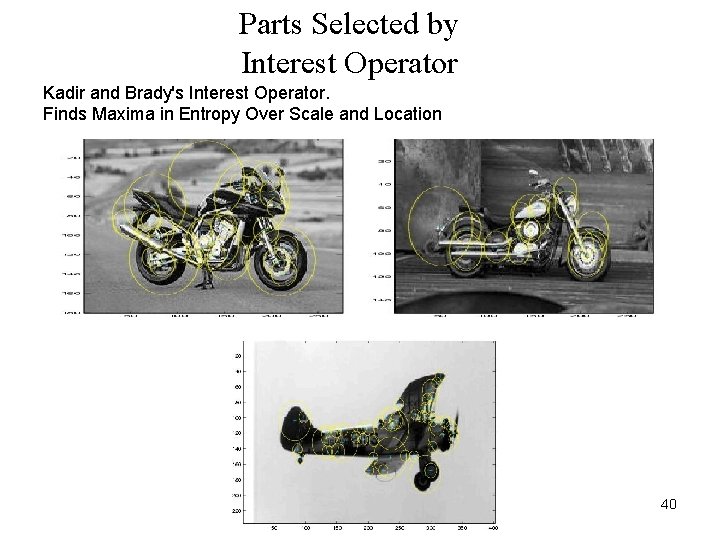
Parts Selected by Interest Operator �adir and Brady's Interest Operator. K �inds Maxima in Entropy Over Scale and Location F 40
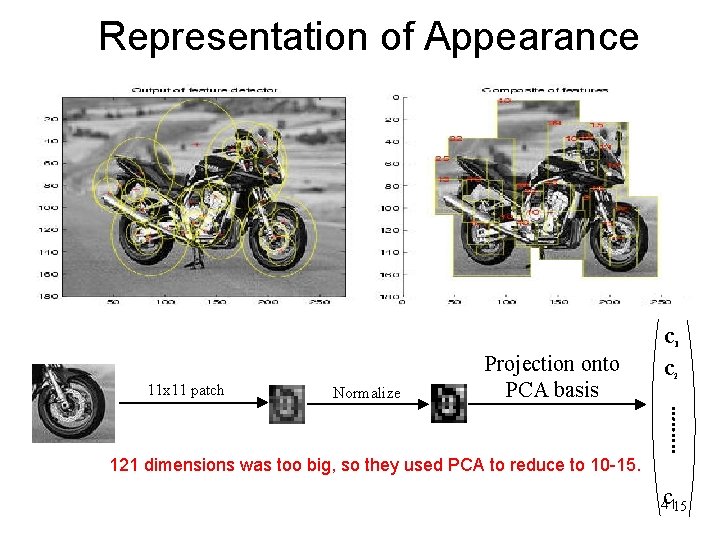
Representation of Appearance 11 x 11 patch Normalize Projection onto PCA basis c c 1 2 121 dimensions was too big, so they used PCA to reduce to 10 -15. c 15 41
Learning a Model • An object class is represented by a generative model with P parts and a set of parameters . • Once the model has been learned, a decision procedure must determine if a new image contains an instance of the object class or not. • Suppose the new image has N interesting features with locations X, scales S and appearances A. 42
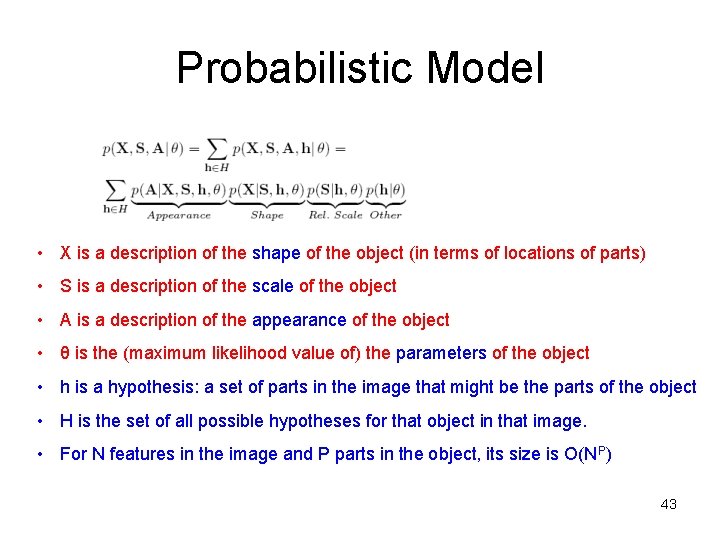
Probabilistic Model • X is a description of the shape of the object (in terms of locations of parts) • S is a description of the scale of the object • A is a description of the appearance of the object • θ is the (maximum likelihood value of) the parameters of the object • h is a hypothesis: a set of parts in the image that might be the parts of the object • H is the set of all possible hypotheses for that object in that image. • For N features in the image and P parts in the object, its size is O(NP) 43
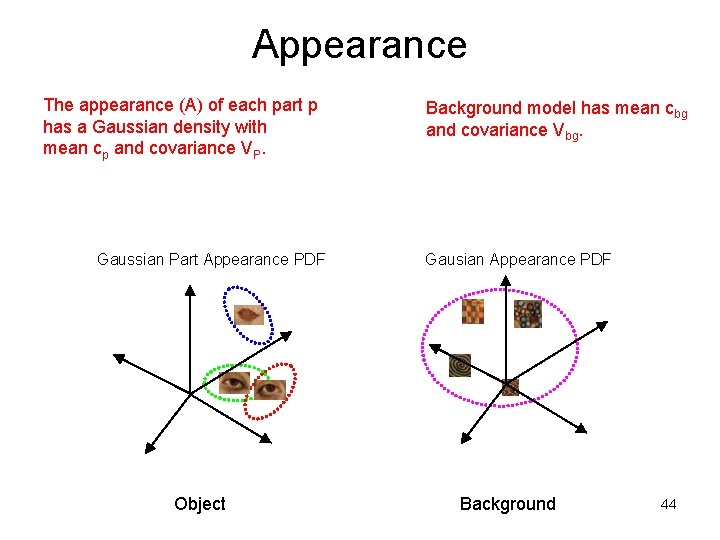
Appearance The appearance (A) of each part p has a Gaussian density with mean cp and covariance VP. Gaussian Part Appearance PDF Object Background model has mean cbg and covariance Vbg. Gausian Appearance PDF Background 44
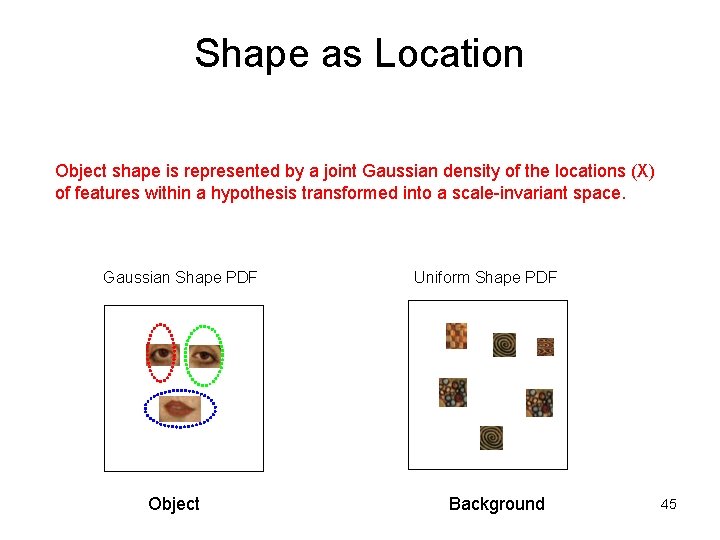
Shape as Location Object shape is represented by a joint Gaussian density of the locations (X) of features within a hypothesis transformed into a scale-invariant space. Gaussian Shape PDF Object Uniform Shape PDF Background 45
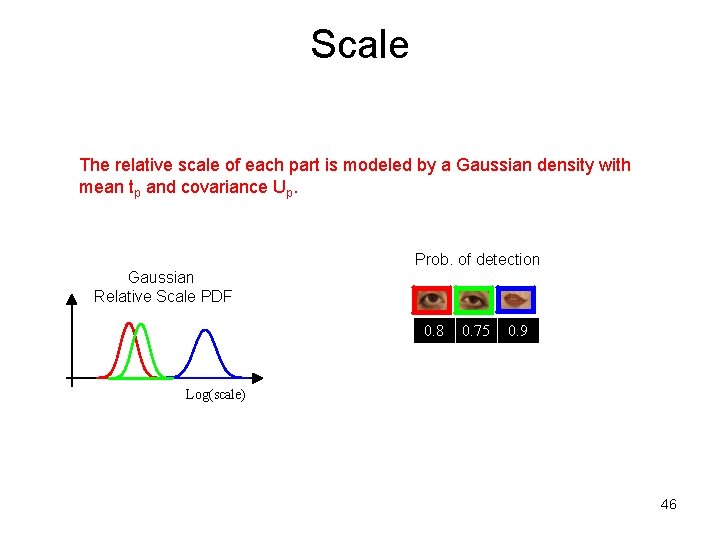
Scale The relative scale of each part is modeled by a Gaussian density with mean tp and covariance Up. Prob. of detection Gaussian Relative Scale PDF 0. 8 0. 75 0. 9 Log(scale) 46
Occlusion and Part Statistics This was very complicated and turned out to not work well and not be necessary, in both Fergus’s work and other subsequent works. 47
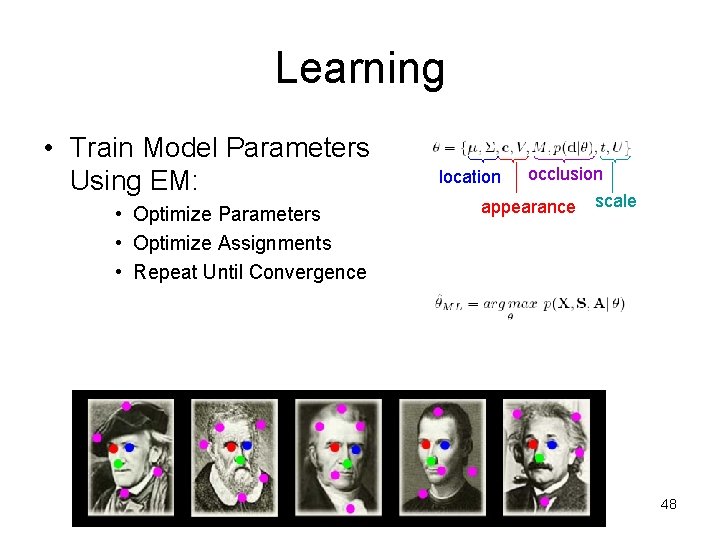
Learning • Train Model Parameters Using EM: • Optimize Parameters • Optimize Assignments • Repeat Until Convergence location occlusion appearance scale 48
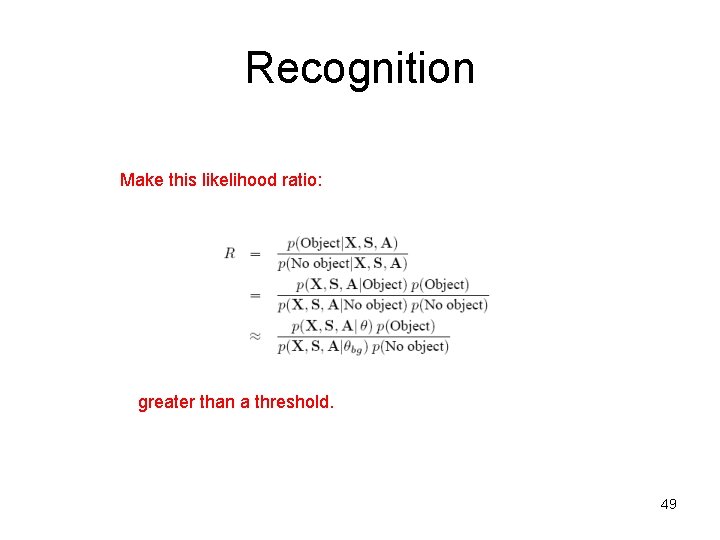
Recognition Make this likelihood ratio: greater than a threshold. 49
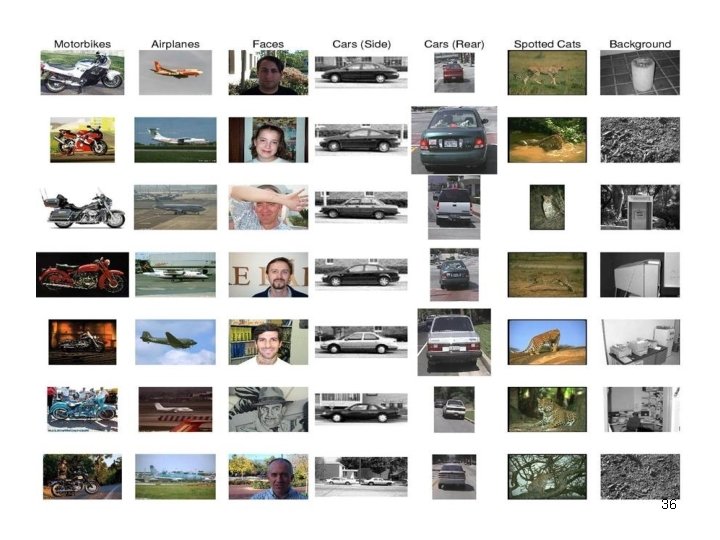
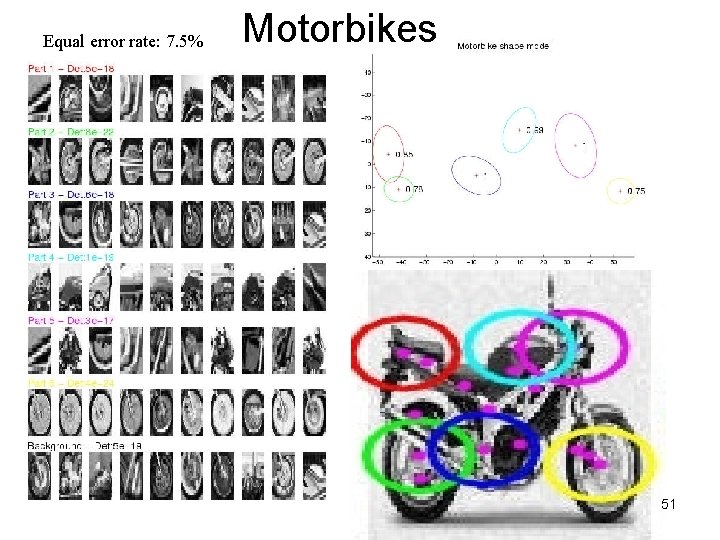
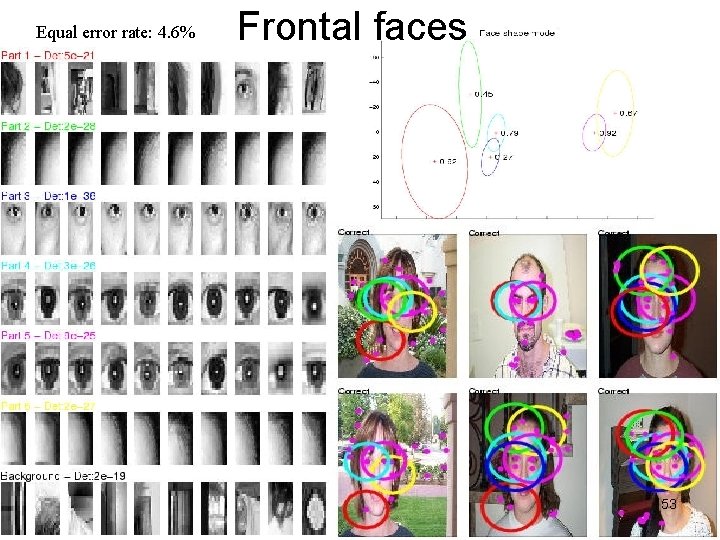
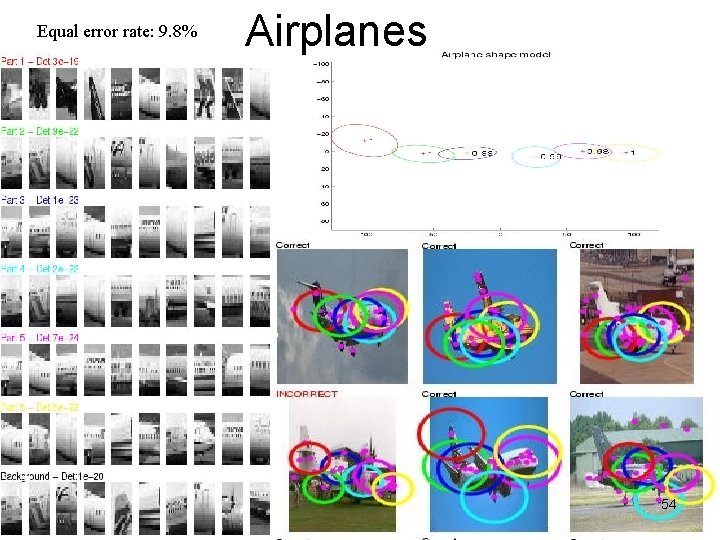
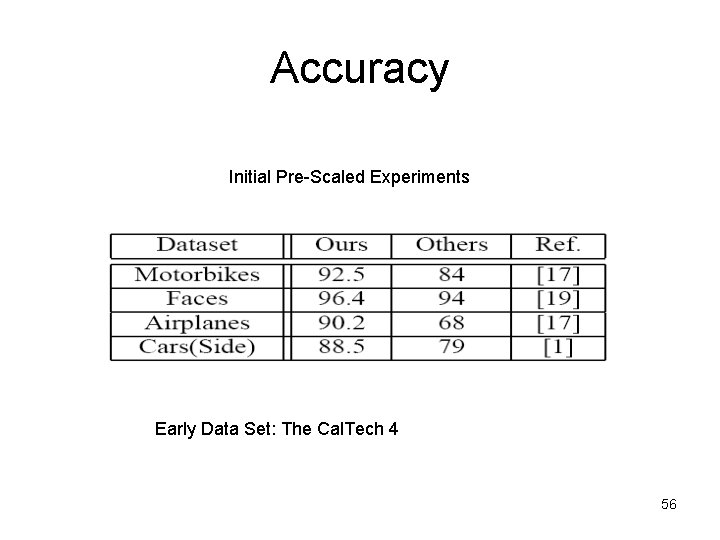
RESULTS • Initially tested on the Caltech-4 data set – motorbikes – faces – airplanes – cars • Now there is a much bigger data set: the Caltech-101 http: //www. vision. caltech. edu/archive. html 50
Equal error rate: 7. 5% Motorbikes 51
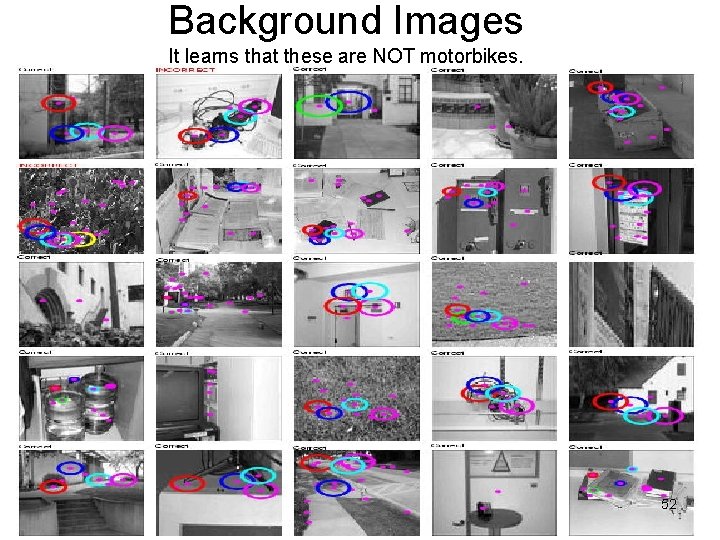
Background Images It learns that these are NOT motorbikes. 52
Equal error rate: 4. 6% Frontal faces 53
Equal error rate: 9. 8% Airplanes 54
Scale-Invariant Cars Equal error rate: 9. 7% 55
Accuracy Initial Pre-Scaled Experiments Early Data Set: The Cal. Tech 4 56
Available Today • Cal. Tech 101 and Caltech 256 • Image. Net • Pascal VOC dataset • CIFAR-10 • MS Coco • Cityscapes https: //analyticsindiamag. com/10 -opendatasets-you-can-use-for-computer-visionprojects/ 57