
Computer Vision Chapter 9 Texture Presented by and
Computer Vision Chapter 9 Texture Presented by 王夏果 and 傅楸善教授 Cell phone: 0937384214 E-mail: r 94922103@ntu. edu. tw Digital Camera and Computer Vision Laboratory Department of Computer Science and Information Engineering National Taiwan University, Taipei, Taiwan, R. O. C.
Introduction l l What does texture mean? Formal approach or precise definition of texture does not exist! Texture discrimination techniques are for the part ad hoc. DC & CV Lab. CSIE NTU
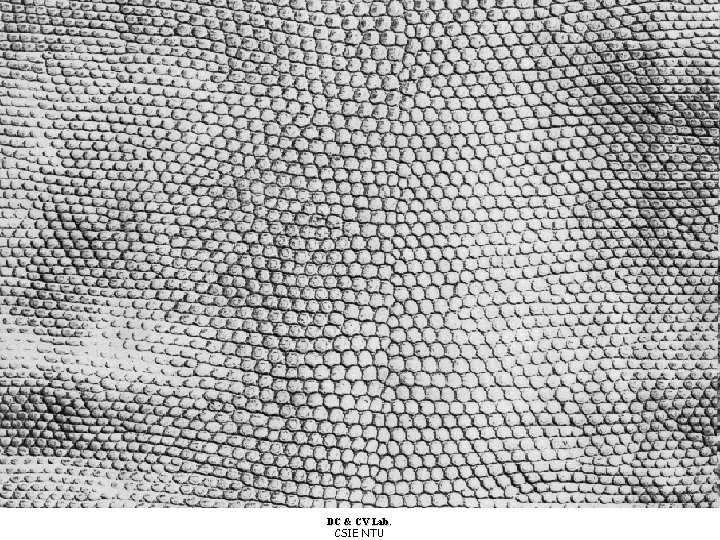
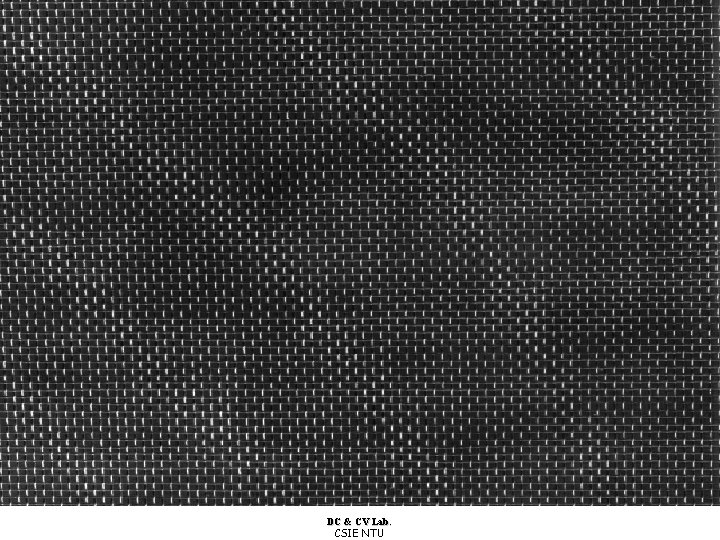
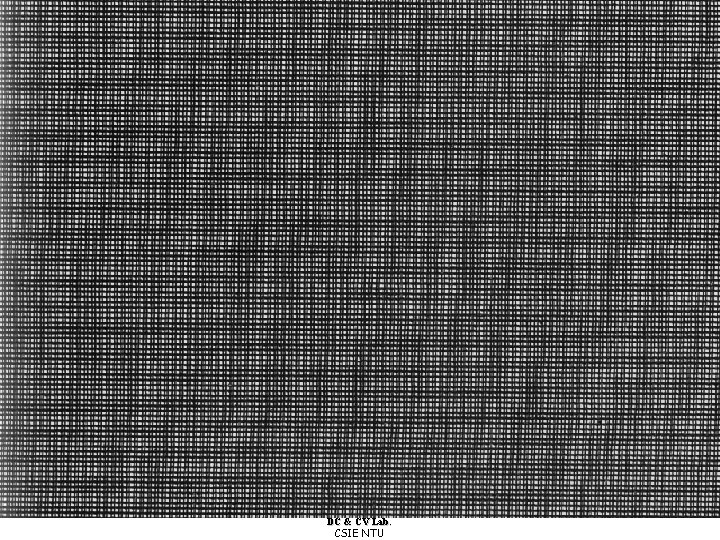
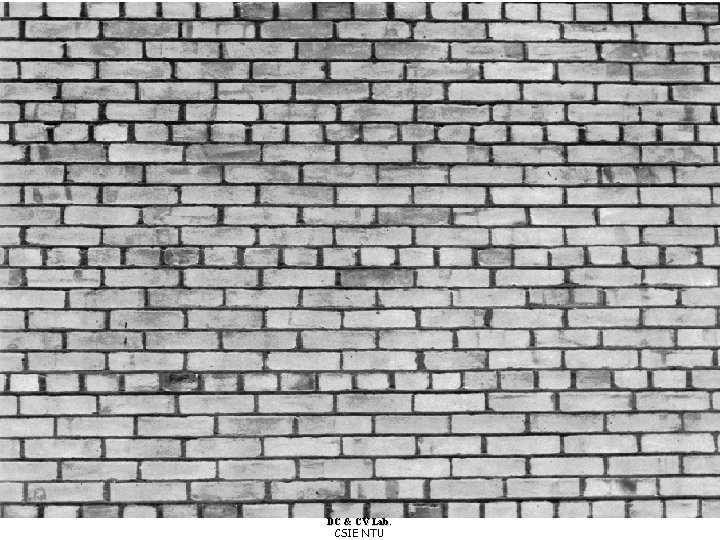
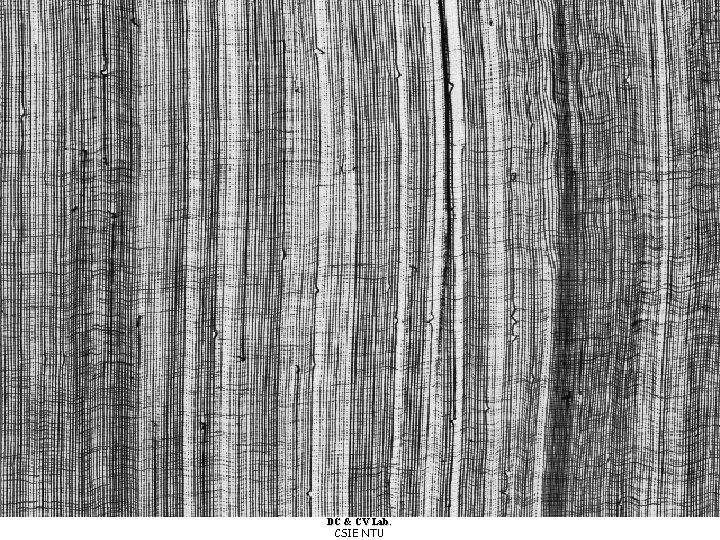
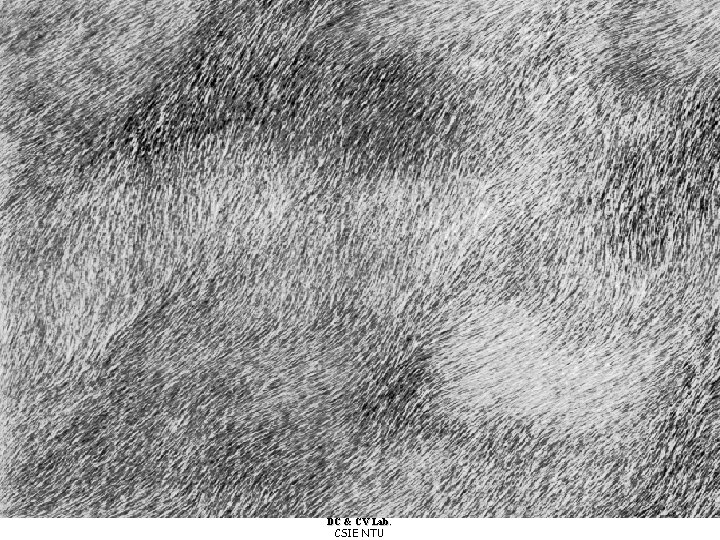
Definition of Texture l l Non-local property, characteristic of region larger than its size Repeating patterns of local variations in image intensity which are too fine to be distinguished as separated objects at the observed resolution DC & CV Lab. CSIE NTU
Definition of Texture (cont. ) l For humans, texture is the abstraction of certain statistical homogeneities from a portion of the visual field that contains a quantity of information grossly in excess of the observer’s perceptual capacity DC & CV Lab. CSIE NTU
DC & CV Lab. CSIE NTU
DC & CV Lab. CSIE NTU
DC & CV Lab. CSIE NTU
DC & CV Lab. CSIE NTU
DC & CV Lab. CSIE NTU
DC & CV Lab. CSIE NTU
Texture Analysis Issues l l l Pattern recognition: given texture region, determine the class the region belongs to Generative model: given textured region, determine a description or model for it Texture segmentation: given image with many textured areas, determine boundaries DC & CV Lab. CSIE NTU
DC & CV Lab. CSIE NTU
Statistical Texture-Feature Approaches l l l l Autocorrelation function Spectral power density function Edgeness per unit area Spatial gray level co-occurrence probabilities Graylevel run-length distributions Relative extrema distributions Mathematical morphology DC & CV Lab. CSIE NTU
Image Texture Analysis l Give a generative model and the values of its parameters, one can synthesize homogeneous image texture samples associated with the model and the given value of its parameters. DC & CV Lab. CSIE NTU
Image Texture Analysis (cont. ) l l Verification: verify given image textures sample consistent with model Estimation: estimate values of model parameters based on observed sample examples of model-based techniques DC & CV Lab. CSIE NTU
Some Model-Based Techniques l l l Autoregressive, moving-average, time-series models (extended to 2 D) Markov random fields Mosaic models DC & CV Lab. CSIE NTU
Texel l Texture element, basic textural unit of some textural primitives qualitatively evaluated image texture properties DC & CV Lab. CSIE NTU
Some Texture Features l l l l Fineness Coarseness Contrast Directionality Roughness Regularity Smoothness Granulation DC & CV Lab. CSIE NTU
Some Texture Features (cont. ) l l l Randomness Lineation Mottled Irregular Hummocky DC & CV Lab. CSIE NTU

Take a Break DC & CV Lab. CSIE NTU
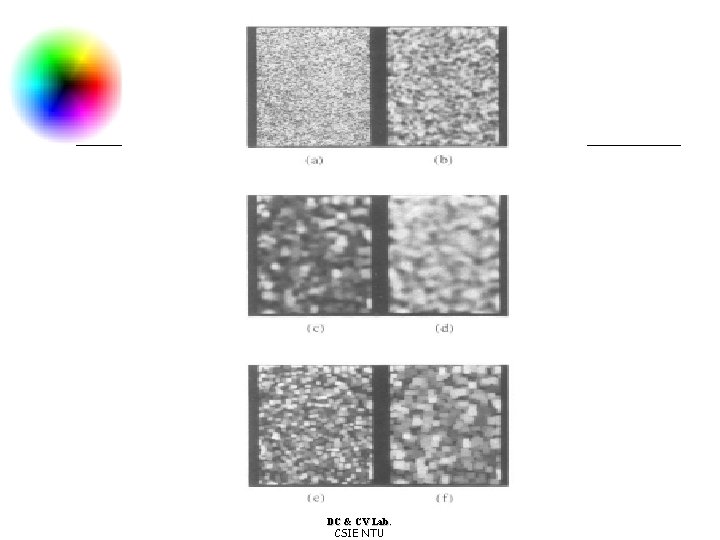
Texture and Scale l l For any textural surface, there exists a scale at which, when the surface is examined, it appears smooth and textureless. (see from infinite distance) As resolution increases, the surfaces appears as a fine texture and then a coarse one, and for multiple-scale textural surface the cycle of smooth, fine, and coarse may repeat. DC & CV Lab. CSIE NTU
Texture and Scale (cont. ) l l Thus, texture cannot be analyzed without frame of reference on scale or resolution. Texture is a scale-dependent phenomenon. DC & CV Lab. CSIE NTU
DC & CV Lab. CSIE NTU
Characterizing Texture l l Characterize gray level primitive properties Characterize spatial relationships between them DC & CV Lab. CSIE NTU
First-Order Gray-Level Statistics l l Statistics of single pixels E. g. Histogram, mean, median, variance DC & CV Lab. CSIE NTU
Second-Order Gray-Level Statistics l l l The combined statistics of gray levels of pairs of pixels in which each two pixels in a pair have a fixed relative position E. g. co-occurrence Gray level spatial dependence: characterize texture by co-occurrence DC & CV Lab. CSIE NTU
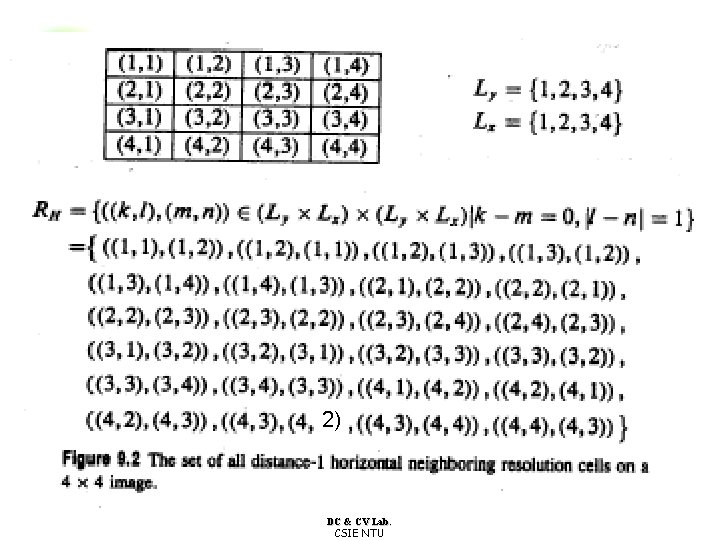
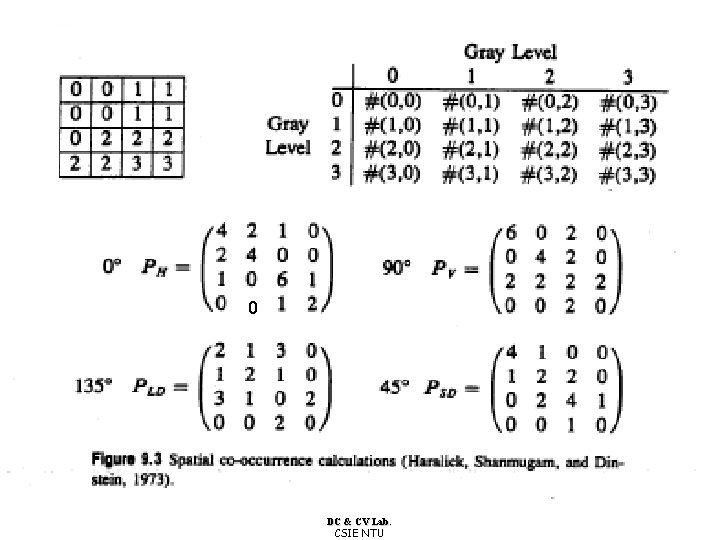
Co-Occurrence Matrix l l l The gray level co-occurrence can be specified in a matrix of relative frequencies Pij with which two neighboring pixels separated by distance d occur on the image, one with gray level i and the other with gray level j Symmetric matrix Function of angle and distance between pixels DC & CV Lab. CSIE NTU
2) DC & CV Lab. CSIE NTU
Co-Occurrence Matrix (cont. ) l Probability of horizontal, d pixels apart pixels P(i, j, d, 0°) = #{[(k, l), (m, n)] | k-m = 0, |l-n| = d, I(k, l) = i, I(m, n) = j} l Probability of 45°, d pixels apart pixels P(i, j, d, 45°) = #{[(k, l), (m, n)] | (k-m = d, l-n = -d) or (k-m = -d, l-n = d), I(k, l) = i, I(m, n) = j} DC & CV Lab. CSIE NTU
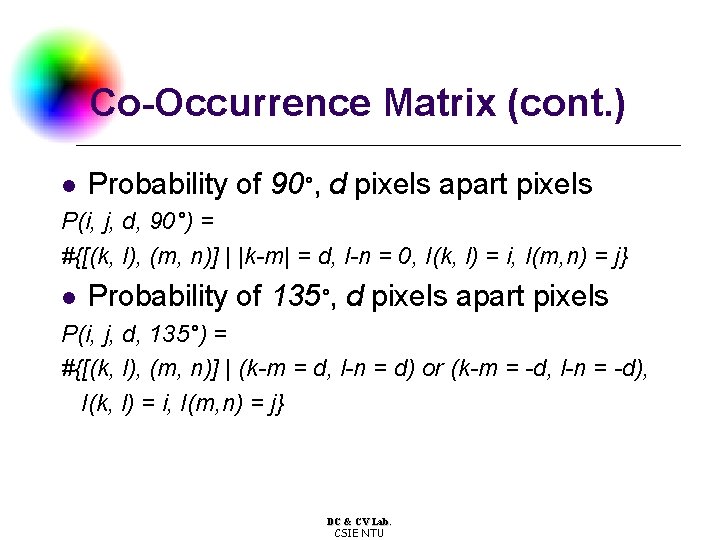
Co-Occurrence Matrix (cont. ) l Probability of 90°, d pixels apart pixels P(i, j, d, 90°) = #{[(k, l), (m, n)] | |k-m| = d, l-n = 0, I(k, l) = i, I(m, n) = j} l Probability of 135°, d pixels apart pixels P(i, j, d, 135°) = #{[(k, l), (m, n)] | (k-m = d, l-n = d) or (k-m = -d, l-n = -d), I(k, l) = i, I(m, n) = j} DC & CV Lab. CSIE NTU
0 DC & CV Lab. CSIE NTU
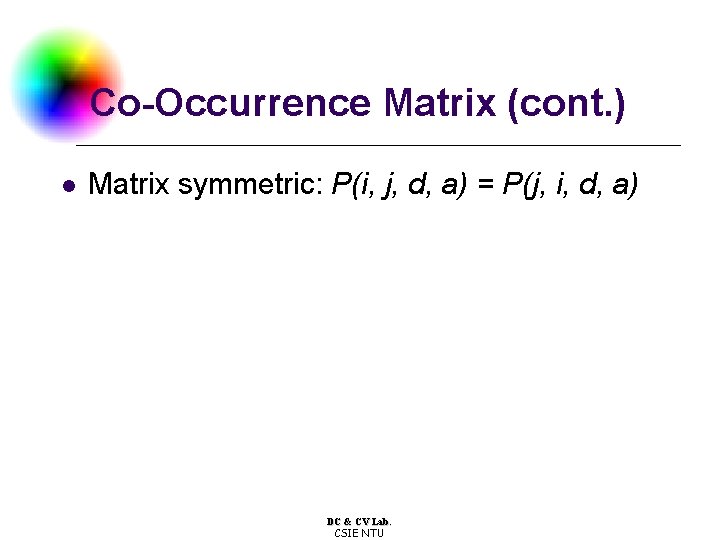
Co-Occurrence Matrix (cont. ) l Matrix symmetric: P(i, j, d, a) = P(j, i, d, a) DC & CV Lab. CSIE NTU

Take a Break DC & CV Lab. CSIE NTU
DC & CV Lab. CSIE NTU
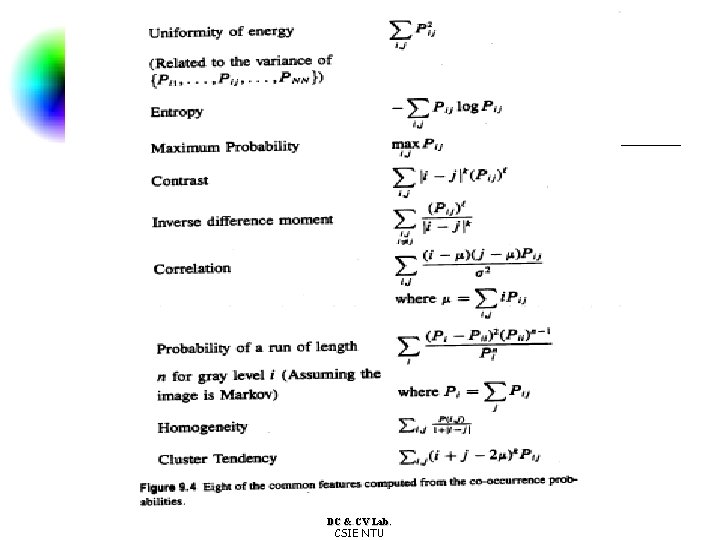
Matrix with Highest Entropy l l When all entries in Pij are equal Image where no preferred gray-level pairs exist features calculated from the cooccurrence matrix DC & CV Lab. CSIE NTU
Generalized Gray Level Spatial Dependence Models for Texture l Simple generalization: consider more than two pixels at a time DC & CV Lab. CSIE NTU
Generalized Co-Occurrence l Strong texture measures take into account the co-occurrence between texture primitives. DC & CV Lab. CSIE NTU
Texture Primitive l l l Connected set of pixels characterized by attribute set Simplest primitive: pixel with gray level attribute More complicated primitive: connected set of pixels homogeneous in level, characterized by size, elongation, orientation, and average gray level DC & CV Lab. CSIE NTU
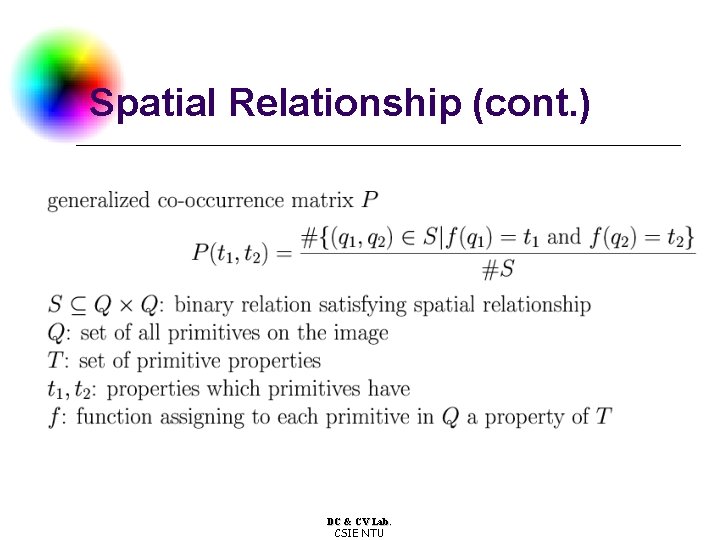
Spatial Relationship l We have a list of primitives, their center coordinate, and their attributes after the primitives have been constructed. DC & CV Lab. CSIE NTU
Spatial Relationship (cont. ) DC & CV Lab. CSIE NTU
Autocorrelation Function l l l Texture relates to the spatial size of the gray level primitives on an image Gray level primitives of larger size are indicative of coarser texture Gray level primitives of smaller size are indicative of finer texture DC & CV Lab. CSIE NTU
Autocorrelation Function (cont. ) l Autocorrelation function describes the size of gray level primitives DC & CV Lab. CSIE NTU
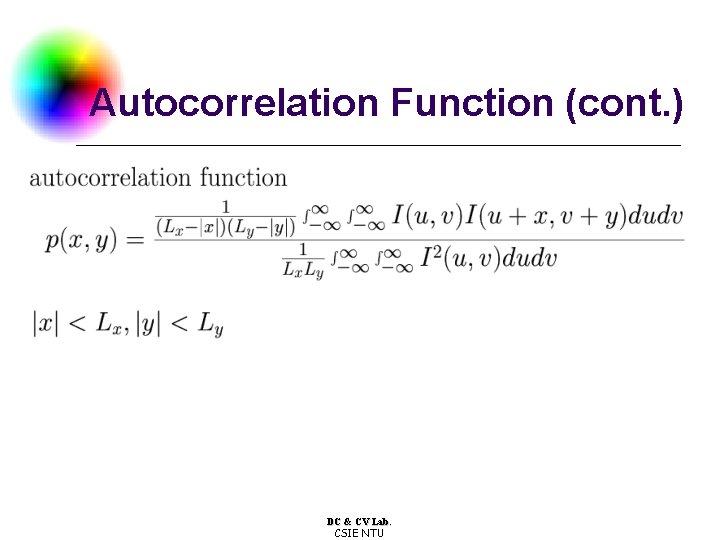
Autocorrelation Function (cont. ) DC & CV Lab. CSIE NTU
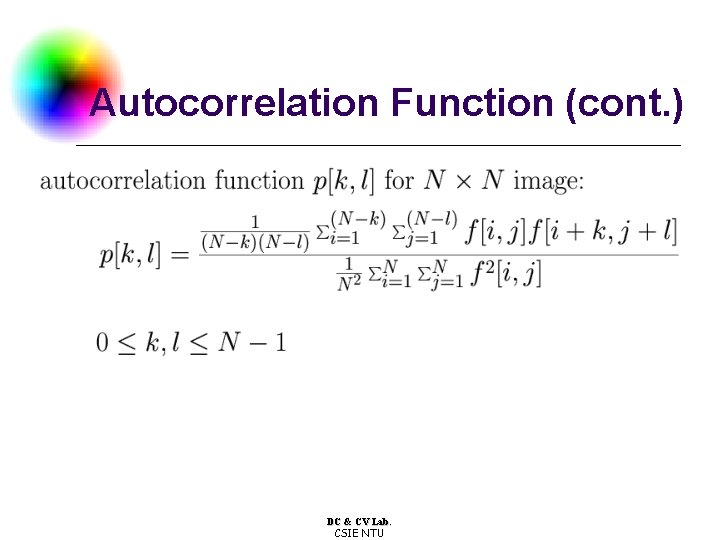
Autocorrelation Function (cont. ) DC & CV Lab. CSIE NTU
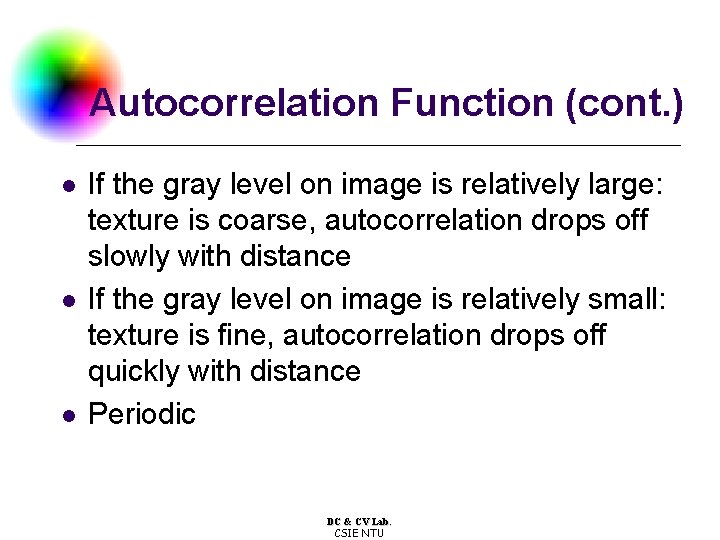
Autocorrelation Function (cont. ) l l l If the gray level on image is relatively large: texture is coarse, autocorrelation drops off slowly with distance If the gray level on image is relatively small: texture is fine, autocorrelation drops off quickly with distance Periodic DC & CV Lab. CSIE NTU

Take a Break DC & CV Lab. CSIE NTU
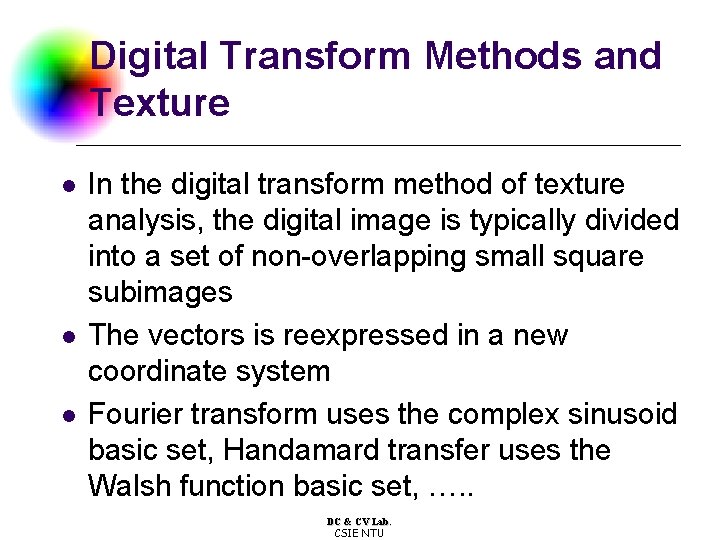
Digital Transform Methods and Texture l l l In the digital transform method of texture analysis, the digital image is typically divided into a set of non-overlapping small square subimages The vectors is reexpressed in a new coordinate system Fourier transform uses the complex sinusoid basic set, Handamard transfer uses the Walsh function basic set, …. . DC & CV Lab. CSIE NTU
Texture Energy l l The image is first convolved with a variety of kernels Then each convolved image is processed with a nonlinear operator to determine the total textural energy in each pixel’s neighborhood DC & CV Lab. CSIE NTU
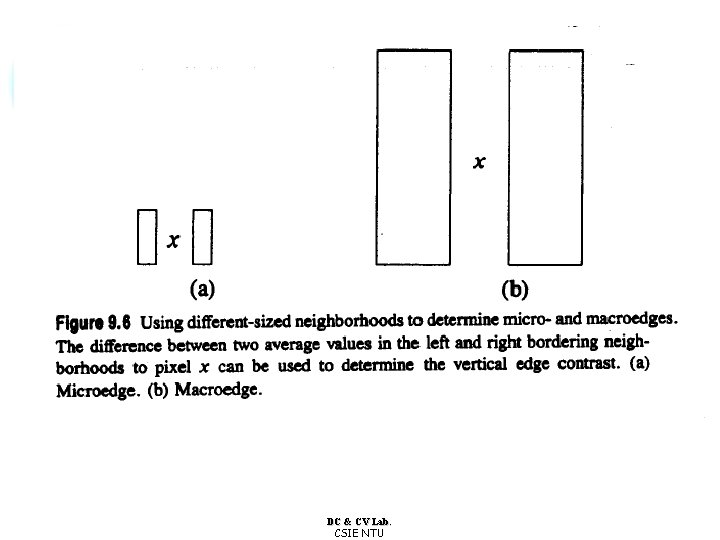
Texture Edgeness l l Autocorrelation function and digital transform both reference texture to spatial frequency Texture Edgeness: conceive texture in terms of edgeness per unit area DC & CV Lab. CSIE NTU
Texture Edgeness (cont. ) l l Use small neighborhood to detect microedge Use large neighborhood to detect macroedge DC & CV Lab. CSIE NTU
DC & CV Lab. CSIE NTU
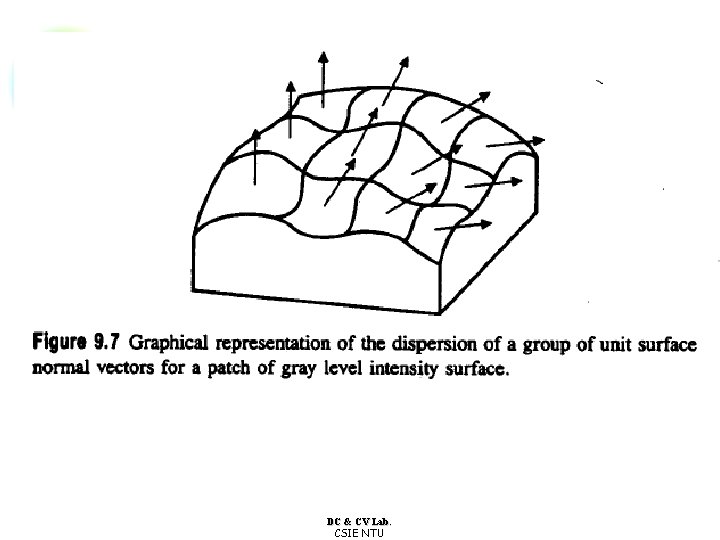
Vector Dispersion l l Divide the texture into mutually exclusive neighborhoods A sloped plane fit to the gray levels is performed for each neighborhood DC & CV Lab. CSIE NTU
DC & CV Lab. CSIE NTU
Relative Extrema Density l l Count the number of extrema per unit area for a texture measure One dimension, along a horizontal scan DC & CV Lab. CSIE NTU
Relative Extrema Density (cont. ) Relative minimum: g(i) ≦ g(i+1) and g(i) ≦ g(i-1) l Relative maximum: g(i) ≧ g(i+1) and g(i) ≧ g(i-1) l Pixels in a constant run: both minimum and maximum l Center a square window around each pixel, and count the number of extrema pixels l DC & CV Lab. CSIE NTU
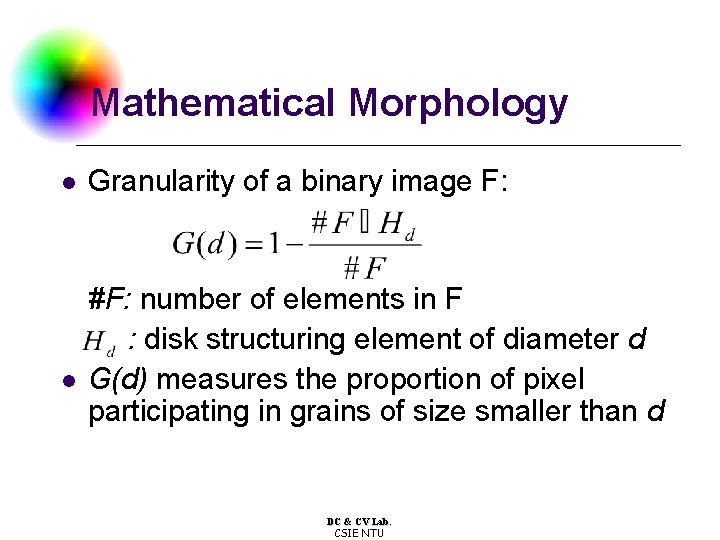
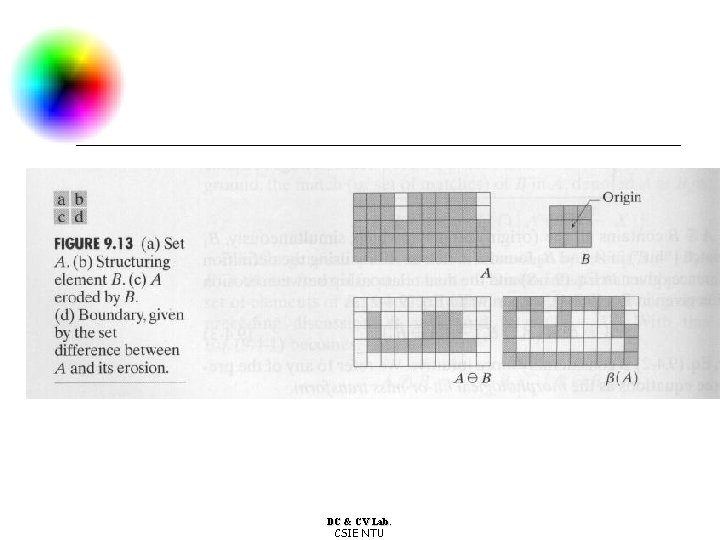
Mathematical Morphology l l Granularity of a binary image F: #F: number of elements in F : disk structuring element of diameter d G(d) measures the proportion of pixel participating in grains of size smaller than d DC & CV Lab. CSIE NTU
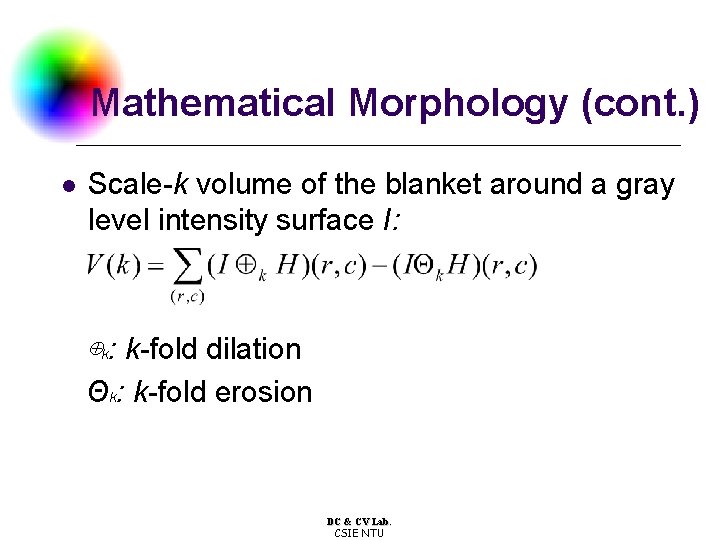
Mathematical Morphology (cont. ) l Scale-k volume of the blanket around a gray level intensity surface I: ⊕k: k-fold dilation Θk: k-fold erosion DC & CV Lab. CSIE NTU
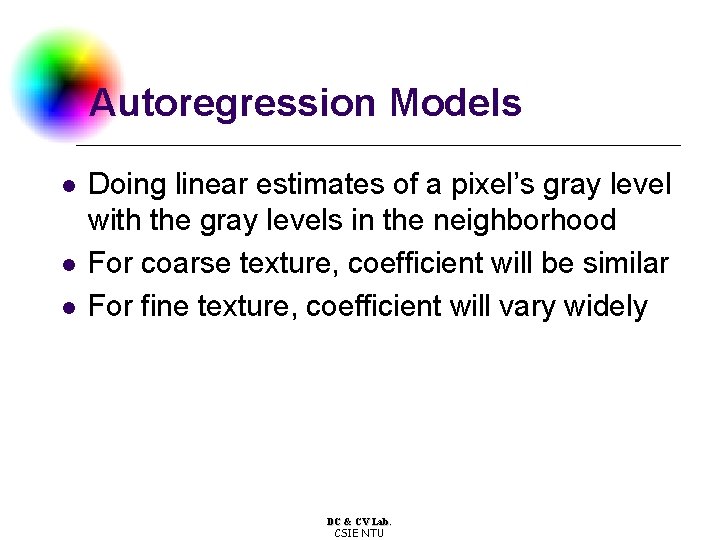
Autoregression Models l l l Doing linear estimates of a pixel’s gray level with the gray levels in the neighborhood For coarse texture, coefficient will be similar For fine texture, coefficient will vary widely DC & CV Lab. CSIE NTU
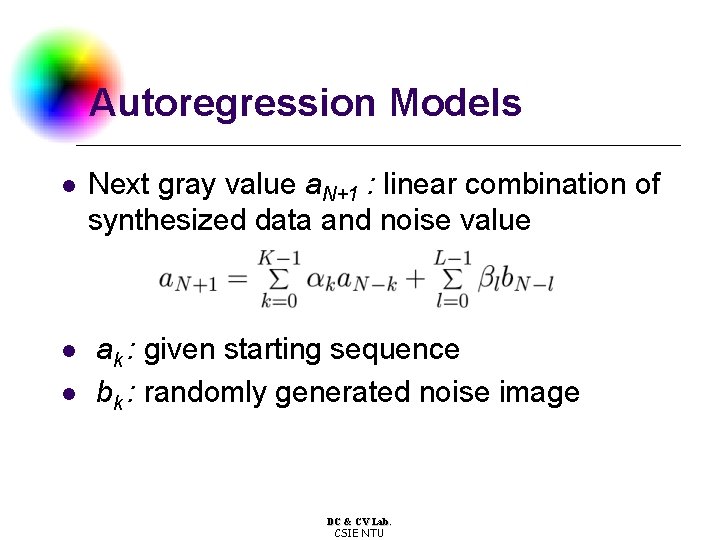
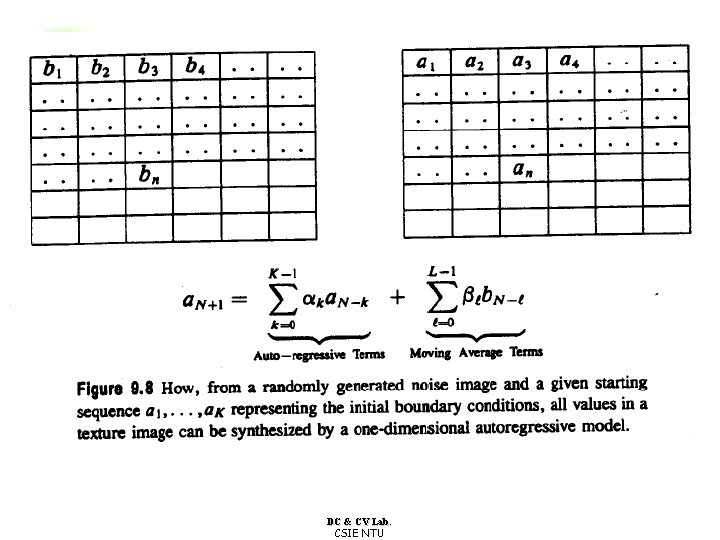
Autoregression Models l l l Next gray value a. N+1 : linear combination of synthesized data and noise value ak : given starting sequence bk : randomly generated noise image DC & CV Lab. CSIE NTU
DC & CV Lab. CSIE NTU
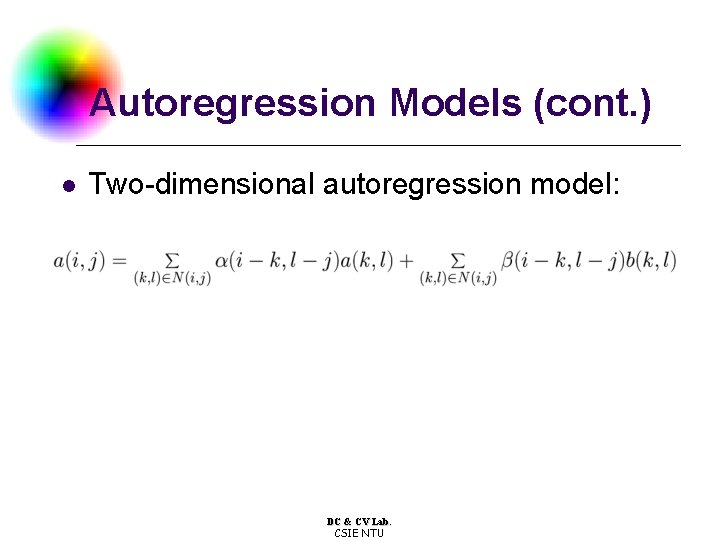
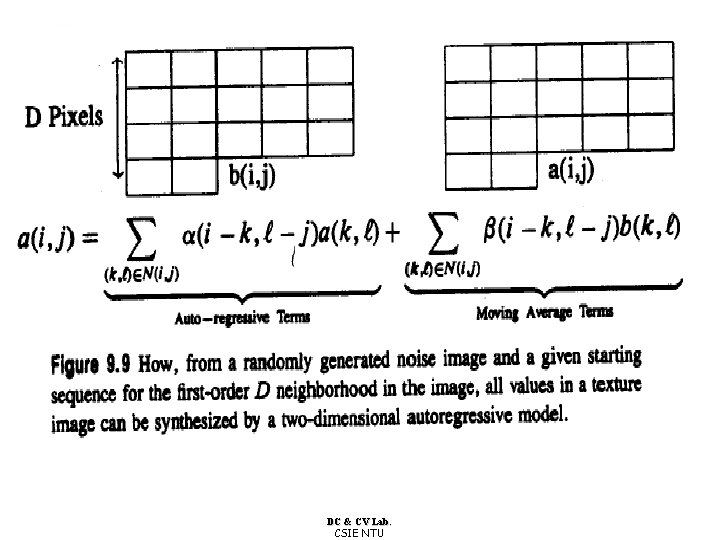
Autoregression Models (cont. ) l Two-dimensional autoregression model: DC & CV Lab. CSIE NTU
DC & CV Lab. CSIE NTU
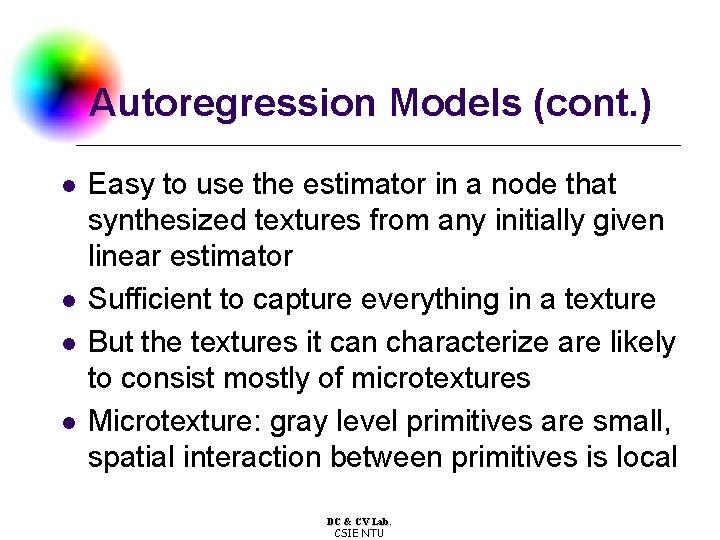
Autoregression Models (cont. ) l l Easy to use the estimator in a node that synthesized textures from any initially given linear estimator Sufficient to capture everything in a texture But the textures it can characterize are likely to consist mostly of microtextures Microtexture: gray level primitives are small, spatial interaction between primitives is local DC & CV Lab. CSIE NTU

Take a Break DC & CV Lab. CSIE NTU
Discrete Markov Random Fields l l Assumption: the texture field is stochastic and stationary and satisfies a conditional independence assumption When the distributions are Gaussian, each pixel’s value is a combination of the value in its neighborhood plus a noise term DC & CV Lab. CSIE NTU
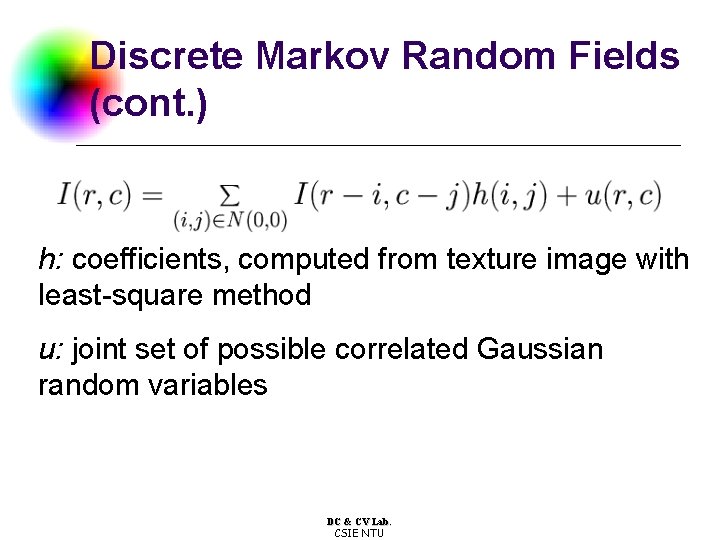
Discrete Markov Random Fields (cont. ) h: coefficients, computed from texture image with least-square method u: joint set of possible correlated Gaussian random variables DC & CV Lab. CSIE NTU
Random Mosaic Models l Constructing steps: 1. Provide a mean of tessellating a plane into cells 2. Assign a property value to each cell DC & CV Lab. CSIE NTU
Structural Approaches to Texture Models l l Pure structural model: primitives in regular repetitive spatial arrangements To describe the texture, describe the primitives and the placement rules DC & CV Lab. CSIE NTU
Texture Segmentation l Each region has homogeneous texture, and each pair of adjacent regions is differently textured DC & CV Lab. CSIE NTU
Synthetic Texture Image Generation l l Fractals: shapes that exhibit recursive selfsimilarity Every fractal can be recursively subdivided into smaller non-overlapping shapes, each of which is a scale-down version of the whole, either in a deterministic sense or in a statistical sense DC & CV Lab. CSIE NTU
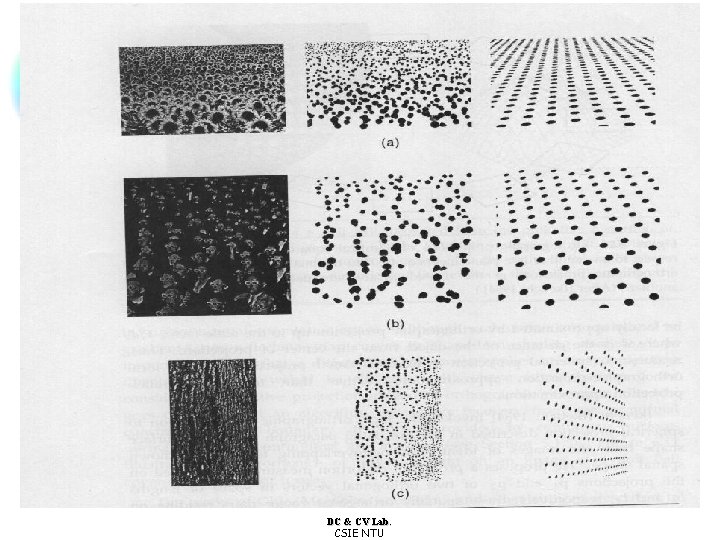
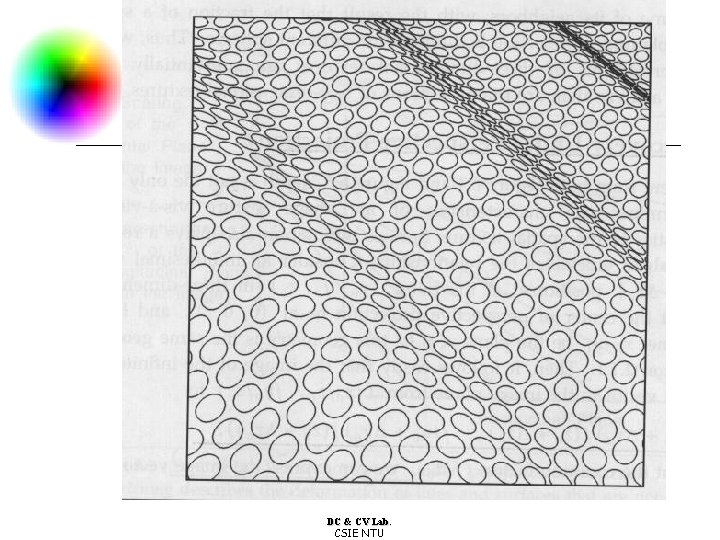
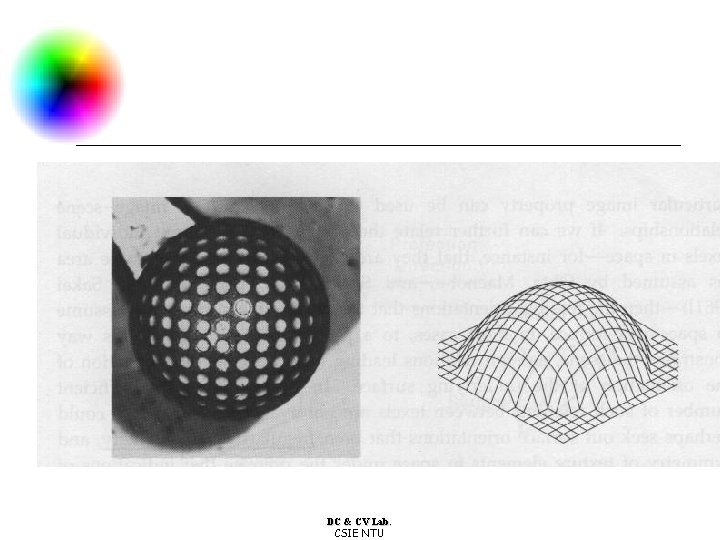
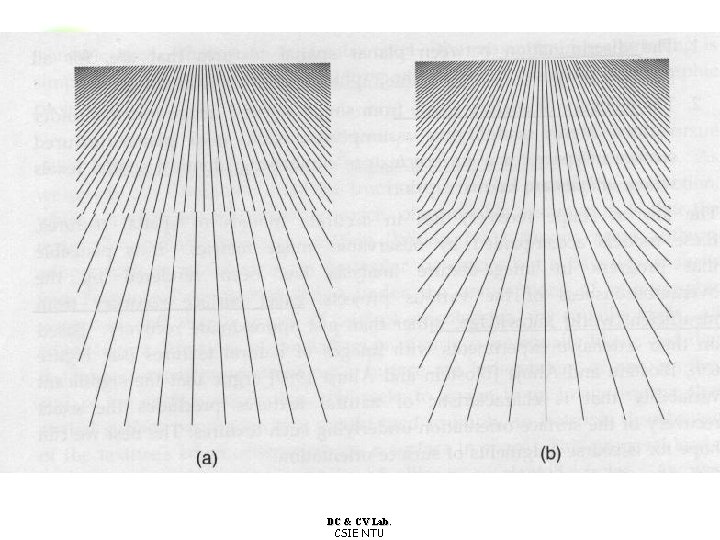
Shape from Texture l l Use image texture gradients to estimate surface orientation of the observed 3 D object Assumption: no depth changes and no texture changes in observed texture area, and no subtextures DC & CV Lab. CSIE NTU
DC & CV Lab. CSIE NTU
DC & CV Lab. CSIE NTU
DC & CV Lab. CSIE NTU
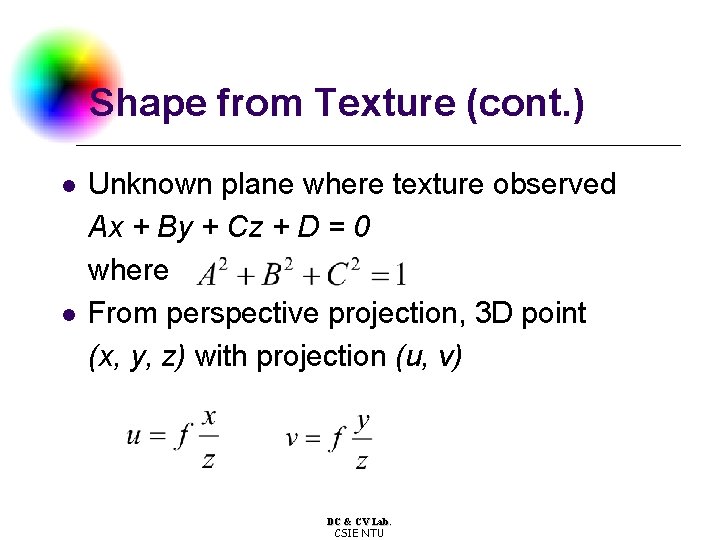
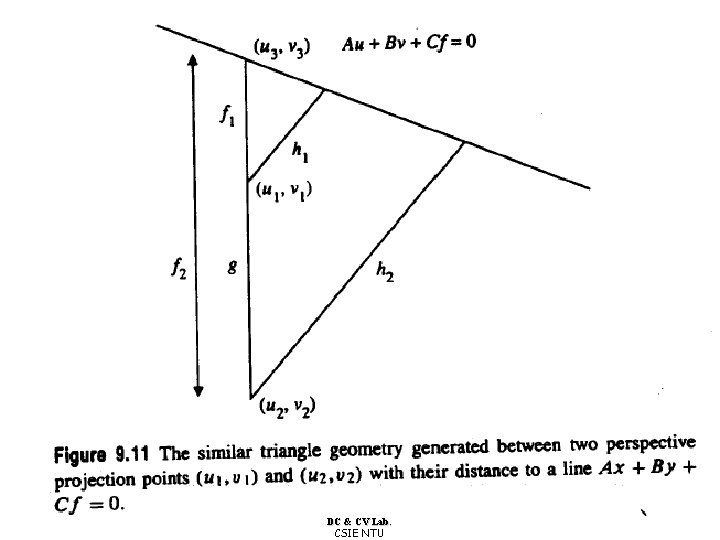
Shape from Texture (cont. ) l l Unknown plane where texture observed Ax + By + Cz + D = 0 where From perspective projection, 3 D point (x, y, z) with projection (u, v) DC & CV Lab. CSIE NTU
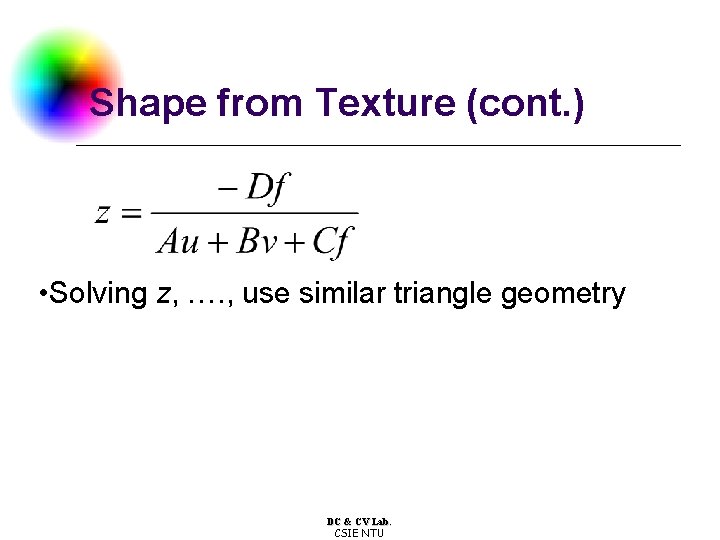
Shape from Texture (cont. ) • Solving z, …. , use similar triangle geometry DC & CV Lab. CSIE NTU
DC & CV Lab. CSIE NTU
DC & CV Lab. CSIE NTU
Summary l l l Texture: in terms of primitives and spatial relationships Qualitatively, shape from texture can work Quantitatively, the techniques are generally not dependable DC & CV Lab. CSIE NTU
- Slides: 79