
Computer Vision applied to Dengues Larvae Death Rate

- Slides: 11
Computer Vision applied to Dengue’s Larvae Death Rate Calculation Preliminary Results SOUZA, K. P. ; QUEIROZ, J. H. F. S; PISTORI, H.
Introduction Main task Development of more effective larvicides to combat Dengue’s transmitter mosquito. Requirements Many experiments with different substances Lab tests, such as larvae death rate (human task) Problem Errors due to human limitations during analysis can reduce results quality (e. g. exhaustion, subjectivity, and inaccuracy) Proposal LARVIC: Computer vision application for larvae counting
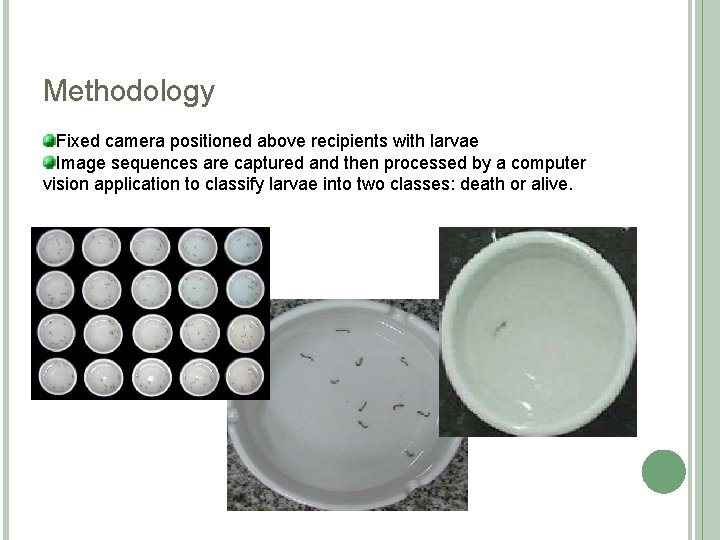
Methodology Fixed camera positioned above recipients with larvae Image sequences are captured and then processed by a computer vision application to classify larvae into two classes: death or alive.
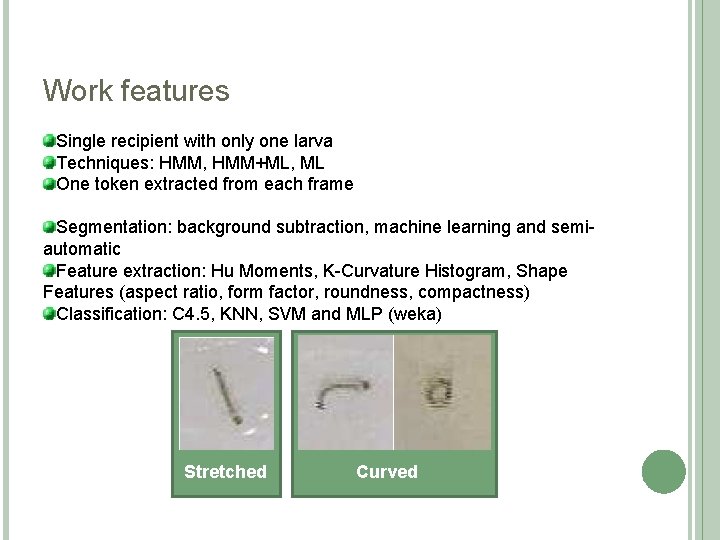
Work features Single recipient with only one larva Techniques: HMM, HMM+ML, ML One token extracted from each frame Segmentation: background subtraction, machine learning and semiautomatic Feature extraction: Hu Moments, K-Curvature Histogram, Shape Features (aspect ratio, form factor, roundness, compactness) Classification: C 4. 5, KNN, SVM and MLP (weka) Stretched Curved
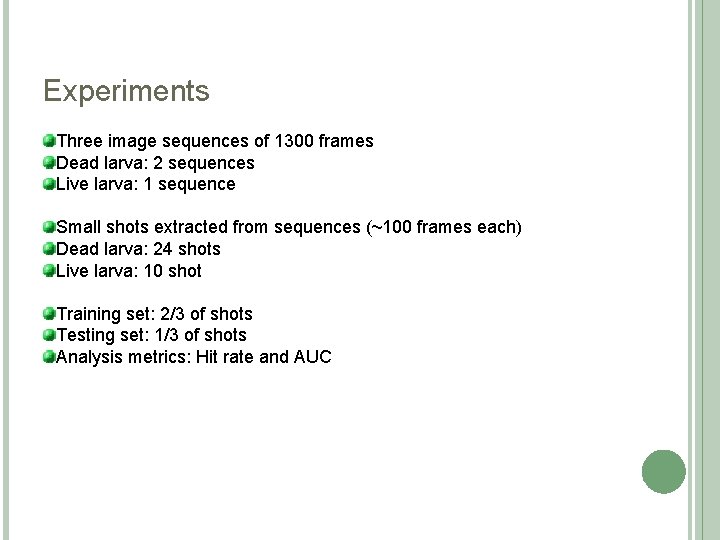
Experiments Three image sequences of 1300 frames Dead larva: 2 sequences Live larva: 1 sequence Small shots extracted from sequences (~100 frames each) Dead larva: 24 shots Live larva: 10 shot Training set: 2/3 of shots Testing set: 1/3 of shots Analysis metrics: Hit rate and AUC
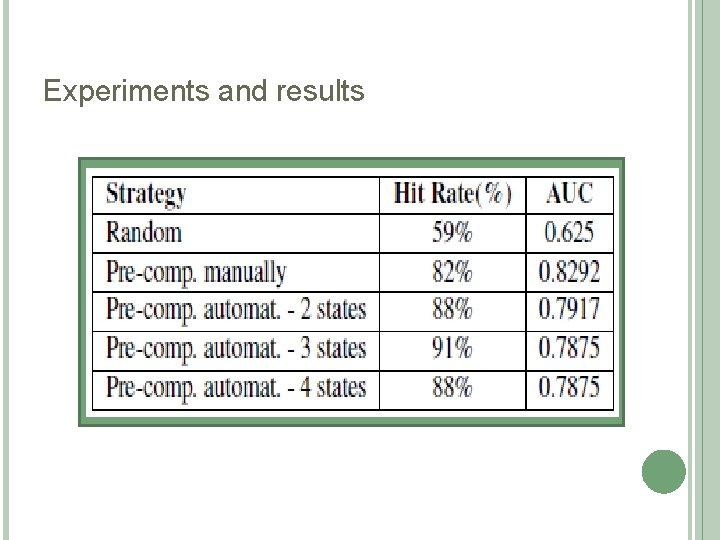
Experiments and results
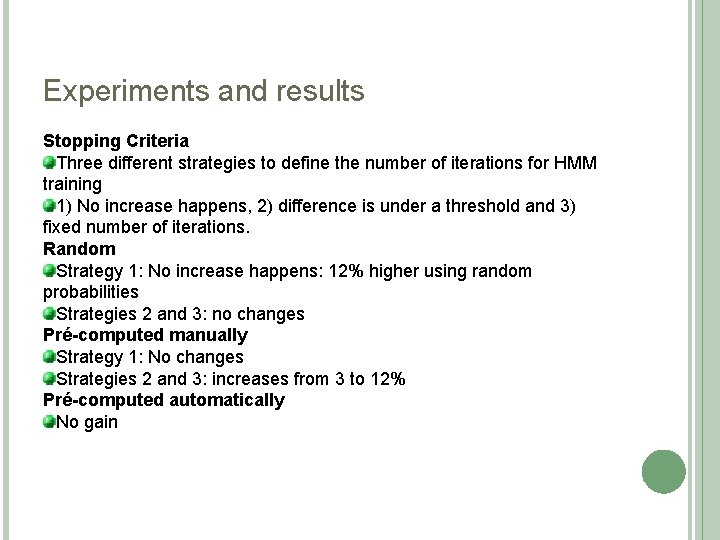
Experiments and results Stopping Criteria Three different strategies to define the number of iterations for HMM training 1) No increase happens, 2) difference is under a threshold and 3) fixed number of iterations. Random Strategy 1: No increase happens: 12% higher using random probabilities Strategies 2 and 3: no changes Pré-computed manually Strategy 1: No changes Strategies 2 and 3: increases from 3 to 12% Pré-computed automatically No gain
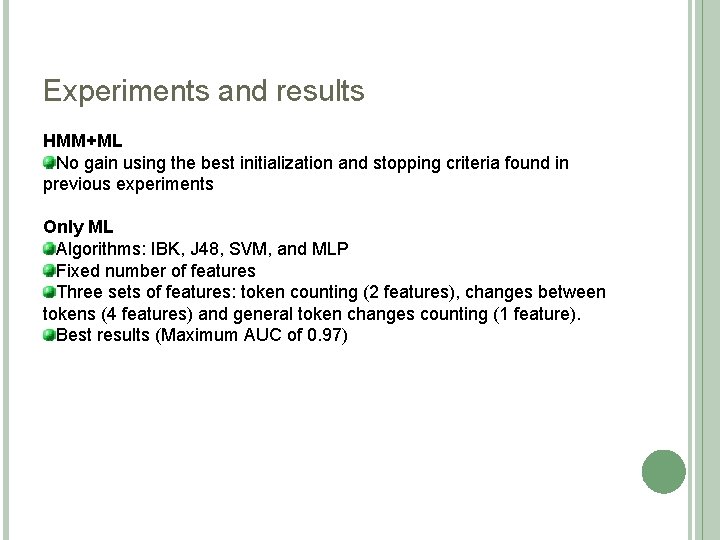
Experiments and results HMM+ML No gain using the best initialization and stopping criteria found in previous experiments Only ML Algorithms: IBK, J 48, SVM, and MLP Fixed number of features Three sets of features: token counting (2 features), changes between tokens (4 features) and general token changes counting (1 feature). Best results (Maximum AUC of 0. 97)
Conclusions Pre-computed initial probabilities obtained better results than random probabilities. Manually (onerous) and automatically pre-computed initial probabilities obtained close results. Considering computational cost, low fixed number of iterations was appropriate for training in this application. No improving detected with combined classifiers. HMM performance was lower than some “vector features” classifiers performances.
Future work Analysis of larger sets of different samples of live and dead larvae Use of other algorithms for training HMM’s Analysis of classifiers based on machine learning algorithms with different patterns
Agradecimentos UCDB FUNDECT CNPQ CAPES CPP MAIS INFORMAÇÕES: www. gpec. ucdb. br/inovisao l