
Computer Systems Architecture Data And Program Representation School

- Slides: 58
Computer Systems Architecture Data And Program Representation School of Computer Science G 51 CSA 1
Digital Logic v. Built on two-valued logic system v. Can be interpreted as v– Five volts and zero volts v– High and low v– True and false School of Computer Science G 51 CSA 2
Data Representation v. Builds on digital logic v. Applies familiar abstractions v. Interprets sets of Boolean values as v– Numbers v– Characters v– Addresses School of Computer Science G 51 CSA 3
Binary Digit (Bit) v. Direct representation of digital logic values v. Assigned mathematical interpretation v 0 and 1 v. Multiple bits used to represent complex data item School of Computer Science G 51 CSA 4
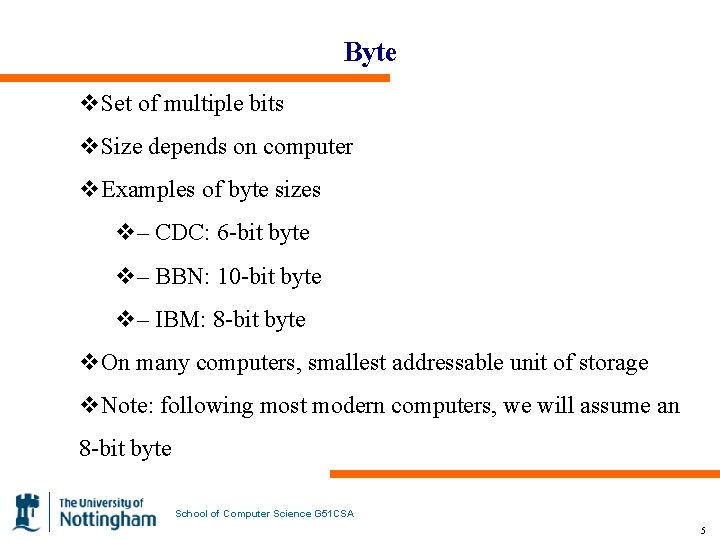
Byte v. Set of multiple bits v. Size depends on computer v. Examples of byte sizes v– CDC: 6 -bit byte v– BBN: 10 -bit byte v– IBM: 8 -bit byte v. On many computers, smallest addressable unit of storage v. Note: following most modern computers, we will assume an 8 -bit byte School of Computer Science G 51 CSA 5
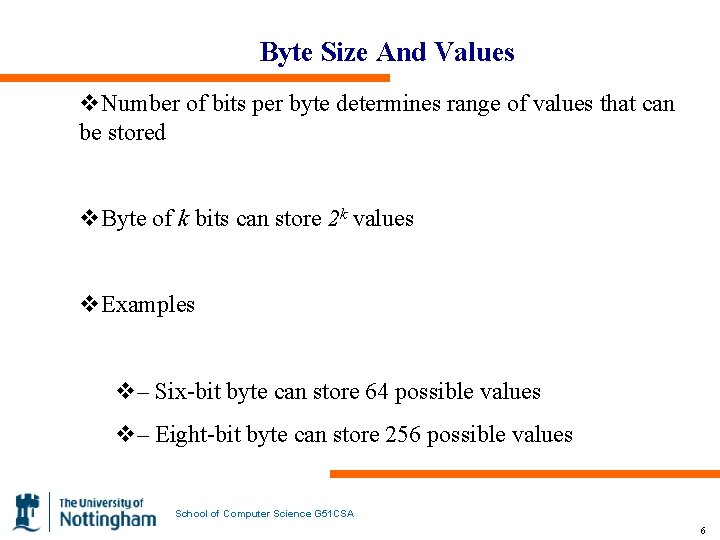
Byte Size And Values v. Number of bits per byte determines range of values that can be stored v. Byte of k bits can store 2 k values v. Examples v– Six-bit byte can store 64 possible values v– Eight-bit byte can store 256 possible values School of Computer Science G 51 CSA 6
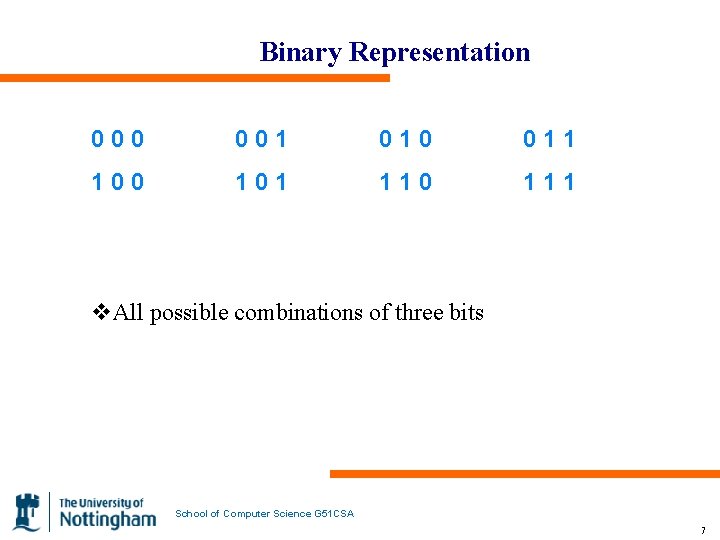
Binary Representation 000 001 010 011 100 101 110 111 v. All possible combinations of three bits School of Computer Science G 51 CSA 7
Meaning Of Bits v. Bits themselves have no intrinsic meaning v. Byte merely stores string of 0’s and 1’s v. All interpretation determined by use School of Computer Science G 51 CSA 8
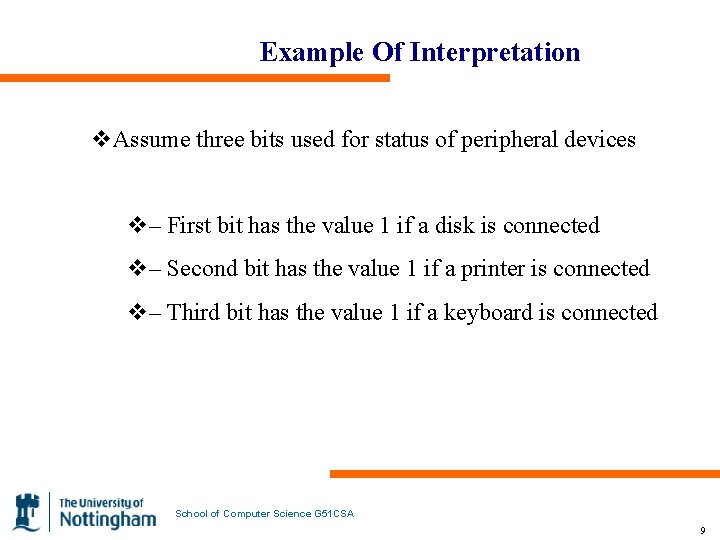
Example Of Interpretation v. Assume three bits used for status of peripheral devices v– First bit has the value 1 if a disk is connected v– Second bit has the value 1 if a printer is connected v– Third bit has the value 1 if a keyboard is connected School of Computer Science G 51 CSA 9
Arithmetic Values v. Combination of bits interpreted as an integer v. Positional representation uses base 2 v. Note: interpretation must specify order of bits School of Computer Science G 51 CSA 10
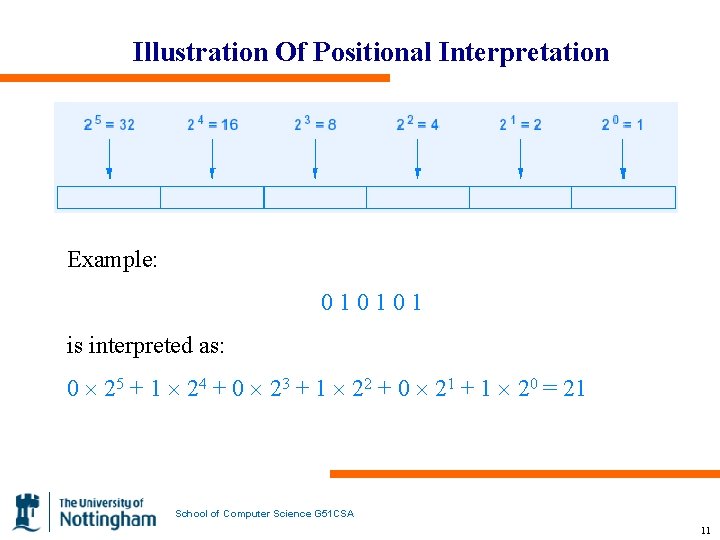
Illustration Of Positional Interpretation Example: 010101 is interpreted as: 0 ´ 25 + 1 ´ 24 + 0 ´ 23 + 1 ´ 22 + 0 ´ 21 + 1 ´ 20 = 21 School of Computer Science G 51 CSA 11
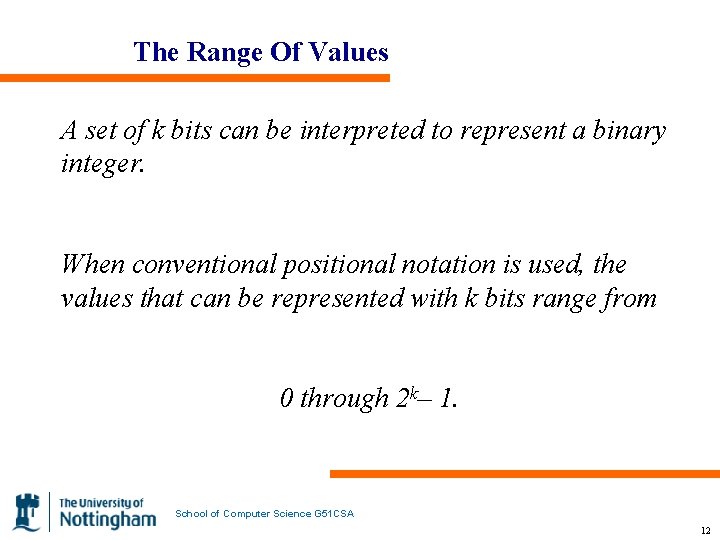
The Range Of Values A set of k bits can be interpreted to represent a binary integer. When conventional positional notation is used, the values that can be represented with k bits range from 0 through 2 k– 1. School of Computer Science G 51 CSA 12
Hexadecimal Notation Convenient way to represent binary data Uses base 16 Each hex digit encodes four bits School of Computer Science G 51 CSA 13
Hexadecimal Digits Hex Binary Decimal Digit Value Equivalent 0 0000 0 1 0001 1 Hex Binary Decimal 2 0010 2 Digit Value Equivalent 3 0011 3 8 1000 8 4 0100 4 9 1001 9 5 0101 5 A 1010 10 6 0110 6 B 1011 11 7 0111 7 C 1100 12 D 1101 13 E 1110 14 F 1111 15 School of Computer Science G 51 CSA 14
Hexadecimal Constants Supported in some programming languages Typical syntax: constant begins with 0 x Example: 0 x. DEC 90949 School of Computer Science G 51 CSA 15
Example Character Encodings v. EBCDIC v. ASCII v. Unicode School of Computer Science G 51 CSA 16
EBCDIC v. Extended Binary Coded Decimal Interchange Code v. Defined by IBM v. Popular in 1960 s v. Still used on IBM mainframe computers v. Example encoding: lower case letter a assigned binary value 10000001 School of Computer Science G 51 CSA 17
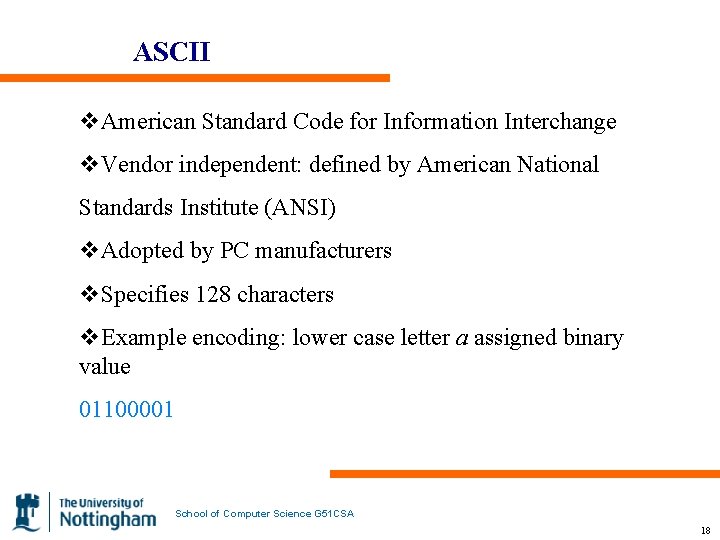
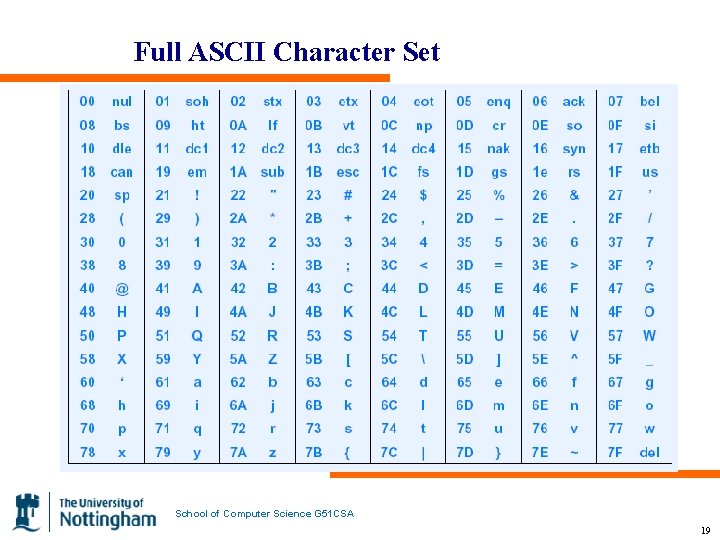
ASCII v. American Standard Code for Information Interchange v. Vendor independent: defined by American National Standards Institute (ANSI) v. Adopted by PC manufacturers v. Specifies 128 characters v. Example encoding: lower case letter a assigned binary value 01100001 School of Computer Science G 51 CSA 18
Full ASCII Character Set School of Computer Science G 51 CSA 19
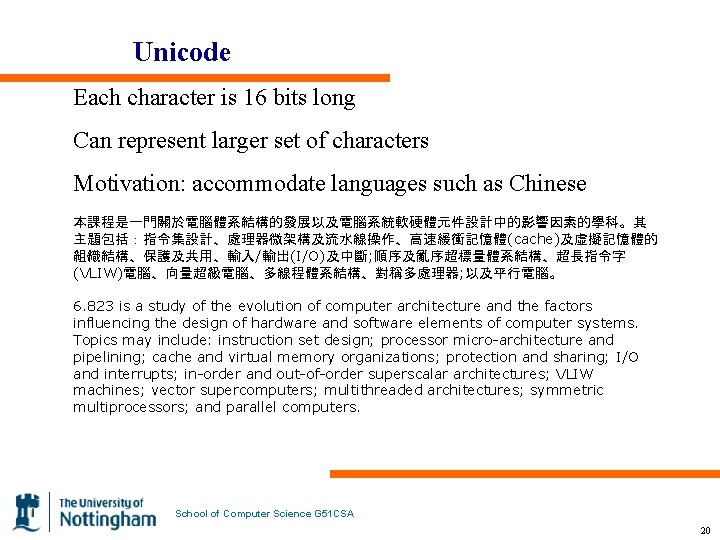
Unicode Each character is 16 bits long Can represent larger set of characters Motivation: accommodate languages such as Chinese 本課程是一門關於電腦體系結構的發展以及電腦系統軟硬體元件設計中的影響因素的學科。其 主題包括:指令集設計、處理器微架構及流水線操作、高速緩衝記憶體(cache)及虛擬記憶體的 組織結構、保護及共用、輸入/輸出(I/O)及中斷; 順序及亂序超標量體系結構、超長指令字 (VLIW)電腦、向量超級電腦、多線程體系結構、對稱多處理器; 以及平行電腦。 6. 823 is a study of the evolution of computer architecture and the factors influencing the design of hardware and software elements of computer systems. Topics may include: instruction set design; processor micro-architecture and pipelining; cache and virtual memory organizations; protection and sharing; I/O and interrupts; in-order and out-of-order superscalar architectures; VLIW machines; vector supercomputers; multithreaded architectures; symmetric multiprocessors; and parallel computers. School of Computer Science G 51 CSA 20
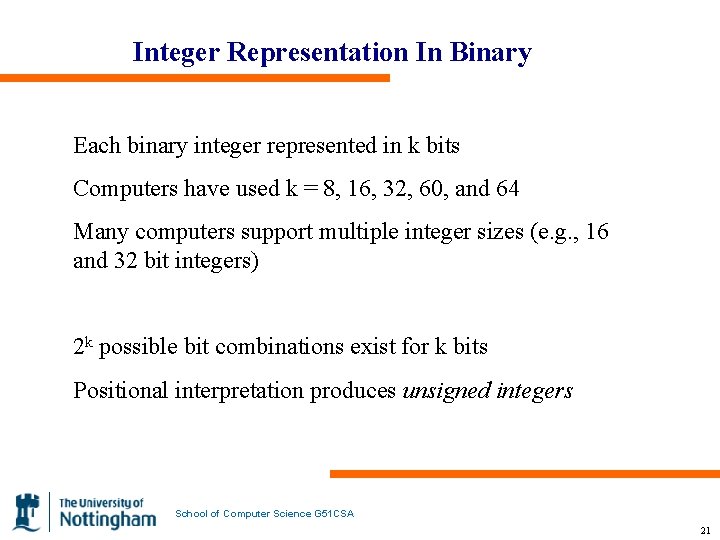
Integer Representation In Binary Each binary integer represented in k bits Computers have used k = 8, 16, 32, 60, and 64 Many computers support multiple integer sizes (e. g. , 16 and 32 bit integers) 2 k possible bit combinations exist for k bits Positional interpretation produces unsigned integers School of Computer Science G 51 CSA 21
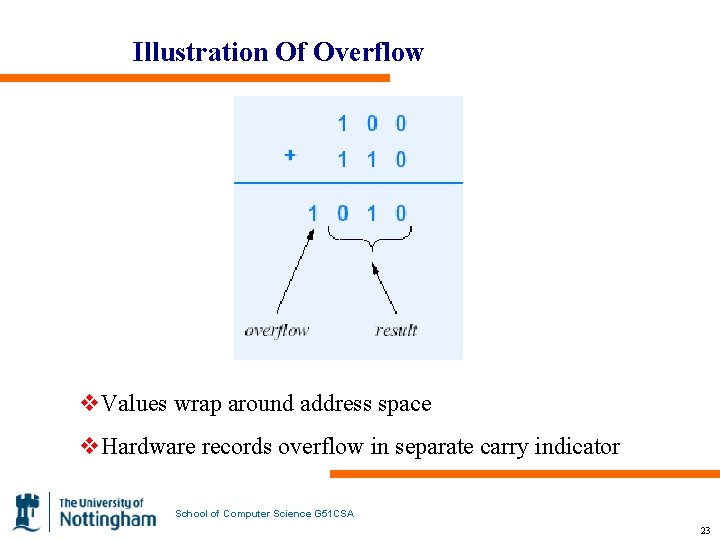
Unsigned Integers v. Straightforward positional interpretation v. Each successive bit represents next power of 2 v. No provision for negative values v. Arithmetic operations can produce overflow or underflow (result cannot be represented in k bits) v. Handled with wraparound and carry bit School of Computer Science G 51 CSA 22
Illustration Of Overflow v. Values wrap around address space v. Hardware records overflow in separate carry indicator School of Computer Science G 51 CSA 23
Example Signed Integer Representations v. Sign magnitude v. One’s complement v. Two’s complement v. Note: each has interesting quirks School of Computer Science G 51 CSA 24
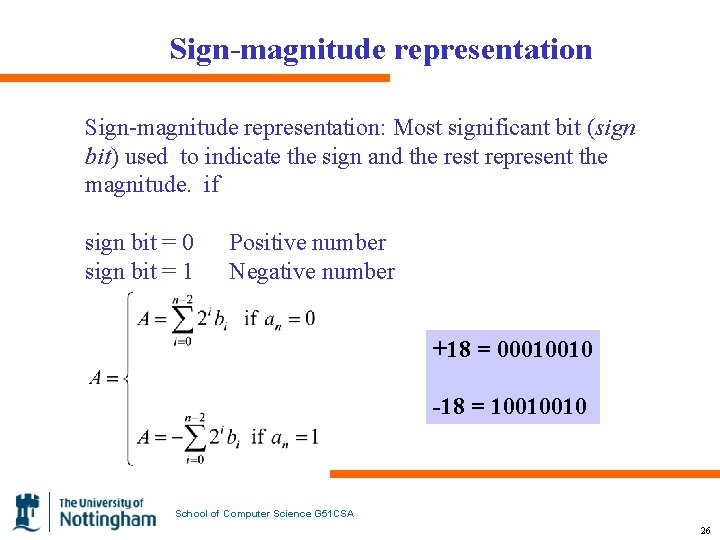
Sign Magnitude Representation v. Familiar to humans v. First bit represents sign v. Successive bits represent absolute value of integer v. Interesting quirk: can create negative zero School of Computer Science G 51 CSA 25
Sign-magnitude representation: Most significant bit (sign bit) used to indicate the sign and the rest represent the magnitude. if sign bit = 0 sign bit = 1 Positive number Negative number +18 = 00010010 -18 = 10010010 School of Computer Science G 51 CSA 26
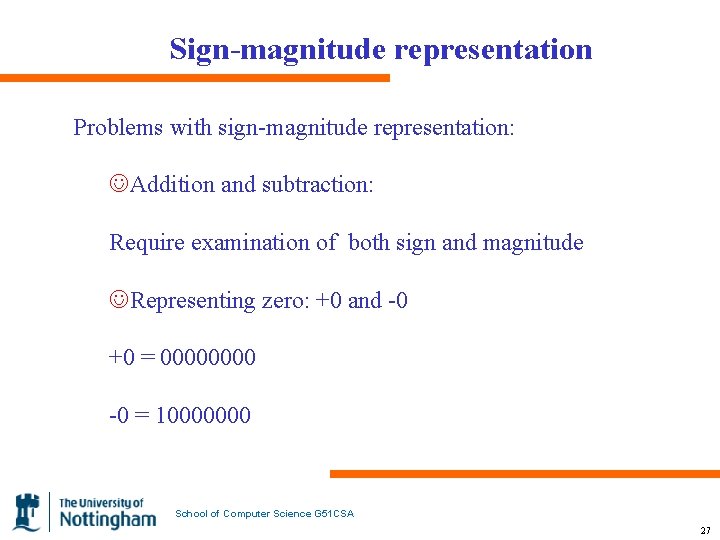
Sign-magnitude representation Problems with sign-magnitude representation: JAddition and subtraction: Require examination of both sign and magnitude JRepresenting zero: +0 and -0 +0 = 0000 -0 = 10000000 School of Computer Science G 51 CSA 27
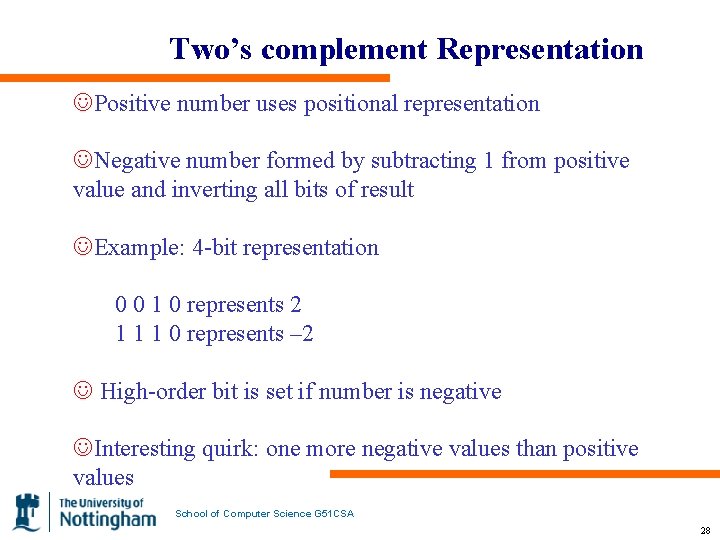
Two’s complement Representation JPositive number uses positional representation JNegative number formed by subtracting 1 from positive value and inverting all bits of result JExample: 4 -bit representation 0 0 1 0 represents 2 1 1 1 0 represents – 2 J High-order bit is set if number is negative JInteresting quirk: one more negative values than positive values School of Computer Science G 51 CSA 28
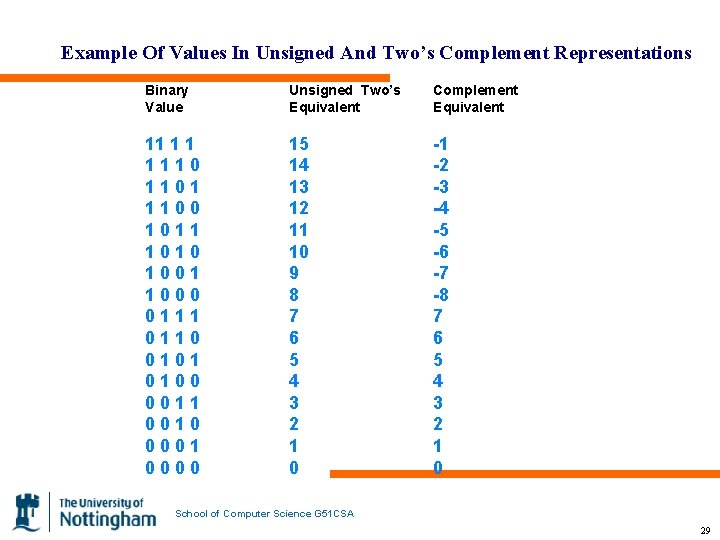
Example Of Values In Unsigned And Two’s Complement Representations Binary Value Unsigned Two’s Equivalent Complement Equivalent 11 1 1 1110 1101 1100 1011 1010 1001 1000 0111 0110 0101 0100 0011 0010 0001 0000 15 14 13 12 11 10 9 8 7 6 5 4 3 2 1 0 -1 -2 -3 -4 -5 -6 -7 -8 7 6 5 4 3 2 1 0 School of Computer Science G 51 CSA 29
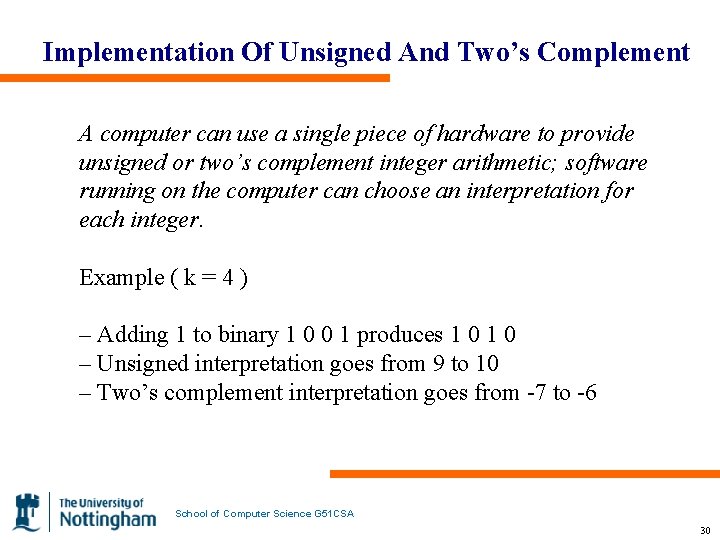
Implementation Of Unsigned And Two’s Complement A computer can use a single piece of hardware to provide unsigned or two’s complement integer arithmetic; software running on the computer can choose an interpretation for each integer. Example ( k = 4 ) – Adding 1 to binary 1 0 0 1 produces 1 0 – Unsigned interpretation goes from 9 to 10 – Two’s complement interpretation goes from -7 to -6 School of Computer Science G 51 CSA 30
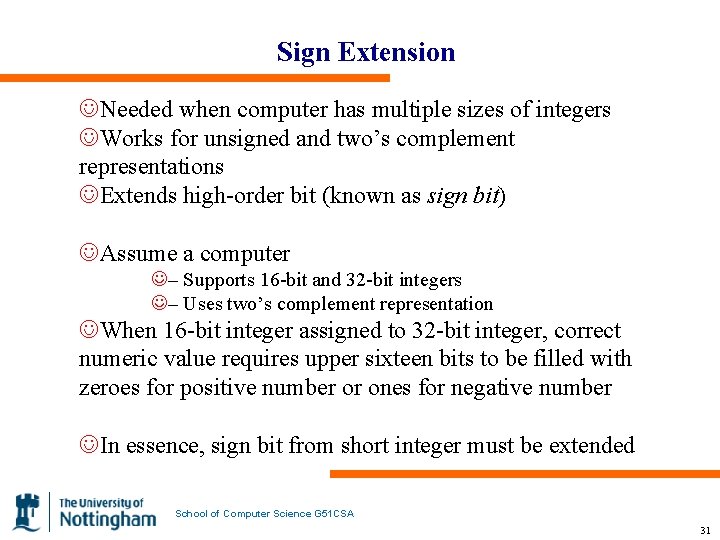
Sign Extension JNeeded when computer has multiple sizes of integers JWorks for unsigned and two’s complement representations JExtends high-order bit (known as sign bit) JAssume a computer J– Supports 16 -bit and 32 -bit integers J– Uses two’s complement representation JWhen 16 -bit integer assigned to 32 -bit integer, correct numeric value requires upper sixteen bits to be filled with zeroes for positive number or ones for negative number JIn essence, sign bit from short integer must be extended School of Computer Science G 51 CSA 31
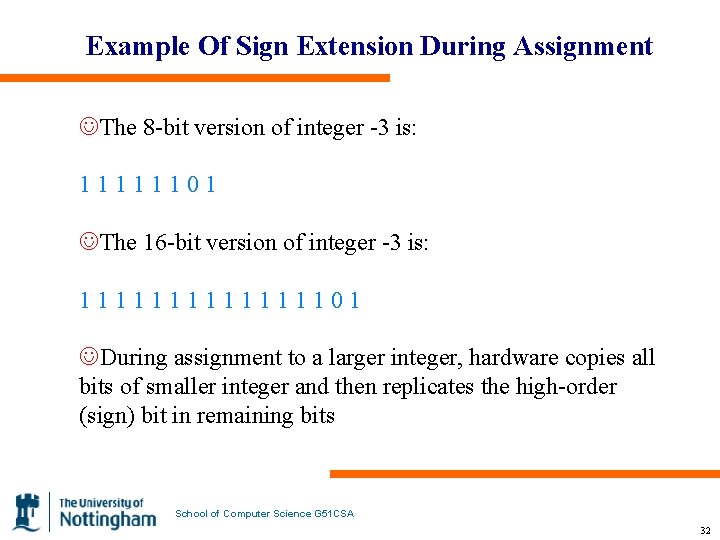
Example Of Sign Extension During Assignment JThe 8 -bit version of integer -3 is: 11111101 JThe 16 -bit version of integer -3 is: 111111101 JDuring assignment to a larger integer, hardware copies all bits of smaller integer and then replicates the high-order (sign) bit in remaining bits School of Computer Science G 51 CSA 32
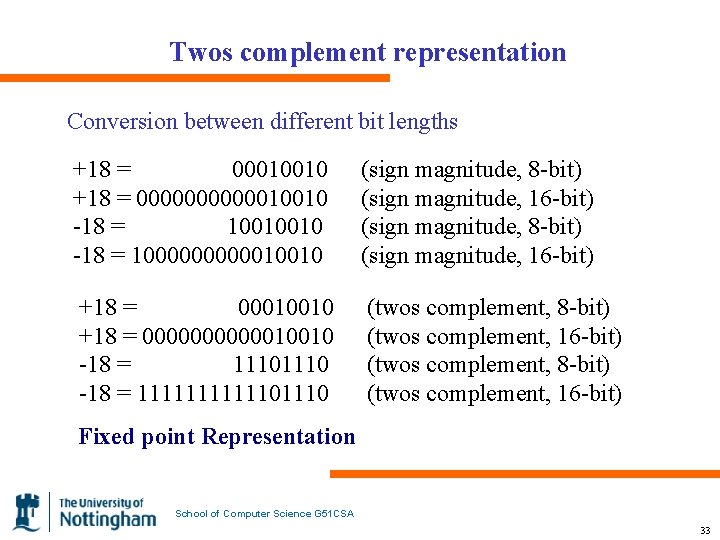
Twos complement representation Conversion between different bit lengths +18 = 00010010 +18 = 00000010010 -18 = 100000010010 (sign magnitude, 8 -bit) (sign magnitude, 16 -bit) +18 = 00010010 +18 = 00000010010 -18 = 1110 -18 = 11111101110 (twos complement, 8 -bit) (twos complement, 16 -bit) Fixed point Representation School of Computer Science G 51 CSA 33
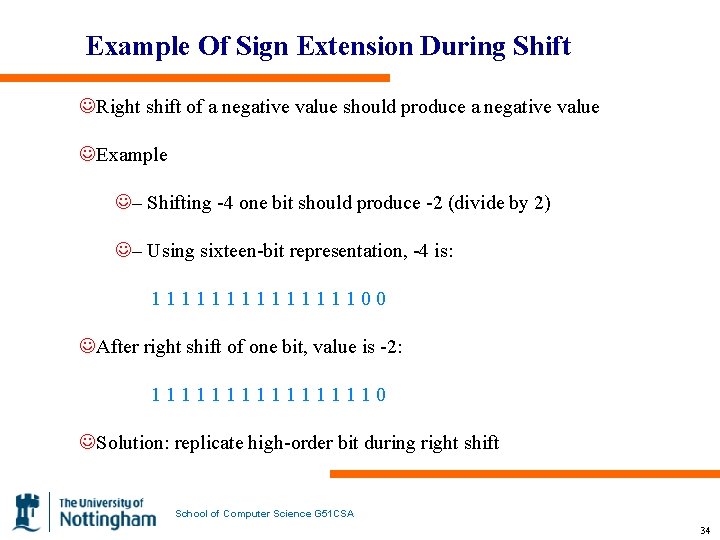
Example Of Sign Extension During Shift JRight shift of a negative value should produce a negative value JExample J– Shifting -4 one bit should produce -2 (divide by 2) J– Using sixteen-bit representation, -4 is: 111111100 JAfter right shift of one bit, value is -2: 111111110 JSolution: replicate high-order bit during right shift School of Computer Science G 51 CSA 34
Summary Of Sign Extension Sign extension: in two’s complement arithmetic, when an integer Q composed of K bits is copied to an integer of more than K bits, the additional high-order bits are made equal to the top bit of Q. Extending the sign bit means the numeric value remains the same. School of Computer Science G 51 CSA 35
A Consequence For Programmers Because two’s complement hardware performs sign extension, copying an unsigned integer to a larger unsigned integer changes the value; to prevent such errors from occurring, a programmer or a compiler must add code to mask off the extended sign bits. School of Computer Science G 51 CSA 36
Numbering Bits And Bytes v. Need to choose order for v– Storage in physical memory system v– Transmission over serial medium (e. g. , a data network) v. Bit order v– Handled by hardware v– Usually hidden from programmer v. Byte order v– Affects multi-byte data items such as integers v– Visible and important to programmer School of Computer Science G 51 CSA 37
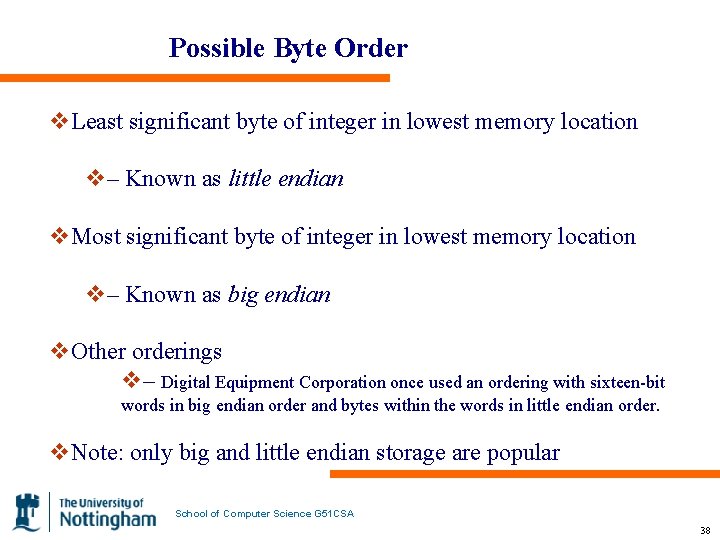
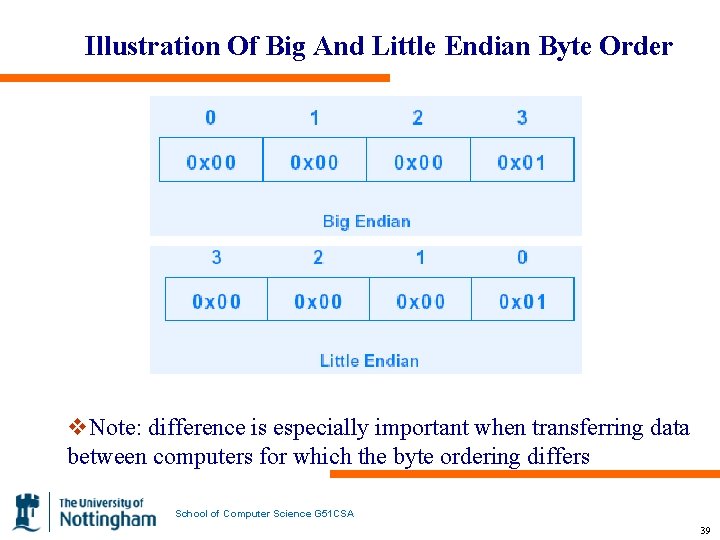
Possible Byte Order v. Least significant byte of integer in lowest memory location v– Known as little endian v. Most significant byte of integer in lowest memory location v– Known as big endian v. Other orderings v– Digital Equipment Corporation once used an ordering with sixteen-bit words in big endian order and bytes within the words in little endian order. v. Note: only big and little endian storage are popular School of Computer Science G 51 CSA 38
Illustration Of Big And Little Endian Byte Order v. Note: difference is especially important when transferring data between computers for which the byte ordering differs School of Computer Science G 51 CSA 39
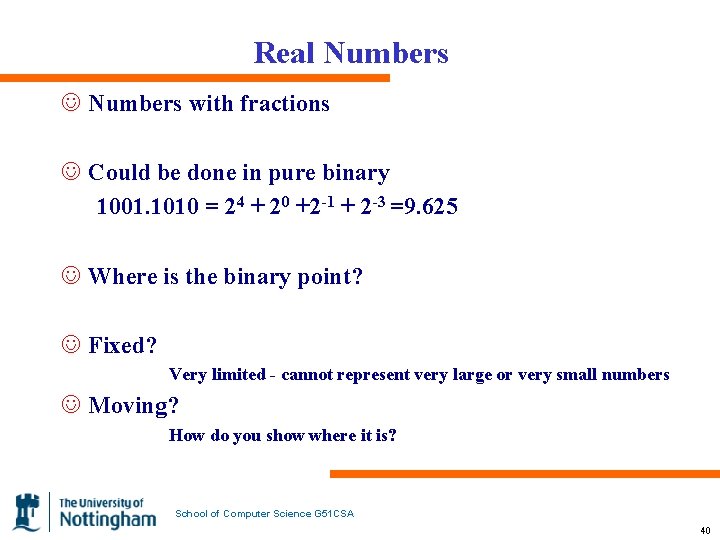
Real Numbers J Numbers with fractions J Could be done in pure binary 1001. 1010 = 24 + 20 +2 -1 + 2 -3 =9. 625 J Where is the binary point? J Fixed? Very limited - cannot represent very large or very small numbers J Moving? How do you show where it is? School of Computer Science G 51 CSA 40
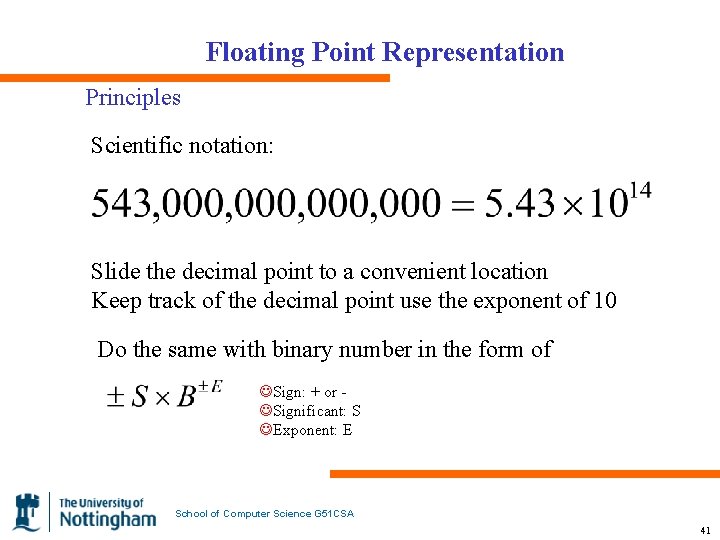
Floating Point Representation Principles Scientific notation: Slide the decimal point to a convenient location Keep track of the decimal point use the exponent of 10 Do the same with binary number in the form of JSign: + or JSignificant: S JExponent: E School of Computer Science G 51 CSA 41
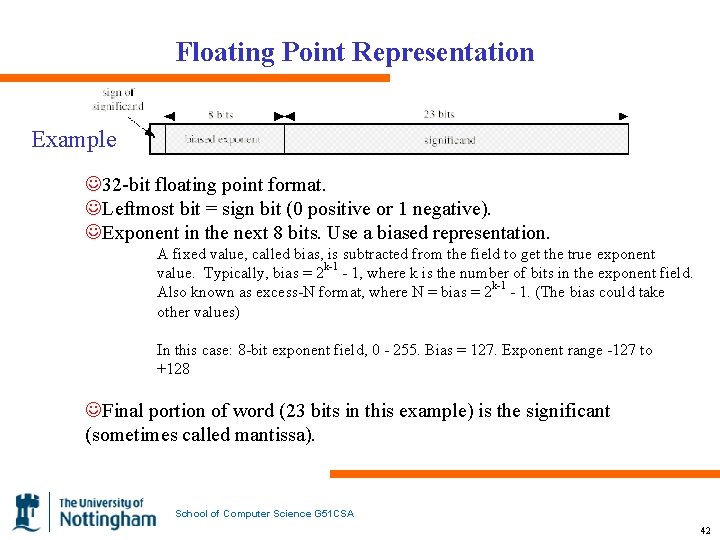
Floating Point Representation Example J 32 -bit floating point format. JLeftmost bit = sign bit (0 positive or 1 negative). JExponent in the next 8 bits. Use a biased representation. A fixed value, called bias, is subtracted from the field to get the true exponent value. Typically, bias = 2 k-1 - 1, where k is the number of bits in the exponent field. Also known as excess-N format, where N = bias = 2 k-1 - 1. (The bias could take other values) In this case: 8 -bit exponent field, 0 - 255. Bias = 127. Exponent range -127 to +128 JFinal portion of word (23 bits in this example) is the significant (sometimes called mantissa). School of Computer Science G 51 CSA 42
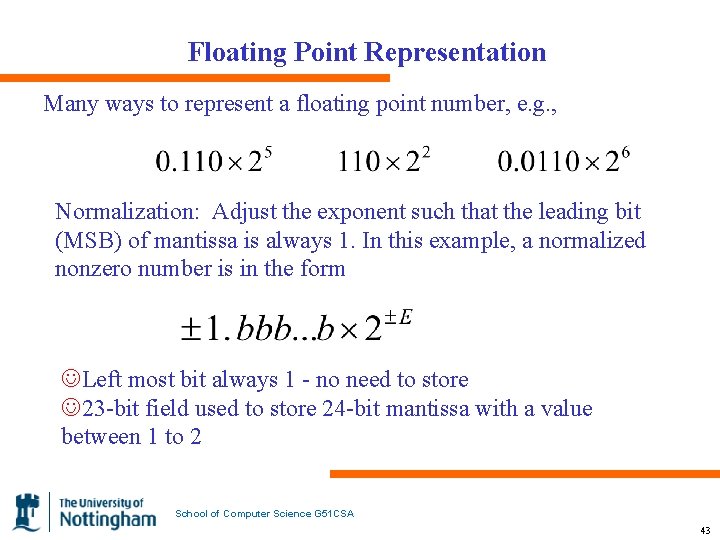
Floating Point Representation Many ways to represent a floating point number, e. g. , Normalization: Adjust the exponent such that the leading bit (MSB) of mantissa is always 1. In this example, a normalized nonzero number is in the form JLeft most bit always 1 - no need to store J 23 -bit field used to store 24 -bit mantissa with a value between 1 to 2 School of Computer Science G 51 CSA 43
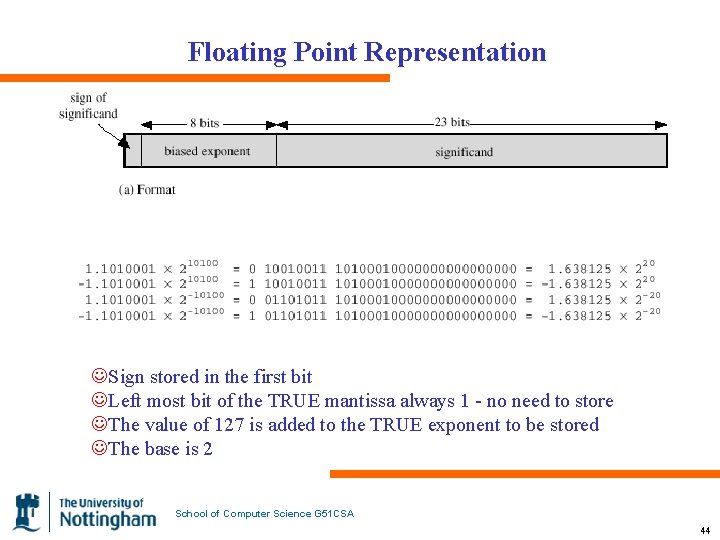
Floating Point Representation JSign stored in the first bit JLeft most bit of the TRUE mantissa always 1 - no need to store JThe value of 127 is added to the TRUE exponent to be stored JThe base is 2 School of Computer Science G 51 CSA 44
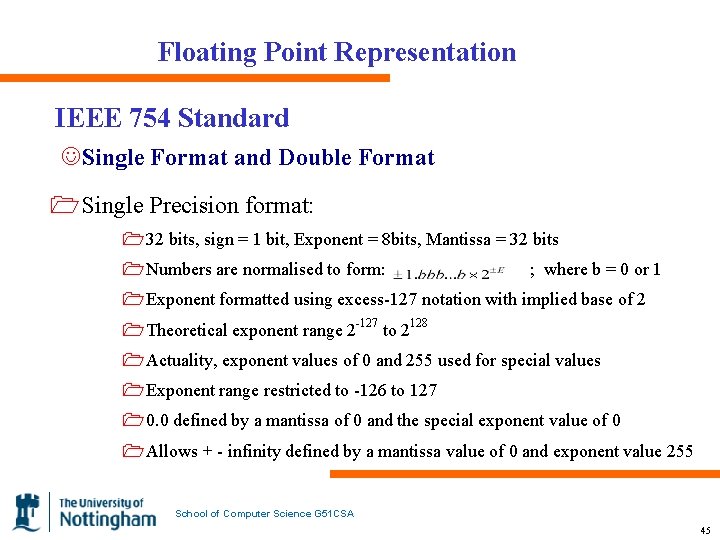
Floating Point Representation IEEE 754 Standard JSingle Format and Double Format 1 Single Precision format: 132 bits, sign = 1 bit, Exponent = 8 bits, Mantissa = 32 bits 1 Numbers are normalised to form: ; where b = 0 or 1 1 Exponent formatted using excess-127 notation with implied base of 2 1 Theoretical exponent range 2 -127 to 2128 1 Actuality, exponent values of 0 and 255 used for special values 1 Exponent range restricted to -126 to 127 10. 0 defined by a mantissa of 0 and the special exponent value of 0 1 Allows + - infinity defined by a mantissa value of 0 and exponent value 255 School of Computer Science G 51 CSA 45
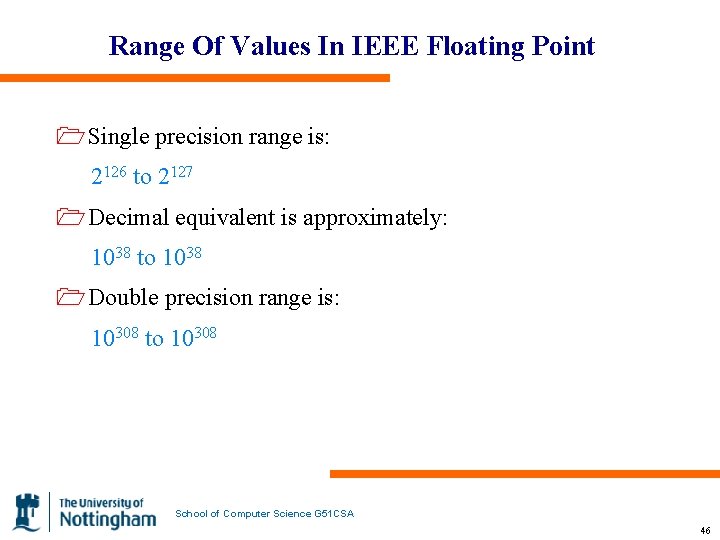
Range Of Values In IEEE Floating Point 1 Single precision range is: 2126 to 2127 1 Decimal equivalent is approximately: 1038 to 1038 1 Double precision range is: 10308 to 10308 School of Computer Science G 51 CSA 46
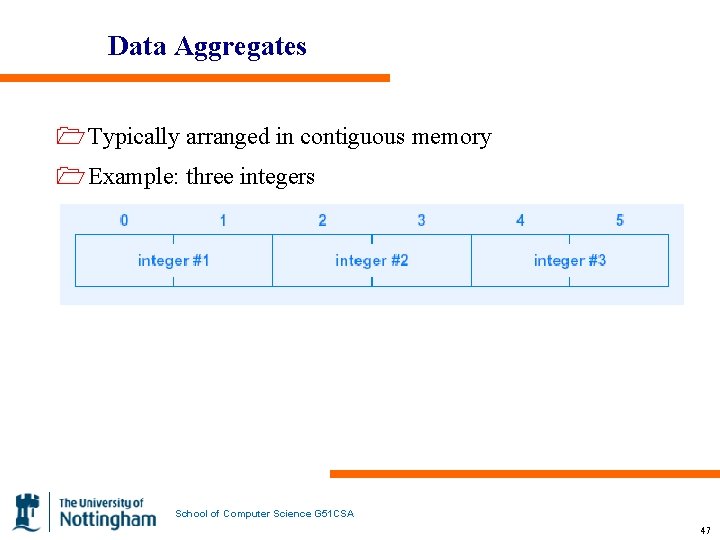
Data Aggregates 1 Typically arranged in contiguous memory 1 Example: three integers School of Computer Science G 51 CSA 47
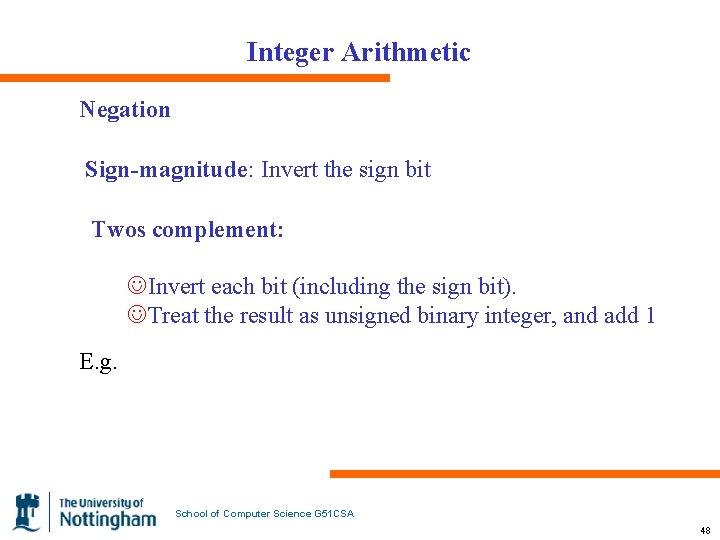
Integer Arithmetic Negation Sign-magnitude: Invert the sign bit Twos complement: JInvert each bit (including the sign bit). JTreat the result as unsigned binary integer, and add 1 E. g. School of Computer Science G 51 CSA 48
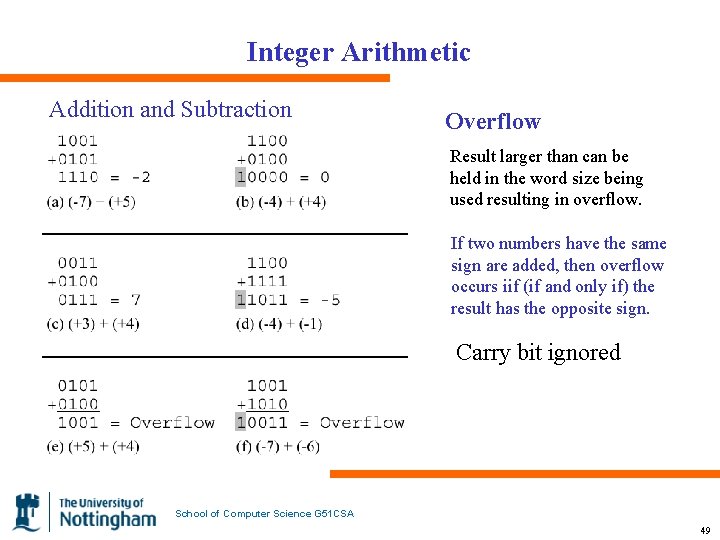
Integer Arithmetic Addition and Subtraction Overflow Result larger than can be held in the word size being used resulting in overflow. If two numbers have the same sign are added, then overflow occurs iif (if and only if) the result has the opposite sign. Carry bit ignored School of Computer Science G 51 CSA 49
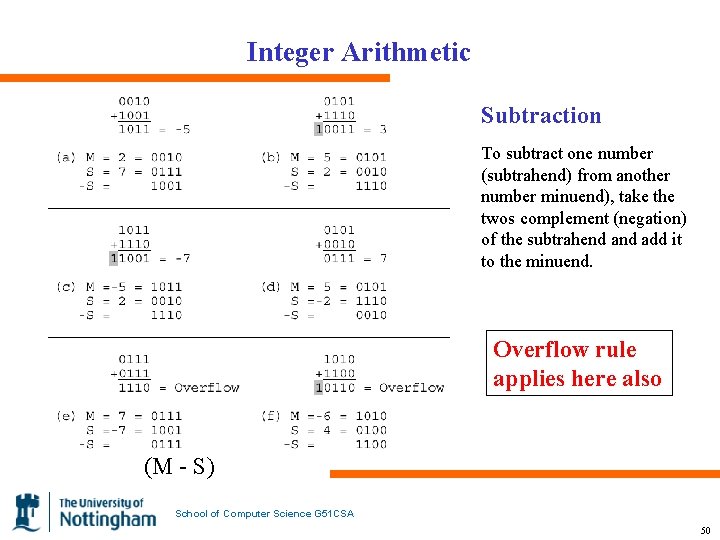
Integer Arithmetic Subtraction To subtract one number (subtrahend) from another number minuend), take the twos complement (negation) of the subtrahend add it to the minuend. Overflow rule applies here also (M - S) School of Computer Science G 51 CSA 50
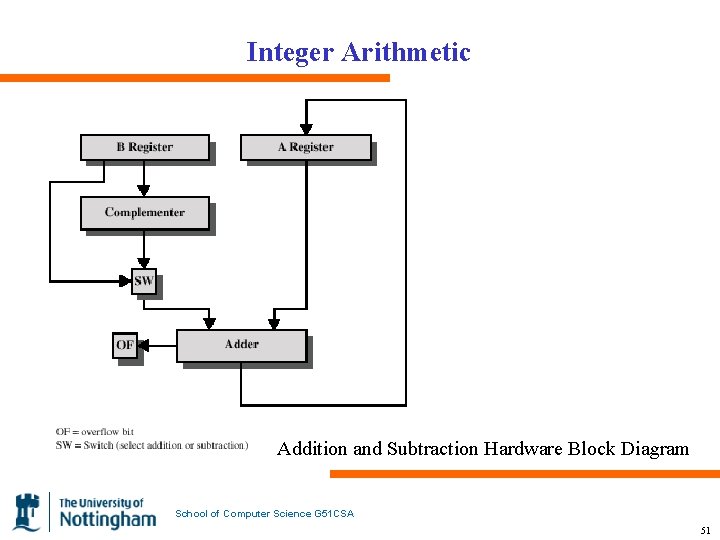
Integer Arithmetic Addition and Subtraction Hardware Block Diagram School of Computer Science G 51 CSA 51
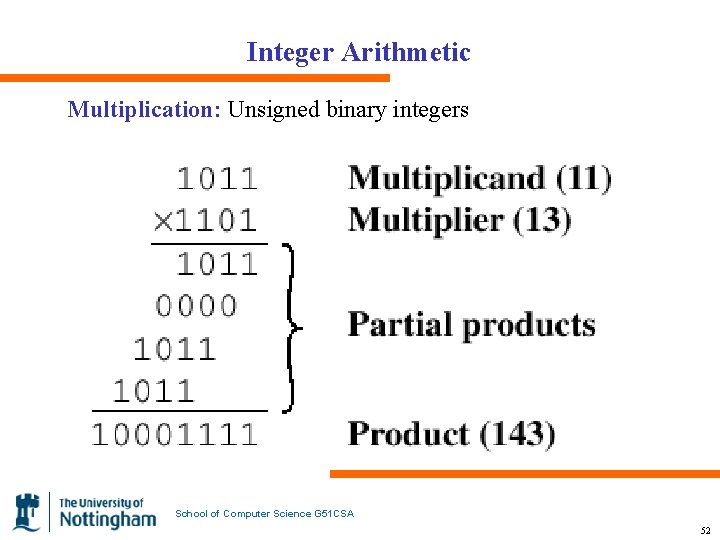
Integer Arithmetic Multiplication: Unsigned binary integers School of Computer Science G 51 CSA 52
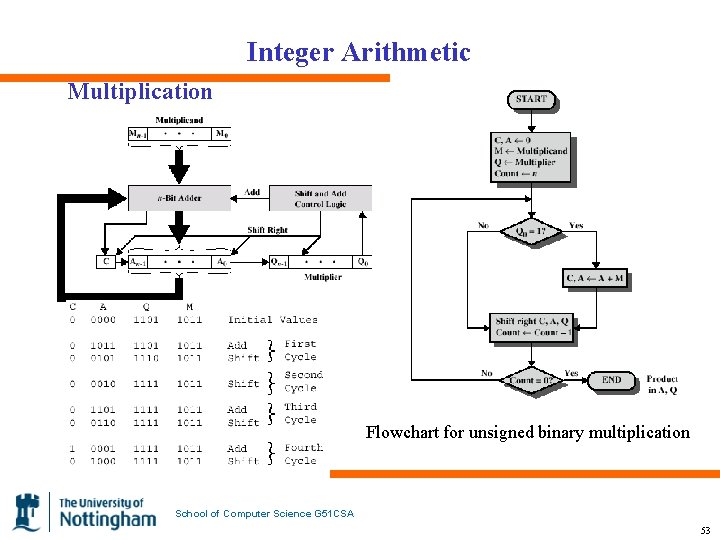
Integer Arithmetic Multiplication Flowchart for unsigned binary multiplication School of Computer Science G 51 CSA 53
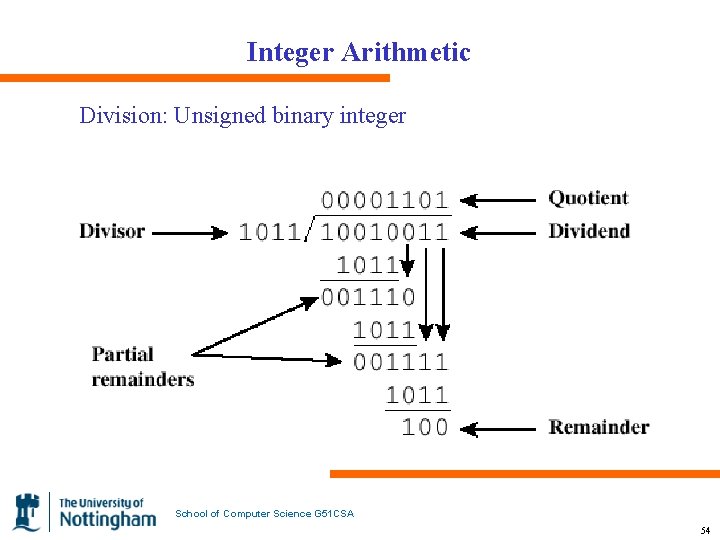
Integer Arithmetic Division: Unsigned binary integer School of Computer Science G 51 CSA 54
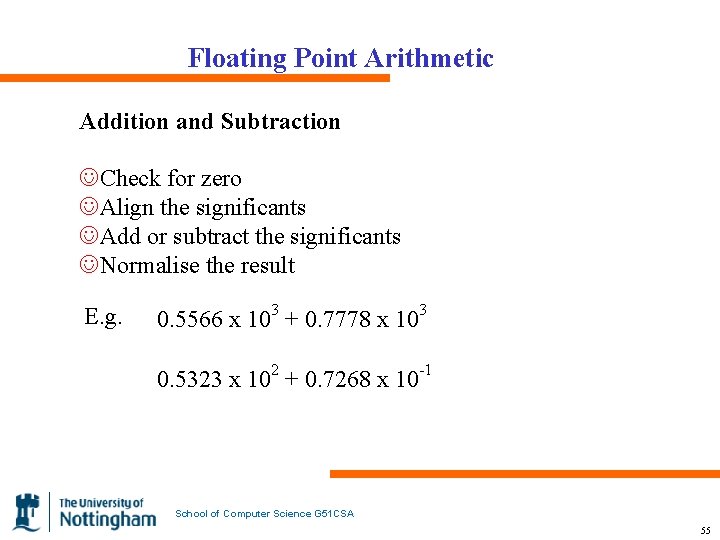
Floating Point Arithmetic Addition and Subtraction JCheck for zero JAlign the significants JAdd or subtract the significants JNormalise the result E. g. 0. 5566 x 103 + 0. 7778 x 103 0. 5323 x 102 + 0. 7268 x 10 -1 School of Computer Science G 51 CSA 55
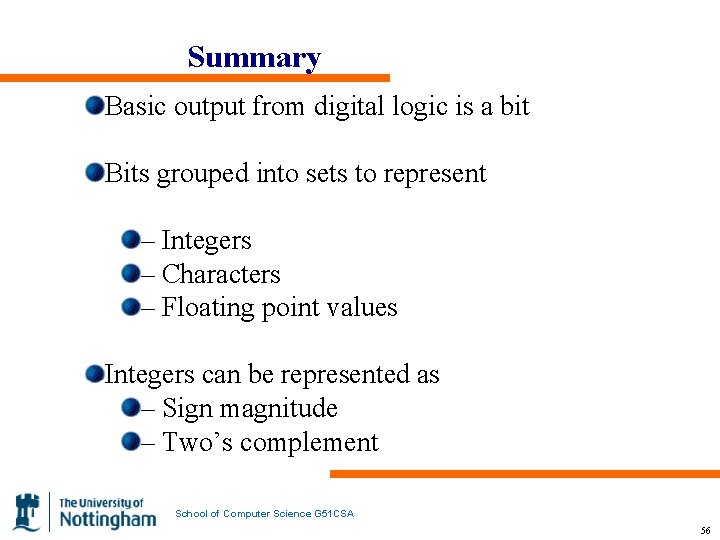
Summary Basic output from digital logic is a bit Bits grouped into sets to represent – Integers – Characters – Floating point values Integers can be represented as – Sign magnitude – Two’s complement School of Computer Science G 51 CSA 56
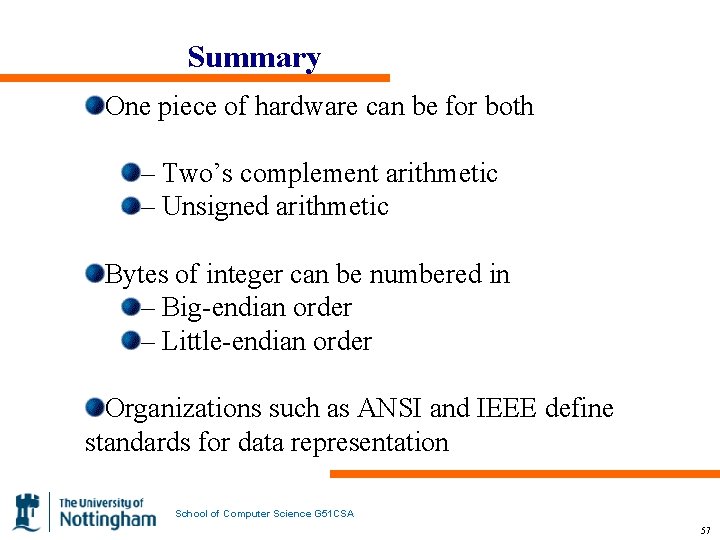
Summary One piece of hardware can be for both – Two’s complement arithmetic – Unsigned arithmetic Bytes of integer can be numbered in – Big-endian order – Little-endian order Organizations such as ANSI and IEEE define standards for data representation School of Computer Science G 51 CSA 57
Summary Integer arithmetic two’s complement - subtraction and addition rules, overflow rule Floating point arithmetic School of Computer Science G 51 CSA 58