
Computer Simulations of Liquid Crystal Models using Condor





- Slides: 14
Computer Simulations of Liquid Crystal Models using Condor C. Chiccoli (1, P. Pasini (1, F. Semeria (1, C. Zannoni (2 (1 INFN Sezione di Bologna, 40126 Bologna, Italy. ( 2 Dipartimento di Chimica Fisica e Inorganica, Università di Bologna, 40136, Bologna, Italy. European Condor Week 2006, Milan 29 -Jun-2006
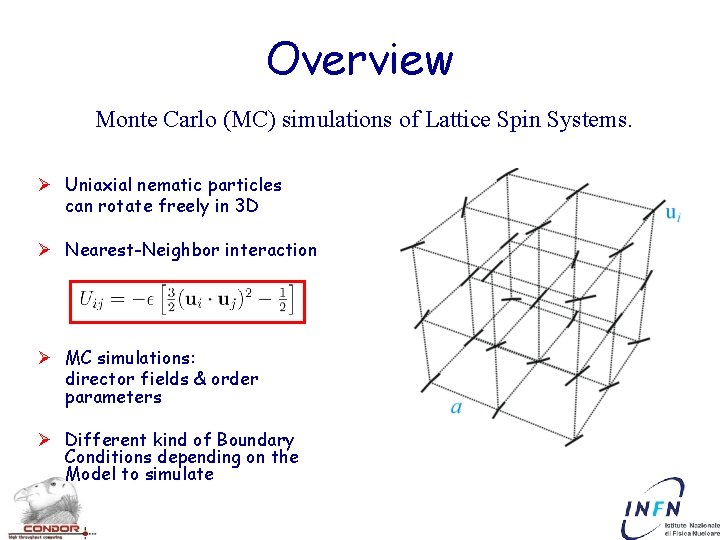
Overview Monte Carlo (MC) simulations of Lattice Spin Systems. Ø Uniaxial nematic particles can rotate freely in 3 D Ø Nearest-Neighbor interaction Ø MC simulations: director fields & order parameters Ø Different kind of Boundary Conditions depending on the Model to simulate
Overview • One evolution cycle: thermodynamic state of all particles is updated. • Each cycle starts from the final state of the previous cycle. • The MC sequence is segmented into runs of 1000 cycles. – get always available the latest produced data for further analysis. – spread the computation over the greatest number of hosts. – avoid the use of the less performing hosts for too long time. • These MC runs are synchronized with DAGMAN.
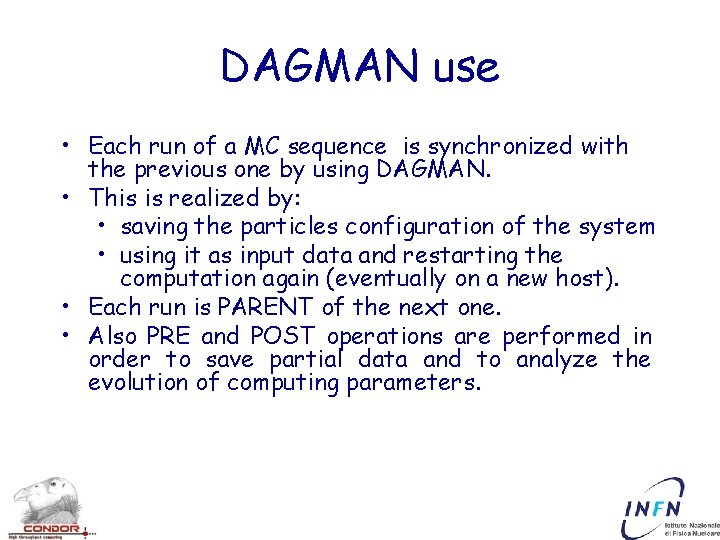
DAGMAN use • Each run of a MC sequence is synchronized with the previous one by using DAGMAN. • This is realized by: • saving the particles configuration of the system • using it as input data and restarting the computation again (eventually on a new host). • Each run is PARENT of the next one. • Also PRE and POST operations are performed in order to save partial data and to analyze the evolution of computing parameters.
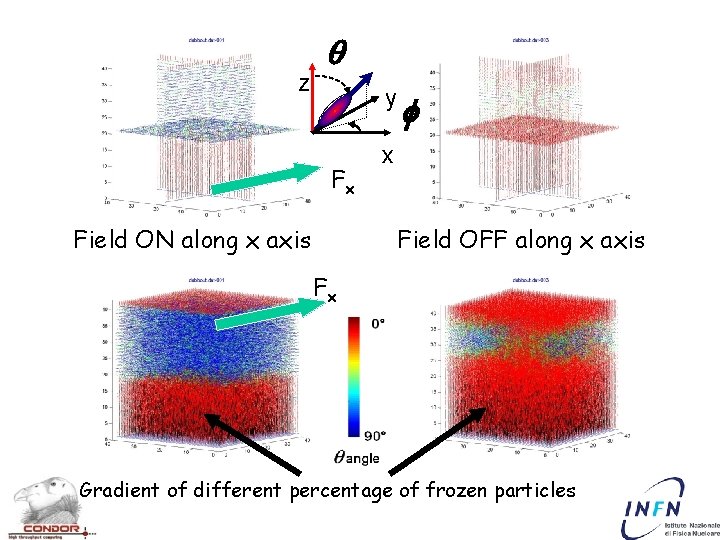
The Model Layers of LC with variable percentages of frozen particles inside the system • Boundary conditions: – top layer: particles fixed along Z – bottom layer: particles fixed along X – inner layers: different percentages of fixed oriented particles • Dynamics: different fields are switched on. After several cycles the fields are turned off and then again on. • The application of the fields allows to detect if memory effects are induced in the system.
q y Fx Field ON along x axis f z x Field OFF along x axis Fx Gradient of different percentage of frozen particles
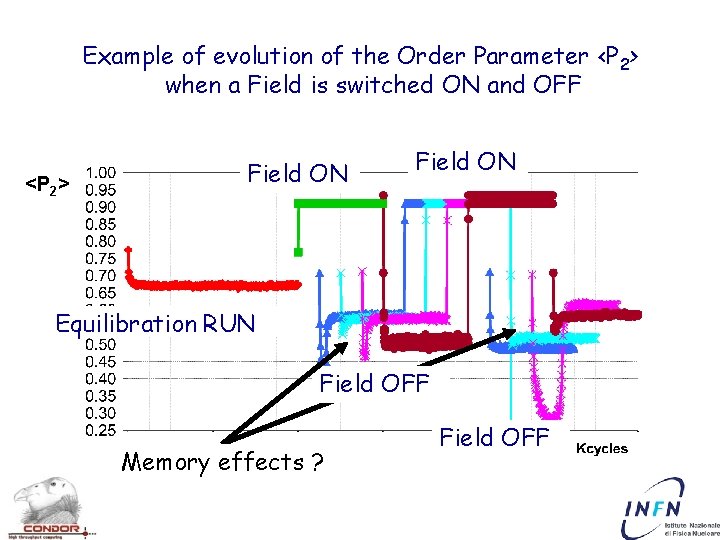
Example of evolution of the Order Parameter <P 2> when a Field is switched ON and OFF <P 2> Field ON Equilibration RUN Field OFF Memory effects ? Field OFF
Why the pool is used The same effort is required for each combination of different: • Mixing in the percentages of the frozen particles. • Geometrical distribution and particles orientation inside the layer. • Boundary conditions. • Field strength. • Temperature. Lot of jobs!
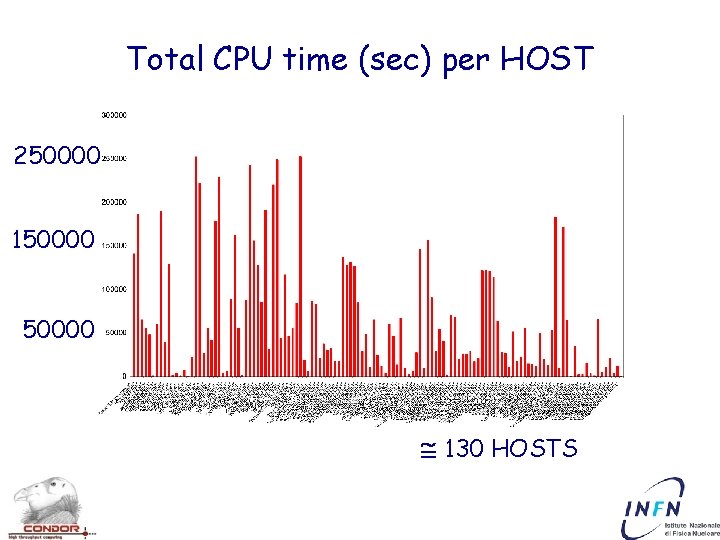
Total CPU time (sec) per HOST 250000 150000 130 HOSTS
Average CPU time (sec) / RUN per HOST (1 RUN = 1000 MC cycles) 1500 130 HOSTS
Total CPU time (sec) per simulation sequence 15000 80 simulation sequences
Average CPU time (sec) / RUN per simulation sequence (1 RUN = 1000 MC cycles) 500 400 80 simulation sequences The CPU time / RUN is about constant because the differences in performance of the used HOSTS are spread all over the simulation sequences.
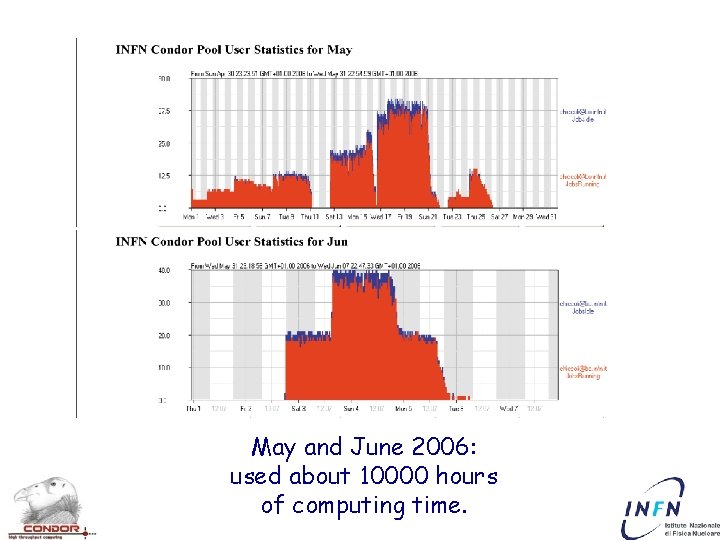
May and June 2006: used about 10000 hours of computing time.
Conclusion • This project needs a lot of computational time • The group does not have many machines • The Pool gives a chance (the only at INFN? )