
Computer simulations create the future Eigenspectrum calculation of
- Slides: 16
Computer simulations create the future Eigenspectrum calculation of the non-Hermitian O(a)-improved Wilson-Dirac operator using the Sakurai-Sugiura method H. Sunoa, Y. Nakamuraa, b, K. -I. Ishikawac, Y. Kuramashia, d, e, Y. Futamuraf, A. Imakuraf, T. Sakuraif a. RIKEN Advanced Institute for Computational Science, b. RIKEN Nishina Center, c. Department of Physical Science Hiroshima Univ. , d. Centerfor Computational Science, Tsukuba Univ. , e. Faculty of Pure and Applied Science, Tsukuba Univ. , f. Department of Computer Science, Tsukuba Univ. LATTICE 2015, Kobe International Conference Center, Kobe, July 14 -18, 2015. 1 RIKEN ADVANCED INSTITUTE FOR COMPUTATIONAL SCIENCE
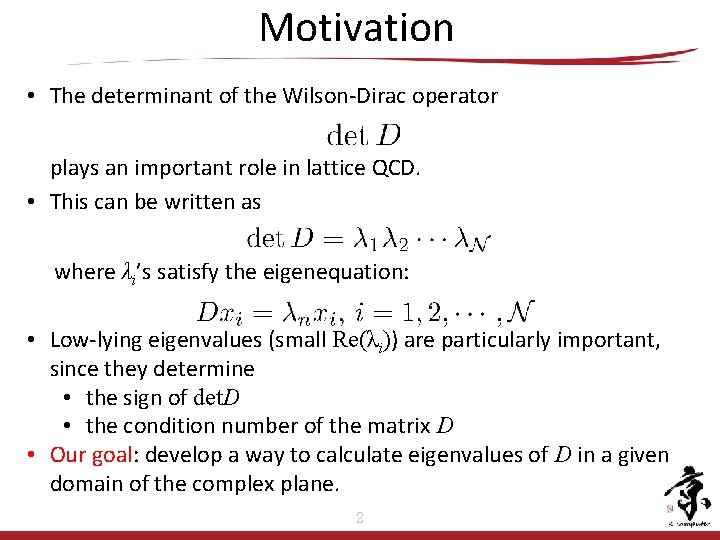
Motivation • The determinant of the Wilson-Dirac operator plays an important role in lattice QCD. • This can be written as where λi’s satisfy the eigenequation: • Low-lying eigenvalues (small Re(λi)) are particularly important, since they determine • the sign of det. D • the condition number of the matrix D • Our goal: develop a way to calculate eigenvalues of D in a given domain of the complex plane. 2
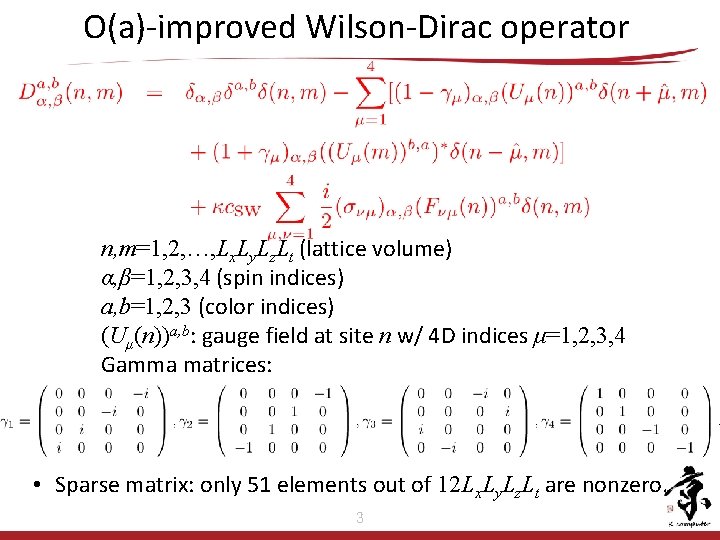
O(a)-improved Wilson-Dirac operator n, m=1, 2, …, Lx. Ly. Lz. Lt (lattice volume) α, β=1, 2, 3, 4 (spin indices) a, b=1, 2, 3 (color indices) (Uμ(n))a, b: gauge field at site n w/ 4 D indices μ=1, 2, 3, 4 Gamma matrices: • Sparse matrix: only 51 elements out of 12 Lx. Ly. Lz. Lt are nonzero. 3
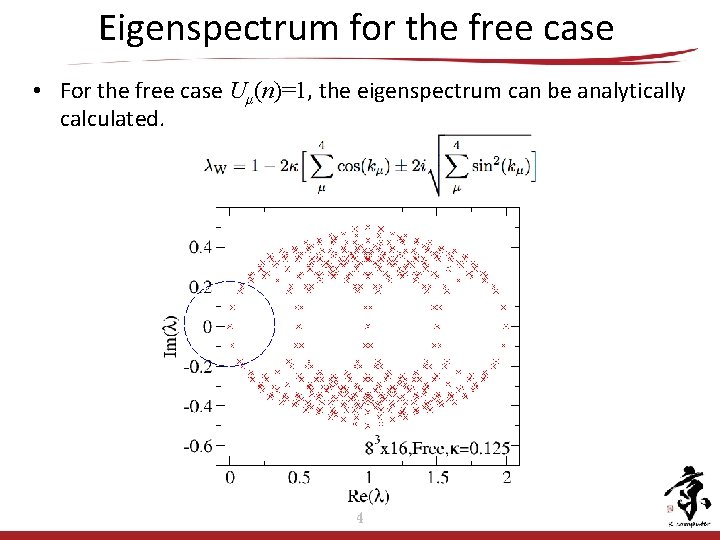
Eigenspectrum for the free case • For the free case Uμ(n)=1, the eigenspectrum can be analytically calculated. 4
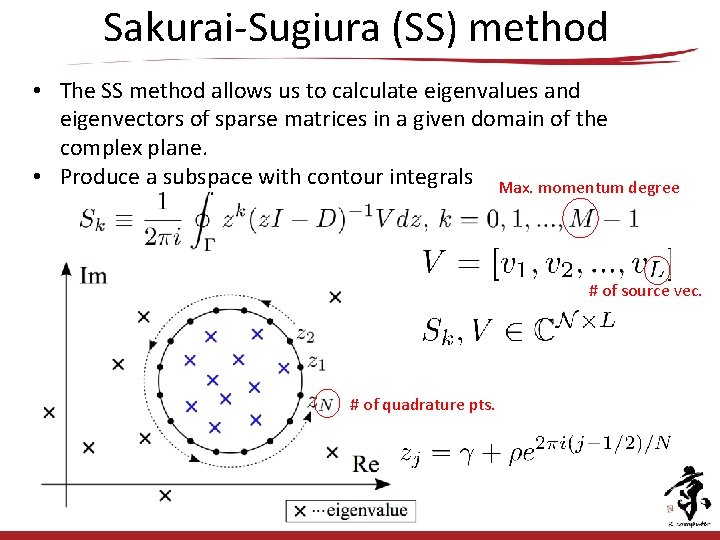
Sakurai-Sugiura (SS) method • The SS method allows us to calculate eigenvalues and eigenvectors of sparse matrices in a given domain of the complex plane. • Produce a subspace with contour integrals Max. momentum degree # of source vec. # of quadrature pts. 5
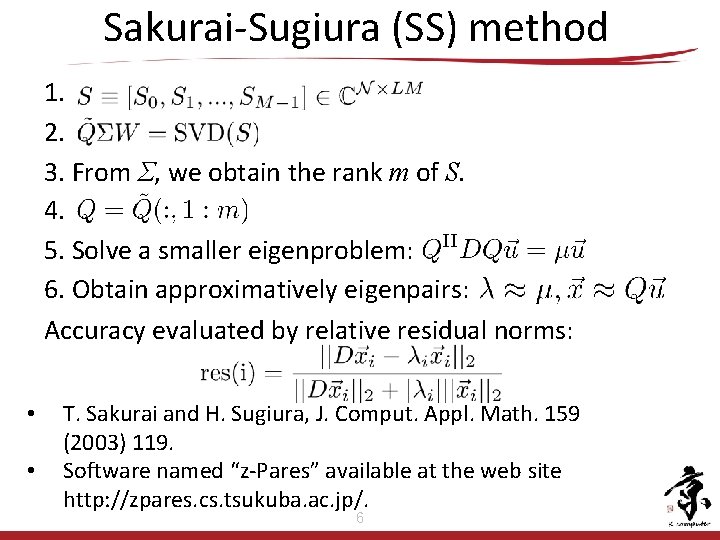
Sakurai-Sugiura (SS) method 1. 2. 3. From Σ, we obtain the rank m of S. 4. 5. Solve a smaller eigenproblem: 6. Obtain approximatively eigenpairs: Accuracy evaluated by relative residual norms: • • T. Sakurai and H. Sugiura, J. Comput. Appl. Math. 159 (2003) 119. Software named “z-Pares” available at the web site http: //zpares. cs. tsukuba. ac. jp/. 6
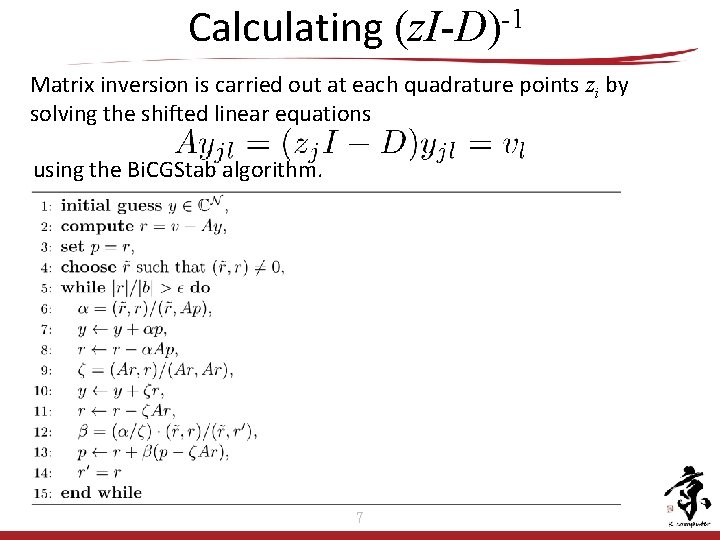
Calculating -1 (z. I-D) Matrix inversion is carried out at each quadrature points zi by solving the shifted linear equations using the Bi. CGStab algorithm. 7
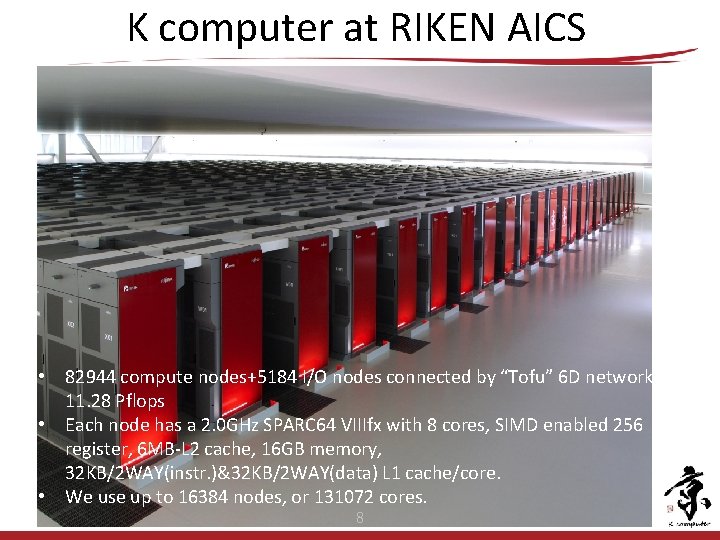
K computer at RIKEN AICS • 82944 compute nodes+5184 I/O nodes connected by “Tofu” 6 D network, 11. 28 Pflops • Each node has a 2. 0 GHz SPARC 64 VIIIfx with 8 cores, SIMD enabled 256 register, 6 MB-L 2 cache, 16 GB memory, 32 KB/2 WAY(instr. )&32 KB/2 WAY(data) L 1 cache/core. • We use up to 16384 nodes, or 131072 cores. 8
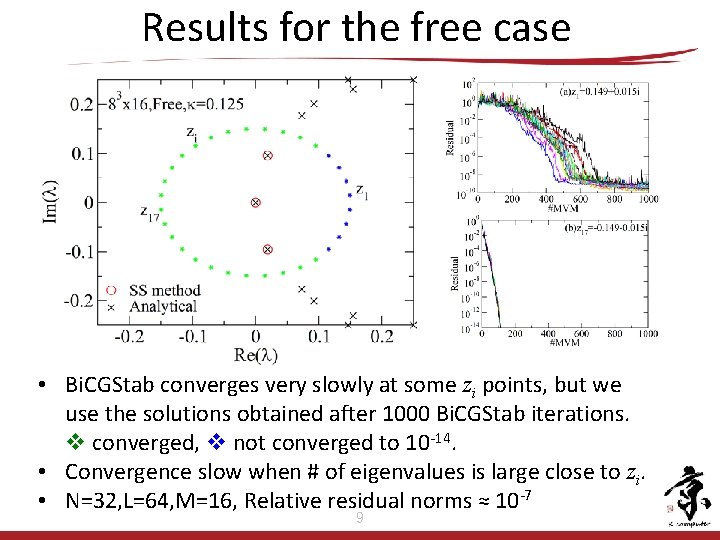
Results for the free case • Bi. CGStab converges very slowly at some zi points, but we use the solutions obtained after 1000 Bi. CGStab iterations. converged, not converged to 10 -14. • Convergence slow when # of eigenvalues is large close to zi. • N=32, L=64, M=16, Relative residual norms ≈ 10 -7 9
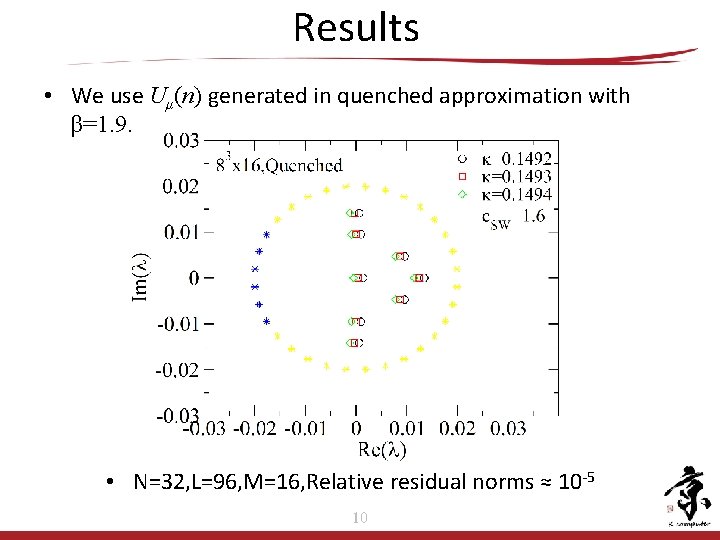
Results • We use Uμ(n) generated in quenched approximation with β=1. 9. • N=32, L=96, M=16, Relative residual norms ≈ 10 -5 10
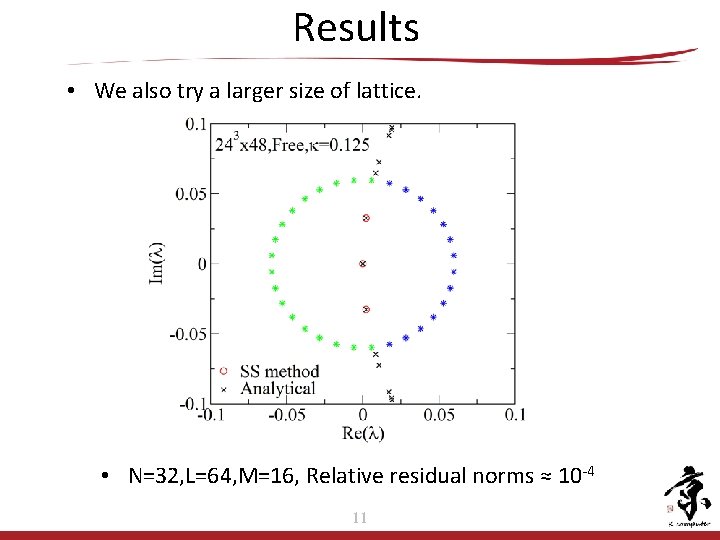
Results • We also try a larger size of lattice. • N=32, L=64, M=16, Relative residual norms ≈ 10 -4 11
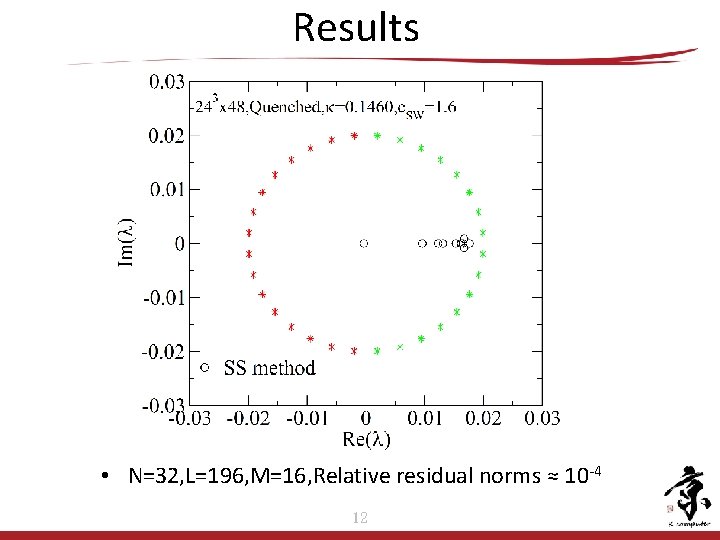
Results • N=32, L=196, M=16, Relative residual norms ≈ 10 -4 12
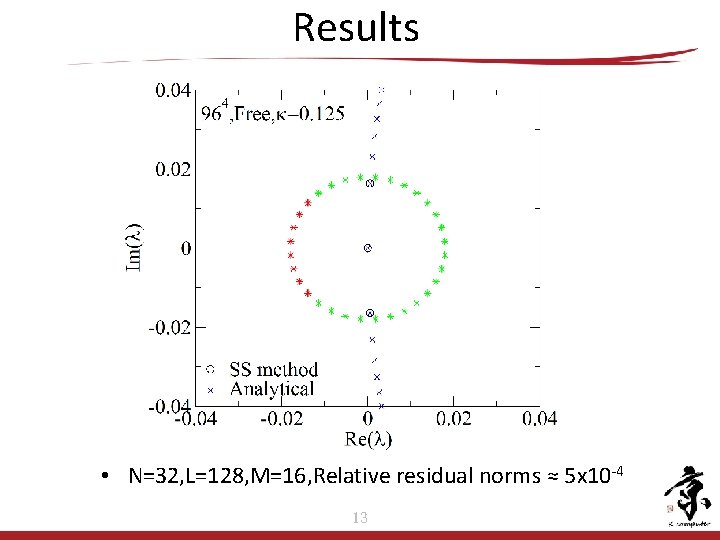
Results • N=32, L=128, M=16, Relative residual norms ≈ 5 x 10 -4 13
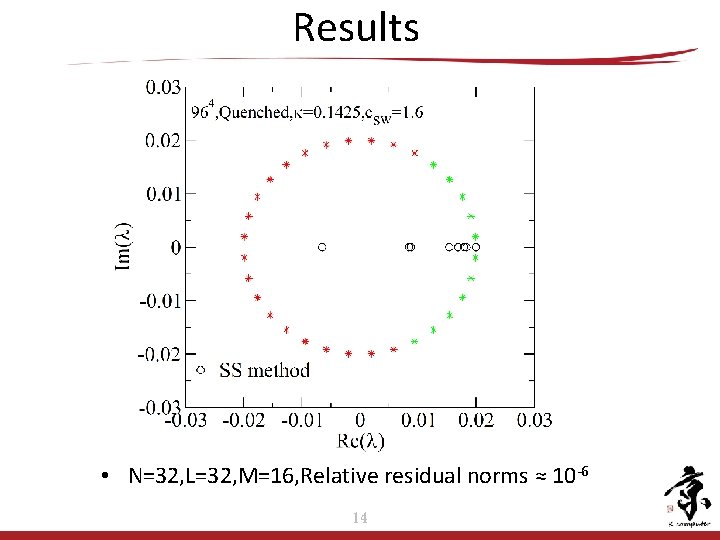
Results • N=32, L=32, M=16, Relative residual norms ≈ 10 -6 14
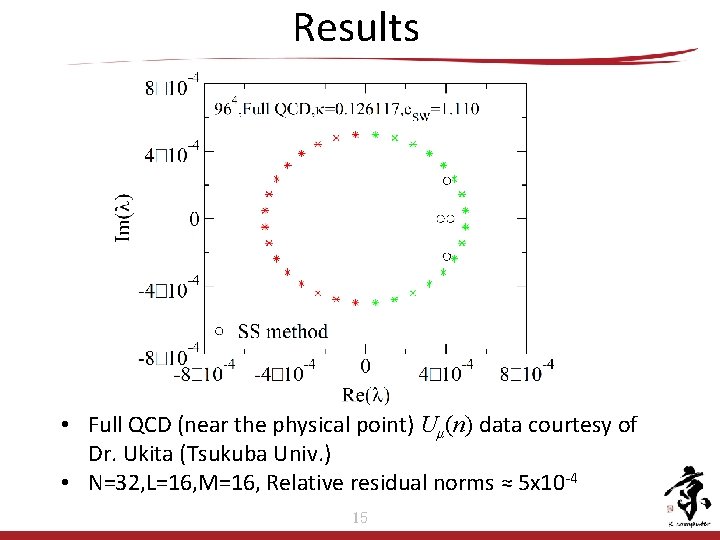
Results • Full QCD (near the physical point) Uμ(n) data courtesy of Dr. Ukita (Tsukuba Univ. ) • N=32, L=16, M=16, Relative residual norms ≈ 5 x 10 -4 15
Summary • We have tried to calculate low energy eigenspectrum of the O(a)-improved Wilson-Dirac operator. • We have implemented the Sakurai-Sugiura method. • We have dealt with the lattice size up to 964. • We have considered gauge field configurations for free case, quenched approximation, and full QCD. • Relative residual norms vary from 10 -7 to 5 x 10 -4. • Accuracy limited due to slow convergence of the Bi. CGStab used to solve the shifted linear equations, but we can think that the eigenvalues can be estimated with 3 or more digits of accuracy. • We need a more efficient iterative solver to the shifted linear equations in order to improve the accuracy. 16