
Computer simulation of fluid flow heat transfer and
- Slides: 34
Computer simulation of fluid flow, heat transfer and combustion; can it be trusted? Turbocon, December 2010 Computer simulation of fluid flow etc is often called ‘Computational Fluid Dynamics’. I shall use its acronym: ‘CFD’. My lecture addresses those of you who are not experts in CFD themselves but who are told by such experts that: • with this air temperature, the total length of tube needed to condense the steam from this turbine will be x meters; • with this cooling system, the maximum temperature of the gasturbine blades will be y degrees Celsius: • in this chamber the efficiency of combustion will be z %. Equipment designers need to know: 1. Whether those predictions are 100% reliable ? 2. If not, what are the sources of uncertainty? 3. Why sometimes the experts say (or ought to say): “CFD cannot answer your question”.
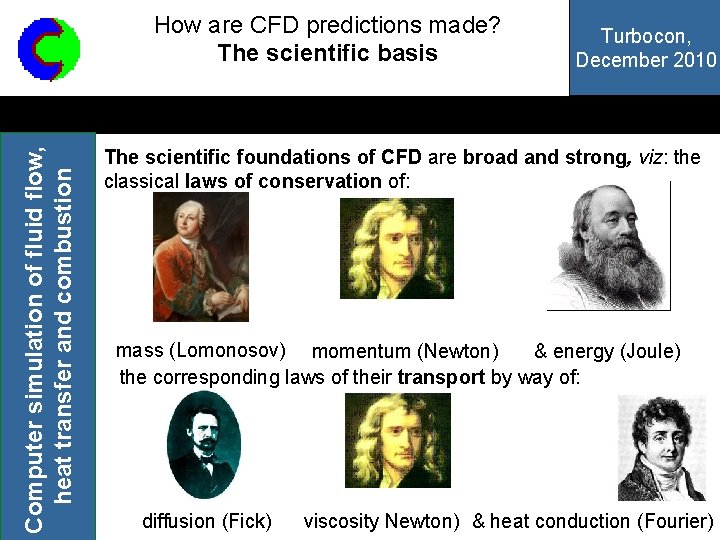
Computer simulation of fluid flow, heat transfer and combustion How are CFD predictions made? The scientific basis Turbocon, December 2010 The scientific foundations of CFD are broad and strong, viz: the classical laws of conservation of: mass (Lomonosov) momentum (Newton) & energy (Joule) the corresponding laws of their transport by way of: diffusion (Fick) viscosity Newton) & heat conduction (Fourier)
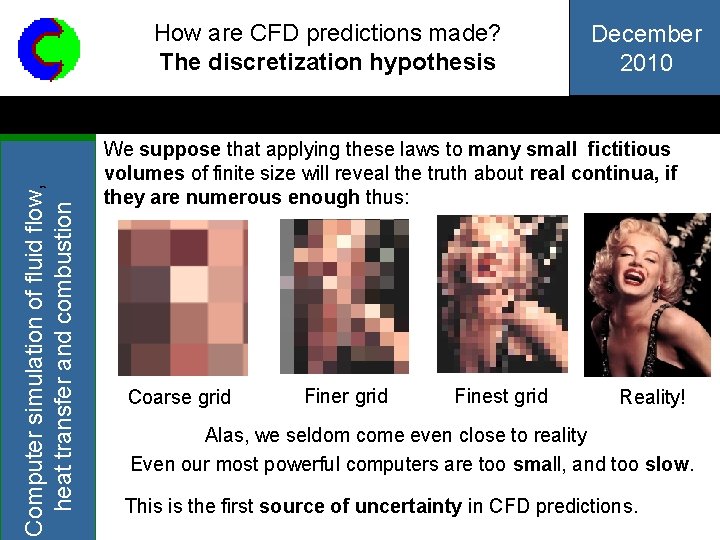
Computer simulation of fluid flow, heat transfer and combustion How are CFD predictions made? The discretization hypothesis December 2010 We suppose that applying these laws to many small fictitious volumes of finite size will reveal the truth about real continua, if they are numerous enough thus: Coarse grid Finer grid Finest grid Reality! Alas, we seldom come even close to reality Even our most powerful computers are too small, and too slow. This is the first source of uncertainty in CFD predictions.
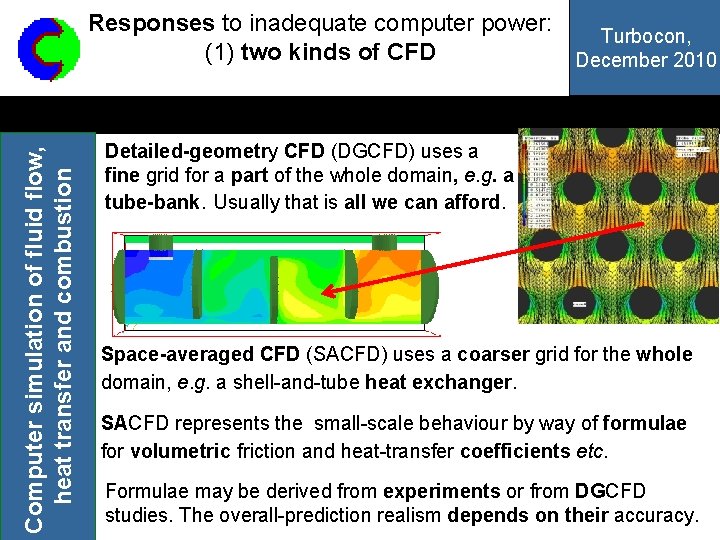
Computer simulation of fluid flow, heat transfer and combustion Responses to inadequate computer power: Turbocon, (1) two kinds of CFD December 2010 Detailed-geometry CFD (DGCFD) uses a fine grid for a part of the whole domain, e. g. a tube-bank. Usually that is all we can afford. Space-averaged CFD (SACFD) uses a coarser grid for the whole domain, e. g. a shell-and-tube heat exchanger. SACFD represents the small-scale behaviour by way of formulae for volumetric friction and heat-transfer coefficients etc. Formulae may be derived from experiments or from DGCFD studies. The overall-prediction realism depends on their accuracy.
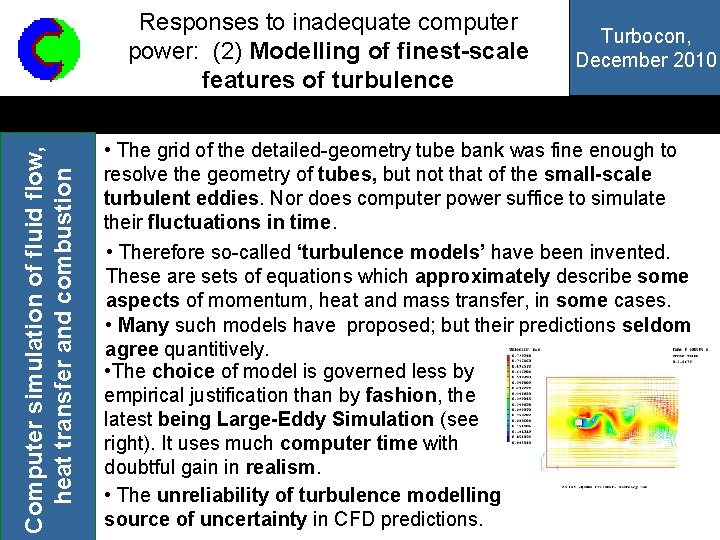
Computer simulation of fluid flow, heat transfer and combustion Responses to inadequate computer power: (2) Modelling of finest-scale features of turbulence Turbocon, December 2010 • The grid of the detailed-geometry tube bank was fine enough to resolve the geometry of tubes, but not that of the small-scale turbulent eddies. Nor does computer power suffice to simulate their fluctuations in time. • Therefore so-called ‘turbulence models’ have been invented. These are sets of equations which approximately describe some aspects of momentum, heat and mass transfer, in some cases. • Many such models have proposed; but their predictions seldom agree quantitively. • The choice of model is governed less by empirical justification than by fashion, the latest being Large-Eddy Simulation (see right). It uses much computer time with doubtful gain in realism. • The unreliability of turbulence modelling is a second serious source of uncertainty in CFD predictions.
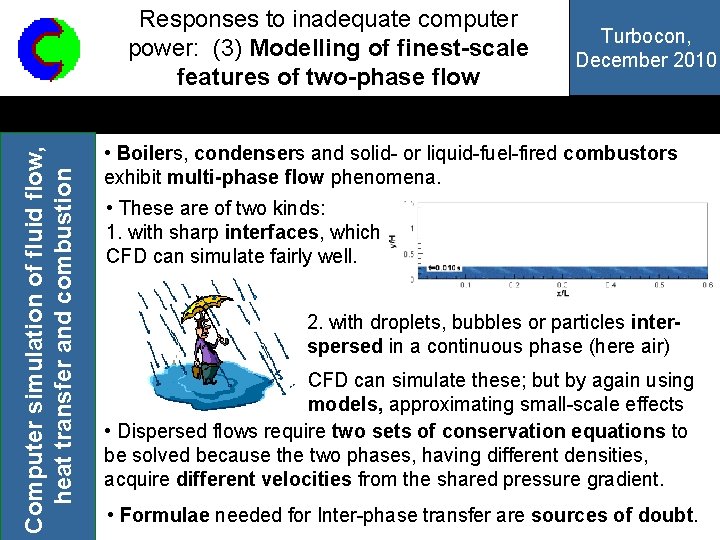
Computer simulation of fluid flow, heat transfer and combustion Responses to inadequate computer power: (3) Modelling of finest-scale features of two-phase flow Turbocon, December 2010 • Boilers, condensers and solid- or liquid-fuel-fired combustors exhibit multi-phase flow phenomena. • These are of two kinds: 1. with sharp interfaces, which CFD can simulate fairly well. 2. with droplets, bubbles or particles interspersed in a continuous phase (here air) CFD can simulate these; but by again using models, approximating small-scale effects • Dispersed flows require two sets of conservation equations to be solved because the two phases, having different densities, acquire different velocities from the shared pressure gradient. • Formulae needed for Inter-phase transfer are sources of doubt.
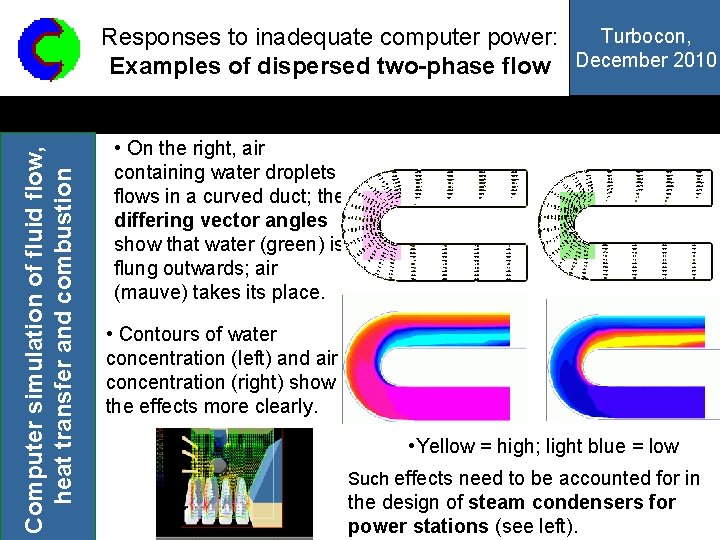
Computer simulation of fluid flow, heat transfer and combustion Turbocon, Responses to inadequate computer power: Examples of dispersed two-phase flow December 2010 • On the right, air containing water droplets flows in a curved duct; the differing vector angles show that water (green) is flung outwards; air (mauve) takes its place. • Contours of water concentration (left) and air concentration (right) show the effects more clearly. • Yellow = high; light blue = low Such effects need to be accounted for in the design of steam condensers for power stations (see left).
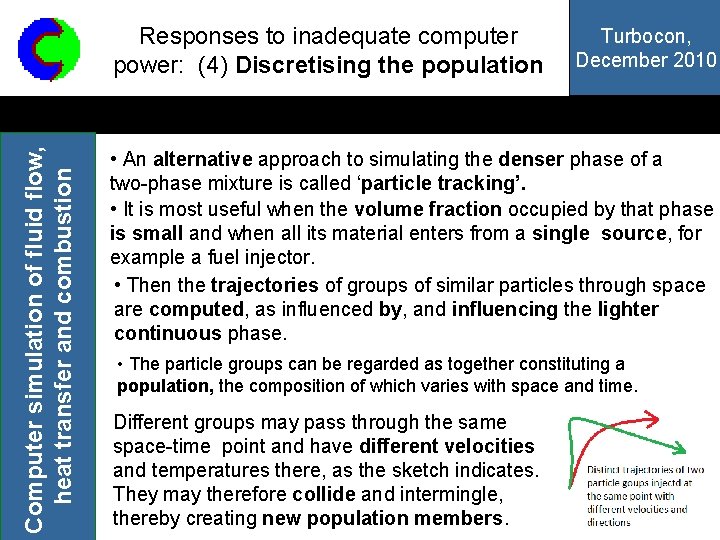
Computer simulation of fluid flow, heat transfer and combustion Responses to inadequate computer power: (4) Discretising the population Turbocon, December 2010 • An alternative approach to simulating the denser phase of a two-phase mixture is called ‘particle tracking’. • It is most useful when the volume fraction occupied by that phase is small and when all its material enters from a single source, for example a fuel injector. • Then the trajectories of groups of similar particles through space are computed, as influenced by, and influencing the lighter continuous phase. • The particle groups can be regarded as together constituting a population, the composition of which varies with space and time. Different groups may pass through the same space-time point and have different velocities and temperatures there, as the sketch indicates. They may therefore collide and intermingle, thereby creating new population members.
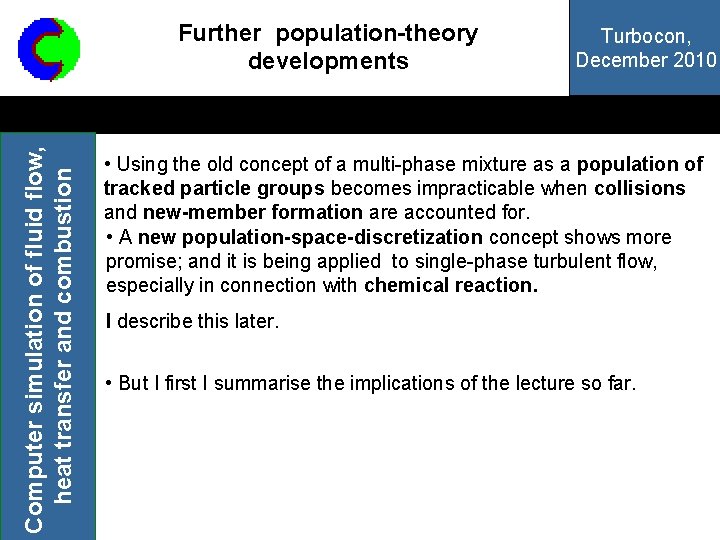
Computer simulation of fluid flow, heat transfer and combustion Further population-theory developments Turbocon, December 2010 • Using the old concept of a multi-phase mixture as a population of tracked particle groups becomes impracticable when collisions and new-member formation are accounted for. • A new population-space-discretization concept shows more promise; and it is being applied to single-phase turbulent flow, especially in connection with chemical reaction. I describe this later. • But I first I summarise the implications of the lecture so far.
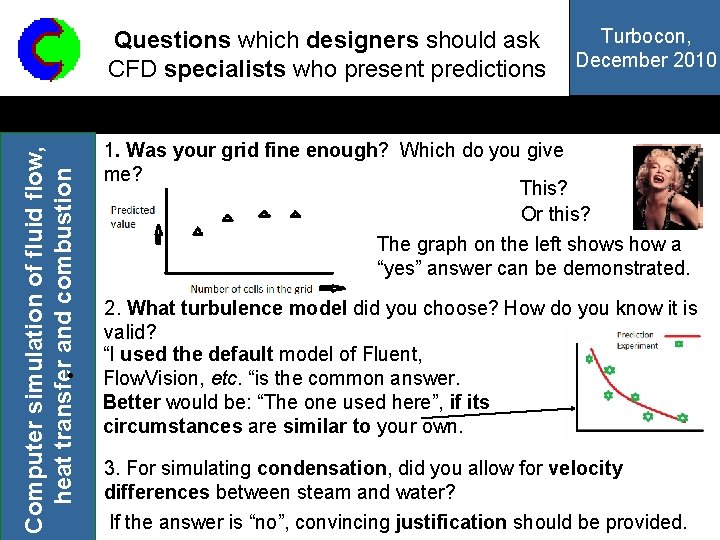
Computer simulation of fluid flow, heat transfer and combustion Questions which designers should ask CFD specialists who present predictions • Turbocon, December 2010 1. Was your grid fine enough? Which do you give me? This? Or this? The graph on the left shows how a “yes” answer can be demonstrated. 2. What turbulence model did you choose? How do you know it is valid? “I used the default model of Fluent, Flow. Vision, etc. “is the common answer. Better would be: “The one used here”, if its circumstances are similar to your own. 3. For simulating condensation, did you allow for velocity differences between steam and water? If the answer is “no”, convincing justification should be provided.
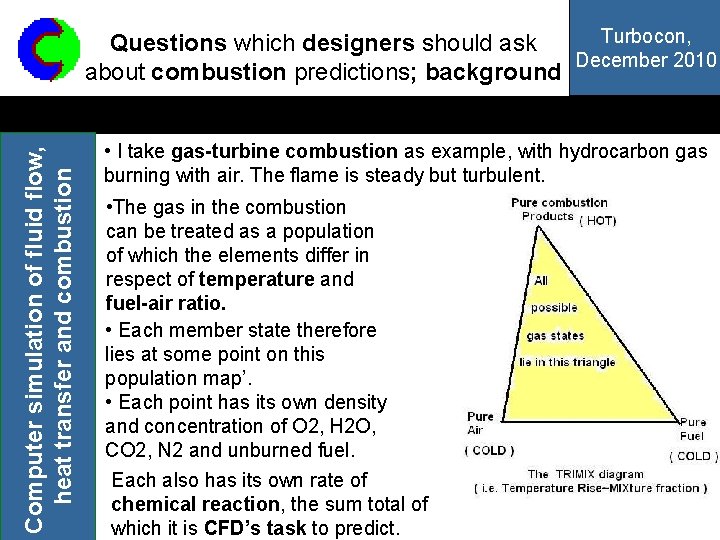
Computer simulation of fluid flow, heat transfer and combustion Turbocon, Questions which designers should ask December 2010 about combustion predictions; background • I take gas-turbine combustion as example, with hydrocarbon gas burning with air. The flame is steady but turbulent. • The gas in the combustion can be treated as a population of which the elements differ in respect of temperature and fuel-air ratio. • Each member state therefore lies at some point on this population map’. • Each point has its own density and concentration of O 2, H 2 O, CO 2, N 2 and unburned fuel. Each also has its own rate of chemical reaction, the sum total of which it is CFD’s task to predict.
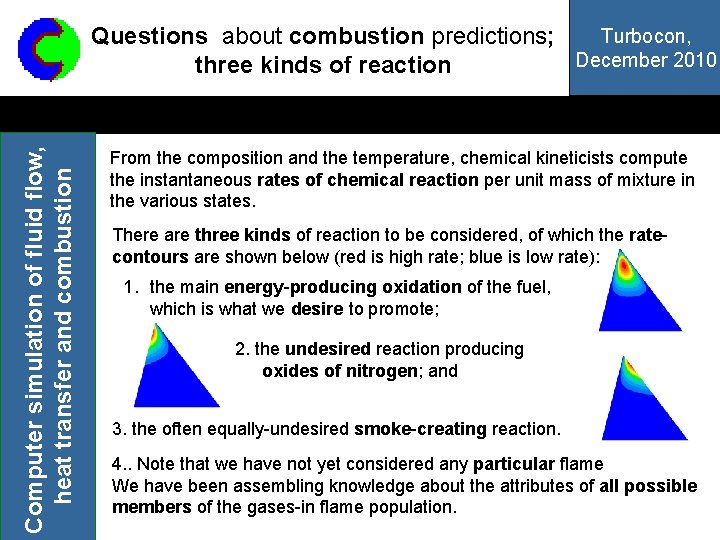
Computer simulation of fluid flow, heat transfer and combustion Turbocon, Questions about combustion predictions; December 2010 three kinds of reaction From the composition and the temperature, chemical kineticists compute the instantaneous rates of chemical reaction per unit mass of mixture in the various states. There are three kinds of reaction to be considered, of which the ratecontours are shown below (red is high rate; blue is low rate): 1. the main energy-producing oxidation of the fuel, which is what we desire to promote; 2. the undesired reaction producing oxides of nitrogen; and 3. the often equally-undesired smoke-creating reaction. 4. . Note that we have not yet considered any particular flame We have been assembling knowledge about the attributes of all possible members of the gases-in flame population.
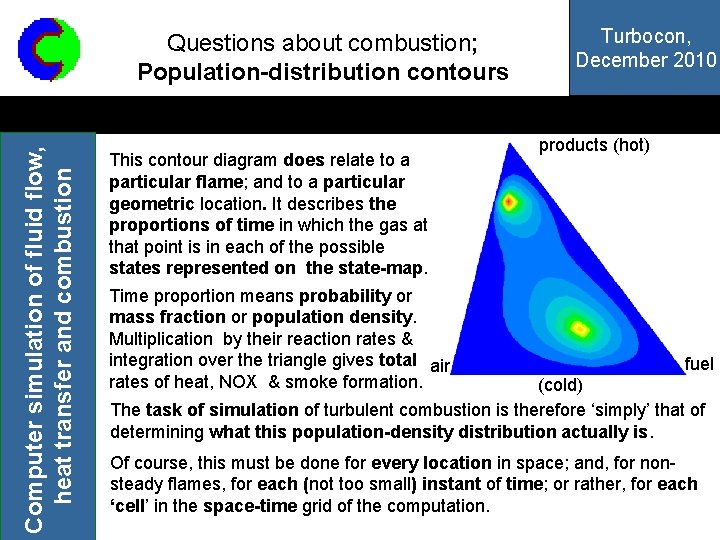
Computer simulation of fluid flow, heat transfer and combustion Questions about combustion; Population-distribution contours This contour diagram does relate to a particular flame; and to a particular geometric location. It describes the proportions of time in which the gas at that point is in each of the possible states represented on the state-map. Time proportion means probability or mass fraction or population density. Multiplication by their reaction rates & integration over the triangle gives total air rates of heat, NOX & smoke formation. Turbocon, December 2010 products (hot) fuel (cold) The task of simulation of turbulent combustion is therefore ‘simply’ that of determining what this population-density distribution actually is. Of course, this must be done for every location in space; and, for nonsteady flames, for each (not too small) instant of time; or rather, for each ‘cell’ in the space-time grid of the computation.
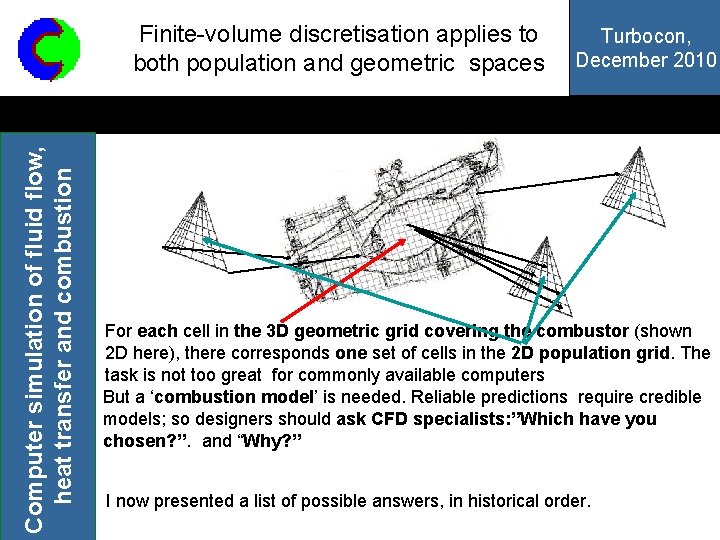
Computer simulation of fluid flow, heat transfer and combustion Finite-volume discretisation applies to both population and geometric spaces Turbocon, December 2010 For each cell in the 3 D geometric grid covering the combustor (shown 2 D here), there corresponds one set of cells in the 2 D population grid. The task is not too great for commonly available computers But a ‘combustion model’ is needed. Reliable predictions require credible models; so designers should ask CFD specialists: ”Which have you chosen? ”. and “Why? ” I now presented a list of possible answers, in historical order.
Computer simulation of fluid flow, heat transfer and combustion Questions about combustion models; Some possible answers Turbocon, December 2010 These are the models which I shall discuss Extremely unrealistic models • One-person populations: NOFMIB, NOFL Somewhat-better but still crude models • Two-person populations: EBU, presumed-pdf, two-fluid, EDC Too-complex-to-be-useful models • Laminar-flame populations: ESCIMO, flamelet; pdf-transport More realistic, and practicable, models • Many-person populations: four-fluid, fourteen fluid, multi-fluid.
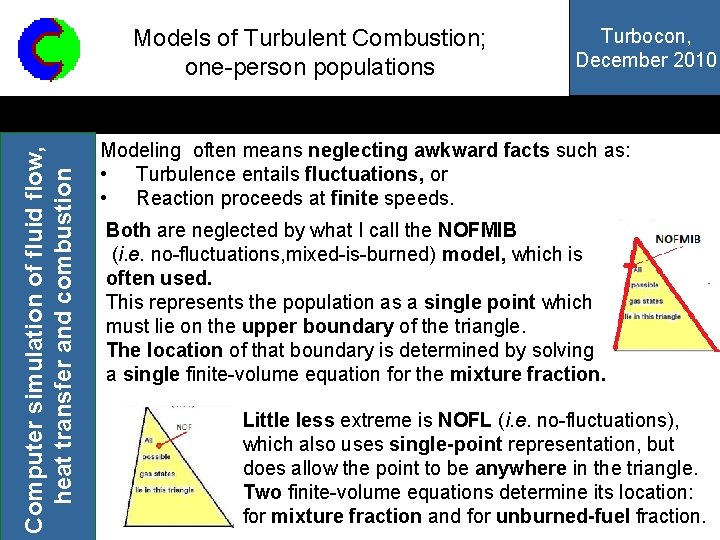
Computer simulation of fluid flow, heat transfer and combustion Models of Turbulent Combustion; one-person populations Turbocon, December 2010 Modeling often means neglecting awkward facts such as: • Turbulence entails fluctuations, or • Reaction proceeds at finite speeds. Both are neglected by what I call the NOFMIB (i. e. no-fluctuations, mixed-is-burned) model, which is often used. This represents the population as a single point which must lie on the upper boundary of the triangle. The location of that boundary is determined by solving a single finite-volume equation for the mixture fraction. Little less extreme is NOFL (i. e. no-fluctuations), which also uses single-point representation, but does allow the point to be anywhere in the triangle. Two finite-volume equations determine its location: for mixture fraction and for unburned-fuel fraction.
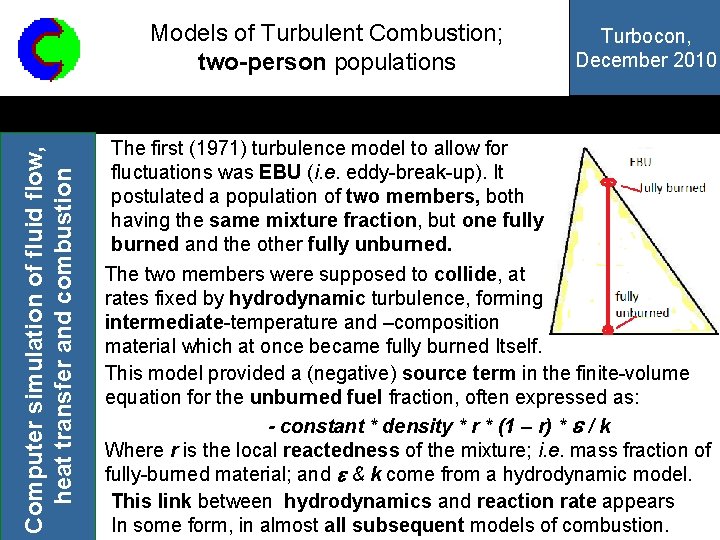
Computer simulation of fluid flow, heat transfer and combustion Models of Turbulent Combustion; two-person populations Turbocon, December 2010 The first (1971) turbulence model to allow for fluctuations was EBU (i. e. eddy-break-up). It postulated a population of two members, both having the same mixture fraction, but one fully burned and the other fully unburned. The two members were supposed to collide, at rates fixed by hydrodynamic turbulence, forming intermediate-temperature and –composition material which at once became fully burned Itself. This model provided a (negative) source term in the finite-volume equation for the unburned fuel fraction, often expressed as: - constant * density * r * (1 – r) * e / k Where r is the local reactedness of the mixture; i. e. mass fraction of fully-burned material; and e & k come from a hydrodynamic model. This link between hydrodynamics and reaction rate appears In some form, in almost all subsequent models of combustion.
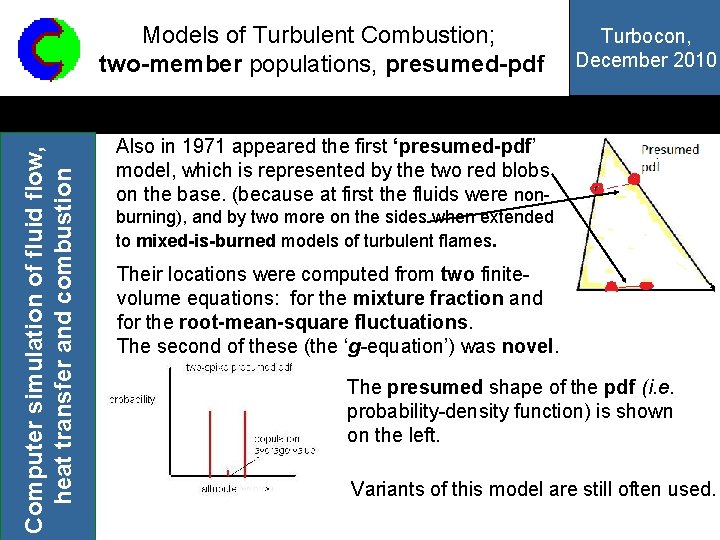
Computer simulation of fluid flow, heat transfer and combustion Models of Turbulent Combustion; two-member populations, presumed-pdf Turbocon, December 2010 Also in 1971 appeared the first ‘presumed-pdf’ model, which is represented by the two red blobs on the base. (because at first the fluids were nonburning), and by two more on the sides when extended to mixed-is-burned models of turbulent flames. Their locations were computed from two finitevolume equations: for the mixture fraction and for the root-mean-square fluctuations. The second of these (the ‘g-equation’) was novel. The presumed shape of the pdf (i. e. probability-density function) is shown on the left. Variants of this model are still often used.
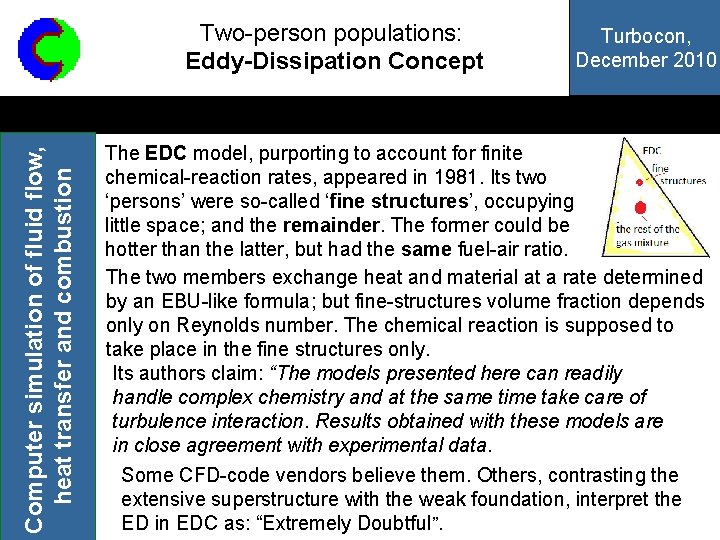
Computer simulation of fluid flow, heat transfer and combustion Two-person populations: Eddy-Dissipation Concept Turbocon, December 2010 The EDC model, purporting to account for finite chemical-reaction rates, appeared in 1981. Its two ‘persons’ were so-called ‘fine structures’, occupying little space; and the remainder. The former could be hotter than the latter, but had the same fuel-air ratio. The two members exchange heat and material at a rate determined by an EBU-like formula; but fine-structures volume fraction depends only on Reynolds number. The chemical reaction is supposed to take place in the fine structures only. Its authors claim: “The models presented here can readily handle complex chemistry and at the same time take care of turbulence interaction. Results obtained with these models are in close agreement with experimental data. Some CFD-code vendors believe them. Others, contrasting the extensive superstructure with the weak foundation, interpret the ED in EDC as: “Extremely Doubtful”.
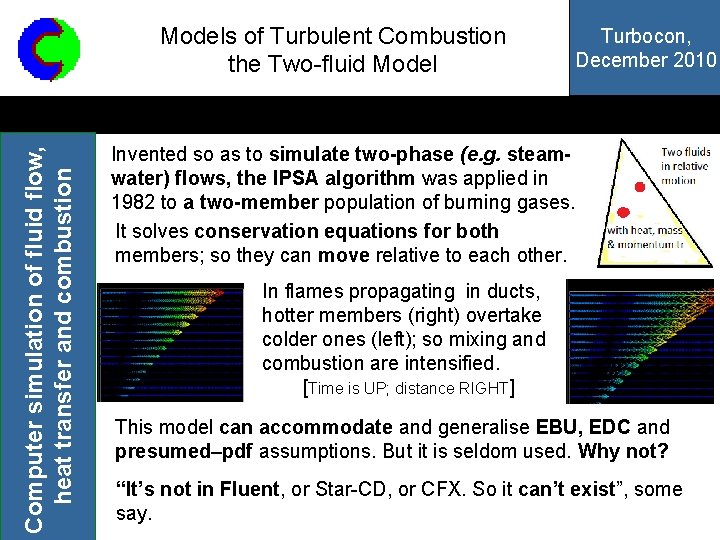
Computer simulation of fluid flow, heat transfer and combustion Models of Turbulent Combustion the Two-fluid Model Turbocon, December 2010 Invented so as to simulate two-phase (e. g. steamwater) flows, the IPSA algorithm was applied in 1982 to a two-member population of burning gases. It solves conservation equations for both members; so they can move relative to each other. In flames propagating in ducts, hotter members (right) overtake colder ones (left); so mixing and combustion are intensified. [Time is UP; distance RIGHT] This model can accommodate and generalise EBU, EDC and presumed–pdf assumptions. But it is seldom used. Why not? “It’s not in Fluent, or Star-CD, or CFX. So it can’t exist”, some say.
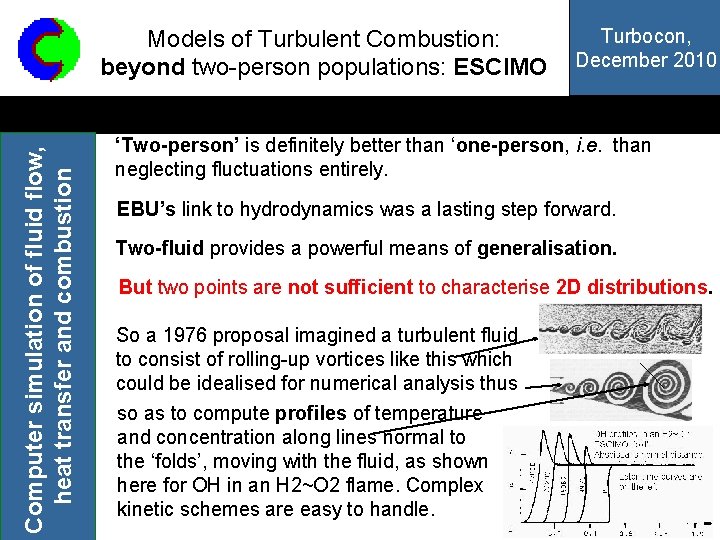
Computer simulation of fluid flow, heat transfer and combustion Models of Turbulent Combustion: beyond two-person populations: ESCIMO Turbocon, December 2010 ‘Two-person’ is definitely better than ‘one-person, i. e. than neglecting fluctuations entirely. EBU’s link to hydrodynamics was a lasting step forward. Two-fluid provides a powerful means of generalisation. But two points are not sufficient to characterise 2 D distributions. So a 1976 proposal imagined a turbulent fluid to consist of rolling-up vortices like this which could be idealised for numerical analysis thus so as to compute profiles of temperature and concentration along lines normal to the ‘folds’, moving with the fluid, as shown here for OH in an H 2~O 2 flame. Complex kinetic schemes are easy to handle.
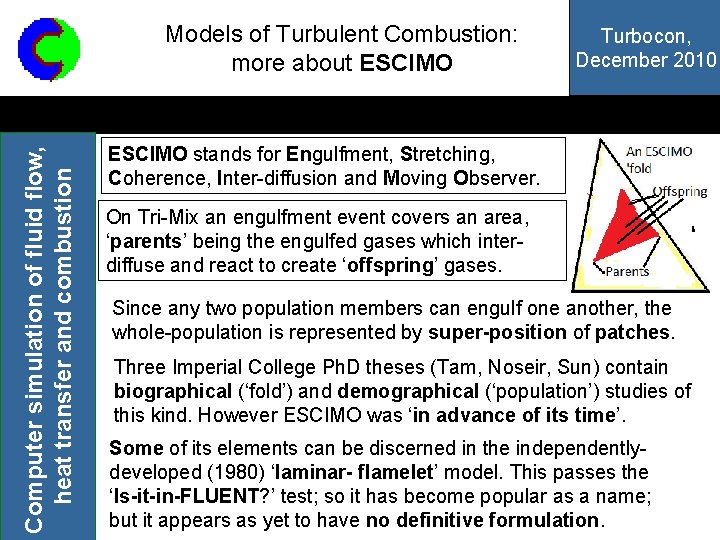
Computer simulation of fluid flow, heat transfer and combustion Models of Turbulent Combustion: more about ESCIMO Turbocon, December 2010 ESCIMO stands for Engulfment, Stretching, Coherence, Inter-diffusion and Moving Observer. On Tri-Mix an engulfment event covers an area, ‘parents’ being the engulfed gases which interdiffuse and react to create ‘offspring’ gases. Since any two population members can engulf one another, the whole-population is represented by super-position of patches. Three Imperial College Ph. D theses (Tam, Noseir, Sun) contain biographical (‘fold’) and demographical (‘population’) studies of this kind. However ESCIMO was ‘in advance of its time’. Some of its elements can be discerned in the independentlydeveloped (1980) ‘laminar- flamelet’ model. This passes the ‘Is-it-in-FLUENT? ’ test; so it has become popular as a name; but it appears as yet to have no definitive formulation.
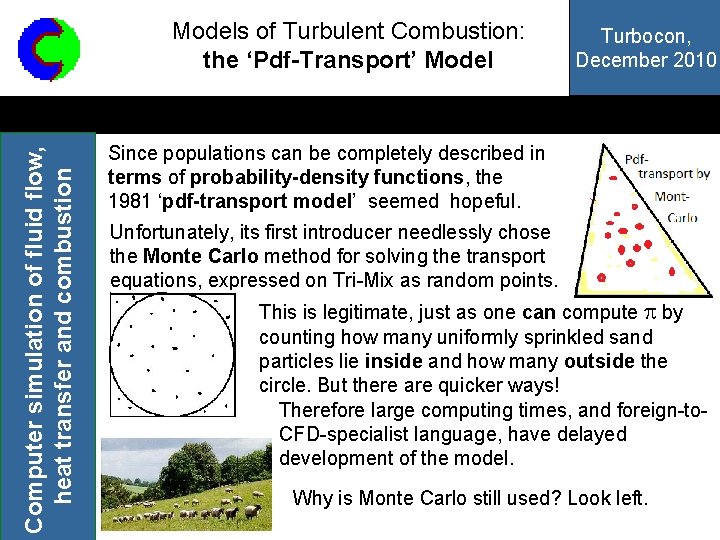
Computer simulation of fluid flow, heat transfer and combustion Models of Turbulent Combustion: the ‘Pdf-Transport’ Model Turbocon, December 2010 Since populations can be completely described in terms of probability-density functions, the 1981 ‘pdf-transport model’ seemed hopeful. Unfortunately, its first introducer needlessly chose the Monte Carlo method for solving the transport equations, expressed on Tri-Mix as random points. This is legitimate, just as one can compute p by counting how many uniformly sprinkled sand particles lie inside and how many outside the circle. But there are quicker ways! Therefore large computing times, and foreign-to. CFD-specialist language, have delayed development of the model. Why is Monte Carlo still used? Look left.
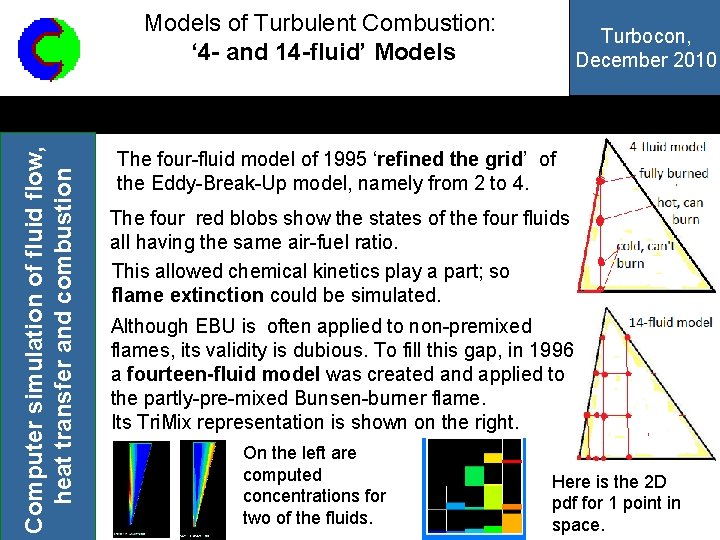
Computer simulation of fluid flow, heat transfer and combustion Models of Turbulent Combustion: ‘ 4 - and 14 -fluid’ Models Turbocon, December 2010 The four-fluid model of 1995 ‘refined the grid’ of the Eddy-Break-Up model, namely from 2 to 4. The four red blobs show the states of the four fluids all having the same air-fuel ratio. This allowed chemical kinetics play a part; so flame extinction could be simulated. Although EBU is often applied to non-premixed flames, its validity is dubious. To fill this gap, in 1996 a fourteen-fluid model was created and applied to the partly-pre-mixed Bunsen-burner flame. Its Tri. Mix representation is shown on the right. On the left are computed concentrations for two of the fluids. Here is the 2 D pdf for 1 point in space.
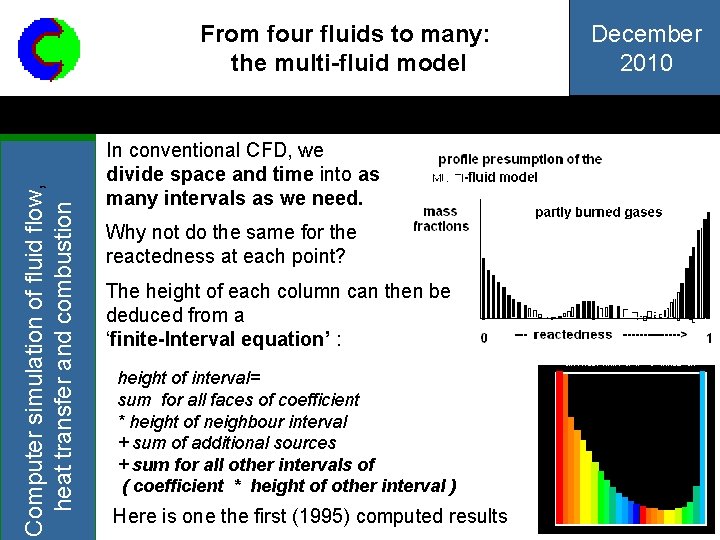
Computer simulation of fluid flow, heat transfer and combustion From four fluids to many: the multi-fluid model In conventional CFD, we divide space and time into as many intervals as we need. Why not do the same for the reactedness at each point? The height of each column can then be deduced from a ‘finite-Interval equation’ : height of interval= sum for all faces of coefficient * height of neighbour interval + sum of additional sources + sum for all other intervals of ( coefficient * height of other interval ) Here is one the first (1995) computed results December 2010
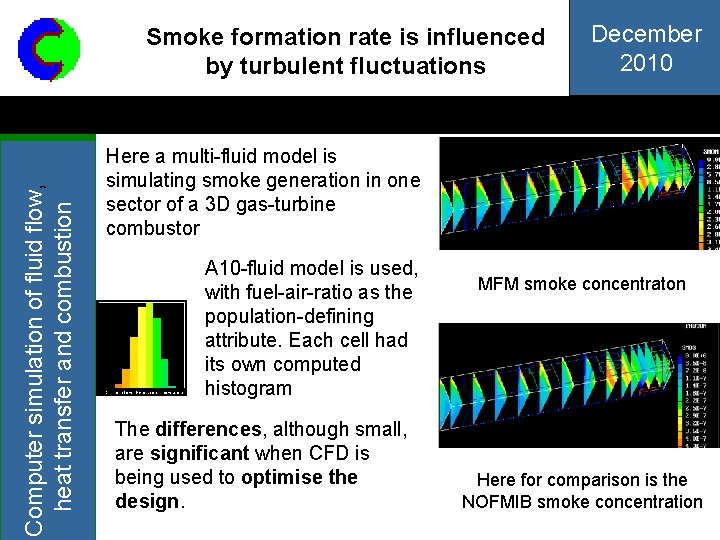
Computer simulation of fluid flow, heat transfer and combustion Smoke formation rate is influenced by turbulent fluctuations December 2010 Here a multi-fluid model is simulating smoke generation in one sector of a 3 D gas-turbine combustor A 10 -fluid model is used, with fuel-air-ratio as the population-defining attribute. Each cell had its own computed histogram The differences, although small, are significant when CFD is being used to optimise the design. MFM smoke concentraton Here for comparison is the NOFMIB smoke concentration
Computer simulation of fluid flow, heat transfer and combustion Conclusions about turbulent-combustion models Turbocon, December 2010 1. To represent the population of gases in a combustion chamber by only one or two states cannot be realistic. 2. Therefore, since multi-fluid models allow many states to be considered, they should be preferred. 3. So combustion-chamber designers should ask their CFD specialists: “When are you going to start? ” However some computer codes are so easy to use that the designers can use them without help from specialists Examples follow
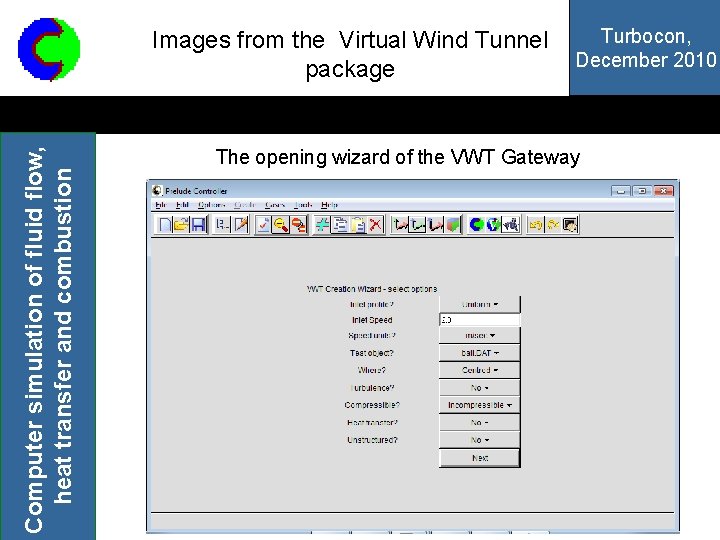
Computer simulation of fluid flow, heat transfer and combustion Images from the Virtual Wind Tunnel package Turbocon, December 2010 The opening wizard of the VWT Gateway
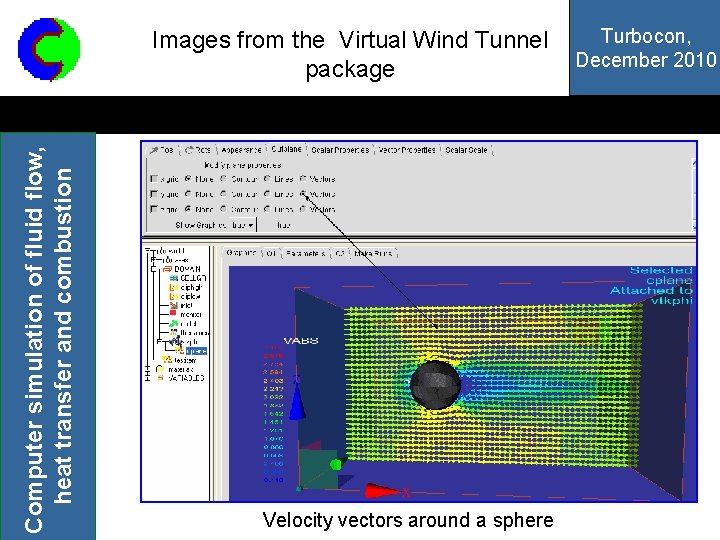
Computer simulation of fluid flow, heat transfer and combustion Images from the Virtual Wind Tunnel package Velocity vectors around a sphere Turbocon, December 2010
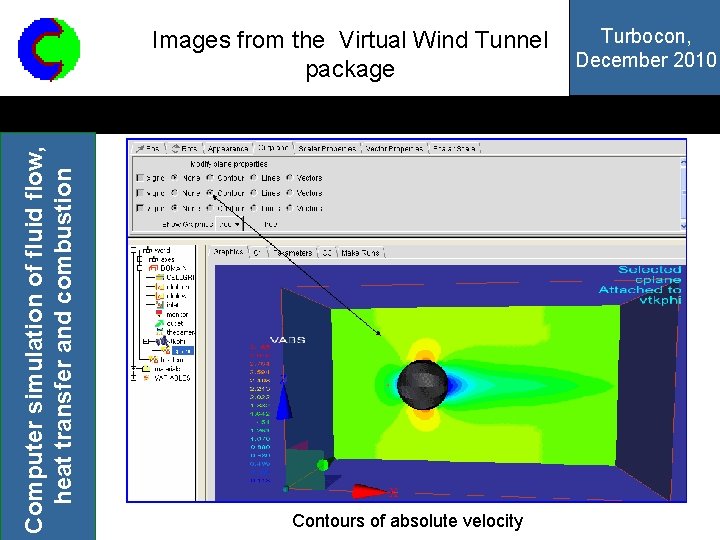
Computer simulation of fluid flow, heat transfer and combustion Images from the Virtual Wind Tunnel package Contours of absolute velocity Turbocon, December 2010
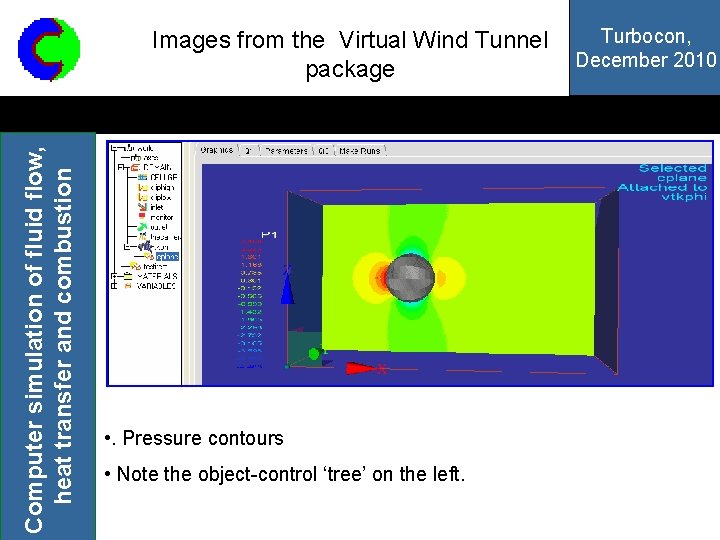
Computer simulation of fluid flow, heat transfer and combustion Images from the Virtual Wind Tunnel package • . Pressure contours • Note the object-control ‘tree’ on the left. Turbocon, December 2010
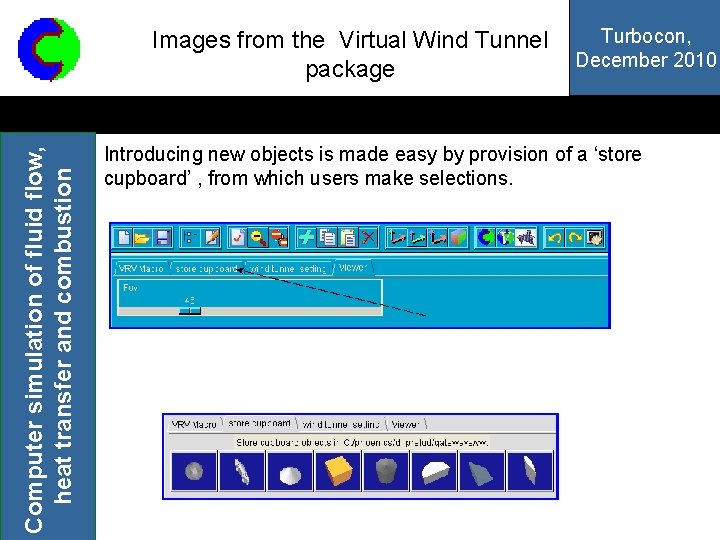
Computer simulation of fluid flow, heat transfer and combustion Images from the Virtual Wind Tunnel package Turbocon, December 2010 Introducing new objects is made easy by provision of a ‘store cupboard’ , from which users make selections.
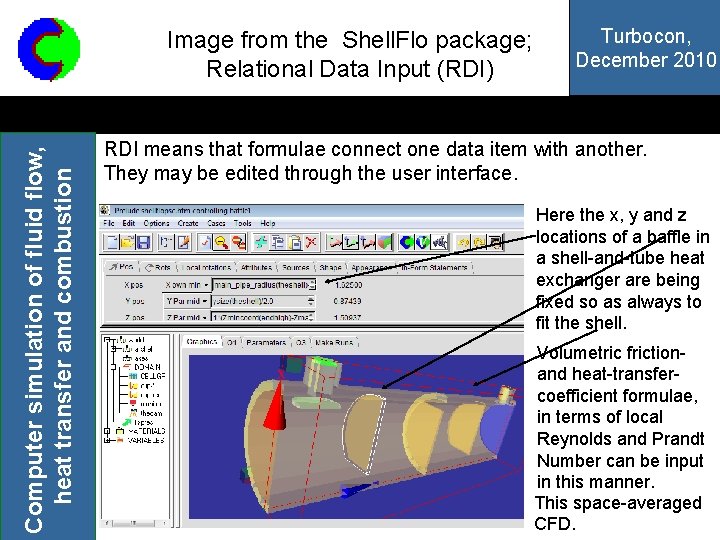
Computer simulation of fluid flow, heat transfer and combustion Image from the Shell. Flo package; Relational Data Input (RDI) Turbocon, December 2010 RDI means that formulae connect one data item with another. They may be edited through the user interface. Here the x, y and z locations of a baffle in a shell-and-tube heat exchanger are being fixed so as always to fit the shell. Volumetric frictionand heat-transfercoefficient formulae, in terms of local Reynolds and Prandt Number can be input in this manner. This space-averaged CFD.
Computer simulation of fluid flow, heat transfer and combustion Final remarks about designer-usable CFD packages Turbocon, December 2010 Packages of interest to Turbocon might facilitate design of: • Air-cooled condensers • Steam-turbine cascades • Gaseous-fuel combustion chambers • Cooling towers All that is needed is to specify what is wanted. Then the general interface-making tools can be applied so to create interfaces enabling the special-equipment designers to make performance predictions for themselves. The End