
Computer Simulation of an Avian Syrinx Phase I
- Slides: 1
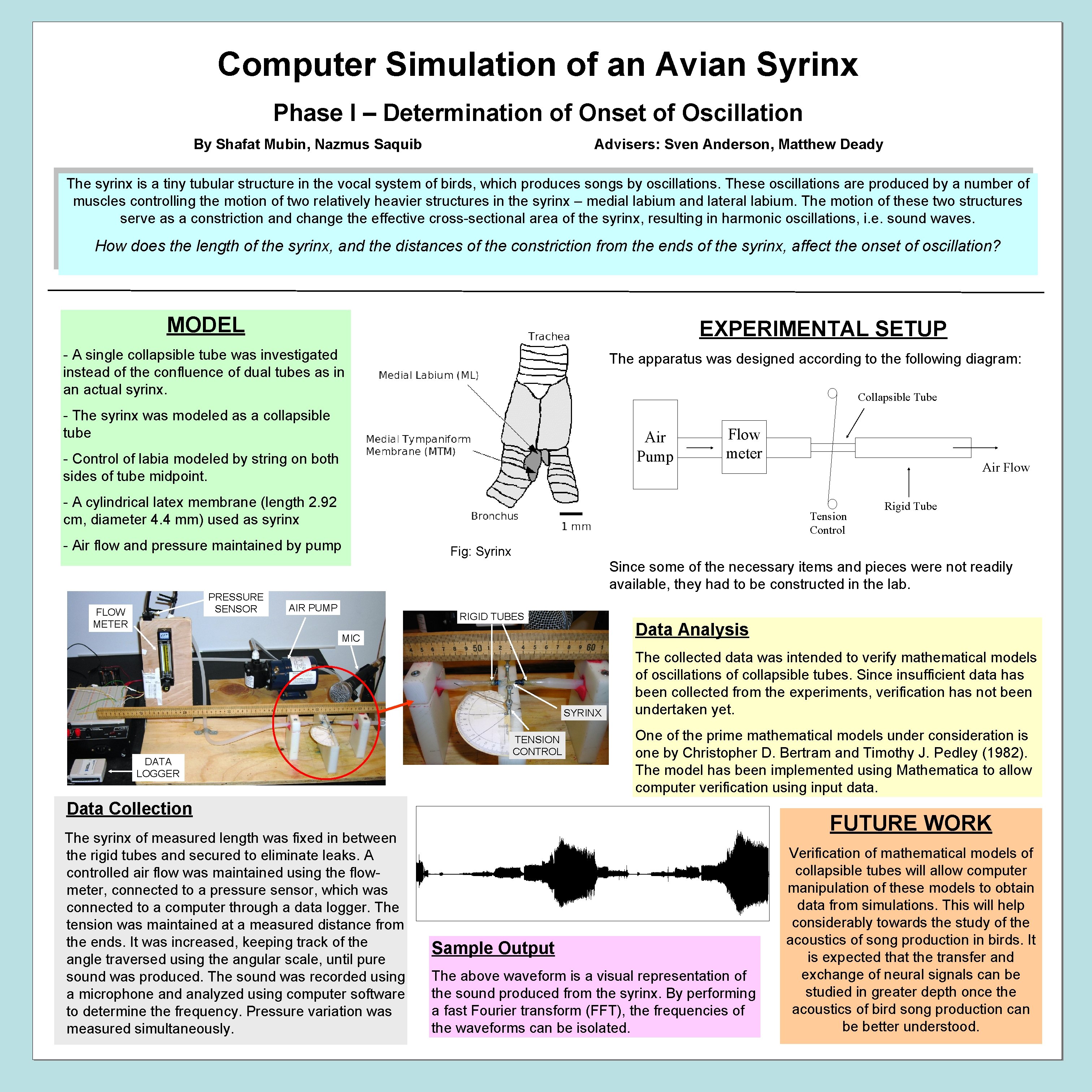
Computer Simulation of an Avian Syrinx Phase I – Determination of Onset of Oscillation By Shafat Mubin, Nazmus Saquib Advisers: Sven Anderson, Matthew Deady The syrinx is a tiny tubular structure in the vocal system of birds, which produces songs by oscillations. These oscillations are produced by a number of muscles controlling the motion of two relatively heavier structures in the syrinx – medial labium and lateral labium. The motion of these two structures serve as a constriction and change the effective cross-sectional area of the syrinx, resulting in harmonic oscillations, i. e. sound waves. How does the length of the syrinx, and the distances of the constriction from the ends of the syrinx, affect the onset of oscillation? MODEL EXPERIMENTAL SETUP - A single collapsible tube was investigated instead of the confluence of dual tubes as in an actual syrinx. The apparatus was designed according to the following diagram: Collapsible Tube - The syrinx was modeled as a collapsible tube Air Pump - Control of labia modeled by string on both sides of tube midpoint. Flow meter - A cylindrical latex membrane (length 2. 92 cm, diameter 4. 4 mm) used as syrinx Tension Control - Air flow and pressure maintained by pump PRESSURE SENSOR FLOW METER Air Flow Rigid Tube Fig: Syrinx Since some of the necessary items and pieces were not readily available, they had to be constructed in the lab. AIR PUMP RIGID TUBES Data Analysis MIC SYRINX DATA LOGGER TENSION CONTROL The collected data was intended to verify mathematical models of oscillations of collapsible tubes. Since insufficient data has been collected from the experiments, verification has not been undertaken yet. One of the prime mathematical models under consideration is one by Christopher D. Bertram and Timothy J. Pedley (1982). The model has been implemented using Mathematica to allow computer verification using input data. Data Collection The syrinx of measured length was fixed in between the rigid tubes and secured to eliminate leaks. A controlled air flow was maintained using the flowmeter, connected to a pressure sensor, which was connected to a computer through a data logger. The tension was maintained at a measured distance from the ends. It was increased, keeping track of the angle traversed using the angular scale, until pure sound was produced. The sound was recorded using a microphone and analyzed using computer software to determine the frequency. Pressure variation was measured simultaneously. FUTURE WORK Sample Output The above waveform is a visual representation of the sound produced from the syrinx. By performing a fast Fourier transform (FFT), the frequencies of the waveforms can be isolated. Verification of mathematical models of collapsible tubes will allow computer manipulation of these models to obtain data from simulations. This will help considerably towards the study of the acoustics of song production in birds. It is expected that the transfer and exchange of neural signals can be studied in greater depth once the acoustics of bird song production can be better understood.