
Computer Security Principles and Practice Chapter 20 PublicKey
Computer Security: Principles and Practice Chapter 20 – Public-Key Cryptography and Message Authentication First Edition by William Stallings and Lawrie Brown Lecture slides by Lawrie Brown
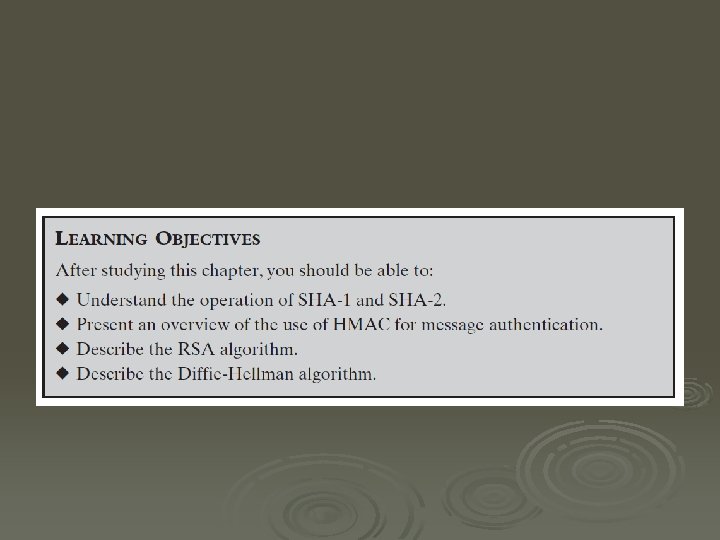
Public-Key Cryptography and Message Authentication Ø now look at technical detail concerning: l l secure hash functions and HMAC RSA & Diffie-Hellman Public-Key Algorithms
Simple Hash Functions Ø a one-way or secure hash function used in message authentication, digital signatures Ø all hash functions process input a block at a time in an iterative fashion Ø one of simplest hash functions is the bit-by -bit exclusive-OR (XOR) of each block l l l Ci = bi 1 bi 2 . . . bim effective data integrity check on random data less effective on more predictable data virtually useless for data security
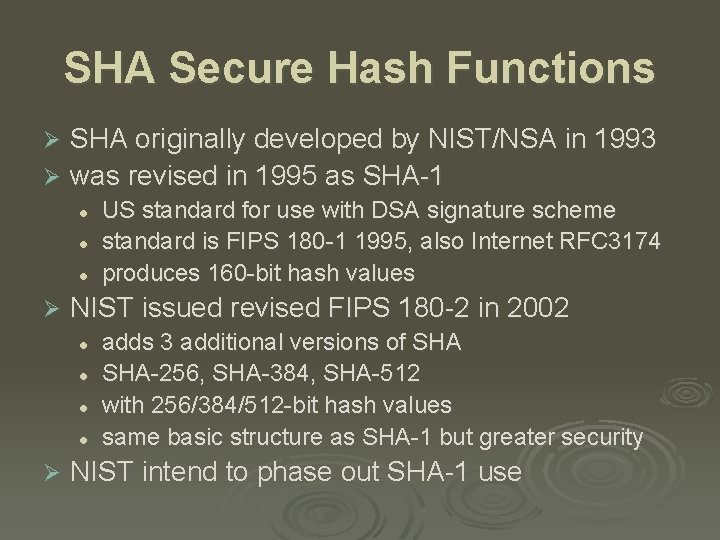
SHA Secure Hash Functions SHA originally developed by NIST/NSA in 1993 Ø was revised in 1995 as SHA-1 Ø l l l Ø NIST issued revised FIPS 180 -2 in 2002 l l Ø US standard for use with DSA signature scheme standard is FIPS 180 -1 1995, also Internet RFC 3174 produces 160 -bit hash values adds 3 additional versions of SHA-256, SHA-384, SHA-512 with 256/384/512 -bit hash values same basic structure as SHA-1 but greater security NIST intend to phase out SHA-1 use

SHA-512 Structure
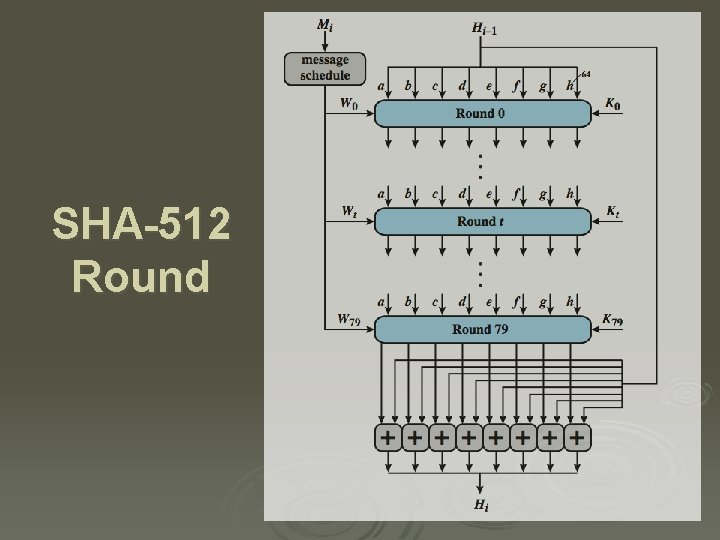
SHA-512 Round
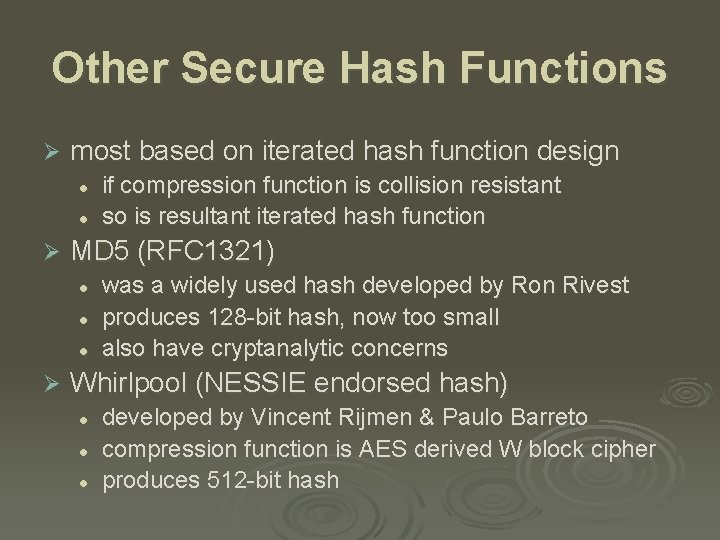
Other Secure Hash Functions Ø most based on iterated hash function design l l Ø MD 5 (RFC 1321) l l l Ø if compression function is collision resistant so is resultant iterated hash function was a widely used hash developed by Ron Rivest produces 128 -bit hash, now too small also have cryptanalytic concerns Whirlpool (NESSIE endorsed hash) l l l developed by Vincent Rijmen & Paulo Barreto compression function is AES derived W block cipher produces 512 -bit hash
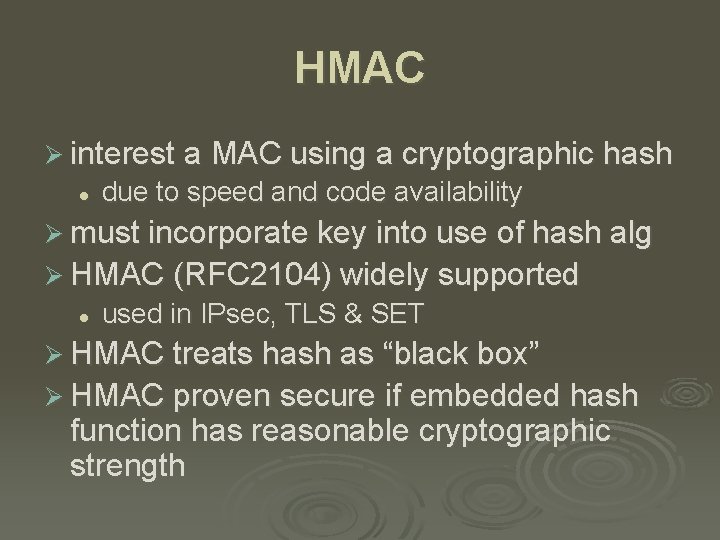
HMAC Ø interest a MAC using a cryptographic hash l due to speed and code availability Ø must incorporate key into use of hash alg Ø HMAC (RFC 2104) widely supported l used in IPsec, TLS & SET Ø HMAC treats hash as “black box” Ø HMAC proven secure if embedded hash function has reasonable cryptographic strength
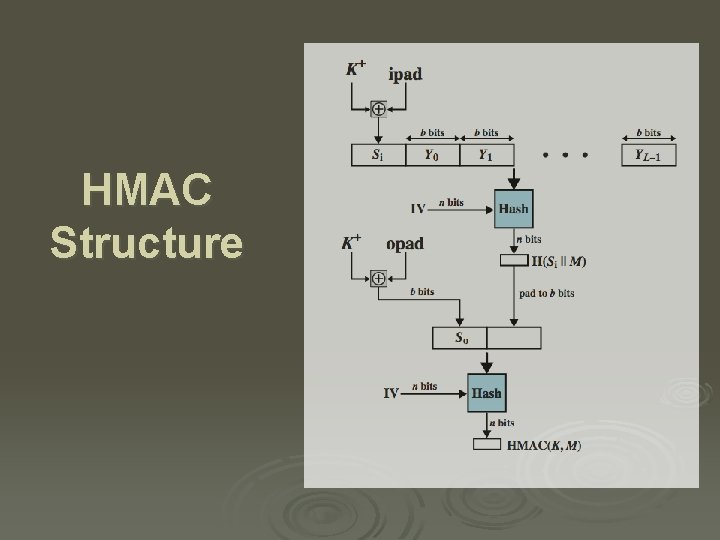
HMAC Structure
Security of HMAC Ø security based on underlying hash strength Ø have prob given time and no msg-MAC’s Ø either attacker computes output even with random secret IV l brute force key O(2 n), or use birthday attack Ø or attacker finds collisions in hash function even when IV is random and secret l l l ie. find M and M' such that H(M) = H(M') birthday attack O( 2 n/2) MD 5 secure in HMAC since only observe
RSA Public-Key Encryption by Rivest, Shamir & Adleman of MIT in 1977 Ø best known & widely used public-key alg Ø uses exponentiation of integers modulo a prime Ø encrypt: C = Me mod n Ø decrypt: M = Cd mod n = (Me)d mod n = M Ø both sender and receiver know values of n and e Ø only receiver knows value of d Ø public-key encryption algorithm with Ø l public key PU = {e, n} & private key PR = {d, n}.
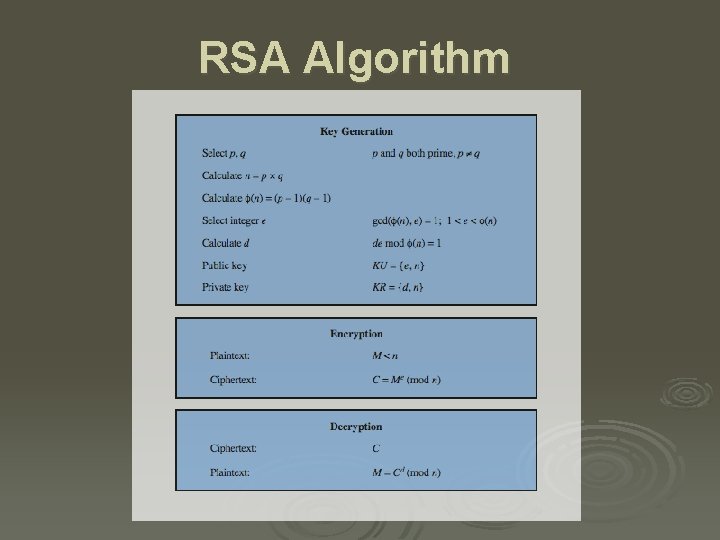
RSA Algorithm
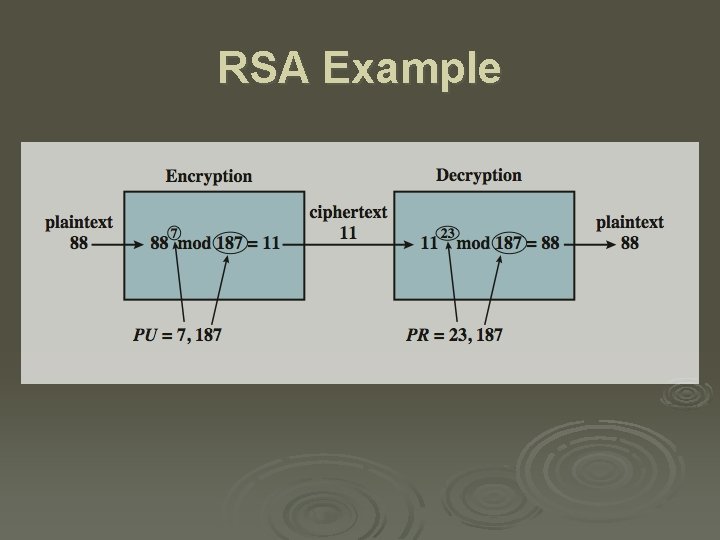
RSA Example
Attacks on RSA Ø brute force l l trying all possible private keys use larger key, but then slower Ø mathematical attacks (factoring n) l l see improving algorithms (QS, GNFS, SNFS) currently 1024 -2048 -bit keys seem secure Ø timing attacks (on implementation) l use - constant time, random delays, blinding Ø chosen ciphertext attacks (on RSA props)
Diffie-Hellman Key Exchange Ø first public-key type scheme proposed Ø by Diffie & Hellman in 1976 along with the exposition of public key concepts l note: now know that Williamson (UK CESG) secretly proposed the concept in 1970 Ø practical method to exchange a secret key Ø used in a number of commercial products Ø security relies on difficulty of computing discrete logarithms
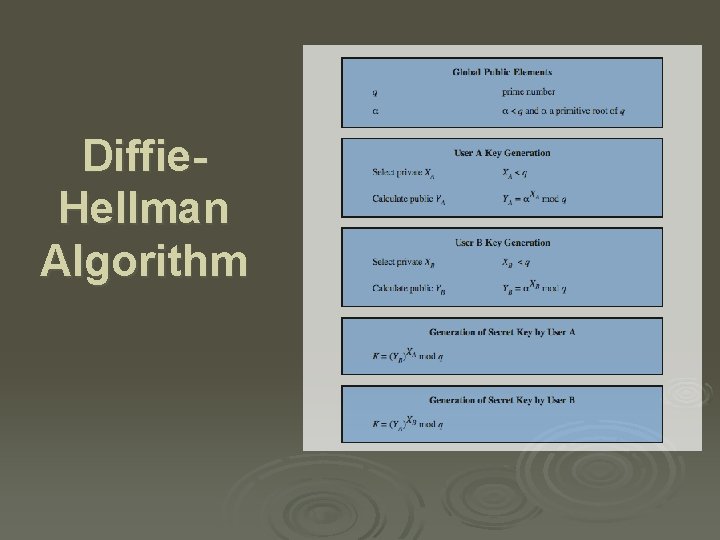
Diffie. Hellman Algorithm
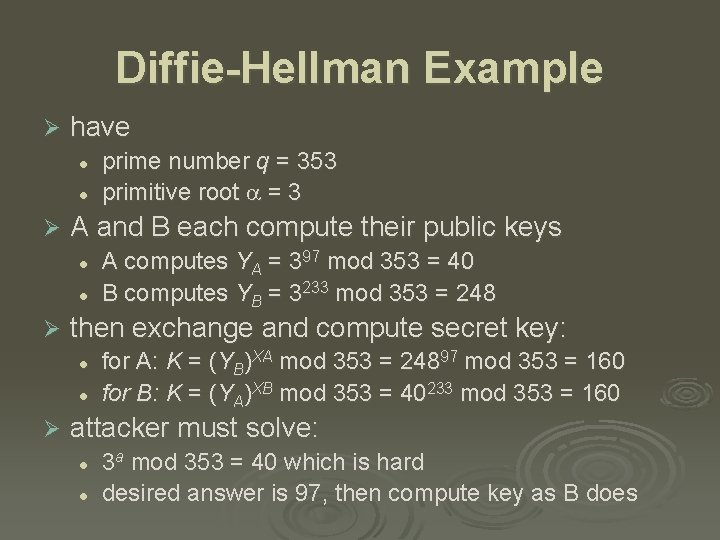
Diffie-Hellman Example Ø have l l Ø A and B each compute their public keys l l Ø A computes YA = 397 mod 353 = 40 B computes YB = 3233 mod 353 = 248 then exchange and compute secret key: l l Ø prime number q = 353 primitive root = 3 for A: K = (YB)XA mod 353 = 24897 mod 353 = 160 for B: K = (YA)XB mod 353 = 40233 mod 353 = 160 attacker must solve: l l 3 a mod 353 = 40 which is hard desired answer is 97, then compute key as B does
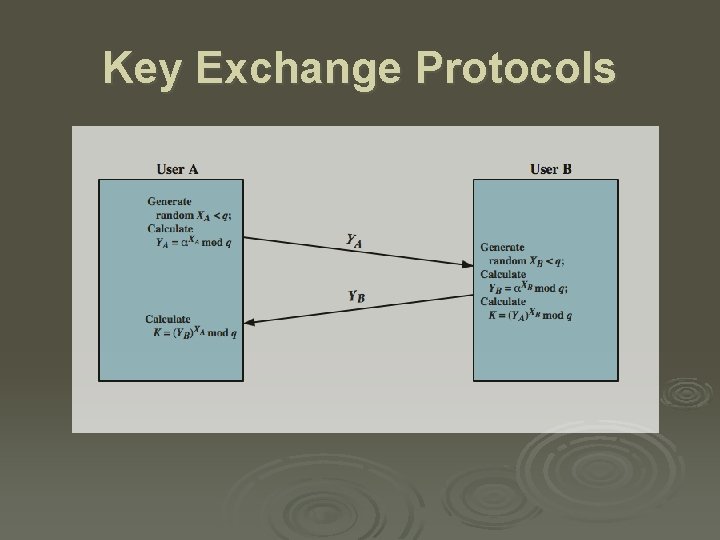
Key Exchange Protocols
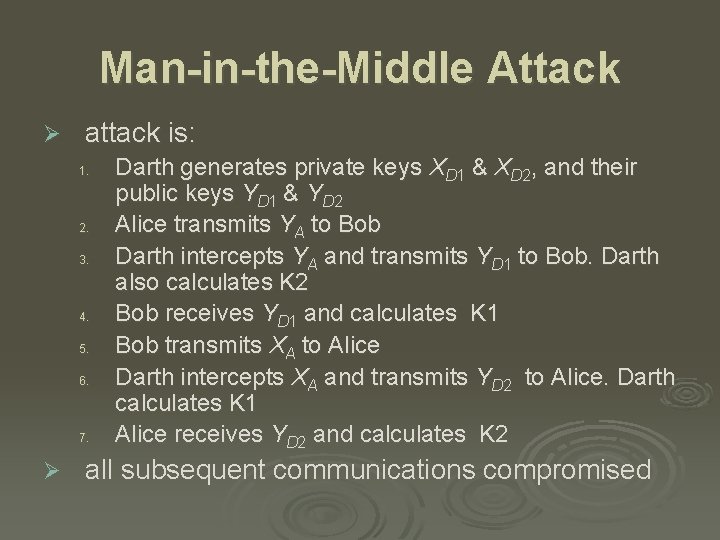
Man-in-the-Middle Attack Ø attack is: 1. 2. 3. 4. 5. 6. 7. Ø Darth generates private keys XD 1 & XD 2, and their public keys YD 1 & YD 2 Alice transmits YA to Bob Darth intercepts YA and transmits YD 1 to Bob. Darth also calculates K 2 Bob receives YD 1 and calculates K 1 Bob transmits XA to Alice Darth intercepts XA and transmits YD 2 to Alice. Darth calculates K 1 Alice receives YD 2 and calculates K 2 all subsequent communications compromised
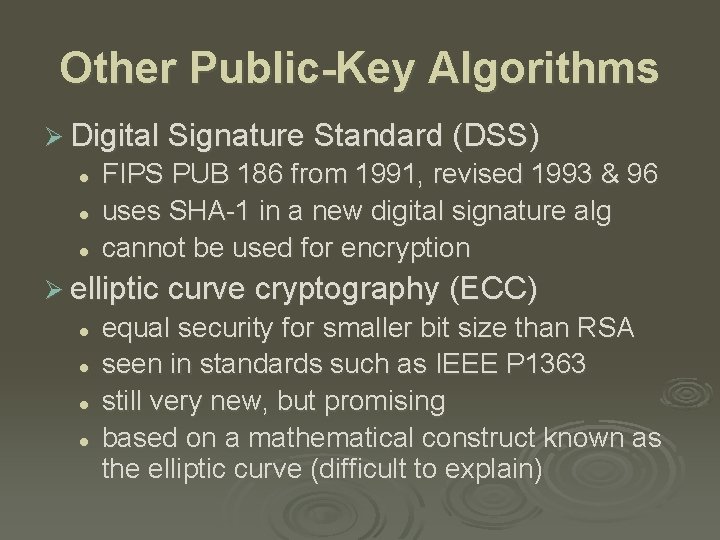
Other Public-Key Algorithms Ø Digital Signature Standard (DSS) l l l FIPS PUB 186 from 1991, revised 1993 & 96 uses SHA-1 in a new digital signature alg cannot be used for encryption Ø elliptic curve cryptography (ECC) l l equal security for smaller bit size than RSA seen in standards such as IEEE P 1363 still very new, but promising based on a mathematical construct known as the elliptic curve (difficult to explain)
Summary Ø discussed technical detail concerning: l l secure hash functions and HMAC RSA & Diffie-Hellman Public-Key Algorithms
- Slides: 22