
Computer Security Introduction and Course Overview 1 Introduction
- Slides: 38
Computer Security Introduction and Course Overview 1
Introduction and overview ¨ What is computer/network security? ¨ Course philosophy and goals ¨ High-level overview of topics 2
“Security” ¨ Most of computer science is concerned with achieving desired behavior ¨ In some sense, security is concerned with preventing undesired behavior – Different way of thinking! – An enemy/opponent/hacker/adversary may be actively and maliciously trying to circumvent any protective measures you put in place 3
Computer vs. network security ¨ One view: – Computer security: focuses on security aspects of systems in isolation – Network security: focuses on security of data as it is transmitted between networked systems ¨ Not always a clear-cut dividing line… 4
Some examples… ¨ Computer security – Viruses – Secure data storage – OS Security ¨ Network security – Authentication protocols – Encryption of transmitted data – Firewalls 5
Broader impacts of security ¨ Explosive growth of interest in security – Most often following notable security failures… ¨ Impact on/interest from all (? ) areas of CS – Theory (especially cryptography) – Databases – Operating systems – AI/learning theory – Networking – Computer architecture/hardware – Programming languages/compilers 6
Philosophy ¨ We are not going to be able to cover everything ¨ Main goals – Exposure to different aspects of security; meant mainly to “pique” your interest – The “mindset” of security: a new way of thinking…about more than computer networks – Become familiar with basic crypto, acronyms (RSA, SSL, PGP, etc. ), and “buzzwords” – Security is a process, not a product 7
High-level overview ¨ Introduction… – Including various classes of attacks ¨ Cryptography – Cryptography is not the (whole) solution… – …but is is an important part of the solution – Along the way, we will see why cryptography can’t solve all security problems 8
High-level overview II ¨ Security policies and analysis – Attack trees – Access control – Confidentiality/integrity – Key management ¨ Principles for secure design/implementation 9
High-level overview III ¨ Network security – Identity – Authentication – Some real-world protocols – Wireless security 10
High-level overview IV ¨ Miscellaneous – Firewalls – Intrusion detection – Buffer overflows; secure programming languages – Viruses and malicious logic – Etc… 11
Information security in past & present v Traditional Information Security – keep the cabinets locked – put them in a secure room – human guards – electronic surveillance systems – in general: physical and administrative mechanisms v Modern World – Data are in computers – Computers are interconnected 12
Security: an Introduction 13
An Overview of Computer Security 14
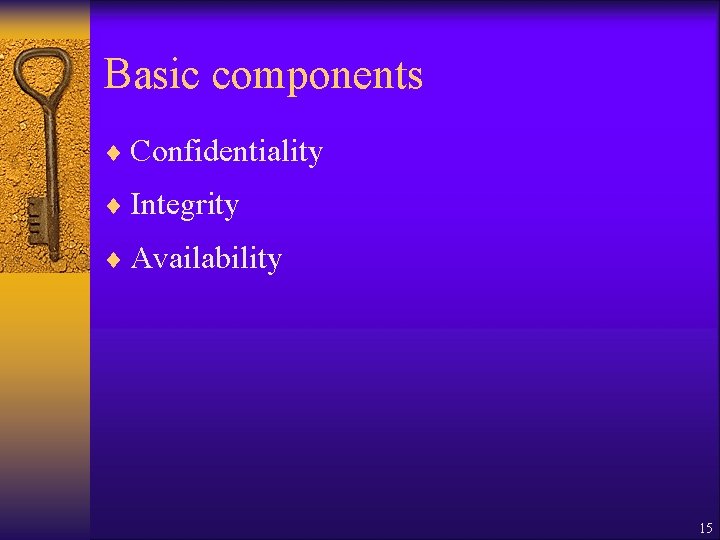
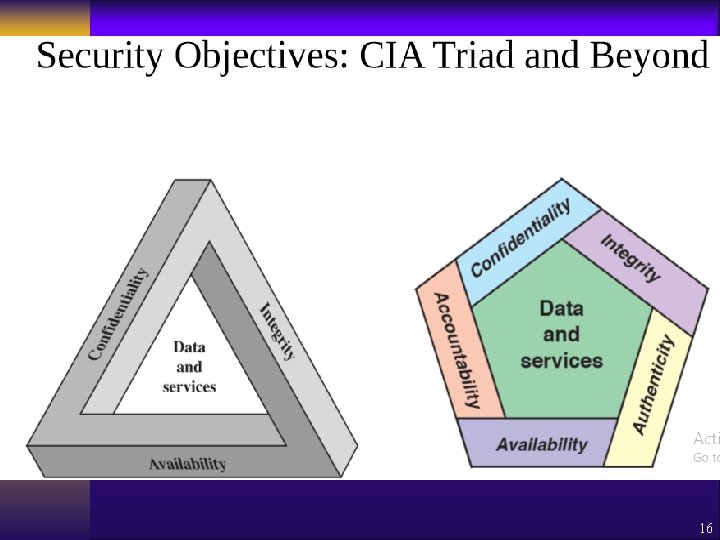
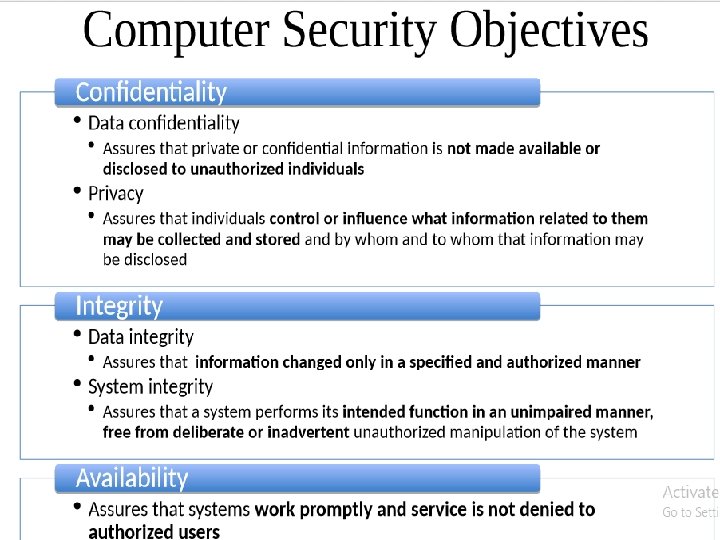
Basic components ¨ Confidentiality ¨ Integrity ¨ Availability 15
16
17
18
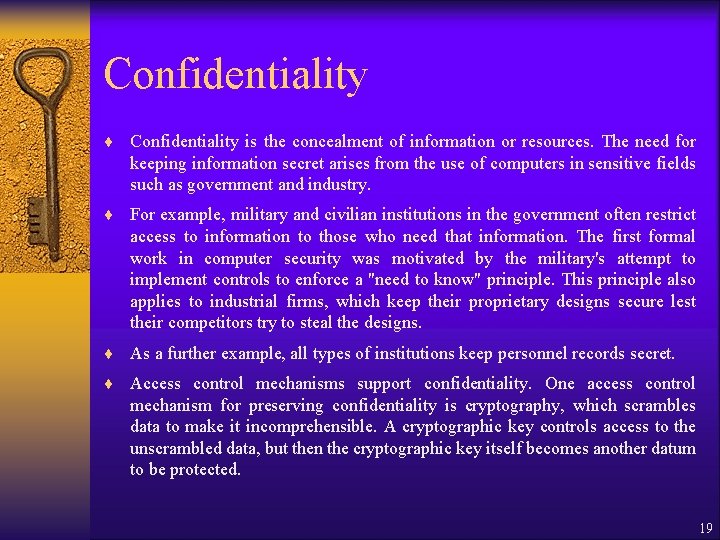
Confidentiality ¨ Confidentiality is the concealment of information or resources. The need for keeping information secret arises from the use of computers in sensitive fields such as government and industry. ¨ For example, military and civilian institutions in the government often restrict access to information to those who need that information. The first formal work in computer security was motivated by the military's attempt to implement controls to enforce a "need to know" principle. This principle also applies to industrial firms, which keep their proprietary designs secure lest their competitors try to steal the designs. ¨ As a further example, all types of institutions keep personnel records secret. ¨ Access control mechanisms support confidentiality. One access control mechanism for preserving confidentiality is cryptography, which scrambles data to make it incomprehensible. A cryptographic key controls access to the unscrambled data, but then the cryptographic key itself becomes another datum to be protected. 19
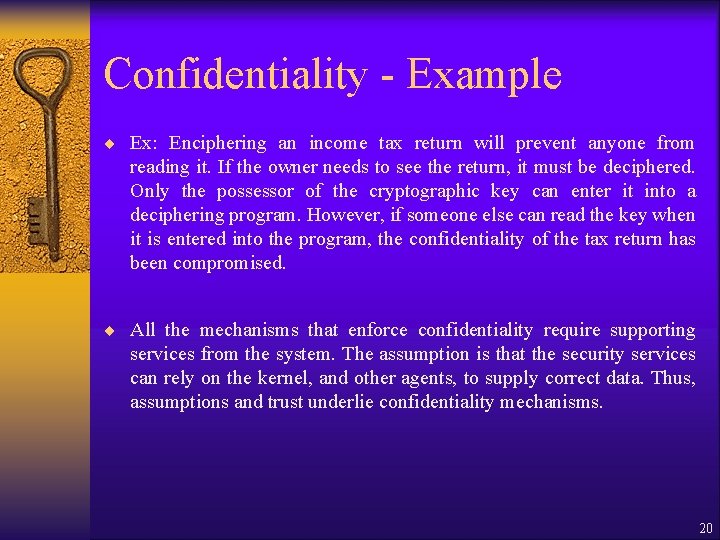
Confidentiality - Example ¨ Ex: Enciphering an income tax return will prevent anyone from reading it. If the owner needs to see the return, it must be deciphered. Only the possessor of the cryptographic key can enter it into a deciphering program. However, if someone else can read the key when it is entered into the program, the confidentiality of the tax return has been compromised. ¨ All the mechanisms that enforce confidentiality require supporting services from the system. The assumption is that the security services can rely on the kernel, and other agents, to supply correct data. Thus, assumptions and trust underlie confidentiality mechanisms. 20
Integrity ¨ Trustworthiness of data or resources ¨ Prevention vs. detection ¨ Blocking unauthorized attempts to change data, or attempts to change data in unauthorized ways – The second is much harder… ¨ Correctness vs. trustworthiness of data 21
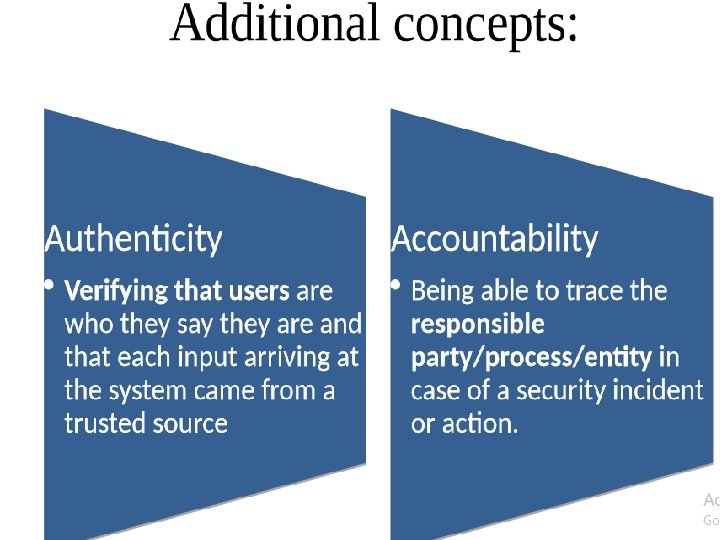
Integrity ¨ Integrity refers to the trustworthiness of data or resources, and it is usually phrased in terms of preventing improper or unauthorized change. Integrity includes data integrity (the content of the information) and origin integrity (the source of the data, often called authentication). The source of the information may bear on its accuracy and credibility and on the trust that people place in the information. This dichotomy illustrates the principle that the aspect of integrity known as credibility is central to the proper functioning of a system. We will return to this issue when discussing malicious logic. ¨ EXAMPLE: A newspaper may print information obtained from a leak at the White House but attribute it to the wrong source. The information is printed as received (preserving data integrity), but its source is incorrect (corrupting origin integrity). 22
¨ Prevention mechanisms seek to maintain the integrity of the data by blocking any unauthorized attempts to change the data or any attempts to change the data in unauthorized ways. The distinction between these two types of attempts is important. The former occurs when a user tries to change data which she has no authority to change. The latter occurs when a user authorized to make certain changes in the data tries to change the data in other ways. ¨ For example, suppose an accounting system is on a computer. Someone breaks into the system and tries to modify the accounting data. Then an unauthorized user has tried to violate the integrity of the accounting database. But if an accountant hired by the firm to maintain its books tries to embezzle money by sending it overseas and hiding the transactions, a user (the accountant) has tried to change data (the accounting data) in unauthorized ways (by moving it to a Swiss bank account). Adequate authentication and access controls will generally stop the break-in from the outside, but preventing the second type of attempt requires very different controls. ¨ Detection mechanisms do not try to prevent violations of integrity; they simply report that the data's integrity is no longer trustworthy. Detection mechanisms may analyze system events (user or system actions) to detect problems or (more commonly) may analyze the data itself to see if required or expected constraints still hold. The mechanisms may report the actual cause of the integrity violation (a specific part of a file was altered), or they may simply report that the file is now corrupt. 23
Availability ¨ Denial of service attacks ¨ Denying access can lead to more serious attacks – I. e. , if credit card verification is down 24
Availability ¨ Availability refers to the ability to use the information or resource desired. Availability is an important aspect of reliability as well as of system design because an unavailable system is at least as bad as no system at all. ¨ The aspect of availability that is relevant to security is that someone may deliberately arrange to deny access to data or to a service by making it unavailable. System designs usually assume a statistical model to analyze expected patterns of use, and mechanisms ensure availability when that statistical model holds. Someone may be able to manipulate use (or parameters that control use, such as network traffic) so that the assumptions of the statistical model are no longer valid. This means that the mechanisms for keeping the resource or data available are working in an environment for which they were not designed. As a result, they will often fail. 25
Availability ¨ EXAMPLE: Suppose Anne has compromised a bank's secondary system server, which supplies bank account balances. When anyone else asks that server for information, Anne can supply any information she desires. Merchants validate checks by contacting the bank's primary balance server. If a merchant gets no response, the secondary server will be asked to supply the data. Anne's colleague prevents merchants from contacting the primary balance server, so all merchant queries go to the secondary server. Anne will never have a check turned down, regardless of her actual account balance. Notice that if the bank had only one server (the primary one), this scheme would not work. The merchant would be unable to validate the check. ¨ Attempts to block availability, called denial of service attacks, can be the most difficult to detect, because the analyst must determine if the unusual access patterns are attributable to deliberate manipulation of resources or of environment. Complicating this determination is the nature of statistical models. 26
Threats (or “attacks”) ¨ Snooping, eavesdropping ¨ Modification, alteration ¨ Masquerading, spoofing ¨ False repudiation/denial of receipt ¨ Network delay, denial of service 27
Threats ¨ A threat is a potential violation of security. The violation need not actually occur for there to be a threat. The fact that the violation might occur means that those actions that could cause it to occur must be guarded against (or prepared for). Those actions are called attacks. Those who execute such actions, or cause them to be executed, are called attackers. ¨ The three security services—confidentiality, integrity, and availability—counter threats to the security of a system. 28
¨ Snooping, the unauthorized interception of information, is a form of disclosure. It is passive, suggesting simply that some entity is listening to (or reading) communications or browsing through files or system information. Wiretapping, or passive wiretapping, is a form of snooping in which a network is monitored. Confidentiality services counter this threat. ¨ Modification or alteration, an unauthorized change of information, covers three classes of threats. The goal may be deception, in which some entity relies on the modified data to determine which action to take, or in which incorrect information is accepted as correct and is released. If the modified data controls the operation of the system, the threats of disruption and usurpation arise. ¨ Masquerading or spoofing, an impersonation of one entity by another, is a form of both deception and usurpation. It lures a victim into believing that the entity with which it is communicating is a different entity. For example, if a user tries to log into a computer across the Internet but instead reaches another computer that claims to be the desired one, the user has been spoofed. Similarly, if a user tries to read a file, but an attacker has arranged for the user to be given a different file, another spoof has taken place. This may be a passive attack (in which the user does not attempt to authenticate the recipient, but merely accesses it), but it is usually an active attack (in which the masquerader issues responses to mislead the user about its identity). 29
¨ Repudiation of origin, a false denial that an entity sent (or created) something, is a form of deception. For example, suppose a customer sends a letter to a vendor agreeing to pay a large amount of money for a product. The vendor ships the product and then demands payment. The customer denies having ordered the product and by law is therefore entitled to keep the unsolicited shipment without payment. The customer has repudiated the origin of the letter. If the vendor cannot prove that the letter came from the customer, the attack succeeds. A variant of this is denial by a user that he created specific information or entities such as files. Integrity mechanisms cope with this threat. ¨ Denial of receipt, a false denial that an entity received some information or message, is a form of deception. Suppose a customer orders an expensive product, but the vendor demands payment before shipment. The customer pays, and the vendor ships the product. The customer then asks the vendor when he will receive the product. If the customer has already received the product, the question constitutes a denial of receipt attack. The vendor can defend against this attack only by proving that the customer did, despite his denials, receive the product. Integrity and availability mechanisms guard against these attacks. 30
¨ Denial of service, a long-term inhibition of service, is a form of usurpation, although it is often used with other mechanisms to deceive. The attacker prevents a server from providing a service. The denial may occur at the source (by preventing the server from obtaining the resources needed to perform its function), at the destination (by blocking the communications from the server), or along the intermediate path (by discarding messages from either the client or the server, or both). Denial of service poses the same threat as an infinite delay. Availability mechanisms counter this threat. ¨ Denial of service or delay may result from direct attacks or from non security-related problems. From our point of view, the cause and result are important; the intention underlying them is not. If delay or denial of service compromises system security, or is part of a sequence of events leading to the compromise of a system, then we view it as an attempt to breach system security. But the attempt may not be deliberate; indeed, it may be the product of environmental characteristics rather than specific actions of an attacker. 31
Policy vs. mechanism ¨ Security policy – Statement of what is and is not allowed ¨ Security mechanism – Method for enforcing a security policy ¨ One is meaningless without the other… ¨ Problems when combining security policies of multiple organizations 32
¨ Definition 1– 1. A security policy is a statement of what is, and what is not, allowed. ¨ Definition 1– 2. A security mechanism is a method, tool, or procedure for enforcing a security policy. ¨ Mechanisms can be nontechnical, such as requiring proof of identity before changing a password; in fact, policies often require some procedural mechanisms that technology cannot enforce. ¨ As an example, suppose a university's computer science laboratory has a policy that prohibits any student from copying another student's homework files. The computer system provides mechanisms for preventing others from reading a user's files. Anna fails to use these mechanisms to protect her homework files, and Bill copies them. A breach of security has occurred, because Bill has violated the security policy. Anna's failure to protect her files does not authorize Bill to copy them. ¨ In this example, Anna could easily have protected her files. In other environments, such protection may not be easy. For example, the Internet provides only the most rudimentary security mechanisms, which are not adequate to protect information sent over that network. Nevertheless, acts such as the recording of passwords and other sensitive information violate an implicit security policy of most sites (specifically, that passwords are a user's confidential property and cannot be recorded by anyone). 33
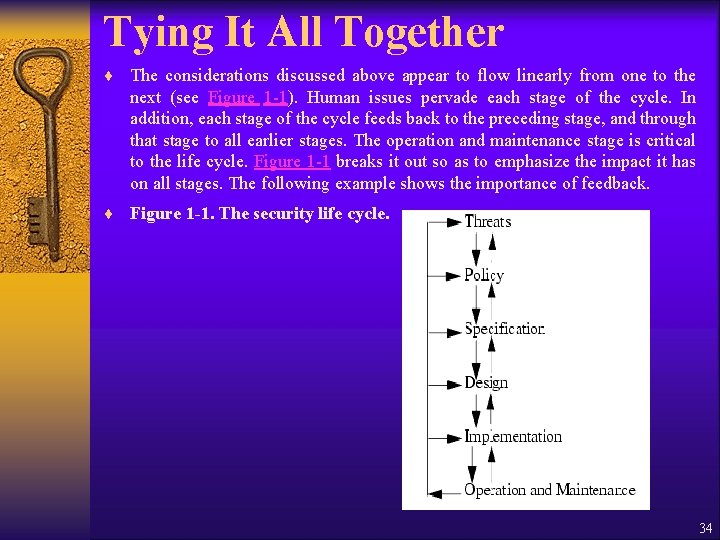
Tying It All Together ¨ The considerations discussed above appear to flow linearly from one to the next (see Figure 1 -1). Human issues pervade each stage of the cycle. In addition, each stage of the cycle feeds back to the preceding stage, and through that stage to all earlier stages. The operation and maintenance stage is critical to the life cycle. Figure 1 -1 breaks it out so as to emphasize the impact it has on all stages. The following example shows the importance of feedback. ¨ Figure 1 -1. The security life cycle. 34
¨ EXAMPLE: A major corporation decided to improve its security. It hired consultants, determined the threats, and created a policy. From the policy, the consultants derived several specifications that the security mechanisms had to meet. They then developed a design that would meet the specifications. ¨ During the implementation phase, the company discovered that employees could connect modems to the telephones without being detected. The design required all incoming connections to go through a firewall. The design had to be modified to divide systems into two classes: systems connected to "the outside, " which were put outside the firewall; and all other systems, which were put behind the firewall. The design needed other modifications as well. ¨ When the system was deployed, the operation and maintenance phase revealed several unexpected threats. The most serious was that systems were repeatedly misconfigured to allow sensitive data to be sent across the Internet in the clear. The implementation made use of cryptographic software very difficult. Once this problem had been remedied, the company discovered that several "trusted" hosts (those allowed to log in without authentication) were physically outside the control of the company. This violated policy, but for commercial reasons the company needed to continue to use these hosts. The policy element that designated these systems as "trusted" was modified. ¨ Finally, the company detected proprietary material being sent to a competitor over electronic mail. This added a threat the company had earlier discounted. The company did not realize that it needed to worry about insider attacks. 35
Computer Security Challenges Computer security is both fascinating and complex. Some of the reasons follow: ¨ 1. Computer security is not as simple as it might first appear to the novice. The requirements seem to be straightforward, but the mechanisms used to meet those requirements can be quite complex and subtle. ¨ 2. In developing a particular security mechanism or algorithm, one must always consider potential attacks (often unexpected) on those security features. ¨ 3. Hence procedures used to provide particular services are often counterintuitive. ¨ 4. Having designed various security mechanisms, it is necessary to decide where to use them. 36
¨ 5. Security mechanisms typically involve more than a particular algorithm or protocol, but also require participants to have secret information, leading to issues of creation, distribution, and protection of that secret information. ¨ 6. Computer security is essentially a battle of wits between a perpetrator who tries to find holes and the designer or administrator who tries to close them. ¨ 7. There is a natural tendency on the part of users and system managers to perceive little benefit from security investment until a security failure occurs. 37
¨ 8. Security requires regular monitoring, difficult in today's short-term environment. ¨ 9. Security is still too often an afterthought - incorporated after the design is complete. ¨ 10. Many users / security administrators view strong security as an impediment to efficient and user-friendly operation of an information system or use of information. 38