
Computer Security CS 426 Lecture 2 Cryptography Terminology
![Shift Cipher • The Key Space: – [1. . 25] • Encryption given a](https://slidetodoc.com/presentation_image_h2/e070818cdadb5839a99fb85dd85a951c/image-10.jpg "Shift Cipher • The Key Space: – [1. . 25] • Encryption given a")
- Slides: 18
Computer Security CS 426 Lecture 2 Cryptography: Terminology & Classic Ciphers CS 426 Fall 2010/Lecture 2 1
Announcements • Join class mailing list: CS 426_Fall 2010@cs. purdue. edu CS 426 Fall 2010/Lecture 2 2
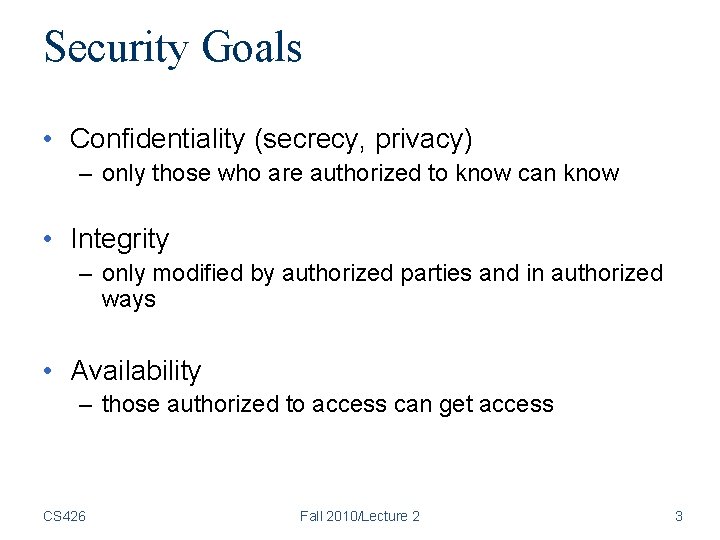
Security Goals • Confidentiality (secrecy, privacy) – only those who are authorized to know can know • Integrity – only modified by authorized parties and in authorized ways • Availability – those authorized to access can get access CS 426 Fall 2010/Lecture 2 3
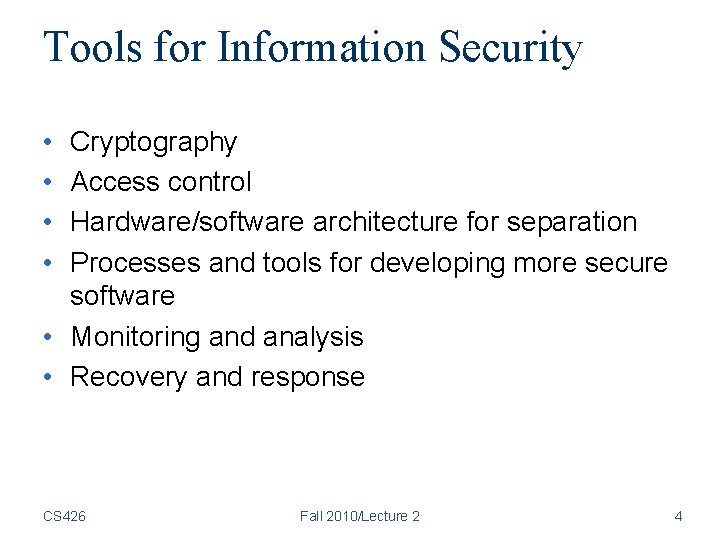
Tools for Information Security • • Cryptography Access control Hardware/software architecture for separation Processes and tools for developing more secure software • Monitoring and analysis • Recovery and response CS 426 Fall 2010/Lecture 2 4
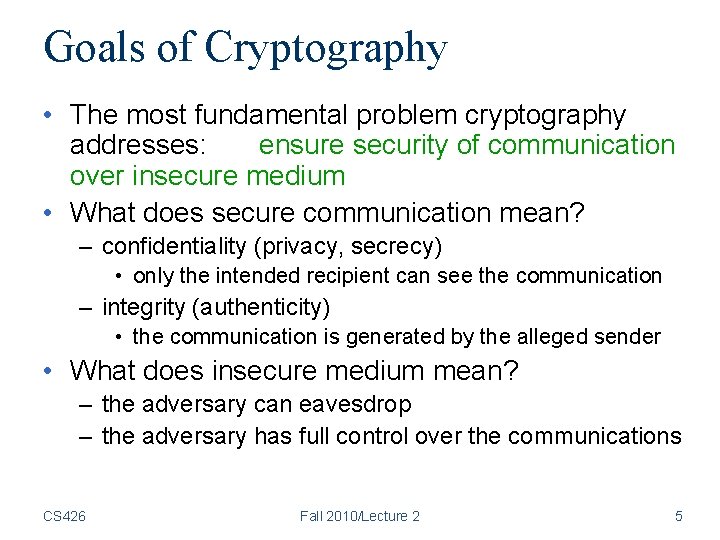
Goals of Cryptography • The most fundamental problem cryptography addresses: ensure security of communication over insecure medium • What does secure communication mean? – confidentiality (privacy, secrecy) • only the intended recipient can see the communication – integrity (authenticity) • the communication is generated by the alleged sender • What does insecure medium mean? – the adversary can eavesdrop – the adversary has full control over the communications CS 426 Fall 2010/Lecture 2 5
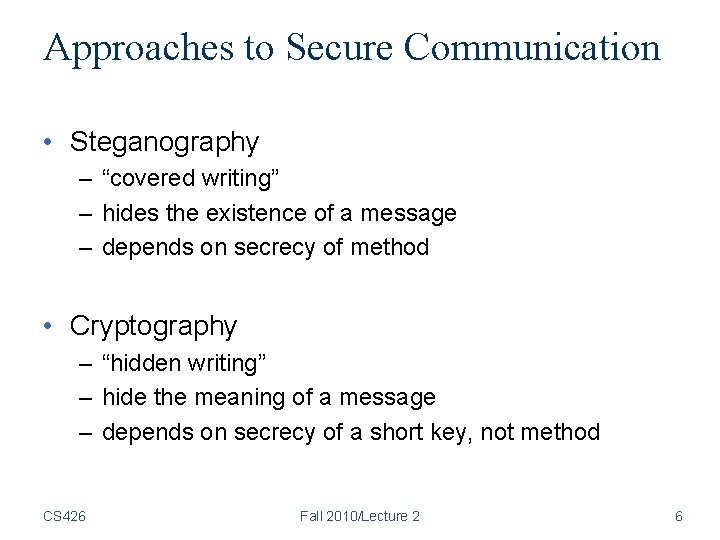
Approaches to Secure Communication • Steganography – “covered writing” – hides the existence of a message – depends on secrecy of method • Cryptography – “hidden writing” – hide the meaning of a message – depends on secrecy of a short key, not method CS 426 Fall 2010/Lecture 2 6
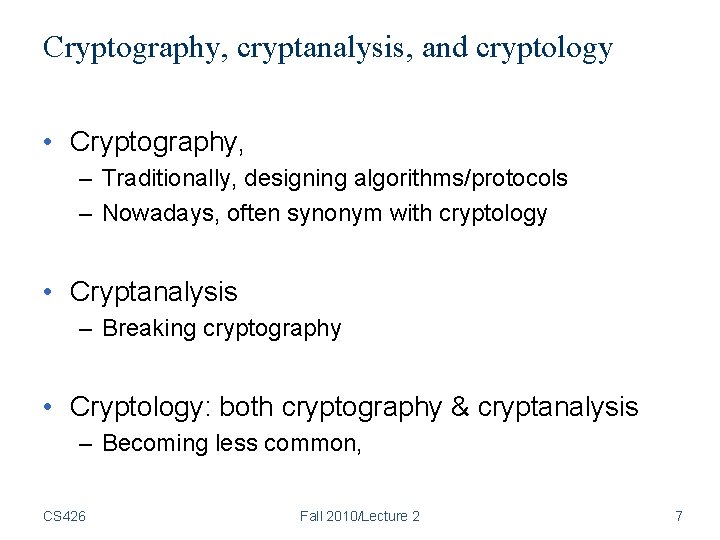
Cryptography, cryptanalysis, and cryptology • Cryptography, – Traditionally, designing algorithms/protocols – Nowadays, often synonym with cryptology • Cryptanalysis – Breaking cryptography • Cryptology: both cryptography & cryptanalysis – Becoming less common, CS 426 Fall 2010/Lecture 2 7
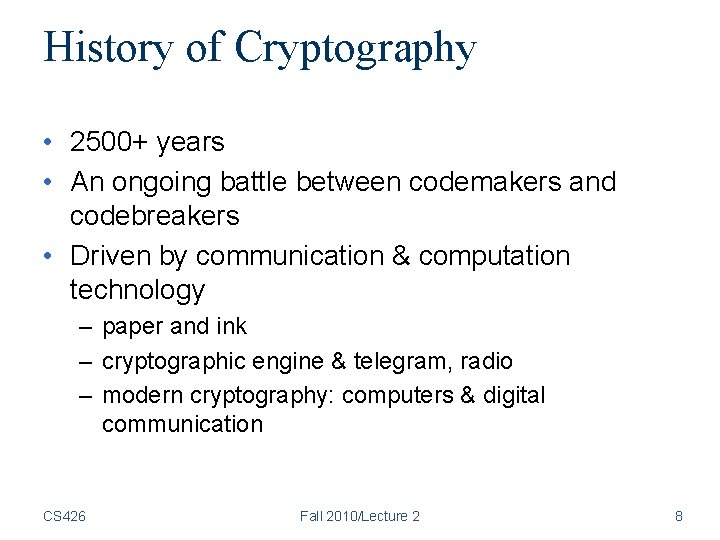
History of Cryptography • 2500+ years • An ongoing battle between codemakers and codebreakers • Driven by communication & computation technology – paper and ink – cryptographic engine & telegram, radio – modern cryptography: computers & digital communication CS 426 Fall 2010/Lecture 2 8
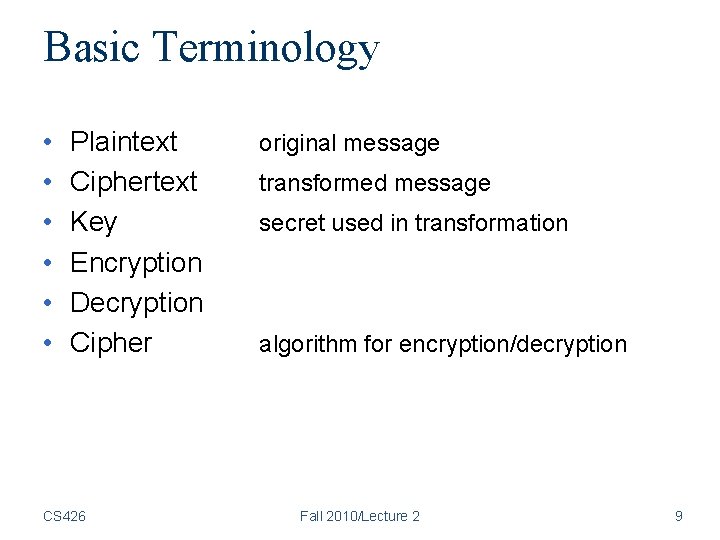
Basic Terminology • • • Plaintext Ciphertext Key Encryption Decryption Cipher CS 426 original message transformed message secret used in transformation algorithm for encryption/decryption Fall 2010/Lecture 2 9
Shift Cipher • The Key Space: – [1. . 25] • Encryption given a key K: – each letter in the plaintext P is replaced with the K’th letter following corresponding number (shift right) • Decryption given K: – shift left History: K = 3, Caesar’s cipher CS 426 Fall 2010/Lecture 2 10
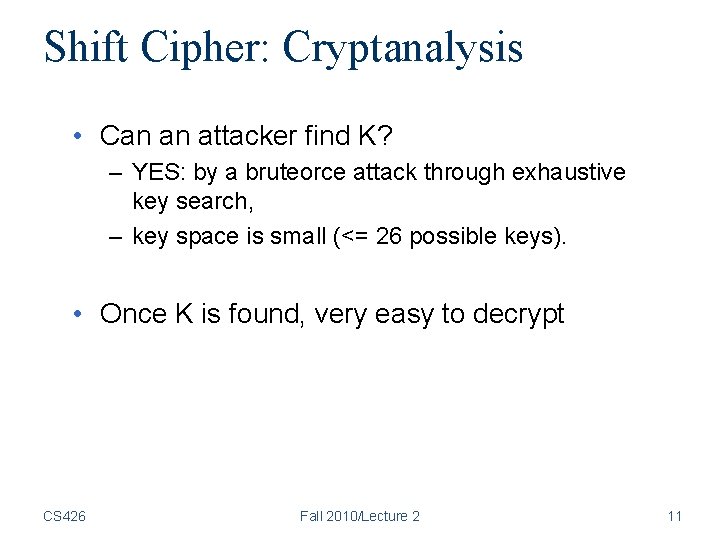
Shift Cipher: Cryptanalysis • Can an attacker find K? – YES: by a bruteorce attack through exhaustive key search, – key space is small (<= 26 possible keys). • Once K is found, very easy to decrypt CS 426 Fall 2010/Lecture 2 11
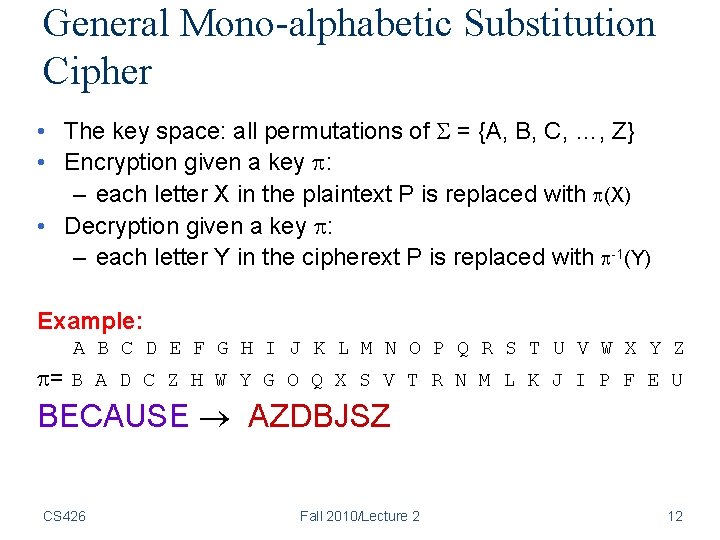
General Mono-alphabetic Substitution Cipher • The key space: all permutations of = {A, B, C, …, Z} • Encryption given a key : – each letter X in the plaintext P is replaced with (X) • Decryption given a key : – each letter Y in the cipherext P is replaced with -1(Y) Example: A B C D E F G H I J K L M N O P Q R S T U V W X Y Z = B A D C Z H W Y G O Q X S V T R N M L K J I P F E U BECAUSE AZDBJSZ CS 426 Fall 2010/Lecture 2 12
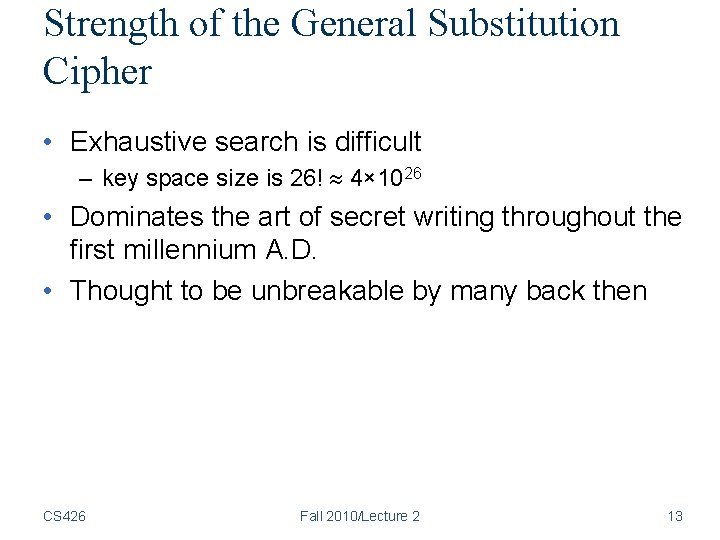
Strength of the General Substitution Cipher • Exhaustive search is difficult – key space size is 26! 4× 1026 • Dominates the art of secret writing throughout the first millennium A. D. • Thought to be unbreakable by many back then CS 426 Fall 2010/Lecture 2 13
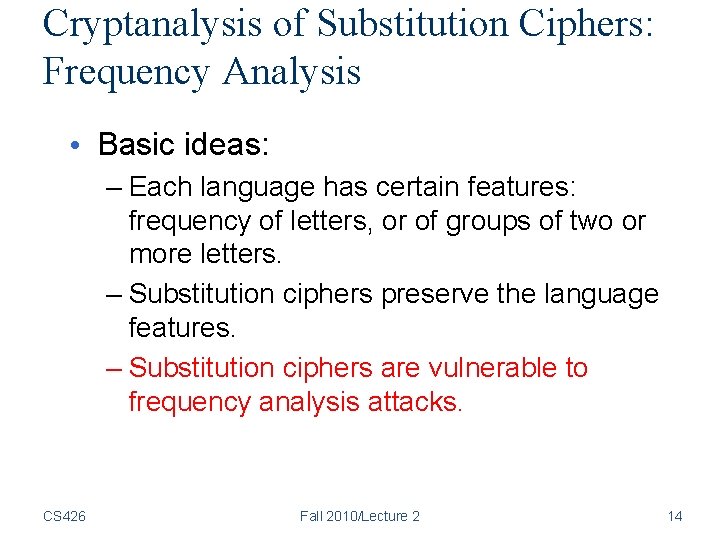
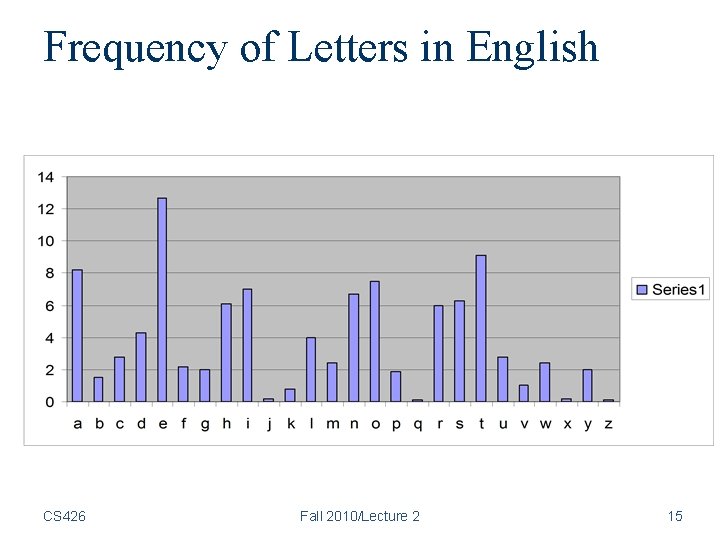
Cryptanalysis of Substitution Ciphers: Frequency Analysis • Basic ideas: – Each language has certain features: frequency of letters, or of groups of two or more letters. – Substitution ciphers preserve the language features. – Substitution ciphers are vulnerable to frequency analysis attacks. CS 426 Fall 2010/Lecture 2 14
Frequency of Letters in English CS 426 Fall 2010/Lecture 2 15
Security Principles • Security by obscurity doesn’t work • Should assume that the adversary knows the algorithm; the only secret the adversary is assumed to not know is the key CS 426 Fall 2010/Lecture 2 16
Readings for This Lecture Required readings: – Cryptography on Wikipedia Optional Readings: – Security in Computing • Chapter 2: Basic Encryption and Decryption Interesting reading – The Code Book by Simon Singh CS 426 Fall 2010/Lecture 2 17
Coming Attractions … • Cryptography: One-time Pad, Informational Theoretical Security, Stream Ciphers CS 426 Fall 2010/Lecture 2 18