
Computer Science LESSON 1 on Number Bases John
Computer Science LESSON 1 on Number Bases John Owen, Rockport Fulton HS 1
Objective In this lesson you’ll learn about different Number Bases, specifically about those used by the computer n Those include: n n Base Two – binary Base Eight – octal Base Sixteen – hexadecimal John Owen, Rockport Fulton HS 2
Base Ten First let’s talk about base ten, the decimal number system which humans use and you have been working with for years. n It’s called base ten because…? n John Owen, Rockport Fulton HS 3
Base Ten If you said, “because it has ten counting digits, 0, 1, 2, 3, 4, 5, 6, 7, 8, and 9”, you are right! n To count in base ten, you go from 0 to 9, then do combinations of two digits starting with 10 all the way to 99 n John Owen, Rockport Fulton HS 4
Base Ten After 99 comes three-digit combinations from 100 – 999, etc. n This combination system is true for any base you use. n The only difference is how many digits you have before you go to the next combination n John Owen, Rockport Fulton HS 5
Base Two n To count in base two, which only has 0 and 1 as counting digits, you count 0, 1, then switch to two digit combinations, 10, 11, then to three digit combos, 100, 101, 110, 111, then four digit, 1000, _______, …, 1111 John Owen, Rockport Fulton HS 6
Base Three n To count in base three, which has 0, 1, and 2 as counting digits, you count 0, 1, 2, then switch to two digit combinations, 10, 11, 12, 20, 21, 22, then to three digit combos, 100, 101, 102, 110, 111, 112, etc… John Owen, Rockport Fulton HS 7

Base Eight Jumping to base eight (often called octal)… what are the counting digits? n Can you count correctly usingle digits, two-digit combinations, and then three-digit combos? n John Owen, Rockport Fulton HS 8
Base Eight n Here is the base eight counting sequence n 0, 1, 2, 3, 4, 5, 6, 7, 10, 11, 12, 13, … 77 n 100, 101, 102, 103, 104, 105, 106, 107 n 110, 111, etc. John Owen, Rockport Fulton HS 9
Base Sixteen Now for one that’s a bit strange. n Base Sixteen, also known as hexadecimal, was especially created by computer scientists to help simplify low-level programming, like machine language and assembly language. n John Owen, Rockport Fulton HS 10
Base Sixteen To count in base sixteen, you need 16 counting digits. n To get sixteen counting digits, you use 0 -9, but still need six more…so it was decided to use A, B, C, D, E, and F. n John Owen, Rockport Fulton HS 11
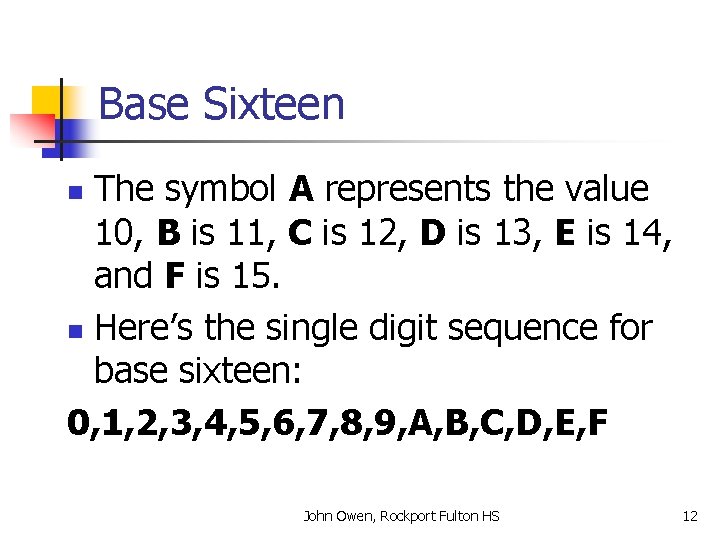
Base Sixteen The symbol A represents the value 10, B is 11, C is 12, D is 13, E is 14, and F is 15. n Here’s the single digit sequence for base sixteen: 0, 1, 2, 3, 4, 5, 6, 7, 8, 9, A, B, C, D, E, F n John Owen, Rockport Fulton HS 12
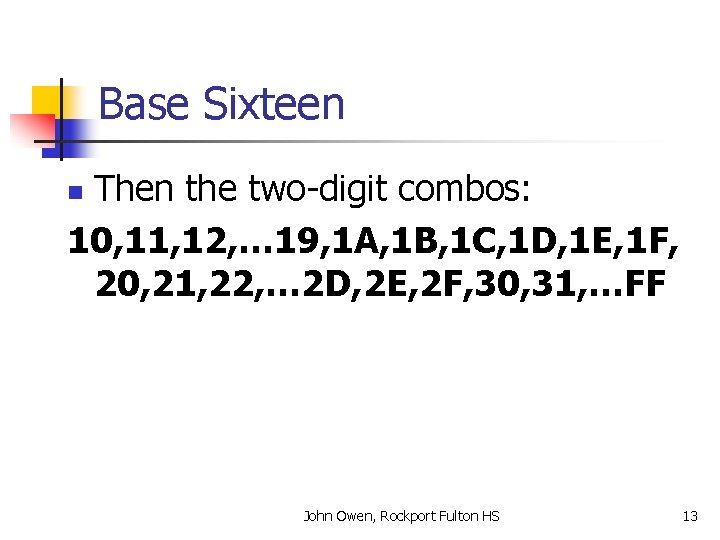
Base Sixteen Then the two-digit combos: 10, 11, 12, … 19, 1 A, 1 B, 1 C, 1 D, 1 E, 1 F, 20, 21, 22, … 2 D, 2 E, 2 F, 30, 31, …FF n John Owen, Rockport Fulton HS 13
Base conversion To convert from base ten to another base, such as base two, eight, or sixteen, is an important skill for computer scientists and programmers. n The next section shows how to do this. n John Owen, Rockport Fulton HS 14
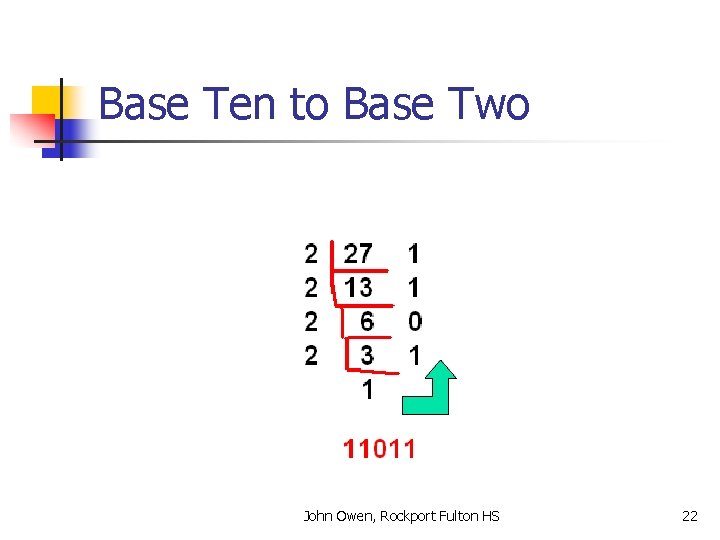
Base Ten to Base Two Let’s take the value 27 and convert it into base 2. n Here’s the process: n Divide 27 by 2 n The answer is 13, remainder 1 n Divide 13 by 2 n Answer is 6, remainder 1 n John Owen, Rockport Fulton HS 15
Base Ten to Base Two n Continue until the answer is 1. 6 divided by 2 = 3, remainder 0 n 3 divided by 2 = 1, remainder 1 n Now take the last answer, 1, and all of the remainders in reverse order, and put them together… 11011 n 27 base 10 = 11011 base two n John Owen, Rockport Fulton HS 16
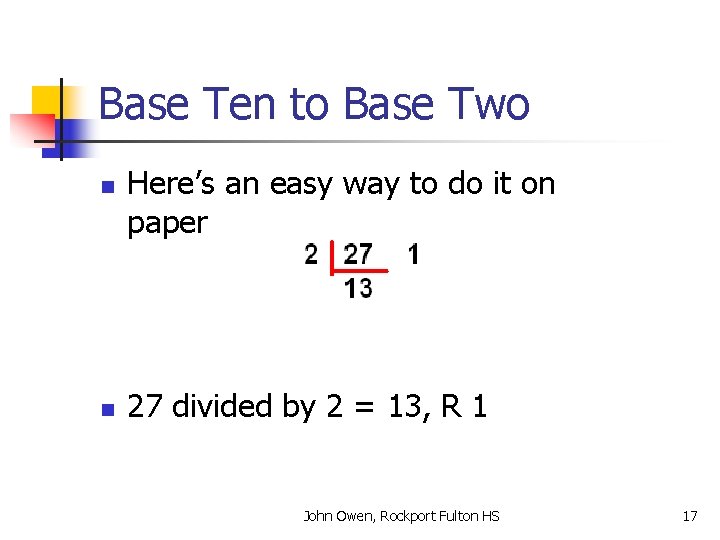
Base Ten to Base Two n n Here’s an easy way to do it on paper 27 divided by 2 = 13, R 1 John Owen, Rockport Fulton HS 17
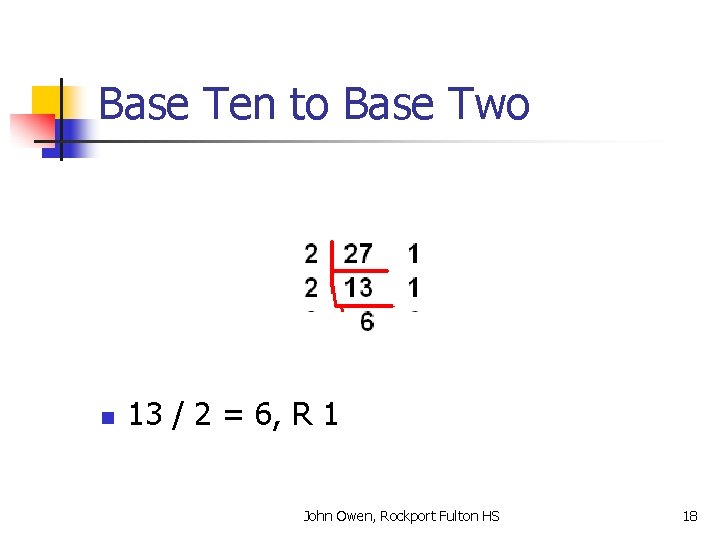
Base Ten to Base Two n 13 / 2 = 6, R 1 John Owen, Rockport Fulton HS 18
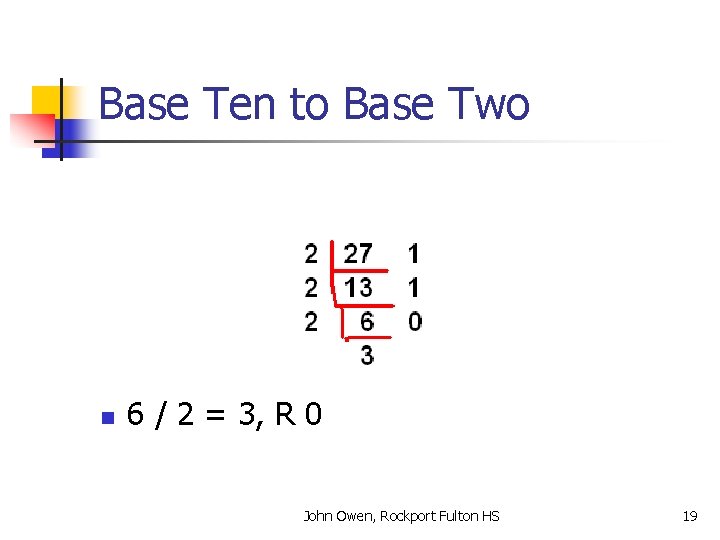
Base Ten to Base Two n 6 / 2 = 3, R 0 John Owen, Rockport Fulton HS 19
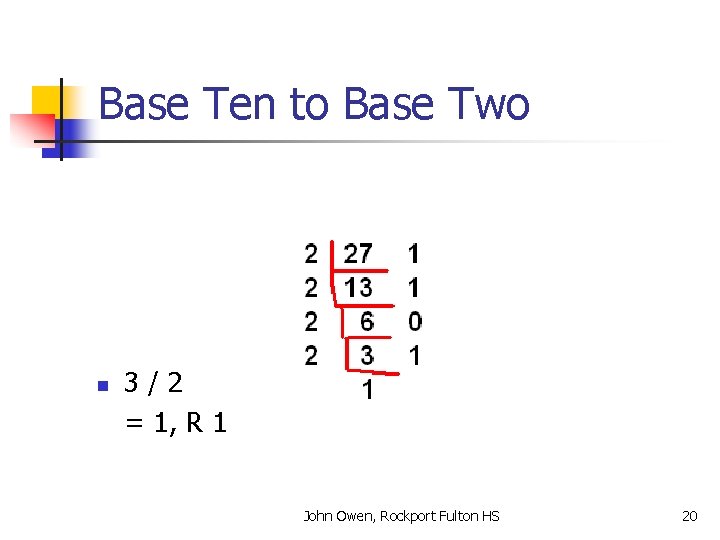
Base Ten to Base Two n 3/2 = 1, R 1 John Owen, Rockport Fulton HS 20
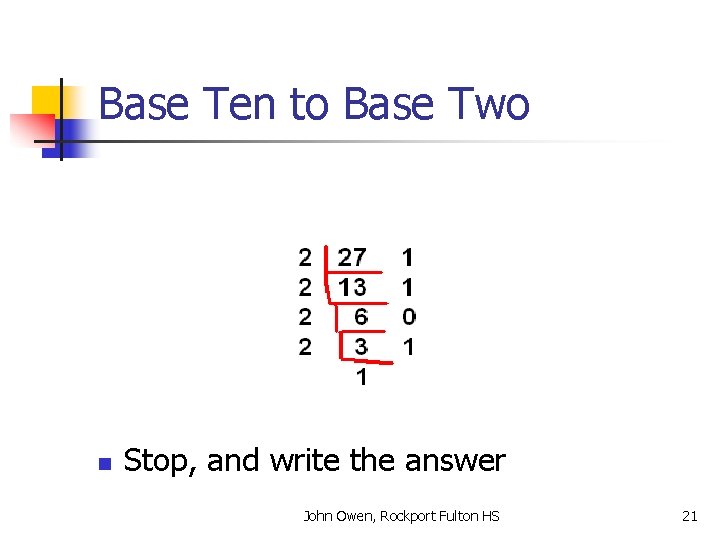
Base Ten to Base Two n Stop, and write the answer John Owen, Rockport Fulton HS 21
Base Ten to Base Two John Owen, Rockport Fulton HS 22
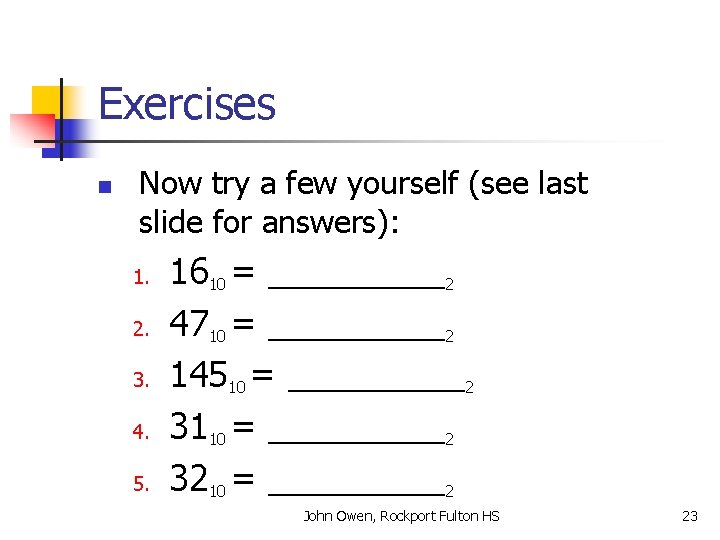
Exercises n Now try a few yourself (see last slide for answers): 1. 2. 3. 4. 5. 1610 = _____2 4710 = _____2 14510 = _____2 3110 = _____2 3210 = _____2 John Owen, Rockport Fulton HS 23
Base Ten to Base Eight Let’s again take the value 27 and convert it into base 8. n Same process: n Divide 27 by 8 n The answer is 3, remainder 3 n Stop! You can’t divide anymore because the answer is less than 8 n John Owen, Rockport Fulton HS 24
Base Ten to Base Eight n The last answer was 3, and the only remainder was 3, so the base eight value is 33, base 8. John Owen, Rockport Fulton HS 25
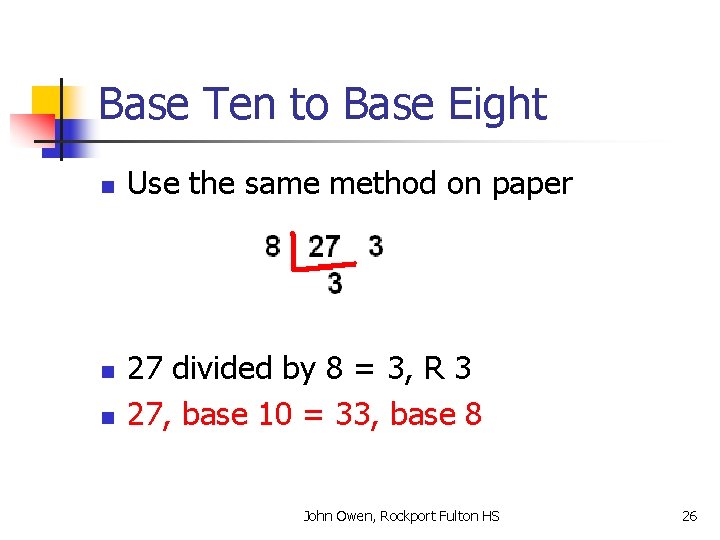
Base Ten to Base Eight n n n Use the same method on paper 27 divided by 8 = 3, R 3 27, base 10 = 33, base 8 John Owen, Rockport Fulton HS 26
Exercises n Now try the same values for base eight. 1610 = _____8 7. 4710 = _____8 8. 14510 = _____8 9. 3110 = _____8 10. 3210 = _____8 6. John Owen, Rockport Fulton HS 27
Base Ten to Base Sixteen n Finally we’ll convert 27 into base 16. Divide 27 by 16 n The answer is 1, remainder 11 n Stop! You can’t divide anymore because the answer is less than 16 n John Owen, Rockport Fulton HS 28
Base Ten to Base Sixteen n The last answer was 1, and the only remainder was 11, which in base 16 is the letter B, so the base sixteen value is 1 B, base 16. John Owen, Rockport Fulton HS 29
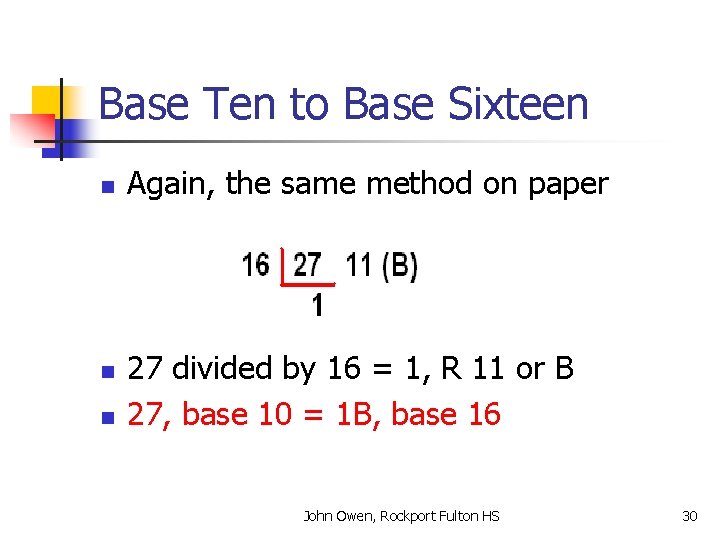
Base Ten to Base Sixteen n Again, the same method on paper 27 divided by 16 = 1, R 11 or B 27, base 10 = 1 B, base 16 John Owen, Rockport Fulton HS 30
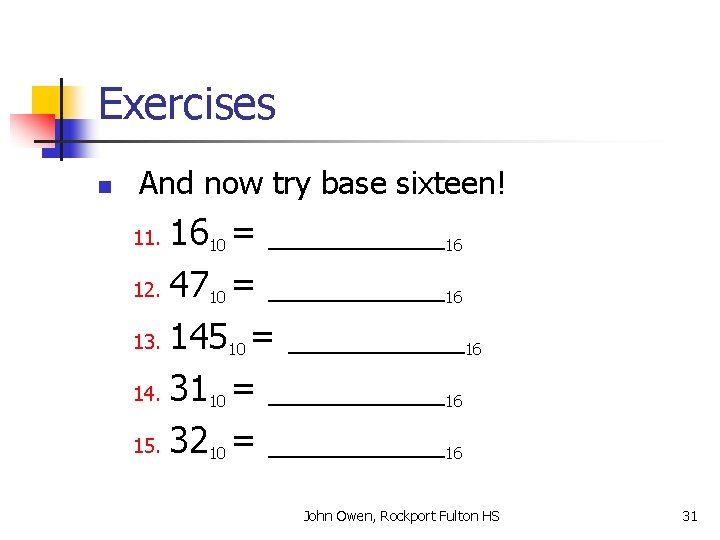
Exercises n And now try base sixteen! 1610 = _____16 12. 4710 = _____16 13. 14510 = _____16 14. 3110 = _____16 15. 3210 = _____16 11. John Owen, Rockport Fulton HS 31
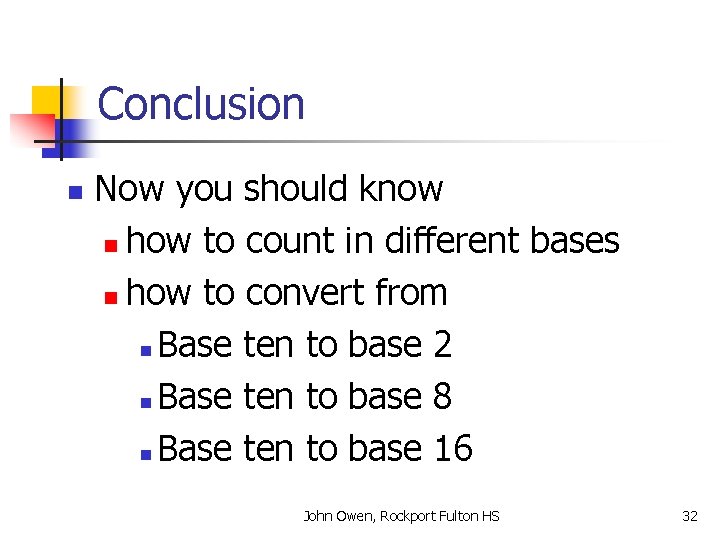
Conclusion n Now you should know n how to count in different bases n how to convert from n Base ten to base 2 n Base ten to base 8 n Base ten to base 16 John Owen, Rockport Fulton HS 32
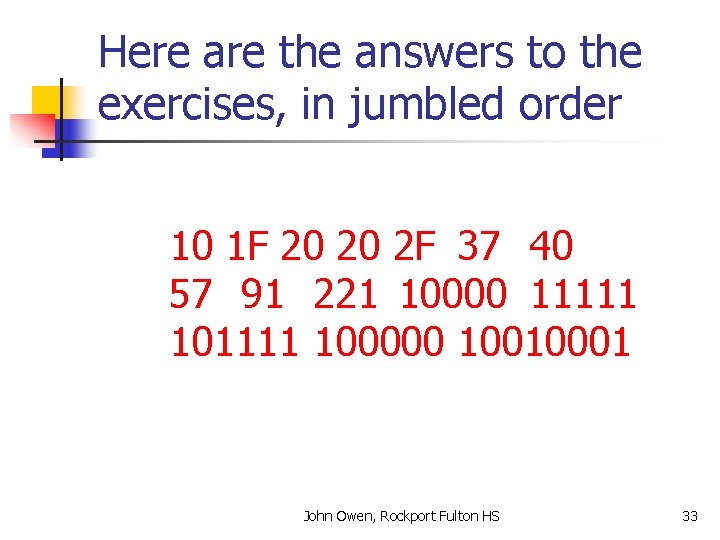
Here are the answers to the exercises, in jumbled order 10 1 F 20 20 2 F 37 40 57 91 221 10000 11111 100000 10010001 John Owen, Rockport Fulton HS 33
- Slides: 33