
Computer science is as much about computers as
"Computer science is as much about computers as astronomy is about telescopes. " - Edsgar Dijkstra
CS: A Way of Thinking l l After 4 years in CS, you will have learned a new way of thinking You will learn to – – – l think methodically and systematically Instinctively think of real-world problems and situations in terms of interacting objects and systems Analyze real-world problems in a methodical way and generate a systematic solution that works! You might not even notice yourself learning this! It will just gradually become instinct. (We hope!)
What is a computer? l Computer: something that “computes” – – – takes input processes input according to particular steps produces output
Question: Today, the fastest PCs run at roughly 3. 5 GHz. Someday, computers may run at 1, 000 GHz. Compared to present computers, those high-speed ones would have to be 1. 2. 3. much larger. much smaller. about the same size.

Observations About Computers l l l They respond to inputs with various outputs They handle all kinds of information Information is measured in bits and bytes Some information is lost when power fails Computers work extremely quickly They follow instructions perfectly
Analog Representation l A number is represented by a physical quantity – – – l l Current Voltage Magnetization Number is proportional to the physical quantity Precision is determined by the quantity itself
Digital Representation l l A number is represented by physical quantities Physical quantities take on discrete values These values represent pieces of the number Precision is determined by number of quantities
Binary Representation l Each physical quantity has two values – – l l One value is defined as a “ 1” The other value is defined as a “ 0” Each quantity represents one information bit A number is represented by several bits The more bits, the more precision Bits are relatively immune to noise
Example: 19 l l Five bits can represent number from 0 to 31 19 is represented by the bits: 10011 Each bit represents a power of 2 1· 24 + 0· 23 + 0· 22 + 1· 21 + 1· 20 = 19
Representing Non-Numbers l Bits or groups of bits are assigned to objects – – – l l Characters Colors Days of the week 8 bits (a byte) can distinguish 256 objects Two bytes can distinguish 65, 536 objects
Quantities Representing Bits l l l l Current Magnetization Charge Optical properties Light Radio Waves Sound
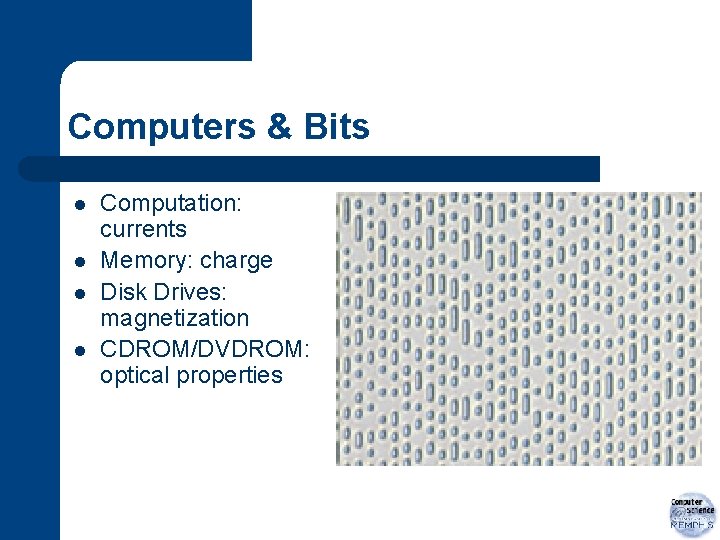
Computers & Bits l l Computation: currents Memory: charge Disk Drives: magnetization CDROM/DVDROM: optical properties
Computing l l Computers perform logical operations with bits Complicated operations based on simple ones Simplest operations: inversion & not-and Any function can be realized from these two
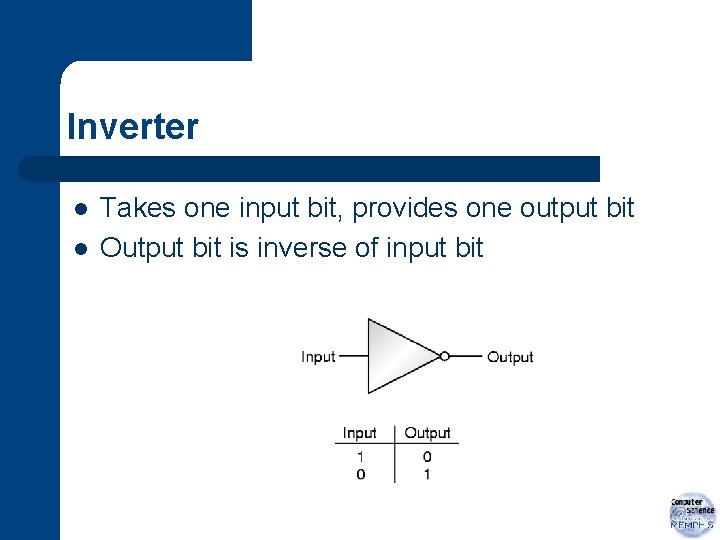
Inverter l l Takes one input bit, provides one output bit Output bit is inverse of input bit
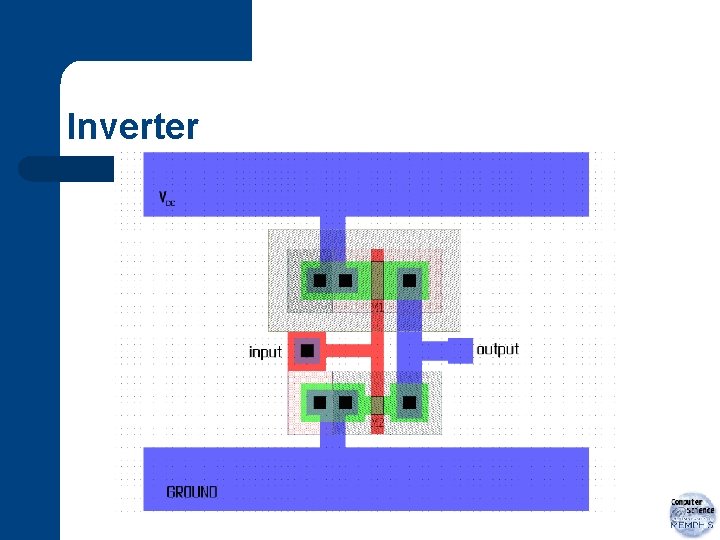
Inverter
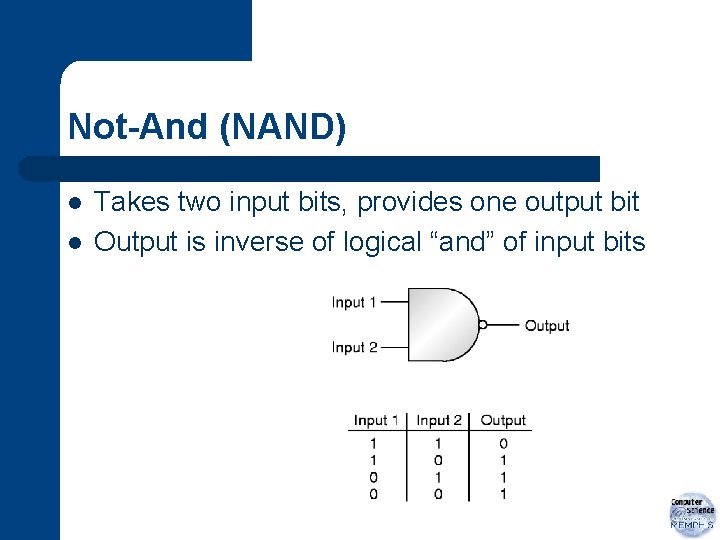
Not-And (NAND) l l Takes two input bits, provides one output bit Output is inverse of logical “and” of input bits
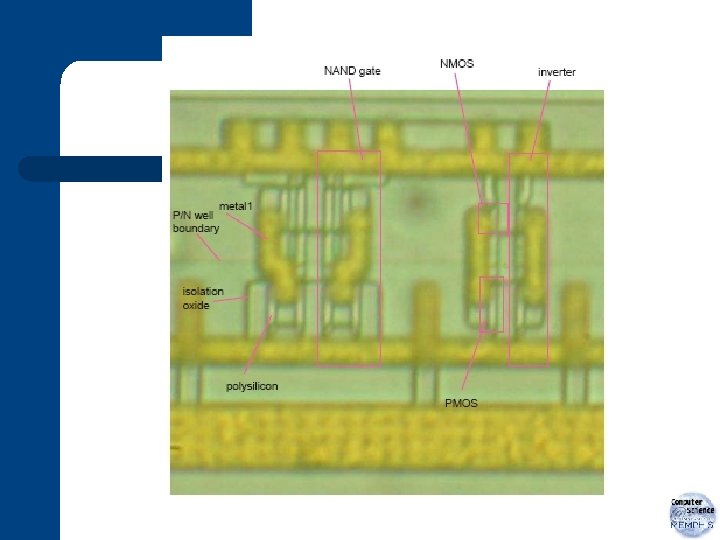
CMOS Logic l l Bits are represented by charge “ 1” is represented by positive charge “ 0” is represented by negative or no charge Logic is built from n-channel and p-channel MOSFETS in complementary pairs
What is programming? l l No matter what kind of computer you have, it works by following specific steps These steps are called the computer’s program
CPU
CPU
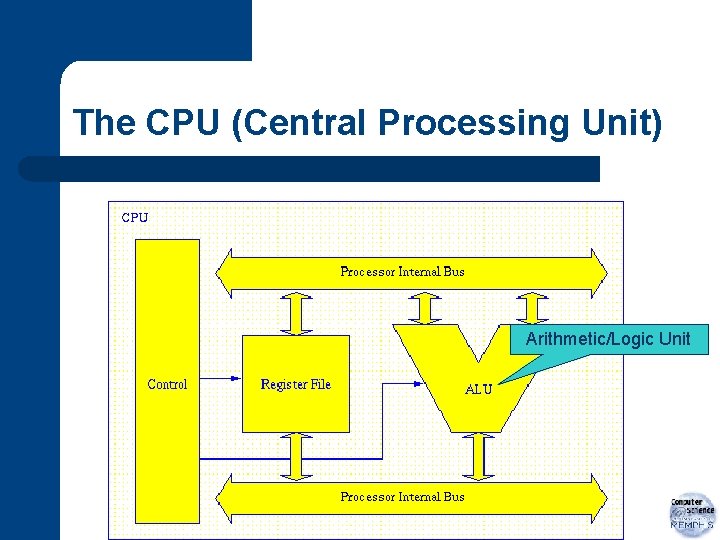
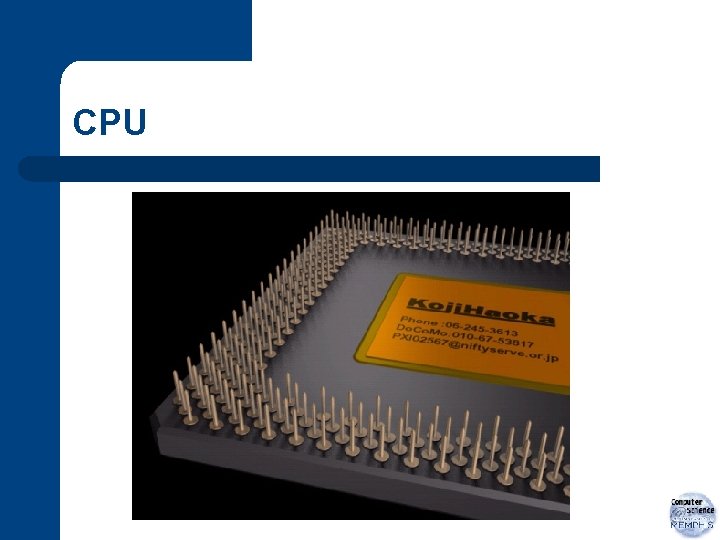
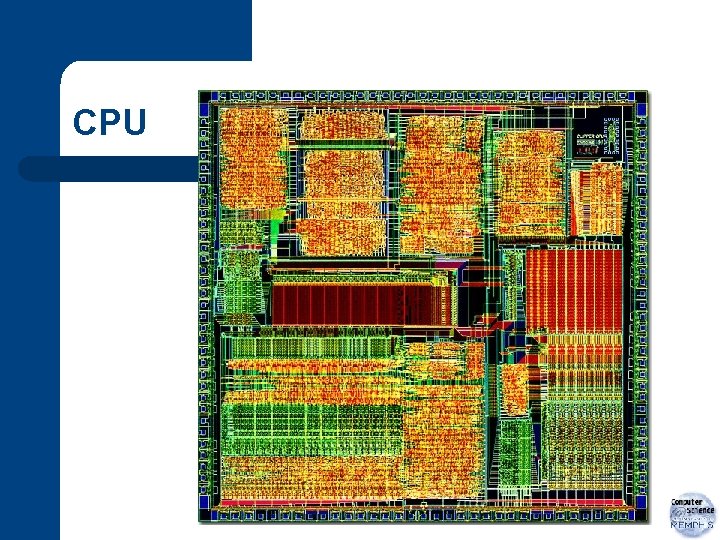
The CPU (Central Processing Unit) Arithmetic/Logic Unit
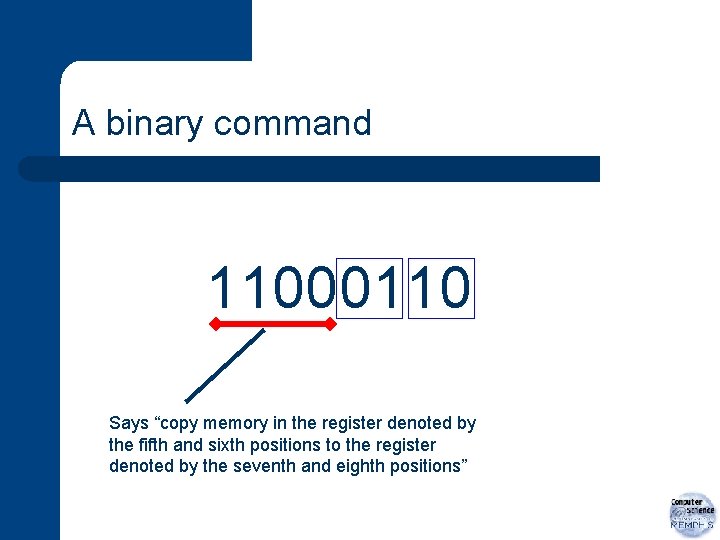
A binary command 11000110 Says “copy memory in the register denoted by the fifth and sixth positions to the register denoted by the seventh and eighth positions”
Personal Computers l l Use CMOS logic for computations Use charge-based memory for fast storage Use magnetization or optical for slow storage Use light, radio, current, or sound for network
Speed Limits l l Bits move no faster than the speed of light Speed of light is approximately 1 foot per nanosecond During one PC cycle, bits can move 1 foot Processors or pathways can’t be bigger than 1 foot
Question: Today, the fastest PCs run at roughly 3. 5 GHz. Someday, computers may run at 1, 000 GHz. Compared to present computers, those high-speed ones would have to be 1. 2. 3. much larger. much smaller. about the same size.
- Slides: 26