
Computer Science Economics and the Effects of Network


- Slides: 17
Computer Science, Economics, and the Effects of Network Structure Michael Kearns Computer and Information Science University of Pennsylvania Nemmers Prize Conference in honor of Ariel Rubenstein May 7, 2005
An Economic System… • • Decentralized Heterogenous preferences Competition Cooperation Free riding Tragedies of the Commons Adaptation …on a network.
Economic Thought in Computer Science • The Economics of Spam • Selfish Routing – Email: a (nearly) free resource – Unlimited usage – Favorable ROI for spammers • even under vanishing uptake – Technology solutions: • spam filters • blacklists & whitelists – Economic policy: • email micropayment schemes – – Internet: a shared resource Competing traffic flows Societal goal: max throughput “Socialist” solution: • centralized route assignment • not realistic – “Capitalist” solution: • let competition flourish! – Formalize as game theory • rational player: minimize latency • very large model – Price of Anarchy: • < 4/3 with linear latencies – Policy: tax congested links
Network Models of Strategic and Economic Interaction • Network dictates restrictions on direct (local) interactions: • Propagation of local interactions global outcome • Long history in economics and game theory – – players in a game trading partners & embargoes exchange of information etc. – traditionally an equilibrium outcome – Matt Jackson’s talk
The Computer Science Perspective • Computational: – How can we manipulate such network models algorithmically? – A rich computational theory (efficient algorithms & intractability) – Generally interested in large populations • Structural: What are the relationships between: – Structural (topological) properties of the network – Properties of the outcome: • • • cooperation and correlation “social value” of the equilibria price variation and wealth distribution stability (e. g. ESS) etc. – What kinds of structural properties? • Generality: – For all or large classes of games – What is implied by network structure alone?
• • Correlated Equilibria and Network Structure Economic Inequality and Expander Graphs Evolutionary Stable Strategies and Edge Density Networks and the Behavioral Price of Anarchy
Correlated Equilibria and Network Structure
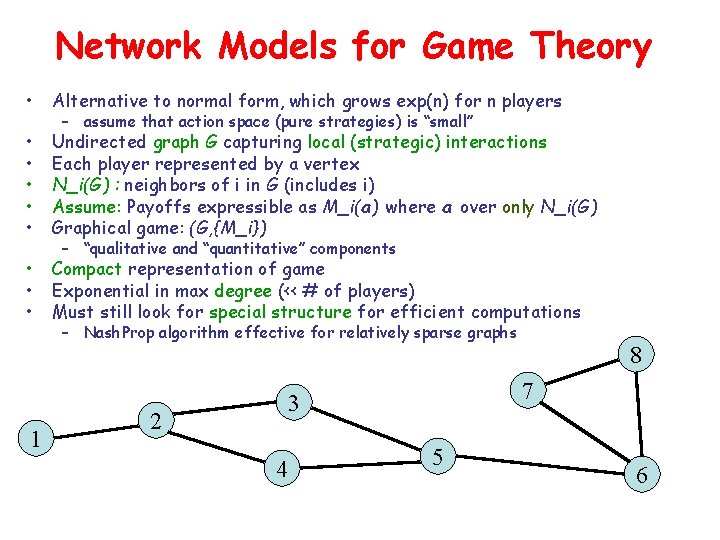
Network Models for Game Theory • Alternative to normal form, which grows exp(n) for n players • • • Undirected graph G capturing local (strategic) interactions Each player represented by a vertex N_i(G) : neighbors of i in G (includes i) Assume: Payoffs expressible as M_i(a) where a over only N_i(G) Graphical game: (G, {M_i}) • • • Compact representation of game Exponential in max degree (<< # of players) Must still look for special structure for efficient computations 1 – assume that action space (pure strategies) is “small” – “qualitative and “quantitative” components – Nash. Prop algorithm effective for relatively sparse graphs 7 3 2 4 8 5 6
Advantages of CE • Correlated actions a fact of the real world – allows “cooperation via correlation” – modeling of shared exogenous influences • Enlarged solution space: all mixtures of NE, and more • new (non-Nash) outcomes emerge, often natural ones • Natural convergence notion for “greedy” learning • But how do we represent an arbitrary CE? – first, only seek to find CE up to (expected) payoff equivalence – second, look to network models for probabilistic reasoning!
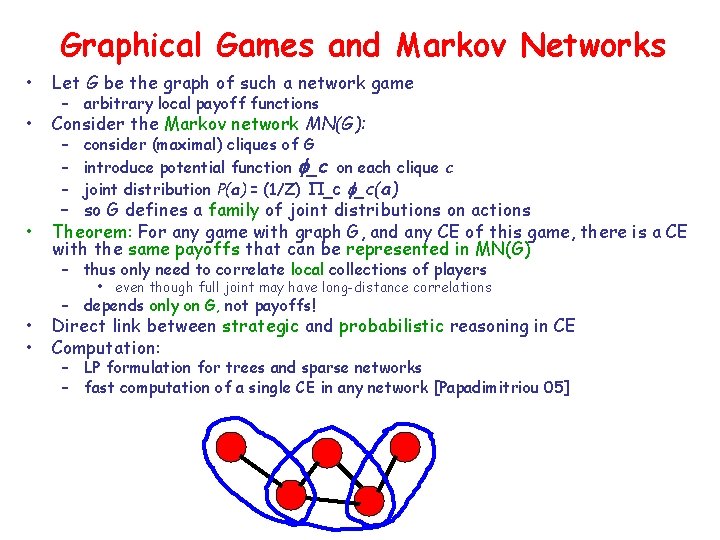
Graphical Games and Markov Networks • Let G be the graph of such a network game • Consider the Markov network MN(G): • – so G defines a family of joint distributions on actions Theorem: For any game with graph G, and any CE of this game, there is a CE with the same payoffs that can be represented in MN(G) – arbitrary local payoff functions – consider (maximal) cliques of G – introduce potential function f_c on each clique c – joint distribution P(a) = (1/Z) P_c f_c(a) – thus only need to correlate local collections of players • even though full joint may have long-distance correlations • • – depends only on G, not payoffs! Direct link between strategic and probabilistic reasoning in CE Computation: – LP formulation for trees and sparse networks – fast computation of a single CE in any network [Papadimitriou 05]
Economic Inequality and Expander Graphs
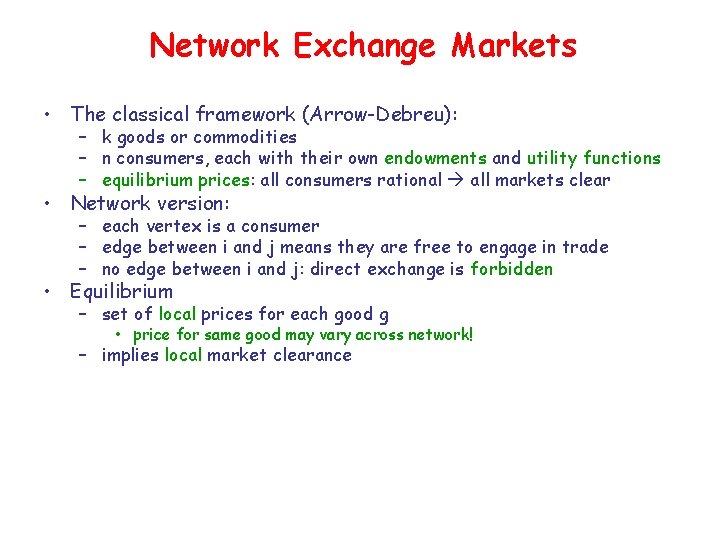
Network Exchange Markets • The classical framework (Arrow-Debreu): – k goods or commodities – n consumers, each with their own endowments and utility functions – equilibrium prices: all consumers rational all markets clear • Network version: – each vertex is a consumer – edge between i and j means they are free to engage in trade – no edge between i and j: direct exchange is forbidden • Equilibrium – set of local prices for each good g • price for same good may vary across network! – implies local market clearance
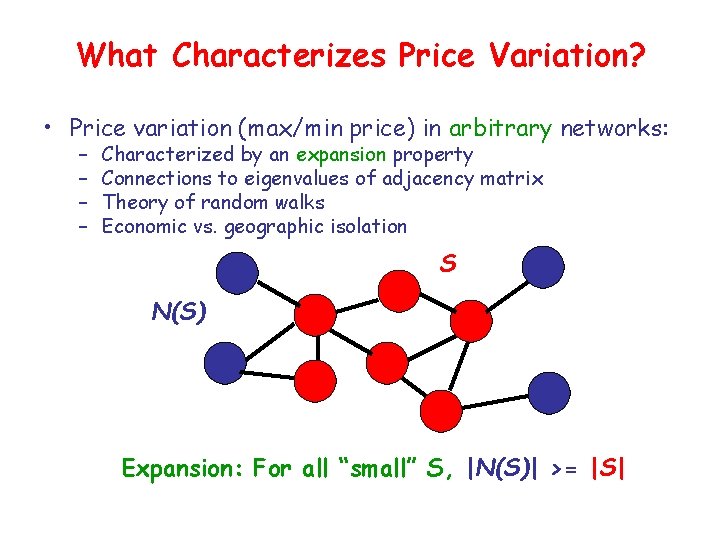
What Characterizes Price Variation? • Price variation (max/min price) in arbitrary networks: – – Characterized by an expansion property Connections to eigenvalues of adjacency matrix Theory of random walks Economic vs. geographic isolation S N(S) Expansion: For all “small” S, |N(S)| >= |S|
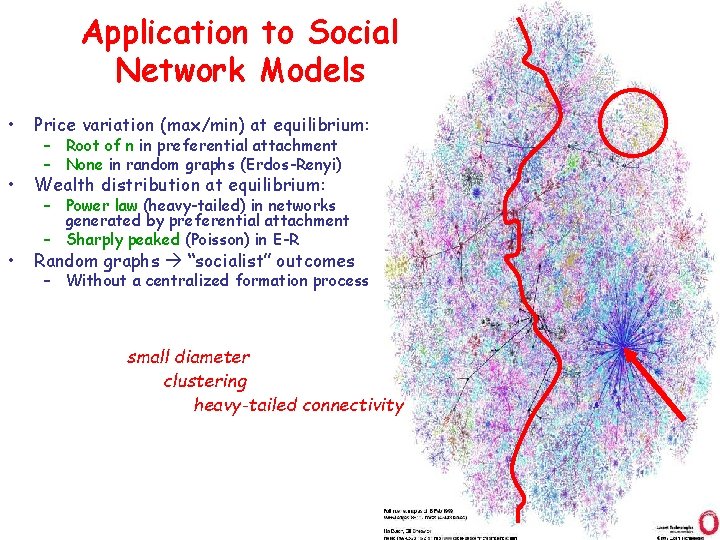
Application to Social Network Models • Price variation (max/min) at equilibrium: • Wealth distribution at equilibrium: • Random graphs “socialist” outcomes – Root of n in preferential attachment – None in random graphs (Erdos-Renyi) – Power law (heavy-tailed) in networks generated by preferential attachment – Sharply peaked (Poisson) in E-R – Without a centralized formation process small diameter clustering heavy-tailed connectivity
Evolutionary Stable Strategies and Edge Density
Network EGT • • Arbitrary 2 -player game Infinite family of undirected graphs {G_n} • • • Individual fitness: average payoffs against neighbors Incumbent strategy p Choose mutant strategy q, mutation set M, |M| < en • One reasonable ESS definition: all such M “contract” • Question: What graph families preserve the ESS of the classical setting? – As usual, will examine limit of large n – Not all choices of M are equivalent! – i. e. some mutant has an incumbent neighbor of higher fitness
The Power of Randomization • • I. {G_n} a family of random (Erdos-Renyi) graphs, M arbitrary II. {G_n} arbitrary family, M random • • In any {G_n} meeting I or II, ESS of any game preserved (w. p. 1 for large n) Local statistics in {G_n} must approximate global “sufficiently often” – subject to minimum edge density requirements – #edges superlinear in n, but possibly far less than n^2