
Computer Science DIGS A Framework for Discovering Goals
![References [Alexander 03] Alexander, Ian. “Misuse Cases: Use Cases with Hostile Intent. ” IEEE](https://slidetodoc.com/presentation_image_h/990d41afe62d02c33790d9494188cafe/image-15.jpg "References [Alexander 03] Alexander, Ian. “Misuse Cases: Use Cases with Hostile Intent. ” IEEE")
![References [Cyber. Sec 2016] Hibshi, Hanan, Travis Breaux, Maria Riaz, and Laurie Williams. “A](https://slidetodoc.com/presentation_image_h/990d41afe62d02c33790d9494188cafe/image-16.jpg "References [Cyber. Sec 2016] Hibshi, Hanan, Travis Breaux, Maria Riaz, and Laurie Williams. “A")
- Slides: 26
Computer Science DIGS – A Framework for Discovering Goals for Security Requirements Engineering Maria Riaz, Jonathan Stallings, Munindar P. Singh, John Slankas, Laurie Williams September 9 th, 2016 1
Agenda • • Motivation Research Objective DIGS Framework Evaluation Methodology Results On-going: Security Goals to Requirements Conclusion Computer Science 2
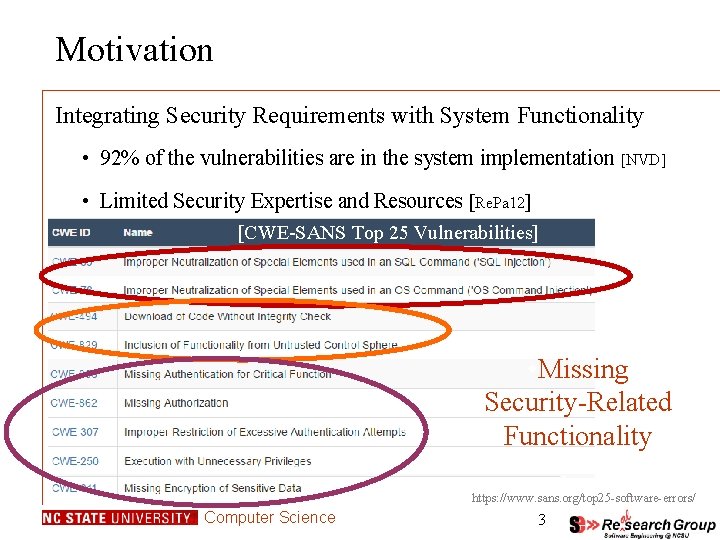
Motivation Integrating Security Requirements with System Functionality • 92% of the vulnerabilities are in the system implementation [NVD] • Limited Security Expertise and Resources [Re. Pa 12] [CWE-SANS Top 25 Vulnerabilities] • Missing Security-Related Functionality https: //www. sans. org/top 25 -software-errors/ Computer Science 3
Research Objective To support analysts in security requirements engineering by providing a framework that supports a systematic and comprehensive discovery of security goals for a software system. Computer Science 4
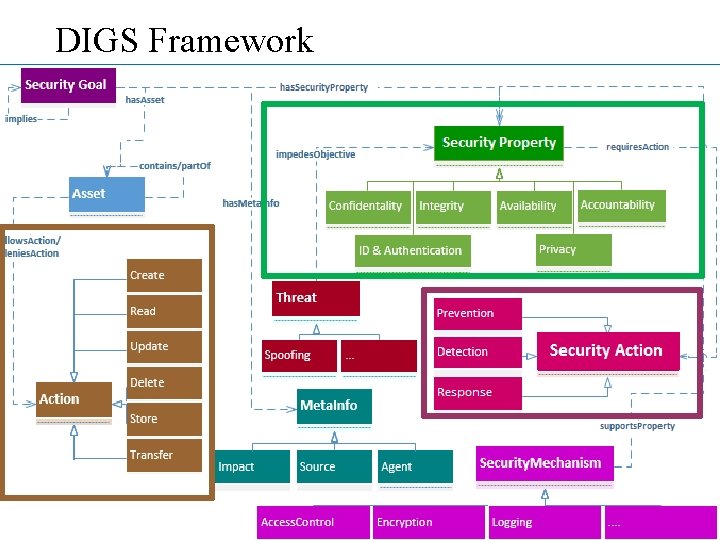
DIGS Framework Computer Science
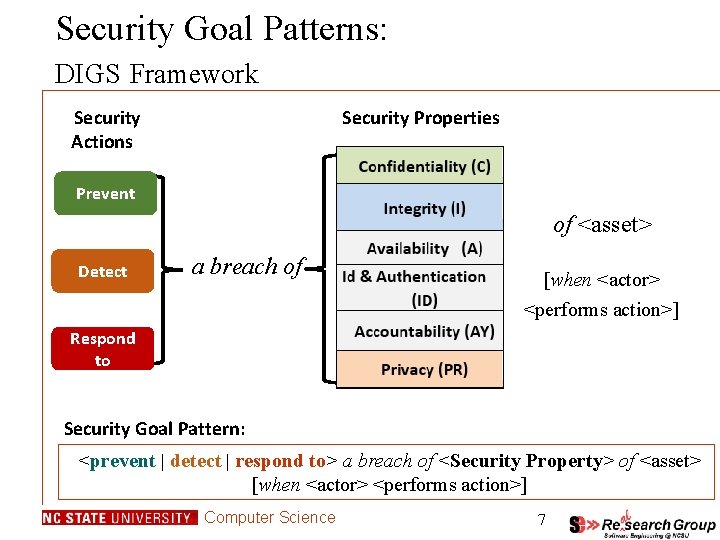
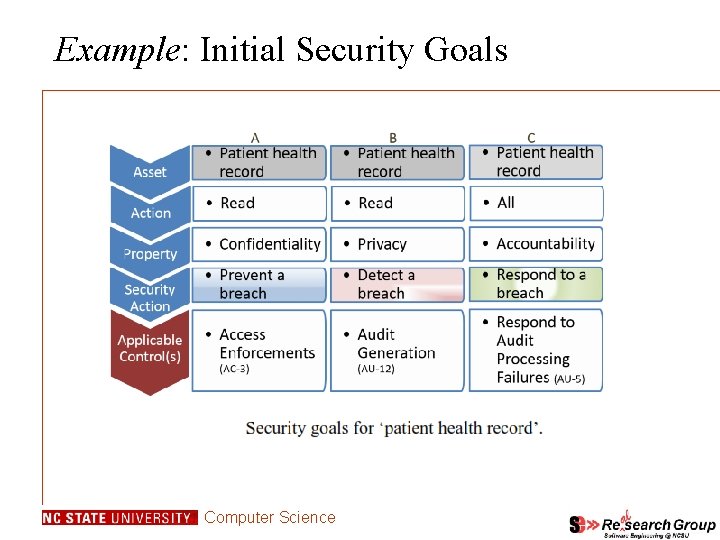
Security Goal Patterns: DIGS Framework • Security Actions • Security Properties Prevent • of <asset> Detect • a breach of • [when <actor> • <performs action>] Respond to • Security Goal Pattern: • <prevent | detect | respond to> a breach of <Security Property> of <asset> • [when <actor> <performs action>] Computer Science 7
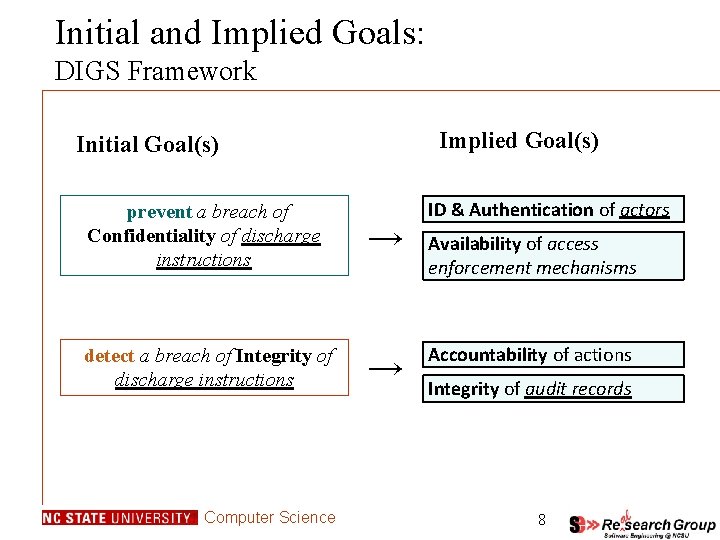
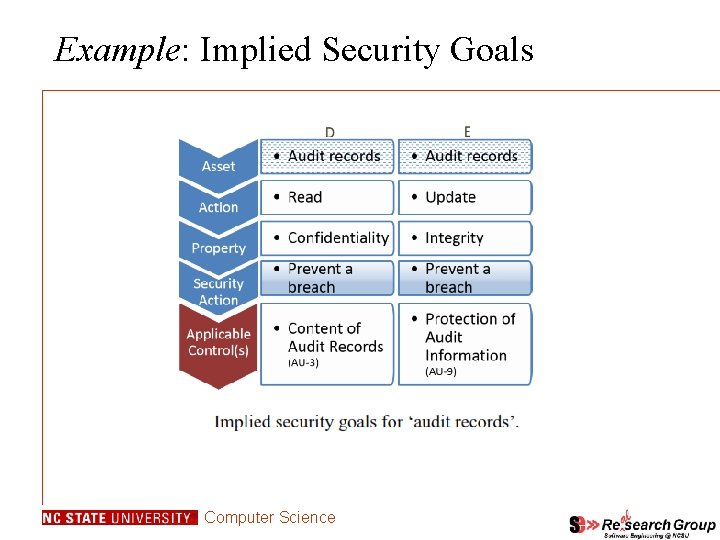
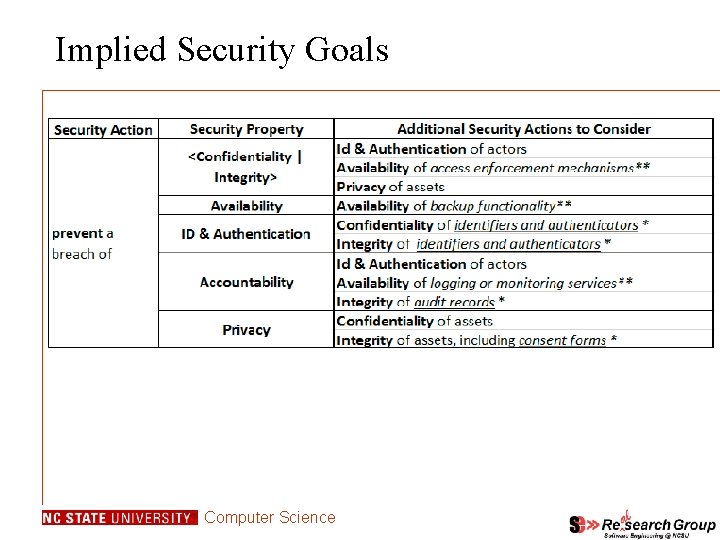
Initial and Implied Goals: DIGS Framework • Implied Goal(s) • Initial Goal(s) • prevent a breach of Confidentiality of discharge instructions • detect a breach of Integrity of discharge instructions Computer Science • → ID & Authentication of actors Availability of access enforcement mechanisms Accountability of actions Integrity of audit records 8
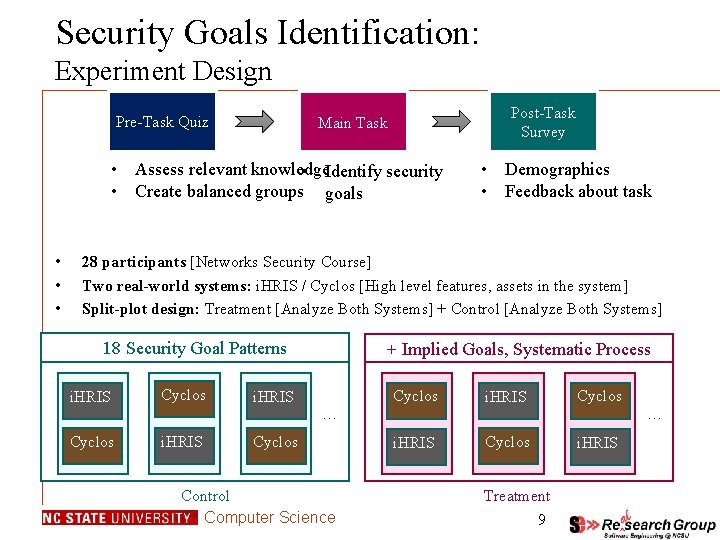
Security Goals Identification: Experiment Design Pre-Task Quiz Post-Task Survey Main Task • Assess relevant knowledge • Identify security • Create balanced groups goals • • Demographics • Feedback about task 28 participants [Networks Security Course] Two real-world systems: i. HRIS / Cyclos [High level features, assets in the system] Split-plot design: Treatment [Analyze Both Systems] + Control [Analyze Both Systems] 18 Security Goal Patterns i. HRIS Cyclos i. HRIS + Implied Goals, Systematic Process … Cyclos Control Computer Science Cyclos i. HRIS Treatment 9 …
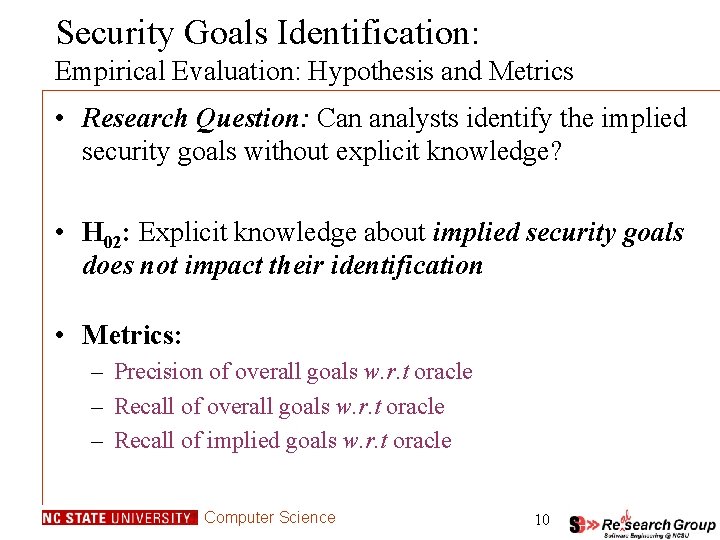
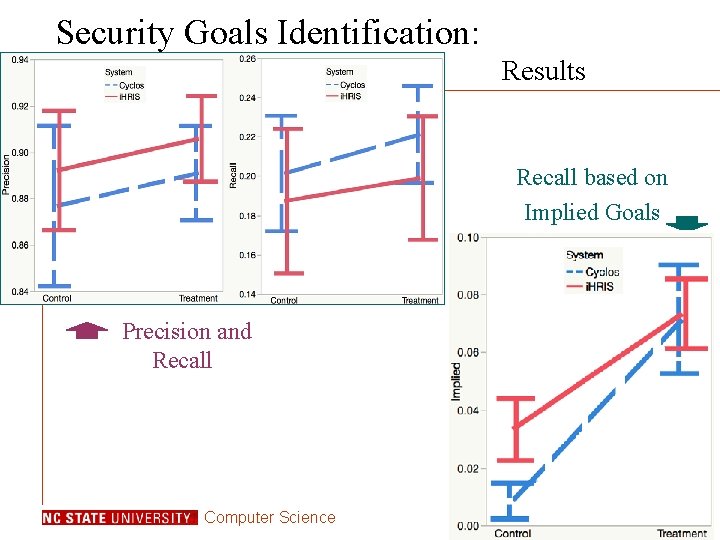
Security Goals Identification: Empirical Evaluation: Hypothesis and Metrics • Research Question: Can analysts identify the implied security goals without explicit knowledge? • H 02: Explicit knowledge about implied security goals does not impact their identification • Metrics: – Precision of overall goals w. r. t oracle – Recall of implied goals w. r. t oracle Computer Science 10
Security Goals Identification: Results • Recall based on • Implied Goals • Precision and Recall Computer Science 11
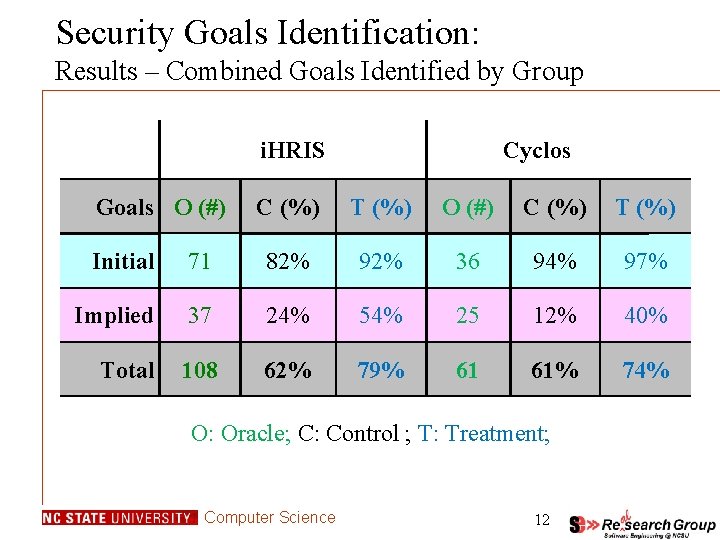
Security Goals Identification: Results – Combined Goals Identified by Group i. HRIS Goals O (#) Cyclos C (%) T (%) O (#) C (%) T (%) Initial 71 82% 92% 36 94% 97% Implied 37 24% 54% 25 12% 40% Total 108 62% 79% 61 61% 74% • O: Oracle; C: Control ; T: Treatment; Computer Science 12
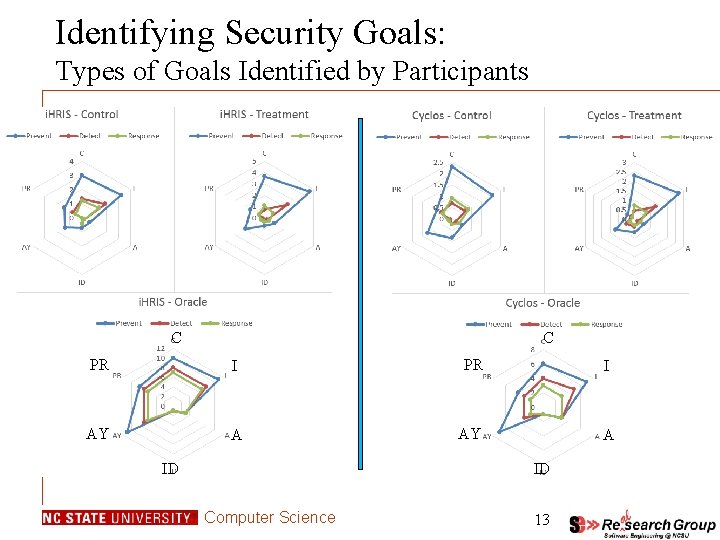
Identifying Security Goals: Types of Goals Identified by Participants C C PR I AY A ID ID Computer Science 13
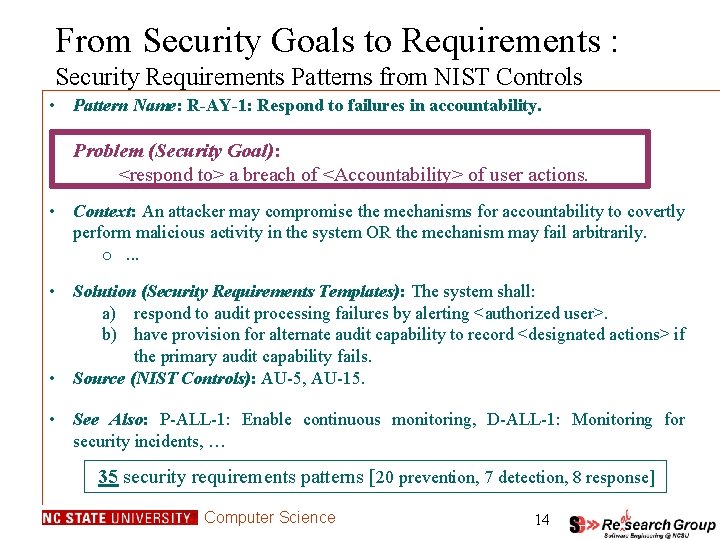
From Security Goals to Requirements : Security Requirements Patterns from NIST Controls • Pattern Name: R-AY-1: Respond to failures in accountability. • Problem (Security Goal): <respond to> a breach of <Accountability> of user actions. • Context: An attacker may compromise the mechanisms for accountability to covertly perform malicious activity in the system OR the mechanism may fail arbitrarily. o. . . • Solution (Security Requirements Templates): The system shall: a) respond to audit processing failures by alerting <authorized user>. b) have provision for alternate audit capability to record <designated actions> if the primary audit capability fails. • Source (NIST Controls): AU-5, AU-15. • See Also: P-ALL-1: Enable continuous monitoring, D-ALL-1: Monitoring for security incidents, … • 35 security requirements patterns [20 prevention, 7 detection, 8 response] Computer Science 14
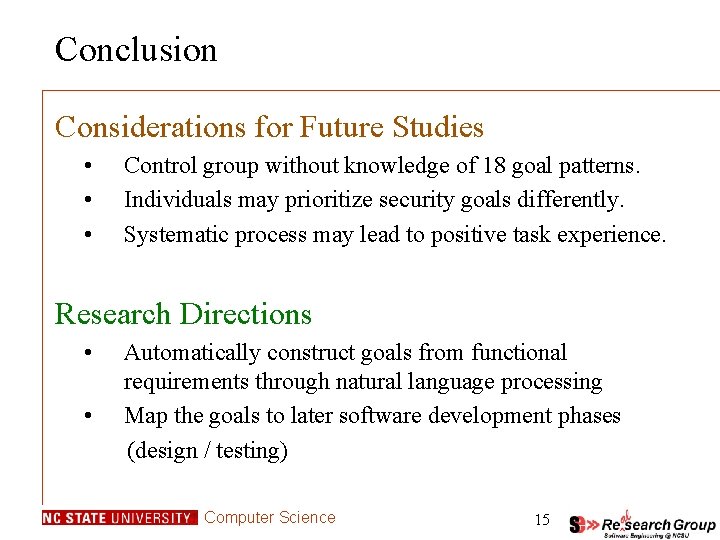
Conclusion Considerations for Future Studies • • • Control group without knowledge of 18 goal patterns. Individuals may prioritize security goals differently. Systematic process may lead to positive task experience. Research Directions • • Automatically construct goals from functional requirements through natural language processing Map the goals to later software development phases (design / testing) Computer Science 15
References [Alexander 03] Alexander, Ian. “Misuse Cases: Use Cases with Hostile Intent. ” IEEE Software 20 (1): 58– 66. 2003 [Ali 09] Ali, Raian, Fabiano Dalpiaz, and Paolo Giorgini. “A Goal Modeling Framework for Self-Contextualizable Software. ” Lecture Notes in Business Information Processing 29 LNBIP: 326– 38. 2009 [Asnar 07] Asnar, Yudistira, Paolo Giorgini, Fabio Massacci, and Nicola Zannone. “From Trust to Dependability through Risk Analysis. ” Proceedings - Second International Conference on Availability, Reliability and Security, ARES 2007, 19– 26. [Daramalo 12] Daramola, Olawande, Guttorm Sindre, and Tor Stalhane. “Pattern-Based Security Requirements Specification Using Ontologies and Boilerplates. ” 2 nd IEEE International Workshop on Requirements Patterns, Re. Pa 2012 - Proceedings, 54– 59. 2012 [Haley 08] Haley, Charles B, Robin Laney, Jonathan D Moffett, and Bashar Nuseibeh. 2008. “Security Requirements Engineering: A Framework for Representation and Analysis. ” IEEE Transactions on Software Engineering 34 (1): 133– 53 [Massacci 10] Massacci, Fabio, John Mylopoulos, and Nicola Zannone. “Security Requirements Engineering: The SI* Modeling Language and the Secure Tropos Methodology. ” Advances in Intelligent Information Systems 265: 147– 74. 2010 [Mc. Graw 06] G. Mc. Graw. “Software Security: Building Security In”, Addison Wesley Professional, 2006. [NVD] Alshazly, A. A. , Elfatatry, A. M. and Abougabal, M. S. 2014. Detecting defects in software requirements specification. Alexandria Engineering Journal. 53, 3 (2014), 513– 527. [Schneider 12] Kurt Schneider, Eric Knauss, Siv Houmb, Shareeful Islam, and J. Jürjens, "Enhancing security requirements engineering by organizational learning, " Requirements Engineering, vol. 17, pp. 35 -56, 2012. [Schumacher 06] M. Schumacher, E. Fernandez-Buglioni, D. Hyberston, F. Buschmann, and P. Sommerlad, Security Patterns: Integrating Security and Systems Engineering. West Sussex: John Wiley & Sons, Ltd, 2006. [Sindre 05] Sindre, G, and A L Opdahl. “Eliciting Security Requirements with Misuse Cases. ” Requirements Engineering 10 (1). 2005 [Slankas 13] J. Slankas and L. Williams, "Access Control Policy Extraction from Unconstrained Natural Language Text", 2013 ASE/IEEE International Conference on Privacy, Security, Risk, and Trust (PASSAT), Washington D. C. , USA, September 8 -14, 2013. [Slankas 14] Slankas, J, X Xiao, L Williams, and T Xie. “Relation Extraction for Inferring Access Control Rules from Natural Language Artifacts. ” Annual Computer Security Applications Conference (ACSAC 2014). New Orleans, LA. 2014 [Souag 15] Souag, Amina, Raúl Mazo, Camille Salinesi, and Isabelle Comyn-Wattiau. “Reusable Knowledge in Security Requirements Engineering: A Systematic Mapping Study. ” Requirements Engineering, 251– 83. 2015 [Square 05] N. R. Mead, E. D. Houg, and T. R. Stehney, "Security Quality Requirements Engineering (SQUARE) Methodology, " Software Engineering Inst. , Carnegie Mellon University 2005. Computer Science 16
References [Cyber. Sec 2016] Hibshi, Hanan, Travis Breaux, Maria Riaz, and Laurie Williams. “A Grounded Analysis of Experts’ Decision-Making During Security Assessments. ” Submitted to: Journal of Cyber. Security, Feb 2016. [ESEM 2014] Riaz, Maria, John Slankas, Jason King, and Laurie Williams. 2014. “Using Templates to Elicit Implied Security Requirements from Functional Requirements - A Controlled Experiment. ” In 8 th ACM/IEEE International Symposium on Empirical Software Engineering and Measurement (ESEM), 1– 10. Torino [ESEM 2016] Riaz, Maria, Jonathan Stallings, Munindar P. Singh, John Slankas, and Laurie Williams. 2016. “DIGS – A Framework for Discovering Goals for Security Requirements Engineering. ” In Empirical Software Engineering and Measurement (ESEM) (to Appear). Ciudad Real [ESE Journal 2016] Riaz, Maria, Jason King, John Slankas, Laurie Williams, Fabio Massacci, Christian Quesada Lopez, and Marcelo Jenkins. “Identifying the implied: Findings from Three Differeniated Replications on the Use of Security Requirements Templates”. Empirical Software Engineering Journal, 1 st Submission: Nov. 2015. Revision: May 2016. [ESE Journal 2016] King, Jason, John Stallings, Maria Riaz, and Laurie Williams. “To Log, or Not To Log: Using Heuristics to Identify Mandatory Log Events – A Controlled Experiment”. Empirical Software Engineering Journal, 1 st Submission: Oct. 2015. Revision: April 2016. [ICSE 2016] Industrial case study with Cisco – To Submit [IST Journal 2015] Riaz, Maria, Travis Breaux, and Laurie Williams. 2015. “How Have We Evaluated Software Pattern Application? A Systematic Mapping Study of Research Design Practices. ” Information and Software Technology 65: 14– 38. doi: 10. 1016/j. infsof. 2015. 04. 002 [RE 2014] Riaz, Maria, Jason King, John Slankas, and Laurie Williams. 2014. “Hidden in Plain Sight: Automatically Identifying Security Requirements from Natural Language Artifacts. ” In 22 nd International Requirements Engineering Conference (RE), 183– 92. Karlskrona: IEEE [RE-ESPRE 2014] Hibshi, Hanan, Travis Breaux, Maria Riaz, and Laurie Williams. 2014. “Towards a Framework to Measure Security Expertise in Requirements Analysis. ” In 1 st International Workshop on Evolving Security and Privacy Requirements Engineering (ESPRE), 13– 18. Sweden [RE-ESPRE 2016] Riaz, Maria, Sarah Elder, and Laurie Williams. 2016. “Systematically Developing Prevention, Detection and Response Patterns for Security Requirements”. Submitted to: 3 rd International Workshop on Evolving Security and Privacy Requirements Engineering (ESPRE). Beijing. [RE Journal 2012] Jeremy C. Maxwell, Annie I. Anton, Peter Swire, Maria Riaz, Christopher M. Mc. Craw. "A Legal Cross-References Taxonomy for Reasoning About Compliance, " Requirements Engineering Journal, 17(2), pp 99 -115, Springer-Verlag, 2012 [Re. Pa 2012] Riaz, Maria, and Laurie Williams. 2012. “Security Requirements Patterns: Understanding the Science behind the Art of Pattern Writing. ” In Proceedings of the 2 nd IEEE International Workshop on Requirements Patterns (Re. Pa), 29– 34. Chicago Computer Science 17
Backup Slides • BACKUP Computer Science 18
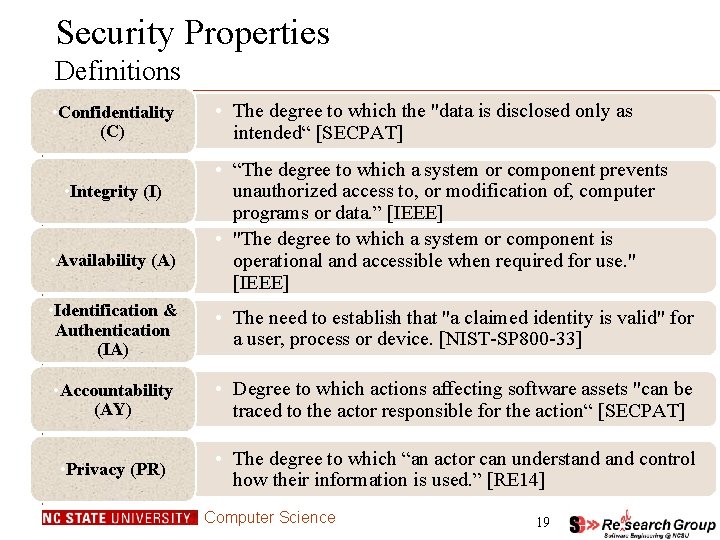
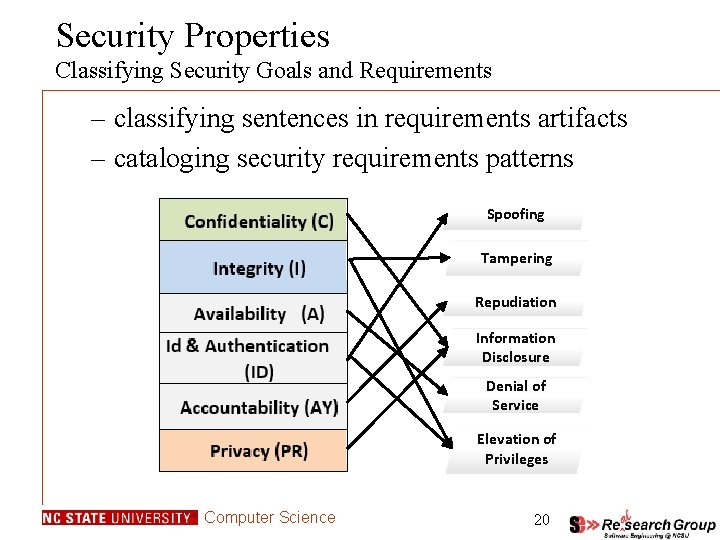
Security Properties Definitions • Confidentiality (C) • Integrity (I) • Availability (A) • The degree to which the "data is disclosed only as intended“ [SECPAT] • “The degree to which a system or component prevents unauthorized access to, or modification of, computer programs or data. ” [IEEE] • "The degree to which a system or component is operational and accessible when required for use. " [IEEE] • Identification & Authentication (IA) • The need to establish that "a claimed identity is valid" for a user, process or device. [NIST-SP 800 -33] • Accountability (AY) • Degree to which actions affecting software assets "can be traced to the actor responsible for the action“ [SECPAT] • Privacy (PR) • The degree to which “an actor can understand control how their information is used. ” [RE 14] Computer Science 19
Security Properties Classifying Security Goals and Requirements – classifying sentences in requirements artifacts – cataloging security requirements patterns Spoofing Tampering Repudiation Information Disclosure Denial of Service Elevation of Privileges Computer Science 20
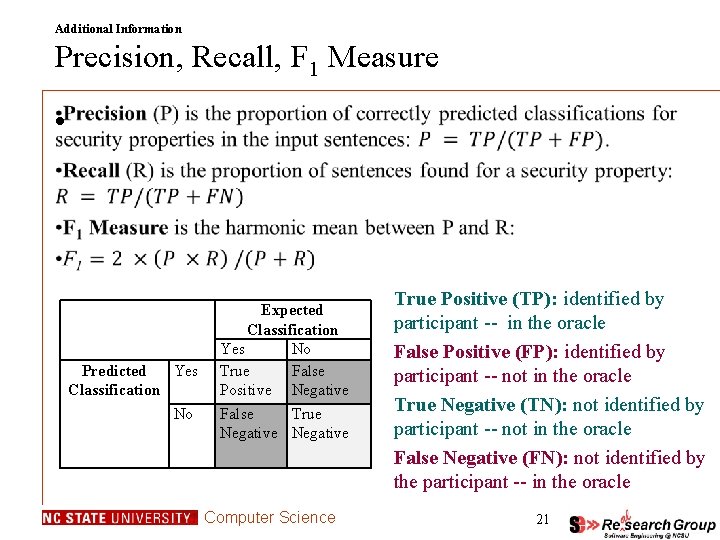
Additional Information Precision, Recall, F 1 Measure • Predicted Yes Classification No Expected Classification Yes No True False Positive Negative False True Negative Computer Science True Positive (TP): identified by participant -- in the oracle False Positive (FP): identified by participant -- not in the oracle True Negative (TN): not identified by participant -- not in the oracle False Negative (FN): not identified by the participant -- in the oracle 21
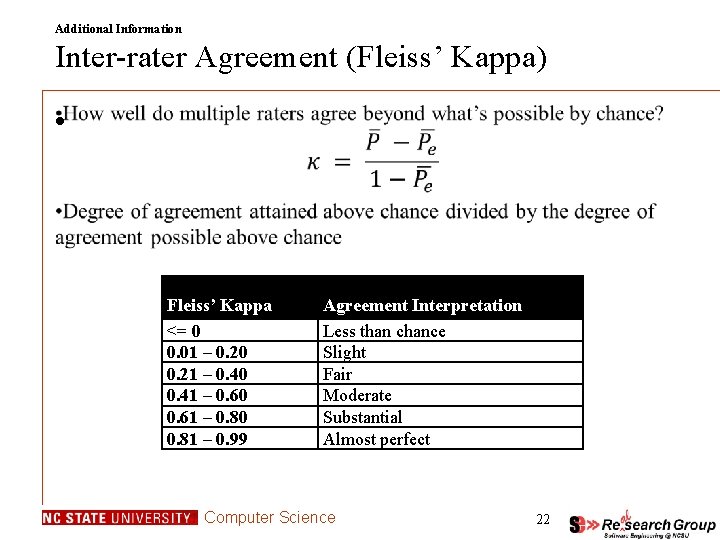
Additional Information Inter-rater Agreement (Fleiss’ Kappa) • Fleiss’ Kappa <= 0 0. 01 – 0. 20 0. 21 – 0. 40 0. 41 – 0. 60 0. 61 – 0. 80 0. 81 – 0. 99 Agreement Interpretation Less than chance Slight Fair Moderate Substantial Almost perfect Computer Science 22
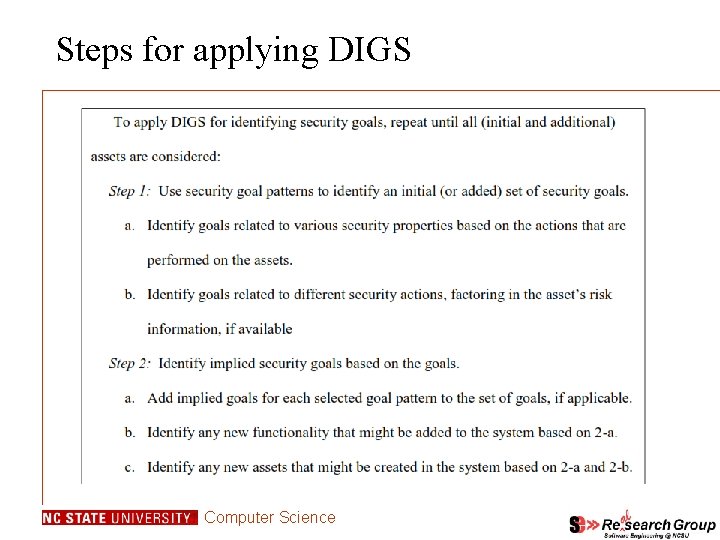
Steps for applying DIGS Computer Science
Example: Initial Security Goals Computer Science
Example: Implied Security Goals Computer Science
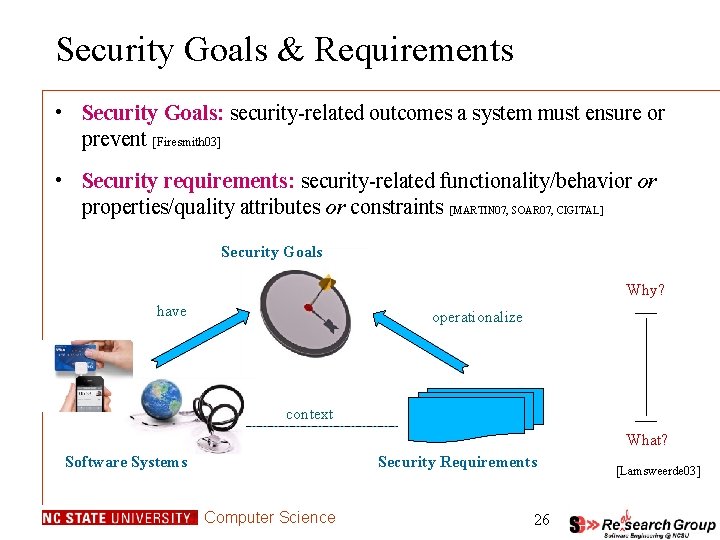
Security Goals & Requirements • Security Goals: security-related outcomes a system must ensure or prevent [Firesmith 03] • Security requirements: security-related functionality/behavior or properties/quality attributes or constraints [MARTIN 07, SOAR 07, CIGITAL] Security Goals Why? have operationalize context What? Software Systems Security Requirements Computer Science 26 [Lamsweerde 03]
Implied Security Goals Computer Science