
Computer Science at Queen Mary University of London
- Slides: 25
Computer Science at Queen Mary, University of London Matthew Huntbach
Admissions at Queen Mary • We tend to be less well known than the other University of London Colleges • So, in order to fill our places, we can accept people with lower grades • But we insist on the high standards associated with the University of London • We don’t believe in “dumbing down”!
An Opportunity for You • You will be taught be people who are internationally known experts in various areas of Computer Science • You will be taught by people who have many years experience teaching Computer Science • If you pass you will receive a qualification which is highly valued
It’s up to you to take the opportunity • You will be treated as adults - we will expect you to do the necessary work, but we won’t force you • Much university study is self-directed. Lectures are only a part of it, labs and selfstudy are as important • It’s a full time job - 40 hours a week (but you can work too hard as well as too little)
You can do it • There isn’t a strong correlation between entrance grades and final degree results • There is a strong correlation between willingness to put in the effort and final degree results • If people fail, it’s much more likely that it’s due to insufficient effort than insufficient ability
Warning • Computer Science does have a high failure rate • The first year exams are the biggest hurdle • Computer Science is different from many other subjects, so assumptions about education you’ve made in the past, or society makes may not apply to it
No. 1 mistaken belief: Education is about memorisation • “I have to memorise what the lecturer wrote” • “I can take it easy now, and revise in the weeks before the exam” • “I can copy what my friend wrote and memorise that” • “It’s hard and boring”
Skills you can’t acquire by memorising • • • Driving a car Speaking another language Playing a musical instrument Ballroom dancing Computer Programming Etc etc
How not to pass your driving test • “The most important thing is to read books about it and know theory by heart” • “Driving practice takes up time from my social life, I’ll skip it if I can” • “One hour a week is plenty enough time” • “I’ll do a bit more when my driving test gets closer”
No. 2 mistaken belief: I’m still at school • • • “Lectures are lessons” “Lecturers are teachers” “I’m doing this because I’m forced to” “It’s fun to play up, cheat, act stupid” “It isn’t ‘cool’ to ask questions, work hard and show a real interest in the subject” • “I’m only here to pass exams”
University level study • Lectures are only the pacemakers of the course • Tutorials are important, but they only work if you put in the effort • Exercises are set because you learn by doing them • Intellectual curiosity about your subject is the key to doing well
Asking Questions • Don’t ask too early: think about it first for yourself • Don’t ask too late: don’t waste hours stuck on a trivial issue • Don’t be afraid of looking stupid: there are maybe dozens of others who feel the same • Don’t forget to use other resources: books, web sites, each other.
No. 3 mistaken belief: I know all this already • There is a big difference between academic Computer Science and school/college Computing • There is a big difference between academic Computer Science and hobby computing • Mistaken assumptions based on previous experience may be hard work to drop • We move very quickly, don’t lose track
What’s wrong with A-level Computing? • Too much emphasis on knowing facts, not enough emphasis on problem solving • Much of it is very out-of-date • Often taught by people with weak knowledge/experience of computing • A-level Information Technology is more relevant to Business Studies than Computing • We prefer A-level Mathematics
So do I need A-level Maths? • It develops and tests the right sort of skills • But we don’t use much of its content • Computer Science Maths is about logic and discrete structures • A mathematical mind often means a good programming mind • But many people with A-level Maths fail our degree, and many without it do well
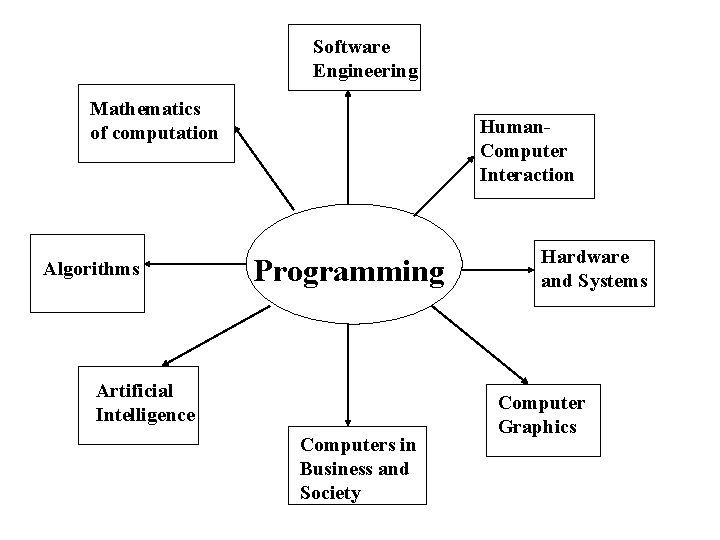
Software Engineering Mathematics of computation Algorithms Human. Computer Interaction Programming Artificial Intelligence Computers in Business and Society Hardware and Systems Computer Graphics
Computer Programming • The key skill in Computer Science • Not about using any particular programming language • Few students have extensive programming experience before coming to us • Pre-university programming experience can be as much a hindrance as a help
Axiomatic Logic • You have to understand a few basic axioms (facts, instructions) plus a few rules (techniques for putting things together into larger things) then you can do an infinite number of things • Not much to know but a lot to do • Mathematics may be the only thing like this you have done before
Abstraction • Making sense of complex things by seeing them in terms of simpler things. Looking for patterns and application of rules. Ignoring unnecessary details. Generalising from particular examples to principles usable much more widely. • Have you ever done this before?
You have done abstraction before • You learnt that 2 apples plus 2 apples makes 4 apples • You learnt that 2 oranges plus 2 oranges makes 4 oranges • You generalised to 2 anything plus 2 anything makes 4 anything • In the abstract, 2 plus 2 makes 4
“Use/Practice/Discuss/Reflect” (Prof. Richard Bornat) • Programming is an intellectual skill, but not learnt in the way of most academic subjects • Practice is the only way to get it inside your head • Use is the only way to keep it there • Discussion exposes your knowledge to yourself and others’ knowledge to you. • Reflection develops your knowledge
Computer whizz-kids • Know a lot about computer applications and computer machinery • Have a head start in some of the mundane aspects of Computer Science • Often join Computer Science degrees with the wrong idea about what they involve • May or may not make good Computer Scientists in the end
Computer Nerds • The classic image of the “computer person”: likes working with computers because he doesn’t like people • You don’t have to be a “nerd” to be a Computer Scientist, it doesn’t even help • Professionals in computing need to work with teams and communicate with clients
“The next Bill Gates” • Bill Gates was more of a salesman or businessman than a Computer Scientist • Computers have many applications in the business world • The computer business is a big one • But if you are only in it to “make money” or “get a good job”, experience suggests you won’t do well on our degree
Prospects • The high demand for Computer Science graduates should, however, act as a driving force for you to succeed • Compare our costs to commercial training • Compare their time scales to ours • We educate for the long term, that’s why we concentrate on principles rather than particular languages/systems/etc.