
COMPUTER SCIENCE Application of reinforcement learning for automated
- Slides: 30
COMPUTER SCIENCE Application of reinforcement learning for automated content validation towards selfimproving online courseware Noboru Matsuda & Machi Shimmei Center for Educational Informatics Department of Computer Science North Carolina State University
COMPUTER SCIENCE Online Course • Aka MOOC: Massive Open Online Course • Potential for a significant impact on outreach and learning – Tremendous volume of students – A wide variety of courses Noboru Matsuda GIFTSym 7 2019 2
COMPUTER SCIENCE Problem • Creating effective large-scale online course is very hard • Existing design theories still require iterative engineering • Lack of scalable method for evidencebased feedback Noboru Matsuda GIFTSym 7 2019 3
COMPUTER SCIENCE Need • Scalable and efficient learning engineering methods • Evidence-based iterative online courseware development Noboru Matsuda GIFTSym 7 2019 4
COMPUTER SCIENCE Solution • PASTEL: Pragmatic methods to develop Adaptive and Scalable Technologies for next generation E-Learning Noboru Matsuda GIFTSym 7 2019 5
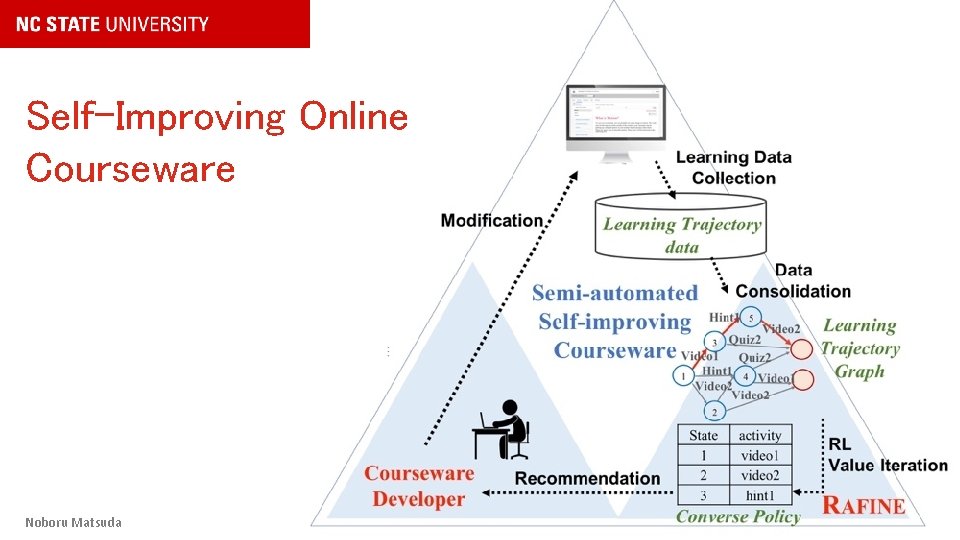
COMPUTER SCIENCE RAFINE • Reinforcement learning Application For INcremental courseware Engineering • Compute a predicted effectiveness of individual instructional components on online courseware Noboru Matsuda GIFTSym 7 2019 6
COMPUTER SCIENCE Relevance to GIFT • Evidence-based courseware improvement • The system can automatically flag contentious instructional components Noboru Matsuda GIFTSym 7 2019 7
COMPUTER SCIENCE Self-Improving Online Courseware Noboru Matsuda GIFTSym 7 2019 8
COMPUTER SCIENCE Reinforcement Learning • Given a state transition graph with goals and a reward for each state, • a policy shows optimal actions that should be taken for a particular state – to maximize a likelihood of reaching to desired goals Noboru Matsuda GIFTSym 7 2019 9
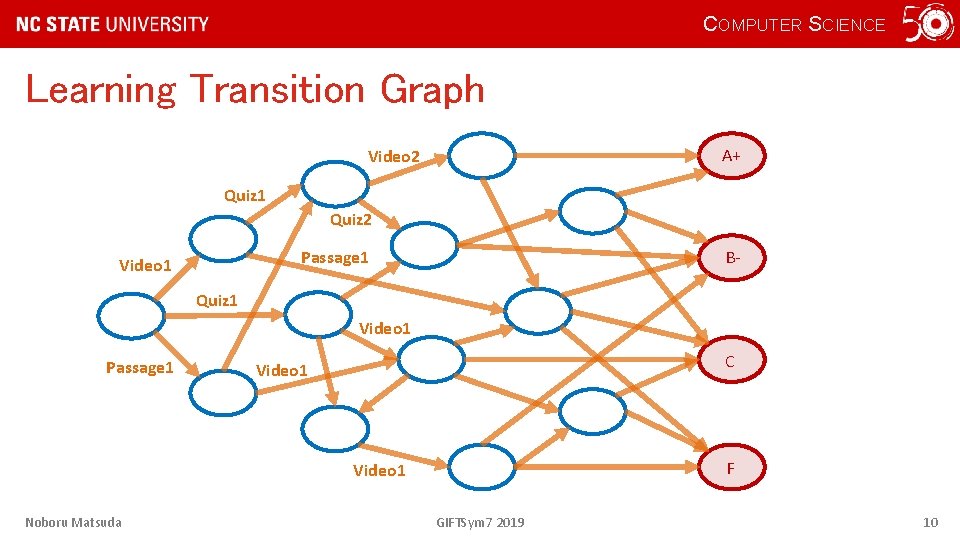
COMPUTER SCIENCE Learning Transition Graph A+ Video 2 Quiz 1 Quiz 2 B- Passage 1 Video 1 Quiz 1 Video 1 Passage 1 C Video 1 F Video 1 Noboru Matsuda GIFTSym 7 2019 10
COMPUTER SCIENCE RAFINE: Hypothesis • If students learning activities were represented as a state transition – A state represents students’ intermediate learning status, and – An edge represents an instructional component • Then by defining reward for each state, we can compute a “policy” that represents the least optimal instructional component for each state Noboru Matsuda GIFTSym 7 2019 11
COMPUTER SCIENCE RAFINE: Hypothesis (cont. ) • Converse policy – The least optimal policy • Instructional components the most frequently appear as converse policy is likely to be inefficient Noboru Matsuda GIFTSym 7 2019 12
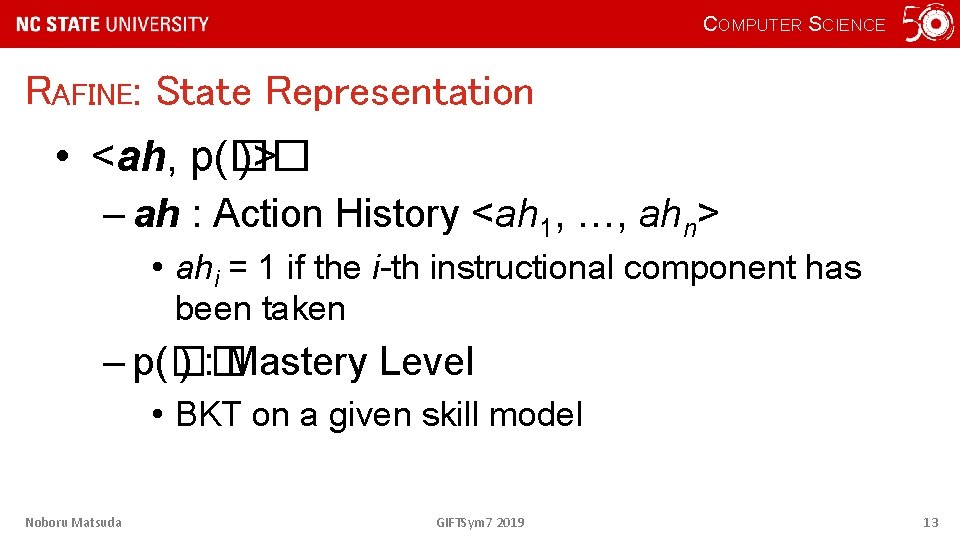
COMPUTER SCIENCE RAFINE: State Representation • <ah, p(�� )> – ah : Action History <ah 1, …, ahn> • ahi = 1 if the i-th instructional component has been taken – p(�� ) : Mastery Level • BKT on a given skill model Noboru Matsuda GIFTSym 7 2019 13
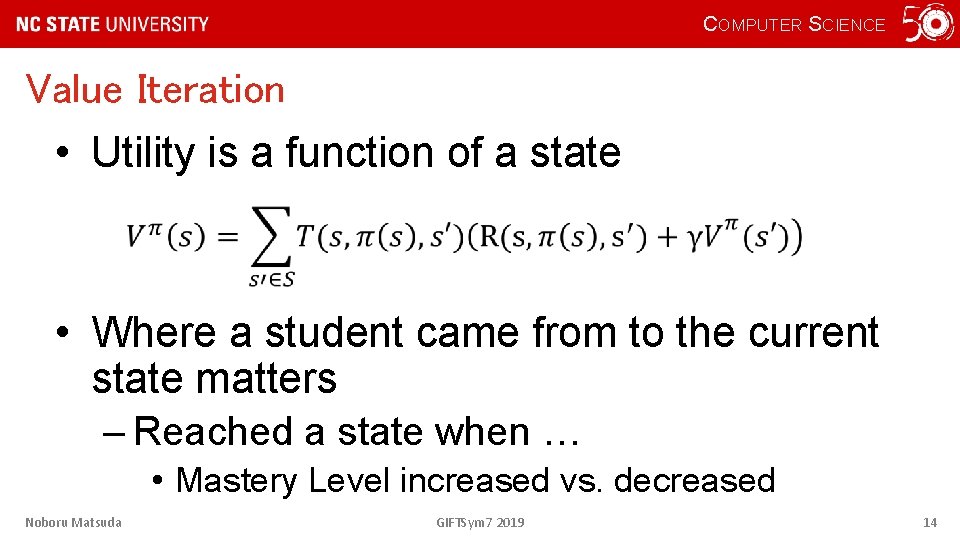
COMPUTER SCIENCE Value Iteration • Utility is a function of a state • Where a student came from to the current state matters – Reached a state when … • Mastery Level increased vs. decreased Noboru Matsuda GIFTSym 7 2019 14
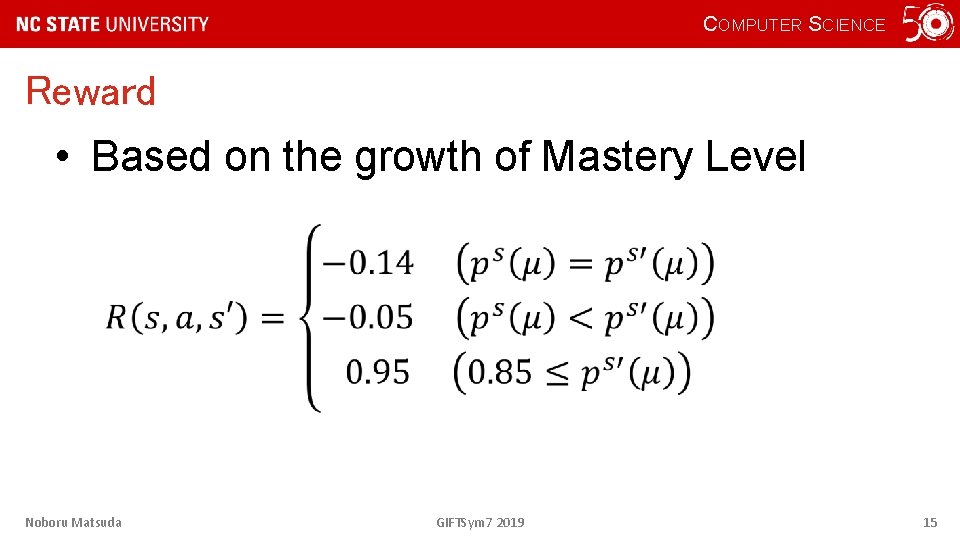
COMPUTER SCIENCE Reward • Based on the growth of Mastery Level Noboru Matsuda GIFTSym 7 2019 15
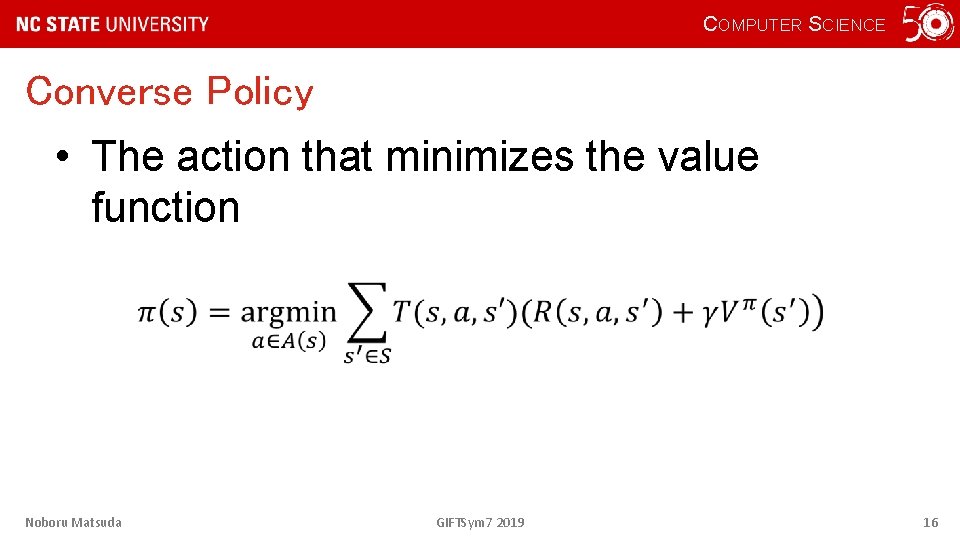
COMPUTER SCIENCE Converse Policy • The action that minimizes the value function Noboru Matsuda GIFTSym 7 2019 16
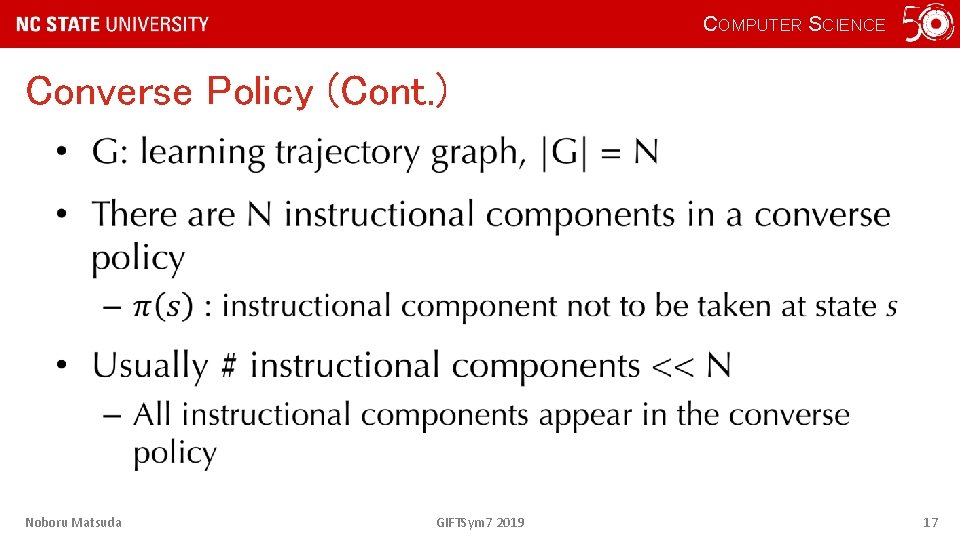
COMPUTER SCIENCE Converse Policy (Cont. ) • Noboru Matsuda GIFTSym 7 2019 17
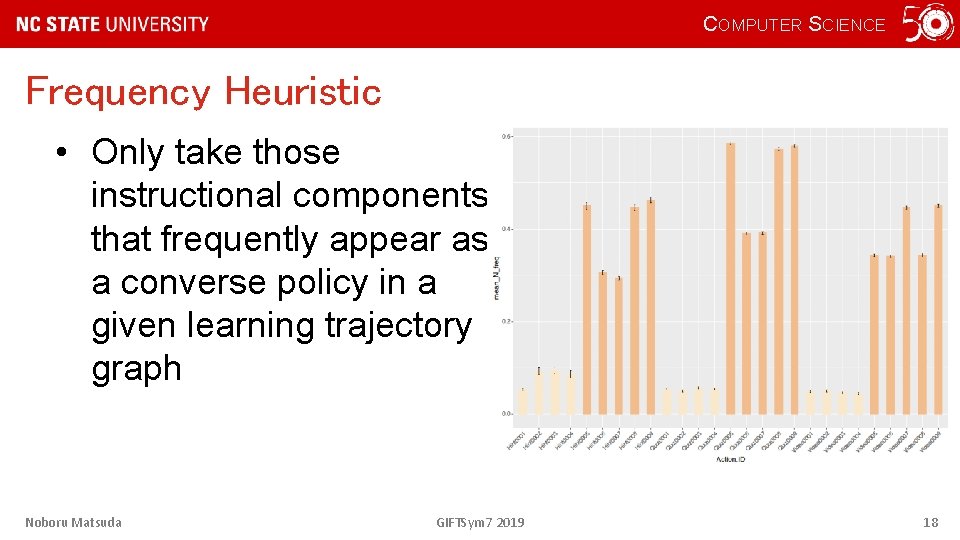
COMPUTER SCIENCE Frequency Heuristic • Only take those instructional components that frequently appear as a converse policy in a given learning trajectory graph Noboru Matsuda GIFTSym 7 2019 18
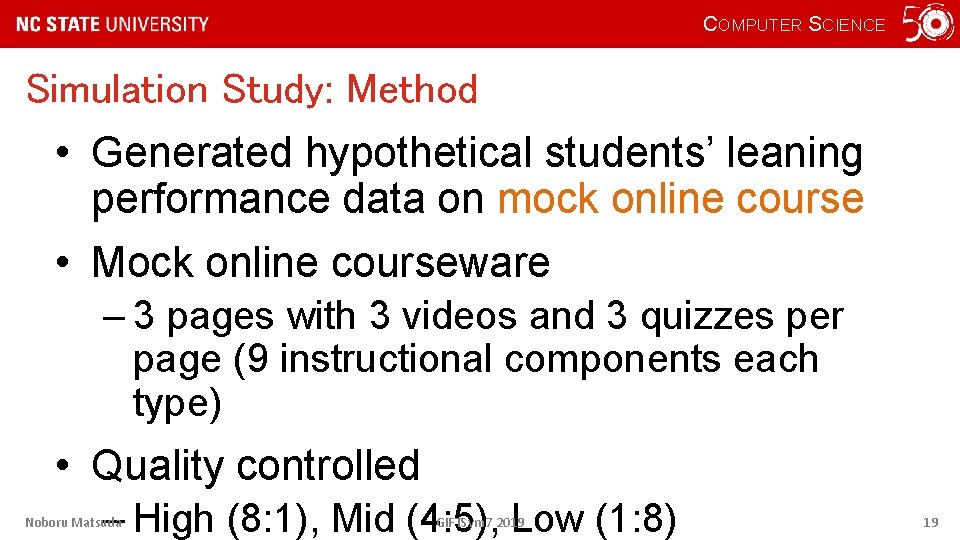
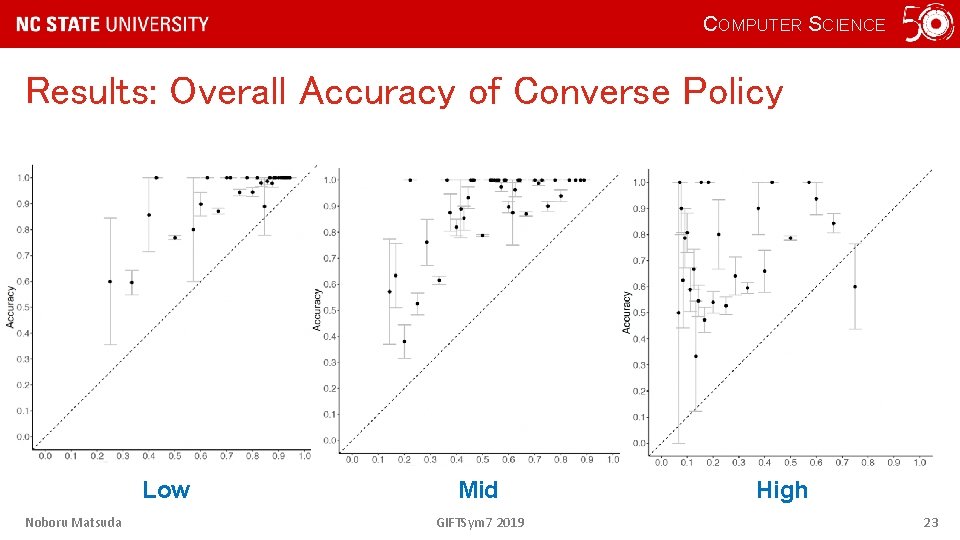
COMPUTER SCIENCE Simulation Study: Method • Generated hypothetical students’ leaning performance data on mock online course • Mock online courseware – 3 pages with 3 videos and 3 quizzes per page (9 instructional components each type) • Quality controlled – High (8: 1), Mid (4: 5), Low (1: 8) Noboru Matsuda GIFTSym 7 2019 19
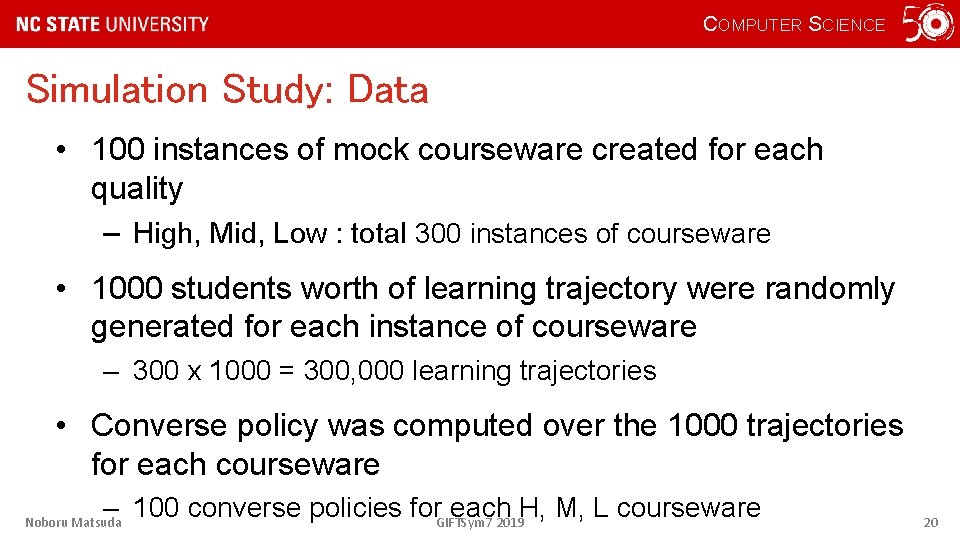
COMPUTER SCIENCE Simulation Study: Data • 100 instances of mock courseware created for each quality – High, Mid, Low : total 300 instances of courseware • 1000 students worth of learning trajectory were randomly generated for each instance of courseware – 300 x 1000 = 300, 000 learning trajectories • Converse policy was computed over the 1000 trajectories for each courseware – 100 converse policies for. GIFTSym 7 each H, M, L courseware 2019 Noboru Matsuda 20
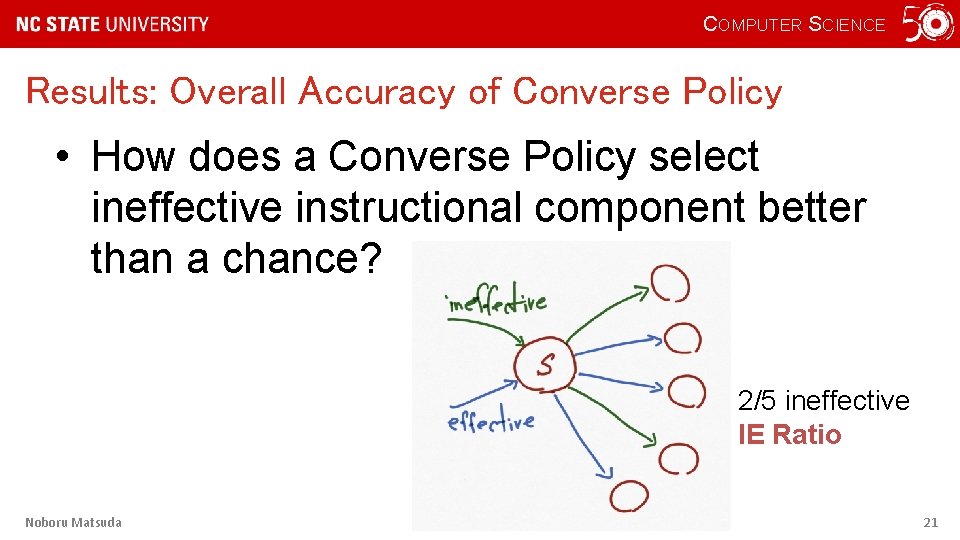
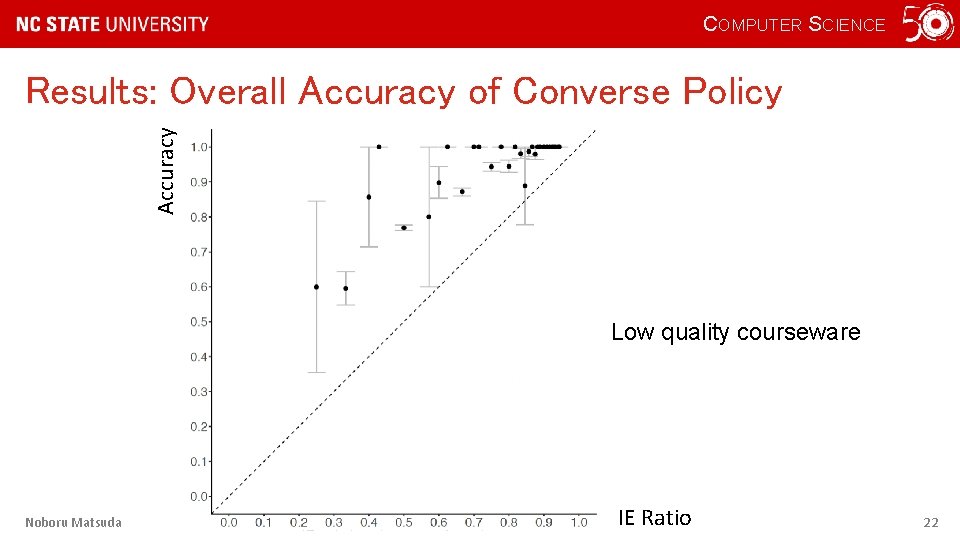
COMPUTER SCIENCE Results: Overall Accuracy of Converse Policy • How does a Converse Policy select ineffective instructional component better than a chance? 2/5 ineffective IE Ratio Noboru Matsuda GIFTSym 7 2019 21
COMPUTER SCIENCE Accuracy Results: Overall Accuracy of Converse Policy Low quality courseware Noboru Matsuda GIFTSym 7 2019 IE Ratio 22
COMPUTER SCIENCE Results: Overall Accuracy of Converse Policy Low Noboru Matsuda Mid GIFTSym 7 2019 High 23
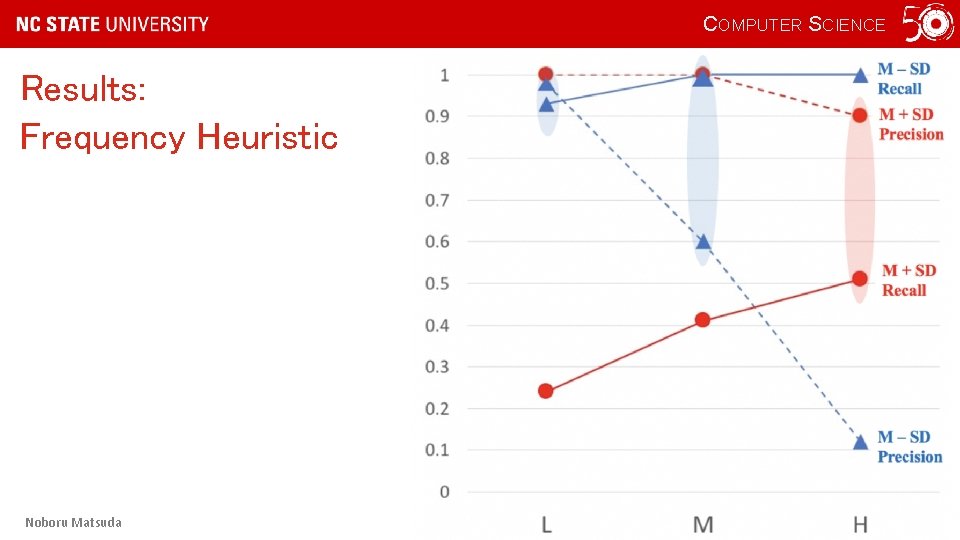
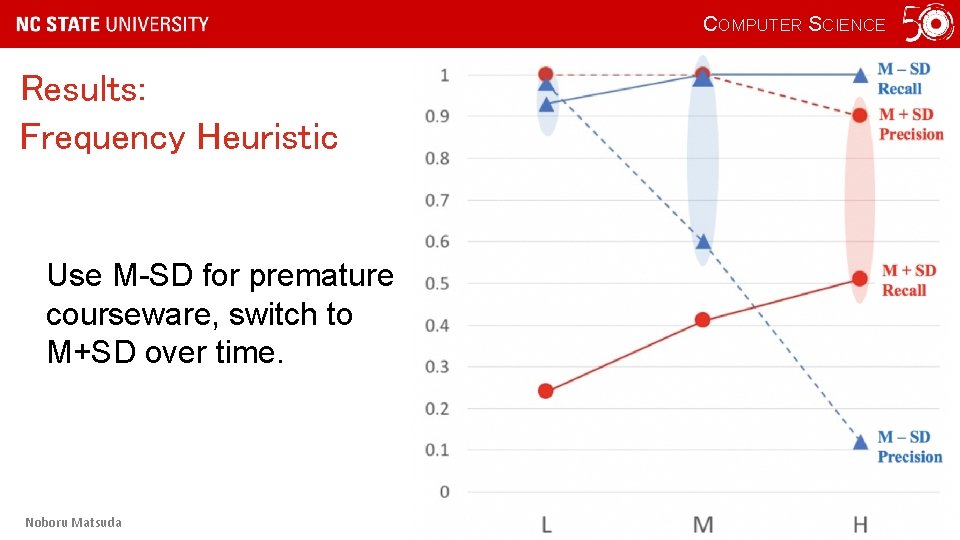
COMPUTER SCIENCE Results: Frequency Heuristic • After applying the frequency heuristic, how well does RAFINE identify ineffective instructional components? • How ”frequent” is frequent? – M ± SD Noboru Matsuda GIFTSym 7 2019 24
COMPUTER SCIENCE Results: Frequency Heuristic Noboru Matsuda GIFTSym 7 2019 25
COMPUTER SCIENCE Results: Frequency Heuristic Use M-SD for premature courseware, switch to M+SD over time. Noboru Matsuda GIFTSym 7 2019 26
COMPUTER SCIENCE Conclusions • When students’ learning trajectories are consolidated into a state transition graph, • the converse policy that represent the least optimal action (instructional component to be taken) can be computed • with a high accuracy of identifying ineffective instructional components. Noboru Matsuda GIFTSym 7 2019 27
COMPUTER SCIENCE Conclusions (Cont. ) • The Frequency Heuristic yields highly trustworthy recommendations for courseware improvement. Noboru Matsuda GIFTSym 7 2019 28
COMPUTER SCIENCE Future Work • Evaluate the practical effect of the Rafine method – Apply Rafine to real data… • The courseware must be structured with skills, AND • A closing-the-loop evaluation Noboru Matsuda GIFTSym 7 2019 29
COMPUTER SCIENCE Recommendations to GIFT • Provide API to tag instructional components with skills • Provide API for authoring tool to flag ineffective components • Provide students freedom on choosing learning activities Noboru Matsuda GIFTSym 7 2019 30