
Computer Programming TsungChu Huang Department of Electronic Engineering
- Slides: 7
程式設計 Computer Programming Tsung-Chu Huang Department of Electronic Engineering National Changhua University of Education Fall, 2004 C Programming, TCH/NCUE, Fall 2004 1
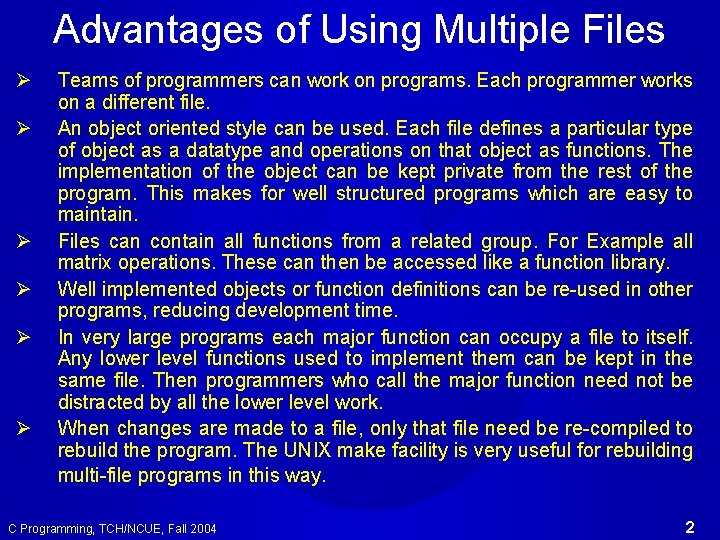
Advantages of Using Multiple Files Ø Ø Ø Teams of programmers can work on programs. Each programmer works on a different file. An object oriented style can be used. Each file defines a particular type of object as a datatype and operations on that object as functions. The implementation of the object can be kept private from the rest of the program. This makes for well structured programs which are easy to maintain. Files can contain all functions from a related group. For Example all matrix operations. These can then be accessed like a function library. Well implemented objects or function definitions can be re-used in other programs, reducing development time. In very large programs each major function can occupy a file to itself. Any lower level functions used to implement them can be kept in the same file. Then programmers who call the major function need not be distracted by all the lower level work. When changes are made to a file, only that file need be re-compiled to rebuild the program. The UNIX make facility is very useful for rebuilding multi-file programs in this way. C Programming, TCH/NCUE, Fall 2004 2
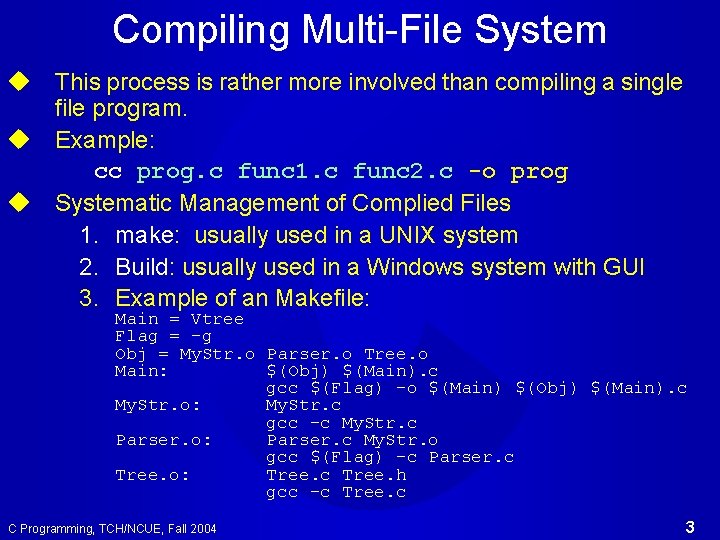
Compiling Multi-File System u This process is rather more involved than compiling a single file program. u Example: cc prog. c func 1. c func 2. c -o prog u Systematic Management of Complied Files 1. make: usually used in a UNIX system 2. Build: usually used in a Windows system with GUI 3. Example of an Makefile: Main = Vtree Flag = -g Obj = My. Str. o Parser. o Tree. o Main: $(Obj) $(Main). c gcc $(Flag) -o $(Main) $(Obj) $(Main). c My. Str. o: My. Str. c gcc -c My. Str. c Parser. o: Parser. c My. Str. o gcc $(Flag) -c Parser. c Tree. o: Tree. c Tree. h gcc -c Tree. c C Programming, TCH/NCUE, Fall 2004 3
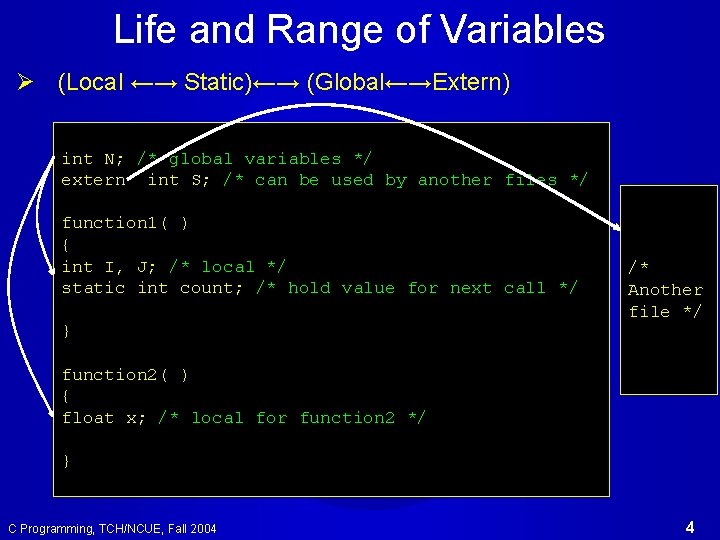
Life and Range of Variables Ø (Local ←→ Static)←→ (Global←→Extern) int N; /* global variables */ extern int S; /* can be used by another files */ function 1( ) { int I, J; /* local */ static int count; /* hold value for next call */ } /* Another file */ function 2( ) { float x; /* local for function 2 */ } C Programming, TCH/NCUE, Fall 2004 4
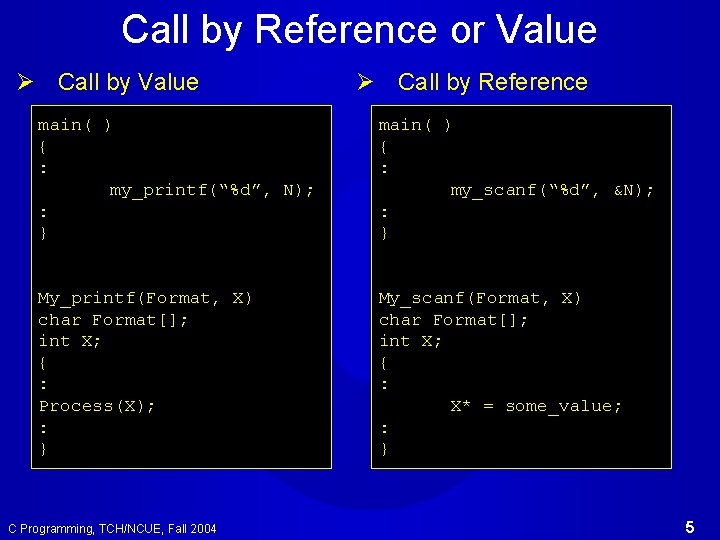
Call by Reference or Value Ø Call by Reference main( ) { : my_printf(“%d”, N); : } main( ) { : my_scanf(“%d”, &N); : } My_printf(Format, X) char Format[]; int X; { : Process(X); : } My_scanf(Format, X) char Format[]; int X; { : X* = some_value; : } C Programming, TCH/NCUE, Fall 2004 5
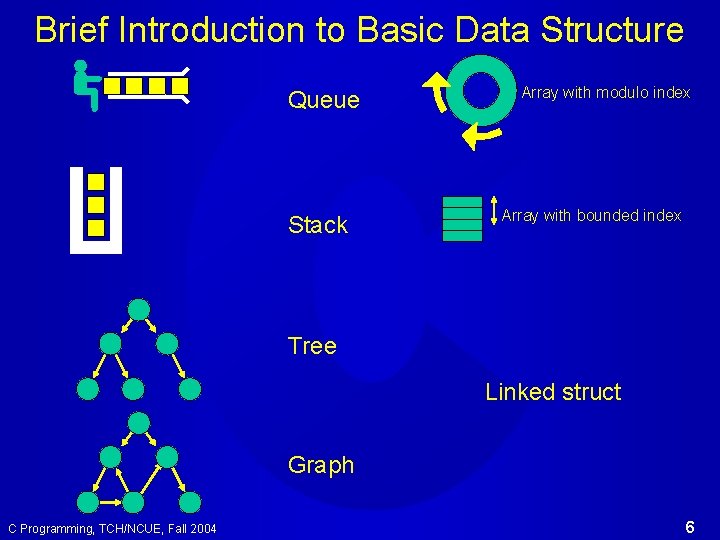
Brief Introduction to Basic Data Structure Queue Stack Array with modulo index Array with bounded index Tree Linked struct Graph C Programming, TCH/NCUE, Fall 2004 6
Exercises u Exercises of multiple files using extern variables and public functions. u Exercises of pointer usage in binary trees. C Programming, TCH/NCUE, Fall 2004 7