
Computer Programming FASTNU FSBCH Campus Lecture No 8
Computer Programming FAST-NU FSB-CH Campus Lecture No. 8 Constructors and Destructors
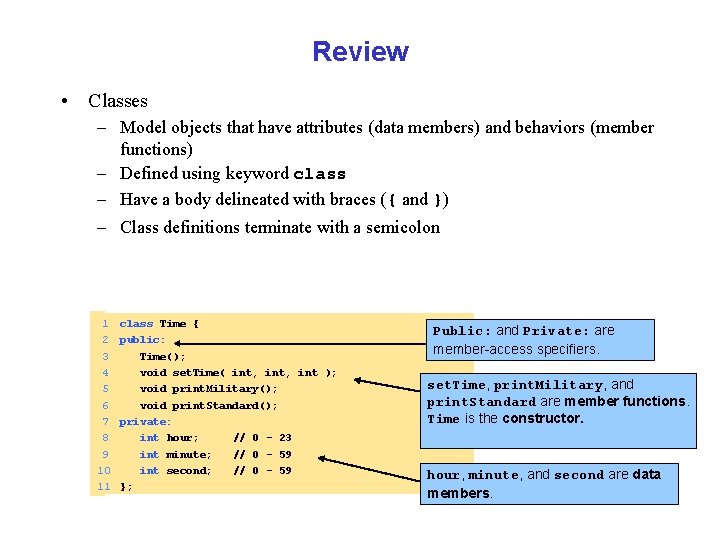
Review • Classes – Model objects that have attributes (data members) and behaviors (member functions) – Defined using keyword class – Have a body delineated with braces ({ and }) – Class definitions terminate with a semicolon 1 2 3 4 5 6 7 8 9 10 11 class Time { public: Time(); void set. Time( int, int ); void print. Military(); void print. Standard(); private: int hour; // 0 - 23 int minute; // 0 - 59 int second; // 0 - 59 }; Public: and Private: are member-access specifiers. set. Time, print. Military, and print. Standard are member functions. Time is the constructor. hour, minute, and second are data members.
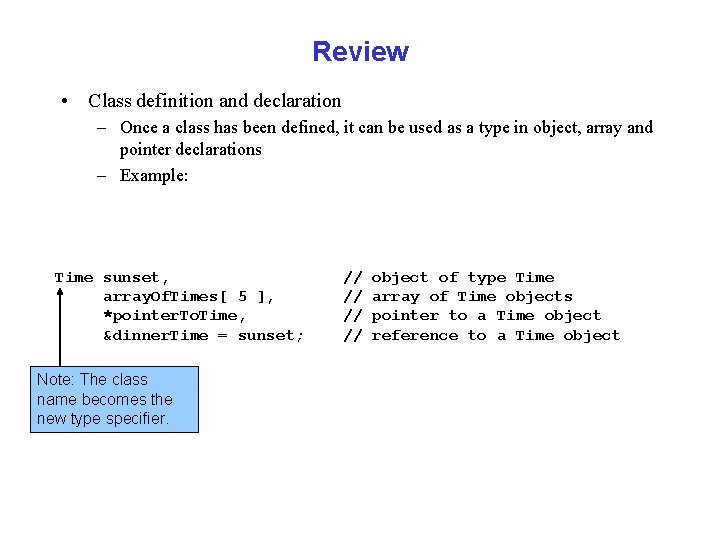
Review • Class definition and declaration – Once a class has been defined, it can be used as a type in object, array and pointer declarations – Example: Time sunset, array. Of. Times[ 5 ], *pointer. To. Time, &dinner. Time = sunset; Note: The class name becomes the new type specifier. // // object of type Time array of Time objects pointer to a Time object reference to a Time object
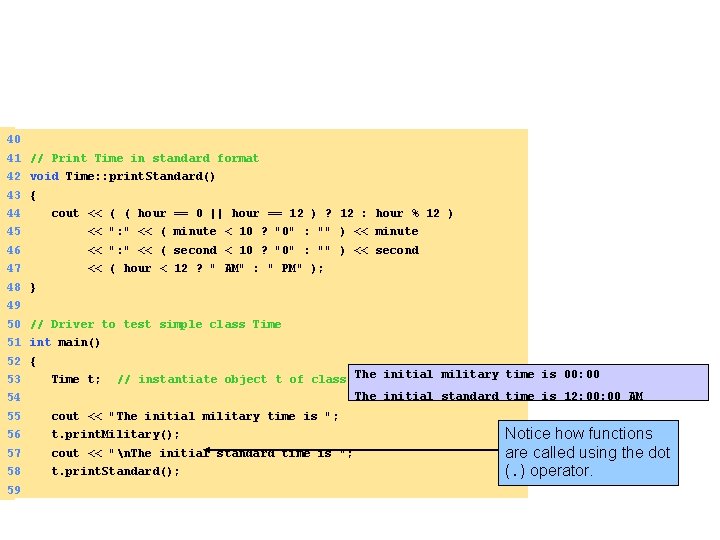
40 41 // Print Time in standard format 42 void Time: : print. Standard() 43 { 44 cout << ( ( hour == 0 || hour == 12 ) ? 12 : hour % 12 ) 45 << ": " << ( minute < 10 ? "0" : "" ) << minute 46 << ": " << ( second < 10 ? "0" : "" ) << second 47 << ( hour < 12 ? " AM" : " PM" ); 48 } 49 50 // Driver to test simple class Time 51 int main() 52 { 53 54 Time t; The initial military time is 00: 00 // instantiate object t of class Time The initial standard time is 12: 00 AM 55 cout << "The initial military time is "; 56 t. print. Military(); 57 cout << "n. The initial standard time is "; 58 t. print. Standard(); 59 Notice how functions are called using the dot (. ) operator.
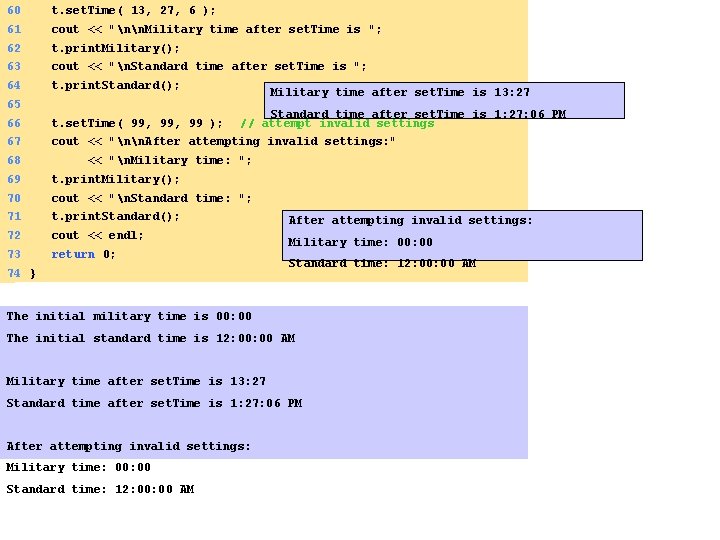
60 t. set. Time( 13, 27, 6 ); 61 cout << "nn. Military time after set. Time is "; 62 t. print. Military(); 63 cout << "n. Standard time after set. Time is "; 64 t. print. Standard(); 65 Military time after set. Time is 13: 27 Standard time after set. Time is 1: 27: 06 PM // attempt invalid settings 66 t. set. Time( 99, 99 ); 67 cout << "nn. After attempting invalid settings: " 68 << "n. Military time: "; 69 t. print. Military(); 70 cout << "n. Standard time: "; 71 t. print. Standard(); 72 cout << endl; 73 return 0; 74 } After attempting invalid settings: Military time: 00 Standard time: 12: 00 AM The initial military time is 00: 00 The initial standard time is 12: 00 AM Military time after set. Time is 13: 27 Standard time after set. Time is 1: 27: 06 PM After attempting invalid settings: Military time: 00 Standard time: 12: 00 AM
Interface vs Implementation • Separating interface from implementation – Makes it easier to modify programs – Header files • Contains class definitions and function prototypes – Source-code files • Contains member function definitions
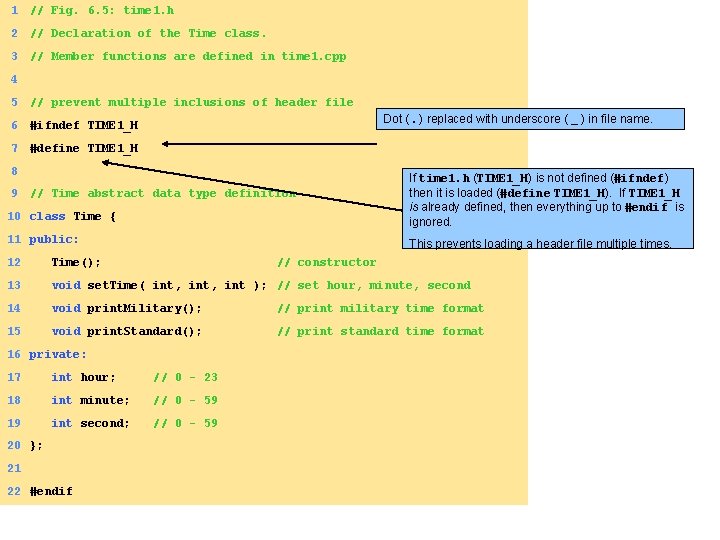
1 // Fig. 6. 5: time 1. h 2 // Declaration of the Time class. 3 // Member functions are defined in time 1. cpp 4 5 // prevent multiple inclusions of header file 6 #ifndef TIME 1_H 7 #define TIME 1_H Dot (. ) replaced with underscore ( _ ) in file name. 8 10 class Time { If time 1. h (TIME 1_H) is not defined (#ifndef) then it is loaded (#define TIME 1_H). If TIME 1_H is already defined, then everything up to #endif is ignored. 11 public: This prevents loading a header file multiple times. 9 // Time abstract data type definition 12 Time(); // constructor 13 void set. Time( int, int ); // set hour, minute, second 14 void print. Military(); // print military time format 15 void print. Standard(); // print standard time format 16 private: 17 int hour; // 0 - 23 18 int minute; // 0 - 59 19 int second; // 0 - 59 20 }; 21 22 #endif
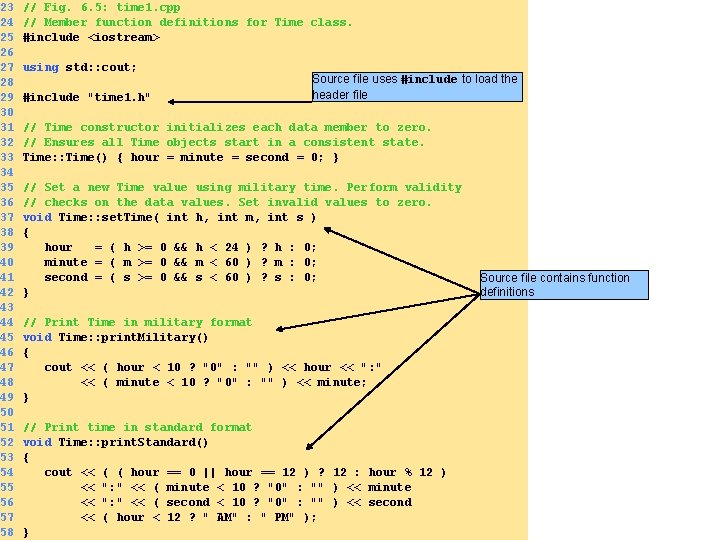
23 24 25 26 27 28 29 30 31 32 33 34 35 36 37 38 39 40 41 42 43 44 45 46 47 48 49 50 51 52 53 54 55 56 57 58 // Fig. 6. 5: time 1. cpp // Member function definitions for Time class. #include <iostream> using std: : cout; #include "time 1. h" Source file uses #include to load the header file // Time constructor initializes each data member to zero. // Ensures all Time objects start in a consistent state. Time: : Time() { hour = minute = second = 0; } // Set a new Time value using military time. Perform validity // checks on the data values. Set invalid values to zero. void Time: : set. Time( int h, int m, int s ) { hour = ( h >= 0 && h < 24 ) ? h : 0; minute = ( m >= 0 && m < 60 ) ? m : 0; second = ( s >= 0 && s < 60 ) ? s : 0; } // Print Time in military format void Time: : print. Military() { cout << ( hour < 10 ? "0" : "" ) << hour << ": " << ( minute < 10 ? "0" : "" ) << minute; } // Print time in standard format void Time: : print. Standard() { cout << ( ( hour == 0 || hour == 12 ) ? 12 : hour % 12 ) << ": " << ( minute < 10 ? "0" : "" ) << minute << ": " << ( second < 10 ? "0" : "" ) << second << ( hour < 12 ? " AM" : " PM" ); } Source file contains function definitions
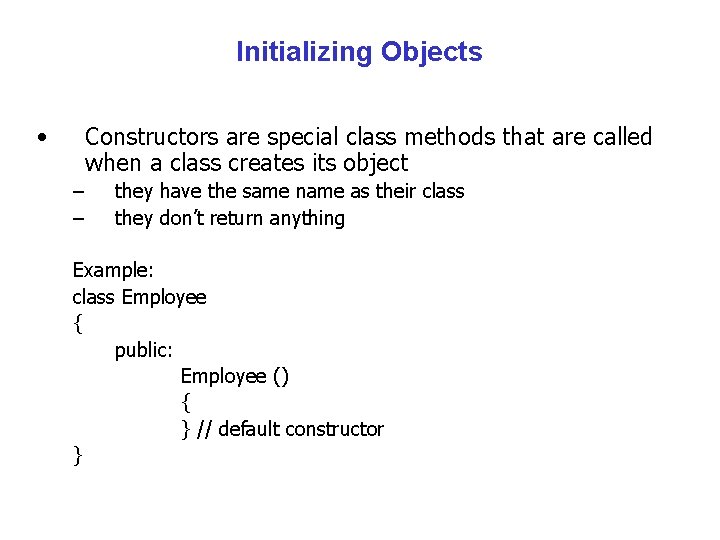
Initializing Objects • Constructors are special class methods that are called when a class creates its object – – they have the same name as their class they don’t return anything Example: class Employee { public: Employee () { } // default constructor }
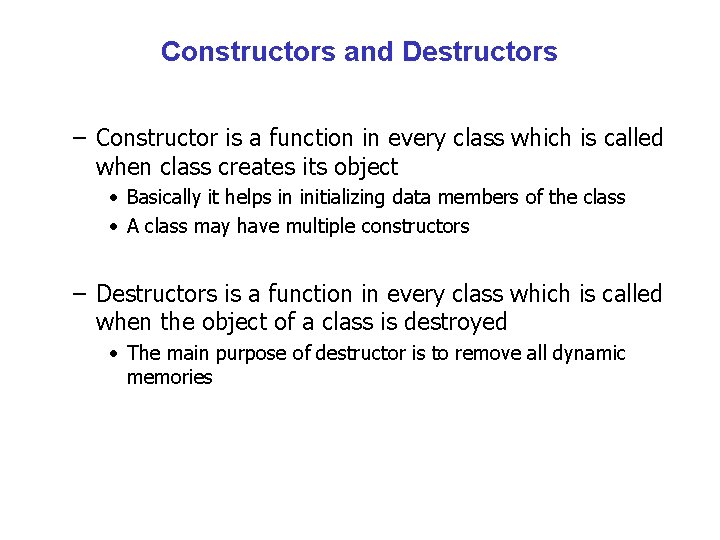
Constructors and Destructors – Constructor is a function in every class which is called when class creates its object • Basically it helps in initializing data members of the class • A class may have multiple constructors – Destructors is a function in every class which is called when the object of a class is destroyed • The main purpose of destructor is to remove all dynamic memories
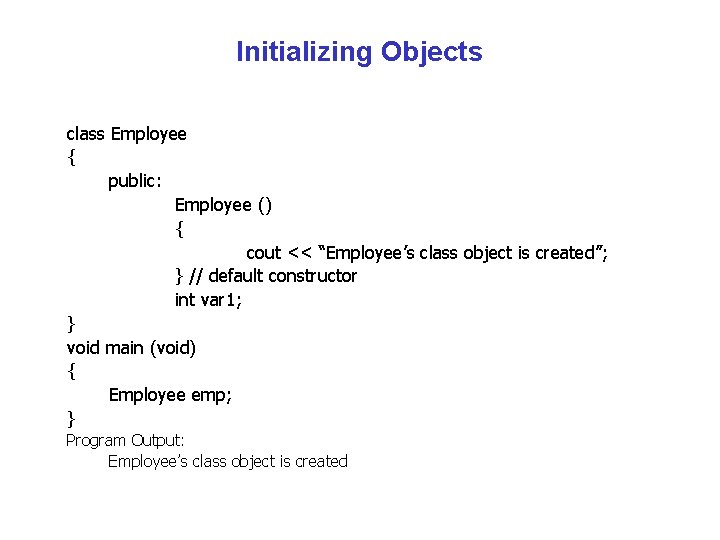
Initializing Objects class Employee { public: Employee () { cout << “Employee’s class object is created”; } // default constructor int var 1; } void main (void) { Employee emp; } Program Output: Employee’s class object is created
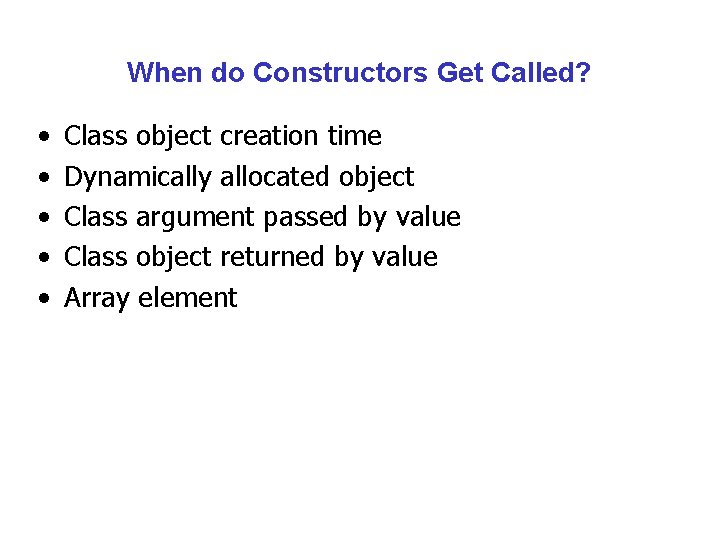
When do Constructors Get Called? • • • Class object creation time Dynamically allocated object Class argument passed by value Class object returned by value Array element
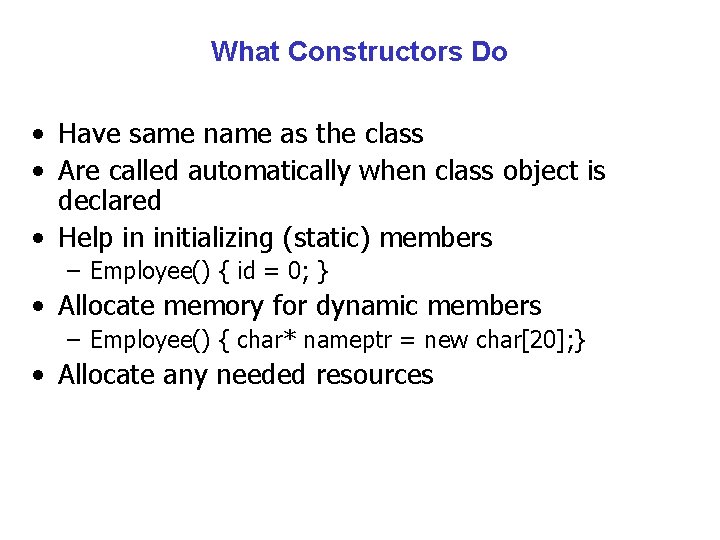
What Constructors Do • Have same name as the class • Are called automatically when class object is declared • Help in initializing (static) members – Employee() { id = 0; } • Allocate memory for dynamic members – Employee() { char* nameptr = new char[20]; } • Allocate any needed resources
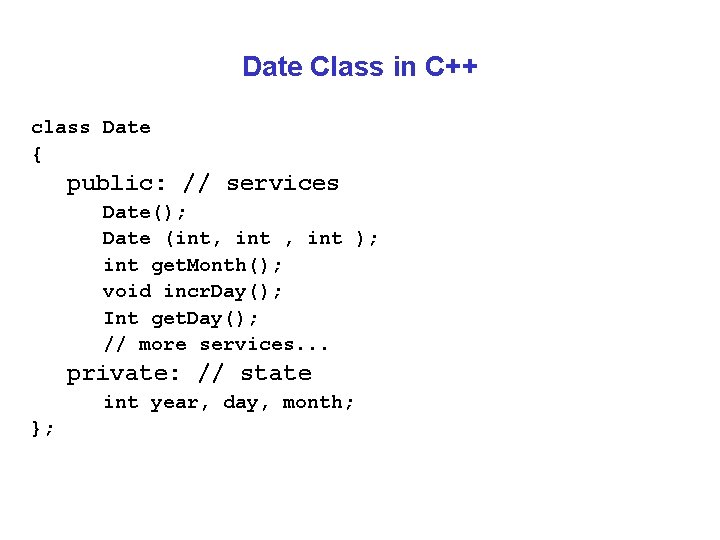
Date Class in C++ class Date { public: // services Date(); Date (int, int ); int get. Month(); void incr. Day(); Int get. Day(); // more services. . . private: // state int year, day, month; };
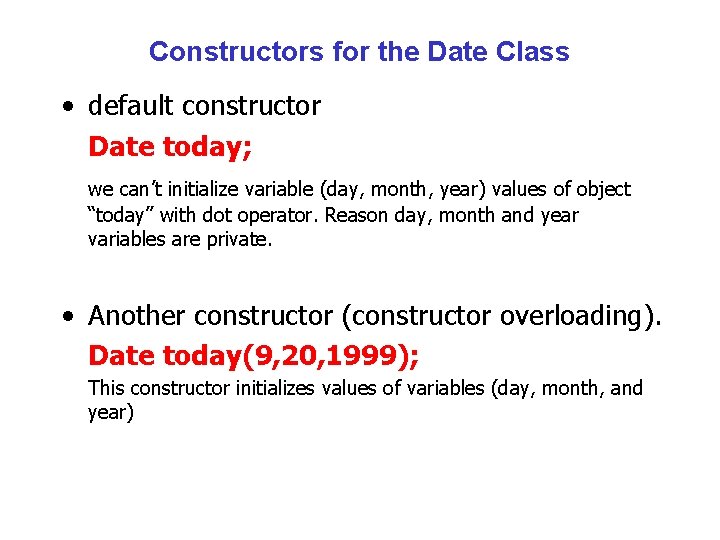
Constructors for the Date Class • default constructor Date today; we can’t initialize variable (day, month, year) values of object “today” with dot operator. Reason day, month and year variables are private. • Another constructor (constructor overloading). Date today(9, 20, 1999); This constructor initializes values of variables (day, month, and year)
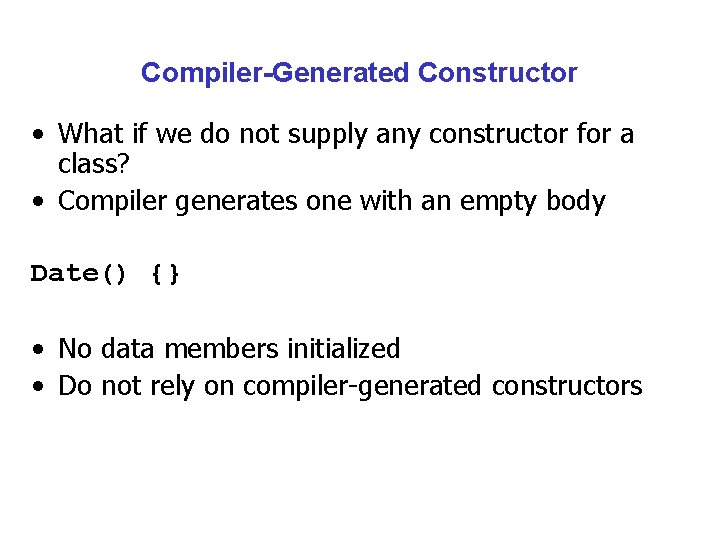
Compiler-Generated Constructor • What if we do not supply any constructor for a class? • Compiler generates one with an empty body Date() {} • No data members initialized • Do not rely on compiler-generated constructors
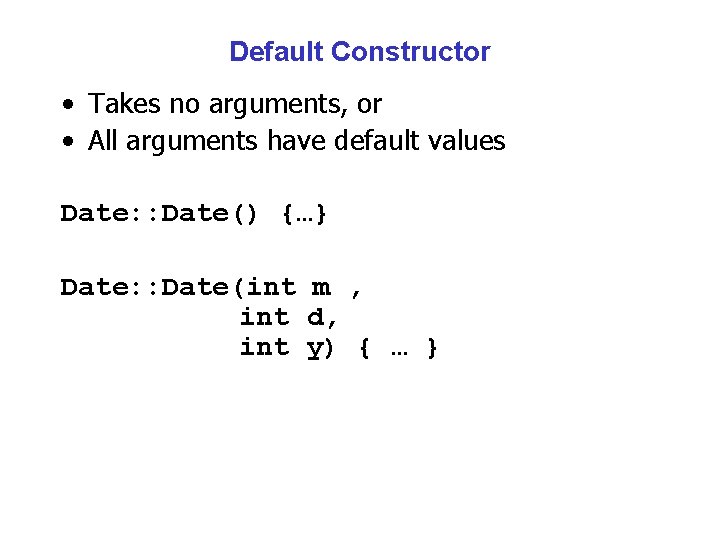
Default Constructor • Takes no arguments, or • All arguments have default values Date: : Date() {…} Date: : Date(int m , int d, int y) { … }
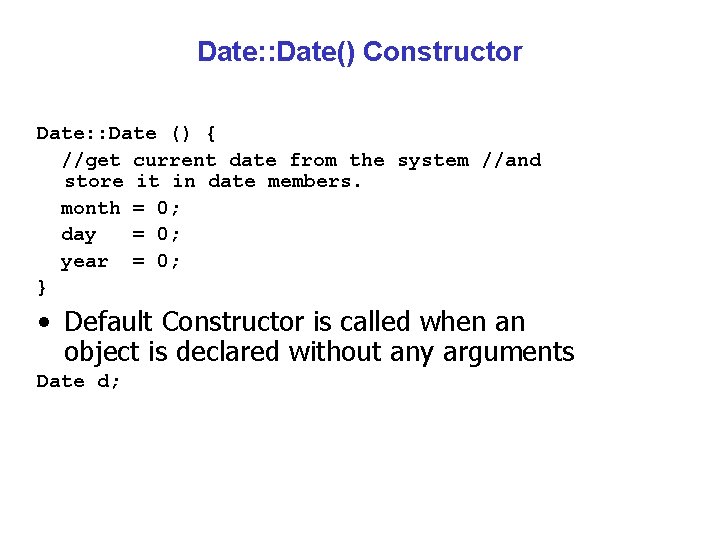
Date: : Date() Constructor Date: : Date () { //get current date from the system //and store it in date members. month = 0; day = 0; year = 0; } • Default Constructor is called when an object is declared without any arguments Date d;
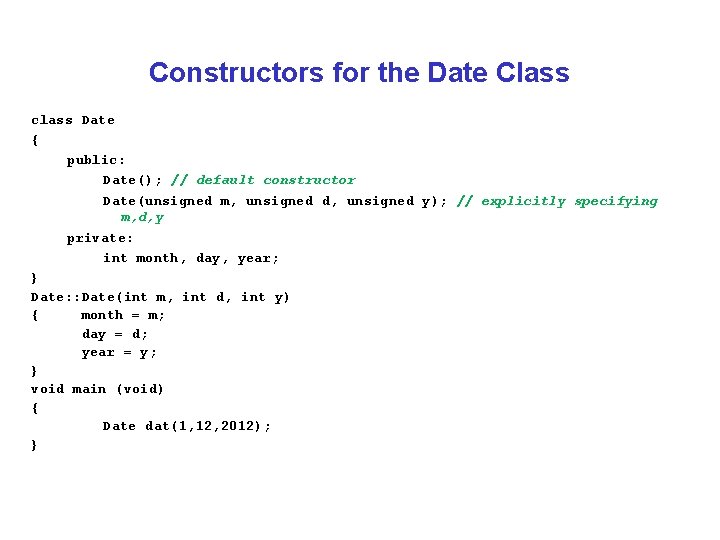
Constructors for the Date Class class Date { public: Date(); // default constructor Date(unsigned m, unsigned d, unsigned y); // explicitly specifying m, d, y private: int month, day, year; } Date: : Date(int m, int d, int y) { month = m; day = d; year = y; } void main (void) { Date dat(1, 12, 2012); }
![Constructing Arrays of Objects Complex cmplarr[10]; Date datearr[20]; • There is no way to](http://slidetodoc.com/presentation_image_h2/42fff58995c7aed7d1fc64e05e628ad2/image-20.jpg "Constructing Arrays of Objects Complex cmplarr[10]; Date datearr[20]; • There is no way to")
Constructing Arrays of Objects Complex cmplarr[10]; Date datearr[20]; • There is no way to call constructors with arguments (non-default) for array members
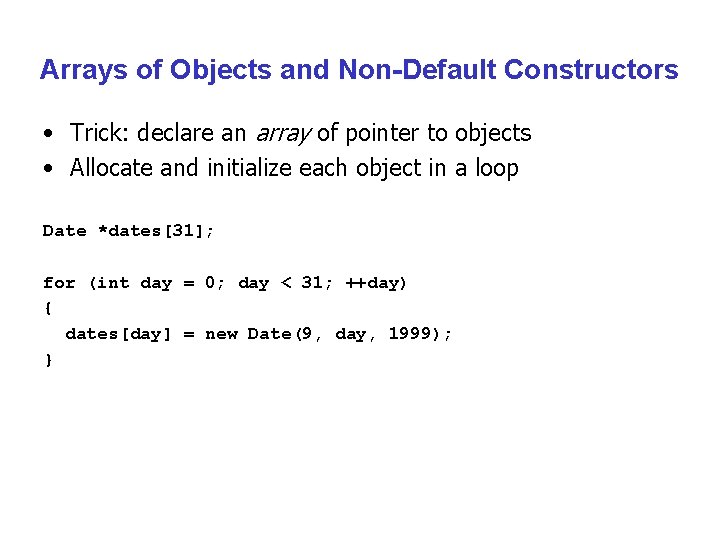
Arrays of Objects and Non-Default Constructors • Trick: declare an array of pointer to objects • Allocate and initialize each object in a loop Date *dates[31]; for (int day = 0; day < 31; ++day) { dates[day] = new Date(9, day, 1999); }
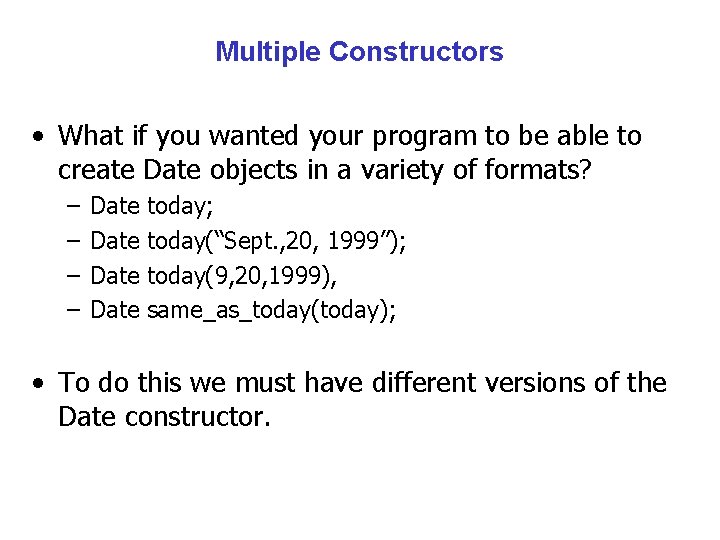
Multiple Constructors • What if you wanted your program to be able to create Date objects in a variety of formats? – – Date today; today(“Sept. , 20, 1999”); today(9, 20, 1999), same_as_today(today); • To do this we must have different versions of the Date constructor.
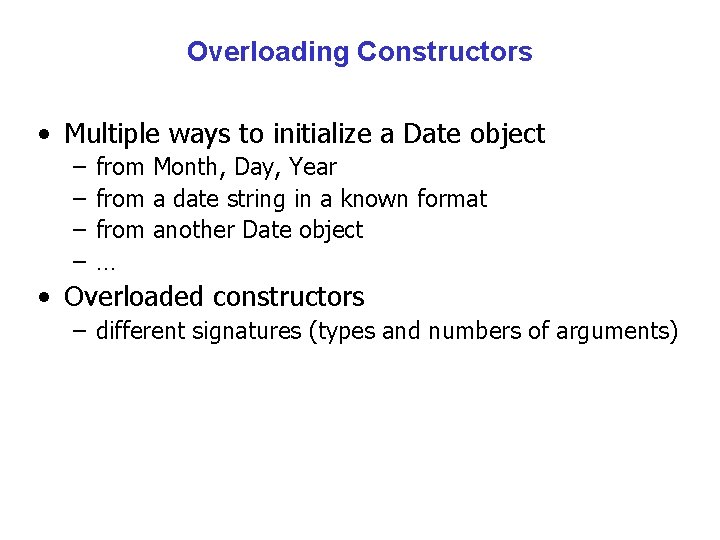
Overloading Constructors • Multiple ways to initialize a Date object – – from Month, Day, Year from a date string in a known format from another Date object … • Overloaded constructors – different signatures (types and numbers of arguments)
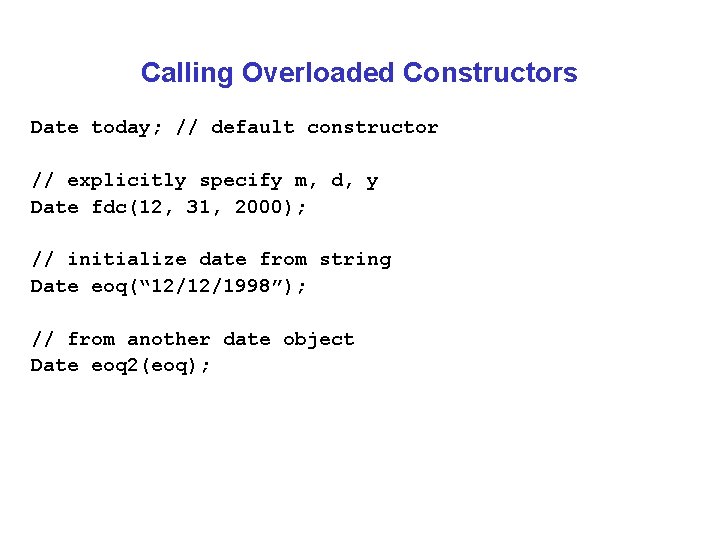
Calling Overloaded Constructors Date today; // default constructor // explicitly specify m, d, y Date fdc(12, 31, 2000); // initialize date from string Date eoq(“ 12/12/1998”); // from another date object Date eoq 2(eoq);
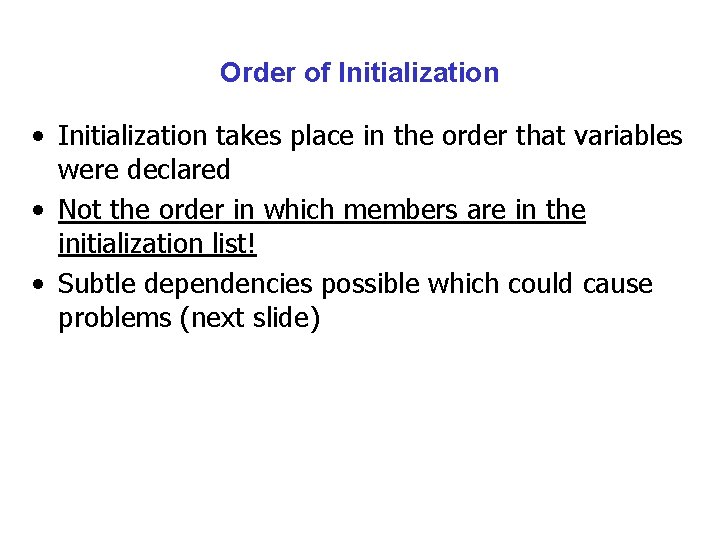
Order of Initialization • Initialization takes place in the order that variables were declared • Not the order in which members are in the initialization list! • Subtle dependencies possible which could cause problems (next slide)

Pitfalls of Initialization Lists class my_string { private: char* rep; unsigned len; public: my_string(const char* cp) { len = strlen(cp); rep = new char[len+1]; }; • Member len initialized after rep • But rep uses len. . .
Copy Constructor • Initializes a new object from another, existing one • Signature: Class: : Class(Class &obj) { }
Copy Constructor for Class Date: : Date(Date &date) { // no need to check passed date arg month = date. month; day = date. day; year = date. year; }
Uses of the Copy Constructor • Implicitly called in 3 situations – defining a new object from an existing object – passing an object by value – returning an object by value
Copy Constructor: Defining a New Object Date eosem(“ 12/20/1999”); // init 2 local objects from eosem Date eosem 2(eosem); // pass by value Date eosem 3 = eosem; // return value // init a dynamic object from eosem Date* pdate = new Date(eosem);
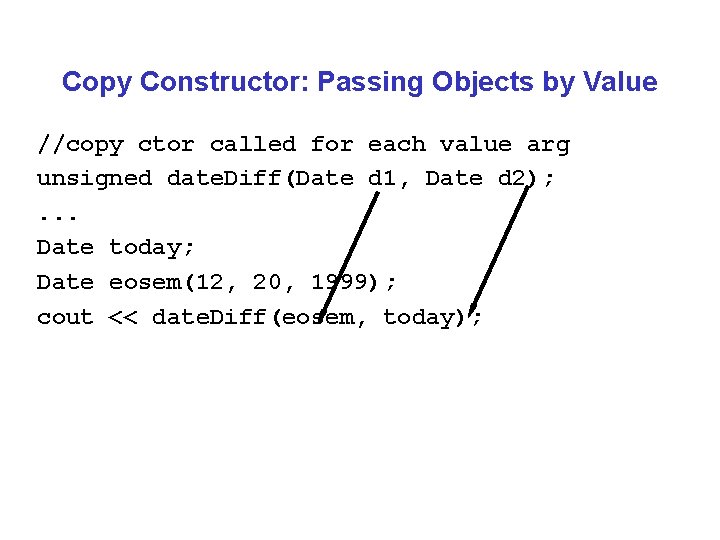
Copy Constructor: Passing Objects by Value //copy ctor called for each value arg unsigned date. Diff(Date d 1, Date d 2); . . . Date today; Date eosem(12, 20, 1999); cout << date. Diff(eosem, today);
Destructors • Called automatically when local objects go out of scope • Called implicitly when dynamic objects are deleted • just letting go of an object is not so safe, what if it modifies some hardware, put something on screen, allocate storage on heap • if you just forgot about it, your object never achieves closure upon its exit.
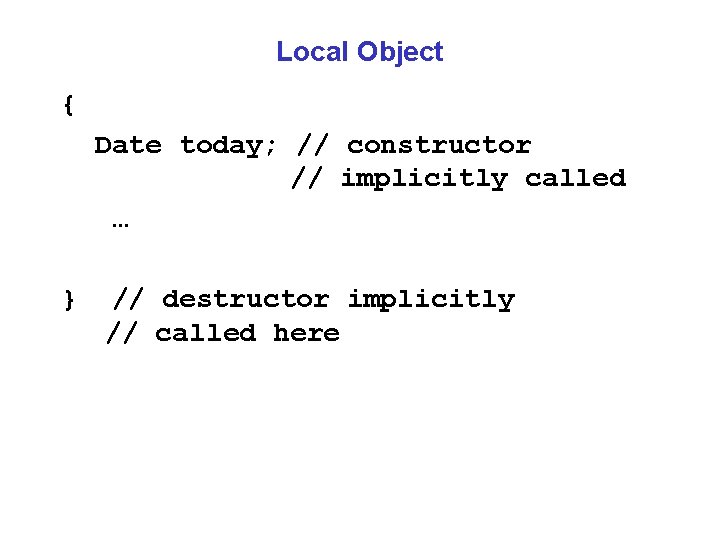
Local Object { Date today; // constructor // implicitly called … } // destructor implicitly // called here
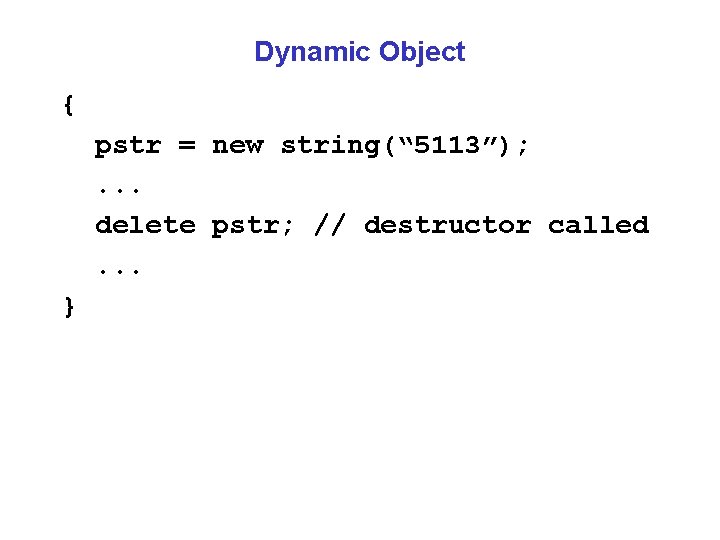
Dynamic Object { pstr = new string(“ 5113”); . . . delete pstr; // destructor called. . . }
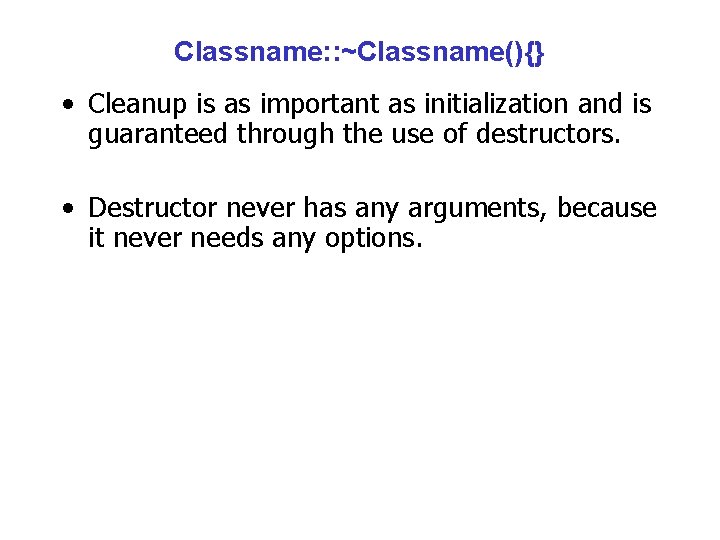
Classname: : ~Classname(){} • Cleanup is as important as initialization and is guaranteed through the use of destructors. • Destructor never has any arguments, because it never needs any options.
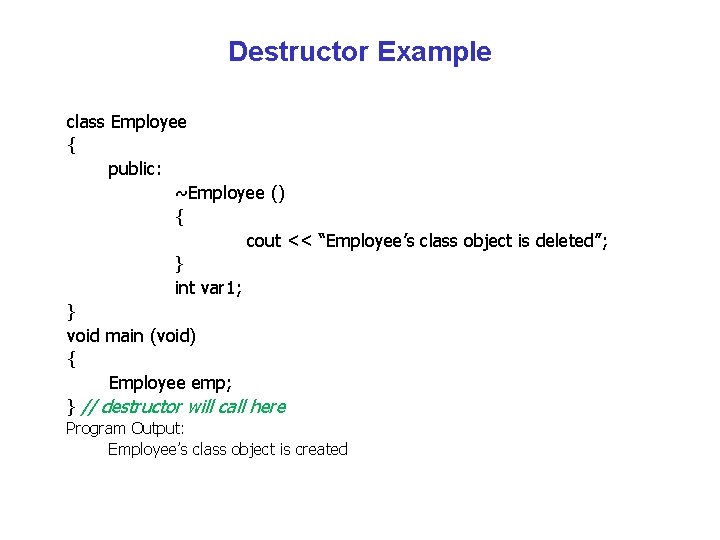
Destructor Example class Employee { public: ~Employee () { cout << “Employee’s class object is deleted”; } int var 1; } void main (void) { Employee emp; } // destructor will call here Program Output: Employee’s class object is created
![Destructor Example Employee *c c[0]. var 1 = c[1]. var 1 = c[2]. var](http://slidetodoc.com/presentation_image_h2/42fff58995c7aed7d1fc64e05e628ad2/image-37.jpg "Destructor Example Employee *c c[0]. var 1 = c[1]. var 1 = c[2]. var")
Destructor Example Employee *c c[0]. var 1 = c[1]. var 1 = c[2]. var 1 = = new Employee[3]; 322; 5 9; delete [] c; //destructor will call here 12/30/202

7 class Create. And. Destroy { 8 public: 9 Create. And. Destroy( int ); 10 ~Create. And. Destroy(); 11 private: 12 int data; 13 }; 14 15 #endif // constructor // destructor
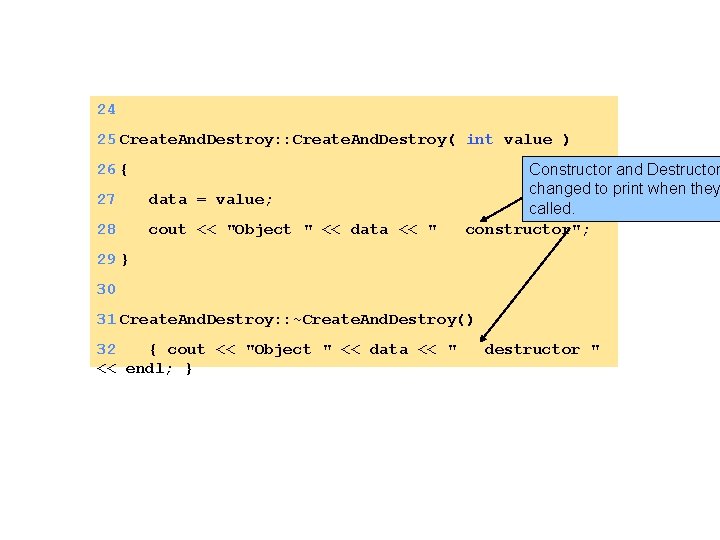
24 25 Create. And. Destroy: : Create. And. Destroy( int value ) 26 { 27 data = value; 28 cout << "Object " << data << " Constructor and Destructor changed to print when they called. constructor"; 29 } 30 31 Create. And. Destroy: : ~Create. And. Destroy() 32 { cout << "Object " << data << " << endl; } destructor "
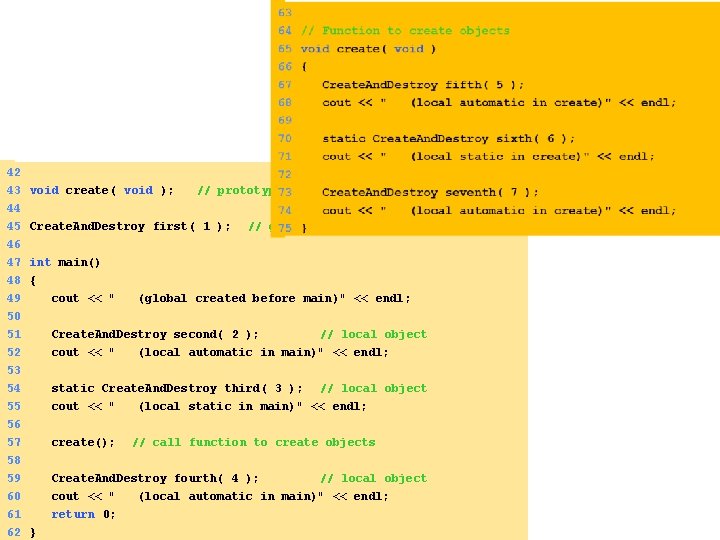
42 43 void create( void ); // prototype 44 45 Create. And. Destroy first( 1 ); // global object 46 47 int main() 48 { 49 cout << " (global created before main)" << endl; 50 51 52 53 54 55 56 57 58 59 60 61 62 } Create. And. Destroy second( 2 ); // local object cout << " (local automatic in main)" << endl; static Create. And. Destroy third( 3 ); // local object cout << " (local static in main)" << endl; create(); // call function to create objects Create. And. Destroy fourth( 4 ); // local object cout << " (local automatic in main)" << endl; return 0;
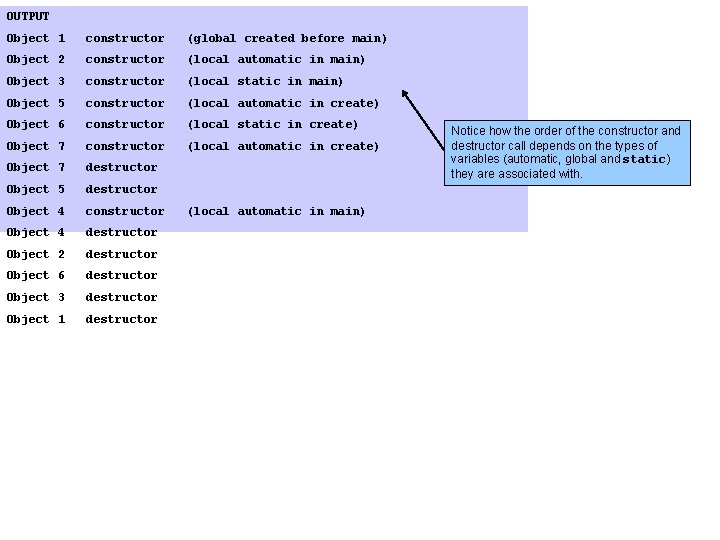
OUTPUT Object 1 constructor (global created before main) Object 2 constructor (local automatic in main) Object 3 constructor (local static in main) Object 5 constructor (local automatic in create) Object 6 constructor (local static in create) Object 7 constructor (local automatic in create) Object 7 destructor Object 5 destructor Object 4 constructor Object 4 destructor Object 2 destructor Object 6 destructor Object 3 destructor Object 1 destructor (local automatic in main) Notice how the order of the constructor and destructor call depends on the types of variables (automatic, global and static) they are associated with.
- Slides: 41