
Computer Networks Topic 1 Introduction to the Module






- Slides: 63
Computer Networks Topic 1: Introduction to the Module and to Networks V 1. 1 © NCC Education Limited
Computer Networks Topic 1 – Lecture 1: Introduction to the Module: What is a Network? V 1. 1 © NCC Education Limited
Introduction to the Module and to Networks Topic 1 - 1. 3 Scope and Coverage This topic will cover: • • V 1. 1 Introduction to module What is a network? Real world networks The OSI seven layer model © NCC Education Limited
Introduction to the Module and to Networks Topic 1 - 1. 4 Learning Outcomes By the end of this topic, students will be able to: • Describe the purpose and development of computer networks • Explain the overarching principles of the OSI seven -layer model V 1. 1 © NCC Education Limited
Introduction to the Module and to Networks Topic 1 - 1. 5 Module Aims This module aims to provide you with: – a broad introduction to the networking and communication systems commonly employed in a business environment; – an understanding of the underlying theoretical frameworks; – an understanding of associated issues such as the testing and security of these systems. V 1. 1 © NCC Education Limited
Introduction to the Module and to Networks Topic 1 - 1. 6 Module Syllabus - 1 • • • V 1. 1 Introduction to Networks Network Protocols and Standards Wireless Networking Standards Network Topology and Architecture Network Media and Connectors Network Hardware © NCC Education Limited
Introduction to the Module and to Networks Topic 1 - 1. 7 Module Syllabus - 2 • • • V 1. 1 Wireless Network Hardware Security Software Firewalls Network and Server Software Voice over IP and Video Conferencing Virtual Private Networks © NCC Education Limited
Introduction to the Module and to Networks Topic 1 - 1. 8 Module Delivery • The teacher-led time for this module is comprised of lectures and laboratory sessions. • Lectures are designed to start each topic. – You will be encouraged to be active during lectures by raising questions and taking part in discussions. • Laboratory sessions are designed to follow the respective topic lecture. – During these sessions, you will be required to work through practical tutorials and various exercises. V 1. 1 © NCC Education Limited
Introduction to the Module and to Networks Topic 1 - 1. 9 Private Study • You are also expected to undertake private study to consolidate and extend your understanding. • Exercises are provided in your Student Guide for you to complete during this time. V 1. 1 © NCC Education Limited
Introduction to the Module and to Networks Topic 1 - 1. 10 Assessment • This module will be assessed by an assignment worth 100% of the total mark. V 1. 1 © NCC Education Limited
Introduction to the Module and to Networks Topic 1 - 1. 11 Network – a Definition If we consider networks in general, rather than computer networks, then a good broad definition is: “a group or system of interconnected people or things” (Source: http: //www. oxforddictionaries. com) V 1. 1 © NCC Education Limited
Introduction to the Module and to Networks Topic 1 - 1. 12 Network Types • Modern society requires many networks to operate: – – – Transport networks Communications networks Power network (electricity distribution) Social networks Business networks Etc. • Society simply could not exist without these interconnections V 1. 1 © NCC Education Limited
Introduction to the Module and to Networks Topic 1 - 1. 13 The Rise of Computer Networks • The Early Years – Highly centralised computing facilities – Few computers, even in large organisations • Miniaturisation – Computers get more powerful, smaller and cheaper – Many more computers • Merging with Communications Systems – Computers connect to each other – A network is born V 1. 1 © NCC Education Limited
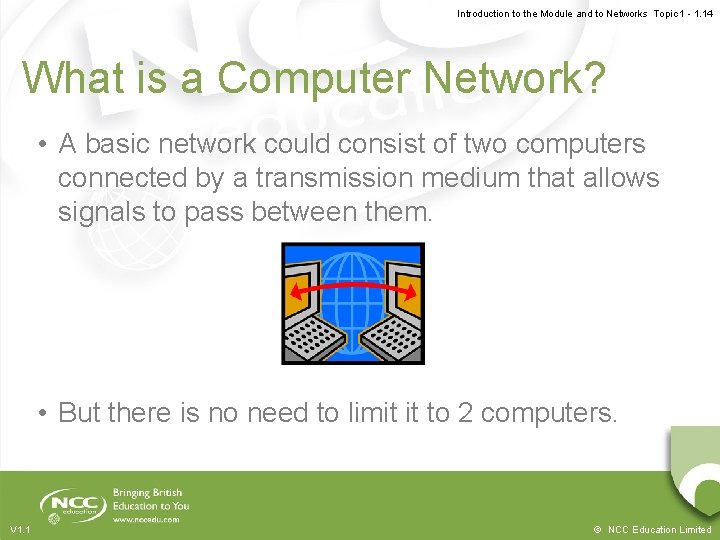
Introduction to the Module and to Networks Topic 1 - 1. 14 What is a Computer Network? • A basic network could consist of two computers connected by a transmission medium that allows signals to pass between them. • But there is no need to limit it to 2 computers. V 1. 1 © NCC Education Limited
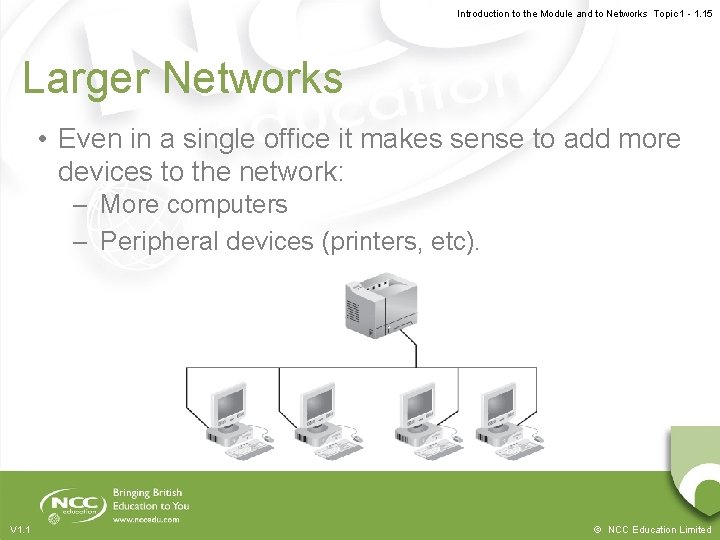
Introduction to the Module and to Networks Topic 1 - 1. 15 Larger Networks • Even in a single office it makes sense to add more devices to the network: – More computers – Peripheral devices (printers, etc). V 1. 1 © NCC Education Limited
Introduction to the Module and to Networks Topic 1 - 1. 16 Multiple Locations • Networks are not limited to a single location. • Modern communications systems allow an organisation to have networks that span: – – – V 1. 1 Multiple rooms in the same building Different buildings Different towns Different countries Different continents © NCC Education Limited
Introduction to the Module and to Networks Topic 1 - 1. 17 Across the World • The development of the Internet and global communications systems allows the network of a single organisation to cover the whole world. • The only limiting factor is the availability of technology in remote areas. • In reality, our networks go beyond the world’s boundaries. . . V 1. 1 © NCC Education Limited
Computer Networks Topic 1 – Lecture 2: Real World Networks V 1. 1 © NCC Education Limited
Introduction to the Module and to Networks Topic 1 - 1. 19 Why Network? • There would be no point building networks if there was no demand for them. • We will briefly examine the computer networks in use today for: – Home use – Business use – Mobile use • We will also consider some of the social issues raised as a result of networking. V 1. 1 © NCC Education Limited
Introduction to the Module and to Networks Topic 1 - 1. 20 Networks in the Home • With many sources suggesting there were over 1 billion computers in the world in 1998, it is no surprise that many homes have a PC or laptop. • But PCs and laptops are not the only computing hardware in many homes … V 1. 1 © NCC Education Limited
Introduction to the Module and to Networks Topic 1 - 1. 21 Networked Devices in the Home • • • V 1. 1 PCs and laptops Telephones – landline and mobile Games consoles TV including cable and satellite Radio Others that are not computer/communication networks such as electricity, gas, water, sewage, etc. © NCC Education Limited
Introduction to the Module and to Networks Topic 1 - 1. 22 Why do we have Home Networks? • In the early days of home PCs, they were mainly used for word processing and games. • Modern home networks are used for: – – V 1. 1 Accessing information from a range of sources Personal communications Entertainment E-commerce © NCC Education Limited
Introduction to the Module and to Networks Topic 1 - 1. 23 Networks in Business • Most businesses have a number of computers and peripheral devices. • Good communications are important if a business is to be successful. • Large businesses hold a huge amount of data and information processing is a key business function. • Networks are needed to compete! V 1. 1 © NCC Education Limited
Introduction to the Module and to Networks Topic 1 - 1. 24 Networked Devices in Business • • • V 1. 1 PCs and laptops Telephones – landline, mobile, and exchanges Peripheral devices Data storage devices Production machinery Others that are not computer/communication networks such as electricity, gas, water, sewage, etc. © NCC Education Limited
Introduction to the Module and to Networks Topic 1 - 1. 25 The Purpose of Business Networks • Resource sharing • General communications • Business-to-business communication • E-commerce V 1. 1 © NCC Education Limited
Introduction to the Module and to Networks Topic 1 - 1. 26 Mobile Networks • People like to keep in touch whilst on the move. • For business, the ability to remain in contact whilst out of the office is important. • Modern handheld devices have the processing power to do much more than phone calls and text. V 1. 1 © NCC Education Limited
Introduction to the Module and to Networks Topic 1 - 1. 27 Networked Mobile Devices • Laptops, notebooks, i. Pad, etc. • Mobile telephones • Smartphones (i. Phone, Blackberry, etc. ) • GPS systems V 1. 1 © NCC Education Limited
Introduction to the Module and to Networks Topic 1 - 1. 28 The Purpose of Mobile Networks • • • V 1. 1 General communications Mobile office Location-based services M-commerce General applications © NCC Education Limited
Introduction to the Module and to Networks Topic 1 - 1. 29 Social Issues • • • V 1. 1 Patterns of work Individual privacy Education Copyright Other legal issues © NCC Education Limited
Computer Networks Topic 1 – Lecture 3: How do Devices Communicate with Each Other? V 1. 1 © NCC Education Limited
Introduction to the Module and to Networks Topic 1 - 1. 31 Human Communication - 1 • Think how you communicate a message to the person sitting nearest to you. The basic steps are: – Create a message (decide what you are going to say) – Transmit the message (speak to the person) V 1. 1 © NCC Education Limited
Introduction to the Module and to Networks Topic 1 - 1. 32 Human Communication - 2 • But that is only half of the process. • For the message to be useful the other person must get the message and understand it. The basic steps are: – Receive a message (listen to what the person says) – Understand the message (process the message in the brain) V 1. 1 © NCC Education Limited
Introduction to the Module and to Networks Topic 1 - 1. 33 Potential Problems - 1 1. The sender cannot send properly – They have a condition that prevents them speaking. – They speak very quietly. 2. The receiver cannot understand – They are deaf. – The message is too quiet. – There is a word they do not understand. V 1. 1 © NCC Education Limited
Introduction to the Module and to Networks Topic 1 - 1. 34 Potential Problems - 2 3. The listener is not listening (transmission problems) – They are already in a conversation with someone else. – The listener does not like the sender and does not wish to have a conversation with them. – There is too much background noise. – The teacher is talking so conversation is not allowed. V 1. 1 © NCC Education Limited
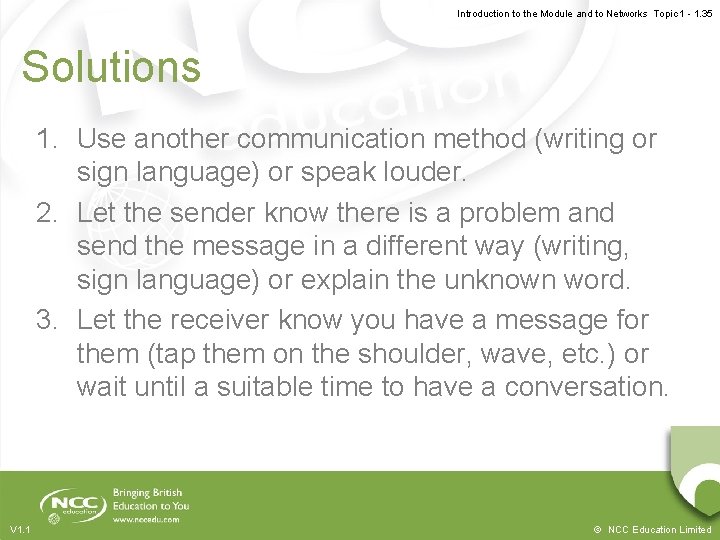
Introduction to the Module and to Networks Topic 1 - 1. 35 Solutions 1. Use another communication method (writing or sign language) or speak louder. 2. Let the sender know there is a problem and send the message in a different way (writing, sign language) or explain the unknown word. 3. Let the receiver know you have a message for them (tap them on the shoulder, wave, etc. ) or wait until a suitable time to have a conversation. V 1. 1 © NCC Education Limited
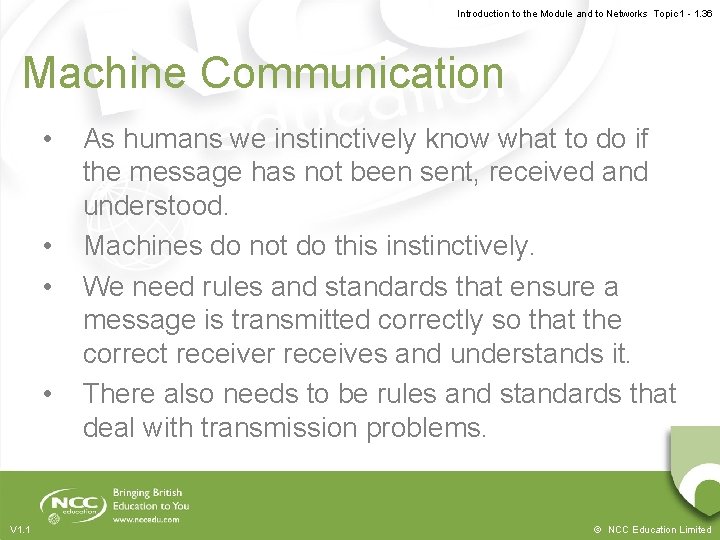
Introduction to the Module and to Networks Topic 1 - 1. 36 Machine Communication • • V 1. 1 As humans we instinctively know what to do if the message has not been sent, received and understood. Machines do not do this instinctively. We need rules and standards that ensure a message is transmitted correctly so that the correct receiver receives and understands it. There also needs to be rules and standards that deal with transmission problems. © NCC Education Limited
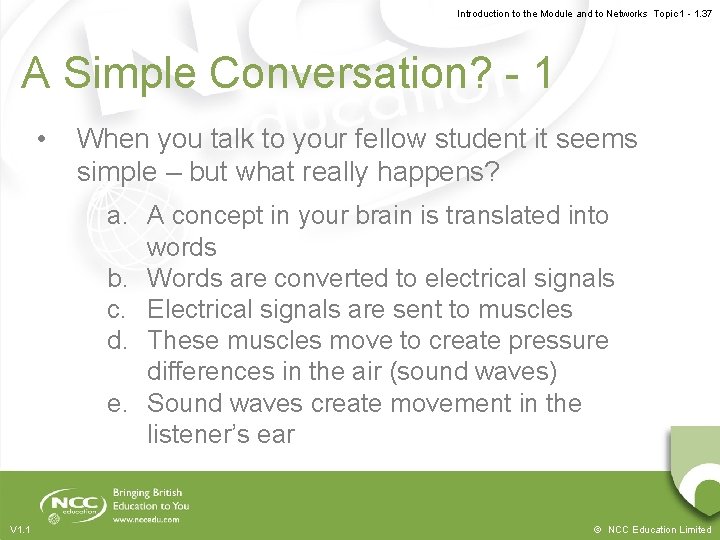
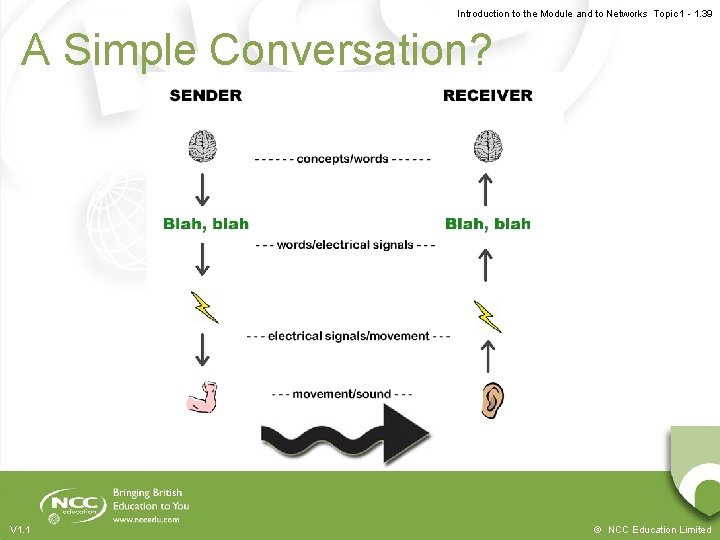
Introduction to the Module and to Networks Topic 1 - 1. 37 A Simple Conversation? - 1 • When you talk to your fellow student it seems simple – but what really happens? a. A concept in your brain is translated into words b. Words are converted to electrical signals c. Electrical signals are sent to muscles d. These muscles move to create pressure differences in the air (sound waves) e. Sound waves create movement in the listener’s ear V 1. 1 © NCC Education Limited
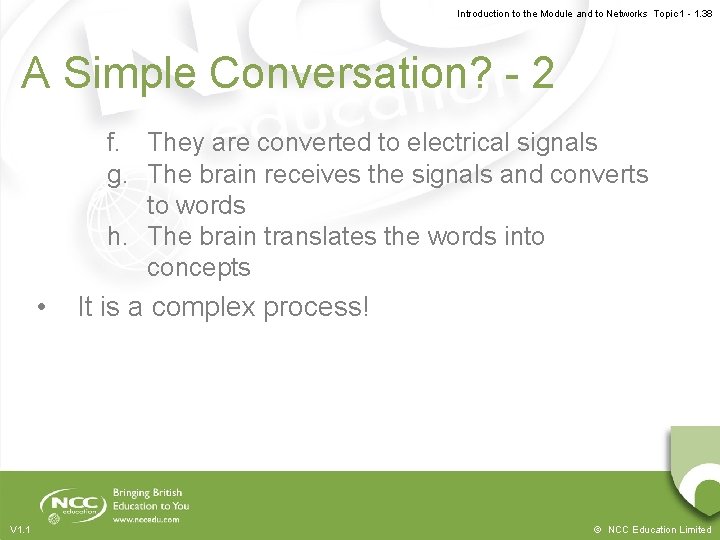
Introduction to the Module and to Networks Topic 1 - 1. 38 A Simple Conversation? - 2 f. They are converted to electrical signals g. The brain receives the signals and converts to words h. The brain translates the words into concepts • V 1. 1 It is a complex process! © NCC Education Limited
Introduction to the Module and to Networks Topic 1 - 1. 39 A Simple Conversation? V 1. 1 © NCC Education Limited
Introduction to the Module and to Networks Topic 1 - 1. 40 A Layered Approach • Considering our conversation, we can see that there are equivalent processes at both receiver and sender: a. b. c. d. • V 1. 1 Converting between concepts and words Converting between words and electrical signals Converting between electricity and movement Converting between muscle movement and sound waves We can model this as 4 layers © NCC Education Limited
Introduction to the Module and to Networks Topic 1 - 1. 41 A Scenario • Your colleague on the other side of the world needs to send you a fax message but there are problems: – – • V 1. 1 Your colleague speaks German His company secretary speaks French Your company secretary speaks French You speak English How does the message, “mein Name ist Heidi” (“my name is Heidi”), get to you? © NCC Education Limited
Introduction to the Module and to Networks Topic 1 - 1. 42 A Solution - Sender 1. German colleague writes message “Mein Name ist Heidi” and states who message is to be sent to. 2. Translator converts this to French, “Je m’appelle Heidi” and adds detail that this is French. 3. Secretary sends message in fax to your office. V 1. 1 © NCC Education Limited
Introduction to the Module and to Networks Topic 1 - 1. 43 A Solution - Receiver 1. Secretary receives message in fax in your office. 2. Translator converts this to English, “My name is Heidi”. 3. You receive and read message. Details of how we know which translator to use or how you get the message from the translator, etc, have not been included here. V 1. 1 © NCC Education Limited
Introduction to the Module and to Networks Topic 1 - 1. 44 A Solution - Layers 1. Write/read message in native language. 2. Translate to common language. 3. Send receive message in common language. V 1. 1 © NCC Education Limited
Introduction to the Module and to Networks Topic 1 - 1. 45 Developing a model for real-life networks • We know we can develop a layered approach but have to deal with many issues including: – – – • V 1. 1 Message language Transmission format Addressing who the message is for Ensuring the receiver is listening Dealing with errors in transmission Understanding the message The model must apply to all networks. © NCC Education Limited
Computer Networks Topic 1 – Lecture 4: The OSI Reference Model V 1. 1 © NCC Education Limited
Introduction to the Module and to Networks Topic 1 - 1. 47 A Hierarchy of Layers • • V 1. 1 Networks can be modelled as a hierarchy or stack of layers. This simplifies the design of a network. Each layer is built upon the layer immediately underneath it. The purpose of each layer is to provide services to the layer above whilst hiding the detail of how those services are created. © NCC Education Limited
Introduction to the Module and to Networks Topic 1 - 1. 48 Our Earlier Scenario V 1. 1 • Our secretary presented the message in French to the translator. The translator did not need to know how the message was received. • The translator presented the message in English to you. You did not need to know what the French message was, nor how it was translated, nor how it was transmitted to your company. © NCC Education Limited
Introduction to the Module and to Networks Topic 1 - 1. 49 Communicating • • • Each layer operates via rules, a protocol. There is an interface between adjacent layers that defines the operations and services that the lower layer provides. Communication requires several layers: – Data and control information passes from top layer to bottom layer in sending device; – This is then transmitted to the receiving device; – It passes from bottom to top at the receiving end. V 1. 1 © NCC Education Limited
Introduction to the Module and to Networks Topic 1 - 1. 50 Design Issues • There a number of key issues when designing a network and these appear in one or more layers: – – – V 1. 1 Addressing Error control Flow control Multiplexing Routing © NCC Education Limited
Introduction to the Module and to Networks Topic 1 - 1. 51 The OSI Model • • • V 1. 1 Based upon a proposal first developed by the International Standards Organization (ISO) as a first step in the standardisation of the protocols used in various layers. It was revised in 1995. It deals with connecting open systems – the Open Systems Interconnection (OSI) Reference Model – so deals with systems that are open to connection with other systems. © NCC Education Limited
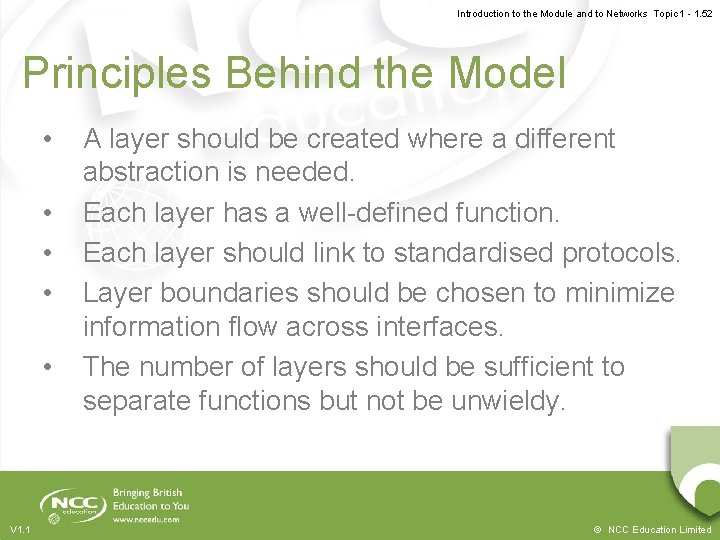
Introduction to the Module and to Networks Topic 1 - 1. 52 Principles Behind the Model • • • V 1. 1 A layer should be created where a different abstraction is needed. Each layer has a well-defined function. Each layer should link to standardised protocols. Layer boundaries should be chosen to minimize information flow across interfaces. The number of layers should be sufficient to separate functions but not be unwieldy. © NCC Education Limited
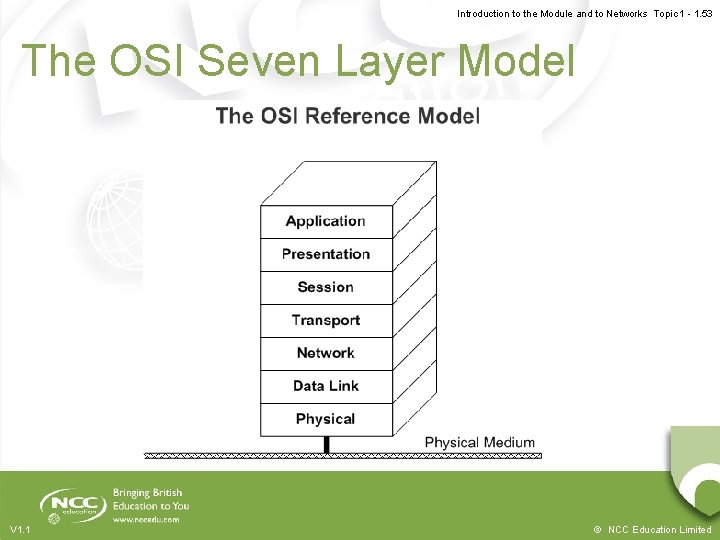
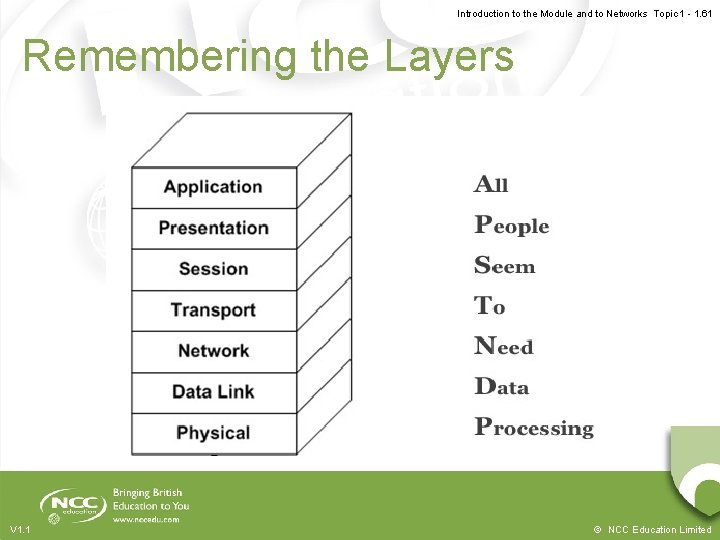
Introduction to the Module and to Networks Topic 1 - 1. 53 The OSI Seven Layer Model V 1. 1 © NCC Education Limited
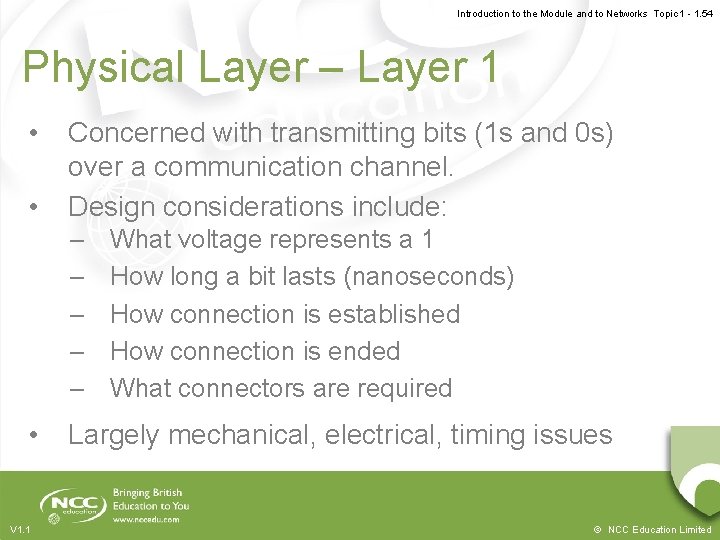
Introduction to the Module and to Networks Topic 1 - 1. 54 Physical Layer – Layer 1 • • Concerned with transmitting bits (1 s and 0 s) over a communication channel. Design considerations include: – – – • V 1. 1 What voltage represents a 1 How long a bit lasts (nanoseconds) How connection is established How connection is ended What connectors are required Largely mechanical, electrical, timing issues © NCC Education Limited
Introduction to the Module and to Networks Topic 1 - 1. 55 Data Link Layer – Layer 2 • • • V 1. 1 Responsible for communications between adjacent network nodes. Transforms raw transmitted data into a line of data that is error free and passed to the network layer. Deals with the different data rates between sender and receiver. © NCC Education Limited
Introduction to the Module and to Networks Topic 1 - 1. 56 Network Layer – Layer 3 • • • V 1. 1 Responsible for establishing paths for data transfer through the network (routing). Routing can be static so that paths remain constant or dynamic so as to reflect network load. The network layer is used to overcome differences in addressing, protocols and message sizes. © NCC Education Limited
Introduction to the Module and to Networks Topic 1 - 1. 57 Transport Layer – Layer 4 • • V 1. 1 Responsible for delivering messages between networked hosts. Also responsible for fragmentation and reassembly of messages. © NCC Education Limited
Introduction to the Module and to Networks Topic 1 - 1. 58 Session Layer – Layer 5 • • Responsible for establishing process-to-process communications between networked hosts. Establishes sessions between different machines that allow for: – Deciding whose turn it is to transmit; – Preventing simultaneous transmissions; – Synchronisation to allow transmission to continue if there has been a failure midtransmission. V 1. 1 © NCC Education Limited
Introduction to the Module and to Networks Topic 1 - 1. 59 Presentation Layer – Layer 6 • • V 1. 1 Responsible for defining the syntax which two network hosts use to communicate. Makes it possible for different systems with different data structures to communicate. © NCC Education Limited
Introduction to the Module and to Networks Topic 1 - 1. 60 Application Layer – Layer 7 • • V 1. 1 Responsible for providing end-user services, such as file transfers, electronic messaging, email, virtual terminal access, and network management. This is the layer with which the user interacts. © NCC Education Limited
Introduction to the Module and to Networks Topic 1 - 1. 61 Remembering the Layers V 1. 1 © NCC Education Limited
Introduction to the Module and to Networks Topic 1 - 1. 62 References • Tanenbaum, A. S. & Weatherall, D. J. (2010). Computer Networks, 5 th edition. Pearson Education. • The ITU website, http: //www. itu. int • The IETF website, http: //www. ietf. org • http: //www. oxforddictionaries. com V 1. 1 © NCC Education Limited
Introduction to the Module and to Networks Topic 1 - 1. 63 Topic 1 – Introduction to the Module and to Networks Any Questions? V 1. 1 © NCC Education Limited