
Computer Networks Topic 1 Introduction to the Module



- Slides: 17
Computer Networks Topic 1: Introduction to the Module and to Networks V 1. 0
Computer Networks Topic 1 – Lecture 1: Introduction to the Module: What is a Network? V 1. 0
Introduction to the Module and to Networks Topic 1 - 1. 3 Scope and Coverage This topic will cover: • • V 1. 0 Introduction to module What is a network? Real world networks The OSI seven layer model
Introduction to the Module and to Networks Topic 1 - 1. 4 Learning Outcomes By the end of this topic, students will be able to: • Describe the purpose and development of computer networks • Explain the overarching principles of the OSI seven-layer model V 1. 0
Introduction to the Module and to Networks Topic 1 - 1. 5 Module Aims This module aims to provide you with: – a broad introduction to the networking and communication systems commonly employed in a business environment; – an understanding of the underlying theoretical frameworks; – an understanding of associated issues such as the testing and security of these systems. V 1. 0
Introduction to the Module and to Networks Topic 1 - 1. 6 Module Syllabus - 1 • • • V 1. 0 Introduction to Networks Network Protocols and Standards Wireless Networking Standards Network Topology and Architecture Network Media and Connectors Network Hardware
Introduction to the Module and to Networks Topic 1 - 1. 7 Module Syllabus - 2 • • • V 1. 0 Wireless Network Hardware Security Software Firewalls Network and Server Software Voice over IP and Video Conferencing Virtual Private Networks
Introduction to the Module and to Networks Topic 1 - 1. 8 Module Delivery • The teacher-led time for this module is comprised of lectures and laboratory sessions. • Lectures are designed to start each topic. – You will be encouraged to be active during lectures by raising questions and taking part in discussions. • Laboratory sessions are designed to follow the respective topic lecture. – During these sessions, you will be required to work through practical tutorials and various exercises. V 1. 0
Introduction to the Module and to Networks Topic 1 - 1. 9 Private Study • You are also expected to undertake private study to consolidate and extend your understanding. • Exercises are provided in your Student Guide for you to complete during this time. V 1. 0
Introduction to the Module and to Networks Topic 1 - 1. 10 Assessment • This module will be assessed by: – an examination worth 75% of the total mark – an assignment worth 25% of the total mark V 1. 0
Introduction to the Module and to Networks Topic 1 - 1. 11 Network – a Definition If we consider networks in general, rather than computer networks, then a good broad definition is: “a group or system of interconnected people or things” (Source: http: //www. oxforddictionaries. com) V 1. 0
Introduction to the Module and to Networks Topic 1 - 1. 12 Network Types • Modern society requires many networks to operate: – – – Transport networks Communications networks Power network (electricity distribution) Social networks Business networks Etc. • Society simply could not exist without these interconnections V 1. 0
Introduction to the Module and to Networks Topic 1 - 1. 13 The Rise of Computer Networks • The Early Years – Highly centralised computing facilities – Few computers, even in large organisations • Miniaturisation – Computers get more powerful, smaller and cheaper – Many more computers • Merging with Communications Systems – Computers connect to each other – A network is born
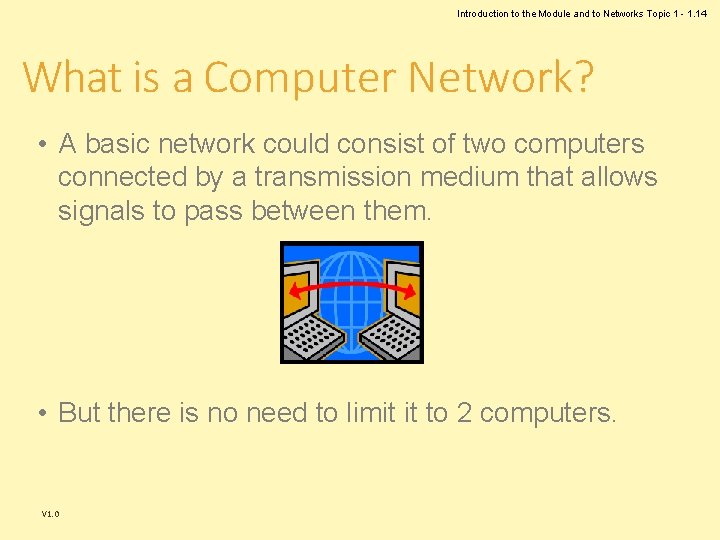
Introduction to the Module and to Networks Topic 1 - 1. 14 What is a Computer Network? • A basic network could consist of two computers connected by a transmission medium that allows signals to pass between them. • But there is no need to limit it to 2 computers. V 1. 0
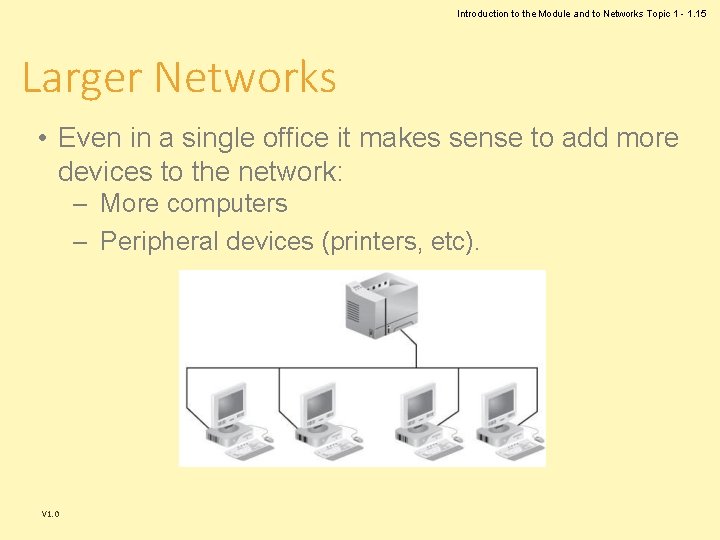
Introduction to the Module and to Networks Topic 1 - 1. 15 Larger Networks • Even in a single office it makes sense to add more devices to the network: – More computers – Peripheral devices (printers, etc). V 1. 0
Introduction to the Module and to Networks Topic 1 - 1. 16 Multiple Locations • Networks are not limited to a single location. • Modern communications systems allow an organisation to have networks that span: – – – V 1. 0 Multiple rooms in the same building Different buildings Different towns Different countries Different continents
Introduction to the Module and to Networks Topic 1 - 1. 17 Across the World • The development of the Internet and global communications systems allows the network of a single organisation to cover the whole world. • The only limiting factor is the availability of technology in remote areas. • In reality, our networks go beyond the world’s boundaries. . . V 1. 0